

Wisdom Has Questions
Wisdom cries aloud in the open air,
The Revised English Bible (Cambridge; New York; Melbourne; Madrid; Cape Town; Singapore; São Paulo; Delhi; Dubai; Tokyo: Cambridge University Press, 1996), Pr 1:20–22.
and raises her voice in public places.
21 She calls at the top of the bustling streets;
at the approaches to the city gates she says:
22 ‘How long will you simple fools be content with your simplicity?
Last week I discussed starting a study of Proverbs and noted a different way of receiving the text. This does not result from a prophetic vision, or from a prophet hearing a voice, but rather from collective (and collected) wisdom from a culture. This is life-time learning, rather than special, instant revelation.
We like instant revelation. We like answers. We especially like answers that come quickly and fit in with our existing lifestyle and our prejudices.
The “wisdom” we can gain in this way has another advantage. It can be formed into “ammunition sentences,” sentences that we can fling at other people to shut them up. Often such sentences begin with “the Bible clearly teaches.” We fill in with things we clearly see, largely because we failed to see the whole of scripture.
I saw a sign in front of a church the other day. The first line read: “God has the answers!” And the second read “Are you listening?”
That’s good. God does have answers. But sometimes God’s answers don’t match our questions, and the reason is that we’re not asking the right questions, or more specifically, we’re asking questions that limit the range of God’s answers. Sometimes we’re even asking questions in order to avoid God’s answers.
Over the years I’ve prayed with many people who were seeking God’s guidance. Many of these people were genuinely uncertain, and were trying to seek God’s will. But more of them already knew what God wanted them to do, often because it was clear in terms of ethics, simple right and wrong, but who were hoping they could get a word from the Lord that would set them on a different path, one they preferred to what they already knew. Maybe God’s voice will allow me to take a different turn.
When you approach things that way, it’s easy to end up believing you’re following God’s path, or the path of wisdom, just because you want so vigorously for that to be the right answer.
I remember once having a conversation with a couple of friends about a business decision. Business decisions are hard for me. In this case I was discussing two options and trying to decide which was the next step. I had struggled with the decision for days. I don’t even recall now what the issue was, but suddenly in the midst of the conversation I held up my hand and said, “I’ve just realized I’m doing this wrong. Option A would result in behaving unethically.” My advisors hadn’t seen that, because they didn’t understand all the processes involved. As soon as I explained what would happen, they recognized what would likely happen, and so the decision was made.
What slowed me down? I knew the process and should have recognized the problem immediately. But I didn’t. I wasn’t responding to the right questions. I was missing them because I wanted something to be true, but it wasn’t. No amount of wanting would make it true.
“Wisdom is calling out in the street.”
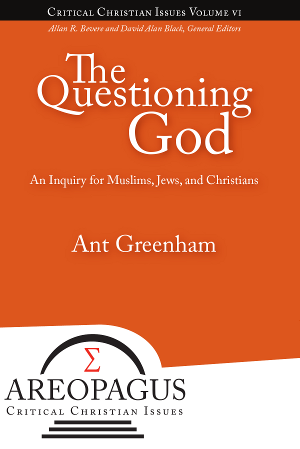
And wisdom is often providing questions. Ant Greenham, in his book The Questioning God, says:
Our foundational identity as human beings, female and male, is inextricably linked to questioning, to inquiry. The fall of humanity notwithstanding, people are repeatedly called to respond to God in the context of mental and spiritual engagement. And the centrality of a questioning approach is reflected throughout the Bible.
Ant Greenham, The Questioning God, (Pensacola, Florida: Energion Publications, 2012), 4.
Greenham goes on to point out the numerous ways in which God’s interactions with us consist of God questioning us. We may have questions of God, but God has even more questions to ask us. I’d suggest as a quick example that you check Job 38. After much discussion and complaint, God becomes active and what does God start with? Lots of questions!
This approach suggests that God wants us to use our mental capacity. Here’s a famous verse, but let’s think about it again:
The fear of the LORD is the foundation* of knowledge; it is fools who scorn wisdom and instruction
The Revised English Bible (Cambridge; New York; Melbourne; Madrid; Cape Town; Singapore; São Paulo; Delhi; Dubai; Tokyo: Cambridge University Press, 1996), Pr 1:7.
Too often this verse is used to contrast the supposed wisdom of the speaker, which the speaker supposes came from God, verses the use of human intellect. “Don’t trust in your education, your degrees, or your own experience. Do what God says instead!” That’s the common advice.
I’ve received this advice from some as an admonition not to trust my study of Greek and Hebrew in interpreting the Bible, but just to let the Holy Spirit tell me what the text means. But the second half of the verse challenges that. “It is fools who scorn wisdom and instruction.” I can be listening for God’s voice in so many ways, while ignoring what I have already learned. Often when I’m searching for an answer, I’m directed (in various ways) to look at the scriptures and the wisdom of the community of faith over the centuries for an answer. I’m directed to, not away from, the sources involving intellect.
I’ve written a few times before on the Wesleyan Quadrilateral. There’s lots of history and debate around that. But I like it a great deal. Today, I’m focused on one element: Reason. We like to put reason down in favor of more spiritual sounding approaches. But in the end, it is with your reason that you will comprehend the messages sent to you by God. That’s why God so frequently asks questions. God wants to awaken your reason.
I want to note one final thing. Intellectual activity and engagement is not exclusively the product of academic instruction. In fact, a great deal of foolishness takes place in academic settings. Any group of people can become so inward looking that they lose site of the whole of creation. They can no longer hear wisdom calling in the street because they are in a room with the windows closed and their select set of sources.
Intellectual activity is also the farmer learning to manage crops, run farm equipment, and take care of animals. God can and will speak wisdom in that setting. The Greek classroom is not more about wisdom and instruction than is the farm, or the corner grocery store. Wisdom is calling out in all these places and through all these processes.
God is asking you questions about everything. Are you listening?