Threads from Henry's Web

Category: Uncategorized

  • No Resting Place – Lamentations 1:3

    No Resting Place – Lamentations 1:3

    3 Judah has wasted away through affliction
    and endless servitude.
    Living among the nations,
    she has found no resting-place;
    her persecutors all fell on her
    in her sore distress.

    Lamentations 1:3 (REB)

    Actual events can be both real and metaphorical. Behind this verse, we can hear the history of Judah, taken into exile by the Babylonians, and then finally returned to their homeland under the Persians. At least, that is to say, a portion returned.

    I’m looking at this history and the lament it produced in this Bible book for ideas as to how each of us can deal with life today. But we shouldn’t forget the horror of the history involved. The Bible records that sorrow in the form of a lament–five chapters’ worth. And we’re on the third verse.

    Many of the nations which were exiled by the Assyrians and the Babylonians lost their identity entirely. The fourth line of the verse tells this story of exile, of removal from your home, family, and everything familiar. It’s easy to lose identity in such a situation. Forgotten, it is easy to forget, to go along with the crowd. One way to get away from persecutors (5th line) is to lose that identity, to become indistinguishable from surrounding society.

    I’ve heard many discussions of why Jews have been persecuted through the centuries, and continue to face antisemitism. One reason is simply that they have maintained their identity. They haven’t faded into the background and become indistinguishable from the rest of society.

    In the New Testament, God’s people are referred to as strangers and exiles (Hebrews 11:13). This is a part of our identity, of who we are. If we want to find a resting place, we’re going to have to do so knowing who we are and whose we are. There’s a put-down in telling someone to know their place. This is used on someone the speaker presumes is getting above themselves, out of their lane, anywhere they don’t belong.

    But we, as Christians have an identity as those who belong to God. Wherever we are we are strangers, but we are also at home with God who has chose us. We are those God has chosen, and we are those who choose to find our identity in God.

    God is, in fact, our resting place.

    What we must fear, therefore, is that, while the promise of entering his rest remains open, any one of you should be found to have missed his opportunity.

    The Revised English Bible (Cambridge; New York; Melbourne; Madrid; Cape Town; Singapore; São Paulo; Delhi; Dubai; Tokyo: Cambridge University Press, 1996), Heb 4:1 (Emphasis mine)

    Even as exiles, we too can have that resting place. Can you feel that rest?

    (Featured image generated by Jetpack AI)

  • Wisdom Has Questions

    Wisdom Has Questions

    Wisdom cries aloud in the open air,
    and raises her voice in public places.
    21 She calls at the top of the bustling streets;
    at the approaches to the city gates she says:
    22 ‘How long will you simple fools be content with your simplicity?

    The Revised English Bible (Cambridge; New York; Melbourne; Madrid; Cape Town; Singapore; São Paulo; Delhi; Dubai; Tokyo: Cambridge University Press, 1996), Pr 1:20–22.

    Last week I discussed starting a study of Proverbs and noted a different way of receiving the text. This does not result from a prophetic vision, or from a prophet hearing a voice, but rather from collective (and collected) wisdom from a culture. This is life-time learning, rather than special, instant revelation.

    We like instant revelation. We like answers. We especially like answers that come quickly and fit in with our existing lifestyle and our prejudices.

    The “wisdom” we can gain in this way has another advantage. It can be formed into “ammunition sentences,” sentences that we can fling at other people to shut them up. Often such sentences begin with “the Bible clearly teaches.” We fill in with things we clearly see, largely because we failed to see the whole of scripture.

    I saw a sign in front of a church the other day. The first line read: “God has the answers!” And the second read “Are you listening?”

    That’s good. God does have answers. But sometimes God’s answers don’t match our questions, and the reason is that we’re not asking the right questions, or more specifically, we’re asking questions that limit the range of God’s answers. Sometimes we’re even asking questions in order to avoid God’s answers.

    Over the years I’ve prayed with many people who were seeking God’s guidance. Many of these people were genuinely uncertain, and were trying to seek God’s will. But more of them already knew what God wanted them to do, often because it was clear in terms of ethics, simple right and wrong, but who were hoping they could get a word from the Lord that would set them on a different path, one they preferred to what they already knew. Maybe God’s voice will allow me to take a different turn.

    When you approach things that way, it’s easy to end up believing you’re following God’s path, or the path of wisdom, just because you want so vigorously for that to be the right answer.

    I remember once having a conversation with a couple of friends about a business decision. Business decisions are hard for me. In this case I was discussing two options and trying to decide which was the next step. I had struggled with the decision for days. I don’t even recall now what the issue was, but suddenly in the midst of the conversation I held up my hand and said, “I’ve just realized I’m doing this wrong. Option A would result in behaving unethically.” My advisors hadn’t seen that, because they didn’t understand all the processes involved. As soon as I explained what would happen, they recognized what would likely happen, and so the decision was made.

    What slowed me down? I knew the process and should have recognized the problem immediately. But I didn’t. I wasn’t responding to the right questions. I was missing them because I wanted something to be true, but it wasn’t. No amount of wanting would make it true.

    “Wisdom is calling out in the street.”

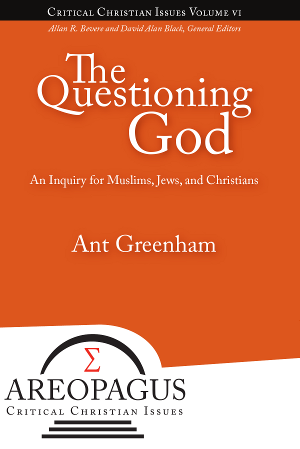
    Cover image of The Questioning God book

    And wisdom is often providing questions. Ant Greenham, in his book The Questioning God, says:

    Our foundational identity as human beings, female and male, is inextricably linked to questioning, to inquiry. The fall of humanity notwithstanding, people are repeatedly called to respond to God in the context of mental and spiritual engagement. And the centrality of a questioning approach is reflected throughout the Bible.

    Ant Greenham, The Questioning God, (Pensacola, Florida: Energion Publications, 2012), 4.

    Greenham goes on to point out the numerous ways in which God’s interactions with us consist of God questioning us. We may have questions of God, but God has even more questions to ask us. I’d suggest as a quick example that you check Job 38. After much discussion and complaint, God becomes active and what does God start with? Lots of questions!

    This approach suggests that God wants us to use our mental capacity. Here’s a famous verse, but let’s think about it again:

    The fear of the LORD is the foundation* of knowledge; it is fools who scorn wisdom and instruction

    The Revised English Bible (Cambridge; New York; Melbourne; Madrid; Cape Town; Singapore; São Paulo; Delhi; Dubai; Tokyo: Cambridge University Press, 1996), Pr 1:7.

    Too often this verse is used to contrast the supposed wisdom of the speaker, which the speaker supposes came from God, verses the use of human intellect. “Don’t trust in your education, your degrees, or your own experience. Do what God says instead!” That’s the common advice.

    I’ve received this advice from some as an admonition not to trust my study of Greek and Hebrew in interpreting the Bible, but just to let the Holy Spirit tell me what the text means. But the second half of the verse challenges that. “It is fools who scorn wisdom and instruction.” I can be listening for God’s voice in so many ways, while ignoring what I have already learned. Often when I’m searching for an answer, I’m directed (in various ways) to look at the scriptures and the wisdom of the community of faith over the centuries for an answer. I’m directed to, not away from, the sources involving intellect.

    I’ve written a few times before on the Wesleyan Quadrilateral. There’s lots of history and debate around that. But I like it a great deal. Today, I’m focused on one element: Reason. We like to put reason down in favor of more spiritual sounding approaches. But in the end, it is with your reason that you will comprehend the messages sent to you by God. That’s why God so frequently asks questions. God wants to awaken your reason.

    I want to note one final thing. Intellectual activity and engagement is not exclusively the product of academic instruction. In fact, a great deal of foolishness takes place in academic settings. Any group of people can become so inward looking that they lose site of the whole of creation. They can no longer hear wisdom calling in the street because they are in a room with the windows closed and their select set of sources.

    Intellectual activity is also the farmer learning to manage crops, run farm equipment, and take care of animals. God can and will speak wisdom in that setting. The Greek classroom is not more about wisdom and instruction than is the farm, or the corner grocery store. Wisdom is calling out in all these places and through all these processes.

    God is asking you questions about everything. Are you listening?

  • Luke 15:11-32 – The Prodigal

    Luke 15:11-32 – The Prodigal

    I’m not going to provide my own translation or paste the text from another one here today, as the passage is long, but I’d strongly suggest re-reading the story before you continue. Read it carefully.

    This parable is often called the parable of the prodigal son. Many commentators, however, have considered it much more about the prodigal father, in the sense of a father who was lavish and extravagant about his love and generosity. This latter view is not bad as the meaning of the parable.

    I’d like to suggest, however, that we can look at this parable in more than one way, and the meaning shifts as we do so.

    The first view is one that I heard many times before. The prodigal son has done many horrible things in his life, and finds himself at rock bottom. From that final landing place he manages to grasp just a little bit of hope. Maybe, he thinks, I can persuade my father to take me back as an employee. The lesson of the story seen from this point of view is that you should be willing to repent and come home, and the Lord will accept you.

    Not bad. Even true.

    But the next view is that this is the story of the father, a father who always loved his son, who gave him early access to his inheritance, and waited for his return as long as he was away from home. We can gather that he lived with this hope because he sees that son returning from a long way off and comes to welcome him. From this point of view, this is the story of the father’s grace, love, and willingness to accept the returning wanderer.

    Even better. Also true.

    But the third point of view is the other brother, the good brother, the one who stayed home and worked hard and thought he was pleasing his father. He’s satisfied with is goodness and believes his father owes him respect for his diligence in keeping the family business going and providing support for his father in his old age.

    Not very nice. But very true.

    Contrary to the way many read this story, I actually think the older son is the target. You see, I am the older son. Yes, I’ve done some wandering, but not as much as other people I know. In fact, I lived a quite respectable and productive life while I was out of the church. When I came back, I was ready to start teaching the Bible and diligently doing God’s work.

    I had to return, but not from a far country. Just from a little ways down the road. And yes, the father was there waiting for me. I was a respectable wanderer who returned in good time and was able to put what I learned in the meantime into God’s work. Many said it was part of God’s plan, that God had been preparing me to work.

    So now I can look at people who have wandered far from God. They’ve gone off and become addicts, criminals, God-haters. They’ve really hurt my heavenly Father. They’re the bad people who need real redemption and not just a little adjustment to their lives.

    But you know what happens? When they show up, the angel choirs break into hallelujahs. God welcomes them into his arms. There is great rejoicing over this one sinner who repents. Even, no, especially, the ones who fell the farthest, who behaved most despicably, who were the least respectable in human terms.

    And yet … there’s the father waiting, watching, jumping up joyfully, welcoming, feasting.

    And I’m left to keep on trying to do everything the father wants me to do. Why don’t I get the reward that I think I ought to get?

    It’s actually very simple. Even when I make the story about me, the older brother, it’s still God’s story. It’s still about the Father whose grace reaches everyone and who’s holiness is so far above that if I were to concentrate on it, I wouldn’t be so incredibly foolish as to try to compare my accomplishments to those of my wandering brethren. We all need to come into the Father’s care and receive the Father’s grace. None of us have anything of our own to bring.

    The story becomes also an invitation to let God take us to the place where we don’t feel superior to the returning prodigal, no matter how long he has wallowed with the pigs, or how much money and life he has squandered.

    In fact, the pig sty is closer to the Father than the management office on the Father’s farm.

    If you are living in that place of service, and waiting for your reward, and wondering why others you think are less worthy than you seem to cause all the rejoicing, consider saying this: “Father, I have sinned against heaven and against you, and am no longer worthy to be called your son.” He’ll interrupt you. You won’t get any further. Because he has been calling you his son all along.

    He’ll rejoice that you finally realized it.

  • Link: On John Wesley and Penal Substitution

    Link: On John Wesley and Penal Substitution

    I found the article Penal Substitution in John Wesley’s Atonement Theology quite helpful. It’s one valuable note that is often not accounted for enough in scattered Wesley quotations is the development of his own experience.

    I value penal substitution, though not nearly enough for many of my Reformed friends, in that I believe it is one of many metaphors used for the atonement. The atonement is a huge topic and we should expect to encounter mystery. Unlike more progressive theologians, who tend to discount penal substitution, I think it has a story to tell. So, however, to other theories.

    Here are a couple of earlier blog posts I’ve written on the subject, not of Wesley’s view, but of penal substitution:

    We are not saved by our theological beliefs any more than we are saved by any other type of works. But good beliefs do make it easier to make that surrender to God.

  • Psalm 119:160 – Truth

    Psalm 119:160 – Truth

    The source of your word is truth,
    and every one of your righteous judgments is eternal.

    It is said that we live in an age where truth is becoming less and less important.

    Personally, I disagree. I think truth has rarely been all that important in human society. From village gossip to the propaganda inscriptions of ancient rulers, words were made to serve the goals of those speaking them, with truth either secondary, or of no concern at all.

    What has happened in our modern society is that technology has made it much easier to spread lies. It is much easier to provide good evidence for falsehood as well.

    I am not an artists, but I wanted a picture of a tiger cat like my Mo (the Energion Spokescat!) taking off on a quadcopter to fly around the house. I fed a couple of sentences to Adobe Firefly and you can see what I got below.

    Cat on a Quadcopter!

    Now I see a number of things about this that indicate it’s not real, but I’m wonder what would happen if I posted this on social media and said that Mo had learned to ride on a quadcopter I’d bought him, and was now carrying out his mission of flinging all objects possible to the ground.

    There might even be people who would repost the picture and claim that they now knew cats could do this, and who wouldn’t care if the picture was generated by AI. This is why I always try to indicate when something I post was generated by AI.

    No, Mo does not ride any kind of flying device. That picture is absolutely artificial. But I have seen less plausible pictures immediately accepted as truth simply because they tended to back someone’s political or social views. When someone points out the problems with a picture or a post, I frequently see people respond what was posted was plausible and fit with the character of the person(s) described.

    No matter how many fact checkers we may line up, people will believe what they want to believe. But that isn’t the main problem. The main problem is that people become indifferent to the truth of any statement or the genuineness of any picture. They decide that doesn’t matter.

    I think it would be better if we had opinions on many less topics, and only took a position on something we had been able to study thoroughly enough to give a good foundation to our opinion on it.

    The Psalmist is here thankful that God’s Word, the foundation of all God’s creation, is founded in genuine reality, really real reality. When God judges it’s right.

    So we get the idea that when we get something from God’s word, it must be true. This is in turn morphed into the idea that if you found it in the Bible, it must be true. That’s obviously why we have hundreds of denominations with a variety of opinions on just what the Bible teaches.

    It’s not that we all have to be right. We’re human. We’re going to make mistakes. Lots of them. The point is that we need to be very careful what we claim is true and what we accept as true. That includes studying your Bible. Are you sure you’ve gotten precisely what that verse said? Perhaps you need to study some more.

    Or perhaps we should simply admit that we are expressing our opinion of what is true.

    Now don’t get the idea that opinions are unimportant. An opinion should be backed by the best evidence you can find. You should try to have accurate, true opinions. Just don’t be arrogant enough to believe you always do.

    A commitment to God’s Word means both a commitment to serious study, and also a realization-an accurate realization!-that we are not perfect.

    Seek truth. Admit fallibility.

    (The featured image, also a cat on a quadcopter, was generated by Jetpack AI. Different take!)

  • Psalm 119:158 – Disgusted

    Psalm 119:158 – Disgusted

    I have seen the treacherous and was disgusted,
    because they don’t observe your word.

    What disgusts you? What makes you angry? What infuriates you?

    Sometimes we get the idea that a believe in a loving God and in God’s grace means that we have to be gentle about evil. Being gracious means that we never deal with evil, and can never be angry or confrontational.

    In my younger days I was more confrontational, but as I’ve gotten older, I’ve gotten less so. I haven’t come to believe that anger at evil, and action against evil is inappropriate. I have come to believe in choosing my battles, and doing so very carefully. There’s anger against evil, but there’s also being a pest about everyone who does anything that I feel is not quite right. You don’t really want me to do that, because there are a lot of things I don’t like. Fortunately for everyone, I generally don’t think most of those things are my business.

    But there is a time to speak and a time to act. Ezekiel 8 & 9. Ezekiel is shown evil going on in the temple, and then he is shown six men who are sent through the city and are told to put a mark on certain people. We find out that those people are the ones who “groan and lament over all the abominations.” Those who are not groaning and lamenting and put to the sword.

    Harsh!

    Then there is the story of Eli and Samuel. Eli’s sons are taking advantage of their position as priests to take the best portions of sacrifices for their own tables, amongst other things. In 1 Samuel 2 we get the message that Eli’s family will be judged. Why? Because Eli knew about the evil that was going on and did nothing. Samuel, in 1 Samuel 3 gets the “execute” message for this one, the word that the time has come and it’s too late to turn aside the judgment.

    Harsh!

    But there’s also a critical protective side-rail on this. The people condemned are condemned because they are not keeping God’s word. Too often we are judgmental and rebuke people for not doing things our way. Often we confuse our preferences for God’s rules. Beware of anger and disgust at someone for not conforming to your expectations. Your expectations are not the guide.

    The other side-rail is where we fail to ever see anything wrong and choose just sweetness and light. Sweetness and light while ignoring clear evil is itself evil.

    I once heard theologian and author Dr. Deanna Thompson speak about being asked to author the commentary on Deuteronomy in the Belief series, a commentary series written by theologians rather than biblical scholars. Thompson wondered why she, as a feminist, liberationist theologian should write a commentary on Deuteronomy. She didn’t seem to be the obvious choice for the task.

    However, she said that once she had accepted the task, she discovered something important (and I quote from memory). She said, “I discovered that a God without wrath would never liberate anyone.” Let me recommend her commentary. It is a very serious theological reflection on the text.

    I would say that when you do provide a gentle person, or one who hopes to be gentle, to wrath, it can be a very dangerous thing. A truly gentle person is disgusted by what is done to the poor, the needy, the stranger, the foreigner, or anyone who cannot defend themselves.

    Will anything disgust you today?

    (Featured image generated by Jetpack AI.)

  • Psalm 119:139 – Zeal

    Psalm 119:139 – Zeal

    I am overcome by my zeal,
    because my enemies have forgotten your word.

    What exactly makes you angry about another person?

    Few of us can claim that we have not been provoked to anger by something about another person. The question is whether or not the cause of our anger is valid. But, you say, we’re talking about zeal. True, but more precisely we’re talking about an emotion regarding other people that is overwhelming.

    So let’s use “zeal,” as I did in the translation. What gets you feeling zealous? What gets you to take action about something?

    And that’s where we can join the Psalmist. For him, what gets him going is that there are people out there who have forgotten God’s word. I wonder what he did about it.

    Often we speak against anger (or sometimes any emotion) as though the emotion itself is bad. I don’t think this is right. I’ll note that when Jesus spoke against anger, it was against anger at your brother that could lead you to doing harm.

    I can get very angry, but my most common approach to interaction is reconciliation. I want to get people talking to one another, or having a dialogue with me, with the hope that we’ll work out some good solution to our problems. I may want to convince them of the (obviously excellent!!!) approaches that I absolutely know are right. Even so, I generally want a solution reached through dialog. One of the things that bothers me most is that so many times people just won’t talk. Either they’ve talked too long already, or the other person is too far off the map for them to engage with.

    And I admit that there are times when these people are right. I have the experience of wasting time talking with people and trying to create meetings and discussions to bring reconciliation when the parties simply weren’t sincerely interested in a peaceful or friendly solution.

    I don’t entirely like the word “balance,” but there is a balance needed here. Or perhaps an integration. Strong emotions exist for a reason. We need to get angry in order to bring ourselves to action. When there is injustice, when people are being hurt, when people’s lives are destroyed, we need to be angry. And if we consider the law as I discussed it a few days ago, as summed up by loving one another, then when we see people hurting others, our zeal should overcome us, because they have forgotten God’s word.

    On the other hand, we find it much easier to get angry at the other people because they annoy us and not because they have forgotten God’s law. Then we like to pretend tat we’re angry about their failure to serve God properly, while it’s really just that they rub us the wrong way.

    What should you be angry about today?

  • Psalm 119:135 – Shine

    Psalm 119:135 – Shine

    Let your face shine on your servant;
    teach me your statutes.

    I have tended to stick with more formal translation, but the first line here could be translated, “Look on your servant with favor.” Part of that favor includes teaching statutes.

    I’ve said a few times that we don’t really tend to look at rules as a blessing. What’s very interesting is that we will look at stability that favors us as a blessing, while often ignoring the fact that it is a set of rules that provides that stability.

    In church, this frequently comes up when we want the freedom to worship or to accomplish whatever goals. We chafe at rules that prevent us from operating freely and creatively. Then when someone goes too far out of our church’s traditions, we get upset. “They can’t do that in our church,” we say. Then we pull out the rule book and hopefully find a rule that will keep them in line.

    We also tend not to notice when our rules get in the way of other people. This contributes to the widespread complains about Home Owners’ Associations. You can easily find reams of complaints about HOAs online. Yet there are HOAs all over the place. Personally, I suspect I would avoid a neighborhood with an HOA. I don’t like that type of thing.

    But what makes HOAs so common, while also making complaints about them ubiquitous? Well, we each have our own taste in what makes a home look friendly, good, or respectable. The HOA gets together and makes rules that they think will keep property values up and make their neighborhood look attractive. I drive through such neighborhoods and think, “I’d really hate to live here. Everything looks the same.”

    This illustrates how we look at rules. Often we don’t even consider the rules until they get in our way. Then we are suddenly irate about them. But one of the reasons other people were able to make rules that annoy you is that you weren’t paying attention when the rules were made.

    It’s important to know what God’s rules are. This is not just so we know the rules to keep, but also so that we know what are not God’s rules, but rather matters of choice and preference. As Christians, we often have a set of rules that are unwritten, but that “everyone knows.” When someone new comes to church, they learn by experience, often unpleasant experience, what the church requires.

    At the same time many members think their own preferences are the equivalent of Divine rules. Dress and behavior in worship is one area. The line from Paul, “Let everything be done decently and in order” is a scripture that has been applied in many inappropriate ways. People use it to forbid clapping in church (it’s irreverent), or to suggest that the pastor has to carefully follow every word of the bulletin.

    Those are not God’s rules. They’re rules we make and then blame God for. In fact, when we make our own rules, in any case where we are not simply applying a Divine rule, we’re violating God’s rules, claiming God has spoken when God has done no such thing.

    My prayer would be that all believers would take this verse to heart. Let’s aim to know what God’s statutes are, and thus what God’s statutes are not.

    In what ways can you avoid imposing your preferences as rules?

  • Psalm 119:126 – Time to Act

    Psalm 119:126 – Time to Act

    It’s time to act, LORD.
    They’ve set your law aside.

    I’ve talked about waiting and patience a few times, so let’s look at the second part of this verse.

    How can one set God’s law, or any law, aside?

    We usually think of simply breaking the law, a sort of binary choice. I’m either doing it or not. And of course, that is one sort of lawlessness. I know what the law is. I have the power to do the right thing, and I choose to do the wrong thing instead. That certainly happens!

    But there are a few other ways to set the law aside, or make it void.

    We can trim around the edges of the law. A common way of doing this is to discuss what limit the state troopers are actually enforcing. Can you get by with 5 miles over the speed limit? 10 miles? You’ll see occasional arguments online about this. Inevitably, there will be an officer in the discussion who says he doesn’t actually have any margin for grace. If you’re speeding, you’re speeding!

    I observed this driving through Ohio way back when the dinosaurs roamed and I was in graduate school. Someone had told me that the Ohio cops didn’t have any margin on enforcement, so I stuck straight to the speed limit. A few miles into the state another car crawled past me. He couldn’t have been doing more than a couple miles over, but in a couple minutes there came the flashing lights as the trooper sped past me and soon I saw the slight speeder at the side of the road.

    I congratulated myself on my great intelligence and waited until the next state to speed up.

    But there are other ways we can make the law void. Another way is to load people down with laws and regulations until it’s pretty certain that no matter how hard they try, they’ll be violating the law at some point. Once you get there, people realize they can’t be completely in the clear no matter what, and they become careless about keeping even more important laws.

    You can also have the attitude of self-righteousness in which you’re convinced that you must keep the law, and that you’re a good person, so you’re doing it. How does this work? You reduce the actual laws to a level that you can. You grade yourself on an imaginary curve.

    All of these tend to result in a certain amount of lawlessness, and when carried far enough can be destructive of a family, a community, or a nation. Laws are important, but they are very much subject to misuse and abuse, often by the people who ought to be upholding them.

    With the psalmist, we can call on God. It’s time to act! People are setting your instructions aside and substituting their own.

    How can you live constructively in relation to the laws that you know?

  • Psalm 119:117 – Sustain

    Psalm 119:117 – Sustain

    Sustain me and I shall be saved,
    And I will continually meditate on your statutes.

    The Message gives a nice feel for this verse:

    Stick with me and I’ll be all right;
    I’ll give total allegiance to your definitions of life.

    Psalm 119:117, The Message

    Now this translation has the problem that many do, which is that it’s clearer than the text it translates. One of the features of poetry is expression which evokes meaning and feeling, but does not lay it out blow by blow. Nonetheless, a translation like The Message can sometimes force us to look for the boundaries of a text.

    One thing I prefer over The Message on this verse is the idea of meditation. The verb used in Hebrew can cover a lot of ground, such as “gaze at,” “pay attention to,” and yes, “meditate” or “keep/observe.” The precise point in that range of meanings that the author intended is difficult to say for certain. My view is that in poetry, the intent is often to evoke broader meaning. When we narrow such a verse to just one set of precise meanings, we can lose the intention of the verse.

    And that’s the thing about meditation. An attorney needs to know more than simply the textual content of the law. In our legal tradition, they need to know the history of interpretation in the form of previous court rulings. Once they know that, they also need to be able to understand the story into which they have been drawn in order to know how they can apply all that material to their particular situation.

    It is similar with God’s law. God could have inspired a compendium, carefully cataloged and containing just the specific ordinances. But that’s not what we have. If you’d like to see what that would look like, consider passages such as Exodus 22 & 23 or the Hammurabi Code. These are codes of law, but in the case of those chapters of Exodus, the code is contained in history, and the foundation of that code of law is in the actions of the lawgiver.

    Is it any wonder that the psalmist can spend 176 verses expressing his joy in the law? He can see his God in that law, and in the way in which that law was presented. He knows that the reality behind the law is the creator-redeemer God. The word used here for “saved” as I uncreatively translated it, can also be translated with words like “be rescued” or “be victorious.”

    The God revealed in the law is the God who saves. When one meditates on the law, one learns about the lawgiver who also rescues, supports, and sustains to the end.

    I again find this verse to be an encapsulation in two short lines of the message of the Psalm.

    Live today as a child of the Creator who sustains you. Always!

    (Featured image credit: Viktor Aheiev. Licensed via iStockPhoto.com.)