Threads from Henry's Web

Tag: New Testament

  • Psalm 119:36 – What’s Your Inclination

    Psalm 119:36 – What’s Your Inclination

    Turn my mind to your testimonies,
    And not to ill-gotten gain.

    How about some alternatives.

    Hearten my mind to your testimonies
    and not to extortion.

    Bob MacDonald, Seeing the Psalter, 382

    Dispose my heart towards your instruction,
    not towards love of gain.

    Psalm 119:36 (REB)

    Christians frequently speak of the Hebrew scriptures (the Old Testament) as a book of all about law, and even sometimes as a book of legalism, in which salvation is to be earned by energetic keeping of God’s law(s). They contrast this to the New Testament, which is a book of love and of grace received through faith.

    I keep wondering whether those who believe this have actually read either. The Hebrew scriptures are filled with God’s grace, and constantly portray God as the one who acts first, while the New Testament speaks a great deal about action, things to do. Paul goes on about salvation by grace through faith, and then goes into a list of good things to do.

    The issue in both cases is the role that these things play in our relationship to God. This verse is a prime example. The Psalmist asks God to incline his heart (or mind) to do what God says. He then says the same thing in reverse. Incline me away from ill-gotten gain. Or from just the stuff.

    God does the inclining first, and we are inclined away from one sort of actions toward another. God’s action precedes and leads to our action. Scripturally, it is always this way. In fact, the very desire to ask for that inclination is the result of divine action.

    This verse points just a bit further than that to what I would say is the most common manifestation of idolatry, and that is the drive to acquisition. I’m not talking about getting things that one needs to live, or carrying out useful and productive work, or even investment. The question is what is the driving force. Why am I doing what I’m doing.

    You see, idolatry keeps our vision low. It makes us short-sighted. Do I want to acquire money so that I can accomplish good things with it? Or do I want money or other stuff just to make myself more important? Please don’t read this as merely wanting money for charitable purposes vs for business activities. I include productive activity, including investment, as accomplishing good things.

    This can go astray in a couple of ways. First, I can gain things by cheating. Cheating takes many forms, but it usually involves a form of manipulation, such as an employer convincing an employee that they will never get anything better, and that their only hope is to accept what that employer has to offer. Or it could be a worker who manipulates the work situation so as to appear more valuable that he or she really is.

    Second, this can take the form of pure acquisition for the sake of possession. I’ve often thought that Ebenezer Scrooge was more to be pitied for the fact that he did not actually enjoy any of his stuff than looked down on for his business practices. He manipulated people in order to acquire, and didn’t even enjoy the possession.

    If the stuff drives the bus, it’s going in the wrong direction.

    We often fail to see the value in things that God commands, whether through the written word, or simply through the nature of the world in which we live. As humans, we regularly try to live in ways that are not sustainable. We can see this in history time after time, yet we are inclined to act as though the consequences won’t catch us.

    Rules are hard to enforce on people who are not inclined to keep them. Just check out the traffic laws and observe the speed and other driving practices taking place on the road. We are inclined to take what shortcuts we think we can get by with. But if we change our inclinations our actions can change. And as the Psalmist demonstrates here, God is the one to ask for that change.

    What are you inclined to do? Would you like to see it change?

    (Featured image generated by Adobe’s Firefly in Adobe Express.)

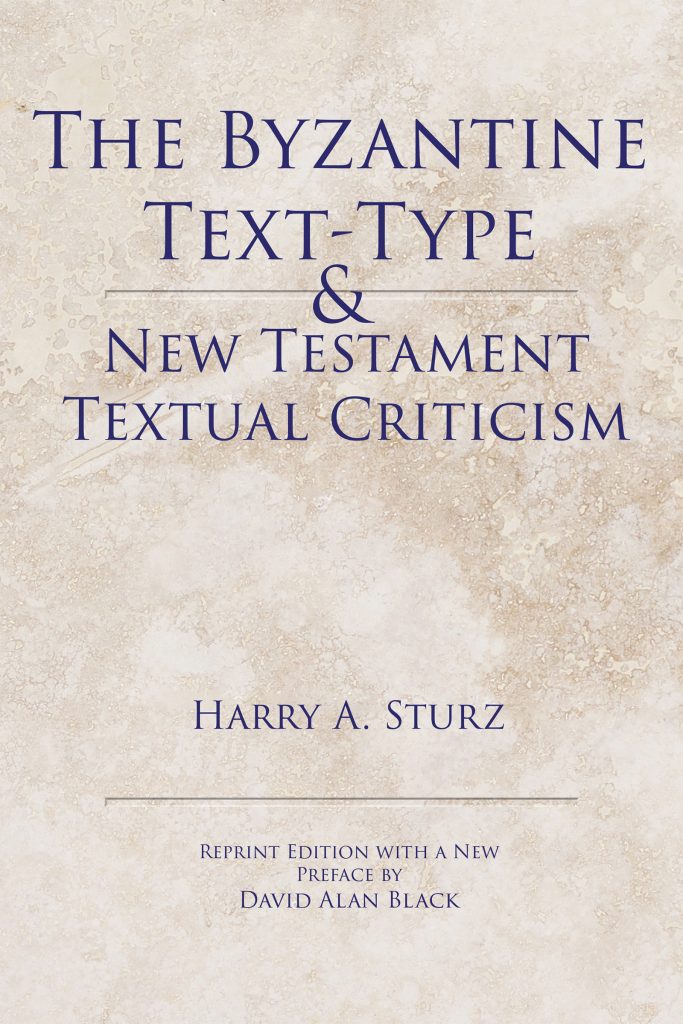
  • Book: The Byzantine Text-Type & New Testament Textual Criticism

    Book: The Byzantine Text-Type & New Testament Textual Criticism

    In my business role as president of Energion Publications, I’ve just cleared the proofs for the release of the book The Byzantine Text-Type & New Testament Textual Criticism by Dr. Harry Sturz. This is a reproduction of the original book, released in 1984 and is produced under license from HarperCollins Christian Books.

    Note: This discussion is not intended for experts, but for people who have only occasional contact with New Testament textual criticism. While I have studied textual criticism, I am not a specialist in it by any stretch of the imagination.

    We have thousands of manuscripts of all (a few) or part (many) of the New Testament. In preparing a Bible translation, translators must make choices of which manuscript readings they are going to use.

    It’s easy to overestimate the problem here, because significant and/or doubtful variations form a very small part of the New Testament text. Nonetheless, in public discussions, the variants get all the press, because we like to find things that are different, and therefore more interesting.

    One thing I learned early in studying textual criticism was that manuscripts should be weighed, rather than counted. What does this mean and how does it work? Well, in general textual critics divided manuscripts into three large groups, which were named for regions associated with them, though actually divided by characteristics of the text. We had the Western text, associated with Rome and parts west, the Alexandrian, associated with Alexandria, Egypt, and the Byzantine text, associated with the eastern church.

    The vast majority of surviving manuscripts are of the Byzantine text-type, largely due to history. The church survived much longer, and many more copies were made in the east. In addition, a great deal of manuscript production in the west was in Latin. I’m brushing past a number of factors, but the bottom line is that there were more Byzantine manuscripts.

    In the 19th century, and somewhat into the 20th, there were a large number of manuscript discoveries, or rediscoveries, which produced texts that differed from the common texts found in the majority of the manuscripts. These newly-found manuscripts were older, in general, than the existing manuscripts, and in many cases included readings that scholars thought were more likely original. This produced a strong swing in scholarly work toward the text in these newly discovered manuscripts. The Alexandrian text got a lot of attention, with the western text following not far behind. A theory developed that the Byzantine text was the result of a major editorial effort, that produced a single, new text.

    As a result, two things happened. First, the Byzantine text was considered generally more recent than those newly discovered manuscripts, and second that it was likely to have readings that were essential 4th/5th-century revisions. At most, it could reflect essentially one manuscript.

    Opposed to this general consensus, on which the text of most modern Bible versions has been based, was the view that the reason we had more Byzantine manuscripts was that the text was actually better preserved there, so that it should be preferred, and manuscripts from the other text-types should be considered some sort of aberration.

    Dr. Sturz argued that the Byzantine text-type could and did preserve older readings. It was not to be preferred over all others, but its readings should be given due consideration in all cases. He provided evidence that many Byzantine readings show up in early papyri, showing either that if there was any unifying editorial process, it had not been one that erased all of the prior evidence.

    The general result of accepting Dr. Sturz’s argument is to improve the evidence that we have for determining the text of the New Testament, as well as change the weight we give to various sources.

    I am glad to be able to release this important book and make it available at a reasonably price again. On the Energion Publications retail site, it will be available for $22.99 (suggested retail 24.99) through Wednesday, which is the official release date.

    Below is an interview I conducted with Dr. David Alan Black (who wrote the preface to the new edition) and Dr. Abidan Shah.

  • Freedom and Responsibility

    Freedom and Responsibility

    I posted an extract from Dave Black’s blog on The Jesus Paradigm today. (I do this because you can’t link to a specific post on Dave’s blog, and I have his permission.) Dave is talking about Galatians 5:13-15, and what freedom means.

    Rather than commenting on this passage myself, I want to put a quote from one of my other authors alongside Dave’s. I like to do this both in terms of seeing where we disagree, but also to note where we might come from different denominations and/or tradition streams, and nonetheless agree.

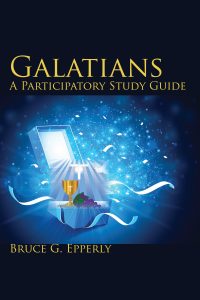
    This is from Galatians: A Participatory Study Guide by Bruce Epperly:

    We are called to freedom, Paul proclaims. Many people believe that freedom means doing exactly what they want without regard to its impact on others. In individualistic North America, we hear the following cries of freedom: “It’s my money and I can do whatever I want with it,” “It’s a woman’s choice,” “It’s my property and I will use it as I please,” “Don’t infringe on my right to gun ownership,” “It’s not hurting anyone, I can do what I want in my private life.” Paul sees Christian freedom from a very different perspective.

    Freedom finds its fullest expression in loving relationships that take into consideration the needs of others. Christian freedom is not coercive, it is invitational, and it invites us to let go of our individualistic possessiveness and live in light of God’s grace and generosity, manifest in our willingness to sacrifice some aspects of our freedom for the well-being of others and the communities of which we are a part.

    “Do not use your freedom as an opportunity for self-indulgence, but through love become slaves to one another” (5:13). Freedom involves responsibilities as well as rights. In fact, in Christian community, Paul asserts that freedom involves sacrifice for the greater good of those around me. Paul’s understanding of freedom within the Christian community is captured in his Letter to the Romans: “I know and am persuaded in the Lord Jesus that nothing is unclean in itself; but it is unclean for anyone who thinks it unclean. If your brother or sister is being injured by what you eat, you are no longer walking in love. Do not let what you eat cause the ruin of one for whom Christ died” (Romans 14:14-15). True freedom goes beyond self-interest to embrace the best interests of those with whom we interact.

    Epperly, Galatians, 57-58

    I find that a critical element of my Bible study is to consult a variety of sources, not just different theological positions, but also different approaches. In my current study of Romans, for example, I follow a theological commentary, an exegetical commentary (from a different perspective), and a linguistic/technical commentary.

  • Link: Geneaology Mixup in Luke Manuscript

    This from CSNTM will give you some insight into the study of manuscripts: From the Library: Luke’s Genealogy in NT Manuscripts.

  • Getting What Was Said

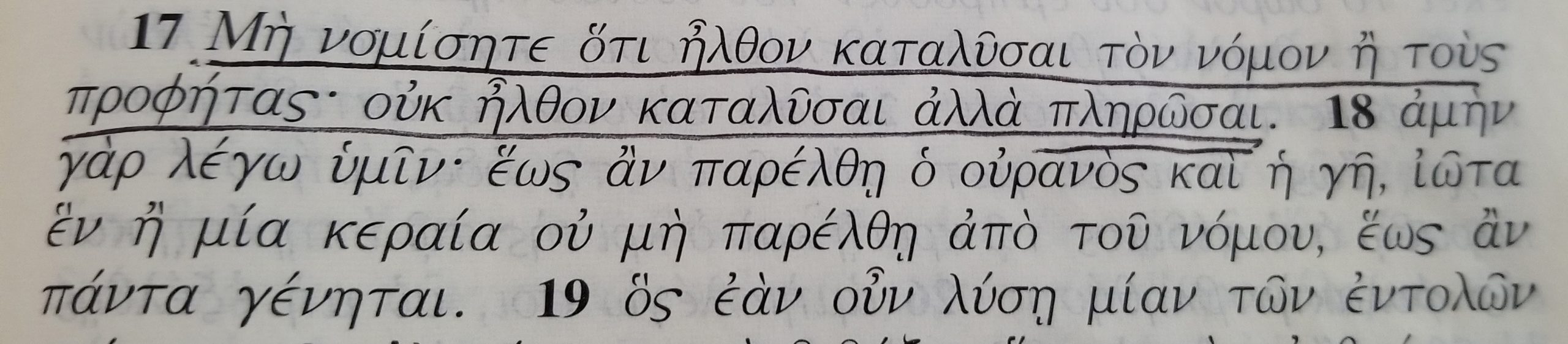
    It can be hard to go from a text to a sermon. The line from past to present can be hard work. But at the root, one must hear clearly what was said. Dave Black looks at a text.

  • The Value of Theological Disagreement

    The Value of Theological Disagreement

    Earlier today I posted links to a video by Andy Stanley and a response by Michael Brown. Some people have commented on this issue indicating that it was unfair to “attack” Andy Stanley about his views.  (These were not on my blog post or its Facebook link; the controversy is widespread.) I have a few comments on this.

    1. There are those who claim that one has to listen to the entire series in order to get the context and respond. I would disagree. If you make a short video, be prepared to be challenged based on the content of that video (or audio file or blog post, for that matter). I think there is sufficient material in Stanley’s presentation to which one can respond.
    2. It’s interesting that one is expected not to respond to Stanley, yet Stanley is critiquing quite a number of other Christians. I do not criticize Stanley for doing this. If you’re going to assert that X is true and Y is not, you’re going to critique someone.
    3. As in #2, those who critique Stanley are in much the same position. If they are to assert that X is true and Y is not they will obviously be offering a critique of those who hold Y.
    4. Which leads to my main question: Why is it wrong to question theological statements, especially sweeping ones that are offered as a critique of other Christian positions?
    5. As for the “Marcionite” argument, we’re in a standard name-calling situation. For some reason, we think that by labeling someone we have responded, and, on the other hand, by defending ourselves from a label, we’re defending our position. Forget the label; ask whether the viewpoint is correct, or whether it can be improved upon.

    I believe it is very important to discuss theology, and discussion involves the assertion that some things are less right than others. The idea that we can never point out what we believe is an error in the teaching of another is ludicrous. Now if we arrogate to ourselves the ability to judge someone’s salvation or their standing with God, that’s another matter. But to assert that some things are true is by nature to assert that others may be less accurate or perhaps untrue.

    In this issue, I actually go farther than I perceive Michael Brown is going. I don’t believe there is a singular, straightforward distinction between the Hebrew Scriptures and the Christian New Testament. I believe that there are many cases of God changing the way in which he relates, as God carries out God’s plan to save humanity. Thus the Christian Bible, consisting of the Old and New Testaments should be read as a single story. There are points of distinction, but they occur in a variety of ways and are usually envisioned ahead and then their interpretation grows afterwards.

    I object to simply dismissing a portion of scripture. You have accomplished nothing of value, I believe, by unhitching the New Testament from the Old, first because they are connected by much more than a hitch. There is an earth-shattering change with the incarnation, the life, the death, and the resurrection of Jesus, but this takes place in the midst of a growing understanding of God and his actions in the Hebrew Scriptures, and we struggle to understand this completely millenia later.

    As an example, many—I suspect the vast majority—of those who heard Jesus may have been surprised by his attitude toward the gentiles, and may have similarly been concerned by the church’s mission to the gentiles. Indeed, the gospels and Acts record that many were. But Isaiah (2nd/3rd Isaiah, 40-66) would not have been so shocked. One may point to differences, yet I think Jesus appears no more radical in his look at the law than Isaiah 56. So if the audience was shocked, they were missing some of the lead-up story. I think they may have been less shocked than modern people imagine. There were many viewpoints in Judaism at the time.

    And if Isaiah 56 wasn’t radical enough, then perhaps Ruth or Jonah would take the place of radical scripture. Or, if we really wanted to get down to it, we might note Genesis 12:3, Genesis 17:5 (from Abram’s call and covenant).

    There are certainly things that are hard to deal with in the Hebrew scriptures/Old Testament. There are also some of those in the New. My problem with a dismissive solution, broadly stated, is that the texts are still there. God has been working with people for a very long time and people have been interpreting God’s actions for a very long time.

    So let’s disagree, critique, and grow. A bit of love and generosity would be good as we do so.

    (Featured Image Credit: OpenClipart.org.)

  • The Sacred Scriptures of the Early Church

    The Sacred Scriptures of the Early Church

    I struggled with the title, as this is almost entirely links, and the issues raised cover so much ground. I’m posting these particularly for my Romans study on Wednesday nights.

    In both the current class and my previous series on Hebrews I maintained that the New Testament was not intended to set aside the Old, or the Hebrew scriptures. In fact, I refer to the idea that Hebrews is doing that is an author climbing out on a limb and then cutting it off behind himself.

    On the Charisma Magazine web site Dr. Michael Brown responds to a video by Andy Stanley.

    I would suggest listening to Andy Stanley and see if you can hear some of the approaches to the Old Testament I mentioned. Michael Brown provides what I consider a good response. I’m glad to note he sent Andy Stanley a copy of his critique (see Brown’s article), but I do not accept that they are not that far apart, as Stanley says. Note that the majority of the issues are in the first five minutes of the video, but I think it then pervades the rest in more subtle ways, then comes out more strongly at the end.

    Anyone who has heard me teach will know my view on this.

    Here are a couple of related books I publish.


  • Linguistics Conference at Southeastern Baptist Theological Seminary

    Linguistics Conference at Southeastern Baptist Theological Seminary

    Re: Linguistics and New Testament Greek: Key Issues in the Current Debate

    It’s more than a year away, April 26-27, 2019, but this conference looks like about the most fun you can have on a seminary campus without breaking the rules! I see several names I know, some well, and one Energion author, Thomas Hudgins, who will be talking about Electronic Tools.

    I’m already planning to be there. Maybe we can meet!


  • Alden Thompson Speaking at Adventist Forum Conference

    Alden Thompson Speaking at Adventist Forum Conference

    Alden was my undergraduate advisor at Walla Walla University (then college), I publish two of his books (Inspiration: Hard Questions, Honest Answers and Who’s Afraid of the Old Testament God?), and he is a friend. Many of my friends have heard him speak in person. Here he is presenting a paper at a conference, so is somewhat less free-wheeling than he is normally, but he’s making some important points.


  • James and a Living Gospel

    James and a Living Gospel

    Our pastor at Chumuckla Community Church started a sermon series on the book of James. This provoked me to look again at Bruce Epperly’s little book Holistic Spirituality: Life Transforming Wisdom from the Letter of James. Here’s a sample:

    Despite Martin Luther’s misguided dismissal of James as “an epistle of straw,” due to James’ emphasis on agency and lifestyle rather than receptive grace as central to Christian experience, James is good news for congregants and seekers. It is the gospel lived out in everyday life, not by words alone or doctrinal requirements, but by actions that transform the world. This is the good news of Jesus Christ who shows us the pathway to abundant life, and not a dead letter or a soul-deadening creed or abstract doctrines about the divinity of Jesus unrelated to daily life. James invites us to be companions on the pathway of the living Christ. (p. 4)

    Dave Black quoted today from Gordon Fee’s commentary on the epistles to the Thessalonians, discussing the connection between believing and living. I’m going to link to Dave’s post again tomorrow, when I briefly discuss Bible commentaries, but Dave’s post is worth reading in this connection as well.

    Bruce Epperly comments again on the supposed contrast between James and Paul:

    While Paul’s theology is often contrasted with the Letter of James, both Christian leaders believed that faith without works is dead (James 5:17).8 Paul affirms “the only thing that counts is faith working through love” (5:6). (Galatians: A Participatory Study Guide, p. xxvii)

    I think we frequently see contrasts when we should see differences in emphasis and even in circumstances.


    Read Now