Threads from Henry's Web

Tag: Education

  • Wisdom Has Questions

    Wisdom Has Questions

    Wisdom cries aloud in the open air,
    and raises her voice in public places.
    21 She calls at the top of the bustling streets;
    at the approaches to the city gates she says:
    22 ‘How long will you simple fools be content with your simplicity?

    The Revised English Bible (Cambridge; New York; Melbourne; Madrid; Cape Town; Singapore; São Paulo; Delhi; Dubai; Tokyo: Cambridge University Press, 1996), Pr 1:20–22.

    Last week I discussed starting a study of Proverbs and noted a different way of receiving the text. This does not result from a prophetic vision, or from a prophet hearing a voice, but rather from collective (and collected) wisdom from a culture. This is life-time learning, rather than special, instant revelation.

    We like instant revelation. We like answers. We especially like answers that come quickly and fit in with our existing lifestyle and our prejudices.

    The “wisdom” we can gain in this way has another advantage. It can be formed into “ammunition sentences,” sentences that we can fling at other people to shut them up. Often such sentences begin with “the Bible clearly teaches.” We fill in with things we clearly see, largely because we failed to see the whole of scripture.

    I saw a sign in front of a church the other day. The first line read: “God has the answers!” And the second read “Are you listening?”

    That’s good. God does have answers. But sometimes God’s answers don’t match our questions, and the reason is that we’re not asking the right questions, or more specifically, we’re asking questions that limit the range of God’s answers. Sometimes we’re even asking questions in order to avoid God’s answers.

    Over the years I’ve prayed with many people who were seeking God’s guidance. Many of these people were genuinely uncertain, and were trying to seek God’s will. But more of them already knew what God wanted them to do, often because it was clear in terms of ethics, simple right and wrong, but who were hoping they could get a word from the Lord that would set them on a different path, one they preferred to what they already knew. Maybe God’s voice will allow me to take a different turn.

    When you approach things that way, it’s easy to end up believing you’re following God’s path, or the path of wisdom, just because you want so vigorously for that to be the right answer.

    I remember once having a conversation with a couple of friends about a business decision. Business decisions are hard for me. In this case I was discussing two options and trying to decide which was the next step. I had struggled with the decision for days. I don’t even recall now what the issue was, but suddenly in the midst of the conversation I held up my hand and said, “I’ve just realized I’m doing this wrong. Option A would result in behaving unethically.” My advisors hadn’t seen that, because they didn’t understand all the processes involved. As soon as I explained what would happen, they recognized what would likely happen, and so the decision was made.

    What slowed me down? I knew the process and should have recognized the problem immediately. But I didn’t. I wasn’t responding to the right questions. I was missing them because I wanted something to be true, but it wasn’t. No amount of wanting would make it true.

    “Wisdom is calling out in the street.”
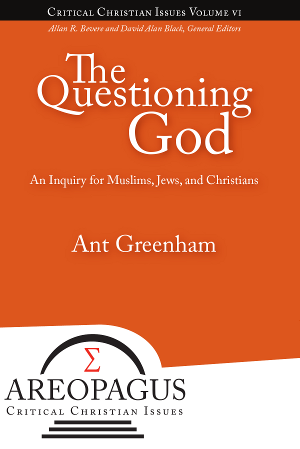
    Cover image of The Questioning God book

    And wisdom is often providing questions. Ant Greenham, in his book The Questioning God, says:

    Our foundational identity as human beings, female and male, is inextricably linked to questioning, to inquiry. The fall of humanity notwithstanding, people are repeatedly called to respond to God in the context of mental and spiritual engagement. And the centrality of a questioning approach is reflected throughout the Bible.

    Ant Greenham, The Questioning God, (Pensacola, Florida: Energion Publications, 2012), 4.

    Greenham goes on to point out the numerous ways in which God’s interactions with us consist of God questioning us. We may have questions of God, but God has even more questions to ask us. I’d suggest as a quick example that you check Job 38. After much discussion and complaint, God becomes active and what does God start with? Lots of questions!

    This approach suggests that God wants us to use our mental capacity. Here’s a famous verse, but let’s think about it again:

    The fear of the LORD is the foundation* of knowledge; it is fools who scorn wisdom and instruction

    The Revised English Bible (Cambridge; New York; Melbourne; Madrid; Cape Town; Singapore; São Paulo; Delhi; Dubai; Tokyo: Cambridge University Press, 1996), Pr 1:7.

    Too often this verse is used to contrast the supposed wisdom of the speaker, which the speaker supposes came from God, verses the use of human intellect. “Don’t trust in your education, your degrees, or your own experience. Do what God says instead!” That’s the common advice.

    I’ve received this advice from some as an admonition not to trust my study of Greek and Hebrew in interpreting the Bible, but just to let the Holy Spirit tell me what the text means. But the second half of the verse challenges that. “It is fools who scorn wisdom and instruction.” I can be listening for God’s voice in so many ways, while ignoring what I have already learned. Often when I’m searching for an answer, I’m directed (in various ways) to look at the scriptures and the wisdom of the community of faith over the centuries for an answer. I’m directed to, not away from, the sources involving intellect.

    I’ve written a few times before on the Wesleyan Quadrilateral. There’s lots of history and debate around that. But I like it a great deal. Today, I’m focused on one element: Reason. We like to put reason down in favor of more spiritual sounding approaches. But in the end, it is with your reason that you will comprehend the messages sent to you by God. That’s why God so frequently asks questions. God wants to awaken your reason.

    I want to note one final thing. Intellectual activity and engagement is not exclusively the product of academic instruction. In fact, a great deal of foolishness takes place in academic settings. Any group of people can become so inward looking that they lose site of the whole of creation. They can no longer hear wisdom calling in the street because they are in a room with the windows closed and their select set of sources.

    Intellectual activity is also the farmer learning to manage crops, run farm equipment, and take care of animals. God can and will speak wisdom in that setting. The Greek classroom is not more about wisdom and instruction than is the farm, or the corner grocery store. Wisdom is calling out in all these places and through all these processes.

    God is asking you questions about everything. Are you listening?

  • Recommending a New Blog: Dr. Dolly’s Musings …

    Recommending a New Blog: Dr. Dolly’s Musings …

    There’s a new blog, Dr. Dolly’s Musings … and I want to recommend it highly. Dr. Dolly Berthelot is an author with Energion Expand (an imprint of my company) with titles PERFECTY SQUARE and Scars to Stars. She has also been a friend and partner in various diversity and dialogue programs over the years. I consider PERFECTLY SQUARE to be one of the best approaches to understanding and managing the value of diversity.

    My company, Energion Publications and all its imprints were founded with a key value and mission of publishing diverse voices and helping to generate more dialogue between very different voices. This value and mission remains.

    I believe you will learn a great deal from Dr. Dolly’s Musings …. But don’t think this will be dry facts. Dolly is one of the most versatile users of words and imagery that I have every encountered. Just when you think she’s found the limits of her imagination, she’ll surprise you.

    We differ in background and some beliefs, but we share the desire to see people learn to work together and produce great value for all of us, not just economic value, but community as well, which is a value beyond price.

    You can read her introductory post here.

  • Psalm 119:37 – Futility!

    Psalm 119:37 – Futility!

    Turn my eyes away from looking at what is futile;
    Give me life in your pathway.

    This one seems pretty obvious. Recently we looked at Isaiah 55:2 – “Why spend your money on what is not food, and your labor for what doesn’t satisfy.” The question becomes exactly what is vain? What is futile?

    There are many things that people describe as futile, or not worth spending your time on. It’s very easy for us to start to equate God’s way (the non-futile way) with what we imagine is a good idea. I’ve encountered church people who thought any form of imagination or fiction was vanity and futility, but in turn spent hours gossiping, passing on information which not one of them need, and from which they will never benefit.

    There are people who call time spent in prayer futile, because one is not busy making money. You need to take care of that first, they’ll tell you. Others see spirituality as the greatest reality and think any sort of detailed study of scripture is a waste of time because people don’t really need to know all that stuff. God will tell them what they need to know. They’re matched by those who think any time spent in meditation or other spiritual activities is wasted, since they can be misled by all that stuff. They should spend their time on scripture and serious theology.

    I know that my parents were told that they were not raising me right because I didn’t get enough social activities, but rather spent too much of my time reading books and playing with electrical equipment. This attitude is often matched by those who argue the balance of social activities, sports, and more intellectual things for students. Some “serious” people think you should get rid of frivolities as art and music. They’re a waste of money, aka “vanity.”

    I recall attending a computer show back in 1980 with a friend of mine. The whole show fit in one classroom at the university. My friend and I were discussing the possibility that one day computers would be able to drive cars. Someone at one of the exhibitor’s tables was listening to us and told us we were being frivolous. If we thought such things could happen we really had no understanding of computers at all. If we ever wanted to do anything in the industry, we needed to get serious. For him, “looking at vain things” was imagining a world in which cars might drive themselves.

    I wonder what he would have thought if we had expressed a much more frivolous thought, by his standards, and talked about a car that you could summon by pressing a button. We had no such idea at the time. I was watching a discussion about a new beta option from Tesla that can do just that, using GPS to locate you. Ridiculous. Totally ridiculous. And in beta testing. The discussion was about the safety of proving actual customers with beta features. I vote no, but nobody asked me!

    The point I’m making here is that a verse of this sort gives us a simple truth. We need to look for God’s way, or more precisely, allow God to “enliven” us in that path. But that simple truth is the door to a great deal more. It’s very easy to dismiss useful things as futile, and embrace futile things as truly important. One key is always just where it is that you’re going.

    And that leads me to the next thing. It’s Sunday. I spent some time thinking about this one!

    How narrowly do you define “God’s path”? For many, if you’re spiritually oriented, everything has to be about religion. So the pastor is much more spiritual and much more “on God’s path” than say the doctor, or the engineer, the fantasy author, the comedian, or the artist. But all of these are part of God’s world. Futility would be to pursue something that is not your calling.

    Don’t assume that you know what is futile. Think about it. Seriously.

    What is God’s path for you? Can you think of some job you’ve looked down on as doing something less valuable than you do? Should you reconsider?

    (Featured image from Adobe Stock, By Sergey Nivens. Licensed, not public domain.)

  • Energion Tuesday Night Hangout

    Tonight my guest will be Dr. Bob LaRochelle, author of books such as Crossing the Street and A Home United, and we’ll be talking about adolescents and faith. Bob is preparing a manuscript for release late spring or early summer on this topic. Join us and bring your questions.


  • My Life and Educational Experiences for Bible Study

    My Life and Educational Experiences for Bible Study

    When I am introduced to speak or teach, mention will doubtless be made of my MA in Religion, concentrating in Biblical and Cognate Languages, though the correct degree name will be shortened, and the language skill usually exaggerated. In my mind, however, there are many things that have contributed to my study of the Bible. I’ve never encountered a biblical scholar who found this surprising, but sometimes non-academics are surprised.

    I thought I’d list some of the key experiences, many of them not of my choice, which have nonetheless been critical in forming my thinking and informing my study.

    1. Bible memorization. As a preteen and early teenager I attended a small private school where we memorized substantial Bible passages. By substantial I mean that we memorized Psalm 119, all 176 verses, Genesis 1 & 2, many Psalms, Luke 2, and so forth. We also memorized scatterings of texts on various topics. This memorization, which I certainly would not have accomplished if it had not been required, has nonetheless stuck with me and helps me see the broader picture. I don’t have to go read Isaiah 53 or 58, because I memorized them, and though I could not repeat them in the KJV (which we used), I still have a fair idea what’s there.
    2. Bible survey. At the same school we were required to memorize titles for most of the chapters (we covered the Psalms by knowing what chapters were in the five books). Along with memorizing, this again helped me with an overview, and made it much easier to find content that I need. I still surprise people by pointing them to a book and range of chapters even when I’m not sure of the specific verse they’re looking for. Further, we had workbooks which asked questions about the text of the entire Bible. These were not thought questions, but content questions. I think it’s unfortunate that people who teach critical and independent thinking often forget that having the facts at hand is useful in thinking, and those who teach the facts often forget that facts strewn about the landscape are not so helpful unless they are critically examined and ordered. Sometimes “Bible study” turns into a simple recitation of opinions, in part because students are so unaccustomed to reading the text and making their own judgment regarding the meaning.
    3. History and historiography. There is an obvious benefit to knowing biblical history and related ancient history. I think some study of other history–any other history–is of great value as well. One of the problems we have with studying the Bible both “seriously and faithfully” is that we make up special methods for studying it as opposed to other texts. We also make up rules for studying biblical history which might not be accepted elsewhere. There’s no substitute for actually reading and studying some good texts on history unrelated to the Bible.
    4. Sociology. I hated my undergraduate sociology, but I’ve come to value that area of study, though I still consider the one undergraduate course I took to have been seriously deficient. People are people, and studying how people behave and respond helps me read Bible stories more faithfully.
    5. And yes, language. Learning to read the biblical languages is valuable in many ways, including being able to spot nuances in the way things are expressed more easily. One of the most important things I learned, however, was how complex the process of translation can be. When you are first learning to read another language (and often for much longer), you are really mentally translating the text into your native language. It can be a struggle and should give you a great appreciation for those who translate on a professional basis. It’s so much easier to criticize scattered renderings where you have a strong opinion than it is to produce a quality translation of a substantial portion of the source text.
    6. English, my native language. The process of understanding an ancient text and then expressing it in modern terms will tax your knowledge of and fluency in your native tongue. Many times I have been trying to express something from the Greek or Hebrew text and have stumbled for lack of a good English expression. Many really bad ideas in biblical studies have resulted from this, such as claims that “English can’t really express this idea.” The real issue is can you use your native language creatively.
    7. Church life. I don’t think you’ll understand the Bible unless you’ve experienced church. I don’t mean that church is such a good representation of what’s in the Bible. Usually not so much. But a great deal of the Bible story is about people trying to form and maintain communities, and if you haven’t actually tried, you may not understand them. I hate church politics, but at the same time church politics is a necessary thing. Politics is what happens when people try to act together. You can do it well or poorly, morally or immorally, but you will have to do it.
    8. Experiencing family. I have nothing against folks who are single, and I remained single until I was 42, and then married and acquired a family all at once. When I was single I was always of the opinion that raising children was likely more difficult than I could imagine. I was right! But again, understanding people who thought of themselves as God’s family is easier after experiencing the parent side of being a family as well as the child side.

    There are other things that have helped, but I hope I have made the point that there are many things other than languages, and indeed many things other than academic study that help one understand. These other elements are even more important if one wants to teach. Being able to clearly express a set of ideas involves not only knowing those ideas well, but also knowing the medium of expression (language, art, etc.) and the audience well. The hermit professor, sitting like Simeon Stylites atop an ivory tower, has little impact on the world around.

    But further, I suspect not one reader of this post does not have one or more of the experiences I listed, or perhaps others I have not. That means that the person without the degree in biblical languages also has a contribution to make. We ought all be prepared to listen and learn.

  • Saber-Tooth Everything

    Saber-Tooth Everything

    Source: Openclipart.org. I think this is the Cheshire saber-tooth tiger, fading toward his smile!

    I love the classic book The Saber-Tooth Curriculum, and I was reminded of it when I read The disposable academic in The Economist, I was reminded of it.

    In education we’re increasing the cost without increasing the benefits, and that’s not sustainable. Educators should be thinking of better ways to operate now, before unchosen and unwanted new ways are forced upon them.

    I think the whole system, which expects students to spend years and dollars getting degrees before they enter the workplace was designed for another time and is hopelessly unfitted for the 21st century.

  • Thinking Things Will Make You Stupid Will Make You Stupid

    Power PointRecently I’ve encountered a seeming avalanche of comments, articles, and posts that claim that some new technological tool will make you stupid. Or possibly lazy. Or immoral. Or something.

    Doubtless the first stone knife was similarly received — as the end of manly dependence upon unformed sticks and stones, and the birth of a generation too lazy to rip the skins off their prey with their bare hands.

    Amongst the things I’ve been told will make people stupid are cell phones, tablets, laptop computers, PowerPoint presentations, television, and YouTube. These things will make you lazy, destroy your memory, rip out your analytical capabilities, and probably precipitate immoral behavior. Or something.

    Thus contrary to the upright nature of previous generations, the current generation is going to hell in a handbasket. And doubtless using cliches and incomplete sentences too.

    Besides the myth of the golden age, which seems to infect people around my age, this is simply nonsense. Tools are tools. We will use them according to our character. Any tool can be misused. Television can convey information and be educational. It can also convey abominable trash. A PowerPoint presentation can be boring beyond belief (I’ve made one or two), or it can contain helpful illustrations that aid understanding and memory.

    I believe it is intellectual laziness that causes us to blame the tools for the result. The sort of moaning that some folks in my generation indulge in regarding modern technology is enabled by our own intellectual laziness, lack of critical thinking, and unwillingness to examine the facts.

    So quit moaning about progress. Learn new things. Make effective use of new tools. Get involved in educating the next generation. Or go ahead and vegetate.

    Oh, and about that seeming avalanche I mentioned in the first paragraph. That’s laziness too. There’s no recent avalanche. People have always complained about these things and always will. The only thing that happened today is that I got annoyed enough to write a blog post.

  • To a Generation yet to Be Born

    To a Generation yet to Be Born

    image

    This is my mother, who will be 96 at the end of May. She’s looking over a book titled Seeing the Psalter. She spent a good hour with it, commenting on methodology and various translations.

    How can she do this? Well, after years as a missionary nurse, she decided to take Hebrew and completed two years. She then taught herself Greek, with a little (remarkably little) help from me.

    She and my dad both passed on their love of Scripture to me. That’s Psalm 78:1-7 in action.

    When she was done looking over the book she took out some sheet music, went to the electronic keyboard and said, “Let’s have worship!” She led our small group of family and we shared God’s wonderful deeds (see Psalm 78 again).

    That’s how you share faith from one generation to the next.

  • Mother Jones on Failing Schools

    I have the same sort of ambivalence on evaluating school performance as I do regarding church performance. A “by the numbers” approach keeps people from (successfully) making excuses, but it may not measure what you actually want to measure.

    In the case of schools, as I see it, the problem is that education is not simply passing on a body of facts or procedures to students. If you do just that, you may make somebody functional in low-end jobs, but they won’t push beyond that. At the same time, if a school does not pass on a body of facts it cannot be successful either. Facts, initiative, thinking, understanding, enthusiasm, function, art, and so forth, all describe some of the desirable results of education. And only a small portion of that is measurable through testing.

    Thus I was fascinated to read Everything You’ve Heard About Failing Schools is Wrong by Kristina Rizga in Mother Jones. Rizga has committed an act of journalism, something that is very rare in our media. She spent time actually learning what was going on in a school. Is everything she says going to point in the right direction? Not necessarily. But it does point out some of the problems of standardized testing as the sole measure of school (and student) performance.

    I’m not sure how we accomplish it, but somehow we need both high expectations and ample scope for creativity in the classroom. What will make that happen? I’m not sure. But the current system isn’t really doing it. We need measures of success if we’re going to spend public money, but at the same time, we need those measures to function properly, and I don’t think we’ve succeeded in making them work even marginally.

    There’s definitely more to it than just stuffing our kids’ heads with certain facts … but there can’t be less.

  • Confronting Critical Issues in Church

    I’m using “critical” here in two senses: 1) critical study of the Bible, as in using the methodologies of the historical-critical method and 2) critical in the sense of “of key importance.

    I believe that issues such as the inspiration of scripture, the nature of scripture, historicity (or not) of various passages, and creation and evolution should be addressed in church. They should be addressed in Sunday School, starting very young. In the modern world, we cannot expect children, not to mention older church members, never to be exposed to various alternate ideas.

    I think that would, in itself, make a good case for seriously addressing these issues in church. If you can’t restrict the flow of information, it’s counterproductive, in the long run, to try. I believe it would be a bad idea to restrict this information in any case. People, including young people, should be encouraged to make a fully informed choice. But the fact that the nature of the world means they will get all that information just makes the idea of narrowly indoctrinating them on a particular view, and/or hoping that certain questions won’t come up, impractical as well as just plain wrong.

    Ken Schenck brought this issue to my mind with his post How to Create a Fundamentalist. He notes: “All you have to do is bring history and context into the chemical process in a confrontative or combative way.” (You really need to read his whole post to get the context for this! He makes an important point.) Now trust me. If a young adult first encounters critical scholarship in a secular college, he or she will certainly encounter it in a confrontational or combative way.

    Now don’t misunderstand me. A certain number of readers will probably assume that I mean we should somehow inoculate church members against the attack on their faith by critical methologies. I think that is going to be a failure as well.

    Too often when we teach about other faiths in church, it becomes a matter of teaching them the most common stereotype of people of that faith and how to convert them. Just go to any Christian book store and look at short guides to other religions. Most of them will be of this type. It’s almost guaranteed that if a 100 page book covers several faiths and supposedly tells you how to “reach them for Christ” the description will be limited. Supposing someone learned about Christianity in 10 pages or less. Would you think they were ready to seriously address Christians?

    I bring this up by analogy, because another approach to teaching something about biblical criticism and the myriad of related topics in church is to have a class that would be best titled “Biblical Critics and How Bad They Are.” This is the same sort of approach. I don’t think one has an adequate idea of critical methodologies, even for a layperson, unless one has actually worked with the texts looking at the process and results. (I have a brief series on my other blog, Threads from Henry’s Web, touching on some of the basics of biblical criticism, along with another series on basic ideas about origins.) But frequently what we hear is a litany of “silly” results (from the viewpoint of the speaker) so that we can laugh at critical scholars and go back to believe limited things.

    But I think liberals and progressives are often weak in this area as well. They very often teach results of critical scholarship, supported largely by the authoritative credentials of particular teachers or speakers. I recall one Sunday School class that invited me to discuss the Jesus Seminar. They generally accepted the results of the seminar, and were pretty sure that conservative critics were wrong, but they actually had no idea how the seminar produced its results. So I took them to a pericope, looking at how one finds the boundaries, and then examining some of the criteria for authenticity. It was complex but enlightening.

    I could have said that I disagree with significant portions of the Jesus Seminar methodology (I do) and cited other scholarship that opposes it, but instead I chose (and will always choose) to break things down to nuts and bolts, if I can possibly find the time. There are, of course, many other methodologies to look at in studying the historical Jesus, and I think if one puts in the effort, one can teach a lay audience a great deal more than we do.

    Instead of this, I think we tend to teach biblical studies (lite) and theology (very lite), repeating the same sort of shallow things. There is plenty out there to teach, and if we’re afraid of discussing the major issues, we (in the mainline protestant churches especially) will continue to lose.