Threads from Henry's Web

Tag: Biblical Inspiration

  • The Passion Translation: Content Review

    The Passion Translation: Content Review

    The Passion Translation has received considerable negative publicity while being supported in an equally passionate way, especially in the charismatic movement. You can find my overview on MyBibleVersion.com, and I presented an overview of criticism and of my review methods in a previous post.

    How I Rate Translations

    Follow the links above to see my rating of The Passion Translation, which also provides an example of how I do such a rating. I do not designate Bible translations as “good,” “bad,” “ordinary,” or some other generic designation without regard to context. I prefer to rate a translation for strengths and weakness in different areas.

    The chart provided shows numeric ratings. Many of these are themselves subjective. I use word counts to determine how formal or functional a translation is. By functional, I don’t mean that the translation works, but rather that it translates in order to provide equivalent impact on the target audience to the original. A formal translation attempts to match specific words or phrases to source words in the Greek, Hebrew, or Aramaic text.

    But having done a word count in a specific passage (I start from Hebrews 1:1-4, which tends to force some rewording), I also look at other passages to see if that number works. Thus the numbers provided should be considered a personal opinion on each item.

    Specific Notes on TPT Ratings

    In the case of The Passion Translation, my own key takeaway was that the overall impact of a translation may be badly skewed by either its critics or its proponents. In the majority of cases, I found that passages were precisely what I would expect of a missionary translator. This doesn’t mean that the translator’s theology has no impact. Everyone’s translator’s theology has an impact. One cannot translate without interpreting, and one’s interpretation and theology will be tied together. What surprised me, after first having heard the hype, was how expected the renderings were.

    Of course, ratings such as whether a translation is by a committee or an individual were fairly clear–this is an individual translation. In addition, it’s clear that the translator is in the charismatic movement, and specific related to the New Apostolic Reformation. Nonetheless, as I’ve stated before, when you have the translated work in front of you, the proper approach is to examine that work.

    In terms of formal vs functional, I found that TPT was closer to formal and less free in rewording than I would have expected from the criticisms. It definitely reflects a willingness to reword and rework passages for the target language and audience. Yet I found it less likely to do so than The Message.

    My initial word counts from Hebrews 1:1-4 actually indicated considerably less rewording than I expected, and after reading a number of other passages, I edged the ratings a point higher on the “functional” scale and a point lower on “formal.” One might describe this as a dynamic or functional translation with some significant deviations.

    Specific Renderings

    Ephesians 5:22

    In my previous post regarding the hype about this translation I included a video. In that video, the translator claims to have received a new translation from God (discussion starts about minute 20:00). I won’t go into this in detail, but on linguistic grounds, I would have to reject his suggested translation.

    Why? First, I would not accept his claim that Jesus and the apostles worked entirely in Aramaic, and certainly not that the book of Ephesians was written in Aramaic. There is no evidence to support the latter at all, and I find any evidence regarding the gospels to be quite weak. Second, the Peshitta, which is the closest thing we have to an Aramaic version, reads very much as the Greek does.

    Note that I would not list this as an error. It’s a strong difference of opinion. I wouldn’t mind if the text read the way TPT reads. I’d be very comfortable with that. But I can’t support that linguistically.

    Because of the intensity of criticism, however, I need to note here that I disagree with most Bible translations at some point. Practically anyone who reads the Bible in the original languages will disagree with any translation at some point or another. Disagreement is different than rejection.

    (For those interested, my friends Elgin and Hanna Hushbeck have written a book in the Topical Line Drives series from Energion Publications, To Love and Cherish, which goes into this passage in depth, based on the Greek text.)

    Psalm 110:1

    Yahweh said to my Lord, the Messiah:
    “Sit with me as enthroned ruler
    while I subdue your every enemy.
    They will bow low before you
    as I make them a footstool for your feet.”

    Psalm 110:1 (TPT)

    There are a few interesting points here compared to the Hebrew, and they’re worth noting in understanding the nature of the functional approach to translation, along with some “transculturation.”

    The use of “Yahweh” has not been traditional in English translations, but here it literally reflects the source text. The traditional approach has been to use LORD for “YHWH” and “Lord” for the Hebrew word “adonay” while using lord for the same word with reference to a human ruler. (Note: I use loose transliteration of the Hebrew to make it easier for readers who don’t know Hebrew. In this case, however, it’s worth noting that “adonay” is “my Lord” with a plural of majesty, while “adon” is just “lord” and “adoniy” is a singular “my lord.”)

    Thus in traditional translations the first line of this verse comes to something like “The LORD said to my L/lord,” with the capitalization of the second “lord” depending on how the translators interpret the verse. Read Messianically, it would generally be capitalized. Read as a blessing on an earlier Israelite king, it would not. I can testify from teaching experience that the LORD/Lord/lord difference can cause some confusion.

    Thus in the first line, TPT makes an interpretation quite clear. The translator is conveying a Messianic interpretation, and clarifying the difference in the terms for English readers. In case the capitalization is insufficient on “Lord,” he adds “the Messiah.”

    One might complain that a reading that is non-Messianic would now not be possible, yet at the same time, the clarification of the fact that the two instances of “lord” (however capitalized) represent different words makes another aspect of the verse much clearer. Translators regularly make this kind of choice for readers. There’s no avoiding it. You can’t convey all the potential meanings.

    So in the second line with have “Sit with me as an enthroned ruler.” This is a more equivocal kind of clarification, a case in which the translation is clearer than the source. Formally, the first part of the Hebrew reads “Sit at my right hand.” This would indicate a position of trust and authority. Some might regard “as enthroned ruler” as an overstatement. James and John as to be seated at Jesus’ right and left hand. This would have meant that they were the first and second rank below Jesus in His kingdom.

    In either a messianic or a royal enthronement context, however, “enthroned” doesn’t miss the point.

    The remainder of the verse is quite valuable in indicating the nature of this translation. Formally, I would translate the Hebrew text as:

    Until I place your enemies as a footstool for your feet.

    Psalm 110:1b, formally translated

    And the TPT:

    … while I subdue your every enemy.
    They will bow low before you
    as I make them a footstool for your feet.

    Psalm 110:1b (TPT)

    So what’s going on here with all the extra words?

    The translator is trying to present you with imagery that will help you understand the meaning of making enemies a footstool. The imagery would likely have been well-understood by ancient Hebrew readers, but words like “subdue” and “bow low” help create a picture.

    You can argue that this is “technically” not correct, though I would ask simply what it is that should be translated when there is poetry that contains rather vivid imagery. What does a translator convey, and how? Both The Message and The Passion Translation often choose to substitute imagery or expand on the original imagery in order to evoke a relevant picture for the readers.

    If you find this disturbing, there are a multitude of much more formal translations with which you would be more comfortable.

    Galatians

    To get a broad feel for this translation I listed to Galatians via Audible. I did this while walking and all in one session. There were only two issues that I noticed.

    The first is quite minor. I would definitely nuance Paul’s use of the term “law” in Galatians differently. This is definitely not an error, but rather a difference in presentation. I think it’s important to be clear that while the specific example of law that is the primary issue in the churches of Galatia is the Jewish law, Torah, Paul is making general points about the function of law. I found this eclipsed to some extent.

    The second is one that I have noted about many paraphrases. Challenging, in-your-face statements are sometimes weakened. One such statement is Galatians 5:12:

    12 I wish that the ones who are disturbing you would also castrate themselves[c]!

    Galatians 5:12 (LEB)

    Now try The Living Bible:

    12 I only wish these teachers who want you to cut yourselves by being circumcised would cut themselves off from you and leave you alone![a]

    Galatians 5:12 (TLB)

    Slightly less in-your-face, isn’t it? Note here that The Message keeps the cutting-edge on this, so to speak!

    Now try The Passion Translation:

    I wish they would go even further and cut off their legalistic influence from your lives.

    Galatians 5:12 (TPT)

    It is important to note, however, that TPT has a footnote indicating the alternate translation. I’ve made comments on this elsewhere. A footnote is a good option when there are viable alternatives or when it’s impossible or just clumsy to get all the meaning packed into one translation.

    Conclusions

    I could go over many other passages, but not that much would be gained for purposes of a review.

    My negatives regarding this Bible translation are that it is done by an individual, that it is very definitely fixed in the charismatic tradition stream, and that some of the hype tends to be distracting. While this doesn’t mean that the translation isn’t valuable, it does mean that it is not well-suited to discussions between traditions.

    The hype, unfortunately, tends to center on God’s call to the translator to produce the translation. (I ignore here the standard complaints that amount to “the translator didn’t translate my favorite verses the way I prefer.”) I personally think that this translator, as well as many others, have been called by God. That call is not the guarantee of their translation work. Solid linguistic work makes a translation good.

    Contrary to my expectations based on what I had heard and read, however, I do not have major problems with the translation itself. One should always take into account the biases of the translator(s). These biases are made clear. That’s all one should expect. There are no sneaky surprises.

    If you are studying, I would recommend comparing more than one English version. For example, using The Passion Translation alongside a Bible with interfaith participation in the committee, such as the Revised English Bible, and perhaps a more evangelical formal translation, such as the ESV, would help you be sure you’re hearing God’s Word in the text.
  • What the Bible Really Says? Really?

    What the Bible Really Says? Really?

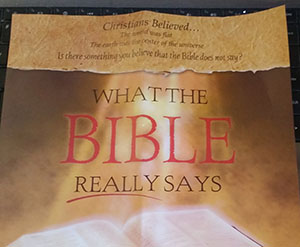
    bible_really_saysI opened my mailbox today to be greeted by a slick flyer inviting me to discover what the Bible really says about a variety of things. Among the the questions I’m told I can get answered: What is the future of our country during this economic downturn? What does the Bible really say about the second coming? What does the Bible really say about law and grace? What does the Bible really say about a vacation every week?

    I’m rather well acquainted with this type of brochure, because I grew up as a Seventh-day Adventist. We had plenty of opportunities to see this sort of advertising. We were supposed to be the people who were right, and thus who would eventually straighten out the rest of the world. Well, at least those who were not destined for the lake of fire.

    One of the things that my SDA teachers wanted me to learn was to go to the Bible about everything and to study it for myself. I did, and as a result I decided that the SDA church wasn’t the church for me. Especially on the topic of eschatology, I came to very different conclusions.

    That’s the critical thing. The internet and the airwaves are filled with people who claim that they know precisely what the Bible teaches about almost any subject you can imagine, even when the Bible may not say much of anything about it.

    To discover God’s message for you in scripture, you need to study for yourself. Now one of the things I was taught to do as a child was to look up the texts the evangelist used to see whether he was citing them correctly. There’s nothing wrong with doing so, but in a way this is a trap.

    Studying the texts that someone else provides in the order and in the structure in which they provide them will very often lead you precisely to their conclusions. What you need to do is study the scriptures for yourself, in an order that you may discover, prayerfully, under the guidance of the Holy Spirit that God promises to you, not just to experts or ordained leaders.

    While you’re doing that you need to examine just how it is that you come to understand the text, and especially to understand the way in which the text applies to you and to your life.

    You can illustrate the problem with the way that the brochure I received talks about a “weekly vacation.” What the writers of the brochure mean is the seventh-day Sabbath. For various reasons that seem good to them, they believe that the command to keep the seventh day holy still applies, while other commands, such as various sacrifices do not. I don’t mean here to argue that they’re wrong about that, but rather that their view comes from a particular way of understanding scripture.

    9781631990991s
    Some of our presuppositions and their impact.

    I remember a certain book about the King James Version, one that advocated it as the only Bible Christians should use. “It’s a very scholarly book,” I was told. “It’s filled with footnotes.” The problem is that the footnotes varied between those that were to unreliable sources, those that were plain wrong, and those that were to other examples of the author’s own work.

    Similarly, just because a presentation of scripture has a large number of texts doesn’t mean it’s scriptural. Neither does it mean it’s not. What it means is that you should examine it and decide for yourself.

    When I cite SDA documents many people approve. Of course we should examine (and dismiss) the claims of schismatics like Seventh-day Adventists. They are, after all, wrong! But there is no type of mistake in understanding scripture that is truly exclusive to SDAs. You’ll find these mistakes in many denominations and tradition streams.

    You need to examine everything. Think about these things for yourself. Get multiple scholarly opinions and test your own work against those. If you do this, you may be surprised at how many opinions about the Bible are predetermined by the presuppositions of the person holding that opinion.

    Including mine.

  • Discussion Tonight: Violence in the Bible

    Discussion Tonight: Violence in the Bible

    violence banner

    On the Energion Hangout tonight at 7:00 PM central time, we’ll be discussing the topic of violence in the Bible, with a particular emphasis on the Old Testament. But as participant Dr. Alden Thompson will doubtless remind us tonight, there’s violence in the New Testament as well. Alden Thompson is author of the very first title in the Energion catalog, now in its 5th edition, Who’s Afraid of the Old Testament God?. Joining Alden will be Dr. Allan Bevere, author of The Character of Our Discontent, a book that resulted from his decision to preach from the Old Testament more, even though he’s a New Testament scholar.

    I’ve known Alden Thompson for a long time. He was my professor for two years of undergraduate Hebrew and for my first quarter of Aramaic. It is no accident that Who’s Afraid of the Old Testament God? was first in the Energion catalog. It was out of print and I ask to reissue it because I wanted to use it in my own teaching.

    I would say, in fact, that Alden is one of the major reasons why, despite all the doubts I’ve had over the years, I’m still a Christian. No, he didn’t prevent me from leaving the church following seminary, and I’m no longer a member of the same denomination, but the kinds of approaches to the various problems in both biblical studies and theology have stuck with me. In addition, I use some of the approaches he teaches, both to inspiration and to dealing with diversity in the church, quite frequently.

    Alden takes a kind and gentle approach to working with those who disagree, no matter what their perspective. He’s careful with questioners’ faith, while still being willing to take their questions seriously.

    I met Allan Bevere more recently, through the medium of blogging and then of print publishing, but I’ve also developed a friendship with him. Allan takes orthodox Christian doctrine seriously and is a pastor first and foremost. He is also an adjunct professor, and helps prepare other pastors.

    Tonight I intend to challenge both these scholars regarding difficult passages of scripture. Can we bypass the violence? Can we look at some aspects of scripture as just plain wrong? If not, how do we deal with such passages as Numbers 31?

    I think this discussion will be lively and lots of fun!

    If you prefer YouTube:

  • Yet Again on the Meaning of Inerrancy

    John Hobbins is again correcting the rest of us regarding the meaning of the word inerrancy. The interesting thing here is that I can affirm everything he says about inspiration in his post.

    He writes in opposition to the approach taken by by Michael Heiser and C. Michael Patton, each of whom have written posts regarding how to deal with errors in the Bible.

    Now I’m going to be brief (don’t laugh!). Michael Heiser and C. Michael Patton aren’t idiots. I don’t mean here to imply that John Hobbins says they are. But a point I have made previously about inerrancy in response to John is that the common usage of the word “inerrancy” does not agree with the way John uses it.

    That doesn’t make Heiser and Patton more right about the inerrancy of scripture, but my observation is that their view accords with the more common understanding of what inerrancy means. Maybe people ought to mean something different, but they don’t. But I’m of the school of thought that suggests the meaning of words is to be determined by their usage, and by that standard, calling Hobbins’ view “inerrancy” is misleading. Most readers, at least non-academic readers, will understanding him to believe something different than he does.

    People in the pews tend to believe someone who claims to accept biblical inerrancy would be concerned with discussing whether Jacob bought or conquered Shechem (as Heiser does), or the details of gospel stories (as Patton does).

    But Hobbins says:

    Now, if you believe that it is part of the Holy Spirit’s teaching office to reveal to us that Jesus (say) healed two blind men at Jericho, not one; that Jacob (say) bought Shechem and then conquered it at a later time, you are claiming that the Holy Spirit speaks, not through Scripture, but through harmonizing exegetes. I oppose such outlandish claims.

    But if I ignore the vocabulary, I find I can affirm, indeed that I really like many of the phrases that Hobbins uses in regard to scripture and inspiration. I like to say that when we discover the message God has for us in scripture (always through the power of the Spirit), it is always true. Recently I have had to add the affirmation that we can discover that message. We have no need to walk in darkness.

    So why not use another term, such as simply stating that one has a high view of scripture?

  • Spong vs Mohler

    I found this video interesting, even though I don’t consider Spong one of the better advocates of a liberal approach to the Bible.  From my perspective he’s slipped off the far edge of the map.  I would suggest there is a position that does not affirm biblical inerrancy, yet maintains biblical authority.

    (HT: Exploring Our Matrix)

    Michael Dowd, also debating with Dr. Mohler (who seems to be keeping busy!) claims that biblical Christianity is bankrupt. I intend to respond from my “passionate moderate” viewpoint a bit later. For now I would just note that I see problems with the definition of “biblical Christianity.”

    (Another HT to: Exploring Our Matrix)

  • Origen: Stumbling Blocks in Scripture

    The following is from Origen, On First Principles, 4.1.15.  All emphasis is mine.  (Also from CCEL.)

    But since, if the usefulness of the legislation, and the sequence and beauty of the history, were universally evident of itself, we should not believe that any other thing could be understood in the Scriptures save what was obvious, the word of God has arranged that certain stumbling-blocks, as it were, and offences, and impossibili­ties, should be introduced into the midst of the law and the history, in order that we may not, through being drawn away in all directions by the merely attractive na­ture of the language, either altogether fall away from the (true) doctrines, as learn­ing nothing worthy of God, or, by not departing from the letter, come to the knowledge of nothing more divine.  And this also we must know, that the principal aim being to announce the “spiritual” connection in those things that are done, and that ought to be done, where the Word found that things done according to the history could be adapted to these mystical senses, He made use of them, concealing from the multitude the deeper meaning; but where, in the narrative of the develop­ment of super-sensual things, there did not follow the performance of those certain events, which was already indicated by the mystical meaning, the Scripture interwove in the history (the account of) some event that did not take place, sometimes what could not have happened; sometimes what could, but did not.  And sometimes a few words are interpolated which are not true in their literal acceptation, and sometimes a larger number.  And a similar practice also is to be noticed with regard to the legislation, in which is often to be found what is useful in itself, and appro­priate to the times of the legislation; and sometimes also what does not appear to be of utility; and at other times impossibili­ties are recorded for the sake of the more skilful and inquisitive, in order that they may give themselves to the toil of investi­gating what is written, and thus attain to a becoming conviction of the manner in which a meaning worthy of God must be sought out in such subjects.

    The more things change, the more they are the same!  We discuss these same sorts of things today.  The more I read Origen, the more I like him!

  • Inerrancy – Romancing the Term

    I’ve previously expressed my surprise about what some people can believe about the Bible and yet call their belief “inerrancy.” As an example, I responded to Earnest Lucas’s excellent commentary on Daniel in which he maintains that one can hold both inerrancy and a late dating of Daniel. I think a good one sentence summary of the approach is to say that what is asserted by a text differs by genre, and that inerrancy refers to what the text is actually asserting.

    Thus if Jonah is fictional, it is not trying to assert an actual size for the city of Nineveh (Jonah 3:3), thus this is not an error, even if that information is incorrect. Jonah is not a book about the sizes of cities, but rather a fictional account designed to deal with other issues. (Which those are is not important right now.) If Daniel relates a history of the Babylonian Empire which does not conform to history, that is not a problem, since it is a pseudonymous work of apocalyptic, and this was a common practice in apocalyptic. If Genesis does not relate well to science, it is not a problem, because Genesis is not a science textbook.

    Now I have no problem with any of those statements as such, but I do have some problem with their relation to the doctrine of inerrancy, though not in equal measure. But before I discuss why I have this problem, let me refer to a post today by John Hobbins on inerrancy. In this he is discussing people with relatively similar views about the inspiration of scripture, but a disagreement about the words. (The views are not identical, but they are close enough for my purposes.)

    In fact, I agree with most of what I read about inspiration on John Hobbins’ blog. I think in some cases he comes out more liberal on the issue than I am, as in this post on legend and history. It seems to me that he and some others are trying to assert that they can believe both in Biblical inerrancy and also that the Bible is a collection of myths and fairy tales.

    Now I think that “myth” and “fairy tale” are actually quite complimentary terms. I have no problem with finding myth in the Bible. In fact, for many purposes I find it to be a more admirable form of literature than some sort of pure, objective, narrative history. Each has its place, but we tend to treat history as good and myth as bad.

    And therein beings the problem. I must note in passing that I don’t think that the Chicago Statement on Biblical Inerrancy says quite what some folks are saying it says. I keep getting told that it allows for all this flexibility, but when I go back and read it, it doesn’t look that way to me. But that is a side issue for me.

    I find it odd that people who can recognize the changing meanings of words in a translation context fail so miserably in seeing the “street” meaning of a word in current usage. Apart from a few people who are trying to save the word “inerrancy” for their own use, almost nobody understands inerrancy to mean that a Bible book that claims to come from Paul might have been written by someone else after Paul was dead, or that a book can claim one author but have been written by quite a different author.

    Thus when someone claims to believe in inerrancy and then writes a commentary on Daniel, for example, it is not expected that the commentator in question will say that Daniel did not write the portions attributed to him in the text. Similarly, it will not be expected that a commentary on Ephesians written by someone who espouses inerrancy will suggest that it was not written by Paul.

    John Hobbins suggests a solution:

    To which I would say, where evangelicalism rules the landscape, it is time for saner voices to take courage with two hands and patiently, ever so patiently, advocate for a broader and safer use of the word “inerrancy.” This is precisely what I see Michael Horton doing, and I commend him for it.

    I would suggest that this is a fool’s errand. People who consider themselves intellectual leaders are constantly trying to save one or another term from the people who use it. It rarely works. If one salvaged inerrancy from those who use it, one would just have to invent another term to distinguish one from of belief in inspiration from another.

    I should note that I believe that the “rescuers” of the word inerrancy have another problem, which is that I don’t think it meant quite what they claim when it was first used. But that would take a different blog post and a number of additional references, so I’m going to leave it aside for now.

    For what it’s worth, my own view is that God always speaks his Word into a human matrix, to be understood by humans according to their knowledge and referents at the time. I believe that God’s Word in a situation is always true and that the Bible is precisely what God wanted it to be. But at the same time, that human matrix was not inerrant, and it impacts the message. I’m quite certain, for example, that early hearers of the story of Genesis heard it as a literal week, evidenced by references in Exodus 20, though not in the liturgy of Genesis 1. (Nonetheless, worshipers using that liturgy would not have distinguished the liturgical presentation from the historical events as I do.)

    That means that the message God sends to me is different in some way from the message that was first heard. Hearing God’s message requires prayerful care and interpretation. Once you have heard God speak, that is truth. In addition, I believe that if we knew all that God knew about those to whom he first spoke, we would understand why things were said as they were.

    It appears that some call that inerrancy. I think I would deceive most who heard me were I to do so.

  • Fallibility, Inerrancy, and Mystery

    I think Mark at Pseudo-Polymath is absolutely correct in his excellent post Of Scripture and Tradition.

    When I first decided that inerrancy didn’t work, it was because I found errors as they would be defined by the people that first taught me to regard the Bible as inerrant.  At the same time I remained convinced of Biblical inspiration.  Over time this has evolved in my mind to the position that inerrancy causes us to ask the wrong questions of scripture, something I still believe, despite the efforts of many to frame inerrancy so that it does not have that effect.  My problem is that once one has so framed inerrancy, it appears meaningless to me.

    It seems to me that we try to judge the Bible as a book amongst books, and that we err in doing so whether our judgment is favorable or not.  As scripture, the Bible is a unique phenomenon.  There is no standard by which we could judge it.  There is no category “books inspired by God” which as a set of criteria (presumably also divinely inspired) against which we can judge the Bible.

    I like Mark’s statement “The mystery is the experience …”  That is a very good descriptive phrase.

    Now I don’t think there is any problem evaluating the Bible’s impact on some area of study, for example, its value to historical study, and so forth.  But its value to historical study is not the same thing as its value as God’s message.

  • Your Brain on Inerrancy

    This video is cute and edgy and well-produced. It has all the characteristics that make a good YouTube video. Since I also don’t accept the doctrine of inerrancy, what is the problem?

    I think it perpetuates the equation of biblical literalism, the verbal dictation view of inspiration, and the doctrine of inerrancy.  I have a problem with the wide variety of doctrines that go by the name “inerrancy” but many of the folks with whom I work and worship do accept the doctrine of inerrancy, and the main difference between their view and mine is the word we use to label it.

    There are many people who believe in inerrancy, or who use the term inerrancy for what they believe about inspiration who do not accept verbal dictation and are not Biblical literalists.

    (HT: Ketuvim)

  • Pete Enns Reviews Inerrant Wisdom

    This is a very worthwhile review to read.  I haven’t yet read the book, but the key points noted are interesting in themselves.