Threads from Henry's Web

Tag: Hebrews

  • No Resting Place – Lamentations 1:3

    No Resting Place – Lamentations 1:3

    3 Judah has wasted away through affliction
    and endless servitude.
    Living among the nations,
    she has found no resting-place;
    her persecutors all fell on her
    in her sore distress.

    Lamentations 1:3 (REB)

    Actual events can be both real and metaphorical. Behind this verse, we can hear the history of Judah, taken into exile by the Babylonians, and then finally returned to their homeland under the Persians. At least, that is to say, a portion returned.

    I’m looking at this history and the lament it produced in this Bible book for ideas as to how each of us can deal with life today. But we shouldn’t forget the horror of the history involved. The Bible records that sorrow in the form of a lament–five chapters’ worth. And we’re on the third verse.

    Many of the nations which were exiled by the Assyrians and the Babylonians lost their identity entirely. The fourth line of the verse tells this story of exile, of removal from your home, family, and everything familiar. It’s easy to lose identity in such a situation. Forgotten, it is easy to forget, to go along with the crowd. One way to get away from persecutors (5th line) is to lose that identity, to become indistinguishable from surrounding society.

    I’ve heard many discussions of why Jews have been persecuted through the centuries, and continue to face antisemitism. One reason is simply that they have maintained their identity. They haven’t faded into the background and become indistinguishable from the rest of society.

    In the New Testament, God’s people are referred to as strangers and exiles (Hebrews 11:13). This is a part of our identity, of who we are. If we want to find a resting place, we’re going to have to do so knowing who we are and whose we are. There’s a put-down in telling someone to know their place. This is used on someone the speaker presumes is getting above themselves, out of their lane, anywhere they don’t belong.

    But we, as Christians have an identity as those who belong to God. Wherever we are we are strangers, but we are also at home with God who has chose us. We are those God has chosen, and we are those who choose to find our identity in God.

    God is, in fact, our resting place.

    What we must fear, therefore, is that, while the promise of entering his rest remains open, any one of you should be found to have missed his opportunity.

    The Revised English Bible (Cambridge; New York; Melbourne; Madrid; Cape Town; Singapore; São Paulo; Delhi; Dubai; Tokyo: Cambridge University Press, 1996), Heb 4:1 (Emphasis mine)

    Even as exiles, we too can have that resting place. Can you feel that rest?

    (Featured image generated by Jetpack AI)

  • Two Mountains

    Two Mountains

    (Featured image generated by Jetpack AI.)

  • Psalm 77:13 – Answering a Question about Translation

    Psalm 77:13 – Answering a Question about Translation

    I am frequently asked questions about the translation of a specific word, often because there is a difference in English translations. Frequently, the specific wording of a text means a great deal to the person who asked, as it may be part of the exposition of some other doctrine or chain of thought. Sometimes it is even a proof text to support such a doctrine.

    In this context, consider the translation of Psalm 77:13:

    Thy way, O God, is in the sanctuary: who is so great a God as our God? (KJV)

    In the NRSVue, however, we read:

    Your way, O God, is holy. What god is so great as our God? (NRSVue)

    Presenting just two translations in this case may give a wrong impression. So running a list of all English translations available on Bible Gateway, I find that KJ21 (21st Century King James Version), ASV (American Standard Version), AMPC (Amplified Bible, Classic Edition), BRG (Blue, Red, and Gold-based on the KJV), DARBY, GNV (Geneva Bible), and KJV read “sanctuary” while most others read “holy” or something very similar.

    Let me outline the process I use (loosely) to answer this sort of question. What I am not going to do is simply give you my preferred translation.

    Differences in translation can result from:

    1. Differences in the text that is translated.
    2. Differences in approach to translation. Some common terms for this include functional equivalence, featured in versions such as the New Living Translation and Formal Equivalence, use in translations such as the New American Standard Bible and New King James Version.
    3. Choice of a different English gloss from within the source word’s semantic range.
    4. Accommodation, such as the effort to make Old Testament passages match New Testament quotations. This one is fairly rare.
    5. Different understandings of the context.

    I avoid the use of the term “translation error” unless there is simply no basis for that translation. I prefer to call an odd translation that is even remotely possible a difference of opinion and characterize it according to what evidence I see that would justify that translation.

    Let’s run through this one in order.

    People often imagine textual differences where there are none. This generally results from not understanding the process of translation in which many English renderings can legitimately be derived from the same text. Usually the problem is not finding a translation, but rather figuring out which possible rendering is best in a particular context. In this case, the fact that the versions that read “sanctuary” tend to center around the King James tradition might suggest such a thing, especially if one forgets that this is Old Testament, and thus the Textus Receptus vs other texts does not apply. In fact, there are no significant textual issues here.

    Also, all of the translations that read “sanctuary” lean toward the formal equivalence end of the spectrum, but those that read “holy” (or related terms) span the spectrum. This is not a difference in overall approach. There is also no New Testament quotation to which one might hope to accommodate the verse.

    This leaves us with a choice of a different English gloss, which might well be based on a different understanding of the context.

    In fact, the Hebrew word used in this passage can properly be translated either “holy” or “sanctuary,” and there are numerous instances of both in the Hebrew Bible. In fact, it may be used to refer to other holy objects or even sacrifices. If Hebrews 9 is a parallel to the LXX in this regard, it could also be regarded as a reference to just the first compartment of the tabernacle, though I think the overall context would be against that reading.

    As I read the Psalm we have a prayer that, after a first introductory verse, begins with a lament. God is not answering as was hoped, but in disappointment, the psalmist recounts prior acts of God and speaks of God’s greatness. This unfolds in two parts, the first affirming miracles, and the second point to God as savior, with the water imagery evoking both creation and the exodus from Egypt. We conclude with the victory, not in an individual way, but affirming that God has led and guided God’s people. We know that the psalmist’s prayer was answered because he affirms that in the first introductory verse.

    The most interesting contextual element in all that is that we have God’s way or path through the sea, which evokes the imagery of creation. So we have God’s way both in the Qodesh (holy/sanctuary) and in the sea within the same Psalm.

    The bottom line is that either translation is possible here and that the context doesn’t explicitly make one more likely than the other. I suspect most translators find it hard to connect God’s way and the sanctuary, whether tabernacle or temple.

    I would have to consider “sanctuary” a potentially valid translation nonetheless if we consider the cosmic quality of the sanctuary introduced in Hebrews. That would not be definitive, but looking at the idea of a new and living way which leads right to the presence of God, and which sees the sanctuary as a shadow of heavenly reality, divine movement in that heavenly reality is not impossible. If this were the idea here, I would see an intended contrast between verse 13 (14 in Hebrew) and verse 19 (20 in Hebrew) telling us that God has his path/way everywhere, in the chaos represented by the sea and the perfection represented through the sanctuary imagery.

    Having said all of that, the evidence behind my comment is far too thin to be regarded as more than suggestive. I do see a sanctuary pattern in the book of Revelation as well, however, which probably tends me to see it as a live option.

    (Featured image generated by Jetpack AI.)

  • Psalm 119:38 – Raise Up Your Word

    Psalm 119:38 – Raise Up Your Word

    Carry out your word to your servant,
    the one who fears you.

    The Hebrew word I translate “carry out” carries a variety of freight in a variety of uses. One option is simply to build and establish. I might loosely render it as “Make your word real.”

    As I study and meditate on scripture, I find more and more that it’s God’s word coming and going and everywhere in between. I think this verse can become a very important and powerful prayer. I don’t mean powerful in the sense of bolts of lightning and claps of thunder, or mountains moving around. Well, at least not in the short term!

    I mean it is a fundamental prayer. In creation God spoke (Genesis 1:2). The heavens were made by God’s word (Psalm 33:6-9). God’s word goes out and does not return empty (Isaiah 55:10-11). It’s the call for God’s creative word to be in control.

    I’m reminded of Hebrews 4:12-13, which starts with “the Word of the God is alive and active” and ends with noting that all is laid bare to the one to whom we must give account. What’s lost in many English translations is that the “Word” of the first clause is the same Greek word as the “account” of the final clause.

    Now many commentators see this differently, saying the two word uses are unrelated. I disagree. I see here this prayer, to raise of God’s word (or promise), and to do so to the one who fears God.

    What does God’s Word discover when looking inside to see everything that is there? What is our account to God?

    I’d suggest that this is to be the Word of God, taken in. For us as Christians we say that we are in Christ and Christ is in us. “… [T]o whom God desired to make know the riches of the glory of this mystery among the nations, which is Christ in you all, the hope of glory” (Colossians 1:27).

    It is God’s Word, which is presented in many ways, but comes from and points to the creator of all things. This is what is to be seen when all is laid bare before God’s Word. That burns away the “scary” part of the fear of God and leaves the awe, wonder, and indeed warmth.

    Word of God, speak to me!

    (The featured image for this post [not the one immediately above] was generated by Jetpack AI.)

  • Psalm 119:30 – I Have Chosen

    Psalm 119:30 – I Have Chosen

    I have chosen faithfulness as my path.
    I’m in place1 with your judgments.

    1 There is considerable controversy about how this verb should be translated.

    A literal translation may make this clearer:

    Decided have I a way of faith
    with your judgments I have agreed

    D. Robert MacDonald, Seeing the Psalter, p. 382

    Let me commend again, Bob MacDonald’s treatment of the Psalms, and indeed is work with music of Hebrew scripture.

    As I meditated on this verse, I kept coming back to New Year’s resolutions and the fact that I don’t make them. I have done so in the past, but I haven’t for years. New Year’s resolutions are famous for their short duration. We determine to do things, but then we really don’t. Thus the broken New Year’s resolution has become a cliche. I heard this question recently on a Family Feud episode, and if I recall correctly, the #1 answer was two weeks. And that might have been optimistic.

    We joke about it, but then we tend to live our lives that way. So should we give up on making decisions? Should we cease to try to do right because we so often fail?

    About two years ago, I got the results of some blood tests that showed my glucose was way too high. The doctor already had a list of prescription medications he wanted me to take. I said, “I don’t think so. I’m going to do some lifestyle changes and see how that goes.” The look of skepticism he gave me was memorable. But he agreed with my process, and I graciously (!) didn’t tell him it wouldn’t have mattered if he hadn’t.

    Three months later the relevant numbers, including now A1C and blood glucose had dropped below levels of concern. They weren’t down to where one would like them, but he confessed that most of his patients who were on medications had trouble maintaining that good of numbers.

    I made a decision, and for the most part, I carried it out. Not nearly to perfection, but to my own benefit. My sleep is better, my productivity is better, I have more energy. The result is great!

    So what if I said, “Most people fail at these things. In fact, I usually fail at these things. There’s no point in making an effort”? I’d be taking more medications, and while my glucose level would likely be lower due to medication, the other benefits would not have occurred.

    Or, on the other hand, I could observe difficult moments, days on which I didn’t complete my exercise goals, or the time back in September when I was sick for a week, and then practically had to start over building up my activity levels.

    I don’t know if Psalm 119 is a Psalm of David, but David was “a man after God’s own heart,” (1 Samuel 13:14), and wrote some of the Psalms. I’ve just been listening to the stories of David including his behavior with Bathsheba and his murder of Uriah. We also have Psalm 51, which the superscription presents as David’s confession and determination to follow God’s way after God has forgiven and restored him.

    I think it’s important to recognize when decisions and resolutions are valuable and when they are not. Writing these meditations was a decision. I plan to write 176 of them. I may skip Christmas and New Year’s Day, but then again, I might not. I can tell you that while my statistics indicate readership is dismally low, simply taking the time to mediate on these verses as been a worthwhile resolution.

    Might I suggest that Hebrews 6:1 “be carried on to perfection” provides a similar resolution. I’ve summarized the message of Hebrews as this: “Get on the right train and stay on it till it reaches the destination.” With the author of Hebrews, I’m determined to stay on the train.

    But don’t let your value be determined by your resolutions or your success at carrying them out. You are “a little lower than God” (Psalm 8:5), you are a child of God, a brother of Jesus Christ (Hebrews 2:11). You are all that already.

    Make good decisions; rest in God’s goodness.

  • Law and Laws in Scripture

    Law and Laws in Scripture

    In my current series on Psalm 119, I’m doing a daily meditation on each verse. These are, by design, short. At the same time, it’s difficult to cover certain nuances effectively in individual posts. One of these is the question of why I would write this particular series.

    I’ve already included my video on the various uses of “law” and related terms in scripture. I’m embedding it here again.

    God’s Eternal Law

    To summarize this, I believe that God has an eternal law. That eternal law is not something that we can comprehend. It rules an entire universe. It is an absolute expression of who God is. Those of us who are not in that “space,” so to speak, are not going to comprehend or attain to this.

    This law expresses not only who God is, but God’s ultimate and glorious purpose for creation, including us. As a starting point for understanding my own view of law and grace, I would point out that we have nothing that is not, in this sense, a gift. We can’t take our next breath without the physical laws, which are God’s creation. We bring nothing into this world that was not given to us.

    But scripture (Psalm 8, for example), also quoted and directly applied in Hebrews 2, carries this concept forward into Christian thought. While everything is a gift, we are, in fact, gifted. Every one of us.

    Various Laws

    Now there are many laws expressed in scripture and in various human documents and institutions. God’s laws as delivered to us are always finite simply because we cannot possibly understand something infinite. When Paul notes (Romans 3:23) that we all fall short of God’s glory, I would take this as also that we cannot really comprehend God’s glory.

    Individual laws or bodies of laws are relative. People are afraid of the word relative, because they think it makes something weak. But things and statements are always relative. We are neither able to make things absolute in all ways, nor would it be desirable to do so.

    To illustrate from daily life, the rules a parent makes for a toddler do not necessarily apply to that same child as a teenager. That’s because the specific commands were related to that particular time and place.

    When we look to biblical laws, we find many of the same things taking place. As Christians, we acknowledge that some laws were for specific times and places.

    Note: Dispensationalism is based on this very real separation, though I think it has substantial problems in that it tries to make something relative more absolute than it was intended to be. In doing so, it both makes thing more rigid, and at the same time makes laws less applicable. Few dispensationalists would agree with a man with whom I had a discussion when he informed me that one clause in a verse in 2 Corinthians referred to a different dispensation than the rest.

    The Torah and Israel (Very Briefly)

    Now Israel’s religion centered more and more over time on the Torah, God’s revelation at Sinai, though many, myself included, would maintain that portions of it developed over a longer period of time. So when an Israelite referred to “the law” as Torah is often translated, he was referring to the core revelation of God to the people of Israel.

    So when the Psalmist starts to celebrate the Torah in this poem, he is, in fact, celebrating both the fact that God made a self-revelation to Israel, and that this revelation was available to him personally. It was not just that this was a life-giving and life-affirming way of carrying out one’s life. It was not just a moral code. It was a revelation that gave meaning to all that was, is, or could be.

    The Revelation of God in Jesus

    We find Jesus portrayed in a similar way in the New Testament. John 1:1-18 is the classic expression. I am a great fan of the book of Hebrews. (I say that Leviticus, Ezekiel, and Hebrews are the three books that have shaped my theology.) Hebrews 1:1-4 is also a classic, though less known passage that expresses this idea explicitly. In the past, we are informed, God’s revelation came at various times and in various ways, but now it has arrived through one who is a Son, a complete portrayal of all that God is.

    So Christian theology is, quite properly, centered in the person of Jesus Christ. I’m not here trying to argue about a “better” religion. I would like to point out that this is the source of a great deal of difficulty when Christians and Jews debate the meaning of Hebrew scripture. We are looking at it with different colored glasses. Rather than seeing the Torah as God’s final and ultimate revelation of God, we see Jesus in the same light.

    But note that the book of Hebrews does not say that the revelation in Jesus Christ, a Son by nature, somehow meant that the other revelation was invalid or useless. It adjusts the center. It changes our viewpoint, and thus changes what we see, but it doesn’t say that the other viewpoint fails to inform.

    I, as a Christian, could actually read Psalm 119 as a celebration of Jesus, though I would not hold that the author saw it or thought of it that way. We read this passage (and most others) very weakly when we consider the point to be one of how hard we should try to accomplish a set of ethical commands and precepts. It is rather a celebration of the God who chose Israel and provided to them the revelation of divinity that is contained in Torah.

    The “Law Words” of Psalm 119

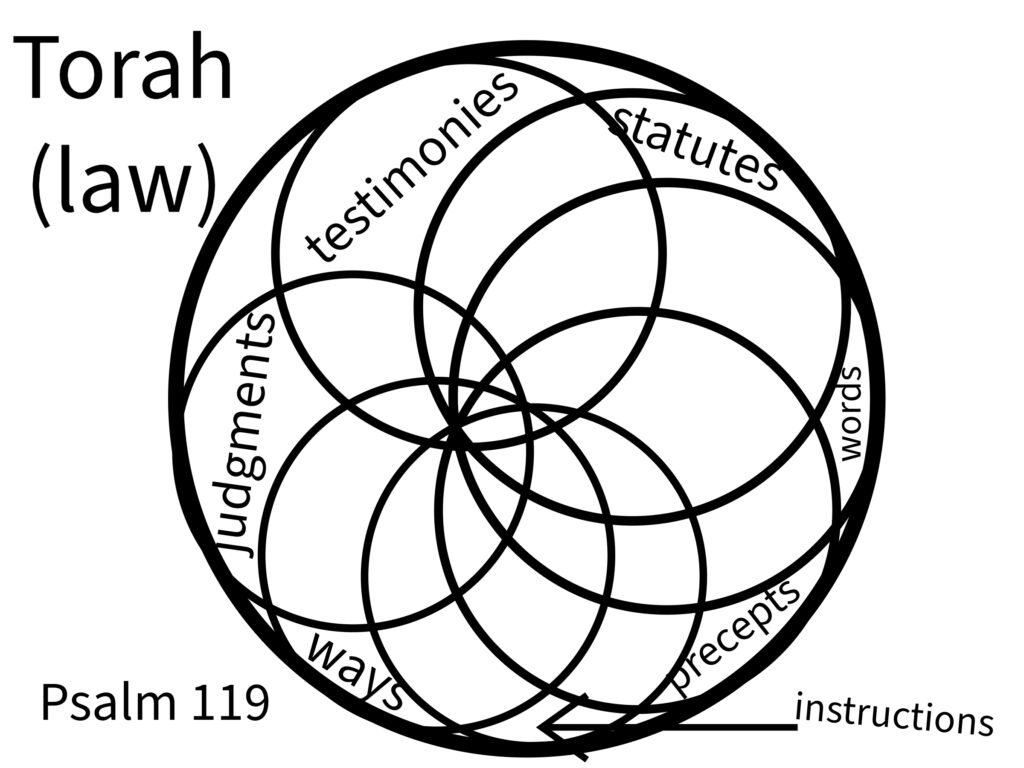
    Psalm 119 uses a variety of words for the the law, including Torah. They are variously translated in various versions, but let’s consider Torah (instruction/law), testimonies, ways, instructions/procedures, statutes, commands, judgments, and words.

    A diagram showing overlapping circles for various terms for law in Psalm 119 displaying all as contained in the broader term Torah

    Each of these terms overlaps in their meanings, but all are included in the overall concept of Torah. Each has a different etymology and some differences in usage, but Psalm 119 seems to be simply using them to bring together the broadest concept of God’s law that is possible.

    This celebration becomes possible for any of us as we celebrate God’s revelation, no matter where or how it is given. Psalm 19 celebrates the revelation of God in the created world, for example.

    Conclusion

    So reading and enjoying Psalm 119 is not just a celebration of commands and a demand for a particular behavior. It is a celebration of the God of law, revealed in Torah. As we see God in other ways and sources, it can become a celebration of those elements as well.

  • Look to Jesus (Hebrews 12:2)

    Look to Jesus (Hebrews 12:2)

    The other day I was just waking up and realizing that I faced a challenging day. I decided to do a little scripture reading before even getting up. I chose to read a language I read only very slowly and with difficulty (Syriac), because that usually gives me more time to meditate. I have a tendency to rush.

    I started in Hebrews 12, and got to verse two, which begins: “Look to Jesus.”

    This seemed to me to be good advice. I stopped there for a bit and marked those two words. (Yes, two words in Syriac.)

    If I had chosen to read it in Greek, the impact would have been a bit different, as the word order goes approximately thus: “Looking to the author and finisher (perfecter) of our faith Jesus.” Not a difference in meaning overall, but it was those first two words that stopped me for a moment, and that was helpful that morning. Good advice, as I said.

    Then I went on to “the head (or beginning) and finisher (perfecter) of our faith.”

    Now that’s a profound statement. This passage (Hebrews 12:1-3) is frequently used a works and behavior modification passage. “You have all these great, holy, and faithful witnesses watching you, so get on with the work of being a Christian. Jesus has saved you, and he expects you to act like it.”

    But that’s not what the passage says. Yes, there is a call to follow, but that call is put in its context right here. It’s Jesus all the way. He begins, he finishes.

    What about all those faithful witnesses?

    Here’s where I get into Bible contradictions. People ask me whether there are contradictions in the Bible and I say, “Yes! They are the best part!”

    Hebrews 11:27 tells us that Moses left Egypt by faith, “not fearing the wrath of the king.” Exodus 2:14 tells us that Moses was afraid and fled. If that isn’t enough, we’re told that Israel passed through the red sea “by faith.” Have you read the story? Not all that much faith was on display!

    Day after day there is not that much faith on display in my life. I worry about everything. I shouldn’t do that, but I do.

    But Jesus is the author and the perfecter of my faith.

    Jesus rewrites the stories of those witnesses’ lives from a grace view. He is doing the same thing for you. It may be very slow, but it’s happening.

    That crowd of witnesses? They’re not people who lived perfect lives and are looking down on you to criticize your every mistake. They know you’re going to make mistakes. They did. They know your faith can be pretty weak at the most difficult moments. Theirs was.

    They’re there to remind you that God saw them through and God will see you through. The grace filtered view of your life is going to make your story heroic.

    Look to Jesus, beginning to end.

  • The Wrath of the Lamb

    The Wrath of the Lamb

    Sometimes the process of preparing to teach Sunday School takes interesting turns, at least for me.

    I’m currently teaching from the Sermon on the Mount, and I was thinking about the transition from the beatitudes to the discussion of fulfilling the law. Sometimes we get so used to the way Scripture passages read that we don’t really notice the impact they would have had. “Blessed are those who hunger and thirst after righteousness …” transitions to “unless your righteousness exceeds the righteousness of the scribes and Pharisees.” We’re used to thinking of Pharisees as bad guys, and we can immediately translate that statement mentally into something less than it would have been to those who first heard it.

    It’s easy to suggest that the Sermon on the Mount does not represent some singular sermon, and that perhaps the beatitudes and the teaching on the law contained in Chapter 5 weren’t really run together that way when Jesus taught them. Indeed, the different settings for portions of the sermon in Luke might suggest that we have compilations of sayings rather than complete sermons.

    But, and it’s an important ‘but’, someone thought these two things went together. I love form, source, and redaction criticism and believe they provide important insights, allowing us to learn from the prehistory of the text in front of us, but in a case like this, they just kick the ball down the field a bit. We still should ask just why the passages go together.

    Let me skip my own answer, which I already had in mind, and go with the experience of thinking about the passage. I like to read what I’m going to teach very early, usually the Sunday afternoon after the previous lesson, and then think about it through the week.

    In this case, I had just gotten a new audio Bible (NRSV) for Audible (unfortunately it is no longer available). I wasn’t actually intending to think about the passage, and I just let the audiobook continue from where I had last left it, which happened to be in Revelation 6. I got to 6:16, and heard the words “the wrath of the lamb.” Or “hide us … from the wrath of the lamb.”

    Now here’s another phrase that doesn’t always have full impact. It takes on that “scriptury” sense in which we imbue it with holiness and piously let the jarring nature of the statement slip by.

    So picture a cute, wooly, harmless lamb. Now picture crowds of people calling for mountains or large rocks to fall on them — splat! — to save them from the wrath of, well, that fluffy bundle of cuteness. For Monty Python fans, let me note that it calls to my mind vorpal bunnies.

    So we go back a bit in Scripture to Revelation 5:5-6:

    (5) One of the elders said to me: ‘Do not weep; the Lion from the tribe of Judah, the shoot growing from David’s stock, has won the right to open the scroll and its seven seals.’ (6) Then I saw a Lamb with the marks of sacrifice on him …

    Revelation 5:5-6a

    I could spend all kinds of time on this, but I’m just looking at one thing: The Lion is the Lamb. Of course, if you read the texts I first reference in context, you’d also note that the fear of the wrath of the lamb was combined with fear of the one sitting on the throne.

    In this case, we have a direct literary relationship. In chapter 6, John is doubtlessly connecting referencing this lamb, who is also not just a, but the Lion. Slightly more intimidating than the wooly lamb I evoked earlier.

    So this turned my mind to something I get from orthodox theology, in this case the incarnation. Jesus is presented as totally human and totally divine. Compare Hebrews 2:17-18 to Hebrews 7:26-28 display a combination of incompatible features. One plus one equals one. Not normal logic.

    I like to distinguish belief in three ways. There is believing that. One can believe that something is true without absorbing it or responding to it. I believe that an aircraft is airworthy and safe, but I stay on the ground. Then there is believing in. In this case belief leads to a trust in the thing in which we believe. I believe that the aircraft is airworthy and safe, so assuming the crew is good as well, I get on board and fly. Then there is believing through. That is when I use one belief to impact the way I understand and respond to other things. In the case of the aircraft analogy I now learn to put reasonable trust in things in which it is reasonable to have confidence.

    In Christian terms, I go from believing that Jesus rose from the dead, to putting my trust in “the pioneer and perfecter of our faith,” and from there to living a life defined by not just by the hope of the resurrection but of the character and power combined of one who gave himself to death and arose. There is some room here to live in hope. The hope comes from seeing other things in the light of my belief in the resurrection.

    Now back to the incarnation, and lions, and lambs.

    There are many things that thinking conditioned (transformed?) by the incarnation can be, many of them at the same time. One is that we lose the binary sense. To take us back to Revelation 5, we can see in one person the Lion and the Lamb. We can see gentleness and sacrifice on the one hand and wrath on the other, all in the form of a wooly lamb, one that someone already sacrificed. That’s seeing these things through our belief in an orthodox doctrine. I have heard folks argue forcefully for an orthodox statement of doctrine, but seeing it only as a thing that must be affirmed to be true, and not something that impacts the rest of our lives.

    I maintain rather that if you really believe in something like the incarnation, it will reshape your thinking all over the place. Constantly. Irrevocably.

    I recall hearing Deanna Thompson, author of the Deuteronomy volume in the Belief Commentary series. She is a feminist and a liberationist. She recalled wondering why she should be the one to write a commentary on Deuteronomy. But she said that as she wrote the commentary, she realized that “a God without wrath will never liberate anybody.” A God such as the one presented in Deuteronomy.

    The Lamb is the Lion. They are not incompatible.

    And then another thing came to mind. I recently watched the movie “Aristocats” again. It’s a favorite of mine. It includes a song with the line:

    Everybody! Everybody! Everybody wants to be a cat!

    Aristocats

    At this point I imagine you’re thinking I’m a bit odd in the things I connect. I also assure you that I like cats.

    But if you look around church, everybody wants to be a cat. That is, we want to get to the Lion part of the act, or the rider on the white horse. We long (as the readers of Revelation did) for the avenging God who does nice things for the good guys (surely this includes us!) and gets all the bad guys. If possible, we want to skip over all the lamblike stuff, and definitely that “slain” stuff.

    So I wind back toward my original topic again, as I know you’re wondering what all of this has to do with Matthew 5? And indeed, in listening to Revelation I had every intention of not working on my Sunday School lesson.

    But Matthew 5 challenges us in a similar way. Jesus is here both the lamb who has humbled himself and is living as one of us, the “gentle Jesus, meek and mild,” and also the one who says our righteousness must exceed that of the scribes and Pharisees (remember that the audience would see that as a high standard), that we must be perfect, and that even being angry or insulting a brother can lead to hell.

    The Lamb is the Lion. Love and wrath work together. It’s not either-or, but both and.

    Featured image by Catherine Stockinger from Pixabay

  • Jumping the Christmas Gap

    Jumping the Christmas Gap

    Most of the time I’m suggesting that people lighten up when they get too deep into theology, so today, when people are lightening up, I want to talk a bit of theology.

    This day represents the core of my Christian faith in so many ways. When I get into discussions about what is essential in Christianity, I always jump straight to the incarnation. There are other ways of thinking about this, but this is the core of my faith, and the launching point for my understanding of ethics.

    All the examples, yelling, legislation, enforcement, and incentives in the world do not do what the incarnation does for me.

    It’s all about jumping gaps.

    You may go on to bridge gaps later, but we start with a jump. And as Christians (of orthodox theology) that’s the incarnation. Infinite God jumps the distance between infinity and the finite. Contemplating the vastness of the universe as we know it can make us feel very small. The distance between infinity and the finite is, by definition, greater than the difference between me and the universe with trillions of galaxies.

    I believe God crossed that gap. I can talk about this in many ways, but that sets the standard.

    I’m teaching through the sermon on the mount with my Sunday School class, and we’re dealing as a whole with passages on the law in Matthew 5:17-48. Verse 48 says to “be perfect as your Father in heaven is perfect.”

    Ouch!

    But it’s a really glorious ouch! This is the example set.

    One of my three favorite books of the Bible, the ones that I find most definitive for my theology, is Hebrews. Hebrews opens with this passage:

    1In old times God spoke to our ancestors through the prophets in many portions and in different ways. 2In these last days, however, he has spoken to us through a Son, one whom he has made heir of everything, and through whom also he created the universe. 3This Son is the brightness of his glory and the exact representation of his real essence. He sustains everything by his powerful word. He performed a cleansing from sins and sat down at the right hand of majesty in the {spiritual/heavenly} heights. 4Thus he became as much greater than the angels as the fame {reputation} he has inherited is of a more outstanding nature than theirs.

    Hebrews 1:1-4 (my translation, emphasis added)

    Across the impossible gap, God communicated with us.

    This differs almost infinitely from anything we would conceive of doing. For us, it would be a military campaign, or a program of political or religious persuasion. To but it bluntly and simply, God instead showed up on our level and said, “Hi! I’m the One.”

    Helpless.

    In a manger.

    Now I find that an amazing concept in itself, but I also see both an invitation and a challenge. The invitation, amongst many other things, says that more things than you can imagine are possible. I’ve set the standard, opened the path, connected with you, and I’m ready to work in you.

    As Paul says in Philippians 2:5-11, Jesus, the anointed one, didn’t consider the heavenly glory and power something to cling to, but rather emptied himself. Then in the next couple of verses he points us to the Way that this works. “Work out your own salvation with fear and trembling.” Sometimes we stop there. That’s because we haven’t gotten the incarnation. We think that the best way to get things done is to hassle and harangue, to push and force.

    The incarnation, on the contrary, says to us, “I value you enough to jump across infinity to reach you.”

    If you get that, you aren’t going to try to fly the gap the other way. You’ll realize that won’t work. That’s why the next verse in Philippians says, “For it is God who works in you, both to will and to do God’s good pleasure.” The book of Hebrews expresses this in 10:20 as “a new and living way, His (Christ’s) flesh.”

    I read and meditate on these verses, and what comes to me is this: How can I find it so difficult to jump the gap between myself and other people

    • Down the pew from me in church
    • Across the aisle
    • Of different denominations
    • Of different religions
    • Of different cultures
    • Of different skin colors
    • Of diffent opinions and lifestyles in so many possible ways

    “But they’re wrong!” someone retorts. Humorously, I’ve heard this more often about the color of the carpet, the placement of the pews, or the style of the music than about the apparently more weighty differences.

    When Jesus reached out to me, I was not right. I needed spiritual change. I needed other changes in my life. If Jesus waited for us all to be right, no salvation would ever happen. It would be like a doctor refusing to treat people who were not already healthy, only worked out on an infinite scale.

    But remember, reaching out is not about you fixing everybody. That’s because you and I are not all right ourselves. We cross the gaps in relationships, bring that connection to the infinite with us. The rest is up to God and the flawed human to whom we’ve crossed the gap. I don’t have the plan. I don’t have the power. I’m just hopefully letting God work through me.

    I’ve commented on this to many classes. People say they are not ready to be witnesses. Why? They have problems. They don’t know enough. They don’t have all the answers. Some suggest I go speak to people for them, using my greater training. Everyone is always a witness. The question is what kind. Is God working in and through you, or are you getting in the way.

    The distance between me and God is not measurably different than the distance between God and the worst sinner out there. With God providing the power, surely I can cross the gap to anyone.

  • Perspectives on Paul 10-28-30

    Perspectives on Paul 10-28-30

    I recorded this on 10-21-30 because of the approach of Hurricane Zeta on the evening of the 28th.

    Video

    PowerPoint

    PDF

    https://henrysthreads.com/wp-content/uploads/2020/10/102820.pdf