On Thursday I had the privilege of interviewing Rev. Geoffrey Lentz, pastor of First United Methodist Church of Pensacola, regarding characteristics Bible study in the Wesleyan tradition.
Geoffrey and I have known one another for many years, and authored a book, Learning and Living Scripture, which was published, well, a long time ago. As Geoffrey pointed out in the interview, “Back then, Henry, even you were young.”
After I posted the final entry on Psalm 119, I thought I might take a break from daily meditations, but my wife has challenged me with the suggestion that I should post some meditations on familiar passages, such as, she suggested, Psalm 23.
I was a bit reluctant to start, but then I spent some time reading today and I decided to try it. So tomorrow morning at 7 am my first post, an introduction to Psalm 23, should appear.
I’m going to continue the same process of study and meditation, not trying to provide exegetical commentary so much as thoughts and application. My study process does involve exegesis, however, so that will be involved.
It’s not really a new thing, but in a number of conversations recently, both in person and online, I’ve been noticing agendas. Someone will make a comment or say something in a conversation that really doesn’t seem to make sense in context, but then if you consider a different context, you’ll suddenly see that the comment makes its own kind of sense.
I know I can do this. If there’s something on my mind that I feel is important, I will tend to tie it into a conversation whether it really fits or not. Other people in the conversation may wonder what’s going on. In real conversations, often the subject just wanders.
This is a natural process. If you’re trying to discuss something in particular, it can be disconcerting. I find it hard to lead in a meeting because my tendency is to try to figure out what the side comment is about and follow it right off the map! I have often asked my wife to lead meetings because she is good at bringing things back to the planned subject, thus letting us complete our agenda.
I often comment that God comes to us in Scripture for conversation while we tend to be looking for information. Now there’s nothing wrong with looking for information. There certainly is information in the Bible. But one can come out of the study of Scripture with a great deal of information and no transformation.
In particular, we tend to come to a book looking for information we believe we need. We come with an agenda. How shall I conduct my life? How should I do business? Is it permissible to do certain things?
Or there’s the more negative agenda of finding things I can use to condemn my neighbor. Where is the text that tells me that so-and-so is wrong?
When we come to Scripture in this way, we are likely to be led astray. Just like we edge conversations with other people right off the edge of the map due to our primary agenda, we can get a message from Scripture that is much more formed by our agenda than by the actual message and story presented in the Scripture passage(s) we consult.
An interesting example of this is the many centuries long search for a precise roadmap to the end of time or the end times. Date setters have repeatedly “found” dates in Scripture. How do they do that? They come to the Word with their own determination of what the Word must tell them. As a result, we have repeated examples of failed predictions, and still we have people looking for more.
For a Christian, the study of Scripture should be an encounter with God. That means coming ready to listen and coming ready to have your agenda adjusted. That will result in conversation and potentially transformation through the Spirit and God’s creative and powerful Word.
In the video, Dave calls this simply “The Word of God.” I’m embedding it at the end of this post.
One of my observations in talking to people about their churches and church programs is that they find the first moment when a book or program differs from their situation and take one of two approaches. First, they might discard the entire thing. This is fairly common. That won’t work for us. It doesn’t matter that what we’re doing isn’t working either. Second, they try to follow the program precisely, despite any differences, because if it worked for the expert who wrote the book, it has to work for them.
Neither of these is a strategy that is likely to succeed. Each person, community, church congregation, denomination (or jurisdiction within a denomination) is different. Each one will have different opportunities and perhaps a different call from God. I am passionately convinced that sharing the good news about Jesus with the world is our general calling. Whether that is going to involve a food pantry, classes, involvement in broader community outreach, collecting money for projects across the globe, or any one of a myriad of other possibilities, is wide open.
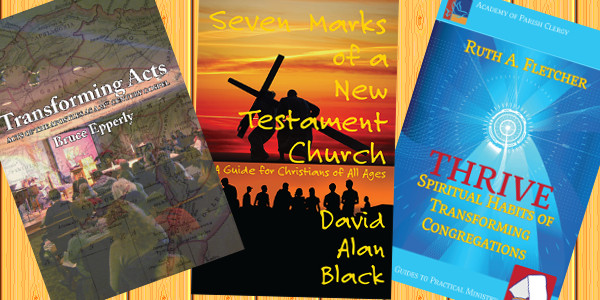
Especially in protestantism we tend to downplay tradition, but our church tradition has a role. The way you will carry out certain missions is going to depend on the history of the church congregation. We don’t all get her in the same way, and we’re not going to move forward in the same way. Dr. Ruth Fletcher, in her book Thrive: Spiritual Habits of Transforming Congregations devotes an entire chapter to choosing, to the necessity of discerning the right path and making and carrying out decisions.
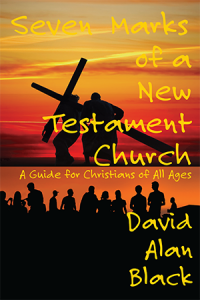
The reason I wanted to emphasize this right now is that quite frequently we think we cannot benefit from something like “apostolic teaching” or “the Word of God” unless we absolutely agree on what it is and how we’re going to deal with it. But just amongst the books that I publish, we have Dr. David Alan Black, a Southern Baptist Greek teacher (and full-time missionary, he’d insist!) and Dr. Bruce Epperly, a United Church of Christ pastor, seminary professor, and a process theologian who are both going back to the same place: Acts of the Apostles. Now I’ll tell you that if you read both of their books, something I urge you to do for reasons beyond the fact that I publish both, you’ll find quite a number of things they disagree on and quite a number of points of different emphasis. But in a church that is often drifting and dying while repeating the same behaviors that led it to its current malaise, that one similarity is enormous. Let’s look back at the early church. Let’s ask what made Christianity what it is. Perhaps there is something there that would help us.
Now one interpreter might be looking for a definitive, apostolic pattern to apply and follow. Another might be looking for a series of commands that one can carry out. Another might be reading the story and asking how are stories might relate. Yet certain things come out of such a study, and certain things result from going to the source.
I’m very protestant in ethos. I’m not at all interested in things like apostolic succession, in the sense of a series of people who had hands laid on them by a person who had hands laid on them leading back to the apostles. But I’m very interested in seeing what those early apostles did. I’m very interested in connecting my story to theirs. There is nothing about that process that is mechanical or that allows me to depend totally on someone else’s work.
Dave makes this point in the interview as he talks about us teaching one another. Why am I comparing what Dave has said with what two other authors have said? Is it so that I can sell more books? Of course I want to sell more books. I’m never going to lie to you and tell you I don’t care about selling books. But that’s not the key reason. I started publishing to do this. I wanted us to teach one another, to do on a broad scale what Dave is talking about in the local church (where I also want to see it done). I want is to help one another learn. I hope we find ourselves challenged.
There is nowhere that I want to see this more than in our use of the Bible. How is it that we can begin to see more of this individual Bible study in the church? And let me specify here by “individual” I mean “individual in community.” Let’s avoid two serious errors: 1) That Bible study is individual without any community control or involvement, and 2) That Bible study is a communal affair that can be handled by an expert passing out information. The reason I named a series I publish “participatory” in spite of the number of people who thought that word was too long, is that it is individuals participating in community who have the best possibility to find the message for themselves, their churches, and their communities.
Ruth Fletcher comments on this. Note how she doesn’t propose the same type of study for all types of churches.
Even though this is an age when people care more about what the church does than what it believes, transforming congregations know they must lessen the gap between people’s experience of God and the church’s teaching about God if the church is once again to become a reliable source of wisdom. Beliefs matter. Transforming congregations that are creedal churches help individuals discover a deeper truth in the words they recite; those that are non-creedal churches create safe space where individuals can work out their own guiding beliefs. They create space within their own tradition where people have the freedom to honestly express doubts, to say what they do not believe, to ask questions that don’t have predetermined answers, and to wonder about the mysteries of the universe. (Thrive, p. 91)
Bruce Epperly has a similar idea:
The first followers of Jesus “devoted themselves to the apostles’ teaching and fellowship, to the breaking of bread and the prayers.” They were a church whose spirituality was truly holistic. They prayed and they studied, and discovered study was a form of prayer. We need thinking Christians, who take theological reflection seriously, who ask serious questions, and challenge unhealthy and superficial images of God and human experience. (Transforming Acts, p. 48)
If you think the various visions are distant from one another consider this: What would happen to the church in America if we were to focus on studying the early church looking for insight into how to be a church following Jesus in the world today? I think that a number of wonderful things might happen despite how we decided to approach the question and the hermeneutical principles we took to the effort. Do I want us to debate such hermeneutical principles? Absolutely! The do make a difference. I think one of the greatest things we can do is to consider and discuss that issue seriously. But if we started at that point, we’d already be devoting ourselves, in our own limited ways, to the apostles’ teaching. Wouldn’t that be a good thing?
The section on this mark in the video begins about 15:30. I’m not setting the video to the starting point, as I suspect most who are willing to invest time in the video will watch it as a whole once.
Yesterday I wrote a bit about using prayer and Bible study as a starting point for change. The problem is that it’s very easy to pray and study the Bible in such a way that it makes you a worse person.
I’ve found a relatively simple way to determine whether I’m doing this myself:
If I’m studying the Bible to figure out what other people are doing wrong, how other people need to change, I’m making a worse person of myself.
If I’m studying the Bible so that by beholding I can be changed, so that I can find out how to be a better follower of Jesus, I’m allowing God to make a better person of me.
I frequently hear (and have sometimes myself offered) prayers that ask God to fix someone else. If you’re praying for your pastor and asking God to make him or her see things your way, you’re on a dangerous path. Let God make the decisions. It might just turn out that what needs to change in your relationship with your pastor might be you.
In Bible study I’d take another step and say that one’s general approach needs adjustment. When I started studying biblical languages I imagined that I would discover the original text and read it in the original languages, and thus resolve issues, at least to the extent that I would be certain of what was right and what was wrong. Getting that information was my entire intent.
As I studied, I found that every aspect of that approach was problematic. Even the idea of an original text wasn’t easy to define. Was I looking for the text that came from the pen of the writer, however inaccessible that might be? Was it to be found in whatever sources were used by a writer? Perhaps the text actually used in the early church was more important than some earlier text that was beyond my reach. Having discovered (or pretended to discover) whatever text I was after I then had the problem with where and how it applied. The hard and indisputable facts were generally in dispute, no matter how long I studied.
Over time I have come to believe that there is value in studying all levels of the text. Those who prefer canonical criticism look down on form, source, and redaction critics, and claim that the canonical form is the “special” form of the text. Source criticism, just as an example, assumes that one wants to get closer to the roots of the text.
I find both approaches helpful. One is certainly on less solid ground looking at the prehistory of the text. While I may have doubt about the details of the canonical form of the text, I am frequently in serious doubt about the text’s prehistory. Yet when I’m studying the text to see God in action, I am always able to listen for the voice of God. Sometimes that voice will even get through the static of my own thoughts.
Talking to God and listening to God are about changing me. Only when I first focus this on me will I be in a position to help someone else. If I respect them and love them as I believe God loves me and calls me to behave, I have to allow them to behold and become changed (2 Cor. 3:18) as well.
Over the last few years I’ve come to believe that we have two key elements that need to be changed, but more fundamentally, we keep talking about the church too much differently than we talk about individuals. As individuals, we need to be following Jesus, not just appropriating the label “Christian.” As a church, we need to be following Jesus. Those who are following Jesus will be witnesses. A church following Jesus is a witness.
What do I see as the two key elements?
Lack of Bible study and reflection. I see this broadly, as in study that leads us closer to God.
We do not lead lives of prayer. This differs from praying occasionally, or offering pre-written prayers in a church service.
I think that if we were to correct these two elements, others would correct themselves. I need to correct them as well. There are those who commend me on my biblical knowledge and who consider me a man of prayer. (Others, not so much!) But the fact is that I don’t live up to the standards I believe in. While we are, indeed, all imperfect, we can all keep heading in the right direction.
I also think these two elements are much more closely connected than is generally realized. Prayer should be communication, conversation, not a monologue directed at God. Bible study should include the discipline of listening and a constant process of opening one’s self up to what God has for one in scripture.
I had hoped to do a bit more writing on how we interpret the Bible before tonight’s discussion. In diving into teaching a bit on eschatology, I have come to feel a bit like someone who has encountered one of the versions of the certification test for senior generalists, or the ultimate final exam. (You’ll find a few different versions and titles.) The extra credit question, “Define the universe. Give three examples,” is a bit of the right feeling.
There does not seem to be any aspect of biblical studies that is not important or even critical in understanding eschatology. Some of the best examples of how not to interpret an be found in the way people handle this subject. There is always the problem of background information. How much must the student know before tackling a topic? But in eschatology, those background items become even more critical.
Tonight I’m going to work from Dr. Vick’s second chapter, “They Remembered Him,” and discuss what is the core of explicitly Christian eschatology. It’s quite easy for people to predict the end of the world. It may take some time, but eventually somebody is likely to be right! But does a particular outline of the end times make this doctrine Christian?
We frequently neglect eschatology in teaching and preaching. But how well does the gospel work when do this? Is it possible just to ignore this issue? Even when we talk eschatology in an individual sense, not when will the world come to an end (if it will), but when will you personally come to an end and meet God? And the latter question may not be quite as simple as it seems either. Are these events simultaneous? Do I go to heaven when I die or not?
So join me tonight as I discuss these issues and also the foundation for what Jesus said in his little apocalypse. You can find in on its Google+ Event Page or using the YouTube embedded below.
I think he makes an important point here, but it is my belief that we all have our ways of avoiding what scripture says. The liberal finds things out of date. The conservative finds ways of categorizing texts, or let’s scripture interpret scripture by finding a text that says something different. The moderate (yes, even passionate moderate!) cuts the sharp edges off of the text making it seem more mainstream and less challenging. And we all find it much easier to notice the passages that correct someone else’s behavior.
I do it very poorly, I admit, but I really want to read scripture so that I can become more closely acquainted with God, seen especially through Jesus Christ, and so that by beholding I can become changed. (Hear the echos of my memorization of the KJV as a child!) Not so that by my beholding I can correct the rest of the world. I want to share, but let the Holy Spirit do the conviction, as necessary.
If we all studied the Bible (and yes, other books as well) with this goal, might the world not be a better place?
Last night after my discussion of eschatology, in which I mentioned that we tend to discover what we’re looking for in scripture, I returned to the house. Now I think this warning is important. We need to check our questions. On my hub site, henryneufeld.com, I use the slogan “helping you find the right questions.” It’s important to examine our questions, as they can determine our conclusions.
And life gave me an illustration. My wife generally has dinner about ready to go when I get done with my study. We were having nachos. She dropped something, and I headed around the counter to pick it up for her. Now at the same time as she dropped something (note that I’m not telling you what it was), I had dropped one pinto bean on the floor. I picked that up first. A stepped-upon pinto bean makes a nasty looking mess. In my head now is dropping an item of food while setting up a plate of nachos.
I go around the counter look back and forth and fail to find the item that my wife had dropped. I see nothing anywhere. Finally, she points at the floor, somewhat frustrated. Her cane has fallen and is right there and obvious as can be. So I picked it up and handed it to her.
What happened? I firmly had in my mind that since we were both fixing our nachos and I had just dropped a food item, she had dropped one too. There was no food item on the floor, therefore there was nothing to pick up. I was totally unaware of the cane, much larger than a food item, sitting there hidden in plain sight.
The question I have is just how many answers will be hidden in plain sight as we study the scripture because we know what is there?
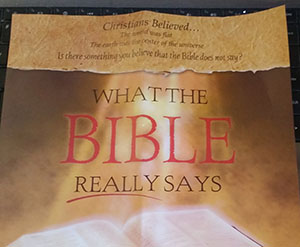
I opened my mailbox today to be greeted by a slick flyer inviting me to discover what the Bible really says about a variety of things. Among the the questions I’m told I can get answered: What is the future of our country during this economic downturn? What does the Bible really say about the second coming? What does the Bible really say about law and grace? What does the Bible really say about a vacation every week?
I’m rather well acquainted with this type of brochure, because I grew up as a Seventh-day Adventist. We had plenty of opportunities to see this sort of advertising. We were supposed to be the people who were right, and thus who would eventually straighten out the rest of the world. Well, at least those who were not destined for the lake of fire.
One of the things that my SDA teachers wanted me to learn was to go to the Bible about everything and to study it for myself. I did, and as a result I decided that the SDA church wasn’t the church for me. Especially on the topic of eschatology, I came to very different conclusions.
That’s the critical thing. The internet and the airwaves are filled with people who claim that they know precisely what the Bible teaches about almost any subject you can imagine, even when the Bible may not say much of anything about it.
To discover God’s message for you in scripture, you need to study for yourself. Now one of the things I was taught to do as a child was to look up the texts the evangelist used to see whether he was citing them correctly. There’s nothing wrong with doing so, but in a way this is a trap.
Studying the texts that someone else provides in the order and in the structure in which they provide them will very often lead you precisely to their conclusions. What you need to do is study the scriptures for yourself, in an order that you may discover, prayerfully, under the guidance of the Holy Spirit that God promises to you, not just to experts or ordained leaders.
While you’re doing that you need to examine just how it is that you come to understand the text, and especially to understand the way in which the text applies to you and to your life.
You can illustrate the problem with the way that the brochure I received talks about a “weekly vacation.” What the writers of the brochure mean is the seventh-day Sabbath. For various reasons that seem good to them, they believe that the command to keep the seventh day holy still applies, while other commands, such as various sacrifices do not. I don’t mean here to argue that they’re wrong about that, but rather that their view comes from a particular way of understanding scripture.
Some of our presuppositions and their impact.
I remember a certain book about the King James Version, one that advocated it as the only Bible Christians should use. “It’s a very scholarly book,” I was told. “It’s filled with footnotes.” The problem is that the footnotes varied between those that were to unreliable sources, those that were plain wrong, and those that were to other examples of the author’s own work.
Similarly, just because a presentation of scripture has a large number of texts doesn’t mean it’s scriptural. Neither does it mean it’s not. What it means is that you should examine it and decide for yourself.
When I cite SDA documents many people approve. Of course we should examine (and dismiss) the claims of schismatics like Seventh-day Adventists. They are, after all, wrong! But there is no type of mistake in understanding scripture that is truly exclusive to SDAs. You’ll find these mistakes in many denominations and tradition streams.
You need to examine everything. Think about these things for yourself. Get multiple scholarly opinions and test your own work against those. If you do this, you may be surprised at how many opinions about the Bible are predetermined by the presuppositions of the person holding that opinion.