Threads from Henry's Web

Tag: law

  • Psalm 119:176 – Seek Me

    Psalm 119:176 – Seek Me

    I have strayed like a lost sheep.
    Seek your servant,
    for I do not forget your commands.

    We have come to the last verse. For me, that’s 176 posts in as many days, each a meditation on one verse of Psalm 119.

    This verse serves as an excellent conclusion to the Psalm, though it doesn’t really introduce a great deal that is new.

    I think there are two critical points that are emphasized by its placement at the end, and its message.

    First, we are again reminded that this is not a Psalm of self-sufficiency. It is not about telling God how wonderful you are, and how you, on your own, are going to get everything right. Sometimes verses from this Psalm are taught in that way, but if seen in the framework of the entire Psalm, the message is clear. The law is of great value. Keeping it is a good thing, but the life giver, and the one who makes righteousness possible is the one who gave the law.

    “I have gone astray like a lost sheep,” says the poet of the law, much like the ordinary human acknowledges, “I have not kept my New Year’s resolutions” in the middle of January. In neither case does it mean the resolutions were bad or that it wouldn’t have been a good idea to keep them. It’s just that we’re all human. We all fail. We all need someone to seek us.

    The Psalmist of the Law, knew who that was. It was the same God who gave the law in the first place. The lawgiver is also your savior and protector.

    Second, we are again reminded of the value of the law itself. While the law cannot replace the lawgiver in any way, it is not a bad thing. In fact, it is a great thing.

    I thought about whether the Psalmist might be saying that God should look for him because he did not forget. But it seems to me more likely that he’s indicating why he would pray that God would seek him. He doesn’t forget God’s commands. He is grateful to the lawgiver. He wants to be found.

    We have a tendency to diminish the law in a number of ways. One way is to imagine the law can take the place of the lawgiver, that just keeping the law is all we need. Oh, it’s a tall order, but even if we could manage to keep all the law for a day, this would still not mean we reached God’s glorious purpose. It would, in fact, be the pursuit of an idol.

    “What!” you exclaim.

    Setting something less than God as an object of worship is idolatry. God has so much more than the accomplishment of a checklist for us. Putting the law in place of God is to worship mediocrity. In fact, all idolatry is worshiping and pursuing something less than what God has in mind.

    It’s our most common form of wandering.

    As you go forward today, pray the prayer of this verse. “Seek your servant!”

  • Psalm 119:175 – Let Me Live

    Psalm 119:175 – Let Me Live

    Let me live so I can praise you,
    and let your judgments help me.

    This is an interesting expression, especially as we come to the end of this Psalm. The entire Psalm is giving praise for the order brought to human existence by God’s actions-instruction, law, judgment, precept, testimony, statute. These various expressions combine to give praise for who God provides order in the universe and also order in human lives.

    The Psalm is anything but legalistic if you pay attention to it as a whole. If you base an accusation of legalism on the number of references made to the law, you are missing the poetic effect. The Psalmist praises God for all this and he also determines to keep all these laws, but then he’ll mention the fact that he knows he fails and ask God to be with him.

    In this next to last verse, we have the expression of praise for a God who gives life. “Let me live,” is the cry of many. Even if you are feeling very self-sufficient, there will be moments of disease, or impending disaster, of simple awareness of all the things that could go wrong. At such moments, you will likely cry out, whether to God or into the void, “Let me live!”

    The second line of the verse fills this out with another hope, that all of God’s judgments will be in our favor. This is again a common cry in scripture, because we know that we often slip up and need mercy. There is a famous “sinner’s prayer” which is a prayer for salvation. But there is an even better sinner’s prayer: “Lord, be merciful to me, a sinner!”

    This is a theme that is woven all through scripture. We may fail, but God’s mercy does not.

    The steadfast love of the LORD never ceases,
    his mercies never come to an end;
    they are new every morning;
    great is your faithfulness.

    Lamentations 3:22-23 (NRSV)

    This is a very famous verse, constantly quoted, but it comes from a book justifiably titled “Lamentations.” Let’s look at a couple of verses just a bit before:

    The thought of my affliction and my homelessness
    is wormwood and gall!
    My soul ccocntinually thinks of it
    and is bowed down within me,
    But this I call to mind,
    and therefore I have hope:

    Lamentations 3:19-21 (NRSV)

    What follows, of course, is the passage I quoted earlier.

    When trouble comes, when you’re burdened by affliction, homelessness, or maybe just besetting doubt, remember this:

    It is the LORD who gives you life, and the LORD’s judgment is going to favor you because you are God’s child.

  • Psalm 119:171 – Sing Praise!

    Psalm 119:171 – Sing Praise!

    Let my lips sing your praise,
    for you have taught me your statutes.

    The underlying theme of Psalm 119 is praise to God for the law. The law is righteous. The law is good. Good things come of keeping the law, even though we have to ask God for the strength to do so.

    I find the relationship of may Christians to the law quite interesting. There quite an interesting theological/biblical discussion between various groups, particularly Lutherans, Calvinists/Reformed, and Wesleyans about the relationship between the law and gospel. As an introduction, let me commend the article on Wikipedia on Law and Gospel, though doubtless many, myself included, would pick at various points.

    In practice, however, we tend to simultaneously declare that we are saved by grace through faith, but then only apply this to the moment of salvation, of becoming part of God’s family. At that point, most of us would say that we are not saved by keeping the law. So we have a distinction here, because law is not the agent, even though law definitely has a role.

    But we turn from that and, whatever we may proclaim, we become people of rules. We want the ten commandments in schools, as though better morality will be achieved because of a display of the ten commandments.

    We aren’t really praising God for the law through all this. Rather, we’re considering that we have to have a stick to use to beat people into proper order. We ditch gospel and grace and become another behavior modification program.

    This is exemplified by the plea I have heard frequently from parents and friends, “Help me get my child/friend back into church.” The goal is to get them into the church structure and organization, such that their behavior can be made more … I’m not sure if it’s more Christlike or more Churchlike.

    I recall having this discussion in a church my mother attended, which she called, to their face, the church of the gottas. You gotta do this, you gotta do that. Having been saved by faith, or rather having been shoved across the starting line by grace received through faith, you gotta get busy running the race and making sure you get everything right.

    My own experience with teaching about tithing is an illustration. Is tithing a command applicable to Christians? For a long time I struggled with the fact that I couldn’t see that it was, yet as part of the leadership team of a church, I was afraid to say so, lest people give even less. I was already irritated by people who spoke of “tithing” 1% or 2%. “Tithing” refers to 10%, though 10% of what is subject to some controversy. But if you’re giving 1%, you’re not tithing.

    My concern, or to be honest, fear, was that if tithing was not a rule, then people wouldn’t give, and then programs of the church that I hoped would be well funded, such as children’s ministries and missions, would suffer.

    It took me a long time to realize that grace was the only thing that was ever going to bring sanctification, including sanctification of our wallets, doubtless the least sanctified of our possessions.

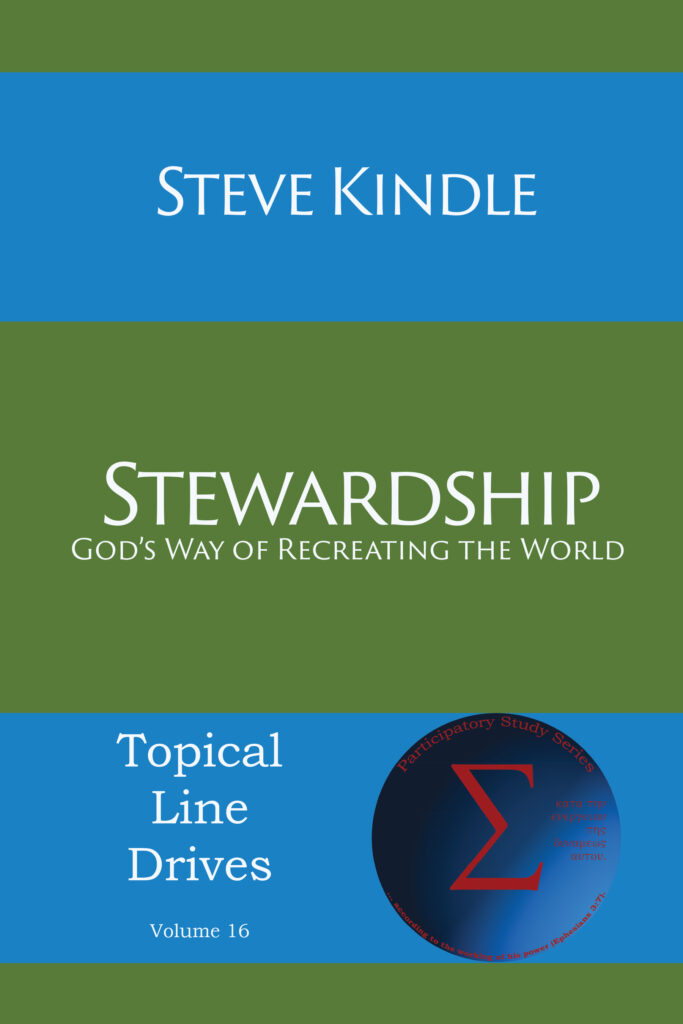
    The bottom line was that in Christ, everything is dedicated to Christ and we make our decisions on spending and giving based on that fact. I had come to this conclusion, but hadn’t expressed it all tat well until I read as an editor, and published the little book Stewardship: God’s Way of Recreating the World by Steve Kindle.

    Here’s a selection from page 25:

    The questions around how much to give are too often reserved for “Stewardship Drives.” So we compartmentalize our giving and tuck it away for another year. In all the talk of stewardship, seldom
    does it go much beyond the pocketbook. Whenever stewardship is reduced to a program, something is terribly wrong, and congregations and individuals continue to struggle.

    The apostle Paul revealed to us the key to successful fundraising in his appeal to the Corinthian congregation to assist in the collection he was taking up for the Jerusalem church. His formula:


    3For, as I can testify, they voluntarily gave according to their means,
    and even beyond their means, 4begging us earnestly for the privilege
    of sharing in this ministry to the saints— 5and this, not merely as we
    expected; they gave themselves first to the Lord and, by the will of God,
    to us,… — 2 Corinthians 8:3-5

    The Macedonians, in spite of their poverty, begged to give to the Jerusalem church—even beyond their means—because they first gave themselves to the Lord. Sure, it is possible to raise a lot of money using sophisticated methods based on psychological triggers and emotional appeals. These are too often resorted to as substitutes for the Macedonian way. A congregation that first “gives themselves to the Lord,” recognizes their stewardship partnership, and everything they do springs from that commitment. So let’s not encourage tithing, that’s about money. Let’s encourage
    seeing all we have as God’s and act accordingly.

    Steve Kindle, Stewardship: God’s Way of Recreating the World, p. 25

    This same approach applies to everything about Christian living, and it’s something we should pay attention to. If we could focus on that connection to God, and the motivation of love that is involved with it, better behavior, empowered by the Holy Spirit, would be the result.

    When we see the law in this way, as a gift, and as a description of what might be and what God is, we can receive it with praises. If it is a club to make people look and act like us, to be “churchy,” then it will always be a negative thing.

    But if we don’t focus on that core of being as the source of all we do, we will inevitably get back to a picky, rule-by-rule attempt at behavior modification, which is sure to fail in the end, not to mention causing a great deal of fiction along the way.

    How can you find joy in being and doing today?

    (Featured image is from Adobe Stock. Licensed, not public domain.)

  • Psalm 119:167 – Keeping

    Psalm 119:167 – Keeping

    I keep your testimonies,
    I love them greatly.

    The first line here is formally “my soul keeps,” which is a way to refer to oneself. I does have the added connotation of keeping them from the heart out. That goes with the second line that says this comes from the love that the Psalmist has for God’s law.

    I couldn’t help today thinking about the difference in the way the various laws are presented here by the Psalmist. In Christian churches you rarely have positive references to the law as something to love and appreciate. We’ve taken pieces of Paul and used them to build the attitude that the law is very negative, so we want to avoid it.

    We have a major problem, however, in that we want to trot the law out to make other people behave the way we want them to. That again presents the law in a negative way, as we keep saying that salvation is by grace, meaning that “getting into heaven” is by grace, and then detaching that from Christian life.

    As a result we act as though God will take you to heaven, but we still need something to control things on earth before we get to heaven, so we have laws, and we enforce them. That tends to result in a loose and capricious application of standards of behavior, and soon the fires of hell will start sneaking in the other way.

    But both the law and grace come from a loving God. It’s not that grace is a way around the law. It’s more of a way through it. Ultimately, sanctifying grace says that God is going to get you in the end, which does not mean that God is going to discipline you into formal good behavior, but rather God is going to make you holy, and that “holy, just, and good” law will be part of you as well.

    Grace is the gift that keeps on giving. Even in Romans 7, which is often viewed as a “downer” chapter, Paul notes that he’d like to do God’s law, but he finds himself in a battle with the flesh which definitely does not want to keep the law.

    The answer is to live by the Spirit, at which point you do, in fact, love God’s law. You may (and should) still realize how much you fall short, and how much your flesh (to use Paul’s term) is at war with it, but it’s something that tells you where God is going to take you.

    As even the very next verse, which we’ll discuss tomorrow, the only reason anyone goes anywhere with any of this is that God is at work.

    Having trouble with keeping God’s law? Let God’s Spirit do the work.

    (Featured image from Adobe Stock. Licensed, not public domain.)

  • Psalm 119:166 – Hope

    Psalm 119:166 – Hope

    I put my hope in your salvation, LORD,
    and I put your commands into action.

    I’m thinking of this today from a distinctively Christian perspective, and less about historical meaning. I’m looking back at the text through another lens.

    In one of my favorite texts, Paul puts these two concepts together:

    … With fear and trembling work out your own salvation, for it is God who works in you both to will and to do his good pleasure.

    Philippians 2:12-13, my translation with the final word taken from the KJV

    This again brings together these two important concepts: Trusting and Doing. If one’s hope is in God’s salvation, then what’s the doing about? Paul makes it clear here (and I think it’s clear in the Psalm as well) that it all depends on God, and yet there is doing involved.

    The problem for us is mixing the two up, getting our hope from our efforts. For many, there is a fear that if we don’t demand effort, no effort will be made. So we try to make salvation, or many other lesser goals depend entirely on work that is simply not sufficient to support it.

    What would it do to someone’s morale if they are facing an impossible barrier, and are told, “You have to put your hope in your own efforts to get over this barrier”? The result is that hope dies and the person gives up. One human approach is to follow this up by calling the person a loser because they have failed to overcome a barrier that was, in fact, impossible.

    The book of Hebrews, also a favorite of mine, leads up to presenting Christ as the one God perfected on our behalf at the end of chapter 5, and then in 6:1 says, “let us be carried on toward perfection.” (I believe the passive, not middle is the correct translation of the verb here.) The idea being that having through Jesus we are now to be carried on to the kingdom.

    If we get this idea of identity, and of a hope provided by God, then the idea of putting God’s commands into action becomes something different. We are winners with every step, not because we have accomplished the goal, but because we are on the journey, being cared along to perfection.

    Given a couple of quotes recently, you might be aware that I’m reading Deanna Thompson’s commentary on Deuteronomy. I have another quote from that book:

    Moses’ act of remembering and retelling Israelite history, as Israel stands between its future and its past, makes an important theological point about Israelite identity: Israel’s relationship with the God who freed them from slavery is its identity, and after years of dishonoring that memory, it is time to remember, honor, and obey.

    Commenting on Deutereonmy 1

    The Bible is very much about trust and hope, but it is also very much about action. Our problem is often leaving one or the other element out, or getting them in the wrong order. Trust and hope make action possible. Knowing who we are is what frees us for action.

    So, after all, this verse of Psalm 119 is very clear and reminds us of the order. Trust in God and do. In that order.

    What will God free you to do today?

    (Featured image generated by Jetpack AI.)

  • Psalm 119:165 – Offense

    Psalm 119:165 – Offense

    Those who love your law have great peace;
    Nothing will offend them.

    I adjusted my translation a bit toward the KJV, which is the translation of this Psalm that I memorized when I was younger. I like the word “offend,” which is within the semantic range of the word used here. You’ll see that many translations use something like “make them stumble.”

    The verse got me thinking about things offend us. One connection between “offense” and “stumbling” is simply that offense makes us think about things around us in suboptimal ways. Offense makes us think about and respond to things that have really done us no harm.

    Why are we so often offended?

    1. We might be looking for an offense so as to divert our attention from our own failings.
    2. We might feel inadequate and find offense at someone else a good distraction from our own inadequacies.
    3. We might want to put someone down who seems to be getting more attention and support than we do.
    4. We might not actually have any idea why we’re offended. We just find it easy to be offended.

    Following God’s instructions is a good antidote to offense. If we are confidently acting in an appropriate manner, if we feel that we are following God, if we are acting with a clear mind and conscience, we are less likely to be offended by others.

    As an old song says, “Full of beauty is the path of duty / Cheerful we may always be!”

    What will build your confidence in God today?

    (Featured image generated by Jetpack AI.)

  • Psalm 119:151 – Near

    Psalm 119:151 – Near

    You are near, LORD,
    and your commands are true.

    One of the interesting paradoxes of Christian theology is the God who is at once very near and also distant. Personal and accessible, yet so far above as to be incomprehensible.

    Paul talks refers to this in calling us to “know the lover of Christ which surpasses knowledge” (Ephesians 3:19). We have many such paradoxes in Christianity, including what I consider the most critical one, the incarnation. Jesus is 100% human and 100% God, and yet is one person.

    In Deuteronomy 30:11-14, the law is described as being near. It’s not in heaven, inaccessible, or beneath the sea, also inaccessible. It’s there. It’s available. It’s not too difficult or beyond our reach. And yet the story of scripture is, in many was, the story of people failing to keep the law, even in the most basic sense.

    Yet again the Psalmist speaks of God having knowledge that is too wonderful for him, beyond his grasp (Psalm 139:6).

    What I see here is God’s presence in our lives, working out divine purposes in and through us. It’s accessible, to the extent we can comprehend it, but one of the things we should comprehend is that we don’t comprehend fully. We comprehend enough for our lives. We comprehend enough to know there is much beyond our comprehension.

    It’s not a bad idea to realize the limitations of our knowledge. In fact, it’s a very good idea.

    Think today of things that you don’t understand. Then imagine a future in which you comprehend more, bit by bit.

    What little bit will you add to your store of knowledge today?

  • Psalm 119:142 – Eternal

    Psalm 119:142 – Eternal

    Your righteousness is right forever,
    and your instruction is reliable.

    I commonly use the phrase “God’s eternal law” in discussing the absolute, eternal, immutable law of God. This is what defines who God is and the purpose of the universe, and is not subject to our perspective. That is to say, objective law. God’s law which is forever, in the words of this verse.

    Our problem is that we cannot really comprehend eternal things, nor can we truly comprehend things objectively. There is always an element of our own experience in what we do. It is a statement of faith when we claim that God’s law is, in fact eternal.

    Each individual law contained in scripture, or expressed in any other way is a derivative of God’s eternal law. A particular expression of God’s law is never the same as God’s eternal law, though it derives its authority from that eternal law. Just as I understand God as without beginning or end, and as trinity, things which are not empirically observable, so I understand God’s law as eternal, again something which cannot be objectively demonstrated.

    Growing up, I regularly heard the ten commandments described as God’s eternal law. This was to be distinguished from various other laws, largely ceremonial, in Torah, which are temporary. (Note that this is growing up in a Christian, Seventh-day Adventist home. This is not the understanding of Judaism.)

    The problem here is that Torah itself does not make this particular distinction. All of the laws given by God are binding. They may be binding at different times, on different people, and under different circumstances, but they remain divine law.

    I maintain that all expressions of law that we can receive an understand relate to particular times and circumstances. Some are much more eternal and broadly applicable than others. All derive from God’s eternal law. None are, themselves, eternal in form and expression.

    I’m going to embed two videos here that come from my series on Paul from some years ago. The first begins a discussion of reading about law in scripture.

    The second follows up with more detail.

    Now there are a few sessions between these two, so if you are very determined, you can view the playlist.

    But now we jump to the second half of the verse. “Eternal” is daunting and impossible to reach. Sometimes we have a tendency to dismiss the things we cannot fully understand. But with this statement we get the other side. We can rely on God’s instruction. We may not be able to fully comprehend the source, but we can rely on what we have.

    In real life we learn to accept what works. We get on airplanes and travel without having a full conception of how that aircraft works. We don’t often think about it, but that aircraft is also not perfectly made. It would be hard to even conceive of what perfect means. Every part is tested, not to some absolute perfection, but rather to certain tolerances. We live with this sort of thing every day.

    One way to discover that you can rely on certain things as a way to live is simply to try them. Taste and see that God is good. Try it. Don’t get shaken by what you can’t understand. You can understand enough.

    Take the challenge to adventure with an incomprehensibly great God!

  • Psalm 119:141 – Despised

    Psalm 119:141 – Despised

    Though I am small and despised,
    I do not forget your precepts.

    There are two times when it is difficult to stay on the right track: When things are going well and people are praising you, and when things are going badly, and people look down on you. Either of these can make you turn away from the right path.

    Well, then there’s the third option, which is that things are going moderately well. Well enough for you to be comfortable, but not so well that people are coming and praising you. Then there’s a major temptation to apathy, to contentment with things being not so bad.

    In real life, we may be confronted with any of these situations. We can find that ridicule prevents us from doing what is right or speaking of what is right. Or when things are going well, we find pride taking over, and we start to think too well of ourselves, and often speaking too highly of ourselves to others.

    Then there is the way that is simple, but very hard. That is to think of ourselves as we ought to. Paul speaks about this in Romans 12:3 —

    I tell all among you through the grace that has been given to me that you shouldn’t think of yourselves as better than you are, but you should think of yourselves properly {or wisely}, each according to the wisdom God has measured out to them.

    This verse doesn’t tell you that you should always think of yourself poorly. You don’t have to say that you are small and despised as did the psalmist. It’s likely you’ll feel that way sometimes, but that’s not some type of “holy” goal. Nor should you consider yourself more important than others. Rather, you’re supposed to think of yourself as you really are, as God sees you.

    This invites a change of vision, a change of perspective. And the psalmist tells us where we need to be. We need to be looking at what is right. He speaks of God’s precepts, as he has elsewhere spoken of God’s word, God’s testimonies, God’s statues, God’s judgments, and God’s commands.

    That’s all the long version of saying, “What’s right.”

    That is often our problem. We aren’t concerned with what’s right, but rather with what other people think of us. That is never a good place to be. Sometimes the person whose opinion matters to you is himself out of sync with what is right, and may be despising you for the things you won’t do in order to get ahead.

    How are you going to look at yourself today?

  • Psalm 119:136 – Crying

    Psalm 119:136 – Crying

    Streams of water flow from my eyes,
    Because people don’t follow your instructions.

    What makes you cry?

    We are often driven to tears by sad events in our lives or in the lives of our loved ones. We can be driven to tears through anger about what someone else does to us. We can be driven to tears by weariness, when life just won’t stop driving us.

    The Psalmist is crying because people are not keeping God’s law or instructions. The word here is Torah, which I have chosen to translate throughout these meditations with the word instruction/instructions. It covers the many categories of instruction that God has provided.

    When Rabbi Hillel the Elder was asked if he could summarize Torah while standing on one foot, he said, “What is hateful to you, do not do to your fellow. That is the whole Torah, the rest is commentary.” That is one of many statements of what we call the golden rule. Jesus gave something very similar, though more than half a century later in Matthew 7:12.

    Jesus also summarized the law in another way. He said that we are called to love the Lord our God with all our heart soul and mind, and our neighbor as ourselves (Matthew 22:40). I hear this taught frequently, but I wonder how often we really take it seriously. Jesus continued by saying that on these two commands “hang” all the law and the prophets. This sounds very important. I’m looking right now at the NLT, which says, “The entire law and all the demands of the prophets are based on these two commandments.” That might clarify things in case we’re having trouble with the word “hang.”

    And please note that the two commands go back to Leviticus and Deuteronomy. They were not a new revelation when Jesus mentioned them. Jesus was quoting scripture.

    One of my practical hermeneutical principles is simply this: If you are interpreting scripture, test your interpretation by seeing if you can make it hang from one of these two laws. In 1 John we get an extension of this when John tells us we should love one another because love is from God (4:7a), everyone who loves has been born of God and knows God (4:7b), the one who does not love does not know God (4:8). Then in verse 20 he asks how someone can say they love God but don’t love their brother. How can you love God, whom you have not seen, but not love your brother, whom you have seen.

    I have drawn in all these verses in order ask this: When we see an absence of love, does that make us cry? Can we say, “Streams of water flow from my eyes, because the people in your church don’t really love one another?” What about “Streams of water flow from my eyes, because the people in the church don’t love the whole world, those who are near and far, those who belong to the church and those who don’t?”

    It’s really nice of me (I pause to pat myself on the back) to state these questions in that polite, unchallenging manner. Here’s the real question: “Do streams of waters flow from my eyes because I am not showing love to everyone God has put in my path?”

    Did I care enough about the elderly man I saw sitting in front of Walmart this afternoon? Sadly, no. I thought about him for a moment or two, and a fleeting thought suggested maybe I should say or do something, but my focus on my own problems took over and I walked right past him. Was that the love of Christ motivating all my actions?

    Jody and I were discussing this and connecting it to the great commission. If we are to make disciples, what will characterize those disciples? Well, Jesus said, “In this way will everyone know that you are my disciples, if you have love for one another” (John 13:35). And if you’re wondering about what love is or how Jesus understood love, practiced love, remember that he was on the way to the cross.

    Nope, I can’t say I cared as much for that man in front of Walmart as Jesus has cared for me. And that should make me sad.

    What will make you sad today? More importantly, what can you do to live that great commission to make disciples, disciples characterized by love?

    Let’s turn that around! What act of sharing God’s love will allow you to rejoice at the end of the day?

    (Featured image was generated by Adobe Firefly in Adobe Express using a prompt generated by Gemini AI. Yes, I’m experimenting.)