
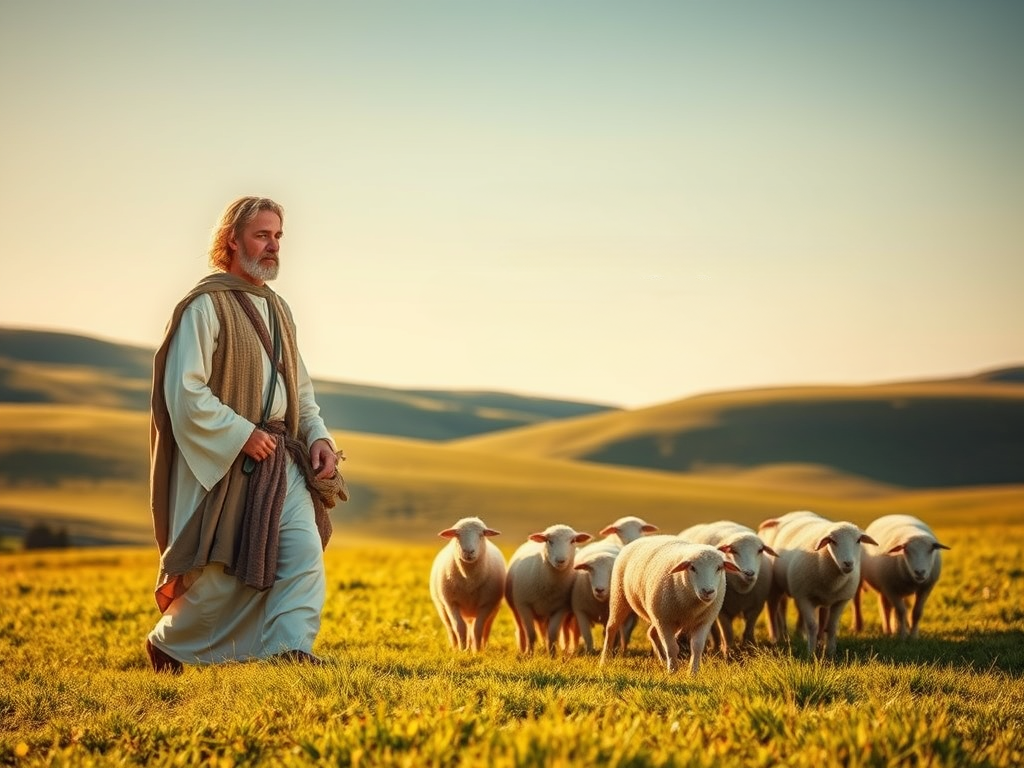
The LORD is my shepherd,
I shall not lack anything.
This initial verse is very compact in Hebrew, and the poet uses that to effect. It is, in fact, just four words. It tells us who is watching over us, and the result, not lacking anything.
I spent some time looking at and thinking about the two parts. The key word in the first part is “shepherd.” Yes, the name of God is there, but the focus is on just who the LORD is in this case.
This reminded me of a passage from Ezekiel:
14 I will feed them with good pasture, and the mountain heights of Israel shall be their pasture; there they shall lie down in good grazing land, and they shall feed on rich pasture on the mountains of Israel. 15 I myself will be the shepherd of my sheep, and I will make them lie down, says the Lord GOD. 16 I will seek the lost, and I will bring back the strayed, and I will bind up the injured, and I will strengthen the weak, but the fat and the strong I will destroy. I will feed them with justice.
The Holy Bible: New Revised Standard Version (Nashville: Thomas Nelson Publishers, 1989), Eze 34:14–16
.Ezekiel is given a message to speak against the shepherds of Israel, those who allowed Israel to go astray, or even themselves led them astray. These words are spoken from the exile in Babylon, the result of this straying.
The shepherds were put in place precisely to prevent this sort of thing, and the LORD calls them out for their failure. The solution? The LORD himself will take over the job of shepherding the people to make sure that they are, in fact, well cared for.
I read this Ezekiel passage in two senses. One is of comfort. Despite the failures of human beings everywhere and all the time, God will find a way to care for those needing care. At the same time, I hear the message to the shepherds, to those who have a responsibility of giving care. What happens when you neglect those duties?
Then there is the question of what happens when the sheep fail to follow the shepherd. As we learned from our final study on Psalm 119:176, that is the time when the call is for God to seek the straying sheep.
And then we come to the idea of “want” or “lack.” In modern English we tend to use “want” less for the sense of things we lack, and more for stating desires. I play on this in a short free verse post on my Jevlir Caravansary blog. We’re always wanting something, but what is it that we really lack?
I was interested in the variety of things one might lack. Uses of this word occur in Ecclesiastes 10:3 for someone who lacks sense. Have you ever considered that with the Lord as your shepherd, you won’t lack for good sense? Doubtless you’ll have times when you don’t use it, but good sense (and wisdom [James 1:5]) are available.
As show in 1 Kings 17:14 & 16, the widow’s oil never lacked while Elijah was staying with her. The same word is used. The Hebrew word, much like its English counterpart, can be used for a variety of types of lack. Do we consider who our shepherd is when our lack is emotional?
The shepherd is the shepherd of our souls and our bodies, and is with us through everything.
What do you lack?
Leave a Reply