Threads from Henry's Web

Category: Bible Translations

  • Reading Hebrew Poetry in English (Brief Edition)

    Reading Hebrew Poetry in English (Brief Edition)

    As my Sunday School class is studying Proverbs, I thought I’d provide them with a bit of an explanation of Hebrew poetry. If you’re someone who reads Hebrew and has done any study of Hebrew poetry, this is not for you. Don’t bother to tell me about all the things I’m leaving out. I already know.

    This actually started from my intention to explain a difference in translation, so let’s start with the verse in question.

    8 Attend, my son, to your father’s instruction
    and do not reject your mother’s teaching;

    Proverbs 1:8 (REB)

    Or …

    8 Hear, my child, your father’s instruction,
    and do not reject your mother’s teaching;

    Proverbs 1:8 (NRSV)

    Or … and here’s where the problem is revealed …

    8 My child, obey the teachings
    of your parents,

    Proverbs 1:8 (CEV)

    So how can the Contemporary English Version come up with the translation they did? Though I think we all can recognize that the overall meaning is essentially the same, one might wonder why the CEV would alter the way in which it is expressed so much. For a discussion of various approaches to Bible translation, see my book What’s in a Version?, or the site MyBibleVersion.com that I maintain.

    But here my interest is how the difference is enabled by the nature of Hebrew poetry. In English, we use various combinations of rhyme and meter for most poetic expression, though there is also much less formal free verse or even poetic prose.

    Hebrew poetry does have meter. While there are many arguments as to detail, what I was taught back in ancient times when I was in school was counting accented syllables. While there are some valid objections to this, I think it generally allows one to get a fairly clear picture of the form. Unfortunately, this method is unavailable to most English readers.

    Hebrew poetry is primarily characterized by parallelism of thought, so as an English reader, if you divide a sentence in Hebrew poetry into elements, you can get an idea of how these elements work in meaning. Once you divide the poetry into these elements, you can look for parallels between them.

    These parallels usually come in one of three forms: synonymous, antithetical, or synthetic. In synonymous parallel, two elements essentially express the same thought. In antithetical, the elements express the thought, but in an opposite way. In synthetic parallelism, the two elements go together to express a single idea more comprehensively.

    In the prior paragraph I’m bypassing a great deal of literature and also probably confusing my readers. Let’s take it to our example verse. I’m going to translate it from Hebrew as literally as possible.

    _____ | Obey ________________ | my son | exhortation of your father
    and | don’t leave unheeded |_________ | the instruction of your mother.

    Proverbs 1:8 (my literal translation)

    Now in analyzing Hebrew poetry, we would generally not separate the conjunction, which is not a separate word in Hebrew, but rather a prefix.

    Multiple things are illustrated here. First, one could call this synonymous parallelism, except that the verbs are stated antithetically, “obey” versus “do not disobey,” while the instruction is synthetic, combining the teaching/discipline of parents into “exhortation (or discipline) of your father” and “instruction of your mother.” In addition, you can see how an element can be left out of one or the other line, yet it applies to both.

    You get the full impact of the verse by seeing the way these two lines stand side by side. In some cases you can get a false impression when you fail to realize that two lines are not expressing the same thing, and you will generally understand a verse, usually 2-3 lines, better if you let them work together to bring their message.

    The reason I chose the REB, NRSV, and CEV is that the REB and CEV are considered functional equivalent translations, while the NRSV is a formal equivalence translation. Functional equivalence means to try to find English words for the Hebrew that have the same impact on the English-speaking audience that the Hebrew would have had on the original audience. Formal equivalent translations try to keep the forms as close as possible in a more word-for-word translation.

    You can pick out the elements I identified from either the REB or the NRSV. The CEV, however, is translated primarily to be read by people whose first language is not English. It has departed from the form in order to convey the function to its audience.

    Why doesn’t the REB do so? Generally because it is written in a more formal variety of English and finds the continued repetition of the Hebrew to be quite comprehensible.

    Again, I have quite obviously over-summarized some things and left many out, but I hope this will help.

    (Featured image generated by Jetpack AI, and modified by me using Photoshop.)

  • The Passion Translation: Content Review

    The Passion Translation: Content Review

    The Passion Translation has received considerable negative publicity while being supported in an equally passionate way, especially in the charismatic movement. You can find my overview on MyBibleVersion.com, and I presented an overview of criticism and of my review methods in a previous post.

    How I Rate Translations

    Follow the links above to see my rating of The Passion Translation, which also provides an example of how I do such a rating. I do not designate Bible translations as “good,” “bad,” “ordinary,” or some other generic designation without regard to context. I prefer to rate a translation for strengths and weakness in different areas.

    The chart provided shows numeric ratings. Many of these are themselves subjective. I use word counts to determine how formal or functional a translation is. By functional, I don’t mean that the translation works, but rather that it translates in order to provide equivalent impact on the target audience to the original. A formal translation attempts to match specific words or phrases to source words in the Greek, Hebrew, or Aramaic text.

    But having done a word count in a specific passage (I start from Hebrews 1:1-4, which tends to force some rewording), I also look at other passages to see if that number works. Thus the numbers provided should be considered a personal opinion on each item.

    Specific Notes on TPT Ratings

    In the case of The Passion Translation, my own key takeaway was that the overall impact of a translation may be badly skewed by either its critics or its proponents. In the majority of cases, I found that passages were precisely what I would expect of a missionary translator. This doesn’t mean that the translator’s theology has no impact. Everyone’s translator’s theology has an impact. One cannot translate without interpreting, and one’s interpretation and theology will be tied together. What surprised me, after first having heard the hype, was how expected the renderings were.

    Of course, ratings such as whether a translation is by a committee or an individual were fairly clear–this is an individual translation. In addition, it’s clear that the translator is in the charismatic movement, and specific related to the New Apostolic Reformation. Nonetheless, as I’ve stated before, when you have the translated work in front of you, the proper approach is to examine that work.

    In terms of formal vs functional, I found that TPT was closer to formal and less free in rewording than I would have expected from the criticisms. It definitely reflects a willingness to reword and rework passages for the target language and audience. Yet I found it less likely to do so than The Message.

    My initial word counts from Hebrews 1:1-4 actually indicated considerably less rewording than I expected, and after reading a number of other passages, I edged the ratings a point higher on the “functional” scale and a point lower on “formal.” One might describe this as a dynamic or functional translation with some significant deviations.

    Specific Renderings

    Ephesians 5:22

    In my previous post regarding the hype about this translation I included a video. In that video, the translator claims to have received a new translation from God (discussion starts about minute 20:00). I won’t go into this in detail, but on linguistic grounds, I would have to reject his suggested translation.

    Why? First, I would not accept his claim that Jesus and the apostles worked entirely in Aramaic, and certainly not that the book of Ephesians was written in Aramaic. There is no evidence to support the latter at all, and I find any evidence regarding the gospels to be quite weak. Second, the Peshitta, which is the closest thing we have to an Aramaic version, reads very much as the Greek does.

    Note that I would not list this as an error. It’s a strong difference of opinion. I wouldn’t mind if the text read the way TPT reads. I’d be very comfortable with that. But I can’t support that linguistically.

    Because of the intensity of criticism, however, I need to note here that I disagree with most Bible translations at some point. Practically anyone who reads the Bible in the original languages will disagree with any translation at some point or another. Disagreement is different than rejection.

    (For those interested, my friends Elgin and Hanna Hushbeck have written a book in the Topical Line Drives series from Energion Publications, To Love and Cherish, which goes into this passage in depth, based on the Greek text.)

    Psalm 110:1

    Yahweh said to my Lord, the Messiah:
    “Sit with me as enthroned ruler
    while I subdue your every enemy.
    They will bow low before you
    as I make them a footstool for your feet.”

    Psalm 110:1 (TPT)

    There are a few interesting points here compared to the Hebrew, and they’re worth noting in understanding the nature of the functional approach to translation, along with some “transculturation.”

    The use of “Yahweh” has not been traditional in English translations, but here it literally reflects the source text. The traditional approach has been to use LORD for “YHWH” and “Lord” for the Hebrew word “adonay” while using lord for the same word with reference to a human ruler. (Note: I use loose transliteration of the Hebrew to make it easier for readers who don’t know Hebrew. In this case, however, it’s worth noting that “adonay” is “my Lord” with a plural of majesty, while “adon” is just “lord” and “adoniy” is a singular “my lord.”)

    Thus in traditional translations the first line of this verse comes to something like “The LORD said to my L/lord,” with the capitalization of the second “lord” depending on how the translators interpret the verse. Read Messianically, it would generally be capitalized. Read as a blessing on an earlier Israelite king, it would not. I can testify from teaching experience that the LORD/Lord/lord difference can cause some confusion.

    Thus in the first line, TPT makes an interpretation quite clear. The translator is conveying a Messianic interpretation, and clarifying the difference in the terms for English readers. In case the capitalization is insufficient on “Lord,” he adds “the Messiah.”

    One might complain that a reading that is non-Messianic would now not be possible, yet at the same time, the clarification of the fact that the two instances of “lord” (however capitalized) represent different words makes another aspect of the verse much clearer. Translators regularly make this kind of choice for readers. There’s no avoiding it. You can’t convey all the potential meanings.

    So in the second line with have “Sit with me as an enthroned ruler.” This is a more equivocal kind of clarification, a case in which the translation is clearer than the source. Formally, the first part of the Hebrew reads “Sit at my right hand.” This would indicate a position of trust and authority. Some might regard “as enthroned ruler” as an overstatement. James and John as to be seated at Jesus’ right and left hand. This would have meant that they were the first and second rank below Jesus in His kingdom.

    In either a messianic or a royal enthronement context, however, “enthroned” doesn’t miss the point.

    The remainder of the verse is quite valuable in indicating the nature of this translation. Formally, I would translate the Hebrew text as:

    Until I place your enemies as a footstool for your feet.

    Psalm 110:1b, formally translated

    And the TPT:

    … while I subdue your every enemy.
    They will bow low before you
    as I make them a footstool for your feet.

    Psalm 110:1b (TPT)

    So what’s going on here with all the extra words?

    The translator is trying to present you with imagery that will help you understand the meaning of making enemies a footstool. The imagery would likely have been well-understood by ancient Hebrew readers, but words like “subdue” and “bow low” help create a picture.

    You can argue that this is “technically” not correct, though I would ask simply what it is that should be translated when there is poetry that contains rather vivid imagery. What does a translator convey, and how? Both The Message and The Passion Translation often choose to substitute imagery or expand on the original imagery in order to evoke a relevant picture for the readers.

    If you find this disturbing, there are a multitude of much more formal translations with which you would be more comfortable.

    Galatians

    To get a broad feel for this translation I listed to Galatians via Audible. I did this while walking and all in one session. There were only two issues that I noticed.

    The first is quite minor. I would definitely nuance Paul’s use of the term “law” in Galatians differently. This is definitely not an error, but rather a difference in presentation. I think it’s important to be clear that while the specific example of law that is the primary issue in the churches of Galatia is the Jewish law, Torah, Paul is making general points about the function of law. I found this eclipsed to some extent.

    The second is one that I have noted about many paraphrases. Challenging, in-your-face statements are sometimes weakened. One such statement is Galatians 5:12:

    12 I wish that the ones who are disturbing you would also castrate themselves[c]!

    Galatians 5:12 (LEB)

    Now try The Living Bible:

    12 I only wish these teachers who want you to cut yourselves by being circumcised would cut themselves off from you and leave you alone![a]

    Galatians 5:12 (TLB)

    Slightly less in-your-face, isn’t it? Note here that The Message keeps the cutting-edge on this, so to speak!

    Now try The Passion Translation:

    I wish they would go even further and cut off their legalistic influence from your lives.

    Galatians 5:12 (TPT)

    It is important to note, however, that TPT has a footnote indicating the alternate translation. I’ve made comments on this elsewhere. A footnote is a good option when there are viable alternatives or when it’s impossible or just clumsy to get all the meaning packed into one translation.

    Conclusions

    I could go over many other passages, but not that much would be gained for purposes of a review.

    My negatives regarding this Bible translation are that it is done by an individual, that it is very definitely fixed in the charismatic tradition stream, and that some of the hype tends to be distracting. While this doesn’t mean that the translation isn’t valuable, it does mean that it is not well-suited to discussions between traditions.

    The hype, unfortunately, tends to center on God’s call to the translator to produce the translation. (I ignore here the standard complaints that amount to “the translator didn’t translate my favorite verses the way I prefer.”) I personally think that this translator, as well as many others, have been called by God. That call is not the guarantee of their translation work. Solid linguistic work makes a translation good.

    Contrary to my expectations based on what I had heard and read, however, I do not have major problems with the translation itself. One should always take into account the biases of the translator(s). These biases are made clear. That’s all one should expect. There are no sneaky surprises.

    If you are studying, I would recommend comparing more than one English version. For example, using The Passion Translation alongside a Bible with interfaith participation in the committee, such as the Revised English Bible, and perhaps a more evangelical formal translation, such as the ESV, would help you be sure you’re hearing God’s Word in the text.

  • Review of The Passion Translation Part I – The Hype

    Review of The Passion Translation Part I – The Hype

    I’m dividing my review of this translation into two parts because my actual review of the translation text and the weighted chart I produced as a result is actually somewhat anticlimactic. The controversy about the translation is quite heated, and claims for the translation are quite strong.

    Evaluating a Bible Translation

    There are differing ways of evaluating a translation. One common way is to critique a set of passages that are of importance to the person doing the review. This is of value provided one considers both the theology of the translator(s) and the reviewer, as it can give you an idea of the theological views of the translators.

    Lists of Passages and Terms

    There’s a subset of this approach which is very concerned with which English terms are used. For example, does the translation in question use propitiation in certain passages.

    Consider, for example, Romans 3:25, in which the ESV uses propitiation:

    … whom God put forward as a propitiation by his blood …

    Romans 3:25, ESV, partial

    For the same phrase, the NRSV reads:

    whom God put forward as a sacrifice of atonement by his blood

    Romans 3:25, NRSV, partial, emphasis mine

    (It is worth noting at this point that references on this blog are linked to the passage on BibleGateway.com. Bible Gateway has chosen not to include The Passion Translation in their selection. Passages from that translation will be marked TPT and accessed from YouVersion.com. Read the Christianity Today story on this removal, dated February 9, 2022.)

    If your teaching of the atonement involves substantial use of the word “propitiation,” it’s likely you’ll prefer to have that word in this particular passage. When I was a first-year Greek student, I encountered this word (loosely transliterated hilasterion) in an exercise and translated it “propitiation.” My instructor informed me that I was not learning Greek so as to translate it into Latin, and that I should choose a word that would be understood well in modern English. (“Propitiation” in English is derived from Latin.)

    The controversy arises when you look at how well each term translates the original. “Sacrifice of atonement” falls within the semantic range of the Greek term, but some might argue.

    Let’s look at the NLT:

    For God presented Jesus as the sacrifice for sin.

    Romans 3;25

    I think you can recognize the connection. If you were wanting to discuss the nature of the sacrifice for sin, that is not specified. “Propitiation” indicates a particular function of the sacrifice.

    We take a further step with The Message:

    God sacrificed Jesus on the altar of the world to clear that world of sin.

    Romans 3:25, The Message, partial

    This is “more different” from the ESV than the others, and certain theological uses of the passage would be more difficult with this rendering.

    Now compare this to The Passion Translation:

    Jesus’ God-given destiny was to be the sacrifice to take away sins, and now he is our mercy seat because of his death on the cross.

    Romans 3:25, TPT, partial

    Just like The Message, The Passion Translation here can annoy many of the theologically inclined. Just what are we teaching with “clear the world of sin” (MSG) or “take away sins”/”now he is our mercy seat” in TPT?

    Thus we have numerous reviews that simply list issues such as this. There is a value in looking at the text in this way, though I would suggest that our doctrinal positions should be better rooted than to be ripped out by the translation of a single verse.

    There are numerous reviews of The Passion Translation that take this approach. Just do a Google search on it, and you’ll find lots. Be sure, however, that you actually check the passages that are critiqued alongside other English translations or the source texts if you can do so.

    A translation can be good as a translation while disagreeing with some of your favorite renderings. That’s one of the reasons preachers often choose a different translation for some passages they preach from: They’re using the one that has wording that best supports their point!

    Arguing against the Translators

    Another approach critiques translators.

    There is a value in looking at the qualifications of Bible translators. How much do they know of the languages? What is their orientation toward the text? Do they see themselves as translating sacred texts or simply common documents in an ancient language?

    For example, in evaluating translations for my site MyBibleVersion.com, I distinguish translations according to those by individuals and those by committee, and the committee translations by their general theological orientation, as well as whether they are interdenominational and even interfaith. My purpose in doing so is that I suggest you compare translations from different perspectives.

    Choosing only translations that reflect your own theological predilections can result in a skewed view of the source texts.

    There is a less valid version of discussing the translators, and that is one’s moral view of them or their lifestyle. A couple of decades ago there was considerable controversy over the NIV because someone on the committee later came out as gay. I see no value in this, and a great deal negative. Evaluate the text. Don’t set yourself up as a moral judge of the committee.

    My Approach Summarized

    What’s in a Version? (ePub) is available for $2.99 from Energion Direct.

    You can find a great deal regarding my approach to Bible translations in my book What’s in a Version?. That book is still available, though now a bit dated, but I still hold the same views about Bible translation I expressed in it. (Reviews of more recent translations are missing from the book, but can be found on my site MyBibleVersion.com.)

    I like to start evaluating a translation as I would any book, by reading the introductory material, which should give me an idea of what the translators intend to accomplish and what they claim to have accomplished. I then try to evaluate the translation in terms of whether it accomplishes those goals.

    I comment on, and readers will need to determine for themselves, just how well the goals of the translator relate to the needs of the reader. With the rich variety of English translations, we might well be looking for a Bible for easy devotional reading, one for serious exegetical study, one for preaching, and another to pass to friends for whom English is a second language.

    One of the characteristics to check is whether a translation intends to present the text in a formal sense, i.e., each Greek form producing a consistent single English form or phrase, or in a functional sense. Recently, as in over the last couple of decades, translators have tended to use “functional” rather than “dynamic,” a term applied by Eugene Nida. I still like dynamic, in that it includes in its semantic range the idea of non-static. As our language changes, so would our translation.

    The term “paraphrase” is generally applied to something that is considered too loose to be properly regarded as a translation. It gives a good general idea, though it isn’t precisely accurate in what it suggests.

    What translation strategy you prefer will be impacted by a number of factors and convictions and goes beyond this.

    A Note on Translation Accuracy

    I have been asked many times which translation is most accurate. I find that a question that can’t be answered in a truly meaningful way. I can critique certain translation for missing the meaning of certain passages.

    Unfortunately, “literal” or “formal” has become for some people a synonym for “accurate.” This is not correct.

    Each approach to translation conveys something from the source text while obscuring other things. If you want to avoid this, learn to read the original languages. Or, alternatively, read a variety of translations.

    Let me give one brief example. In Ezekiel 40-48 Ezekiel describes a vision of a rebuilt temple. He presents measurements in cubits which are round numbers. These numbers allow you to see the proportions somewhat better and might provide some key to the way certain measurements are presented in Revelation.

    A formal translation, such as the NRSV, presents these measurements in cubits. How many people know what cubits actually are? Can you picture the distances based on this? The NLT thinks perhaps not, and presents the distances in modern measures with the distance in cubits in footnotes. Different information is conveyed in different ways.

    Ideally, I think, someone would get both, either by having the distance in cubits in the text with footnotes giving the modern measures, or with modern measures in the text and conversions in the footnotes (as does the NLT). But that’s my prejudice. The information communicated is different with the two approaches.

    Long Live Hype!

    As a publisher, I’m well acquainted with hype as it relates to translations. Translators don’t decide to do new translations of the Bible because all the others are just fine and they felt like producing yet another one. They believe they have something to contribute to Bible knowledge by producing a translation that is better in some way.

    This is why I like to ask what the aim of a translation was and then comment on the success it has in accomplishing that aim. It is up to my readers, or any readers of that translation, to determine whether the goal of the translation fits their needs.

    If you’re looking for a translation that will let you easily relate the English content to Greek or Hebrew words using a concordance that is keyed to the languages, then you need something more literal. You don’t want to pick up The Message. You likely also won’t want The Passion Translation, because that is not the translation approach used.

    Hype on The Passion Translation

    The hype regarding The Passion Translation differs in one important way from that on most other translations. The translator makes strong claims regarding the divine origin of his call to this work of translation and also to specific translations.

    I think a good way to get the flavor of the hype is to listen to the translator himself.

    Interview with Brian Williamson by Sid Roth. (The video does not provide an option to embed.)

    Let me start by listing things that I don’t object to.

    1. I do not object to the translator claiming a call from God to do the work. In fact, I would suggest that any Christian could and perhaps should make such a claim when embarking on a project. I pray over and consider God’s call with every book I publish. That doesn’t mean I am without error in my choices.
    2. I do not mind claims of miracles. I haven’t investigated these but I do not reject such things unless I have investigated and found a false claim.
    3. I definitely don’t mind getting translation ideas from the Holy Spirit. I’ve gotten great ideas, or at least ideas I think were great, while sleeping. These, of course, must then be validated where such validation is possible. In the case of translation ideas, they should be validated through actual manuscript and linguistic data.

    I would note that I do not agree with the particular translation in Ephesians 5 that is offered in the video, nor with the reasoning behind it. I’ll comment a bit further in my next post completing my review of the translation.

    A Concern

    I have a concern, however, which is strengthened and perhaps made more urgent by my experience growing up as a Seventh-day Adventist. One of the concerns evangelicals have had with reference to the SDA church is whether they are adding to the Bible through the writings of Ellen G. White.

    Ellen White saw herself as a messenger of God, but her writings often have exaggerated respect among members of the church. By “exaggerated respect” I do not mean that people believe Ellen White heard from God. I regard that as quite possible. I do not mean that people find her writings enlightening. I have my library of Ellen White books in my office and find a number of them helpful, despite some theological disagreements with the author.

    No, by exaggerated respect I mean those who would regard Ellen White as definitive regarding interpretation of the Bible. I recall a discussion I had that involved a theology professor with a PhD in ancient near eastern literature. He expressed a particular interpretation of a Bible passage. I disagreed, and gave some reasons why I believed it didn’t fit. He, in turn, told me that “Ellen White gives this interpretation.” I told him I did not make my decisions on that basis. He expressed shock that I would not accept Ellen White as the final authority on the interpretation of a passage where she had rendered an opinion.

    I was shocked myself. I had not expected someone of his skill to simply accept the word of a claimed messenger of God as definitive with regards to what a Bible passage means.

    The Bible is the common source of doctrines of the Christian faith. I’m not talking here about inerrancy or infallibility, but rather of simple appeal. We go back to this source in common. (Note that I believe the formation of doctrine is much more complex. See my most recent note on the Wesleyan Quadrilateral.)

    When we have either a denominationally specific or a tradition stream-specific authoritative source that tells us what the Bible means, that historical connection breaks. This is a key reason why I prefer committee translations and specifically committees that include members from various tradition streams.

    If one is asked to accept a particular translation based on a message one has received from God, I suggest sticking with the source.

    Now just as I can now read Ellen White as inspirational and very helpful because I don’t read her as a final authority, so I can read a variety of translations without feeling obligated to agree with any of the renderings if I find the evidence suggests otherwise.

    Summary

    Other than the greater involvement of references to the Holy Spirit and to miraculous activity, I don’t find either the hype or the criticism of that hype extraordinary. It is normal for strong claims to be made for a translation and for reviewers to challenge those claims.

    In my next post, I’ll review the data and discuss how I view the translation as a whole. I’ll give you a spoiler: I found that the translation was much less out of the mainstream than most claims about it, and I also found that I was somewhat less excited about the way it is phrased. It falls into the tradition I would call hyper-dynamic, also known as paraphrases, and should be evaluated as such.

    Here’s a link to the second part.

  • A Problem in Translation: Isaiah 3:12

    A Problem in Translation: Isaiah 3:12

    In a post on Facebook by Bob Edwards, I encountered an interesting case that illustrates some of the issues Bible translators face in choosing what precisely out of the meaning of a passage to translate and how to accomplish that. My point here is not to critique the critique of the ESV, but rather to look at this particular passage and how it highlights issues faced by translators.

    Biases Up Front

    First, my own biases, especially as they relate to this passage:

    1. I’m egalitarian in that I believe all people, irrespective of gender, should not just be allowed, but should be encouraged to serve in whatever capacity they are gifted for. In case anyone is in doubt, I do mean leadership roles, including pastor, bishop, or whatever title a position is given.
    2. I believe that the Bible conveys to us a message that is inspired by God.
    3. I believe the message is related through the experience and in the cultural matrix of those who receive the message. Thus to get God’s will for my own life, I need to hear God’s message in my cultural matrix. This message may call, and indeed I think it does call for a disruption of the prevailing culture.

    The Passage

    I’m going to ignore further heremeneutical points in how I develop #3 in order to address the issues of this particular passage.

    As for my people, children are their oppressors, and women rule over them.

    Isaiah 3:12a (KJV, emphasis mine)

    The key word is “women,” which is translated in this way by a large number of Bible versions. The NRSVue changed the word to “creditors,” but prior editions also read women. Versions that do not read women include the NET and the CEB.

    So what is going on here? What leads to a particular translation of this word?

    The Text

    Well, the technical issues are rather straightforward, but one’s views on textual criticism of the Hebrew Bible will have some impact. The dominant position among translators has been to give priority to the Masoretic text (MT). There are some who argue for a higher priority on the LXX (Septuagint) and versions translated from it, such as the Syriac.

    In this case, the MT clearly reads “women.” The Jewish Publication Society Tanakh Translation (which I read from their excellent Jewish Study Bible edition), reads women in the text, with a footnote indicating that an emendation would produce “boys.” An emendation is a correction of the text based on internal factors, i.e., without full support of any manuscript. It’s a sort of proofreading of the text looking for things that a clearly copyist’s errors. In this case, the JPS translators did not think the emendation was well supported enough to be in the text, but thought it was worthwhile to let the reader know that there were alternatives.

    The variant translations in other English translations, however, are based on the LXX, which results in “oppressors” and “creditors,” with “creditors” replacing “women.”

    Those are some nice options. I like them. I much prefer them to “women” in the text.

    But what I like doesn’t settle a textual issue. Most of the translators are giving priority to the MT, and likely doing so because they consider that the most probable original reading. One can debate whether they are right, but what one believes about the rights and value of women should not be a basis for deciding on the text.

    I am absolutely not accusing those who have chosen a different reading to translate of allowing their biases to determine the translation. The LXX can reflect an earlier Hebrew reading, lost in the Hebrew manuscript tradition. It would take too long to go into details here. I’m looking at the choices translators made.

    First the Text, then the Translation Thereof!

    The first choice, then, is the text to translate. In this case, you have at least two options, along with some possible emendation of the text. (Note that one possible justification for a conjectural emendation is that there are multiple readings and these multiple readings may have grown from a difficult original which has been lost.)

    For those translators who chose to use the LXX text, conveying the meaning of the chosen text is fairly straightforward. There may be multiple views on what having creditors rule over you means, but it’s fairly easy to translate.

    But what if you believe the text says that “women rule over you” as part of a litany of the problems of God’s people?

    Clearly, most translators have chosen to just go with the word and perhaps provide a footnote. I’m not going to review interpretive notes in various editions, but they doubtless have some explanations for what they believe the passage means.

    Let me give just two options to illustrate the issue:

    1. A literal translation that may be misunderstood in a 21st century context
    2. A figurative translation that obscures the culture of the time in which the passage was first spoken/written

    If we go with #1, we convey accurately (assuming we made the right textual choice) the words that were spoken, but what happens in interpretation? It looks clear to me that this passage is not addressing women in leadership positions directly. Rather, it assumes that the audience will find being led by women to be objectionable, and thus uses this to convey the sad state of the country.

    My problem with this would be that we convey the source culture into the modern context without giving the reader adequate help in understanding the metaphor.

    If we go with #2, we then convey the way in which we understand the passage, but we obscure the original cultural context, and deny readers the opportunity to hear the Spirit speaking through the text in its original context.

    Adding a footnote is good and constructive with either option, indicating what one has done. Unfortunately, footnotes are much more often ignored than read.

    Conclusion

    Either option has the potential to lose some of the meaning. Depending on your primary concerns with the text, you will likely prefer one or the other, possibly vehemently. The difference, however, is in what the translator is most anxious to convey in translation.

    Here’s The Message for reference: “Skinny kids terrorize my people. Silly girls bully them around. My dear people! Your leaders are taking you down a blind alley. They’re sending you off on a wild-goose chase.”

    Ummm.

    Something is always lost in translation. The question is, what?

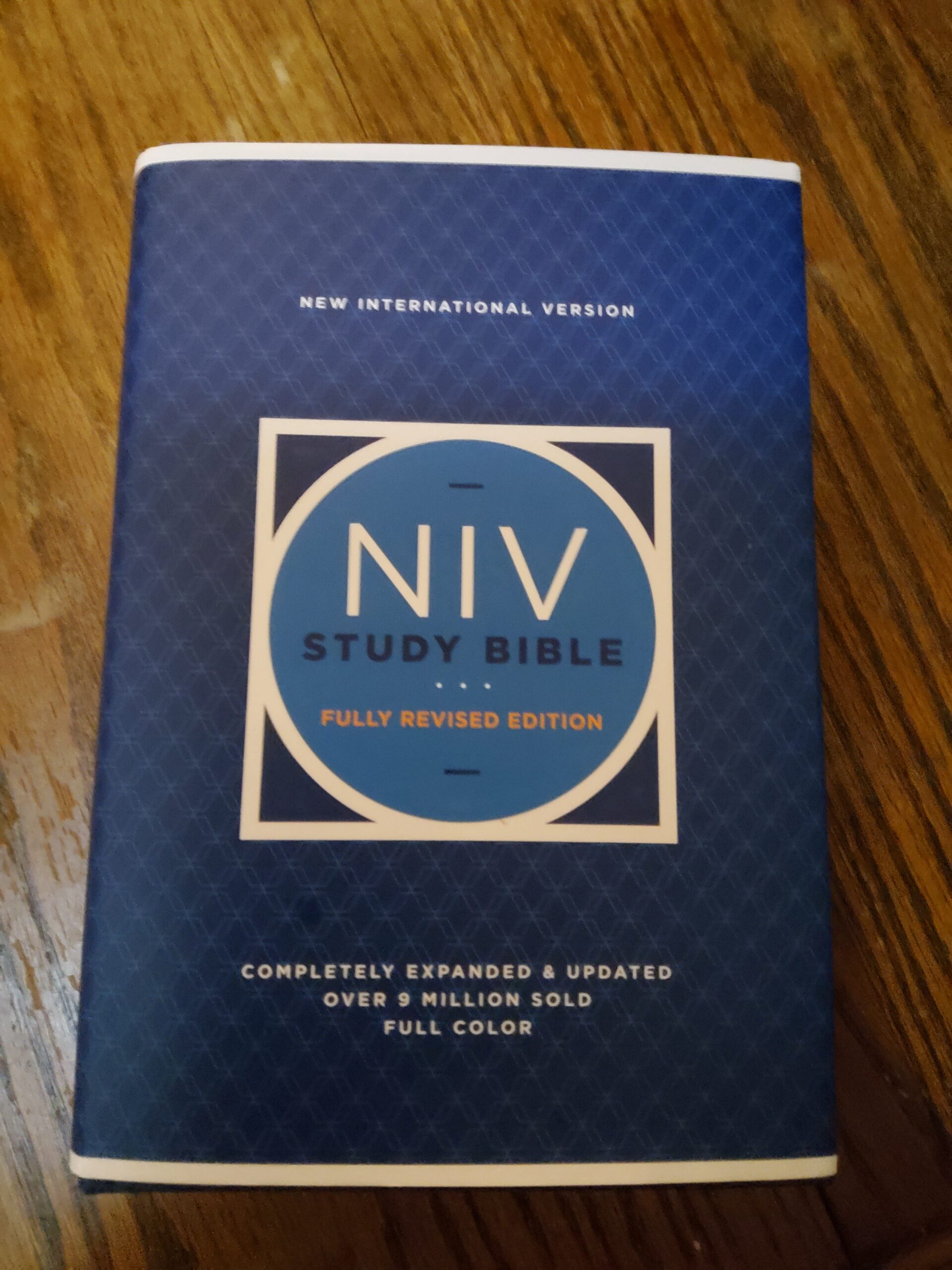
  • The NIV Study Bible (Fully Revised Edition

    The NIV Study Bible (Fully Revised Edition

    (I’m writing as a #BibleGatewayPartner and a member of the #BGBloggerGrid. See note at the end of this post.)

    When a book that I generally like undergoes a revision, I approach it with a bit of trepidation. Is it going to match the older edition? Will it be better? Or maybe it will lose all value.

    The NIV Study Bible hasn’t been central for me personally, but I have interacted with it through many, many students who used it as they attended my classes. It’s the sort of book that kind of fades into the background simply because so many people have it.

    I also haven’t lost my issues with study Bibles in general, in particular the potential that people become dependent on the interpretations of their particular study Bible, rather than actually reading the scripture, interacting with it, and also testing their interpretations against other streams. Having notes on interpretation so closely connected with the text of scripture can contribute to laziness.

    So I’ll start with my standard recommendation: Use more than one Bible translation, and use more than one study Bible, taken from different perspectives. You can find one set of suggestions here.

    That said, this study Bible is takes a balanced approach. By balanced, I don’t mean theologically. To some extent one’s theology will impact a study Bible. One has to write from a perspective if one doesn’t want to simply be confusing. What I mean by “balanced” is that it covers the various needs of a Bible student who may be working without a helpful teacher, and does so in good proportion.

    Consider charts like the chart of covenants conveniently placed near the text on the covenant with Noah. This chart helps a reader identify broad themes through scripture and draw connections.

    The spread with the chart on covenants.

    This combines with a variety of other charts that will help a student get perspective. Again, because this sort of information must be from some theological perspective, a serious student should compare other Bibles as well, preferably written from other perspectives. But this material is solid, and it makes a good case for itself being part of regular plan for study.

    Images are generally not just so you can feel good about a location, but are helpful to understanding the passage. Below is the tabernacle, conveniently place in the book of Hebrews. As I review my own study guide to the book of Hebrews I will doubtless recommend this as one option for study Bibles a group might use.

    From the book of Hebrews, on chapters 8-9

    At the same time, it is quite possible (and appropriate!) to disagree with a study Bible. On page 2161 there’s an article titled “Can Christians Lose Their Salvation?” with which I would take some issue.

    Conservative evangelicals will find the commentary on Romans 1:24-28 and the verses following quite to their taste, as it says the passage is one that makes it clear that homosexual practice is sinful. Progressive evangelicals will not. This is a passage where a commentator is doomed to anger somebody. For purposes of review, I’m simply stating the viewpoint so readers can get an idea of where this study Bible stands on the spectrum of study Bibles.

    A great feature of this Bible is that notes about background are clearly distinguished from those about application by color icons. Readers want help with application, but it’s important to realize that when you are applying scripture to modern times, you are that much further from the text itself. It’s good to know when you’re working with raw data (or as close to that as possible) and when someone is spanning the huge gaps of culture and time to tell you what you ought to do about it. Somewhere between these two are notes that talk about personalities or people groups, which are also clearly marked. These notes partake of both ideas.

    I should note as well that charts, such as those I have praised also fall somewhere between background and application. This simply means whatever you do study, you need to study carefully. Be aware constantly of the human element in scripture, where God uses humans as communicators, and also in all layers of interpretation. Simply by suggesting a background text from the ancient near east that is related to a scripture passage one introduces the bias involved in that selection. Prayerful, open-minded, in-depth study is needed.

    I can’t resist saying all of that, but if you want a conservative evangelical study Bible, this is an excellent choice. I’ll repeat my recommendation that you not depend on a single study Bible or commentary, but select sources that start from different perspectives.

    Zondervan provided me with a free copy of this Bible in exchange for an honest review, for which I thank them. I will provide a link to purchase the Bible in its various editions below.

  • Link: The Comma Johanneum

    Bill Mounce discusses the evidence that the added trinitarian formula in 1 John 5:7-8 is not original. This is a summary of well-known evidence, not breaking new ground, but is one of the clearest presentations I’ve seen.

  • Link: Mounce on Translation and Verbal Inspiration

    Link: Mounce on Translation and Verbal Inspiration

    While I disagree with a number of minor points, the one major one being that I would not use the word “verbal” in describing inspiration, this is an excellent outline of how Bible translators think and the reasons behind that thinking. The author, William D. Mounce, responds in some cases to Grudem, but the article can be read on its own.

    Read the complete article on Themelios.

    For full disclosure, I have used Mounce’s introductory Greek grammar for a number of years before I switched to Dave Black’s. Dave is one of my authors. Links to the two books are below for those interested. (Two different stores as I don’t yet have the February 5 edition available for my Aer.io store.) The third book is about Bible translation by some unknown author.

  • Galatians 2:16 – A Problem in Translation and Theology

    Galatians 2:16 – A Problem in Translation and Theology

    I wanted to write a quick note here as this relates to my study tonight, as well as illustrating quite a number of translation problems. Here is our text, with CEV (NOT CEB) to the left, NRSV in the center as a “literal” comparison, and NLT to the right. I’m copying the NRSV notes as they highlight the issue.

    CEV

    But we know that God accepts only those who have faith in Jesus Christ. No one can please God by simply obeying the Law. So we put our faith in Christ Jesus and God accepted us because of our faith.

    NRSV

    yet we know that a person is justifiedd not by the works of the law but through faith in Jesus Christ.e And we have come to believe in Christ Jesus, so that we might be justified by faith in Christ,f and not by doing the works of the law, because no one will be justified by the works of the law.
    Notes: d. Or reckoned as righteous and so elsewhere. e. Or the faith of Jesus Christ. f. Or the faith of Jesus Christ.
    (The Holy Bible: New Revised Standard Version. (1989). (Ga 2:16). Nashville: Thomas Nelson Publishers.

    NLT

    “Yet we know that a person is made right with God by faith in Jesus Christ, not by obeying the law. And we have believed in Christ Jesus, so that we might be made right with God because of our faith in Christ, not because we have obeyed the law. For no one will ever be made right with God by obeying the law.”

    Tyndale House Publishers. (2013). Holy Bible: New Living Translation (Ga 2:16). Carol Stream, IL: Tyndale House Publishers.

    If you look at notes e & f which are identical, you’ll see the problem. The Greek text can justifiably be translated either as “faith in Christ,” that is, our faith directed to Christ, or as “the faith of Christ,” Christ’s faithfulness to us. That’s not an insignificant difference. The NRSV does well here by translating one way and footnoting another. The problem is that people rarely read footnotes. In a Dynamic Equivalence (or functional) version the translator is obliged to make a choice. You cannot clearly express the meaning of the original in a new language if you have not understood it. Having understood it (you think), there is always the possibility that you have misunderstood it.

    This is another important reason why I urge people who study the Bible in translation to both use more than one and also to read translator’s footnotes. They can be critical.

    (See MyBibleVersion.com for some comparisons.)

  • Study Your Bible in English

    Study Your Bible in English

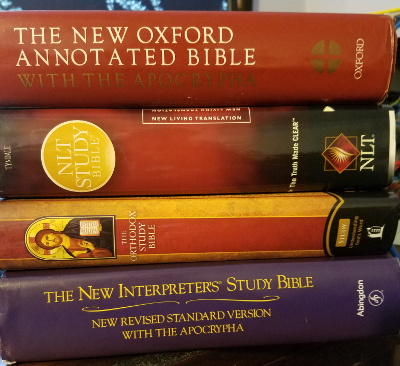
    Study Bibles Galore!
    Despite My Dislike, All These Bibles were within Arm’s Reach of My Desk

    That is, study it in English if English is your native language, and when your knowledge of biblical languages isn’t up to the task. Face it. For most people, even those who have some study of biblical languages. Different levels of study of the languages provide different levels of benefits. But for most people, the best idea is to study the Bible more carefully and thoroughly in the language they actually know.

    There’s a sense among people in the pews that knowledge of Greek or Hebrew provides some sort of magic key. This even affects pastors, who want to look up a particular Greek or Hebrew word in order to spice up their sermons or  to find the real meaning of a text. The problem is that looking up a particular Greek or Hebrew word and then wielding that definition like an axe, chopping chips out of the text, more often misleads than enlightens.

    For laypeople, the approach is often to find “the meaning of the Greek” through a commentary, or even worse through a concordance such as Strong’s. A correspondent once sent me a complete translation of a verse derived from glosses (single word or short phrase translations of a term) in Strong’s, in which not one single word was translated correctly in the context. One could, however, track the English words back through the concordance to a Greek word which did, in fact, occur in the verse.

    Words do not have singular meanings. It is more accurate to say they have fields of meaning, sometimes called semantic ranges. I look out the window in front of me and I see a number of things that I would call “trees,” yet they are not identical. Some are larger, some are smaller. At some point there is the transition between “bush” and “tree,” and “bush,” again, covers a range of items. The actual boundary is set by usage. Now that I live in Florida, I have to realize that Floridians call things “hills” that northwesterners would call mounds or bumps, while there’s nothing in easy range of here that a northwesterner would call a mountain.

    If you have the time and inclination to learn the biblical languages, by all means do so. But if you don’t, what can you do?

    Here are some suggestions:

    1. Don’t just go to the most literal translation you can find. People often believe that by using the New American Standard Bible, the English Standard Version, the New Revised Standard Version, or something similar, they are getting closer to the source language. In one way, these versions do get you closer to the original, an I don’t have a problem with using any of them. Just don’t assume that they take care of getting you closer to the original.
    2. Instead of #1, choose 3 or more translations. Try to find translations that are committee translations and represent different theological backgrounds. For example, the NASB, NIV, and NLT are all done by evangelical translation committees. They represent three different approaches to translation, but their committees are all conservative. The NASB is formal, the NIV is a kind of compromise version, while the NLT is dynamic or functional. (There are many more differences in approach to translation. Check my site mybibleversion.com and/or my book What’s in a Version?.) On the other hand, the NRSV is quite formal/literal while the Revised English Bible is quite functional/dynamic, yet the committees involved are from mainline denominations and thus more liberal. I recommend choosing your three translations to represent different theological traditions and different styles of translating. For protestants, I’d recommend including the New American Bible or the New Jerusalem Bible, which are translated by Catholic committees. The NAB is probably a bit more literal/formal than the NIV and the NJB is dynamic/functional like the NLT or REB.
    3. Instead of spending your time looking for glosses to Greek words in a concordance like Strong’s, spend more time studying relevant passages in English. Don’t find a gloss and then force it into all the verses. Rather, study each passage and look for definitions from the context. I mean definitions of the English words provided by the English context in your English Bible. So if you want to know what the “church” is, don’t worry about the definition of ekklesia in Greek. (Dave Black wrote some good notes on this the other day. If you read what he wrote about the Greek words carefully, you will see some of the difficulties in doing this sort of study unless you are very well versed in the language.) Worry about the definition of “church” (and related terms like “body of Christ”)  in English verses. How does Paul view this in Ephesians 4, for example?
    4. In order to keep from getting stuck with the work of just one committee, compare those translations. While the formal translations may be closer to the form of the Greek or Hebrew, you may not correctly comprehend what that form means. Try the options in one of the dynamic/functional versions. Then listen to the context. Many, many misinterpretations are produced by deciding what a word in the original language is suppose to mean and then forcing the verse to fit that meaning. Ask instead whether the definition you have in mind truly fits. In English, for example, the word “car” might refer to an automobile, the part of an elevator you ride in, or one element of a train. You wouldn’t take the elevator-related definition and force it into a passage about automobiles, would you? Don’t do it to the biblical text either. Consider words like “salvation,” which may refer to a moment of new birth, a continuous process of God’s work in the believer, or the eventual salvation from final death, among other things.
    5. Don’t be afraid of surface reading. Surface reading is a good starting point for study. I like to read an entire book of the Bible through before focusing on a section. That’s harder to do if we’re talking Isaiah or Ezekiel, but for most of the New Testament it’s not that hard. It’s a bit like standing on a mountain looking across a forest before trying to hike through it. You can read rapidly and you don’t need to understand everything. That’s what your later study is for.
    6. Don’t be intimidated. Those of us who read the languages also make plenty of mistakes. We’re subject to all the same human biases. I thank the Lord for the opportunity I’ve had to learn and for the gift of reading the Bible in its original languages. But none of that work gave me the right to lord it over others or to demand that they accept my view because of my study.

    Above all, I encourage you to study the scriptures for yourself and listen for God to speak to you. It is the privilege of everyone, not just of clergy or scholars. Many people have given their time and some have even given their lives so that you can have that Bible in your own language. Make the most of it!


  • Translating Metaphors and the NLT of Isaiah 43:2

    Translating Metaphors and the NLT of Isaiah 43:2

    is43-2

    I am very slow to criticize translations in broad terms. Every time I point out what I consider to be a problematic rendering in some Bible translation, someone will ask me if they should discard that version in exchange for a more accurate one. Any translation will contain renderings that can be questioned. In many cases there were people on the translation committee who questioned the chosen rendering. Translation has a great deal of art to it. Keep that in mind as I criticize this rendering in the New Living Translation.

    Here’s the NLT of Isaiah 43:2 —

    When you go through deep waters,
        I will be with you.
    When you go through rivers of difficulty,
        you will not drown.
    When you walk through the fire of oppression,
        you will not be burned up;
        the flames will not consume you. (via Biblegateway.com)

    Now I think the NLT has captured some of the meaning very clearly. The interesting thing is the translation of the metaphors. The words [of difficulty] and [of oppression] are not explicit in the Hebrew. Now the metaphor probably justifies this reading as a good option for understanding the text. My problem with it is that the metaphor is, in my opinion, equally comprehensible in English as it is in Hebrew. That is, in reading this passage, an English-speaking reader would probably feel free to choose from the same set of events or experiences that might be referenced by the metaphor.

    On the other hand, the modern reader might tend not to see the same range of literal understandings. “Through deep waters” doubtless would evoke the Red Sea (Sea of Reeds) and possibly the flood. “Through rivers” would likely evoke the story of crossing the Jordan, while “fire of oppression” might well draw on the story of the three Hebrews (Daniel 3), though of course based on dating, that story might even be said to draw on this. In this way the NLT rendering takes away some literal connections to the narrative of Israel’s history/traditions which might easily be missed.

    The three metaphors are each translated with a different impact. The first, “deep waters” is left literal. This is perhaps due to the flood, Red Sea (Sea of Reeds), and the Jordan. In the second case we break out the metaphor, though it is closely parallel to the first, but we break it out in a generic sense, “of difficulty,” which says to the reader, “Don’t take this literally, but it has broad application.” Finally, in discussing fire, we get very specific, and say, “fire of oppression.”

    But does not that third option reduce the potential for the English reader to less than the Hebrew intends? Yes, sometimes translators have to make this sort of choice, but in this case, I think we take a passage that can be clearly understood when rendered in a largely formal fashion, and actually diminish its impact with explanatory prepositional phrases.

    This isn’t a terrible rendering, but at the same time, it struck me as not being one of the better ones in the NLT.