But all the tools I use benefit from making manuscripts more accessible. I recommend looking at a manuscript digitized in the type of resolution they’re talking about to understand the benefits for researchers. I wrote a paper for my class in NT textual criticism in college and had to acquire microfiche images for a number of manuscripts. Not fun to read!
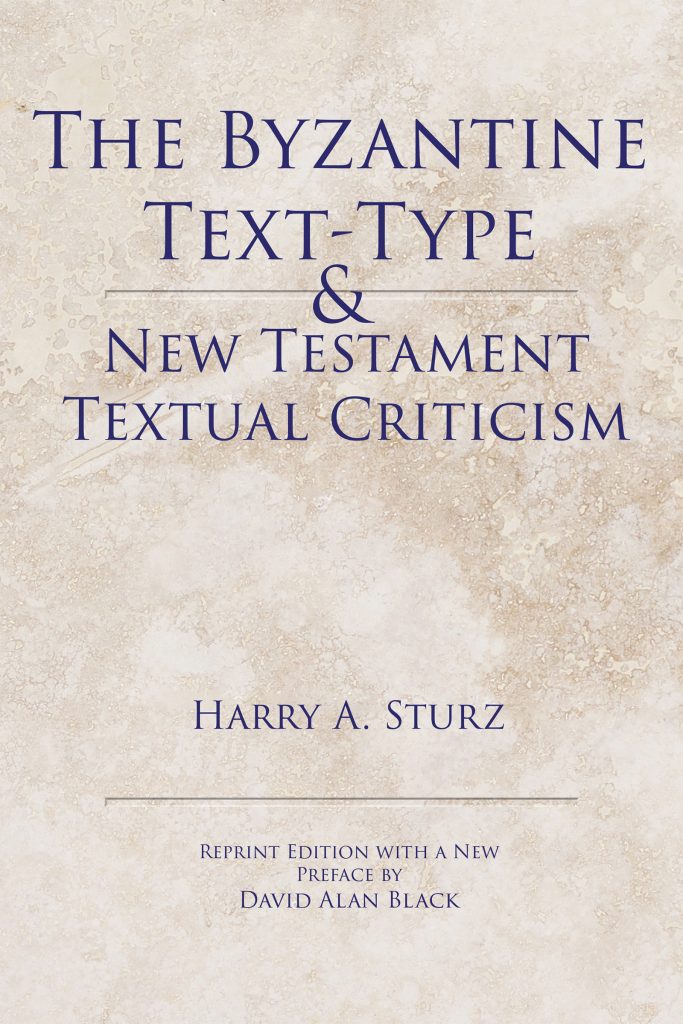
PS: My company has just released a reprint of a work from the 1970s, The Byzantine Text & New Testament Textual Criticism. As I was reading this, I was thinking how much easier it would be to research the kind of information used with current digitized manuscripts.
In my business role as president of Energion Publications, I’ve just cleared the proofs for the release of the book The Byzantine Text-Type & New Testament Textual Criticism by Dr. Harry Sturz. This is a reproduction of the original book, released in 1984 and is produced under license from HarperCollins Christian Books.
Note: This discussion is not intended for experts, but for people who have only occasional contact with New Testament textual criticism. While I have studied textual criticism, I am not a specialist in it by any stretch of the imagination.
We have thousands of manuscripts of all (a few) or part (many) of the New Testament. In preparing a Bible translation, translators must make choices of which manuscript readings they are going to use.
It’s easy to overestimate the problem here, because significant and/or doubtful variations form a very small part of the New Testament text. Nonetheless, in public discussions, the variants get all the press, because we like to find things that are different, and therefore more interesting.
One thing I learned early in studying textual criticism was that manuscripts should be weighed, rather than counted. What does this mean and how does it work? Well, in general textual critics divided manuscripts into three large groups, which were named for regions associated with them, though actually divided by characteristics of the text. We had the Western text, associated with Rome and parts west, the Alexandrian, associated with Alexandria, Egypt, and the Byzantine text, associated with the eastern church.
The vast majority of surviving manuscripts are of the Byzantine text-type, largely due to history. The church survived much longer, and many more copies were made in the east. In addition, a great deal of manuscript production in the west was in Latin. I’m brushing past a number of factors, but the bottom line is that there were more Byzantine manuscripts.
In the 19th century, and somewhat into the 20th, there were a large number of manuscript discoveries, or rediscoveries, which produced texts that differed from the common texts found in the majority of the manuscripts. These newly-found manuscripts were older, in general, than the existing manuscripts, and in many cases included readings that scholars thought were more likely original. This produced a strong swing in scholarly work toward the text in these newly discovered manuscripts. The Alexandrian text got a lot of attention, with the western text following not far behind. A theory developed that the Byzantine text was the result of a major editorial effort, that produced a single, new text.
As a result, two things happened. First, the Byzantine text was considered generally more recent than those newly discovered manuscripts, and second that it was likely to have readings that were essential 4th/5th-century revisions. At most, it could reflect essentially one manuscript.
Opposed to this general consensus, on which the text of most modern Bible versions has been based, was the view that the reason we had more Byzantine manuscripts was that the text was actually better preserved there, so that it should be preferred, and manuscripts from the other text-types should be considered some sort of aberration.
Dr. Sturz argued that the Byzantine text-type could and did preserve older readings. It was not to be preferred over all others, but its readings should be given due consideration in all cases. He provided evidence that many Byzantine readings show up in early papyri, showing either that if there was any unifying editorial process, it had not been one that erased all of the prior evidence.
The general result of accepting Dr. Sturz’s argument is to improve the evidence that we have for determining the text of the New Testament, as well as change the weight we give to various sources.
I am glad to be able to release this important book and make it available at a reasonably price again. On the Energion Publications retail site, it will be available for $22.99 (suggested retail 24.99) through Wednesday, which is the official release date.
Below is an interview I conducted with Dr. David Alan Black (who wrote the preface to the new edition) and Dr. Abidan Shah.
The limited number of comments focus, as might be expected, on New Testament. In fact, it seems to me that most discussion of textual criticism tends to focus on the New Testament, and this sometimes leaves the wrong impression. For example, to a query about the reliability of the biblical text an apologist might respond with the number of manuscripts we have … of the New Testament. But what about Hebrew Scriptures?
If I were to answer the question posed (and if it’s not obvious, I’m not a practicing textual critic), I would have to say that when looking at a passage in the Greek New Testament I’m going to look at the external evidence first, and then the internal. This is for practical reasons. With the number of New Testament manuscripts, versions, and quotations available, one hopes to find the best reading somewhere in the external evidence. Internal evidence can help refine one’s choice, but in practical terms, most of the actual readings are likely to be contained in some manuscript somewhere.
I wouldn’t argue that all readings that ever existed are to be found in one of our extant manuscripts. There is a theoretical place for a conjecture. So I wouldn’t say that the external evidence places a fixed limit on where we can go with the internal evidence, but I would say that it sets a pretty fair boundary. I would require substantial evidence to go with a conjecture, and even then, it might be a conjecture about an original reading that would generate the external evidence as we have it. So it’s a line, but it’s a line in the sand. It can be moved. In my experience, however, it is rarely necessary to move it.
But when we turn to the Hebrew Scriptures/Old Testament, the situation is much different. The manuscripts we have come from a time much more removed from the composition of the texts involved, and there are less of them. I think the time between the composition of a text and the first extant manuscript receives too little attention in discussions, because the time before a text is established as sacred is when I suspect much of the variation will occur. It’s quite possible that there are a number of New Testament variations that we don’t consider simply because they are no longer represented in the manuscripts.
The shift to Old Testament textual criticism was rather interesting for me, as it seems to some extent that you travel to a different world. There are necessary differences because the nature of the external evidence is different. There are even more differences because there are more texts that are obscure. In reading commentaries, one might think that for OT texts lectiodificilior is turned on its head as one runs through possible readings, including conjectures until one finds a reading that “works.” Nobody is going to quite say it that way, but that is how it often feels. And, of course, lectio dificilior has its problems in that it’s quite possible that a difficult, yet translatable, reading could be introduced by error. So it’s not an absolute.
In the Hebrew scriptures we have more cases in which a passage is truly obscure. Nobody really knows how to translate or interpret. So you get a translation and footnotes. I had a professor in graduate school who absolutely hated the idea of conjectural emendation. He simply wouldn’t accept any. But he’d accept some very wild conjectures on how to translate the text that is actually there. He and I went a few rounds on what the difference was between arbitrarily conjecturing a text that you could then translate or arbitrarily choosing some English words you could say were a translation of the text. In either case, the meaning presented by your translation is a conjecture.
Conjectural emendation has a bad name, and there is a good reason for this. Critical commentaries on Old Testament books are often filled with conjectural reconstructions of the text that have very little basis in either an internal analysis of the text and transcriptional probabilities or in any external evidence. Often the emendations simply make the book fit some theory of composition, or better represent the theme that the commentator believes, for whatever reasons, must have been intended by the author or redactor.
Nonetheless, in theory, it is possible that a reading not contained in any manuscript could be the correct reading. The problem is always making a solid case that it is. Few conjectures have managed to gain the support of a strong consensus of scholars.
Does any of this make any difference to you and me as we try to study our Bibles? Well, yes and no. The problem, as I see it, is to acknowledge the value of textual criticism without believing one must get to that elusive “original text” in order to have good theology or be a good disciple.
I would suggest that it’s important to seek the best text of scripture simply because it’s important to seek out the best information we can on any subject. At the same time I don’t think we need to be concerned about variants, even substantial ones. We tend to take the biblical data in a selfish way, as though all the manuscripts exist in order to provide us with an accurate view of scripture. But each one of those manuscripts was (part of) someone’s Bible at some time and place. I can worry about whether the Hebrew text behind the Septuagint (LXX) is better or if the Masoretic Text is better, but early Christians lived and did theology with the LXX and the Reformation (not to mention Judaism) thrived on the MT. These aren’t just witnesses to which text I should use; they are Bibles, sacred texts, used by real people.
The much criticized Vulgate, abandoned by protestants in pursuit of the sources, was nonetheless the Bible for many people. So in modern times was the Living Bible, as flawed as I think it was as a translation.
If God desired the kind of precision that some of us seem to think is required of the biblical text, I think God would have taken a different approach. But instead of a clean process in which we can give absolute or near absolute answers to all questions about the text, we have a variety of materials produced in different ways. While we long for perfection, for the inerrant text, we don’t actually have it. The claim of inerrancy is made for the autographs, not for any text you have or are likely to have in your hands.
Which, incidentally, is why I have little use for the doctrine of inerrancy, one way or the other. And let me be clear that I do mean as expressed in the Chicago Statement. I just don’t care whether the autographs were inerrant or not. If God was happy to use an error-prone process of transmission, why must I conclude that he somehow protected the original manuscript.
Let me illustrate. Supposing that Ezekiel (my very most favorite prophet) is hearing from the Holy Spirit, and he slips and writes the wrong word on the page. It’s a mistake. The manuscript is now no longer inerrant. The autograph is flawed. Oops!
Now suppose instead that the first scribe to copy the book made the very same mistake, after which the original was destroyed. Now we have only one copy of the book of Ezekiel, and it has the very same error.
The first scenario is considered problematic. The second is OK. It’s a copyist’s error.
I disagree. God has chosen to provide God’s Word to us in written form with every evidence of human involvement all along the way. I find it amazing that the text has been preserved as well as it has been. I find it more amazing that it has been available, used, and defended by people in so many places and at so many times. Many of these people were defending texts that various modern scholars would call “corrupt.” They might have been preaching from a manuscript copied by a careless scribe. And yet preach they did! And they lived out their faith as they knew how.
It’s not just thousands of witnesses to the text. It’s thousands of Bibles used by many more thousands of people.
We ask the question of whether we can rely on the text. I think it’s the wrong question. The question is whether we can rely on God who, through the Holy Spirit, has been speaking since before anyone conceived of a Bible and who is ready to talk to us today. We’re not perfect. None of us. We don’t have perfect texts. None at all.
But we can work through the multitude of materials available to us and so communicate not only with God, but with the community of faith that God has established. It’s a community that extends across time as well as space. It’s made up of people who were never perfect but always trying and hoping.
Now don’t let the fact that we can’t get 100% of the original, perfect text keep you from getting as much of it as you can. And don’t let the fact that you can’t really know all there is to know about God keep you from trying to get to know God better.
I think that God has set this up so that in trying to know God better (vertically?) we also need to get to know and appreciate one another (horizontally). It is in community that we come to know.
Or better, it is in community that we keep on the journey toward knowing.
A couple of weeks ago I was asked to teach a Sunday School class on the history of the Bible. Teaching a class on how we got the Bible in about 50 minutes requires some serious decisions; you can’t cover everything, but you want to cover the most important thing.
At one time I would have thought this idea of translation of translations and copy of copies would largely be a waste of time. Surely everyone understands at least this much of how copying and translation work, both in ancient times and today. But then there is the truly dismal article recently in Newsweek, which demonstrates yet again that you can’t count on major news sources to do even minimal research and fact checking. It’s not my intention to refute that article; it’s both self-refuting, and has been refuted quite ably multiple times. But I am interested in the number of Christians who don’t seem to know how to respond to a claim such as I have in the title.
So has the Bible been translated so many times that you can no longer rely on the content? Has it been copied so many times that the cumulative weight of errors has made it essentially unrecoverable?
Quite apart from bad journalism, these questions were awaiting me in Sunday School. I’m going to first go through the logic copying and translation generations, then talk about definitions and how we use terms such as “reliable,” “original,” “significant,” and “accurate,” then finally look at what we should do about this sort of thing. I really don’t blame Newsweek, surprisingly enough. They are much more a symptom than a cause.
This first part is simple. If you already have some knowledge of the history of the Bible or of ancient manuscripts, you shouldn’t need to read it at all.
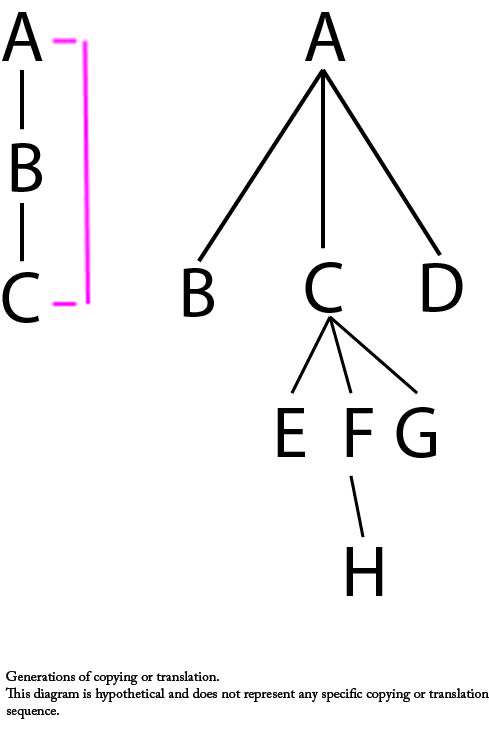
The following chart will help illustrate the discussion:
Translation/Copying generations illustrated.
Translating a document is non-destructive. If you look at the left hand side of the chart you’ll see a simple illustration of generations, A, B, and C. If this is the generations of a translation, then some meaning will be lost between A and B, and then additional meaning will be lost if C is translated from B. An illustration might be the translation of the Old Testament from Hebrew to Greek in the LXX (Septuagint), and then into Old Latin. Jerome preferred to go back to the Hebrew when he produced the Vulgate.
The loss of meaning is ameliorated if one consults the original while translating from a translation, as shown by the red lines. This latter situation illustrates the story of the Douai-Rheims Bible, which was translated from Latin, but with the Greek and Hebrew texts available. Until Vatican II, Roman Catholic translators were expected to translate the Bible from the Latin. Since that time, a number of excellent Catholic translations have been produced from the original languages, including the NAB and NJB.
Note, however, that the A-B-C chart on the left illustrates the worst situation, a translation of a translation. Not only that, but you will find it hard to locate a translation of this nature in the Bible section of any bookstore, because almost all modern translations are made from the original languages. One exception is The Living Bible. That version stands alone in being properly called a paraphrase, as it was paraphrased from an English version, the American Standard Version, so it was a paraphrase of a translation.
So the idea that the Bible has been translated so many times that we have lost all idea of its meaning is simply false. Most translations are from the original languages, and besides that, I can pick up my Greek New Testament, or one of my copies of the Hebrew scriptures, and read directly from the original languages.
If we look now at the chart on the right, just the part showing A through D, we see this illustration. Yes, the Bible has been translated many times, but the vast majority of these translations went back to the original languages, and not to any translation.
In class I was asked about the KJV. Where does it fall in all this? It’s a translation from the original languages. There are those who accuse the translators of using the LXX as the source for the Old Testament, but what they actually did was consult the LXX as they translated the Hebrew, which was (and is) a good idea.
So what about copies of copies? Notice that when I said the translators go back to the original, it was always “original languages,” not necessarily “original text.” That’s because it’s quite true that we do not have the autographs. Further, we don’t know precisely how many generations of copying have gone on.
But there are two counterpoints to this. First, it is vanishingly unlikely that the number of generations is in the thousands. We have thousands of copies, but those that date back to the first few centuries are doubtless only a few generations removed. Second, and more importantly, the number of copies made actually works against the issue of copyist generations, because it is unlikely that each generational sequence will produce the same errors. So as you look at the right hand side of my chart above, you will see how you can have many, many copies in only a few generations. In the case of the Bible we can look back through history using multiple paths. This allows us to attain a fairly high level of confidence in the text that we use.
And what we use is a critical edition, either one already available, or one made by the translators of a particular version. We don’t go back and just grab a manuscript and start translating. First we must study the text, comparing these many, many witnesses to the source text, and coming to the best conclusion we can. For the vast majority of the New Testament text, there is next to no controversy.
But here is where the issue of definitions comes in. What is significant? What can be considered reliable? What do I mean by confidence in the text? It’s extremely important for us to be clear on these things, otherwise it’s quite easy to seem to be lying.
There are significant variants in manuscripts. What do I mean by “significant” in this case? Simply that these variants would alter the way I would translate. There may be spelling differences, but these I would not regard as significant.
On the other hand, one might consider only those variants that might impinge about a doctrine, or perhaps a major doctrine, of one’s denomination as significant. Such a variant would be the supposed Trinitarian statement in 1 John 5:7-8.
But that, in turn, raises another type of significance: How viable is a reading. A goof by a scribe in one manuscript out of hundreds that might witness to a particular passage hardly qualifies as significant to the textual critic. Interesting in terms of scribal practices and lack thereof, but hardly significant to determining the actual reading. In the case of 1 John 5:7-8, we would have to say that the reading is not significant, at least to the vast majority of textual critics, as it is not regarded as viable. (Disagreement is possible on virtually anything, of course. The question is how valid or well-founded such disagreement is.)
My point here is that we need to be careful with these terms. I find a text that is 95% non-controversial quite reliable as historical materials go. Historians often work with less. But to certain KJV-Only advocates, the only thing that would be reliable would be 100% equivalence. They tend to waffle, however, when presented with printing errors in the history of the KJV.
I read my Bible with confidence, not because I don’t think there’s any question anywhere in it, but because I think the reconstruction is extremely good and the differences that remain don’t make problems for me. In fact, they make the whole thing more interesting. I see God working in the imperfect people who experience His presence and activity and recorded that for us. I again see God working in the amazing distribution and preservation of copies of what those people wrote. I am not disturbed by the problems; I’m astounded by how few there are.
All this leads me to what I see as the problem. People with the training to understand this process rarely talk about these things in Sunday School or from the pulpit. I have heard two reasons for this: 1) It’s too complicated and people don’t want to know, and 2) It might shake their faith to hear about this stuff.
I think both are bogus. I haven’t encountered anyone who can’t understand the process of copying and translation once it’s explained, and people are going to hear about this from someone, perhaps someone who claims the Bible has been translated hundreds of times, with the implication that it has gone through that many generations. Not talking about it isn’t helping anything.
When we do talk about it, we need to do much ore than simply say that we know how it works and you can rely on your Bible. In modern terms people will expect at least 99.9% accuracy when you say that, if not 100%. The first person to come along and point out that there are thousands of variations in the text will then be able to shake their faith.
You may say that claiming this level of reliability is not deceptive. After all, considering historical processes and understanding how copying and translation work, the Bible is remarkably well preserved. But the people in the pew don’t hear it that way because they often don’t have the background in historical methodology to figure it out. They’re going to feel deceived, because they interpreted what you said within their context, and they got the wrong idea.
You may not regard the absence of John 7:53-8:11 from some of our oldest manuscripts as significant, but your congregation almost certainly will. I’ve been told that it isn’t significant, because we can still teach about forgiveness even without the story, but that is a rather loose idea of reliability, accuracy, or confidence.
My suggestion is to take the time, provide the background, and let people understand just what is in question and what is not. Define terms carefully, so people understand just what portion of the text is in question and what is not.
We need to do more than just respond to miserable articles like the one I referenced above. We need to teach this material up front.
After all, in one way or another our congregations are relying on the Bible as at least one witness to the Word of God. We need to tell them why we think they can.
An interesting discussion arose via a comment to my post on last week’s discussion of the Gospel of John. This relates to a textual variant in John 3:13. The verse ends in most versions, and in the UBS4 Greek NT that I use regularly, with “the son of man.” But there is another reasonably well attested variant which adds “who is in heaven” following “son of man.”
Dave Black, who posted the question, has written a journal article about this. In the comments I said I’d like to get a copy of that article, but it was only moments later that I located it. You can read it here. On this computer I’m having trouble with the Greek text, probably due to font issues, but I was able to follow it well enough as is. [Update: Dave sent me another link, this one to a PDF, and the Greek text is good in it.]
Prior to reading Dave’s article, I had come to the conclusion that I preferred to include this phrase rather than leave it out. I did not make use of this in my study, as it has little impact, as I see it, on what I said. I always dither over how much time to spend discussing textual variants. This is a very interesting variant, however. Please read Dave’s article first. While my reasoning is a bit different, and my interpretation considerably so, he covers the facts of the case, and I’ll just note those differences here.
Please read with a caveat: I’m not a NT textual critic. My last class in NT textual criticism was as an undergraduate. All my graduate work was on the Hebrew scriptures.
Of the canons of textual criticism, the one I consider to be the most useful is this: Favor the reading that best explains the others. I find that choosing the most difficult reading involves so much debate that it adds little weight to the result. I do think it’s valid, i.e., a difficult (but workable) reading is more likely to produce variants through correction, simple misunderstanding, or hearing/seeing what you know is there. But that also feeds into determining which reading best explains the others. In this case, I find it very difficult to see an explanation for the other variants if “who is in heaven” is not the original text. In fact, as Dave notes, Metzger (A Textual Commentary on the Greek New Testament) presents this as the argument of the committee minority, while the majority was swayed by the quality of the witnesses to the shorter text.
I would not necessarily accept the variety of the external evidence if the reading did not also so clearly explain all other variants. In combination, I find them convincing. Of course, one should always remember that textual criticism is not an exact science. There’s plenty of room for valid disagreement. I would note, for example, that the UBS4 rates this reading a B, while my edition of the Textual Commentary, based on UBS3, rates it a C. I’m not sure what happened to increase their certainty. I don’t share it.
At first blush, this reading seems difficult. Here’s the son of man on earth, and he’s also being affirmed in heaven. Either this is a very high christology, or we have a problem. That very problem contributes to the probability that the reading is original. There’s plenty of reason for someone to remove it, thinking it’s an error, but little to add it. But on further reflection, I think it’s very possible we are here, as in vs 11 & 12 (at least) hearing the voice of the author/community, with the affirmation that Jesus has ascended. Though I see a few difficulties with it, I would be unsurprised if everything after John 3:10 through the end of the chapter represented further comment by the author and is not intended as a quote attributed to Jesus.
That said, I will pursue further christological heresies this coming Thursday! Or not … as the case may be.
On the matter of older manuscripts, one of the key reasons this is less of a concern than it might be otherwise is that we have so many manuscripts available that we can afford to make a few mistakes. Really! I mean that! There are so many manuscripts, Lectionaries, quotations, and translations that the New Testament scholar can be overwhelmed with the sheer quantity of potential evidence. Having done most of my own work on the Old Testament/Hebrew Scriptures, I really notice this difference when I turn to NT passages.
Second, we try to avoid other potential problems by looking for a reading that shows up in different geographical areas. The point of this is that we are more likely to be finding manuscripts that reflect different exemplars if they were copied in places that are far apart. This again helps to correct for any other problems that a lack of a detailed history might cause. In modern textual criticism this is accomplished by looking for manuscripts in different families.
Most scholars would still hold that there are three major families of manuscripts, the Alexandrian, the Western, and the Byzantine. One of the current debates is over the value of the Byzantine manuscripts. Unless you get seriously into textual criticism, you will not likely need to engage with this particular debate. Just look for variety!
When you encounter a textual note in your English translation, you likely won’t have this kind of information. The best source for a person who does not know Greek and cannot resort to a good Greek edition is a commentary that discusses the available evidence. A brief explanation such as this might help you understand such discussions.
Finally, let me comment on what variants mean for the reliability of our text. The number of variants in the NT text is often cited as a reason to believe that the text is hopelessly uncertain, but that’s simply not the case. The more manuscripts you have, considering that they are copied by hand, the more variants you will have. But the more manuscripts you have, the better you are able to determine the original reading. In addition most variants are relatively insignificant.
Why do I say insignificant? Let me give an analogy from my publishing work. When I edit a manuscript the majority of issues I find will be very easily identified typographical or spelling errors. There is never any doubt what the author was trying to say, and correction is easy. In a much smaller number of cases a word will be wrong and the correction a bit more difficult, yet one can be fairly certain of the desired result. In a relatively small number of cases an author will have written something I simply can’t decipher, and I have to ask what he or she meant.
The vast majority of errors in the manuscripts belong to the first category. Sure, they are variants, but it’s obvious what the original text is. Of the remainder, a large percentage have an almost overwhelming consensus on what the correct reading is. The number on which there is a viable dispute is rather small.
Philosophers sometimes appear to talk in obscure ways. They do so because they take into consideration what people often overlook. If a poet (Longfellow) can say, ‘things are not what they seem’, the philosopher will give reasons why. The fact is that we do not always make a correct judgment about what we sense. Perception may mislead. So, taking this into account, the philosopher says, ‘I seem to see a red pencil.’ By using the expression ‘I seem to’ he suggests that what he sees may not be what it seems to him to be.
In spite of this allowance for doubt, it is usually the case that what seems to us to be so in our ordinary experience is probably so. So we quite reasonably judge that the way things seem is the way they are. So in our ordinary course of life we do not say, ‘I seem to see a pigeon’, ‘I seem to hear a loud noise’, ‘I seem to be touching a tennis ball’. We only use the term ‘seem’ when we have some doubt about what we are perceiving.
The question is whether there is an analogy from such ordinaryexperience to religious experience.… (Edward W. H. Vick, Philosophy for Believers, p. 119)
I was thinking of the first two sentences in connection with the use of definitions. Philosophers tend to spend more time defining, and often those who are not philosophers get rather impatient with this. But I was working with the word “significant” in connection with textual criticism.
One of the great arguments in textual criticism and its application to Christian faith and understanding of the Bible involves what are significant variants. So one person says that there are many significant variants in the New Testament text, meaning, perhaps, that the variant could impact a translation in some way. Another says that there are less significant variants, but still a fair number, considering only those variants which would impact the exegesis of the particular verse as significant. Yet another says that there are very few or even no significant variants at all, considering as significant only those variants that would impact a Christian doctrine.
Thus we have great, and sometimes angry debates, which might go back to what we think is significant.
Perhaps getting a bit more pedantic about the definitions would help!
I chose to do some reading from Hebrews this morning, but instead of using my NA27 or my UBSIV text, I went to Bible Gateway and read from the SBL text. There I encountered (again) the reading chwris rather than chariti. (I checked out NA28 online and I see it still reads chariti.
I tend to lean just a bit toward internal evidence over external in textual issues. The reason for this is that I suspect that most variations in the text likely occurred early in the transmission history, where we by nature will have the least evidence for them. In this case, however, I would have to say that one can argue the internal evidence either way. Which text is more difficult? It depends on how you read it. Using chariti seems almost superfluous to the conversation. Some of the explanations for chwris as a marginal gloss seem pretty reasonable. Either reading could cause someone to go for the other. Either can be explained as fitting the text.
At this point, I think the Nestle-Aland text has it right. The overwhelming external evidence would need to be countered by much stronger internal arguments to convince me that chwris was original.
I took a quick glance through a few translations that are here within arm’s reach, and found none that accept chwris as their primary text. The NRSV and the REB both mention chwris as an alternative in a footnote.