Threads from Henry's Web

Category: Bible Translation

  • The Passion Translation: Content Review

    The Passion Translation: Content Review

    The Passion Translation has received considerable negative publicity while being supported in an equally passionate way, especially in the charismatic movement. You can find my overview on MyBibleVersion.com, and I presented an overview of criticism and of my review methods in a previous post.

    How I Rate Translations

    Follow the links above to see my rating of The Passion Translation, which also provides an example of how I do such a rating. I do not designate Bible translations as “good,” “bad,” “ordinary,” or some other generic designation without regard to context. I prefer to rate a translation for strengths and weakness in different areas.

    The chart provided shows numeric ratings. Many of these are themselves subjective. I use word counts to determine how formal or functional a translation is. By functional, I don’t mean that the translation works, but rather that it translates in order to provide equivalent impact on the target audience to the original. A formal translation attempts to match specific words or phrases to source words in the Greek, Hebrew, or Aramaic text.

    But having done a word count in a specific passage (I start from Hebrews 1:1-4, which tends to force some rewording), I also look at other passages to see if that number works. Thus the numbers provided should be considered a personal opinion on each item.

    Specific Notes on TPT Ratings

    In the case of The Passion Translation, my own key takeaway was that the overall impact of a translation may be badly skewed by either its critics or its proponents. In the majority of cases, I found that passages were precisely what I would expect of a missionary translator. This doesn’t mean that the translator’s theology has no impact. Everyone’s translator’s theology has an impact. One cannot translate without interpreting, and one’s interpretation and theology will be tied together. What surprised me, after first having heard the hype, was how expected the renderings were.

    Of course, ratings such as whether a translation is by a committee or an individual were fairly clear–this is an individual translation. In addition, it’s clear that the translator is in the charismatic movement, and specific related to the New Apostolic Reformation. Nonetheless, as I’ve stated before, when you have the translated work in front of you, the proper approach is to examine that work.

    In terms of formal vs functional, I found that TPT was closer to formal and less free in rewording than I would have expected from the criticisms. It definitely reflects a willingness to reword and rework passages for the target language and audience. Yet I found it less likely to do so than The Message.

    My initial word counts from Hebrews 1:1-4 actually indicated considerably less rewording than I expected, and after reading a number of other passages, I edged the ratings a point higher on the “functional” scale and a point lower on “formal.” One might describe this as a dynamic or functional translation with some significant deviations.

    Specific Renderings

    Ephesians 5:22

    In my previous post regarding the hype about this translation I included a video. In that video, the translator claims to have received a new translation from God (discussion starts about minute 20:00). I won’t go into this in detail, but on linguistic grounds, I would have to reject his suggested translation.

    Why? First, I would not accept his claim that Jesus and the apostles worked entirely in Aramaic, and certainly not that the book of Ephesians was written in Aramaic. There is no evidence to support the latter at all, and I find any evidence regarding the gospels to be quite weak. Second, the Peshitta, which is the closest thing we have to an Aramaic version, reads very much as the Greek does.

    Note that I would not list this as an error. It’s a strong difference of opinion. I wouldn’t mind if the text read the way TPT reads. I’d be very comfortable with that. But I can’t support that linguistically.

    Because of the intensity of criticism, however, I need to note here that I disagree with most Bible translations at some point. Practically anyone who reads the Bible in the original languages will disagree with any translation at some point or another. Disagreement is different than rejection.

    (For those interested, my friends Elgin and Hanna Hushbeck have written a book in the Topical Line Drives series from Energion Publications, To Love and Cherish, which goes into this passage in depth, based on the Greek text.)

    Psalm 110:1

    Yahweh said to my Lord, the Messiah:
    “Sit with me as enthroned ruler
    while I subdue your every enemy.
    They will bow low before you
    as I make them a footstool for your feet.”

    Psalm 110:1 (TPT)

    There are a few interesting points here compared to the Hebrew, and they’re worth noting in understanding the nature of the functional approach to translation, along with some “transculturation.”

    The use of “Yahweh” has not been traditional in English translations, but here it literally reflects the source text. The traditional approach has been to use LORD for “YHWH” and “Lord” for the Hebrew word “adonay” while using lord for the same word with reference to a human ruler. (Note: I use loose transliteration of the Hebrew to make it easier for readers who don’t know Hebrew. In this case, however, it’s worth noting that “adonay” is “my Lord” with a plural of majesty, while “adon” is just “lord” and “adoniy” is a singular “my lord.”)

    Thus in traditional translations the first line of this verse comes to something like “The LORD said to my L/lord,” with the capitalization of the second “lord” depending on how the translators interpret the verse. Read Messianically, it would generally be capitalized. Read as a blessing on an earlier Israelite king, it would not. I can testify from teaching experience that the LORD/Lord/lord difference can cause some confusion.

    Thus in the first line, TPT makes an interpretation quite clear. The translator is conveying a Messianic interpretation, and clarifying the difference in the terms for English readers. In case the capitalization is insufficient on “Lord,” he adds “the Messiah.”

    One might complain that a reading that is non-Messianic would now not be possible, yet at the same time, the clarification of the fact that the two instances of “lord” (however capitalized) represent different words makes another aspect of the verse much clearer. Translators regularly make this kind of choice for readers. There’s no avoiding it. You can’t convey all the potential meanings.

    So in the second line with have “Sit with me as an enthroned ruler.” This is a more equivocal kind of clarification, a case in which the translation is clearer than the source. Formally, the first part of the Hebrew reads “Sit at my right hand.” This would indicate a position of trust and authority. Some might regard “as enthroned ruler” as an overstatement. James and John as to be seated at Jesus’ right and left hand. This would have meant that they were the first and second rank below Jesus in His kingdom.

    In either a messianic or a royal enthronement context, however, “enthroned” doesn’t miss the point.

    The remainder of the verse is quite valuable in indicating the nature of this translation. Formally, I would translate the Hebrew text as:

    Until I place your enemies as a footstool for your feet.

    Psalm 110:1b, formally translated

    And the TPT:

    … while I subdue your every enemy.
    They will bow low before you
    as I make them a footstool for your feet.

    Psalm 110:1b (TPT)

    So what’s going on here with all the extra words?

    The translator is trying to present you with imagery that will help you understand the meaning of making enemies a footstool. The imagery would likely have been well-understood by ancient Hebrew readers, but words like “subdue” and “bow low” help create a picture.

    You can argue that this is “technically” not correct, though I would ask simply what it is that should be translated when there is poetry that contains rather vivid imagery. What does a translator convey, and how? Both The Message and The Passion Translation often choose to substitute imagery or expand on the original imagery in order to evoke a relevant picture for the readers.

    If you find this disturbing, there are a multitude of much more formal translations with which you would be more comfortable.

    Galatians

    To get a broad feel for this translation I listed to Galatians via Audible. I did this while walking and all in one session. There were only two issues that I noticed.

    The first is quite minor. I would definitely nuance Paul’s use of the term “law” in Galatians differently. This is definitely not an error, but rather a difference in presentation. I think it’s important to be clear that while the specific example of law that is the primary issue in the churches of Galatia is the Jewish law, Torah, Paul is making general points about the function of law. I found this eclipsed to some extent.

    The second is one that I have noted about many paraphrases. Challenging, in-your-face statements are sometimes weakened. One such statement is Galatians 5:12:

    12 I wish that the ones who are disturbing you would also castrate themselves[c]!

    Galatians 5:12 (LEB)

    Now try The Living Bible:

    12 I only wish these teachers who want you to cut yourselves by being circumcised would cut themselves off from you and leave you alone![a]

    Galatians 5:12 (TLB)

    Slightly less in-your-face, isn’t it? Note here that The Message keeps the cutting-edge on this, so to speak!

    Now try The Passion Translation:

    I wish they would go even further and cut off their legalistic influence from your lives.

    Galatians 5:12 (TPT)

    It is important to note, however, that TPT has a footnote indicating the alternate translation. I’ve made comments on this elsewhere. A footnote is a good option when there are viable alternatives or when it’s impossible or just clumsy to get all the meaning packed into one translation.

    Conclusions

    I could go over many other passages, but not that much would be gained for purposes of a review.

    My negatives regarding this Bible translation are that it is done by an individual, that it is very definitely fixed in the charismatic tradition stream, and that some of the hype tends to be distracting. While this doesn’t mean that the translation isn’t valuable, it does mean that it is not well-suited to discussions between traditions.

    The hype, unfortunately, tends to center on God’s call to the translator to produce the translation. (I ignore here the standard complaints that amount to “the translator didn’t translate my favorite verses the way I prefer.”) I personally think that this translator, as well as many others, have been called by God. That call is not the guarantee of their translation work. Solid linguistic work makes a translation good.

    Contrary to my expectations based on what I had heard and read, however, I do not have major problems with the translation itself. One should always take into account the biases of the translator(s). These biases are made clear. That’s all one should expect. There are no sneaky surprises.

    If you are studying, I would recommend comparing more than one English version. For example, using The Passion Translation alongside a Bible with interfaith participation in the committee, such as the Revised English Bible, and perhaps a more evangelical formal translation, such as the ESV, would help you be sure you’re hearing God’s Word in the text.


  • A Problem in Translation: Isaiah 3:12

    A Problem in Translation: Isaiah 3:12

    In a post on Facebook by Bob Edwards, I encountered an interesting case that illustrates some of the issues Bible translators face in choosing what precisely out of the meaning of a passage to translate and how to accomplish that. My point here is not to critique the critique of the ESV, but rather to look at this particular passage and how it highlights issues faced by translators.

    Biases Up Front

    First, my own biases, especially as they relate to this passage:

    1. I’m egalitarian in that I believe all people, irrespective of gender, should not just be allowed, but should be encouraged to serve in whatever capacity they are gifted for. In case anyone is in doubt, I do mean leadership roles, including pastor, bishop, or whatever title a position is given.
    2. I believe that the Bible conveys to us a message that is inspired by God.
    3. I believe the message is related through the experience and in the cultural matrix of those who receive the message. Thus to get God’s will for my own life, I need to hear God’s message in my cultural matrix. This message may call, and indeed I think it does call for a disruption of the prevailing culture.

    The Passage

    I’m going to ignore further heremeneutical points in how I develop #3 in order to address the issues of this particular passage.

    As for my people, children are their oppressors, and women rule over them.

    Isaiah 3:12a (KJV, emphasis mine)

    The key word is “women,” which is translated in this way by a large number of Bible versions. The NRSVue changed the word to “creditors,” but prior editions also read women. Versions that do not read women include the NET and the CEB.

    So what is going on here? What leads to a particular translation of this word?

    The Text

    Well, the technical issues are rather straightforward, but one’s views on textual criticism of the Hebrew Bible will have some impact. The dominant position among translators has been to give priority to the Masoretic text (MT). There are some who argue for a higher priority on the LXX (Septuagint) and versions translated from it, such as the Syriac.

    In this case, the MT clearly reads “women.” The Jewish Publication Society Tanakh Translation (which I read from their excellent Jewish Study Bible edition), reads women in the text, with a footnote indicating that an emendation would produce “boys.” An emendation is a correction of the text based on internal factors, i.e., without full support of any manuscript. It’s a sort of proofreading of the text looking for things that a clearly copyist’s errors. In this case, the JPS translators did not think the emendation was well supported enough to be in the text, but thought it was worthwhile to let the reader know that there were alternatives.

    The variant translations in other English translations, however, are based on the LXX, which results in “oppressors” and “creditors,” with “creditors” replacing “women.”

    Those are some nice options. I like them. I much prefer them to “women” in the text.

    But what I like doesn’t settle a textual issue. Most of the translators are giving priority to the MT, and likely doing so because they consider that the most probable original reading. One can debate whether they are right, but what one believes about the rights and value of women should not be a basis for deciding on the text.

    I am absolutely not accusing those who have chosen a different reading to translate of allowing their biases to determine the translation. The LXX can reflect an earlier Hebrew reading, lost in the Hebrew manuscript tradition. It would take too long to go into details here. I’m looking at the choices translators made.

    First the Text, then the Translation Thereof!

    The first choice, then, is the text to translate. In this case, you have at least two options, along with some possible emendation of the text. (Note that one possible justification for a conjectural emendation is that there are multiple readings and these multiple readings may have grown from a difficult original which has been lost.)

    For those translators who chose to use the LXX text, conveying the meaning of the chosen text is fairly straightforward. There may be multiple views on what having creditors rule over you means, but it’s fairly easy to translate.

    But what if you believe the text says that “women rule over you” as part of a litany of the problems of God’s people?

    Clearly, most translators have chosen to just go with the word and perhaps provide a footnote. I’m not going to review interpretive notes in various editions, but they doubtless have some explanations for what they believe the passage means.

    Let me give just two options to illustrate the issue:

    1. A literal translation that may be misunderstood in a 21st century context
    2. A figurative translation that obscures the culture of the time in which the passage was first spoken/written

    If we go with #1, we convey accurately (assuming we made the right textual choice) the words that were spoken, but what happens in interpretation? It looks clear to me that this passage is not addressing women in leadership positions directly. Rather, it assumes that the audience will find being led by women to be objectionable, and thus uses this to convey the sad state of the country.

    My problem with this would be that we convey the source culture into the modern context without giving the reader adequate help in understanding the metaphor.

    If we go with #2, we then convey the way in which we understand the passage, but we obscure the original cultural context, and deny readers the opportunity to hear the Spirit speaking through the text in its original context.

    Adding a footnote is good and constructive with either option, indicating what one has done. Unfortunately, footnotes are much more often ignored than read.

    Conclusion

    Either option has the potential to lose some of the meaning. Depending on your primary concerns with the text, you will likely prefer one or the other, possibly vehemently. The difference, however, is in what the translator is most anxious to convey in translation.

    Here’s The Message for reference: “Skinny kids terrorize my people. Silly girls bully them around. My dear people! Your leaders are taking you down a blind alley. They’re sending you off on a wild-goose chase.”

    Ummm.

    Something is always lost in translation. The question is, what?

  • Link: On the Participles of Hebrews 6:4-6

    Link: On the Participles of Hebrews 6:4-6

    Via Dave Black, I found this post, which outlines the participles of this passage well. I have expressed my view on this passage previously, and it takes the participles into account and aligns with one of the positions suggested.

  • Why Digitize Manuscripts

    An extremely brief rundown from the Center for the Study of New Testament Manuscripts. I really appreciate the work of this group, though I rarely need to consult a manuscript directly, and then usually only to ooh and aah over some feature mentioned by an expert.

    But all the tools I use benefit from making manuscripts more accessible. I recommend looking at a manuscript digitized in the type of resolution they’re talking about to understand the benefits for researchers. I wrote a paper for my class in NT textual criticism in college and had to acquire microfiche images for a number of manuscripts. Not fun to read!

    PS: My company has just released a reprint of a work from the 1970s, The Byzantine Text & New Testament Textual Criticism. As I was reading this, I was thinking how much easier it would be to research the kind of information used with current digitized manuscripts.

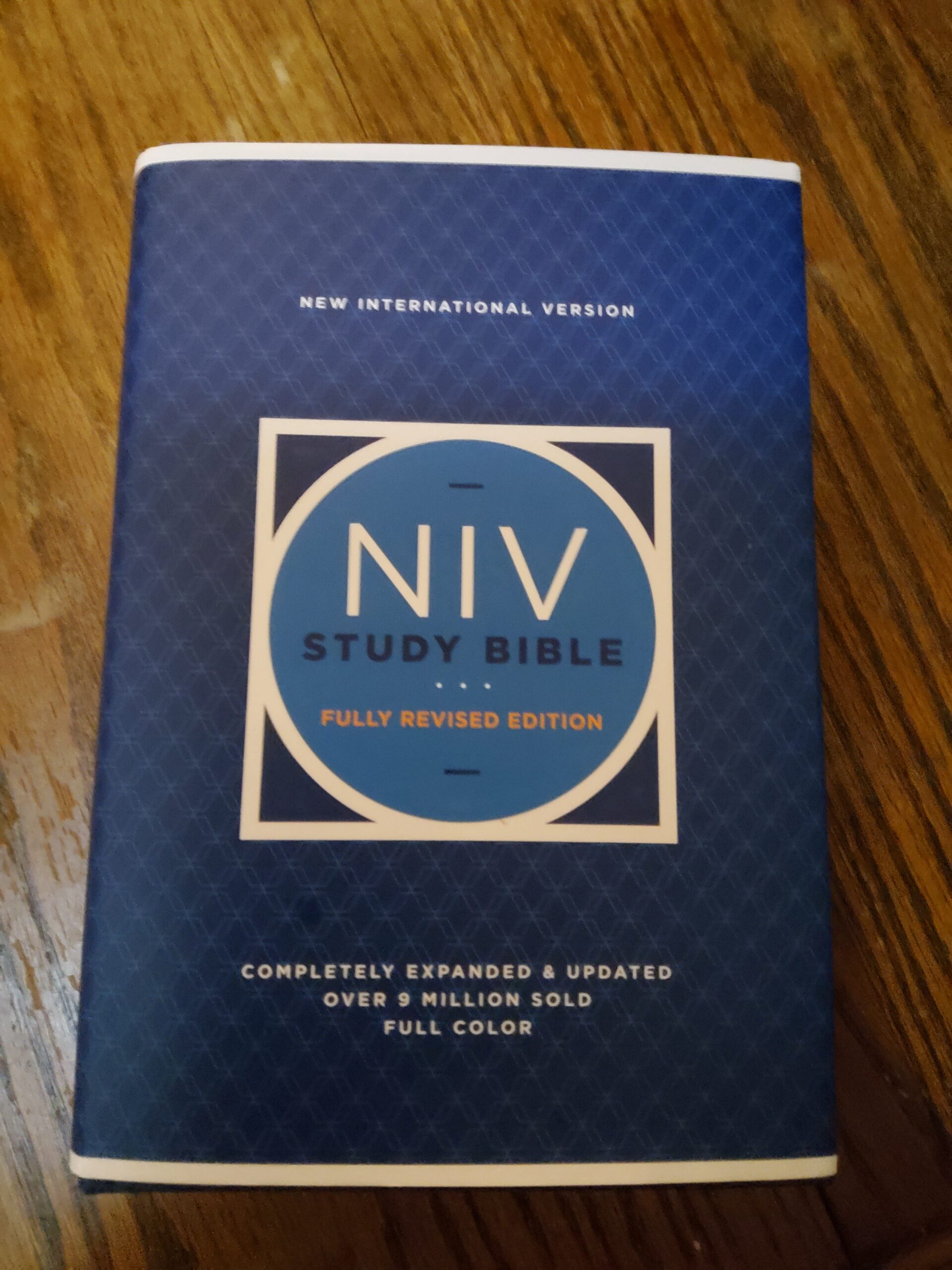
  • The NIV Study Bible (Fully Revised Edition

    The NIV Study Bible (Fully Revised Edition

    (I’m writing as a #BibleGatewayPartner and a member of the #BGBloggerGrid. See note at the end of this post.)

    When a book that I generally like undergoes a revision, I approach it with a bit of trepidation. Is it going to match the older edition? Will it be better? Or maybe it will lose all value.

    The NIV Study Bible hasn’t been central for me personally, but I have interacted with it through many, many students who used it as they attended my classes. It’s the sort of book that kind of fades into the background simply because so many people have it.

    I also haven’t lost my issues with study Bibles in general, in particular the potential that people become dependent on the interpretations of their particular study Bible, rather than actually reading the scripture, interacting with it, and also testing their interpretations against other streams. Having notes on interpretation so closely connected with the text of scripture can contribute to laziness.

    So I’ll start with my standard recommendation: Use more than one Bible translation, and use more than one study Bible, taken from different perspectives. You can find one set of suggestions here.

    That said, this study Bible is takes a balanced approach. By balanced, I don’t mean theologically. To some extent one’s theology will impact a study Bible. One has to write from a perspective if one doesn’t want to simply be confusing. What I mean by “balanced” is that it covers the various needs of a Bible student who may be working without a helpful teacher, and does so in good proportion.

    Consider charts like the chart of covenants conveniently placed near the text on the covenant with Noah. This chart helps a reader identify broad themes through scripture and draw connections.

    The spread with the chart on covenants.

    This combines with a variety of other charts that will help a student get perspective. Again, because this sort of information must be from some theological perspective, a serious student should compare other Bibles as well, preferably written from other perspectives. But this material is solid, and it makes a good case for itself being part of regular plan for study.

    Images are generally not just so you can feel good about a location, but are helpful to understanding the passage. Below is the tabernacle, conveniently place in the book of Hebrews. As I review my own study guide to the book of Hebrews I will doubtless recommend this as one option for study Bibles a group might use.

    From the book of Hebrews, on chapters 8-9

    At the same time, it is quite possible (and appropriate!) to disagree with a study Bible. On page 2161 there’s an article titled “Can Christians Lose Their Salvation?” with which I would take some issue.

    Conservative evangelicals will find the commentary on Romans 1:24-28 and the verses following quite to their taste, as it says the passage is one that makes it clear that homosexual practice is sinful. Progressive evangelicals will not. This is a passage where a commentator is doomed to anger somebody. For purposes of review, I’m simply stating the viewpoint so readers can get an idea of where this study Bible stands on the spectrum of study Bibles.

    A great feature of this Bible is that notes about background are clearly distinguished from those about application by color icons. Readers want help with application, but it’s important to realize that when you are applying scripture to modern times, you are that much further from the text itself. It’s good to know when you’re working with raw data (or as close to that as possible) and when someone is spanning the huge gaps of culture and time to tell you what you ought to do about it. Somewhere between these two are notes that talk about personalities or people groups, which are also clearly marked. These notes partake of both ideas.

    I should note as well that charts, such as those I have praised also fall somewhere between background and application. This simply means whatever you do study, you need to study carefully. Be aware constantly of the human element in scripture, where God uses humans as communicators, and also in all layers of interpretation. Simply by suggesting a background text from the ancient near east that is related to a scripture passage one introduces the bias involved in that selection. Prayerful, open-minded, in-depth study is needed.

    I can’t resist saying all of that, but if you want a conservative evangelical study Bible, this is an excellent choice. I’ll repeat my recommendation that you not depend on a single study Bible or commentary, but select sources that start from different perspectives.

    Zondervan provided me with a free copy of this Bible in exchange for an honest review, for which I thank them. I will provide a link to purchase the Bible in its various editions below.

  • Link: The Comma Johanneum

    Bill Mounce discusses the evidence that the added trinitarian formula in 1 John 5:7-8 is not original. This is a summary of well-known evidence, not breaking new ground, but is one of the clearest presentations I’ve seen.

  • Link: Mounce on Translation and Verbal Inspiration

    Link: Mounce on Translation and Verbal Inspiration

    While I disagree with a number of minor points, the one major one being that I would not use the word “verbal” in describing inspiration, this is an excellent outline of how Bible translators think and the reasons behind that thinking. The author, William D. Mounce, responds in some cases to Grudem, but the article can be read on its own.

    Read the complete article on Themelios.

    For full disclosure, I have used Mounce’s introductory Greek grammar for a number of years before I switched to Dave Black’s. Dave is one of my authors. Links to the two books are below for those interested. (Two different stores as I don’t yet have the February 5 edition available for my Aer.io store.) The third book is about Bible translation by some unknown author.

  • Getting What Was Said

    It can be hard to go from a text to a sermon. The line from past to present can be hard work. But at the root, one must hear clearly what was said. Dave Black looks at a text.

  • Notes on Terms and Language Teaching

    Notes on Terms and Language Teaching

    Dave Black comments some on linguistics and teaching biblical languages in a post today. (Check out the linguistics conference coming up!)

    The difficulty is the difference between teaching someone a language in a classroom and in discussing and describing that language in some detail as a linguist would want to do. Both the framework and the deeper understanding are good and proper goals, though there is often a conflict between the two. When do you teach what?

    Dave covers a good selection of points from the debate over verbal aspect. There are problems with words like “punctiliar” or even “progressive” in terms of verbs. There are also problems in mapping the tense system (and the word “tense” itself) when teaching. But these issues are part of the problem of linguistics generally.

    Consider a label like “tree.” What do I mean by the word tree? Is the plant growing in my yard that is three feet tall a tree, a weed, a plant, or perhaps a bush? It might, under the right circumstances be called any one of those things. A simple, singular label is necessary to communication, but at the same time, a singular, simple label is also a cause of problems. For example, if I say to my wife, “We need to throw that tree out,” I may mean that a potted plant has grown very large, and I’m using tree hyperbolically to refer to it while demanding its exit forthwith. On the other hand, I could be referring to a shoe tree that’s worn out and should be discarded.

    This is why the line, “it’s just semantics” is so often lazy. When someone is playing rule book lawyer with the language, it’s quite appropriate to point out that one is expecting more of language than one is likely to get from it. We get along with ambiguity all the time. The problem comes in when we decide to be picky, or when we accidentally manage to use just the wrong word at the wrong time, meaning one that is almost right, but that can lead one off into a completely different semantic range than intended. But semantics is precisely what “it” is, and what it always is. It is about meaning. What did you expect? So it’s semantics. The word “just” is a bit oddly used. Bad semantics!

    What I try to do is very quickly introduce students to the idea that labels are shorthand. When I use the term “punctiliar,” I point out that this is a shorthand label. Why don’t I change the word then? Because my new shorthand label will also pick up unnecessary connotations, and then I’ll have to explain how it applies. Further, the student is doubtless going to see the word “punctiliar” in commentaries (as Dave points out), and he or she needs to know its intention, and even how to understand the potential fallacy. Commentaries are quite capable of containing incorrect linguistic information.

    It’s easier for me, because I teach by ones and twos, not by large classes of seminarians forced to do their required courses. I had that experience as a graduate student when I tried to tutor marginal or failing Greek students. They wanted me to get them past the test. I wanted to help them understand. Conflict! But those students I have taught since have come to me because they want to learn and understand, so I take the time.

    My conclusion is that no matter how you label it, you’re going to have to make sure students understand how these labels we call “words” work. Even if you take a living language approach, and try to get the students to understand the language as naturally as possible, you’re still going to have to help them understand linguistics if they’re going to translate those words and ideas into their own language for the benefit of those who haven’t learned a foreign language. I’d almost, almost, prefer to teach a student linguistics over teaching that student Greek or Hebrew. If I had to choose, that is. Which I don’t.

    (Featured Image Credit: Adobe Stock #126360408. Not Public Domain)

  • Linguistics Conference at Southeastern Baptist Theological Seminary

    Linguistics Conference at Southeastern Baptist Theological Seminary

    Re: Linguistics and New Testament Greek: Key Issues in the Current Debate

    It’s more than a year away, April 26-27, 2019, but this conference looks like about the most fun you can have on a seminary campus without breaking the rules! I see several names I know, some well, and one Energion author, Thomas Hudgins, who will be talking about Electronic Tools.

    I’m already planning to be there. Maybe we can meet!