Threads from Henry's Web

Category: Bible Backgrounds

  • Psalm 119:52 – Finding Comfort

    Psalm 119:52 – Finding Comfort

    I remembered your judgments from ages past,
    Oh Lord, in them I found comfort.

    The division of this verse into two lines seems slightly odd. I’ve taken it as a chiasm, a b b’ a’: (a) I remember your judgments (b) from ages past (b’) Oh Lord, (a’) I found comfort. It’s interesting to watch for chiasms in the Bible, because it places emphasis on certain concepts. I may be wrong about the division, but if I’m right, the form places the emphasis on God’s eternal nature and God’s enduring judgments.

    And that format led me to think about human tendencies, and two opposite things that we tend to like, not always consistently. First, we like to think of stability. The idea that a practice or a law has been done for a long time and has been successful gives us a feeling of stability. We also have a drive to change, which challenges that stability. We’d like to have complete freedom combined with absolute stability.

    In the real world we can’t actually have both. Freedom and innovation always challenge safety and stability. We live with this sort of tension all the time, often resolving it by considering our own innovations as just natural developments, not threatening the fabric of society, while the innovations of others are clearly destructive and must be stopped!

    In scripture, God is presented as being on both sides of this. God is the creator, a continuing creative force. God is also ancient, reliable, providing comfort to those threatened by hostile changes.

    Am I speaking scripturally?

    “I am YHWH, I do not change ….” Malachi 3:6

    “Look! I am doing a new thing! …” (Isaiah 43:19)

    Sometimes when asked if I think there are contradictions in the Bible I say, “Yes! I think they’re the best part!”

    What exactly is God up to? Is it new or is it eternal? I like to think about this with what I call “orthodox Christian thinking,” by which I mean thinking formed by doctrines such as the trinity and the incarnation. “God is three, but God is one.” “Which?” “Yes!” … or … “Jesus is fully human and fully divine.” “Which?” “Again, yes!”

    God never changes. God is doing a new thing. It’s really a beautiful and powerful contradiction.

    “I am YHWH, I do not change. Therefore you sons of Jacob have not been finished off.” (Malachi 3:6)

    Because God is faithful to God’s promises, because having chosen, God doesn’t give up, Israel will not be destroyed.

    “Look! I am doing a new thing! Right now it’s springing up! Can’t you see it? I’m raising up a path in the wilderness, in dry places, rivers!” (Isaiah 43:19)

    Wonderful thing, context. Useful to read each verse completely.

    The end of each verse is this: God is redeeming Israel. God is not giving up. God is staying the same. God is doing something new.

    What new path does the unchanging God have for you today?

    (Featured image generated by Jetpack AI.)

  • Psalm 119:45 – Walk in Liberty

    Psalm 119:45 – Walk in Liberty

    So I will walk in liberty
    for I seek your precepts.

    I must credit Mitchell Dahood in his 3 volume commentary on Psalms in the Anchor Bible (vol 1, vol 2, vol 3) for the word “liberty.” I was struggling for a translation that I felt lived up to the context. I think that one does. Mitchell Dahood was an interesting character. One of my professors in graduate school said of him that he was right no more than 20% of the time, but when he was right, he was so right that it made up for all the rest!

    This verse seems to express a contradiction, or perhaps more of a creative tension between rules and liberty. We generally think that the more rules there are, the less liberty, and vice-versa. But the Psalmist here is talking about walking, i.e., living his life in liberty precisely because he seeks God’s precepts.

    Our problem as humans is that we (or at least most of us) want to be in control. Some people are very controlling, and we often call them control freaks. But there are very, very few people who actually want to be controlled by someone else.

    The experiment in the United States with prohibition illustrates a problem with such control. When you make a law banning some sort of behavior, it’s critical that most people believe that rule is a good one, one that should be enforced. In the case of prohibition, too few people thought it was a good rule and too many wanted to control what they were imbibing themselves. This sort of attitude makes a law difficult to enforce. (Note that I don’t consider this a full exploration of the sociology of prohibition. It is just one aspect.)

    Consider as an easier case the 55 mile per hour national speed limit. Enforcing it was massively difficult, especially in the wide open spaces of the mid-west and northwest. Many people thought in the abstract that it was a good idea, but when they got out on the road, they drove a great deal faster.

    I remember one occasion when I was on leave from the Air Force and was driving on I-80 through Wyoming. There are some really long sections where you can see for miles, and driving 55 mph was unlikely. My speed crawled up to 70 mph. Soon I saw those flashing blue lights in the distance and I was pulled over. I was concerned, because 70 in 55 is quite a bit over the limit.

    The trooper was a nice guy. He took care of identifying me, and then said, “Young man, would it be possible for you to see your way clear to drive just a little bit slower across my state?” I said, “Yes sir, I imagine I could.” He grinned, wrote me a warning, and off I went.

    Neither of us were really seeing my rule-breaking as all that bad. Yes, he wanted me to slow down, but if he was a real stickler for the rules, things could have gone much worse. He could also have said something like, “The limit is 55 mph you idiot, and you didn’t get to 70 mph by mistake!” But he didn’t.

    But there is a best way of doing things. There’s a “safest” way of driving, a healthiest way of living, the most productive way of working, and the most effective way of relating to one another.

    I think that’s what the Psalmist is thinking about. If I can get on the same wavelength as the creator of all of this, it’s likely I’ll find that place where I find the best balance between all the various factors of my existence, a place where I really have liberty, but don’t suffer from falling into stupid.

    I once participated in an online discussion in which a Canadian cop commented that if he could eliminate stupid and drunk, he’d be out of a job.

    How about aiming for eliminating our own versions of stupid and drunk from our lives by finding God’s best alignment?

    Some resource books on the Psalms:

    (Featured image generated by Jetpack AI.)
  • Psalm 119:40 – Grant Me Life

    Psalm 119:40 – Grant Me Life

    I long for your precepts.
    By your righteousness give me life.

    I spent a good deal of time thinking about the phrase “by your righteousness.” It could be understood in a number of different ways. Two of these would be “in your righteousness” and “with your righteousness.” The second of these might lead Christians into a discussion of imputed and imparted righteousness. I’m not going there.

    It seems to me that we find it easy to deny God’s promises by using our theology. As we figure out how God works, we tend to add in many derived ideas about what God can and can’t do, or if we’re being more theologically orthodox, what God will or will not do. It’s very easy to reduce God to a manageable size as we figure out just how God accomplishes things.

    The psalmist has the right idea here. Simply ask the righteous God for life, righteous life, produced by a righteous God.

    I can’t understand the process. I have ideas. I prefer certain explanations to others. But I think this verse makes a pretty good prayer. “I want the life you offer Lord. Please give me that life.”

    I’m making that my simple prayer for 2025.

    (Featured image generated by Jetpack AI, then modified slightly by me.)

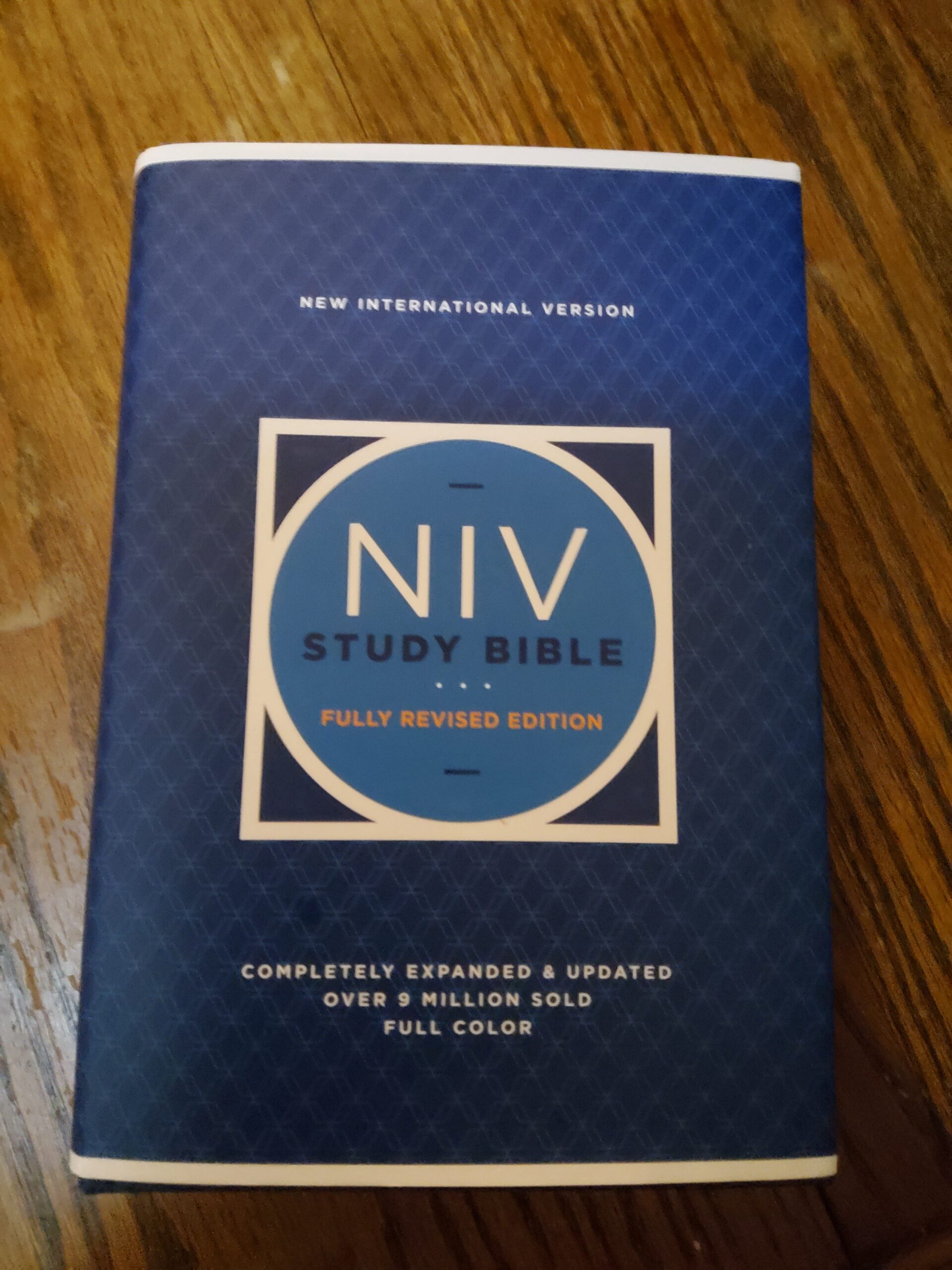
  • The NIV Study Bible (Fully Revised Edition

    The NIV Study Bible (Fully Revised Edition

    (I’m writing as a #BibleGatewayPartner and a member of the #BGBloggerGrid. See note at the end of this post.)

    When a book that I generally like undergoes a revision, I approach it with a bit of trepidation. Is it going to match the older edition? Will it be better? Or maybe it will lose all value.

    The NIV Study Bible hasn’t been central for me personally, but I have interacted with it through many, many students who used it as they attended my classes. It’s the sort of book that kind of fades into the background simply because so many people have it.

    I also haven’t lost my issues with study Bibles in general, in particular the potential that people become dependent on the interpretations of their particular study Bible, rather than actually reading the scripture, interacting with it, and also testing their interpretations against other streams. Having notes on interpretation so closely connected with the text of scripture can contribute to laziness.

    So I’ll start with my standard recommendation: Use more than one Bible translation, and use more than one study Bible, taken from different perspectives. You can find one set of suggestions here.

    That said, this study Bible is takes a balanced approach. By balanced, I don’t mean theologically. To some extent one’s theology will impact a study Bible. One has to write from a perspective if one doesn’t want to simply be confusing. What I mean by “balanced” is that it covers the various needs of a Bible student who may be working without a helpful teacher, and does so in good proportion.

    Consider charts like the chart of covenants conveniently placed near the text on the covenant with Noah. This chart helps a reader identify broad themes through scripture and draw connections.

    The spread with the chart on covenants.

    This combines with a variety of other charts that will help a student get perspective. Again, because this sort of information must be from some theological perspective, a serious student should compare other Bibles as well, preferably written from other perspectives. But this material is solid, and it makes a good case for itself being part of regular plan for study.

    Images are generally not just so you can feel good about a location, but are helpful to understanding the passage. Below is the tabernacle, conveniently place in the book of Hebrews. As I review my own study guide to the book of Hebrews I will doubtless recommend this as one option for study Bibles a group might use.

    From the book of Hebrews, on chapters 8-9

    At the same time, it is quite possible (and appropriate!) to disagree with a study Bible. On page 2161 there’s an article titled “Can Christians Lose Their Salvation?” with which I would take some issue.

    Conservative evangelicals will find the commentary on Romans 1:24-28 and the verses following quite to their taste, as it says the passage is one that makes it clear that homosexual practice is sinful. Progressive evangelicals will not. This is a passage where a commentator is doomed to anger somebody. For purposes of review, I’m simply stating the viewpoint so readers can get an idea of where this study Bible stands on the spectrum of study Bibles.

    A great feature of this Bible is that notes about background are clearly distinguished from those about application by color icons. Readers want help with application, but it’s important to realize that when you are applying scripture to modern times, you are that much further from the text itself. It’s good to know when you’re working with raw data (or as close to that as possible) and when someone is spanning the huge gaps of culture and time to tell you what you ought to do about it. Somewhere between these two are notes that talk about personalities or people groups, which are also clearly marked. These notes partake of both ideas.

    I should note as well that charts, such as those I have praised also fall somewhere between background and application. This simply means whatever you do study, you need to study carefully. Be aware constantly of the human element in scripture, where God uses humans as communicators, and also in all layers of interpretation. Simply by suggesting a background text from the ancient near east that is related to a scripture passage one introduces the bias involved in that selection. Prayerful, open-minded, in-depth study is needed.

    I can’t resist saying all of that, but if you want a conservative evangelical study Bible, this is an excellent choice. I’ll repeat my recommendation that you not depend on a single study Bible or commentary, but select sources that start from different perspectives.

    Zondervan provided me with a free copy of this Bible in exchange for an honest review, for which I thank them. I will provide a link to purchase the Bible in its various editions below.

  • Perspectives on Paul for 10-14-20

    Perspectives on Paul for 10-14-20

    PowerPoint

    PDF

    https://henrysthreads.com/wp-content/uploads/2020/10/101420.pdf

    Video

  • Who Was Paul? – Interview with Allan R. Bevere

    Embedded below is the video of my interview with Dr. Allan R. Bevere in the series asking the same 10 questions of a variety of people. You can find all the interview videos at Resources for Studying Paul. Allan is a United Methodist pastor, and author of several Energion titles.

  • Who Was Paul? – Interview with Pat Badstibner

    Embedded below is the video of my interview with Pat Badstibner in the series asking the same 10 questions of a variety of people. You can find all the interview videos at Resources for Studying Paul. Pat is president of World Prayr.

  • Perspectives on Paul for 10-07-20

    Perspectives on Paul for 10-07-20

    Presentation Video:

    Power Point:

    PDF:

    https://henrysthreads.com/wp-content/uploads/2020/10/100720.pdf

    Remember: Resources for Studying Paul

  • Perspectives on Paul 09.30.2020

    Perspectives on Paul 09.30.2020

    Law Through Scripture – I

    Here is the video (via YouTube) and the PowerPoint slides for my study of September 30, 2020. I am taking a look at the law through scripture and looking at how that impacts Paul and his message.

    First, the PowerPoint:

    And for those, especially on mobile devices, who may have trouble viewing the PowerPoint, here it is as a PDF.

    https://henrysthreads.com/wp-content/uploads/2020/10/093020.pdf

    And the video:

    If you want to participate in the study, you can view it live on the Facebook page my wife and I share, Henry and Jody Neufeld.

  • Guthrie on the Authorship of Hebrews

    Guthrie on the Authorship of Hebrews

    I took note of this quote from George Guthrie’s discussion of authorship:

    As with other matters of background we are almost entirely dependent on evidence internal to the book. So, what does the work reveal of its maker?

    George H. Guthrie, Hebrews, The NIV Application Commentary, Kindle edition

    In a way, this is the key issue. If you favor internal evidence, you will doubtless favor someone other than Paul as the author. If, on the other hand, you consider the early patriotic accounts, you are much more likely to consider Paul.

    This was underlined for me when David Alan Black asked me this: “So if the book of Hebrews claimed Paul as the author in the text you would accept Paul as author?”

    The answer to that is yes, absolutely. The internal evidence would never lead me to Paul apart from external statements, I don’t see enough issues in the text to convince me Paul was not the author if the claim was made in the text, assuming that the claim was textually secure.

    I publish Dave’s book The Authorship of Hebrews: The Case for Paul, and I credit editing that book for changing my view from “anyone but Paul” to “unknown, but Paul is an option.” One of the key values of Dave’s book is the discussion of the internal evidence.