Threads from Henry's Web

Category: Bible Translations

  • A Note on Translations and Commentaries

    A Note on Translations and Commentaries

    CBC based on the NLT
    Are we veiling the commentary with the translation used?

    As I’ve been reading a commentary based on the New Living Translation (NLT), it has been interesting to note how the commentators differ from the readings of the translation on which the commentary is ostensibly based.

    For example, as I finished reading the section on Numbers today (pp. 217-443), written by Dale A. Brueggemann, I noted two important translation notes.

    1. 35:12, in which the NLT refers to “relatives” rather than to the singular “goel” or avenger/redeemer, a translation that the commentator says “… may be misleading” (p. 426n). Certainly potentially misleading and may cause one to miss connecting thoughts built on this concept.
    2. 35:20, in which two points are noted. First, the NLT adds “a dangerous object” which is not in the Hebrew source, and also omits “while lying in wait,” which is in the Hebrew. The latter omission the commentator calls “this telling qualification” (p. 427n).

    It’s not surprising that a commentator will work for the source text, of course, but it’s interesting to note. You’ll find this sort of disagreement in almost any commentary where the author is required to use a particular translation. Sometimes one could almost say “with the ___ version included” rather than saying it’s a commentary on that version.

    With a dynamic equivalence translation, however, the odds are greater that there will be a certain tension between commentator and English text. This is not really surprising. Is it problematic? For many, this disagreement is an argument in favor of more formal equivalence translations.

    It seems to me, however, that a formal equivalence translation, besides allowing for misunderstanding, such as when it verbally translates some idioms, also simply leaves greater room for one to imagine the translation agrees with one’s own approach, even when it’s simply a bit ambiguous.

    It’s valuable for lay persons who read scripture to become aware of the fact that there are differences in the way translations are done. That’s why I frequently recommend reading from more than one translation. For example, a good counterpoint to the NLT might be the New Revised Standard Version (which also provides from more theological diversity in the translation committee) or the English Standard Version (with an evangelical team similar to that of the NLT).

  • Translating Hebrews 2:6-8 – Gender, Number, and Breaking the Discourse

    Translating Hebrews 2:6-8 – Gender, Number, and Breaking the Discourse

    dreamstimefree_235996_smI’ve written about this a couple of times before, though using the NIV1984 and NIV2011, in A Gender Neutral Example – Hebrews 2:6-8 and Quick Follow-up on Hebrews 2:6-8.

    I covered most of the key issues in those two short posts, but to summarize quickly, I note the questions of how one should translated the quotation of Psalm 8:4-6 as it is presented in Hebrews 2:6-8. One of the questions is the text. In some cases translators have “corrected” New Testament quotations of Hebrew scriptures by using readings from the Massoretic  text even when the NT writer is quoting from the LXX. In this passage “for a little while” gets a footnote to the MT in some translations.

    The question for the translator is whether to reconcile the texts, in this case make Hebrews 2:6-8 correspond to the text of Psalm 8:4-6, so that a reader is not confused (or even challenged) by the difference, or whether the texts should be translated faithfully in each instance. In the case of either decision, what should be indicated in the footnotes?

    I was reading this passage today in the NRSV, immediately after having read it in Greek. Here it is:

    6 But someone has testified somewhere,
    “What are human beings that you are mindful of them,
    or mortals, that you care for them?
    7 You have made them for a little while lower than the angels;
    you have crowned them with glory and honor,
    8 subjecting all things under their feet.”

    In this case there is a footnote (one of several), which reads: ”

    Gk or the son of man that you care for him? In the Hebrew of Psalm 8:4-6 both man and son of man refer to all humankind

    In fact, the plural continues into the remainder of verse 8, which is not quoted: “Now in subjecting all things to them, God left nothing outside their control.” It is not the authors argument here that everything is placed under the command of humanity in general, but rather of one human being, Jesus. I fully agree with the translators (and their footnote), that Psalm 8 is referring, in its original context, to humankind in general, and our relationship, as a whole, to God—our place in creation.

    By translating the quotation “accurately,” as it occurs in a different text and location, the translators have disrupted the discourse of this passage. So while I will not call this an error (it’s certainly intentional, and I can formulate the arguments for doing it, even though I find them dismally unconvincing), I do think it’s a very unfortunate approach. One could let readers know that the quoted text, in its historical context, refers to humanity as a whole, but that it is being used here specifically of one particular human male, Jesus.

    In fact, one could argue that acknowledging “humankind” in Psalm 8 need not be inconsistent with the usage here, as we will shortly see the author of Hebrews continue with the argument that Jesus must very much be one of us (humankind) in order to be able to redeem us. One could discuss the idea of being “in Christ,” though that is not the language of Hebrews. In Hebrews the language is one of kinship and community.

    I do think that this makes it harder, though not impossible to follow the flow of the authors argument in this passage.

  • Review – Tyndale Select NLT: Select Reference Edition

    nlt_with_spineWhen the e-mail arrived offering me a copy of this gorgeous Bible edition, I didn’t really read the material thoroughly enough or I might have declined. I’m a content man. I have one complete bookcase and parts of three more dedicated to Bibles. Very few of them are special in terms of their binding. It’s the text that drives me.

    But I saw that this was the New Living Translation, and that it was in a new edition, and so I said I’d review it. I’m actually glad I did. I’ve read a few of the other reviews, and they emphasize some simple facts about this Bible. It’s a work of art. Mine is goat skin for the cover, the paper and font are magnificent. It’s truly an heirloom Bible. You can find out all these details, however, from Amazon or from the publisher. I’m going to include some pictures in my review here on my blog so you can get an idea.

    Though it is an heirloom Bible it is not one of those huge books that are destined to stay on whatever table they’re placed on first. It’s easy to carry and to use. You can reference it, which is nice, considering it’s a reference edition. So while you may not feel like doing anything too vigorous around it, lest you damage the work of art, it is nonetheless quite useful as a reading or study Bible.

    Those who know me can predict where I’m going next. I’m afraid I have to admit that I start to twitch when I just hold this Bible. I didn’t actually look up the price before I received it, but within moments of actually putting my hands on it, I realized that it was a more costly Bible than I imagined. I’m not going to cite the price in my review, simply because current prices change. I’ll let you follow the link and get that information from the Amazon.com web site. I have never owned, and rarely touched or handled a Bible that costs this much. That leaves me with mixed emotions about it. But a book review should talk about the book from the point of view of what that book was written and/or designed for. I don’t criticize the NLT for not being either The Message or the NRSV. A Bible translation is designed for a purpose, and so is a Bible edition. You can decide what is right for you. If your plan is to buy an heirloom Bible that is to last and be passed on from generation to generation, you should be looking at this one.

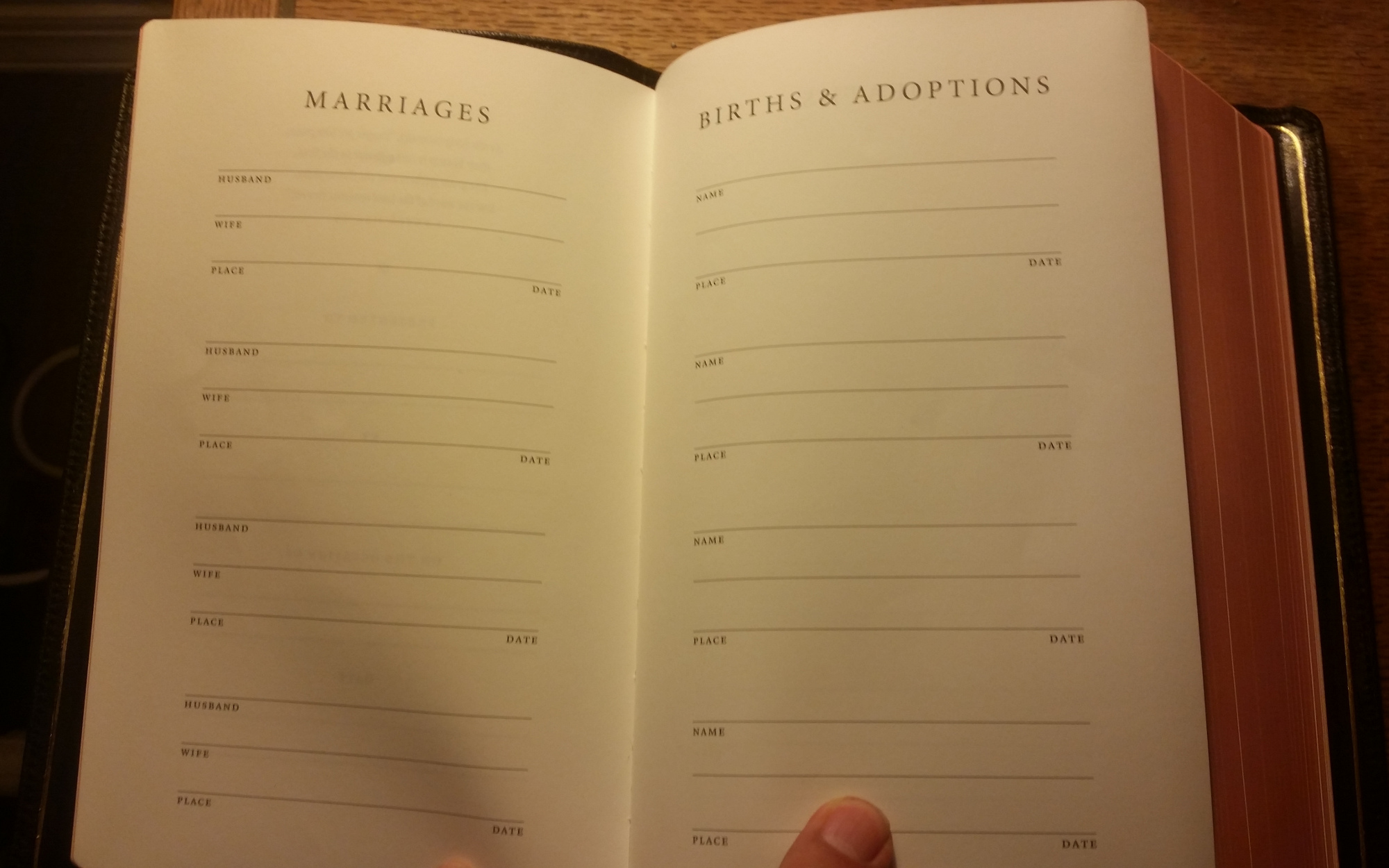
    Did I meniont that this Bible is designed to last and to be passed down from generation to generation. In pursuit of that goal it has lovely presentation and family record pages as well.

    nlt_presentation

    The text is, of course, the NLT. I have a high opinion of this translation for the appropriate audience. In one sense the NLT is descended from the Living Bible. One of the weakness of the Living Bible was that Kenneth Taylor didn’t read Hebrew or Greek. He worked from the English text of the American Standard Version. As a result, while the Living Bible was very readable, it was not always as accurate as it could have been. This problem was corrected for the NLT by a highly qualified evangelical translation committee. They managed to keep the readability, though I think they lost some of the charm and all of the eccentricity. How good that was is open to question. I have linked a couple of references to the NLT to my MyBibleVersion.com web site where you can get some additional information and see how I rate the translation in various categories.

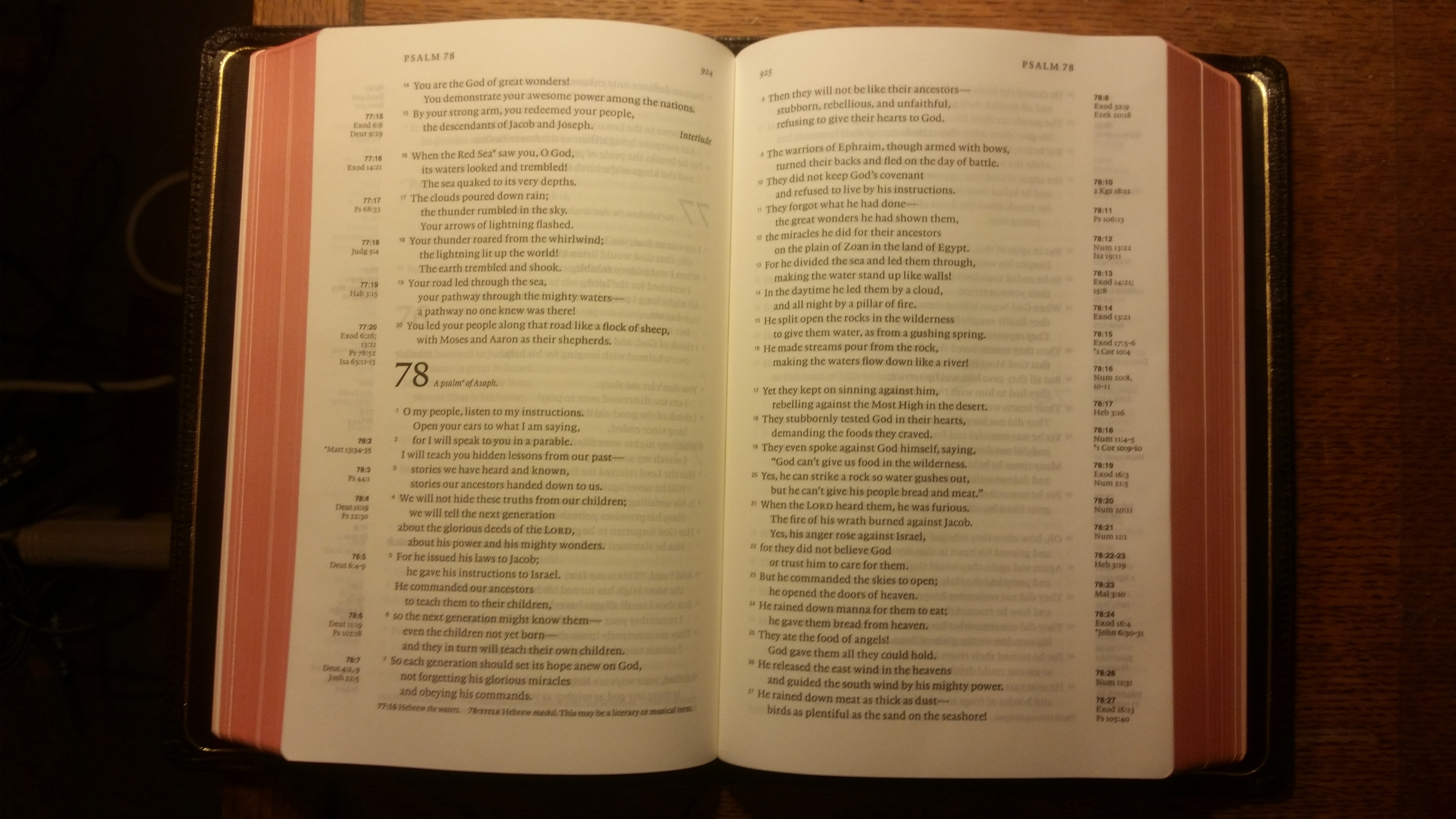
    nlt_interior_psalm_78As I say on the cover of my own book What’s in a Version? the best Bible version is one you read. The first question should be whether you’ll be able to use and understand a Bible version. Accuracy in details is of no particular value if you don’t actually read and comprehend the accurate words. Of course, readability should not be an excuse for inaccuracy. Unfortunately, reviewers of Bible versions frequently call disagreements with their preferred translation of some particular verse “inaccurate,” when it is really just “different than I would have done.” The NLT may be different, but it is competently different.

    The things that stuck out for me in this edition are first things that are missing. This is not a study Bible in the sense of one with study notes, book introductions and so forth. I am pleased with that. Too many people are treating study notes as the inspired text and ignoring the actual text. You won’t do that here. You’ll need a good Bible handbook or Bible dictionary if you want to get that sort of information.

    What you do have is a single column that is a good width for rapid reading. I’ve discussed before many different approaches to reading, and I think one of the most neglected is sustained reading of quantities of the biblical text. This Bible will make that easy. I prefer that greatly to the multiple narrow columns that tend to slow me down. Further, there are quite a number of cross-references. It is possible to become dependent here, just as it is to become dependent on notes, but in this case I think most people can do with the help. The NLT translation notes are included at the bottom of each page.

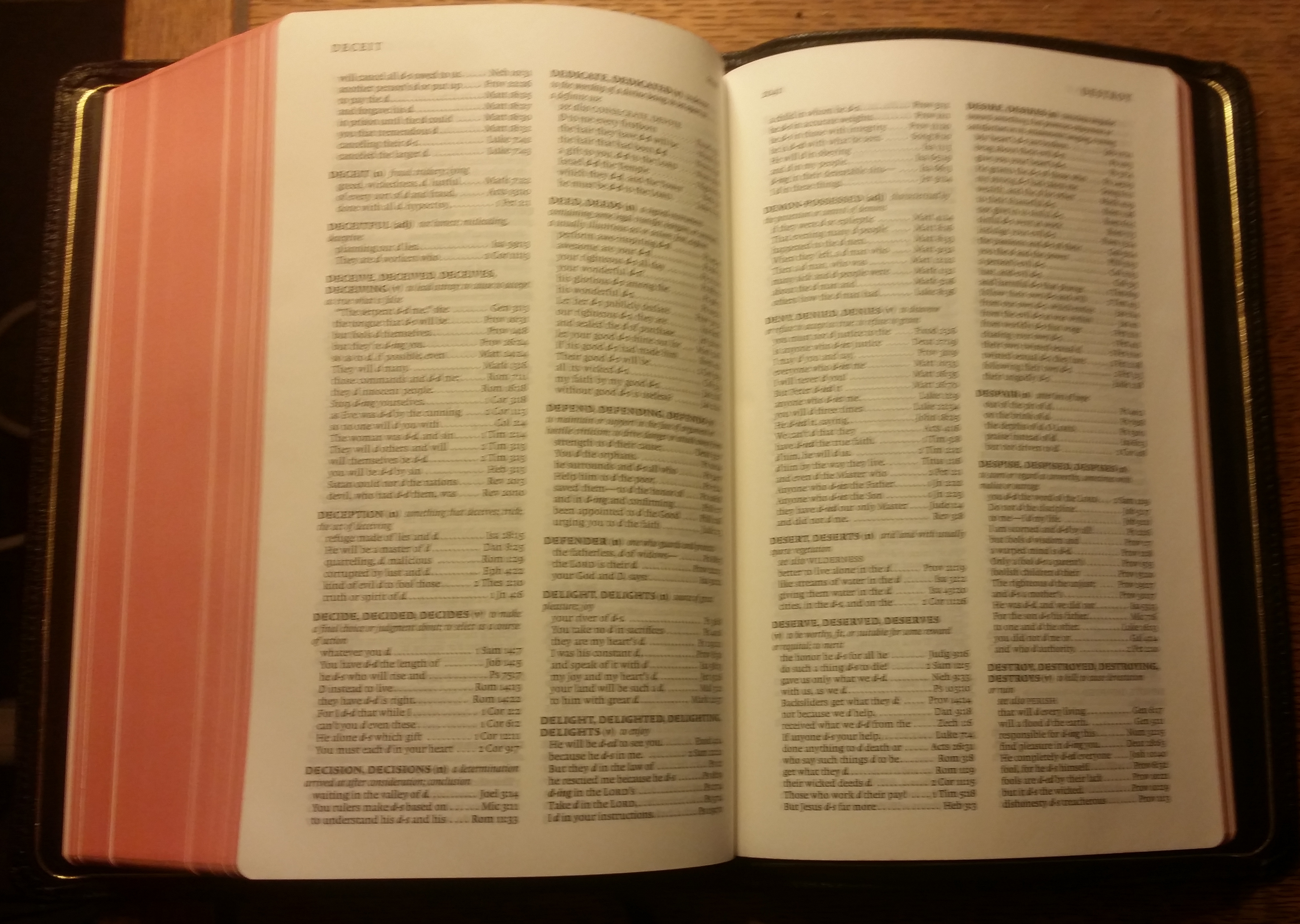
    nlt_dictionary_concordance

    In the back you have a basic concordance and dictionary. This is not a replacement for your Bible dictionary but it will give you the basics and help you find a variety of references on a topic. This is followed by a selection of maps. Again, no effort is made to compete with your Bible atlas, but for reference on the run or in your study group, the material is better than average.

    nlt_maps

    While the binding, paper, and high quality construction are the distinctive features of this Bible edition, I found that it is fully valuable as a Bible for your actual use. If you do choose to spend the money on an heirloom Bible edition, and hope to pass it on to your children, this will fit the bill. With decent (though not massive) margins, you may also be able to leave your notes and your testimony in it for your children as well.

    I remain a content person, but I can respect a true work of publishing art when I see it, and this is one.

    For those interested in the text, here’s my video review of the NLT:

    (Disclosure: I received a copy of this book free from the publisher for review.)

  • Quick Follow-up on Hebrews 2:6-8

    I commented earlier on the difficult choices involved in translating an Old Testament reference that does not match the Old Testament passage in your own translation.

    Here’s an example from the NIV1984. First, Psalm 8:4-6 –

    what is man that you are mindful of him,
    the son of man that you care for him?

    You made him a little lower than the heavenly beings
    and crowned him with glory and honor.

    You made him ruler over the works of your hands,
    you put everything under his feet.

    Now look at this as translated in Hebrews 2:6-8 –

    “What is man that you are mindful of him,
    the son of man that you care for him?

    You made him a little lower than the angels;
    you crowned him with glory and honor
    and put everything under his feet.”

    The key phrase here is “a little lower than the angels.” The usage of this line in Hebrews will reflect an alternate translation of the Greek (LXX), “for a little while lower.” The translation is, I believe, accommodated to the phraseology in the Old Testament. The NASB is pretty open about simply translated the text in front of the committee, and leaving it to commentators to deal with the difference in the text and translation.

    I find this interesting, though not a major issue. It is valuable, however, to understand the approach taken by your translation. I am much more concerned with the attempt by the NIV to “fix” problems through questionable translations, such as the sudden introduction of an unjustified pluperfect at Genesis 2:19, a rendering that survived from the 1984 to the 2011 NIV.

  • A Gender Neutral Example – Hebrews 2:6-8

    A couple of days ago I discussed gender-neutral language in a post dealing with both inerrancy and Bible translation issues. Today, as I was doing some reading about Hebrews, I encountered a vigorous comment against such language in a passage in Hebrews. The passage in question is Hebrews 2:6-8, and it quotes from Psalm 8:4-6. The NIV translates the first anthrwpos as “mankind” and then huios anthrwpou as “a son of man.” They then continue with a series of plural pronouns in the explanation.

    In his The New American Commentary: Hebrews, David L. Allen responds to this translation with some vigor. (Note that he is responding to the TNIV, and relying on the text of the 1984 NIV, but the text of the 2011 NIV has in it every difficulty he references in his discussion. I really can’t get the flavor of his arguments without quoting more than I’m going to quote in a blog, but he starts with two major issues. The first is that by obscuring the anthrwpos/’adam reference with a plural (TNIV uses “mortals” while NIV2011 uses “mankind”) one loses the sense of the unity of the human race through descent from Adam. Secondly, by using plural references in succeeding texts, one makes it more difficult, if not impossible, to connect this to “son of man” as a Messianic title for Jesus. Whether this was the intent of Psalm 8 in its original context, it appears to be an intent of the author of Hebrews.

    Of these he says:

    Third, to change the word or phrase to a more “gender neutral” expression, especially in light of the other two problems above, is simply an exercise in linguistic political correctness. (p. 240, Nook edition)

    The issues here are somewhat more complex than any case I was referencing in my earlier post. When you have someone address a congregation that includes both men and women using adelphoi, the issue is more one of referent. In this case, we need to ask a couple of questions:

    1) In what way was the author reading the passage? In other words, how would he have understood it in then making his argument? It seems courteous, in a sense, to render a quotation in the same way as the person quoting it intended. This is by no means uncontroversial. If an author quotes the LXX, as is done here, but the Bible translation in question translates its Old Testament from the Hebrew, what should be done? There are cases in which a translation will accommodate their own rendering of the OT verse to the translation as they have it in their OT, whether or not that fits the author. On the other hand, to have the author of Hebrews quote Psalm 8:4-6, and then have the rendering there differ from what a reader will find when he or she turns to the Old Testament in that very same Bible edition can (and will) raise questions. So it is a case of decisions, decisions, and no matter what you do, there will be disagreement.

    2) What will your readers miss when they read your rendering? In this case we have two choices. We might leave out some understanding of the unity of humanity and the connection between a singular son of man and Jesus. On the other hand, for some readers, we might be leaving out the sense that this is humanity and not just some particular man. I know of nothing that would cover all options except for an explanatory note, and most of us are likely aware of how many people read explanatory notes.

    I don’t consider this a clear case of a change of language requiring a change of translation. The word anthrwpos, as used here, is covering a different semantic range, and the translator needs to take that into account. The danger into which the NIV2011 and the TNIV have both slipped here is that they undercut the author’s presentation by using a different translation of the passage he’s building on. He chose the LXX of his time. Perhaps we should honor the idea of his choosing a translation by translating that translation in a way that matches his use.

    What do you think?

  • On Prettying-Up the Bible (In Reply to @drbobcwcc and @RevKindle)

    Does the Bible need some improvements, if not in content, at least in presentation? That’s one way to put the question addressed by Rev. Steve Kindle in a guest post on Dr. Bob Cornwall’s blog. I want to make some fairly picky comments on this post. As I do so, I want you to be aware that I generally applaud the goals of this post, even while disagreeing in detail.

    My previous experience with prettying-up the Bible involves the violent passages. I previously reviewed Jack Blanco’s book (I have trouble calling it a translation), the Clear Word Bible. Some of his renderings are much more comfortable reading than the original, but I haven’t been able to conceive of a paradigm that would allow me to think of them as accurate. I often think, however, that some of the violent passages of scripture are saved from revision largely because so few people read them. Numbers 31 has the advantage of being in a portion of scripture rarely consulted by Christians. When they do consult it, they are often shocked and wish it would go away.

    Besides honesty (or accuracy), there is a problem with smoothing out the past. It conceals the nature of scripture, of the experience with God that comes from different people at different times. Seeing trajectories of change in scripture will change our approach to how we get from the words in the book to ethical action in our world.

    Rev. Kindle is primarily addressing gender language. This is a fairly controversial topic in modern Bible translation. Translations have been excluded from certain Christian book stores because of the way the represent gender. As is often the case, however, the issue was much more how one was perceived to represent gender. The same store carried other Bible translations that used gender neutral renderings. These other versions were simply less well-known. The Council on Biblical Manhood and Womanhood is very involved in these issues from a conservative point of view, and are opposed by the Christians for Biblical Equality. In perusing these sites, one can see that there is a great deal of weight put on these issues in church doctrine and politics.

    What is unusual in Rev. Kindle’s presentation is that it comes from a progressive Christian who supports equality. He supports gender neutral language in many endeavors, excluding one:

    I am all for the use of gender neutral terms for God in all church settings including sermons, liturgies, and conversations. But when it comes to inclusive language in Bible translations, I must object.

    There is a valid distinction between those fields of endeavor. There is a great deal of difference between determining the way I will discuss God and the way I will translate. Do I refer to god solely with masculine pronouns? Do I avoid the use of pronouns at all? Those questions involve different issues when I am translating the apostle Paul, for example, as opposed to expressing my own theology. I am not a pastor, a liturgist, or a theologian. My studies were in biblical languages, and I’m a publisher. I’m interested in the words.

    And that’s where we tend to get into trouble.

    Whats in a Version?Most people, in my experience, view Bible translation as a singular effort, one with a definite, definable goal. I encounter this attitude almost every time I speak or teach or any other time someone manages to connect my face with my book, What’s in a Version?. The question I’m most often asked is: What is the best Bible version? Sometimes there’s a variant: What’s the most accurate Bible version?

    But those questions reflect the problem. On the cover of my book I have a one-line answer: The best Bible version is the one you read!

    Surely that’s a horrible answer! There have to be bad Bible translations, and I could be reading one of them! And yes, it’s not a complete answer, yet it does make a point. The task of Bible translation is not singular. There is no one “most accurate” Bible translation. There is no single “most readable” translation. In order to answer that common question I have to know who the questioner is. What is the best Bible version for you? I also need to know the activity in view. What is the best Bible version for you to use for devotional reading? What is the best Bible version to use in your study group? What is the best Bible version to use from the pulpit?

    The reason is that one cannot transfer the entire meaning of a a source text into any target language. You are going to lose something. The question is what?

    Let me take a short digression here. When I discuss loss of meaning I do not mean solely between the text of the source language and the tip of the pen (or the little pixels on the computer screen) of the translator. I mean loss of meaning between what a well-qualified reader of the source language could get from the source text itself, and what a reader of the target language can get from the text in the target language. There is no great value in a text which is accurate in an abstract sense, but is not understood accurately by actual readers. It follows from this that a translation must consider who is to read the text in order to determine how to express thoughts from the source accurately.

    Further, understanding comes in different forms. Do I emotionally “get” the story told? Do I comprehend the facts that are narrated? Am I swept away by the literary beauty of the passage? Can I place myself in the shoes of those whose story is told, or who might have first heard the story? All of these things are desirable to various extents at various times, but successfully conveying them is not easy. In fact, it’s impossible to do everything at once. I cannot, for example, convey the rhetorical impact of the Greek of To The Hebrews while also making every point of theology clear to an American audience.

    I know readers will object that it is up to teachers and preachers to get the theology right, and they may be correct, but that is a choice in what will be translated. I could then say, “Translation X conveys the theology of Hebrews with great clarity, while translation Y gives one a feel for the literary tour-de-force executed by the author.” The author, however, was intending to convey his (or her, I must concede) theological points in a powerful and compelling exhortation. Where do I compromise?

    This is why some have commented on the irenic tone of my book. It’s not that I’m such a peaceable personality, or that I am a great peacemaker, though I would love to be. The reason is that I believe that there are many possible goals for Bible translation and that there are many audiences for which one might translate. Thus there are many possible ways in which one can (and should) translate, so I have less of a tendency to condemn any particular rendering. I do not mean that all translations are equal. I do not mean that there are no wrong translations. I simply mean that there are multiple right translations within various parameters.

    I am disturbed when I hear preachers and teachers refer to translations that are supported by significant numbers of scholars as “mistaken” or just as “errors in translation.” This presents the task of translation as too simple. There are many legitimate disagreements which should be referenced as such. Reserve the word “error” for a translation that cannot be justified.

    But to get back to the gender issue, Bob, in his introduction brings it up,

    Thus, the New Revised Standard Version and the Common English Bible will, where the translators deem appropriate, translate a word like adelphoi, the Greek word for brother as “brothers and sisters.”

    and Rev. Kindle uses similar phraseology (9th paragraph from the end):

    “Member” here is literally, “brother.”

    I have been accused of not giving users of the word “literal” the sort of latitude I give with any other word, i.e. recognizing that words have different meanings. The problem with “literal,” especially in circumstances such as these, is that it is extremely susceptible to equivocation. As its use has developed in the language, it is often heard as “accurate” or “faithful” when those who use it intend something more like “simple,” “direct,” or “most common meaning.”

    In this case I would disagree with the usage in either case. The Greek word adelphos or its plural adelphoi may have as its referent either a male person (or group of males, as appropriate), or a person of undefined gender, or a group of both men and women. It is probably significant that the masculine form was used in both cases, though it is very easy to take grammatical gender too far in translating a language in which grammatical and natural gender do not match.

    Similarly, until recently (change is still in progress) we used “he” to refer to a generic person in English, and “men” and “brethren” to refer to groups of mixed gender. In groups I have been able to survey informally, there seems to be a break right around 40 years of age (adjusted for the passage of time) as to how this usage is understood. Older people will understand “brethren” as including both genders when a group is addressed, while younger ones do not. A pastor illustrated this to me very clearly when he objected to the NRSV because of its gender neutral language. He couldn’t see how “brothers and sisters” was an accurate translation of adelphoi, so he would stick to the more accurate (in his view) RSV. The next Sunday he was reading scripture and he came to a passage in Paul where the apostle was clearly addressing an entire congregation. He stopped, looked up, and said, “And that includes you sisters too!” Clearly he knew some in his congregation would not hear the passage as inclusively as it was intended.

    This would apply differently in different passages. For example:

    My brothers and sisters, believers in our glorious Lord Jesus Christ must not show favoritism (James 2:1, NIV, from #BibleGateway).

    The words “brothers and sisters” here translated the Greek adelphoi. I think it unlikely that James intended men in the congregation to eschew favoritism, while the women were allowed to practice it. He addresses the whole congregation. Yet if I read the usage of the English language correctly, a congregation with people largely below the age of forty would hear the passage as excluding women if we used the “literal” translation “brothers.”

    On the other hand, we have James 3:1:

    Not many of you should become teachers, my fellow believers, because you know that we who teach will be judged more strictly (James 3:1, NIV, from #BibleGateway).

    Now here we have a historical decision to make. My belief is that there were many more women teaching in the early church than we have imagined. This is not the place to argue the point. If, on the other hand, one believes that only men were permitted to teach, this would lose historical information as translated by the NIV, as “fellow believers” is here also a translation of the Greek adelphoi. (Another interesting question is whether “fellow believers” or “brothers and sisters” is the more literal rendering of adelphoi. But I will avoid diving into the morass of meanings for the word “literal” that would evoke.)

    This is different, however, from the kind of effort made by The Inclusive Bible, which changes many cases in which the original intent of the passage, by which I mean in this case the original referent, is not inclusive. The passage Rev. Kindle quotes from 1 Corinthians 14:34-35, for example, if it is original to the epistle (I believe, with Gordon Fee, that it is not), certainly is not intended as inclusive. That case is very different from either of the cases I referenced in the book of James.

    These cases should be handled differently, according to the nature of the audience and the usage in the target language. Right now we are somewhat in transition on inclusive language in English, and that will complicate the work of the translator, and even the liturgist. Something that is heard one way by part of the congregation may be heard in the opposite way by another.

    In addition, we need to recognize multiple goals in the use of our ancient texts. We do not translate just to convey data. We also translate for liturgy, for devotion, for prayer, for meditation, and for other goals. The particular way we handle the material at hand must take this different uses into consideration. There are certainly illegitimate translations (1 Corinthians 14:34-35 above from The Inclusive Bible, and many Old Testament passages from The Clear Word, for example) but there are also multiple legitimate goals and multiple audiences to which the translator will hope to convey something of the source text.

  • The Potential Arrogance of Critiquing Bible Translations

    When I wrote yesterday about the HCSB introduction and its use of the label “optimal equivalence” I fully intended to write another post complaining about that introduction. And I will mention the other issue briefly in this post. But something else was drawn to my attention in the meantime.

    Let me lay a foundation. Some years ago I was chatting about a particular Bible passage with a young person who was also a new Christian. We were discussing the best rendering of a particular verse in the Old Testament and when I defended the version we were looking at he said, “Wouldn’t ____ (naming a well-known figure) know best, since he reads Hebrew?” Now I didn’t point out that I read Hebrew as well, which was, perhaps, relevant! But I did point out that the translation we were examining had been made by a committee of several people, each of whom read Hebrew, and then it was reviewed by editorial committees, many of whom read Hebrew. They should get some credit!

    This is one thing that concerns me when I hear pastors or teachers say, “This is how this text should be translated …” or “What the Greek text really means is ….” I’ve commented before that you’re generally about to be misinformed when someone says that. But even when an expert makes a comment about just what a translation should be, I have concerns. (Note that I’ve never heard someone say “what the Greek text really means” who was well-qualified in the language. They just don’t talk that way.)

    My concern even when the linguistic information to follow is accurate is that this suggests to people that our Bible translations are carelessly put together by people with less language skills than the average pastor. Anyone with a few minutes and a reasonable pastor’s library can correct the work of the Bible translation committee! That’s simply not accurate. It also feeds a concern amongst many Christians that they cannot truly get to the meaning of scripture because so much is lost in translation, and they don’t have the time or talent to acquire facility with the source languages.

    People like these come up to me in church hallways all the time. They’ve heard me introduced as knowing Greek and Hebrew, usually in exaggerated terms. “Reads Greek as well as you read English,” is one line that’s been used. I don’t know where they get that. No, most English readers exceed my speed at reading Greek. My main claim to fame is that I have kept my Greek and Hebrew up. I read my devotions in the original languages, so my comprehension is better than average, but I have not kept abreast of all the best linguistic scholarship. Nonetheless, people ask me what’s the best Bible translation. Can they trust the translation they’re using? What wonderful insights can I give them quickly that are missing from their Bible version?

    These kinds of questions result, I think, from a profound ignorance about how Bible translations are made, who makes them, and the general quality of the work. I don’t want to diminish the value of knowing biblical languages. I wouldn’t trade that training for anything. But the best use to make of such knowledge is to deepen your own understanding of the scriptures, and then express that deeper understanding in words that people in the pews can understand. You don’t have to tell them with every insight how wonderfully smart you are because you know the languages.

    The fact is that we have a very good set of translation options. Most—nearly all, I think—significant errors in interpretation can be avoided simply by carefully studying your text in context from your translation, and then comparing a few other translations to check your work. Properly using the linguistic comments of a few commentaries will help you even more. (May I recommend a book that I publish, “In the Original Text It Says …”?)

    My point here is that Bible translators, in general, are a skilled and dedicated group of people who have provided a number of excellent translations for the English-speaking world.

    Barring a couple of really troubling efforts, such as Jack Blanco’s Clear Word, any critique I offer relates to details and general approach. I don’t intend to call a translation bad unless I say it outright, for example, The Clear Word is a bad translation, if it can even properly be called a translation. So when I publish a couple of posts criticizing something in the HCSB introduction, I’m not trying to tell you it’s a bad translation. It’s not. It’s quite good. As with most translations, I disagree with some renderings.

    Here’s some key points I try to remember in order to avoid the potential pitfalls. How successful am I?

    • Most “errors” reported in a Bible translation are not errors. Yes, I mean that. I have found very few translations for which I cannot find the justification. I may not agree with that justification, but it exists. For example, the following are not errors: Choosing a different textual variant than I prefer, translating a Greek genitive as a different type than I think appropriate, finding the English translation in a different part of the semantic range of a word, choosing a different option for what a clause modifies, using English words that I think are less than well-known by people in the pews. Each of those things can be annoying. I’ll criticize it in the translation. But that simply means that I would make another choice than the translation committee did. In general, there were more of them with higher level degrees. Read my arguments and make your choice. Reserve the word “error” for an error of fact, such as citing that reading incorrectly, proposing a meaning for a word that has no foundation at all, or using an English word that doesn’t fall in the semantic range of the word in the source language. You’ll find that translation committees make very few errors under this latter definition.
    • Say “I disagree” or I would prefer” rather than “this is wrong” or “the right way to translate this is.” It’s not a matter of uncertainty, or not caring about the truth. It’s a matter of giving credit to qualified people who disagree.
    • Don’t preach about translation differences. Preach about the text and the message of the text. You can almost always do this well in English without trotting out your Greek and Hebrew knowledge.
    • Say some good things about Bible translators. I have some concerns about the priority placed on providing more and more English translations as opposed to providing for those who have no translation, or even don’t have the quality we have in English. But these people are doing good work for the Lord and your congregation should know about them and be thankful for them.
    • When the foundation of your difference is theological, make sure people know it. Sometimes our theology influences our translation. It could hardly be otherwise. That overlaps closely with thoroughly studying the context. If I understand Paul’s theology in one way, I am going to be influenced away from a linguistically sustainable translation that has him teaching something else. The theology matters.

    But this last point leads me to my other complaint from the HCSB introduction. It’s under the heading “The gender language policy in Bible translation.”

    Some people today ignore the Bible’s teachings on distinctive roles of men and women in family and church and have an agenda to eliminate those distinctions in everhy arena of life. These people have begun a program to engineer the removal of a perceived male bias in the English language. The targets of this program have been such traditional linguistic practices as the generic use of “man” or “men,” as well as “he,” “him,” and “his.”

    I resemble that remark. Well, not very much. You see, I prefer “people” to “men,” “humankind” to “mankind,” and “brothers and sisters” rather than “brothers” or “brethren.” I’ve found, in surveying folks I teach, that there is a bit of a generation gap on these terms. Younger people tend to hear “men” as referring just to male persons. Older folks understand it generically. So my approach in translation is to translate as I think my audience understands the term.

    I was quite amused by a former pastor of mine who complained bitterly about the use of “brothers and sisters” to translate the Greek adelphoi. In the NRSV this is done when the translators thought the referrent was a group including both genders. He preferred the older RSV because of this issue. Yet when he read from the RSV in church and came to “brothers” he’d look up and say, “That means you sisters as well!” He complained about the translation, but he knew about the problem with understanding, and his pastor’s gift kicked in to make sure nobody felt left out.

    But having said that, I don’t think I’m ignoring the Bible’s teaching on “distinctive roles of men and women.” I disagree on where lines should be drawn. You may think I’m wrong, but I assure you my motivation is not to avoid the teaching of scripture. I simply read it differently.

    Could we not simply say something like, “We believe that gender distinctions should be maintained in the language and have translated according to the Colorado Springs guidelines? (The introduction references these in the next paragraph.)

    The issue of gender roles and gender languages is a legitimate topic of debate. What I’m suggesting here is that we don’t make this kind of issue, on either side, a matter of questioning one’s commitment to scripture or the quality of one’s work on Bible translation.

    In my little charting program (MyBibleVersion.com) I rate translations on such issues. The point is that you can use this information to pick a translation that you are comfortable with. Find the NRSV annoying because of gender language? The ESV handles the issue differently while otherwise following a similar translation philosophy. And so on …

  • Optimal Equivalence and the HCSB

    It has been some time since I complained about something in a Bible translation, so here goes! In this case it’s not the translation itself, but rather the description of the translation in the introduction.

    I used the HCSB in church today, and I noticed something interesting about the way the name of God is used. In most cases, they use LORD for YHWH, but in one case they used Yahweh. According to the introduction, they use Yahweh if there is an emphasis on the name and what the name is. I haven’t looked at how they make this determination, but it would make an interesting study. I’m using the Nook edition, which loses the small caps on LORD, so it comes out as Lord in the edition. The print edition uses the long standing conventions for indicating the name of God.

    This was not, however what got on my nerves. Translations handle the name of God in a variety of ways. I just wanted to know how they justified their approach. On the way to finding this explanation I found their description of their translation philosophy. They reject both “dynamic (or functional) equivalence” and “formal equivalence” in favor of “optimal equivalence.”

    So what is optimal equivalence? Amongst the various things that seem to characterize it are an acknowledgement that neither formal nor functional equivalence can be followed absolutely, that form cannot completely be separated from meaning, and that the text should be exhaustively analyzed at all levels. Then using “the latest and best language tools and experts, the nearest corresponding semantic and linguistic equivalents are used to convey as much of the information and intention of the original text with as much clarity and readability as possible.”

    That, of course, is completely contrary to the intention of other translators who ….

    Well, actually, that’s pretty much how translators describe their work. Naming it “optimal equivalence” is just marketing speak. In fact, I think the HCSB has failed in these goals in a number of cases, as do most translations (see my notes on the HCSB). Doubtless were I to put my best effort into accomplishing those goals in a translation, I would fail numerous times. So claiming these ideas as a distinguishing feature of a particular translation is, to put it mildly, a bit misleading. The point is not that the HCSB, contrary to other translations, wants “to convey as much of the information and intention of the original text … as possible.” Rather, they tend to approach that goal in their own particular way, and you can find a statement on that in their introduction as well: “… form cannot be neatly separated from meaning and should not be changed (for example, nouns to verbs or third person ‘they’ to second person ‘you’) unless comprehension demands it.” That suggests that they lean toward formal equivalence, and indeed, my own analysis, done a couple of years ago, supports my initial impression.

    I don’t want to be too negative about this particular translation. I actually find it overall quite readable. It’s a credible and usable translation, though not my favorite. The issue is that it is not some sort of break through in translation theory or practice. Everybody tries to accurately convey what’s in their source text via the target language. The question is just what information is regarded as most important (you’re going to lose something) and how that information can best be conveyed.

    And that is where the very legitimate differences in translation philosophies occur.

  • KJV Only and Pisseth Against the Wall

    I found these two videos after reading this post. I post these because they are so humorous in the way they proudly and piously display extreme ignorance.

    First, 7 common sense reasons why we should never leave the KJV BIBLE. What is even more humorous about this is that it is listed under the category “education.”

    Then the one with preaching about “pisseth against the wall”, who is “Pastor Steven L Anderson, pastor of Faithful Word Baptist Church in Tempe, Arizona, expounds on the King James Bible phrase, “him that pisseth against the wall.” (according to his info on YouTube.)

    If you can’t self-fisk these, see my FAQ on Bible Translations for a good start. You can also check out the pamphlet I edited, What About the KJV?.

    Oops! Forgot the hat tip: One Thing I Know

  • From my Blogroll: Better Bibles, Baptists, and Brothers

    Better Bibles was one of the earliest entries on my blogroll, and one of the blogs I read before I began blogging myself. I look to the authors for lots of challenging material on Bible translation. They often go much deeper than I would. But these posts are not just about explaining who’s on the blogroll. My plan is to interact with a post.

    Wayne Leman posted the Baptist is in. In which he discusses the “clarification” provided by the New Living Translation in John 1:6, in which “just plain John” (John in the text), gets the added identifier of “Baptist.” There’s no doubt that this is a reference to the person we call John the Baptist, so just what precisely is the problem with more clearly identifying him?

    On the surface, there doesn’t seem to be a problem. The identification is true, and the identification is true. This isn’t an issue of a difference between the ambiguity in Greek and in English. Whether it’s Greek or English, the same clarity is achieve with name, or the combination of name and title.

    Doug at Metacatholic brought up some excellent issues in his post The NLT and the intrusive baptist. The author of John apparently did not see the need for clarity here, and in fact may have had some reasons for expressing things precisely as he did. Now I’d normally comment about now that rhetorical devices that are not noticed by the audience are irrelevant. In other words, if a test audience got no different meaning from a translation that included “baptist” and one that did not, what difference does it make? In this case, however, I think that because there is, in fact, no essential difference between the Greek and English usage, in other words, the inclusion of the title or not has the same impact in both languages, we have a clear choice. In this case we would not be expressing the same thought as was in the Greek using different English wording. Rather, we would justly be accused of modifying the intention of the Greek author.

    Let me contrast this to another controversial translation issue where I would make the opposite choice. I happened to encounter this today in 2 Corinthians 13:11, in which Paul’s address of “adelphoi” is translated “brothers and sisters” with the unfortunate footnote, “13:11 Greek Brothers.” Actually “adelphoi” was the proper form of address to an audience of mixed genders in the Greek of Paul’s day. In the dialect of English most dominant where I work, “brothers” would refer to men. The Greek doesn’t say “brothers” it says “adelphoi” and the best English expression available to convey that meaning today is “brothers and sisters.”

    I think there would be little controversy if we just happened to have three words, brothers, sisters, and _____, a word used to address an audience of both men and women. I think few would doubt, in that case, that we should use _____ as a translation in this case.