Threads from Henry's Web

Category: Bible Versions

Comments on various translations of the Bible and relation translation issues.

  • Review of The Passion Translation Part I – The Hype

    Review of The Passion Translation Part I – The Hype

    I’m dividing my review of this translation into two parts because my actual review of the translation text and the weighted chart I produced as a result is actually somewhat anticlimactic. The controversy about the translation is quite heated, and claims for the translation are quite strong.

    Evaluating a Bible Translation

    There are differing ways of evaluating a translation. One common way is to critique a set of passages that are of importance to the person doing the review. This is of value provided one considers both the theology of the translator(s) and the reviewer, as it can give you an idea of the theological views of the translators.

    Lists of Passages and Terms

    There’s a subset of this approach which is very concerned with which English terms are used. For example, does the translation in question use propitiation in certain passages.

    Consider, for example, Romans 3:25, in which the ESV uses propitiation:

    … whom God put forward as a propitiation by his blood …

    Romans 3:25, ESV, partial

    For the same phrase, the NRSV reads:

    whom God put forward as a sacrifice of atonement by his blood

    Romans 3:25, NRSV, partial, emphasis mine

    (It is worth noting at this point that references on this blog are linked to the passage on BibleGateway.com. Bible Gateway has chosen not to include The Passion Translation in their selection. Passages from that translation will be marked TPT and accessed from YouVersion.com. Read the Christianity Today story on this removal, dated February 9, 2022.)

    If your teaching of the atonement involves substantial use of the word “propitiation,” it’s likely you’ll prefer to have that word in this particular passage. When I was a first-year Greek student, I encountered this word (loosely transliterated hilasterion) in an exercise and translated it “propitiation.” My instructor informed me that I was not learning Greek so as to translate it into Latin, and that I should choose a word that would be understood well in modern English. (“Propitiation” in English is derived from Latin.)

    The controversy arises when you look at how well each term translates the original. “Sacrifice of atonement” falls within the semantic range of the Greek term, but some might argue.

    Let’s look at the NLT:

    For God presented Jesus as the sacrifice for sin.

    Romans 3;25

    I think you can recognize the connection. If you were wanting to discuss the nature of the sacrifice for sin, that is not specified. “Propitiation” indicates a particular function of the sacrifice.

    We take a further step with The Message:

    God sacrificed Jesus on the altar of the world to clear that world of sin.

    Romans 3:25, The Message, partial

    This is “more different” from the ESV than the others, and certain theological uses of the passage would be more difficult with this rendering.

    Now compare this to The Passion Translation:

    Jesus’ God-given destiny was to be the sacrifice to take away sins, and now he is our mercy seat because of his death on the cross.

    Romans 3:25, TPT, partial

    Just like The Message, The Passion Translation here can annoy many of the theologically inclined. Just what are we teaching with “clear the world of sin” (MSG) or “take away sins”/”now he is our mercy seat” in TPT?

    Thus we have numerous reviews that simply list issues such as this. There is a value in looking at the text in this way, though I would suggest that our doctrinal positions should be better rooted than to be ripped out by the translation of a single verse.

    There are numerous reviews of The Passion Translation that take this approach. Just do a Google search on it, and you’ll find lots. Be sure, however, that you actually check the passages that are critiqued alongside other English translations or the source texts if you can do so.

    A translation can be good as a translation while disagreeing with some of your favorite renderings. That’s one of the reasons preachers often choose a different translation for some passages they preach from: They’re using the one that has wording that best supports their point!

    Arguing against the Translators

    Another approach critiques translators.

    There is a value in looking at the qualifications of Bible translators. How much do they know of the languages? What is their orientation toward the text? Do they see themselves as translating sacred texts or simply common documents in an ancient language?

    For example, in evaluating translations for my site MyBibleVersion.com, I distinguish translations according to those by individuals and those by committee, and the committee translations by their general theological orientation, as well as whether they are interdenominational and even interfaith. My purpose in doing so is that I suggest you compare translations from different perspectives.

    Choosing only translations that reflect your own theological predilections can result in a skewed view of the source texts.

    There is a less valid version of discussing the translators, and that is one’s moral view of them or their lifestyle. A couple of decades ago there was considerable controversy over the NIV because someone on the committee later came out as gay. I see no value in this, and a great deal negative. Evaluate the text. Don’t set yourself up as a moral judge of the committee.

    My Approach Summarized

    What’s in a Version? (ePub) is available for $2.99 from Energion Direct.

    You can find a great deal regarding my approach to Bible translations in my book What’s in a Version?. That book is still available, though now a bit dated, but I still hold the same views about Bible translation I expressed in it. (Reviews of more recent translations are missing from the book, but can be found on my site MyBibleVersion.com.)

    I like to start evaluating a translation as I would any book, by reading the introductory material, which should give me an idea of what the translators intend to accomplish and what they claim to have accomplished. I then try to evaluate the translation in terms of whether it accomplishes those goals.

    I comment on, and readers will need to determine for themselves, just how well the goals of the translator relate to the needs of the reader. With the rich variety of English translations, we might well be looking for a Bible for easy devotional reading, one for serious exegetical study, one for preaching, and another to pass to friends for whom English is a second language.

    One of the characteristics to check is whether a translation intends to present the text in a formal sense, i.e., each Greek form producing a consistent single English form or phrase, or in a functional sense. Recently, as in over the last couple of decades, translators have tended to use “functional” rather than “dynamic,” a term applied by Eugene Nida. I still like dynamic, in that it includes in its semantic range the idea of non-static. As our language changes, so would our translation.

    The term “paraphrase” is generally applied to something that is considered too loose to be properly regarded as a translation. It gives a good general idea, though it isn’t precisely accurate in what it suggests.

    What translation strategy you prefer will be impacted by a number of factors and convictions and goes beyond this.

    A Note on Translation Accuracy

    I have been asked many times which translation is most accurate. I find that a question that can’t be answered in a truly meaningful way. I can critique certain translation for missing the meaning of certain passages.

    Unfortunately, “literal” or “formal” has become for some people a synonym for “accurate.” This is not correct.

    Each approach to translation conveys something from the source text while obscuring other things. If you want to avoid this, learn to read the original languages. Or, alternatively, read a variety of translations.

    Let me give one brief example. In Ezekiel 40-48 Ezekiel describes a vision of a rebuilt temple. He presents measurements in cubits which are round numbers. These numbers allow you to see the proportions somewhat better and might provide some key to the way certain measurements are presented in Revelation.

    A formal translation, such as the NRSV, presents these measurements in cubits. How many people know what cubits actually are? Can you picture the distances based on this? The NLT thinks perhaps not, and presents the distances in modern measures with the distance in cubits in footnotes. Different information is conveyed in different ways.

    Ideally, I think, someone would get both, either by having the distance in cubits in the text with footnotes giving the modern measures, or with modern measures in the text and conversions in the footnotes (as does the NLT). But that’s my prejudice. The information communicated is different with the two approaches.

    Long Live Hype!

    As a publisher, I’m well acquainted with hype as it relates to translations. Translators don’t decide to do new translations of the Bible because all the others are just fine and they felt like producing yet another one. They believe they have something to contribute to Bible knowledge by producing a translation that is better in some way.

    This is why I like to ask what the aim of a translation was and then comment on the success it has in accomplishing that aim. It is up to my readers, or any readers of that translation, to determine whether the goal of the translation fits their needs.

    If you’re looking for a translation that will let you easily relate the English content to Greek or Hebrew words using a concordance that is keyed to the languages, then you need something more literal. You don’t want to pick up The Message. You likely also won’t want The Passion Translation, because that is not the translation approach used.

    Hype on The Passion Translation

    The hype regarding The Passion Translation differs in one important way from that on most other translations. The translator makes strong claims regarding the divine origin of his call to this work of translation and also to specific translations.

    I think a good way to get the flavor of the hype is to listen to the translator himself.

    Interview with Brian Williamson by Sid Roth. (The video does not provide an option to embed.)

    Let me start by listing things that I don’t object to.

    1. I do not object to the translator claiming a call from God to do the work. In fact, I would suggest that any Christian could and perhaps should make such a claim when embarking on a project. I pray over and consider God’s call with every book I publish. That doesn’t mean I am without error in my choices.
    2. I do not mind claims of miracles. I haven’t investigated these but I do not reject such things unless I have investigated and found a false claim.
    3. I definitely don’t mind getting translation ideas from the Holy Spirit. I’ve gotten great ideas, or at least ideas I think were great, while sleeping. These, of course, must then be validated where such validation is possible. In the case of translation ideas, they should be validated through actual manuscript and linguistic data.

    I would note that I do not agree with the particular translation in Ephesians 5 that is offered in the video, nor with the reasoning behind it. I’ll comment a bit further in my next post completing my review of the translation.

    A Concern

    I have a concern, however, which is strengthened and perhaps made more urgent by my experience growing up as a Seventh-day Adventist. One of the concerns evangelicals have had with reference to the SDA church is whether they are adding to the Bible through the writings of Ellen G. White.

    Ellen White saw herself as a messenger of God, but her writings often have exaggerated respect among members of the church. By “exaggerated respect” I do not mean that people believe Ellen White heard from God. I regard that as quite possible. I do not mean that people find her writings enlightening. I have my library of Ellen White books in my office and find a number of them helpful, despite some theological disagreements with the author.

    No, by exaggerated respect I mean those who would regard Ellen White as definitive regarding interpretation of the Bible. I recall a discussion I had that involved a theology professor with a PhD in ancient near eastern literature. He expressed a particular interpretation of a Bible passage. I disagreed, and gave some reasons why I believed it didn’t fit. He, in turn, told me that “Ellen White gives this interpretation.” I told him I did not make my decisions on that basis. He expressed shock that I would not accept Ellen White as the final authority on the interpretation of a passage where she had rendered an opinion.

    I was shocked myself. I had not expected someone of his skill to simply accept the word of a claimed messenger of God as definitive with regards to what a Bible passage means.

    The Bible is the common source of doctrines of the Christian faith. I’m not talking here about inerrancy or infallibility, but rather of simple appeal. We go back to this source in common. (Note that I believe the formation of doctrine is much more complex. See my most recent note on the Wesleyan Quadrilateral.)

    When we have either a denominationally specific or a tradition stream-specific authoritative source that tells us what the Bible means, that historical connection breaks. This is a key reason why I prefer committee translations and specifically committees that include members from various tradition streams.

    If one is asked to accept a particular translation based on a message one has received from God, I suggest sticking with the source.

    Now just as I can now read Ellen White as inspirational and very helpful because I don’t read her as a final authority, so I can read a variety of translations without feeling obligated to agree with any of the renderings if I find the evidence suggests otherwise.

    Summary

    Other than the greater involvement of references to the Holy Spirit and to miraculous activity, I don’t find either the hype or the criticism of that hype extraordinary. It is normal for strong claims to be made for a translation and for reviewers to challenge those claims.

    In my next post, I’ll review the data and discuss how I view the translation as a whole. I’ll give you a spoiler: I found that the translation was much less out of the mainstream than most claims about it, and I also found that I was somewhat less excited about the way it is phrased. It falls into the tradition I would call hyper-dynamic, also known as paraphrases, and should be evaluated as such.

    Here’s a link to the second part.

  • A Problem in Translation: Isaiah 3:12

    A Problem in Translation: Isaiah 3:12

    In a post on Facebook by Bob Edwards, I encountered an interesting case that illustrates some of the issues Bible translators face in choosing what precisely out of the meaning of a passage to translate and how to accomplish that. My point here is not to critique the critique of the ESV, but rather to look at this particular passage and how it highlights issues faced by translators.

    Biases Up Front

    First, my own biases, especially as they relate to this passage:

    1. I’m egalitarian in that I believe all people, irrespective of gender, should not just be allowed, but should be encouraged to serve in whatever capacity they are gifted for. In case anyone is in doubt, I do mean leadership roles, including pastor, bishop, or whatever title a position is given.
    2. I believe that the Bible conveys to us a message that is inspired by God.
    3. I believe the message is related through the experience and in the cultural matrix of those who receive the message. Thus to get God’s will for my own life, I need to hear God’s message in my cultural matrix. This message may call, and indeed I think it does call for a disruption of the prevailing culture.

    The Passage

    I’m going to ignore further heremeneutical points in how I develop #3 in order to address the issues of this particular passage.

    As for my people, children are their oppressors, and women rule over them.

    Isaiah 3:12a (KJV, emphasis mine)

    The key word is “women,” which is translated in this way by a large number of Bible versions. The NRSVue changed the word to “creditors,” but prior editions also read women. Versions that do not read women include the NET and the CEB.

    So what is going on here? What leads to a particular translation of this word?

    The Text

    Well, the technical issues are rather straightforward, but one’s views on textual criticism of the Hebrew Bible will have some impact. The dominant position among translators has been to give priority to the Masoretic text (MT). There are some who argue for a higher priority on the LXX (Septuagint) and versions translated from it, such as the Syriac.

    In this case, the MT clearly reads “women.” The Jewish Publication Society Tanakh Translation (which I read from their excellent Jewish Study Bible edition), reads women in the text, with a footnote indicating that an emendation would produce “boys.” An emendation is a correction of the text based on internal factors, i.e., without full support of any manuscript. It’s a sort of proofreading of the text looking for things that a clearly copyist’s errors. In this case, the JPS translators did not think the emendation was well supported enough to be in the text, but thought it was worthwhile to let the reader know that there were alternatives.

    The variant translations in other English translations, however, are based on the LXX, which results in “oppressors” and “creditors,” with “creditors” replacing “women.”

    Those are some nice options. I like them. I much prefer them to “women” in the text.

    But what I like doesn’t settle a textual issue. Most of the translators are giving priority to the MT, and likely doing so because they consider that the most probable original reading. One can debate whether they are right, but what one believes about the rights and value of women should not be a basis for deciding on the text.

    I am absolutely not accusing those who have chosen a different reading to translate of allowing their biases to determine the translation. The LXX can reflect an earlier Hebrew reading, lost in the Hebrew manuscript tradition. It would take too long to go into details here. I’m looking at the choices translators made.

    First the Text, then the Translation Thereof!

    The first choice, then, is the text to translate. In this case, you have at least two options, along with some possible emendation of the text. (Note that one possible justification for a conjectural emendation is that there are multiple readings and these multiple readings may have grown from a difficult original which has been lost.)

    For those translators who chose to use the LXX text, conveying the meaning of the chosen text is fairly straightforward. There may be multiple views on what having creditors rule over you means, but it’s fairly easy to translate.

    But what if you believe the text says that “women rule over you” as part of a litany of the problems of God’s people?

    Clearly, most translators have chosen to just go with the word and perhaps provide a footnote. I’m not going to review interpretive notes in various editions, but they doubtless have some explanations for what they believe the passage means.

    Let me give just two options to illustrate the issue:

    1. A literal translation that may be misunderstood in a 21st century context
    2. A figurative translation that obscures the culture of the time in which the passage was first spoken/written

    If we go with #1, we convey accurately (assuming we made the right textual choice) the words that were spoken, but what happens in interpretation? It looks clear to me that this passage is not addressing women in leadership positions directly. Rather, it assumes that the audience will find being led by women to be objectionable, and thus uses this to convey the sad state of the country.

    My problem with this would be that we convey the source culture into the modern context without giving the reader adequate help in understanding the metaphor.

    If we go with #2, we then convey the way in which we understand the passage, but we obscure the original cultural context, and deny readers the opportunity to hear the Spirit speaking through the text in its original context.

    Adding a footnote is good and constructive with either option, indicating what one has done. Unfortunately, footnotes are much more often ignored than read.

    Conclusion

    Either option has the potential to lose some of the meaning. Depending on your primary concerns with the text, you will likely prefer one or the other, possibly vehemently. The difference, however, is in what the translator is most anxious to convey in translation.

    Here’s The Message for reference: “Skinny kids terrorize my people. Silly girls bully them around. My dear people! Your leaders are taking you down a blind alley. They’re sending you off on a wild-goose chase.”

    Ummm.

    Something is always lost in translation. The question is, what?

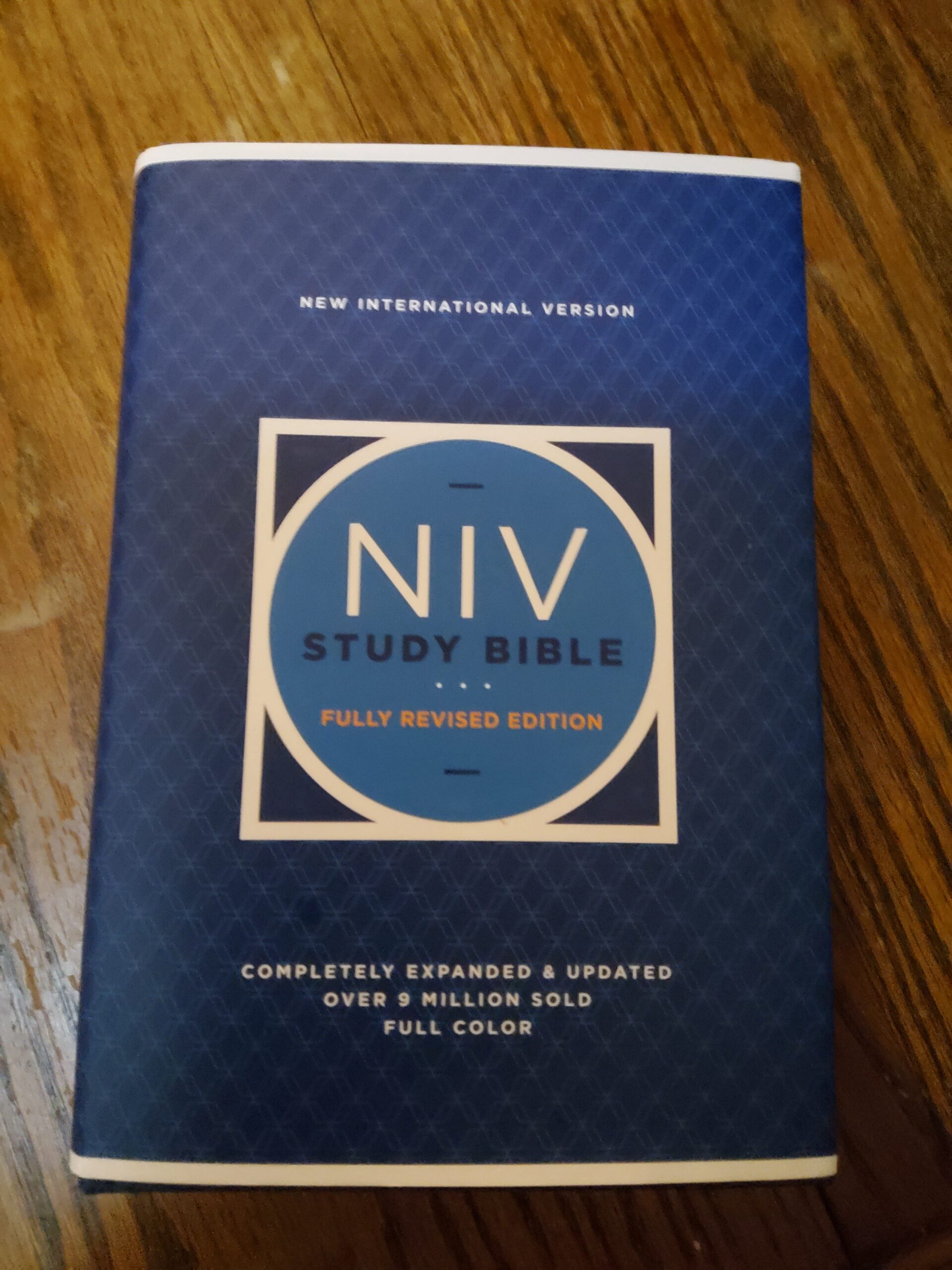
  • The NIV Study Bible (Fully Revised Edition

    The NIV Study Bible (Fully Revised Edition

    (I’m writing as a #BibleGatewayPartner and a member of the #BGBloggerGrid. See note at the end of this post.)

    When a book that I generally like undergoes a revision, I approach it with a bit of trepidation. Is it going to match the older edition? Will it be better? Or maybe it will lose all value.

    The NIV Study Bible hasn’t been central for me personally, but I have interacted with it through many, many students who used it as they attended my classes. It’s the sort of book that kind of fades into the background simply because so many people have it.

    I also haven’t lost my issues with study Bibles in general, in particular the potential that people become dependent on the interpretations of their particular study Bible, rather than actually reading the scripture, interacting with it, and also testing their interpretations against other streams. Having notes on interpretation so closely connected with the text of scripture can contribute to laziness.

    So I’ll start with my standard recommendation: Use more than one Bible translation, and use more than one study Bible, taken from different perspectives. You can find one set of suggestions here.

    That said, this study Bible is takes a balanced approach. By balanced, I don’t mean theologically. To some extent one’s theology will impact a study Bible. One has to write from a perspective if one doesn’t want to simply be confusing. What I mean by “balanced” is that it covers the various needs of a Bible student who may be working without a helpful teacher, and does so in good proportion.

    Consider charts like the chart of covenants conveniently placed near the text on the covenant with Noah. This chart helps a reader identify broad themes through scripture and draw connections.

    The spread with the chart on covenants.

    This combines with a variety of other charts that will help a student get perspective. Again, because this sort of information must be from some theological perspective, a serious student should compare other Bibles as well, preferably written from other perspectives. But this material is solid, and it makes a good case for itself being part of regular plan for study.

    Images are generally not just so you can feel good about a location, but are helpful to understanding the passage. Below is the tabernacle, conveniently place in the book of Hebrews. As I review my own study guide to the book of Hebrews I will doubtless recommend this as one option for study Bibles a group might use.

    From the book of Hebrews, on chapters 8-9

    At the same time, it is quite possible (and appropriate!) to disagree with a study Bible. On page 2161 there’s an article titled “Can Christians Lose Their Salvation?” with which I would take some issue.

    Conservative evangelicals will find the commentary on Romans 1:24-28 and the verses following quite to their taste, as it says the passage is one that makes it clear that homosexual practice is sinful. Progressive evangelicals will not. This is a passage where a commentator is doomed to anger somebody. For purposes of review, I’m simply stating the viewpoint so readers can get an idea of where this study Bible stands on the spectrum of study Bibles.

    A great feature of this Bible is that notes about background are clearly distinguished from those about application by color icons. Readers want help with application, but it’s important to realize that when you are applying scripture to modern times, you are that much further from the text itself. It’s good to know when you’re working with raw data (or as close to that as possible) and when someone is spanning the huge gaps of culture and time to tell you what you ought to do about it. Somewhere between these two are notes that talk about personalities or people groups, which are also clearly marked. These notes partake of both ideas.

    I should note as well that charts, such as those I have praised also fall somewhere between background and application. This simply means whatever you do study, you need to study carefully. Be aware constantly of the human element in scripture, where God uses humans as communicators, and also in all layers of interpretation. Simply by suggesting a background text from the ancient near east that is related to a scripture passage one introduces the bias involved in that selection. Prayerful, open-minded, in-depth study is needed.

    I can’t resist saying all of that, but if you want a conservative evangelical study Bible, this is an excellent choice. I’ll repeat my recommendation that you not depend on a single study Bible or commentary, but select sources that start from different perspectives.

    Zondervan provided me with a free copy of this Bible in exchange for an honest review, for which I thank them. I will provide a link to purchase the Bible in its various editions below.

  • Galatians 2:16 – A Problem in Translation and Theology

    Galatians 2:16 – A Problem in Translation and Theology

    I wanted to write a quick note here as this relates to my study tonight, as well as illustrating quite a number of translation problems. Here is our text, with CEV (NOT CEB) to the left, NRSV in the center as a “literal” comparison, and NLT to the right. I’m copying the NRSV notes as they highlight the issue.

    CEV

    But we know that God accepts only those who have faith in Jesus Christ. No one can please God by simply obeying the Law. So we put our faith in Christ Jesus and God accepted us because of our faith.

    NRSV

    yet we know that a person is justifiedd not by the works of the law but through faith in Jesus Christ.e And we have come to believe in Christ Jesus, so that we might be justified by faith in Christ,f and not by doing the works of the law, because no one will be justified by the works of the law.
    Notes: d. Or reckoned as righteous and so elsewhere. e. Or the faith of Jesus Christ. f. Or the faith of Jesus Christ.
    (The Holy Bible: New Revised Standard Version. (1989). (Ga 2:16). Nashville: Thomas Nelson Publishers.

    NLT

    “Yet we know that a person is made right with God by faith in Jesus Christ, not by obeying the law. And we have believed in Christ Jesus, so that we might be made right with God because of our faith in Christ, not because we have obeyed the law. For no one will ever be made right with God by obeying the law.”

    Tyndale House Publishers. (2013). Holy Bible: New Living Translation (Ga 2:16). Carol Stream, IL: Tyndale House Publishers.

    If you look at notes e & f which are identical, you’ll see the problem. The Greek text can justifiably be translated either as “faith in Christ,” that is, our faith directed to Christ, or as “the faith of Christ,” Christ’s faithfulness to us. That’s not an insignificant difference. The NRSV does well here by translating one way and footnoting another. The problem is that people rarely read footnotes. In a Dynamic Equivalence (or functional) version the translator is obliged to make a choice. You cannot clearly express the meaning of the original in a new language if you have not understood it. Having understood it (you think), there is always the possibility that you have misunderstood it.

    This is another important reason why I urge people who study the Bible in translation to both use more than one and also to read translator’s footnotes. They can be critical.

    (See MyBibleVersion.com for some comparisons.)

  • A Note on Translations and Commentaries

    A Note on Translations and Commentaries

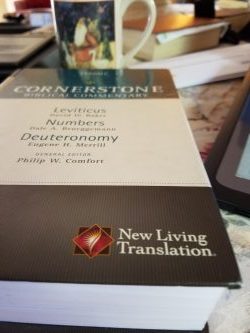
    CBC based on the NLT
    Are we veiling the commentary with the translation used?

    As I’ve been reading a commentary based on the New Living Translation (NLT), it has been interesting to note how the commentators differ from the readings of the translation on which the commentary is ostensibly based.

    For example, as I finished reading the section on Numbers today (pp. 217-443), written by Dale A. Brueggemann, I noted two important translation notes.

    1. 35:12, in which the NLT refers to “relatives” rather than to the singular “goel” or avenger/redeemer, a translation that the commentator says “… may be misleading” (p. 426n). Certainly potentially misleading and may cause one to miss connecting thoughts built on this concept.
    2. 35:20, in which two points are noted. First, the NLT adds “a dangerous object” which is not in the Hebrew source, and also omits “while lying in wait,” which is in the Hebrew. The latter omission the commentator calls “this telling qualification” (p. 427n).

    It’s not surprising that a commentator will work for the source text, of course, but it’s interesting to note. You’ll find this sort of disagreement in almost any commentary where the author is required to use a particular translation. Sometimes one could almost say “with the ___ version included” rather than saying it’s a commentary on that version.

    With a dynamic equivalence translation, however, the odds are greater that there will be a certain tension between commentator and English text. This is not really surprising. Is it problematic? For many, this disagreement is an argument in favor of more formal equivalence translations.

    It seems to me, however, that a formal equivalence translation, besides allowing for misunderstanding, such as when it verbally translates some idioms, also simply leaves greater room for one to imagine the translation agrees with one’s own approach, even when it’s simply a bit ambiguous.

    It’s valuable for lay persons who read scripture to become aware of the fact that there are differences in the way translations are done. That’s why I frequently recommend reading from more than one translation. For example, a good counterpoint to the NLT might be the New Revised Standard Version (which also provides from more theological diversity in the translation committee) or the English Standard Version (with an evangelical team similar to that of the NLT).

  • Identifying Extremes – Examining Everything (An Example)

    Identifying Extremes – Examining Everything (An Example)

    book cross-hatchThis morning Dave Black posted some things about reading Hebrews from the Good News Bible (TEV) and also on authorship and canonicity. I’m not posting to enter into a debate on this point, but rather to note an attitude.

    Dave says:

    The undeniable reality is that questions of canon and authorship matter. Of course, both sides demonize the other. Proponents of Pauline authorship are dismissed as obscurantists, while proponents of Hebrews’ non-Paulinity are accused of succumbing to the spirit of the age. But why should we tolerate this kind of judgmental divisiveness? Maybe we need another conference on campus to discuss the issue!

    Good points! I am deeply concerned when people who are treated with intolerance by one group, move to another, and then treat their former group with intolerance. Is there justification for some reaction? I know many people personally who have been treated badly and many of them have been deeply hurt. There’s some justification here for anger. I publish books by authors who have lost their jobs over theological positions.

    But is the justification enough? I don’t think so. Our response to intolerance needs to be greater tolerance. That doesn’t mean we have to accept and approve behavior. What it means is that we need to look for a freer exchange of ideas and better treatment of people.

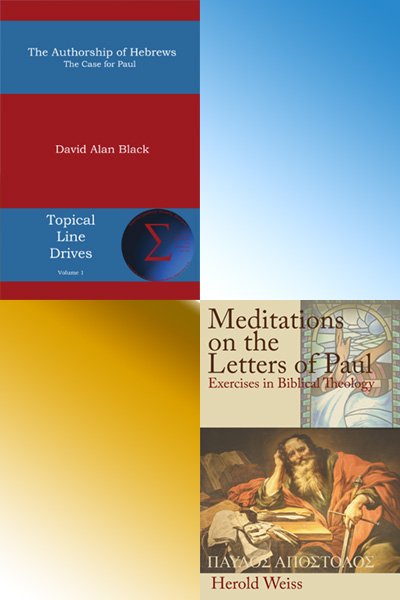
    There are those who wonder why I publish a book like Dave’s The Authorship of Hebrews. Not only do I publish that book, but I requested it. Dave didn’t push it on me. I don’t accept Pauline authorship of Hebrews. I don’t believe we can know the author’s name with any confidence. Yet Dave’s work on this topic shifted my position from one that excluded Paul from the list of possible authors to accepting that his authorship is a possibility. More importantly, Dave demonstrates how to challenge an academic consensus—with detailed, careful scholarship.

    Now let me provide a contrast and a comparison. In the lower right of my little graphic today we have the cover for the forthcoming book from Dr. Herold Weiss, Meditations on the Letters of Paul, which I’m currently editing. First, the contrast. Contrary to Dave Black’s acceptance of Pauline authorship of Hebrews, not to mention the pastorals, Dr. Weiss accepts a minimal Pauline corpus. He even rejects Colossians. So his meditations are on a substantially smaller set of writings that Dr. Black’s would be. Now for the similarity: Besides the fact that I enjoy and have learned much from both writers and both books, neither of these men has ever asked me to accept something because it’s in their tradition, or just because they said so. They are both willing to debate and discuss.

    I can give you numerous reasons why I publish books from a variety of perspectives, and I’ve done so before. But there’s a personal reason. I like them and I benefit from them. I have published some books that I really wish had been better. I do not claim any sort of editorial infallibility. In fact, I would claim feet of clay. But I have learned from and benefitted by reading each and every book I have published.

    Let me suggest a response to Dave’s little book. How about looking at some of the vocabulary comparisons excluding the pastorals, or even working from a minimal Pauline corpus? I’d like to play with that. I don’t know if it would be meaningful, but somebody could look at it.

    Just a thought …

  • Review – Tyndale Select NLT: Select Reference Edition

    nlt_with_spineWhen the e-mail arrived offering me a copy of this gorgeous Bible edition, I didn’t really read the material thoroughly enough or I might have declined. I’m a content man. I have one complete bookcase and parts of three more dedicated to Bibles. Very few of them are special in terms of their binding. It’s the text that drives me.

    But I saw that this was the New Living Translation, and that it was in a new edition, and so I said I’d review it. I’m actually glad I did. I’ve read a few of the other reviews, and they emphasize some simple facts about this Bible. It’s a work of art. Mine is goat skin for the cover, the paper and font are magnificent. It’s truly an heirloom Bible. You can find out all these details, however, from Amazon or from the publisher. I’m going to include some pictures in my review here on my blog so you can get an idea.

    Though it is an heirloom Bible it is not one of those huge books that are destined to stay on whatever table they’re placed on first. It’s easy to carry and to use. You can reference it, which is nice, considering it’s a reference edition. So while you may not feel like doing anything too vigorous around it, lest you damage the work of art, it is nonetheless quite useful as a reading or study Bible.

    Those who know me can predict where I’m going next. I’m afraid I have to admit that I start to twitch when I just hold this Bible. I didn’t actually look up the price before I received it, but within moments of actually putting my hands on it, I realized that it was a more costly Bible than I imagined. I’m not going to cite the price in my review, simply because current prices change. I’ll let you follow the link and get that information from the Amazon.com web site. I have never owned, and rarely touched or handled a Bible that costs this much. That leaves me with mixed emotions about it. But a book review should talk about the book from the point of view of what that book was written and/or designed for. I don’t criticize the NLT for not being either The Message or the NRSV. A Bible translation is designed for a purpose, and so is a Bible edition. You can decide what is right for you. If your plan is to buy an heirloom Bible that is to last and be passed on from generation to generation, you should be looking at this one.

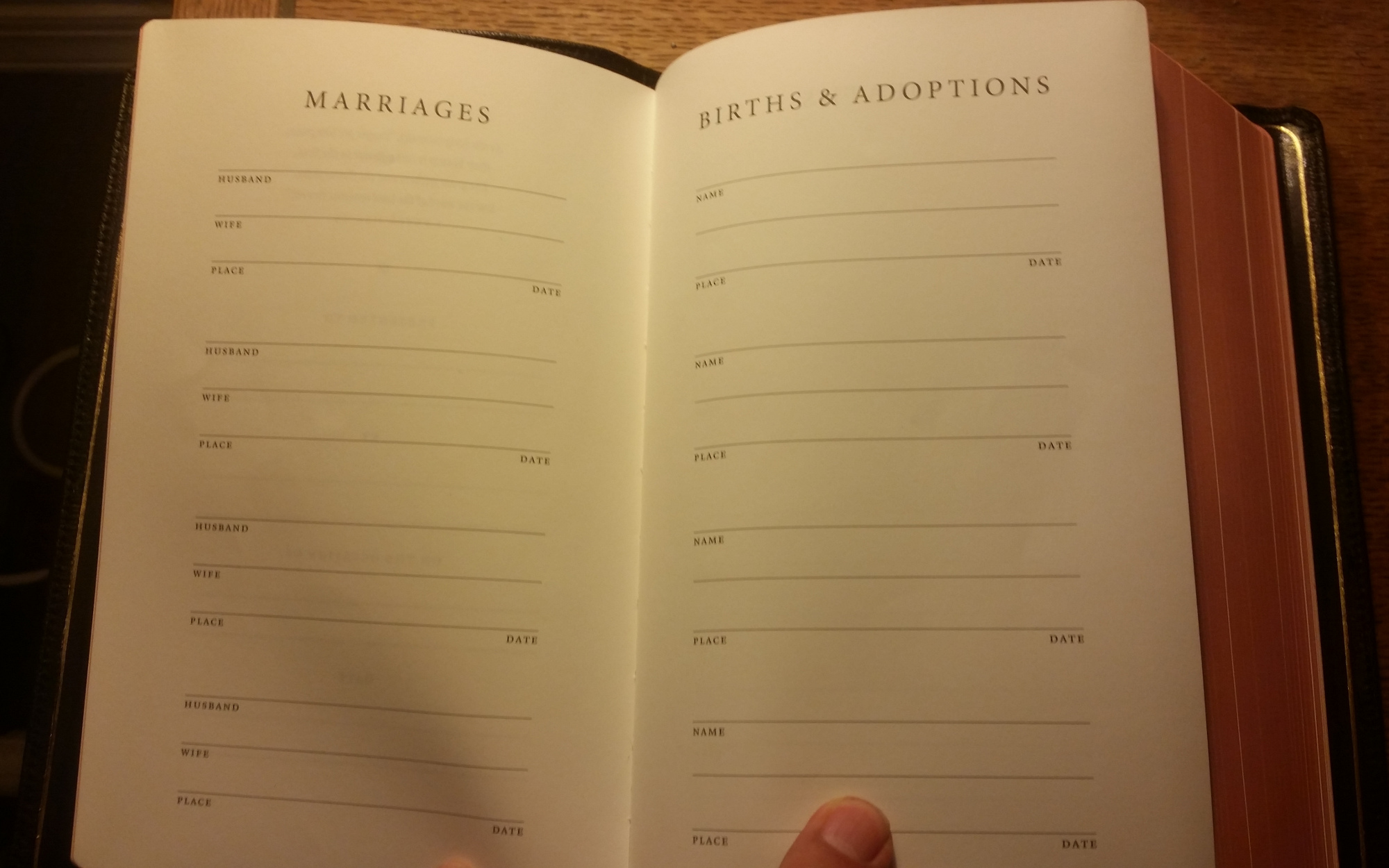
    Did I meniont that this Bible is designed to last and to be passed down from generation to generation. In pursuit of that goal it has lovely presentation and family record pages as well.

    nlt_presentation

    The text is, of course, the NLT. I have a high opinion of this translation for the appropriate audience. In one sense the NLT is descended from the Living Bible. One of the weakness of the Living Bible was that Kenneth Taylor didn’t read Hebrew or Greek. He worked from the English text of the American Standard Version. As a result, while the Living Bible was very readable, it was not always as accurate as it could have been. This problem was corrected for the NLT by a highly qualified evangelical translation committee. They managed to keep the readability, though I think they lost some of the charm and all of the eccentricity. How good that was is open to question. I have linked a couple of references to the NLT to my MyBibleVersion.com web site where you can get some additional information and see how I rate the translation in various categories.

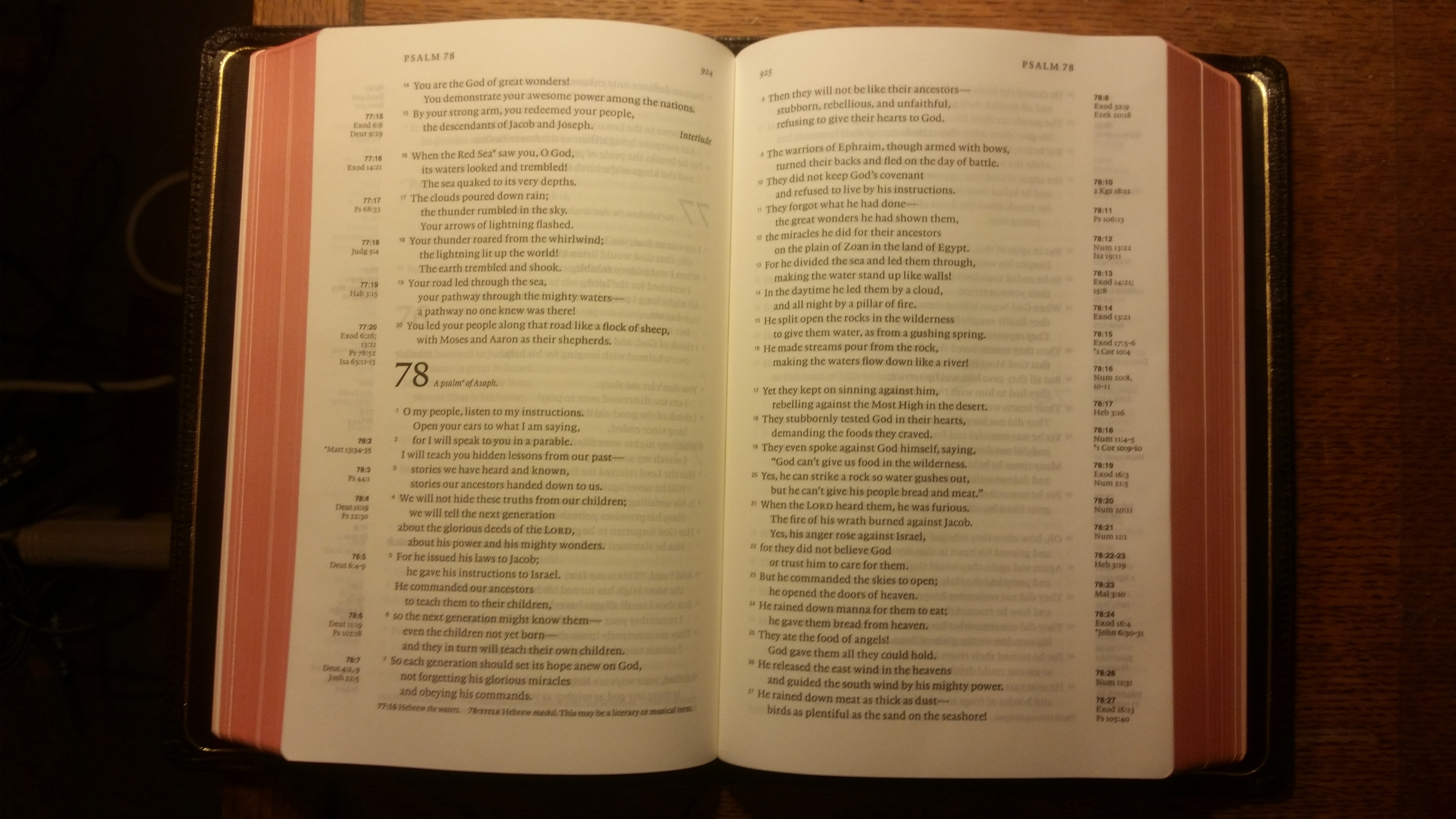
    nlt_interior_psalm_78As I say on the cover of my own book What’s in a Version? the best Bible version is one you read. The first question should be whether you’ll be able to use and understand a Bible version. Accuracy in details is of no particular value if you don’t actually read and comprehend the accurate words. Of course, readability should not be an excuse for inaccuracy. Unfortunately, reviewers of Bible versions frequently call disagreements with their preferred translation of some particular verse “inaccurate,” when it is really just “different than I would have done.” The NLT may be different, but it is competently different.

    The things that stuck out for me in this edition are first things that are missing. This is not a study Bible in the sense of one with study notes, book introductions and so forth. I am pleased with that. Too many people are treating study notes as the inspired text and ignoring the actual text. You won’t do that here. You’ll need a good Bible handbook or Bible dictionary if you want to get that sort of information.

    What you do have is a single column that is a good width for rapid reading. I’ve discussed before many different approaches to reading, and I think one of the most neglected is sustained reading of quantities of the biblical text. This Bible will make that easy. I prefer that greatly to the multiple narrow columns that tend to slow me down. Further, there are quite a number of cross-references. It is possible to become dependent here, just as it is to become dependent on notes, but in this case I think most people can do with the help. The NLT translation notes are included at the bottom of each page.

    nlt_dictionary_concordance

    In the back you have a basic concordance and dictionary. This is not a replacement for your Bible dictionary but it will give you the basics and help you find a variety of references on a topic. This is followed by a selection of maps. Again, no effort is made to compete with your Bible atlas, but for reference on the run or in your study group, the material is better than average.

    nlt_maps

    While the binding, paper, and high quality construction are the distinctive features of this Bible edition, I found that it is fully valuable as a Bible for your actual use. If you do choose to spend the money on an heirloom Bible edition, and hope to pass it on to your children, this will fit the bill. With decent (though not massive) margins, you may also be able to leave your notes and your testimony in it for your children as well.

    I remain a content person, but I can respect a true work of publishing art when I see it, and this is one.

    For those interested in the text, here’s my video review of the NLT:

    (Disclosure: I received a copy of this book free from the publisher for review.)

  • On Prettying-Up the Bible (In Reply to @drbobcwcc and @RevKindle)

    Does the Bible need some improvements, if not in content, at least in presentation? That’s one way to put the question addressed by Rev. Steve Kindle in a guest post on Dr. Bob Cornwall’s blog. I want to make some fairly picky comments on this post. As I do so, I want you to be aware that I generally applaud the goals of this post, even while disagreeing in detail.

    My previous experience with prettying-up the Bible involves the violent passages. I previously reviewed Jack Blanco’s book (I have trouble calling it a translation), the Clear Word Bible. Some of his renderings are much more comfortable reading than the original, but I haven’t been able to conceive of a paradigm that would allow me to think of them as accurate. I often think, however, that some of the violent passages of scripture are saved from revision largely because so few people read them. Numbers 31 has the advantage of being in a portion of scripture rarely consulted by Christians. When they do consult it, they are often shocked and wish it would go away.

    Besides honesty (or accuracy), there is a problem with smoothing out the past. It conceals the nature of scripture, of the experience with God that comes from different people at different times. Seeing trajectories of change in scripture will change our approach to how we get from the words in the book to ethical action in our world.

    Rev. Kindle is primarily addressing gender language. This is a fairly controversial topic in modern Bible translation. Translations have been excluded from certain Christian book stores because of the way the represent gender. As is often the case, however, the issue was much more how one was perceived to represent gender. The same store carried other Bible translations that used gender neutral renderings. These other versions were simply less well-known. The Council on Biblical Manhood and Womanhood is very involved in these issues from a conservative point of view, and are opposed by the Christians for Biblical Equality. In perusing these sites, one can see that there is a great deal of weight put on these issues in church doctrine and politics.

    What is unusual in Rev. Kindle’s presentation is that it comes from a progressive Christian who supports equality. He supports gender neutral language in many endeavors, excluding one:

    I am all for the use of gender neutral terms for God in all church settings including sermons, liturgies, and conversations. But when it comes to inclusive language in Bible translations, I must object.

    There is a valid distinction between those fields of endeavor. There is a great deal of difference between determining the way I will discuss God and the way I will translate. Do I refer to god solely with masculine pronouns? Do I avoid the use of pronouns at all? Those questions involve different issues when I am translating the apostle Paul, for example, as opposed to expressing my own theology. I am not a pastor, a liturgist, or a theologian. My studies were in biblical languages, and I’m a publisher. I’m interested in the words.

    And that’s where we tend to get into trouble.

    Whats in a Version?Most people, in my experience, view Bible translation as a singular effort, one with a definite, definable goal. I encounter this attitude almost every time I speak or teach or any other time someone manages to connect my face with my book, What’s in a Version?. The question I’m most often asked is: What is the best Bible version? Sometimes there’s a variant: What’s the most accurate Bible version?

    But those questions reflect the problem. On the cover of my book I have a one-line answer: The best Bible version is the one you read!

    Surely that’s a horrible answer! There have to be bad Bible translations, and I could be reading one of them! And yes, it’s not a complete answer, yet it does make a point. The task of Bible translation is not singular. There is no one “most accurate” Bible translation. There is no single “most readable” translation. In order to answer that common question I have to know who the questioner is. What is the best Bible version for you? I also need to know the activity in view. What is the best Bible version for you to use for devotional reading? What is the best Bible version to use in your study group? What is the best Bible version to use from the pulpit?

    The reason is that one cannot transfer the entire meaning of a a source text into any target language. You are going to lose something. The question is what?

    Let me take a short digression here. When I discuss loss of meaning I do not mean solely between the text of the source language and the tip of the pen (or the little pixels on the computer screen) of the translator. I mean loss of meaning between what a well-qualified reader of the source language could get from the source text itself, and what a reader of the target language can get from the text in the target language. There is no great value in a text which is accurate in an abstract sense, but is not understood accurately by actual readers. It follows from this that a translation must consider who is to read the text in order to determine how to express thoughts from the source accurately.

    Further, understanding comes in different forms. Do I emotionally “get” the story told? Do I comprehend the facts that are narrated? Am I swept away by the literary beauty of the passage? Can I place myself in the shoes of those whose story is told, or who might have first heard the story? All of these things are desirable to various extents at various times, but successfully conveying them is not easy. In fact, it’s impossible to do everything at once. I cannot, for example, convey the rhetorical impact of the Greek of To The Hebrews while also making every point of theology clear to an American audience.

    I know readers will object that it is up to teachers and preachers to get the theology right, and they may be correct, but that is a choice in what will be translated. I could then say, “Translation X conveys the theology of Hebrews with great clarity, while translation Y gives one a feel for the literary tour-de-force executed by the author.” The author, however, was intending to convey his (or her, I must concede) theological points in a powerful and compelling exhortation. Where do I compromise?

    This is why some have commented on the irenic tone of my book. It’s not that I’m such a peaceable personality, or that I am a great peacemaker, though I would love to be. The reason is that I believe that there are many possible goals for Bible translation and that there are many audiences for which one might translate. Thus there are many possible ways in which one can (and should) translate, so I have less of a tendency to condemn any particular rendering. I do not mean that all translations are equal. I do not mean that there are no wrong translations. I simply mean that there are multiple right translations within various parameters.

    I am disturbed when I hear preachers and teachers refer to translations that are supported by significant numbers of scholars as “mistaken” or just as “errors in translation.” This presents the task of translation as too simple. There are many legitimate disagreements which should be referenced as such. Reserve the word “error” for a translation that cannot be justified.

    But to get back to the gender issue, Bob, in his introduction brings it up,

    Thus, the New Revised Standard Version and the Common English Bible will, where the translators deem appropriate, translate a word like adelphoi, the Greek word for brother as “brothers and sisters.”

    and Rev. Kindle uses similar phraseology (9th paragraph from the end):

    “Member” here is literally, “brother.”

    I have been accused of not giving users of the word “literal” the sort of latitude I give with any other word, i.e. recognizing that words have different meanings. The problem with “literal,” especially in circumstances such as these, is that it is extremely susceptible to equivocation. As its use has developed in the language, it is often heard as “accurate” or “faithful” when those who use it intend something more like “simple,” “direct,” or “most common meaning.”

    In this case I would disagree with the usage in either case. The Greek word adelphos or its plural adelphoi may have as its referent either a male person (or group of males, as appropriate), or a person of undefined gender, or a group of both men and women. It is probably significant that the masculine form was used in both cases, though it is very easy to take grammatical gender too far in translating a language in which grammatical and natural gender do not match.

    Similarly, until recently (change is still in progress) we used “he” to refer to a generic person in English, and “men” and “brethren” to refer to groups of mixed gender. In groups I have been able to survey informally, there seems to be a break right around 40 years of age (adjusted for the passage of time) as to how this usage is understood. Older people will understand “brethren” as including both genders when a group is addressed, while younger ones do not. A pastor illustrated this to me very clearly when he objected to the NRSV because of its gender neutral language. He couldn’t see how “brothers and sisters” was an accurate translation of adelphoi, so he would stick to the more accurate (in his view) RSV. The next Sunday he was reading scripture and he came to a passage in Paul where the apostle was clearly addressing an entire congregation. He stopped, looked up, and said, “And that includes you sisters too!” Clearly he knew some in his congregation would not hear the passage as inclusively as it was intended.

    This would apply differently in different passages. For example:

    My brothers and sisters, believers in our glorious Lord Jesus Christ must not show favoritism (James 2:1, NIV, from #BibleGateway).

    The words “brothers and sisters” here translated the Greek adelphoi. I think it unlikely that James intended men in the congregation to eschew favoritism, while the women were allowed to practice it. He addresses the whole congregation. Yet if I read the usage of the English language correctly, a congregation with people largely below the age of forty would hear the passage as excluding women if we used the “literal” translation “brothers.”

    On the other hand, we have James 3:1:

    Not many of you should become teachers, my fellow believers, because you know that we who teach will be judged more strictly (James 3:1, NIV, from #BibleGateway).

    Now here we have a historical decision to make. My belief is that there were many more women teaching in the early church than we have imagined. This is not the place to argue the point. If, on the other hand, one believes that only men were permitted to teach, this would lose historical information as translated by the NIV, as “fellow believers” is here also a translation of the Greek adelphoi. (Another interesting question is whether “fellow believers” or “brothers and sisters” is the more literal rendering of adelphoi. But I will avoid diving into the morass of meanings for the word “literal” that would evoke.)

    This is different, however, from the kind of effort made by The Inclusive Bible, which changes many cases in which the original intent of the passage, by which I mean in this case the original referent, is not inclusive. The passage Rev. Kindle quotes from 1 Corinthians 14:34-35, for example, if it is original to the epistle (I believe, with Gordon Fee, that it is not), certainly is not intended as inclusive. That case is very different from either of the cases I referenced in the book of James.

    These cases should be handled differently, according to the nature of the audience and the usage in the target language. Right now we are somewhat in transition on inclusive language in English, and that will complicate the work of the translator, and even the liturgist. Something that is heard one way by part of the congregation may be heard in the opposite way by another.

    In addition, we need to recognize multiple goals in the use of our ancient texts. We do not translate just to convey data. We also translate for liturgy, for devotion, for prayer, for meditation, and for other goals. The particular way we handle the material at hand must take this different uses into consideration. There are certainly illegitimate translations (1 Corinthians 14:34-35 above from The Inclusive Bible, and many Old Testament passages from The Clear Word, for example) but there are also multiple legitimate goals and multiple audiences to which the translator will hope to convey something of the source text.

  • A Bible and Book Burning

    Pastor Marc Grizzard of (oh the irony!) Amazing Grace Baptist Church (I’d link, but the web page at the only link I have is suspended) is planning a book burning. He believes the KJV is the only true Word of God for English speaking people, so he’s going to burn copies of all those “perversions.” But he’s also going to burn books by heretics such as Billy Graham, Rick Warren, and Mother Theresa.

    I think I’m a much worse heretic than any of those guys, and in proof I present my YouTube video, Why I Hate the KJV:

    1893729206mIn addition, I write about and commend all those “perversions” of the Bible in my own book, What’s in a Version? complete with the friendly slogan on the front: The best Bible version is the one you read. Alternatively, one might read my book Not Ashamed of the Gospel: Confessions of a Liberal Charismatic. Surely there is enough heresy (as defined by Marc Grizzard) in there to merit burning.

    I’ll tell you what. I’ll even supply copies of the books. It’s probably too late to get them there for this Halloween, but it’s not too early to plan for next year.

    And send me a video of my books going in the flames, of course.

    Just noticed how old the story was. Oh well … it was fun anyhow!

  • Tabulated Lists in Translation

    Elements of formatting and layout can have a significant impact on the use of a Bible translation and even the way in which it will be read and understood. Examples of formatting choices that may be very significant include paragraph divisions (not to mention the more historical, though unoriginal, chapter and verse divisions), section headings, and the often overlooked capitalization choices for divine names and titles.

    In reading Numbers 13 the other day I noticed another case, which I doubt will impact interpretation very much, though I do think it impacts readability–tabulated data. In the NLT, Numbers 13:4 introduces the list of those chosen to spy the land of Canaan. Here NLT breaks out, puts headers of “Tribe” and “Leader” and presents the content in tabular form. This doubtless makes it easier for a modern reader to scan through the list.

    I thought I’d check a few other translations that I had close at hand, just for fun. (This selection is neither carefully selected nor exhaustive. These are Bibles that are on my ready-reading shelves.) Providing a tabulated list are the NLT, JPS, NIV, and REB. Breaking these verses out into separate lines, while maintaining paragraph format otherwise are the NJB, CEV, HCSB, and NAB. I’m skipping any versions that do not include paragraphing, as each leader would automatically start on a new line due to verse breaks. Finally, both the NRSV and the ESV include the names in a paragraph, not broken onto separate lines. (I’m not certain if this might change by edition or if this part of formatting is protected.

    This is doubtless a trivial point, but when all aspects of formatting and page layout are combined, the overall impact can be considerable. It is a good idea for the serious Bible student to be aware of the choices that are being made by translators.