Threads from Henry's Web

Category: Biblical Criticism

Discussion of the historical-critical method and its various methodologies and their application to Bible study and formation of doctrine.

  • A Note on Relationships between Texts

    A Note on Relationships between Texts

    I think there’s considerable confusion about the way texts in scripture can/do relate to one another. Often people simply take the Bible as a simple, flat space in which one can bring any set of texts or passages together to create a valid theological result. (I should pause to reflect on the notion of a “valid theological result, but, hmmm, some other time!)

    So let’s just look at the ways in which texts might relate:

    1. Quotation. One text can quote from another. In some cases this is clear, especially with quotations of Hebrew scripture in the New Testament.
    2. Paraphrase: Similar phraseology is used. This may involve simply use of a familiar turn of phrase, or it can be a substitute for quotation. This, and quotation can present a problem for translators who translate the Hebrew text in the Old Testament, but then deal with an Old Testament quotation which is taken from the LXX. I commented on this in Hebrews 2:6-8 here and here.
    3. Allusion. A word or idea brings to mind words or ideas in an earlier book, but doesn’t directly quote or paraphrase.
    4. Similar imagery. This is a sort of common technical language, and can be hard to trace or prove. It is more a matter of a similar well drawn from by both texts.
    5. Canonical relationship. A text may show no knowledge of another, but it is related in the way the overall canon of scripture is understood. Here we are looking much more at how the people using the text perceive the combined message of various books than at anything in the mind of the various writers.
    6. Ideas. There may be ideas held by multiple writers that we cannot trace to an exposition by any one of them, but that form part of the basis for thought.
    7. Theological. The relationship may reside largely in the reader’s theology, in that they see various doctrines expressed, usually in part, through various texts that really only relate in that theological connection. The connection may be one none of the writers conceived of.
    8. Not related. Just for completion.

    It’s important to be aware of these and other relationships between texts, because the specific way in which texts relates impacts our answers to questions of interpretation. For example, a brief quote might draw in thoughts from the source text, carrying more freight than the simple text conveys. Unfortunately, this sort of “umbra” drawn in with a text is easy to exaggerate or imagine completely.

    I post this list simply to suggest things to think about as you read. If you see some connection between texts, think of just what that connection might be, and whether the author of the text you’re reading might have been aware of it and intended it to be part of the meaning of his text.

    Folks such as myself who emphasize exegesis and critical Bible study tend especially to look negatively on #7, but we should remember that whether we attribute our theology to specific Bible writers or not, we do have a theological view. Everyone partakes of #7 at some point.

    Key point: Be aware of the sort of relationship you are either using or creating when going from scripture to theology.

    (Featured image credit: yra1111 from iStockPhoto.com)

  • Book: The Byzantine Text-Type & New Testament Textual Criticism

    Book: The Byzantine Text-Type & New Testament Textual Criticism

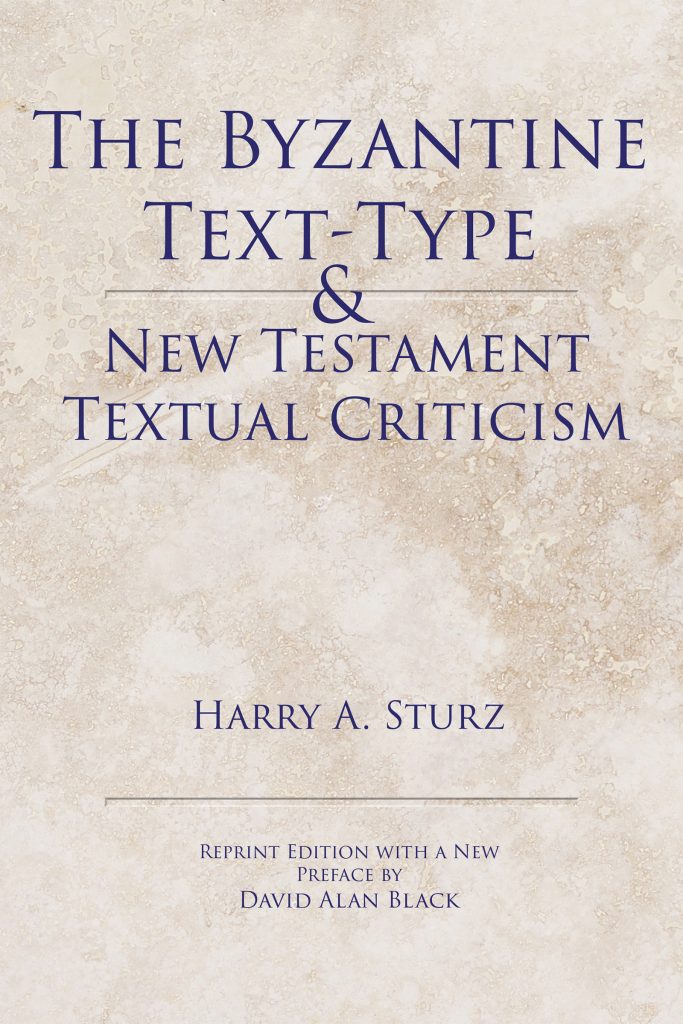
    In my business role as president of Energion Publications, I’ve just cleared the proofs for the release of the book The Byzantine Text-Type & New Testament Textual Criticism by Dr. Harry Sturz. This is a reproduction of the original book, released in 1984 and is produced under license from HarperCollins Christian Books.

    Note: This discussion is not intended for experts, but for people who have only occasional contact with New Testament textual criticism. While I have studied textual criticism, I am not a specialist in it by any stretch of the imagination.

    We have thousands of manuscripts of all (a few) or part (many) of the New Testament. In preparing a Bible translation, translators must make choices of which manuscript readings they are going to use.

    It’s easy to overestimate the problem here, because significant and/or doubtful variations form a very small part of the New Testament text. Nonetheless, in public discussions, the variants get all the press, because we like to find things that are different, and therefore more interesting.

    One thing I learned early in studying textual criticism was that manuscripts should be weighed, rather than counted. What does this mean and how does it work? Well, in general textual critics divided manuscripts into three large groups, which were named for regions associated with them, though actually divided by characteristics of the text. We had the Western text, associated with Rome and parts west, the Alexandrian, associated with Alexandria, Egypt, and the Byzantine text, associated with the eastern church.

    The vast majority of surviving manuscripts are of the Byzantine text-type, largely due to history. The church survived much longer, and many more copies were made in the east. In addition, a great deal of manuscript production in the west was in Latin. I’m brushing past a number of factors, but the bottom line is that there were more Byzantine manuscripts.

    In the 19th century, and somewhat into the 20th, there were a large number of manuscript discoveries, or rediscoveries, which produced texts that differed from the common texts found in the majority of the manuscripts. These newly-found manuscripts were older, in general, than the existing manuscripts, and in many cases included readings that scholars thought were more likely original. This produced a strong swing in scholarly work toward the text in these newly discovered manuscripts. The Alexandrian text got a lot of attention, with the western text following not far behind. A theory developed that the Byzantine text was the result of a major editorial effort, that produced a single, new text.

    As a result, two things happened. First, the Byzantine text was considered generally more recent than those newly discovered manuscripts, and second that it was likely to have readings that were essential 4th/5th-century revisions. At most, it could reflect essentially one manuscript.

    Opposed to this general consensus, on which the text of most modern Bible versions has been based, was the view that the reason we had more Byzantine manuscripts was that the text was actually better preserved there, so that it should be preferred, and manuscripts from the other text-types should be considered some sort of aberration.

    Dr. Sturz argued that the Byzantine text-type could and did preserve older readings. It was not to be preferred over all others, but its readings should be given due consideration in all cases. He provided evidence that many Byzantine readings show up in early papyri, showing either that if there was any unifying editorial process, it had not been one that erased all of the prior evidence.

    The general result of accepting Dr. Sturz’s argument is to improve the evidence that we have for determining the text of the New Testament, as well as change the weight we give to various sources.

    I am glad to be able to release this important book and make it available at a reasonably price again. On the Energion Publications retail site, it will be available for $22.99 (suggested retail 24.99) through Wednesday, which is the official release date.

    Below is an interview I conducted with Dr. David Alan Black (who wrote the preface to the new edition) and Dr. Abidan Shah.

  • Link: Bible Criticism – A Common Sense Approach to the Bible

    This article is quite helpful in understanding what biblical criticism is, how it is helpful, and also how it may be threatening to some.

    Here’s a quote:

    The basic point, however, is an important one: until we know what kind of material we are dealing with, we don’t know what questions it is sensible to expect it to answer for us.

    TheTorah.com

    Read the rest and enjoy!

  • Taint None of Us Perfect, Never, Nohow

    Taint None of Us Perfect, Never, Nohow

    A manuscript fragment
    Credit: OpenClipart.org

    (Leave Christology out of it!)

    Reading the post A Similarity Between Reasoned Eclecticism & Byzantine Priority over on the Evangelical Textual Criticism blog (HT: Dave Black Online, Monday, June 6, 12:35), set me to thinking. Fair warning: This will be a bit rambling. These are thoughts triggered by the post, not largely in response to it.

    The limited number of comments focus, as might be expected, on New Testament. In fact, it seems to me that most discussion of textual criticism tends to focus on the New Testament, and this sometimes leaves the wrong impression. For example, to a query about the reliability of the biblical text an apologist might respond with the number of manuscripts we have … of the New Testament. But what about Hebrew Scriptures?

    If I were to answer the question posed (and if it’s not obvious, I’m not a practicing textual critic), I would have to say that when looking at a passage in the Greek New Testament I’m going to look at the external evidence first, and then the internal. This is for practical reasons. With the number of New Testament manuscripts, versions, and quotations available, one hopes to find the best reading somewhere in the external evidence. Internal evidence can help refine one’s choice, but in practical terms, most of the actual readings are likely to be contained in some manuscript somewhere.

    I wouldn’t argue that all readings that ever existed are to be found in one of our extant manuscripts. There is a theoretical place for a conjecture. So I wouldn’t say that the external evidence places a fixed limit on where we can go with the internal evidence, but I would say that it sets a pretty fair boundary. I would require substantial evidence to go with a conjecture, and even then, it might be a conjecture about an original reading that would generate the external evidence as we have it. So it’s a line, but it’s a line in the sand. It can be moved. In my experience, however, it is rarely necessary to move it.

    But when we turn to the Hebrew Scriptures/Old Testament, the situation is much different. The manuscripts we have come from a time much more removed from the composition of the texts involved, and there are less of them. I think the time between the composition of a text and the first extant manuscript receives too little attention in discussions, because the time before a text is established as sacred is when I suspect much of the variation will occur. It’s quite possible that there are a number of New Testament variations that we don’t consider simply because they are no longer represented in the manuscripts.

    The shift to Old Testament textual criticism was rather interesting for me, as it seems to some extent that you travel to a different world. There are necessary differences because the nature of the external evidence is different. There are even more differences because there are more texts that are obscure. In reading commentaries, one might think that for OT texts lectio dificilior is turned on its head as one runs through possible readings, including conjectures until one finds a reading that “works.” Nobody is going to quite say it that way, but that is how it often feels. And, of course, lectio dificilior has its problems in that it’s quite possible that a difficult, yet translatable, reading could be introduced by error. So it’s not an absolute.

    In the Hebrew scriptures we have more cases in which a passage is truly obscure. Nobody really knows how to translate or interpret. So you get a translation and footnotes. I had a professor in graduate school who absolutely hated the idea of conjectural emendation. He simply wouldn’t accept any. But he’d accept some very wild conjectures on how to translate the text that is actually there. He and I went a few rounds on what the difference was between arbitrarily conjecturing a text that you could then translate or arbitrarily choosing some English words you could say were a translation of the text. In either case, the meaning presented by your translation is a conjecture.

    Conjectural emendation has a bad name, and there is a good reason for this. Critical commentaries on Old Testament books are often filled with conjectural reconstructions of the text that have very little basis in either an internal analysis of the text and transcriptional probabilities or in any external evidence. Often the emendations simply make the book fit some theory of composition, or better represent the theme that the commentator believes, for whatever reasons, must have been intended by the author or redactor.

    Nonetheless, in theory, it is possible that a reading not contained in any manuscript could be the correct reading. The problem is always making a solid case that it is. Few conjectures have managed to gain the support of a strong consensus of scholars.

    Does any of this make any difference to you and me as we try to study our Bibles? Well, yes and no. The problem, as I see it, is to acknowledge the value of textual criticism without believing one must get to that elusive “original text” in order to have good theology or be a good disciple.

    I would suggest that it’s important to seek the best text of scripture simply because it’s important to seek out the best information we can on any subject. At the same time I don’t think we need to be concerned about variants, even substantial ones. We tend to take the biblical data in a selfish way, as though all the manuscripts exist in order to provide us with an accurate view of scripture. But each one of those manuscripts was (part of) someone’s Bible at some time and place. I can worry about whether the Hebrew text behind the Septuagint (LXX) is better or if the Masoretic Text is better, but early Christians lived and did theology with the LXX and the Reformation (not to mention Judaism) thrived on the MT. These aren’t just witnesses to which text I should use; they are Bibles, sacred texts, used by real people.

    The much criticized Vulgate, abandoned by protestants in pursuit of the sources, was nonetheless the Bible for many people. So in modern times was the Living Bible, as flawed as I think it was as a translation.

    If God desired the kind of precision that some of us seem to think is required of the biblical text, I think God would have taken a different approach. But instead of a clean process in which we can give absolute or near absolute answers to all questions about the text, we have a variety of materials produced in different ways. While we long for perfection, for the inerrant text, we don’t actually have it. The claim of inerrancy is made for the autographs, not for any text you have or are likely to have in your hands.

    Which, incidentally, is why I have little use for the doctrine of inerrancy, one way or the other. And let me be clear that I do mean as expressed in the Chicago Statement. I just don’t care whether the autographs were inerrant or not. If God was happy to use an error-prone process of transmission, why must I conclude that he somehow protected the original manuscript.

    Let me illustrate. Supposing that Ezekiel (my very most favorite prophet) is hearing from the Holy Spirit, and he slips and writes the wrong word on the page. It’s a mistake. The manuscript is now no longer inerrant. The autograph is flawed. Oops!

    Now suppose instead that the first scribe to copy the book made the very same mistake, after which the original was destroyed. Now we have only one copy of the book of Ezekiel, and it has the very same error.

    The first scenario is considered problematic. The second is OK. It’s a copyist’s error.

    I disagree. God has chosen to provide God’s Word to us in written form with every evidence of human involvement all along the way. I find it amazing that the text has been preserved as well as it has been. I find it more amazing that it has been available, used, and defended by people in so many places and at so many times. Many of these people were defending texts that various modern scholars would call “corrupt.” They might have been preaching from a manuscript copied by a careless scribe. And yet preach they did! And they lived out their faith as they knew how.

    It’s not just thousands of witnesses to the text. It’s thousands of Bibles used by many more thousands of people.

    We ask the question of whether we can rely on the text. I think it’s the wrong question. The question is whether we can rely on God who, through the Holy Spirit, has been speaking since before anyone conceived of a Bible and who is ready to talk to us today. We’re not perfect. None of us. We don’t have perfect texts. None at all.

    But we can work through the multitude of materials available to us and so communicate not only with God, but with the community of faith that God has established. It’s a community that extends across time as well as space. It’s made up of people who were never perfect but always trying and hoping.

    Now don’t let the fact that we can’t get 100% of the original, perfect text keep you from getting as much of it as you can. And don’t let the fact that you can’t really know all there is to know about God keep you from trying to get to know God better.

    I think that God has set this up so that in trying to know God better (vertically?) we also need to get to know and appreciate one another (horizontally). It is in community that we come to know.

    Or better, it is in community that we keep on the journey toward knowing.

  • Hebrews and the Problem of Writing Introductions

    [ncs_ad pid=’0664239013′ adtype=’aer.io’]

    I’m reading through Luke Timothy Johnson’s commentary in the New Testament Library and have just completed the introduction. I have a couple of thoughts today, not least of which is to note the problem with writing introductions.

    For a reader to truly follow an introduction, it would best come after the commentary and some serious time reading the book, but (catch-22), the commentary is best understood in light of the introduction. For me this has often involved reading the introduction, then the commentary, and then reading the introduction again as a sort of conclusion.

    But often the introductory material is still quite illusive, if not illusory, and the author is left to construct the sort of fantasy realm in which the study will take place. This isn’t a particular criticism of Johnson, who is an excellent writer and makes some quite profound points about Hebrews and Bible study in general in the course of his introduction. His arguments on the dating of the book (45-68 CE) are interesting but not conclusive and he admits as much.

    [ncs_ad pname=’the-authorship-of-hebrews’ adtype=’aer.io’]

    On authorship he expresses the strong conviction that it is right that modern scholarship has abandoned the idea of Pauline authorship of the book. He gives us notice that this is coming a couple of times earlier in the introduction. And he provides a quite good set of reasons for why he believes this to be the case, though I cannot read references to Origen and “God only knows” with the same confidence after seeing Dave Black’s discussion of it in The Authorship of Hebrews (full disclosure: I’m the publisher).

    Then he begins to make his case for his own candidate as author, Apollos. Here he provides affirmation of my rule of biblical introduction: Authors are much better at critiquing the proposals of others than they are at establishing their own. I can’t quite say that there is no evidence whatsoever to support Apollos as author, but someone proposing Apollos should restrain himself from critiquing too vigorously the proposal of Priscilla as author (Johnson lays into it, admittedly with quite good arguments).

    The line I like regarding Priscilla is: “… the fact that everything supporting her candidacy would apply equally to her male partner, Aquila.” Just so. And further, pretty much every argument advanced in favor of Apollos would apply to any Greek speaking Jew who met Paul at some point. Some may object that Apollos was considered a good orator, and there is the elevated language of Hebrews, but if such an argument were advanced about a modern book (the book is well written, and so-and-so is a good writer), it would be laughable.

    I can, of course, leave the laughing to others more qualified than I, and there are plenty who will take up the cause. The fact is, that if you abandon Paul, you pretty much need to abandon naming the author. There is so little known about the candidates. Other than Luke, we lack any written material from them which can be used to compare to the text of Hebrews, and their biographies are so short that one can make up whatever story one wants.

    But such is the hardship of writing an introduction. How many paragraphs does it take to say “I don’t know”?

  • Identifying Extremes – Examining Everything (An Example)

    Identifying Extremes – Examining Everything (An Example)

    book cross-hatchThis morning Dave Black posted some things about reading Hebrews from the Good News Bible (TEV) and also on authorship and canonicity. I’m not posting to enter into a debate on this point, but rather to note an attitude.

    Dave says:

    The undeniable reality is that questions of canon and authorship matter. Of course, both sides demonize the other. Proponents of Pauline authorship are dismissed as obscurantists, while proponents of Hebrews’ non-Paulinity are accused of succumbing to the spirit of the age. But why should we tolerate this kind of judgmental divisiveness? Maybe we need another conference on campus to discuss the issue!

    Good points! I am deeply concerned when people who are treated with intolerance by one group, move to another, and then treat their former group with intolerance. Is there justification for some reaction? I know many people personally who have been treated badly and many of them have been deeply hurt. There’s some justification here for anger. I publish books by authors who have lost their jobs over theological positions.

    But is the justification enough? I don’t think so. Our response to intolerance needs to be greater tolerance. That doesn’t mean we have to accept and approve behavior. What it means is that we need to look for a freer exchange of ideas and better treatment of people.

    There are those who wonder why I publish a book like Dave’s The Authorship of Hebrews. Not only do I publish that book, but I requested it. Dave didn’t push it on me. I don’t accept Pauline authorship of Hebrews. I don’t believe we can know the author’s name with any confidence. Yet Dave’s work on this topic shifted my position from one that excluded Paul from the list of possible authors to accepting that his authorship is a possibility. More importantly, Dave demonstrates how to challenge an academic consensus—with detailed, careful scholarship.

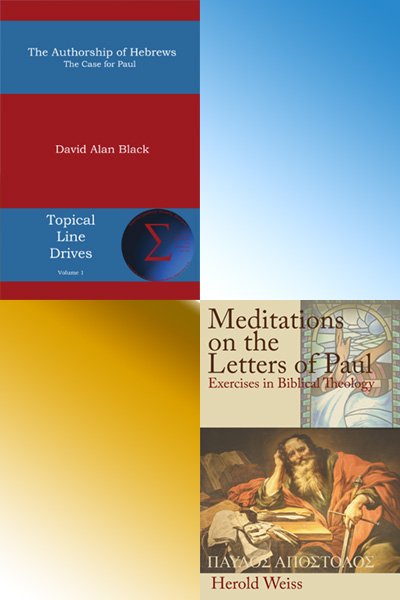
    Now let me provide a contrast and a comparison. In the lower right of my little graphic today we have the cover for the forthcoming book from Dr. Herold Weiss, Meditations on the Letters of Paul, which I’m currently editing. First, the contrast. Contrary to Dave Black’s acceptance of Pauline authorship of Hebrews, not to mention the pastorals, Dr. Weiss accepts a minimal Pauline corpus. He even rejects Colossians. So his meditations are on a substantially smaller set of writings that Dr. Black’s would be. Now for the similarity: Besides the fact that I enjoy and have learned much from both writers and both books, neither of these men has ever asked me to accept something because it’s in their tradition, or just because they said so. They are both willing to debate and discuss.

    I can give you numerous reasons why I publish books from a variety of perspectives, and I’ve done so before. But there’s a personal reason. I like them and I benefit from them. I have published some books that I really wish had been better. I do not claim any sort of editorial infallibility. In fact, I would claim feet of clay. But I have learned from and benefitted by reading each and every book I have published.

    Let me suggest a response to Dave’s little book. How about looking at some of the vocabulary comparisons excluding the pastorals, or even working from a minimal Pauline corpus? I’d like to play with that. I don’t know if it would be meaningful, but somebody could look at it.

    Just a thought …

  • Links and Notes on Textual Criticism

    Links and Notes on Textual Criticism

    Grid-Pattern-200px
    Grid Search Pattern by Scout, OpenClipart.org

    Jeremy Myers at Redeeming God has an interesting post on textual criticism (HT: Thomas Hudgins). Myers is comparing the textual commentaries written by Bruce Metzger (with input of the UBS committee) and Philip W. Comfort. It’s fun to watch the critical scholars disagree!

    If anyone believes I consider that a negative comment on critical scholars, let me disabuse you of that notion. It is, instead, a comment on the texts and sources we have to work with. The reason we have disagreements is not that scholars are somehow stupid or unnecessary, but rather that the evidence is, in fact, complex and requires serious study. Often there isn’t enough evidence to come up with any real conclusion. Where I would criticize critics, and in fact any biblical scholar, is in making conclusions that imply evidence that is better than they have or are likely to acquire.

    When attempting to make the evidence solidly in favor of one conclusion, Christian apologists like to spend their time talking about the New Testament. Why? Because the New Testament evidence is much clearer. Not necessarily clear, but clearly than that for the Hebrew scriptures (or Old Testament). You have an abundance of New Testament manuscripts that tends to put most issues into pretty strong consensus territory. Such is not the case for the Old. We have, in many cases, just enough evidence to suggest that there is a great deal we’d like to know but lack the evidence to study. Looking at the differences between the Septuagint and the Massoretic Text, for example, suggests many possibilities, but leaves us without a detailed trail of evidence to study.

    There are a number of responses to this complexity. We can give up on knowing what scripture teaches. We can decide that the inspiration of scripture operates in very different ways. Or perhaps we can think that the Holy Spirit guides people in the church (and out of the church, for that matter) as they study, and that God doesn’t mind that we come to different conclusions.

    I choose the latter, and apply this to various higher critical methodologies as well as textual criticism. The details are fun to study, but we don’t have to settle all the details in order to be followers of Jesus. We don’t have to settle all the doctrinal issues in order to be followers of Jesus. Yes, it’s fun, and I think even useful to study all those things, but settling them is not necessary. God can guide you when you study your English (or other native language) Bible as well as he can study me when I read Hebrew, Aramaic, or Greek. Maybe even better, for all I know.

    Because I believe that inspiration resides in God’s actions in history and that one of those actions was the production of scripture (yes, scripture in its various debated forms), I think it’s still useful to study everything about the text, from its prehistory to it’s canonical state, to it’s dissemination and variety of translation. I don’t believe God resides at just one point. I may hear from God as I apply source criticism to Genesis, for example, seeing two different creation stories and looking at them independently. I can also hear from God when I see those as combined into the larger volume of the book of Genesis and the Pentateuch as a whole. I can still see God when I look back at that creation story from the perspective of the New Creation which is in Christ Jesus.

    When I read scripture in this fashion, debates about inerrancy and historicity tend to fade into the background as I hope to listen to every echo of God’s voice in the texts I have using whatever means I have to dig out that echo.

    I’m an Amateur Radio operator (KT4B for those who care). I remember when I was in my teens how I would try to contact different parts of the world. It was nice to do so using a reasonably high powered (200 watt at the time) transceiver and a directional antenna on a tower 50 ft high. I could hold conversations with people on the other side of the world if I did the work right. Sometimes, however, things didn’t work so well. Careful listening and careful sorting through the interference could still get a message through.

    I remember once operating from Georgetown, Guyana (WB4BUQ/8R1 at the time) and trying to contact a station in Iceland that was using just 200 mW of power. To qualify for the award he was seeking we had to be able to exchange a certain amount of information and then verify the contact via mail. In normal conversation it would take less than 30 seconds. Using Morse Code and his low power station it took close to a half an hour.

    The information was of no value to me or to him, other than to confirm the effort and its success. But there was great growth in my skills (I don’t know about his) to be gained simply from the effort.

    That is my view of digging into the shadowy, difficult details of scripture. It’s a learning process. It doesn’t really matter whether I come to the same conclusion as you do. I’ve spent time searching for and looking at the echoes of God’s work, and that is enough to justify the effort.


  • Serious about Whose Faith

    I was mentioned by Ed Brayton (blogs at Dispatches from the Culture Wars) in a comment to a post on Facebook, and made a couple of comments myself. Here’s the Facebook post:

    https://www.facebook.com/ed.brayton.3/posts/10153647364908642

    There are two things here that interest me. First is the claim that moderates and liberals don’t take their faith seriously. This is silly, sort of like the claim that atheists really do believe in God, they’re just rebelling against him. What these two things share in common is that the person making the accusation makes assumptions about the other person’s mental processes that are not justified.

    I have spoken to people who called themselves atheists, but who were actually angry with God. They say certain things that tell you they actually believe. I also have spoken to any number of atheists. While they vary in the reasons they don’t believe in God, I have found their thinking quite clear. I have actually occasionally told someone who claimed to be an atheist that they sounded more like a deist or an agnostic (or a whatever to me), and asked them to explain their use of the term. It’s amazing what you can learn just by asking and listening to the response.

    On the other hand my faith is my faith, i.e., I have come to believe certain things. I don’t deny that many of these result from my upbringing. I was born into a Christian home, and that does predispose me to be a Christian. On the other hand, I know atheists who were born into a Christian home as well. More importantly, I don’t believe the same things my parents did. My Christianity is somewhat different. They were (and are) Seventh-day Adventists. I am not. They accepted and taught me young earth creationism. I have rejected that and am, to the extent I can tolerate the term, a theistic evolutionist. There are parts of the Bible that they treated as historical that I do not.

    How do you find that out? In my case, of course, you could read. But if you want to have dialogue with someone, it’s a good idea to find out what they actually believe. It may differ from your assumptions. I am probably more frequently accused of not taking my faith seriously by people who are more conservative Christians than I am. What they mean, generally, is that I don’t take their faith seriously, and generally I don’t. No, I don’t mean that I don’t take the faith of conservative Christians seriously. What I don’t take seriously is the faith of people who are so shallow as to make such accusations without bothering to investigate and learn.

    Let me illustrate this with a more specific example. While guest teaching a Sunday School class I stated that I found prayer at public events questionable at best, and that if asked (unlikely) I would decline to participate. I emphasized that I was not speaking here of constitutionality.  This was not a political position, but a religious one.

    One of the class members immediately accused me of not really being willing to stand up for my convictions because I would not uphold them publicly by praying there. But you see, those were his convictions about prayer, not mine.

    My convictions say that prayer is communion with God. My prayer takes place most commonly in my office while I’m studying my Bible. My prayer time is largely silent. You might even think I’m sleeping. If I pray in a group setting, I want that to be in a setting where we, as a group or community, pray. My city, county, state, or country does not constitute such a community. I can guarantee that someone in that audience is being forced to participate in my spiritual activity.

    I’d like to say that I don’t do it because I don’t want them to be forced to pray, and indeed I don’t want them to. But what drives me is that my own idea of what it means to commune with my heavenly parent is so contradictory to the idea of someone being involved involuntarily, that I find it offensive. I find it hard to pray. You may think I’m stupid, but those are my convictions, and they are the convictions that I will take seriously and uphold.

    I feel the same way about public school prayer. I would find it personally offensive for my children or grandchildren to be drafted into a government organized (or any other imposed) form of spiritual activity. So when I oppose prayer in public schools, I am not refusing to uphold my faith. Rather I am upholding it against something that is offensive to it. In my view the place for prayer with children would be at home with their parents,  or in some sort of voluntary faith community, not in the classroom with a public official.

    The second thing that interests me is the question of what the Bible actually is. Is it metaphor? Is it myth? Is it history?

    The problem here is that the Bible is many things. It contains history, fiction, a legend or so, plenty of metaphors, liturgy, political discussion, and even occasional theological discourse. In addition, it contains literature that is not commonly found elsewhere, such as visions and apocalyptic passages.

    Anyone who says the Bible is any one thing is either ignorant or not paying attention. The idea that there is a variety of types of literature in scripture is not a liberal or progressive idea. Conservatives are aware of it. Many fundamentalists will try to deny it. But where the serious divide comes is in determining what is what. Is Jonah some sort of historical story or is it fiction? (I would say fiction, and written to challenge the activities of some folks like Nehemiah, but it’s hard to pin down precisely.)

    One of the big questions is whether the early chapters of Genesis consist of myth or history. Obviously, young earth creationists regard them as history. I’ve heard people use the question “Is Genesis 1 a myth?” as a sort of touchstone. If you say “yes” you’re a liberal, but if you say “no” you’re a fundamentalist.

    Well, I say no, and yet I accept the theory of evolution. How can this be? Well, quite simply the question of whether a passage contains accurate history and science is quite different from the question of its literary genre. The genre of Genesis 1 is, in my opinion, liturgy. Liturgy does not need to portray accurate history. Genesis 2:4ff, on the other hand, shares most of the characteristics of myth. It’s a different story, told in a different way.

    I’ve been asked why, if the two stories are contradictory, they appear side by side. The reason is that they function in such different ways that they cannot really contradict, any more than an Easter liturgy, celebrating the resurrection at 11 on Sunday morning in Pensacola can contradict an account of a missing body at about dawn near Jerusalem. They’re just not talking the same language.

    I find it annoying that so much Bible study has to do with proving or disproving the Bible. This often results in people taking positions because of what they need the result to be. One person wants to believe that the gospels were written late because he doesn’t want them to be eyewitness accounts. Another wants them to be written early because he does. Neither desire is relevant to the actual dating. I wrote a post about an hour ago maintaining that I thought it probable that Paul wrote Colossians, a position challenged by some scholars. Does this make me conservative? No, nor does it make me liberal. It means that’s what I believe the balance of the evidence is.

    Whether you are a Christian supposedly defending the Bible or a non-Christian who wishes to challenge it, contrived arguments aren’t going to help. Ultimately they’ll undermine your position with thinking people. I don’t mean every wrong conclusion is somehow a disaster. What I mean is every trite, contrived solution whose best evidence is the fact that you need it to be true, is going to backfire.]

    Well, at least it will backfire eventually with thinking people.

  • When Should You Talk about Textual Criticism?

    I’ve posted a question that originates with Thomas Hudgins over on the Energion Discussion blog. Here are my comments to go with that post.

    The question has quite a number of implications. For example, if your listeners do not normally look at the textual notes in their Bible translation, they might not be aware of the issues. Not mentioning a difficulty might be an issue of honesty. (“Pastor, you never gave me any idea how many variants there are in the New Testament text. You lied to me!”) On the other hand, constantly mentioning textual variants, most of which are fairly minor (though translations normally mention only a very small minority, NET excepted, and thus only ones that impact meaning more significantly), and discussing the text all the time can be very distracting.

    I resonate with much of what Thomas says in his post. It’s very easy, as a pastor or teacher, to leave the wrong impression. You can leave your listeners thinking they can’t study the Bible at all unless they’ve spent time with textual criticism as you have. You can make them think no translation is at all trustworthy.

    There are always at least two types of tension here.

    First, there’s the issue of what skill is needed in order to study the Bible. I took a Biblical Languages major as an undergraduate, rather than religion or theology, because I wanted to understand the Bible better. I don’t think I wasted my time. I can get more out of a passage using what I learned, including a quarter each in New Testament and Old Testament textual criticism, than I could if I was limited to English translations. On the other hand, it is not impossible to understand the vast majority of scripture using an English translation, especially considering the number we have available and the wonderful resources we have in addition.

    Second, there’s the issue of the trustworthiness of the Bible. Many pastors avoid issues in the text because they’re afraid people will get the idea that they cannot trust the text of scripture. (“If major translations don’t even agree, how can I be sure?”) I think this is a questionable approach, because the vast majority of the text of the New Testament is not in dispute. It’s much more convincing to mention that before, rather than after, someone discovers textual variants. If you haven’t mentioned it, you’ll sound like you’re on defense, and you’ll sound like you’re making it up as you go along.

    Some may ask why I’m concerned this much about the reliability of the text when I don’t accept the doctrine of biblical inerrancy. There are three answers to this:

    1) It is a matter of historical fact that we have very strong evidence for the text of the New Testament, and that variations are, on the average, minor. Are there significant variants? Yes, but the disputed texts are not that numerous. In fact, a great deal of debate in this area centers around the vocabulary used to describe the situation. Numbers always need to be kept in perpsective.

    2) I do believe in the providential preservation of God’s message. (Vocabulary alert: What is meant by “providential preservation” differs from person to person.)

    3) I believe we need to be honest at all times.

  • Of Scholarship and Tribalism

    When I was working on my MA, one of my professors recommended a paper I had written for publication. He suggested submitting it to the university’s journal, Andrews University Seminary Studies. I was of course greatly pleased to have one of my papers recognized in this way, especially considering the respect I had for that particular professor.

    Some days later I was approached by the journal editor who informed me that the paper had been read by one reviewer, and that he wanted to talk to me before proceeding further. Apparently this reviewer had suggested that I was trying to become “a new Wellhausen” and that the paper should not be published for many, many reasons.

    Now the fact is that my paper was not as interesting, nor as creative, nor as radical as the work of Julius Wellhausen, and the reader was in no sense commending me by referring to that famous name. Rather, it was his way of saying I was jumping tribes. The editor had several suggestions for me, but the one he favored involved dividing my paper into two parts, separating my interpretation from my discussion of structure, and he would publish the one on structure and then “consider” publishing a separate paper on the interpretation. Considering the interdependence of the two portions of the paper, after seeking some advice, I chose to withdraw the paper.

    Now one isn’t supposed to know who one’s reviewers are in circumstances like these, but I found out because the reader cornered me right after graduation and told me. His reason for doing so was that he was concerned for my soul as, if I did work such as I had done in that paper, I was headed straight for perdition. Oh, and he also disagreed with my approach to the scholarship, but that was a footnote.

    At the time, I associated such tribalism with conservative and fundamentalist scholarship. I had grown up in the Seventh-day Adventist Church with a belief in the Mosaic authorship of the Pentateuch, a 6,000 year age for the earth, a literal seven day creation week, and traditional authorship for the books of the New Testament, including all the gospels, the pastoral epistles, Hebrews, and Revelation. So I had seen the arguments that would make the same John author of the gospel, the epistles and the book of Revelation. In that context, suggesting I was trying to be a second Wellhausen was to suggest a radical departure from the norms of the tribe.

    Well, I learned about jumping tribes. I first became unchurched and uninvolved. After many years I joined a new tribe. I became a member of a United Methodist congregation. In this new tribe, I thought, I would find church without the sort of loss of freedom to think represented by my former denomination. And indeed, there is a substantial difference. Yet there is a note of very similar tribalism.

    Repeatedly I have heard in meetings that one should only use United Methodist curriculum. Presumably this is because organizationally prepared and approved curriculum materials are safe whereas others might lead the congregation astray. These arguments come from all sides. At one meeting it was in objection to a piece of Baptist material that was said to have “too much Jesus” in it. Really?

    As a publisher, although not an academic publisher, I have noticed this same sort of thing from scholars. There are boundaries to the scholarship one wants to consider and discuss, and these boundaries often don’t have to do with the quality of the scholarship involved.

    Excursus: What do I mean by quality in scholarship? Primarily I mean that a scholar should have a good overview knowledge of the literature in the field, have given consideration to opposing viewpoints in forming arguments, cite good sources, include original work, accurately represent opponents’ work, and present arguments based on evidence.

    Readers give great latitude on all those points to someone they agree with, and become hypercritical with someone outside their tribe. Considering that people are people, there are always points to be criticized. In academic publishing, that’s one of the points. Hear those criticisms and hopefully improve down the road. The goal is consensus. (The tribes have labels such as “evangelical,” “fundamentalist,” “liberal,” “progressive,” “Methodist,” “Baptist,” and on and on.)

    But that consensus comes at a price. Once a consensus is formed, it becomes difficult to get people to reconsider the consensus, because there is a tribe named “mainstream scholarship” and membership in it is desirable. You don’t want to be a crackpot. So the scholars wait for a sufficiently famous individual to break with the consensus or for something earth shattering to happen, that will break the consensus. Then people can move.

    But if the consensus can later be broken, then surely it was already fragile even when it couldn’t be challenged, and the various crackpots who challenged it back then, and were summarily dismissed, may actually have been right. But no, we have to move with the consensus. Or so we’re told.

    Of course, if a different tribe opposes us, they are just anti-intellectual! Know-nothings! Nobody in our own tribe supports them, so they can be dismissed!

    What interests me most is that I see this view all around. Conservatives tell me that liberals are against academic freedom. Liberals tell me it’s conservatives. Evangelicals in the “evangelical mainstream” are accused of being there just because “evangelical” is a good label. Those outside are accused by those on the inside of just wanting the approval of men. The players and the playing field changes; the game does not.

    I think it is quite possible for someone who grew up in a traditional background such as I did to have studied the same material I did, and to have concluded honestly that he or she should stick with the same set of views. I should not accuse that person of just seeking the approval of people (the SDA community, for example) because of that conclusion. It is possible for someone who starts from a liberal position to move toward conservative positions. I would like to see these things argued on the evidence. In fact, I don’t think one has successfully defended a position until one has defended it against the folks outside of the tribe.

    It is from this view that I get my philosophy of publication. In particular, I designed the Participatory Study Series to represent different views. In this series the study guide to Ecclesiastes advances the claim that Solomon did, in fact, write the book, while the guide to Ephesians suggests that Paul did not write that epistle. It happens I disagree with both positions, but I’m delighted to see both books in the series. I also publish the book The Authorship of Hebrews: The Case for Paul, which claims that Paul did write the book of Hebrews. Three for three: I disagree with all.

    Well, I do admit that the last one has adjusted my position. I used to say that it was quite certain Paul did not write Hebrews, but beyond that it was impossible to say. Now I just say that there is no conclusive case on authorship.

    Many might (and do) say that I have no idea what I’m doing if I can publish things that differ this greatly. On the contrary I have a very specific aim. If someone studies through the Participatory Study Series, I would like them to have approached the study of various biblical books from a number of different perspectives and developed the ability to evaluate these viewpoints and come to conclusions of their own. I never had, and do not now have, the desire to provide a set of study materials that display just one viewpoint.

    This is not because I don’t have a viewpoint. I definitely do. While I never pursued academic work beyond the MA level, and while I do not write scholarly articles myself, I have been a lifelong consumer of biblical scholarship. What I want is for people to interact with these different viewpoints, especially those outside of the views of their tribe, and to be able to make up their own minds and defend their position. I bluntly find all the tribes (including the “no-tribe tribe) to be deficient on this point.

    I’m often told that I look scattered. My response is that biblical scholarship looks narrow to me. I don’t mean in the sense that one can’t find a great variety of views, but rather in the sense that there are too few conversations between the various tribes.

    My suggestion for the New Year is that you include in your reading a variety of materials written by people who would not be comfortable in your church or in your scholarly “club.” When you do so, try to give them the same benefit of the doubt that you would give to someone who was in your own crowd, or alternatively apply the same critical approach to those on the inside.

    I think the results could be great!