Threads from Henry's Web

Category: Bible Books

  • From My Editing Work: The Bible Comes Alive

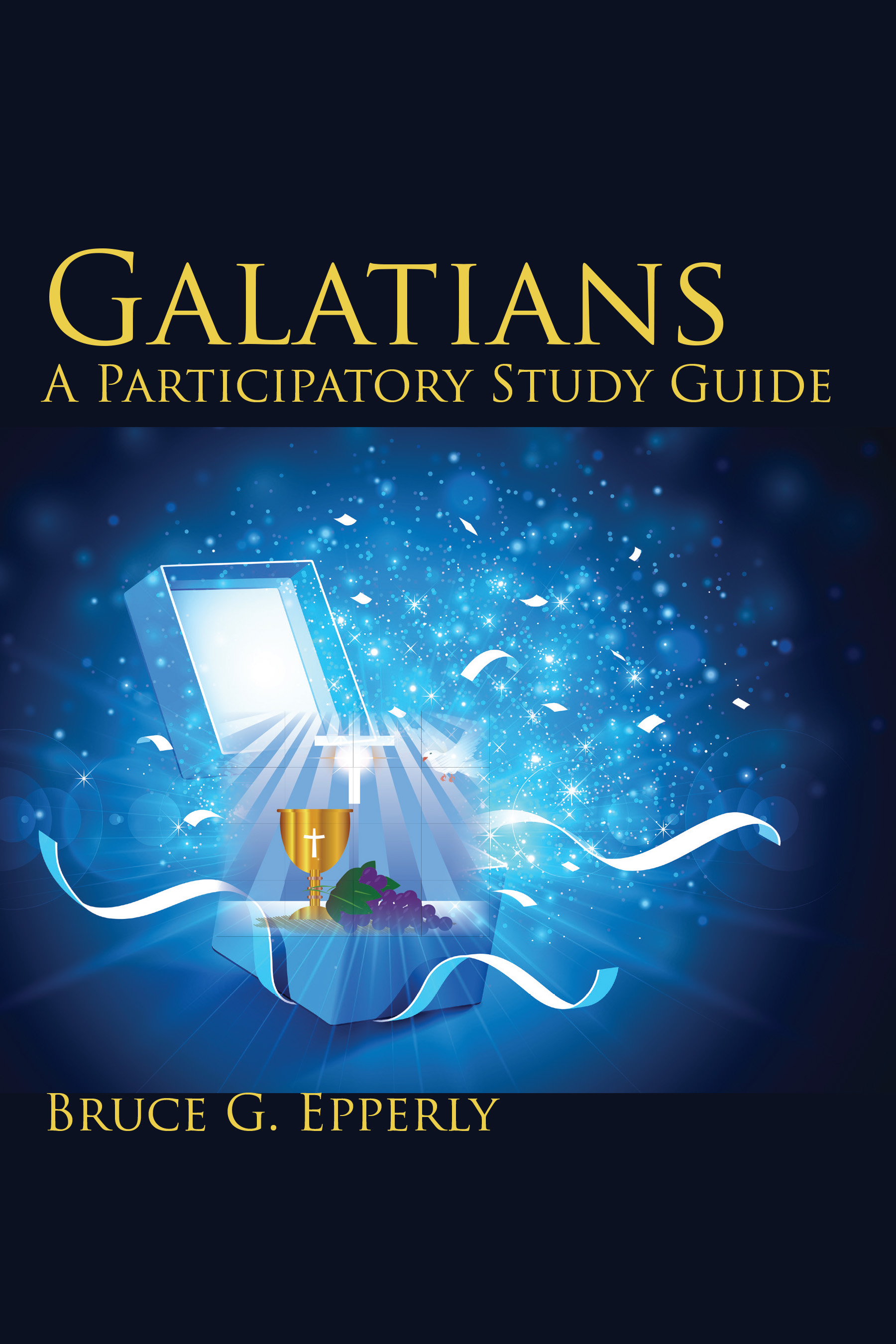
    From page xvii of Galatians: A Participatory Study Guide by Bruce Epperly —

    When we encounter scripture with heart, mind, and hands, the Bible comes alive and changes our lives and communities.  We become the Galatians of our time, reveling in Christian freedom and living in the Spirit.  We discover that God’s liberating Word, incarnate in the crucified and risen Christ, challenges everything that gets in the way of spiritual freedom and faithful discipleship.

    Sounds like fun!

    Galatians: A Participatory Study Guide

  • According to John: Remember My Words

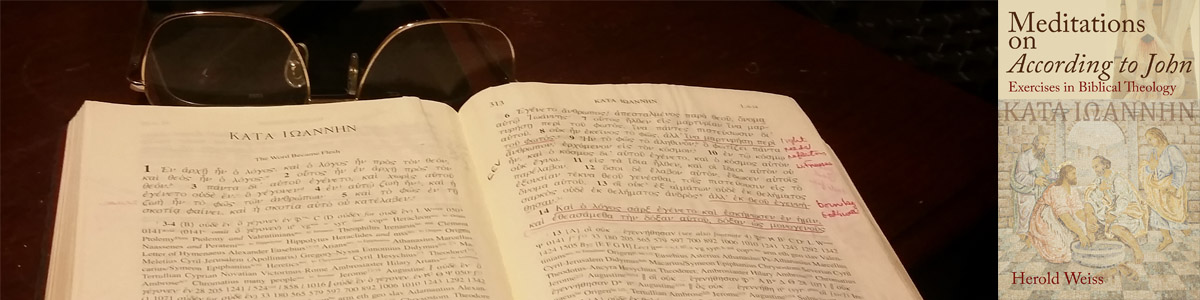
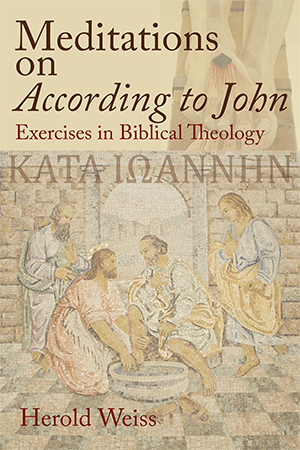
    Tonight’s study on According to John, based on Chapter 14 of Dr. Herold Weiss’s book Meditations on According to John, will have me going far afield from the gospel of John into a discussion of individual and community memory and the importance of a message transmitted by and shaped by a community. I will argue that rather than seeing this type of transmission as a weakness, it is, in fact a great strength and should be embraced.

    What does it mean today to hear Jesus saying “Remember” (John 15:20) today? What is the role of the Holy Spirit in all this?

  • Yet Again Hebrews Authorship

    9781938434730sIn September of 2013 I published a book titled The Authorship of Hebrews: The Case for Paul by David Alan Black. It has been interesting to read material on this topic since. I would note that while I believe Dave’s case is well presented, and was convinced by it to give more room to the idea of Pauline authorship, I have not been convinced to abandon my agnosticism on the authorship of Hebrews.

    Today my attention was drawn to two more posts. The first is by Dave Black, which I copied to the Topical Line Drives site to create a permanent link (Dave’s blog doesn’t support this). It’s a short comment, but makes clear Dave’s view that Hebrews is not so anonymous as one might think.

    The second post is by Kyle O’Neill (HT: Thomas Hudgins), who favors Apollos or Aquilla and Priscilla.

    There is a broad consensus among scholars that Paul did not write the book of Hebrews. There is no similar consensus about who did write the book. There’s an easy explanation, however, for the difference between these positions. It’s simply the view of the authors in question of the external evidence. Is the testimony of the early church fathers reliable on matters of authorship? While there are some disagreements about precisely what each church father said (Dave Black provides his own translations of many of these references in his book), in general if one is prepared to accept the testimony of the early church fathers, one is likely to accept Paul as the author of Hebrews.

    On the other hand, if one favors internal evidence over this external testimony, one likely will not favor Paul. Note that I do not mean here a simple differentiation between how one favors internal over external evidence, such as one might have in textual criticism. In this case, we’re looking at specific testimony with specific issues. How much could each witness have known? To what extent are they reporting hearsay? To what extent might they be trying to shore up the claim of Hebrews to be scripture? So one can have a general position favoring external evidence on many other topics, but nonetheless not have the same emphasis with regard to authorship.

    In my view, if we did not have the testimony of the early church fathers, nobody (or almost nobody) would assign Hebrews to Paul based on the internal evidence. But I also believe that if you don’t accept the testimony of the early church fathers on this point, there is no basis to claim any particular author for the book. The problem with determining authorship based on internal evidence is that you must have a body of material with known authorship with which to compare the book. Of the proposed authors of the book of Hebrews, only three have a significant body of written material, Luke, Paul, and Clement. For others, such as Apollos or Aquilla and Priscilla, we have no written material, and precious little biographical information. It is always possible that one of these many candidates wrote the book, but the evidence just isn’t there.

    That’s why, having decided that there is enough internal evidence in the book to question Paul’s authorship, I do not propose an alternative. I don’t know who wrote it. I realize there are answers to the difficulties with Pauline authorship, but in my view it seems that there’s just a bit too much to explain away. It could be Paul, but then again, not so much.

    It’s interesting how strong the consensus against Pauline authorship has become. I would think that there would be a greater body of argument in favor of the testimony of the early church fathers. A very slight swing in favor of that testimony would probably shake the consensus quite substantially.

  • According to John: Excursus #2 – Interview with Dr. Herold Weiss

    john-weiss-trailerYou can get more details on the Google+ event, and you can watch either through that link, or using the viewer below.

    I apologize for posting this so late. I will post the YouTube and some comments tomorrow. Dr. Weiss is the author of the book I’m using for this study, Meditations on According to John.

  • Book: I’m Right and You’re Wrong

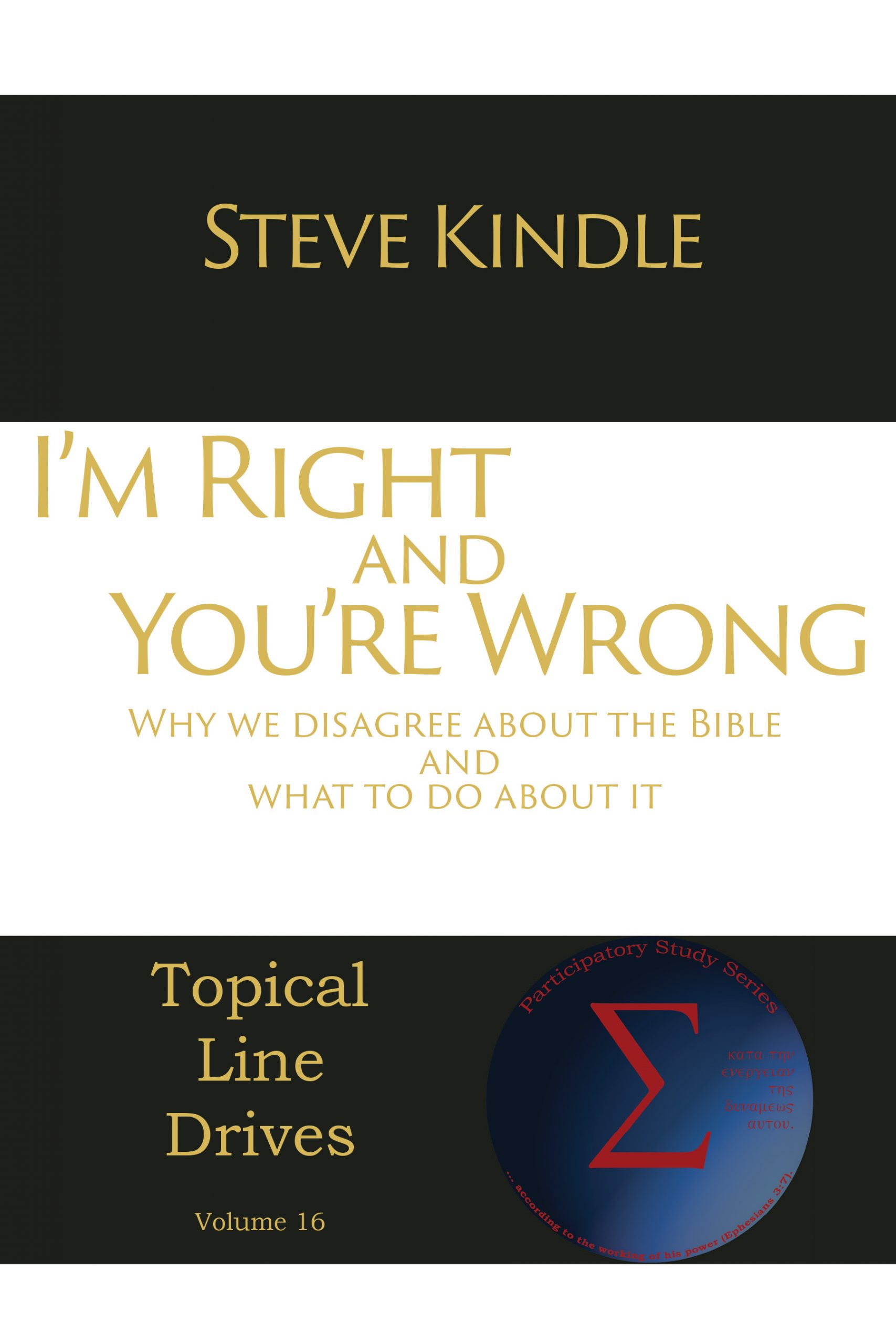
    Book: I’m Right and You’re Wrong

    When I started Energion Publications just over 10 years ago, my primary interest was in Bible study materials. My goal was to get the people in our churches to study the Bible more, and to do so for themselves. My complaint about much of the material available was that it was often shallow and repetitive, and that people had often been seeing the same things over and over again. (I don’t mean that there were or are no good materials; merely that there are not enough materials that address people in the pews.)

    It wasn’t just that some material was shallow. It was that often when the material was a bit deeper it tended to present conclusions without really teaching students just how those conclusions were reached. Quite frequently, church members were simply accepting the conclusions they were taught on authority, not because they had really examined them and come to accept them for good reasons. Their pastor, or some well-respected person from their denomination or tradition stream claimed that a verse meant a certain thing, so that’s what it meant.

    When people from two different tradition streams would meet, debate could get heated as people fired spiritual canon loaded with pre-interpreted texts. They thought they were firing them at one another, but generally they were firing them past one another, because their targets had memorized a completely different interpretation for that particular passage.

    I launched several projects in response to this. First was the Participatory Study Series, the first series I know of to intentionally select authors from different tradition streams to cover different books of the Bible. My idea was to give people a chance not just to study about the various methodologies, but to study a whole book of the Bible with the guidance of a qualified scholar from different traditions. Thus you can study Philippians with the guidance of process theologian Bruce Epperly and Ecclesiastes with conservative evangelical Russel Meek. As time goes on, this variety will increase rather than decrease.

    There was still more to be done. Our conclusions about scripture depend heavily on our approach to interpretation, our interpretation depends to some extent on our view of authority, and both interpretation and authority depend, to some extent on our understanding of inspiration.

    Thus I published Learning and Living Scripture: A Introduction to the Participatory Study Method, but that little book didn’t really deal with the conclusion. It embraced it and invited more! So I wrote my own book about inspiration and listening to God, When People Speak for God, and then acquired a truly masterful work, From Inspiration to Understanding: Reading the Bible Seriously and Faithfully by Edward W. H. Vick. Shoring up a more conservative viewpoint was Elgin Hushbeck’s Evidence for the Bible.

    9781631990991With all those books, the question still remained. How does one learn to understand and even benefit from the variety of approaches to Bible study?

    Well, now we have a short, easy-to-read book that will help you understand why we disagree about what the Bible says, and why so many of those disagreements are so intractable. It’s I’m Right and You’re Wrong: Why we disagree about the Bible and what to do about it. It’s a challenging title, and in just 40 pages, you’re going to begin to get a picture of the variety of scriptural interpretation.

    Author Steve Kindle writes with a gentle passion. This is not a book proving that his approach to interpretation is the one and only right approach. He doesn’t deny that there is objective truth out there; he just doubts that we are going to be able to get there with are finite and not-so-objective minds. What he does instead is try to give us an idea how various approaches work.

    There are at least two things you can do, starting with this book. The first is simply improve your ability to converse with people whose approach to the Bible might be different than your own. With the basic information Rev. Kindle provides, you can build your understanding by listening to others. Second, you can use the excellent footnotes to find more detailed expositions of these various approaches and learn more about them than could possibly be contained in a 40 page book.

    As a publisher, of course, I would be delighted if you’d also embark on a journey with the Participatory Study Series and actually study some books using guides written from a perspective other than your own.

    At a minimum, however, learn how to break through the hostility that often characterizes debates about the Bible to come to understand how someone else has become convinced that he’s right and you’re wrong!

    Note: This book is already printing, but we’re leaving the pre-order pricing up for one more day. That means you can order from Energion Direct for just $3.49. If you take this opportunity to get 3 or more copies, shipping will be free. The shipping charge is just $2.00 on orders of less than $9.99.

  • According to John – Excursus 1 – Interview with Dr. Bruce Epperly

    9781938434136sThursday night will represent an excursus in my study through the gospel of John, as I interview Dr. Bruce Epperly, author of the books Healing Marks and Process Theology: Embracing Adventure with God, about the healing stories of Jesus. We’ll be discussing what it means to say that Jesus was a healer and we’ll likely have time to talk about words like “panentheism” that have come up in the study thus far. You can use the link above for more details. I’m embedding the YouTube player for this event at the end of this post.

    There’s also something to look forward to further down the road. Dr. Herold Weiss, author of our text Meditations on According to John, will join us on March 12 to discuss his approach to the gospel. We’ll touch on date and authorship, but most importantly on the theology of the book.

  • According to John: From His Fullness We Have All Received

    According to John: From His Fullness We Have All Received

    john bannerI’m a little late posting the event for this, but my study of John will continue. I expect to post a couple more notes on the last hangout in this series as well as a follow-up to my conversation with Elgin Hushbeck, Jr. on the Energion Publications weekly hangout. For more information, see the link above. I will embed the viewer below if you want to go via YouTube.

    My major purpose in doing this study was to engage in the discipline of following through the book(s), both According to John and Dr. Herold Weiss’s Meditations on According to John thoroughly, discussing the material, and taking questions and comments. This is a difficult process for me because both my training and my inclination is in the historical exegesis of the text, using the word “exegesis” as narrowly as possible to refer to extracting the historical meaning to the first audience. So thinking about the theology is hard work for me, and some of the rough edges definitely show. At the same time, I think this is a worthwhile exercise. Fortunately for me, some people who have a great deal of skill have challenged me on some points and that has helped me dig even deeper.

    This week’s topic introduces an interesting aspect of biblical theology: comparing and contrasting the theology of two different passages. Colossians and John share some points of theology here according to Dr. Weiss, and we’re going to look at how one can examine this sort of claim and what the results are.

    I do plan some conversations with experts for this series. Dr. Weiss himself has agreed to join me for a discussion. I suspect that one will emphasize christology and the statements he’s made relating the christology of John to various stages of the early church. That will in turn doubtless tie into some discussion of the trinity. Dr. Drew Smith, author of Energion Publications title Reframing a Relevant Faith will be joining me to discuss biblical theology and how it differs from systematic theology among other topics. Dr. Smith has his PhD from the University of Edinburgh in New Testament where his dissertation dealt with the theology of Mark. We’ll try to make him talk about John nonetheless! I will announce dates for these conversations soon.

    So join the fun tonight at 7:00 pm central, 8:00 pm eastern, or watch the video later and respond through comments of blog posts.

  • The Text of John 3:13 – The One Who Is in Heaven

    An interesting discussion arose via a comment to my post on last week’s discussion of the Gospel of John. This relates to a textual variant in John 3:13. The verse ends in most versions, and in the UBS4 Greek NT that I use regularly, with “the son of man.” But there is another reasonably well attested variant which adds “who is in heaven” following “son of man.”

    Dave Black, who posted the question, has written a journal article about this. In the comments I said I’d like to get a copy of that article, but it was only moments later that I located it. You can read it here. On this computer I’m having trouble with the Greek text, probably due to font issues, but I was able to follow it well enough as is. [Update: Dave sent me another link, this one to a PDF, and the Greek text is good in it.]

    Prior to reading Dave’s article, I had come to the conclusion that I preferred to include this phrase rather than leave it out. I did not make use of this in my study, as it has little impact, as I see it, on what I said. I always dither over how much time to spend discussing textual variants. This is a very interesting variant, however. Please read Dave’s article first. While my reasoning is a bit different, and my interpretation considerably so, he covers the facts of the case, and I’ll just note those differences here.

    1. Please read with a caveat: I’m not a NT textual critic. My last class in NT textual criticism was as an undergraduate. All my graduate work was on the Hebrew scriptures.
    2. Of the canons of textual criticism, the one I consider to be the most useful is this: Favor the reading that best explains the others. I find that choosing the most difficult reading involves so much debate that it adds little weight to the result. I do think it’s valid, i.e., a difficult (but workable) reading is more likely to produce variants through correction, simple misunderstanding, or hearing/seeing what you know is there. But that also feeds into determining which reading best explains the others. In this case, I find it very difficult to see an explanation for the other variants if “who is in heaven” is not the original text. In fact, as Dave notes, Metzger (A Textual Commentary on the Greek New Testament) presents this as the argument of the committee minority, while the majority was swayed by the quality of the witnesses to the shorter text.
    3. I would not necessarily accept the variety of the external evidence if the reading did not also so clearly explain all other variants. In combination, I find them convincing. Of course, one should always remember that textual criticism is not an exact science. There’s plenty of room for valid disagreement. I would note, for example, that the UBS4 rates this reading a B, while my edition of the Textual Commentary, based on UBS3, rates it a C. I’m not sure what happened to increase their certainty. I don’t share it.
    4. At first blush, this reading seems difficult. Here’s the son of man on earth, and he’s also being affirmed in heaven. Either this is a very high christology, or we have a problem. That very problem contributes to the probability that the reading is original. There’s plenty of reason for someone to remove it, thinking it’s an error, but little to add it. But on further reflection, I think it’s very possible we are here, as in vs 11 & 12 (at least) hearing the voice of the author/community, with the affirmation that Jesus has ascended. Though I see a few difficulties with it, I would be unsurprised if everything after John 3:10 through the end of the chapter represented further comment by the author and is not intended as a quote attributed to Jesus.

    That said, I will pursue further christological heresies this coming Thursday! Or not … as the case may be.

  • Quote: The Son of Man Lifted up on a Cross

    From my reading for next week’s study on John (Thursday night, 7:00 pm central time via Google Hangouts on Air):

    In the same way in which a flag lifted up on its pole draws together a people and constitutes it a nation, the Son of Man lifted up on a cross draws toward himself all who believe and constitutes them “born of God.” (Weiss, Meditations on According to John, 42)

    I am truly enjoying my reading in preparation for this study. I’ve been talking about metaphors, and leading toward the point that we use multiple metaphors to describe something that cannot be readily depicted in concrete language. Metaphors allow us to talk about the same subject in a variety of ways, each of which may contribute to our understanding.

    When a single metaphor becomes the one and only one permitted in describing an event, we begin to lose some of the content of the reality. Similarly, any time we allow one word for (or description of) God to replace God—what I call conceptual idolatry—we lose some of the reality of our experience of God. We can allow our description to limit who God is. In terms of the atonement, I believe that stating that the one explanation of the atonement is the metaphor of substitution in a forensic context, we start to lose some of the meaning of the atonement.

    Unlike some, I do see forensic and substitutionary metaphors in play in some scriptural descriptions of atonement. I don’t deny them as ways to discuss and understand atonement. My concern is that they not become the sole view, driving out other strong metaphors. The gospel of John uses a couple of different metaphors, especially centering around light and family, and we need to read those in their own context with their own integrity.

    When I was in college, I took Exegesis of Romans, which was intended as a sort of taste of Greek III, from a professor (Malcolm Maxwell for my fellow Walla Walla alumni), who was an advocate of the moral influence theory of the atonement. I was very attracted to the theology involved, but despite my best efforts, I couldn’t find it in Romans. It is wrong, in my view, though without any diminution in my great respect for Dr. Maxwell, to force the moral influence metaphor onto Romans. It is equally wrong to force forensic substitution onto the gospel of John. You may hear its echoes, but it doesn’t dominate.

    The quote above provides a taste. I’ll be discussing this in more detail on Thursday night.

  • Announcing According to John: The Word Became Flesh

    This will be the second study. I’m going to mention a few things to think about. The question remains as to how many of these things I will be able to address, but I think it’s worthwhile to consider these in any case. The study will be via Google Hangouts on Air at 7:00 pm central time, Thursday, January 18. The event on Google+ is here. And here’s the trailer:

    I’ll embed the YouTube below, but first, some things to think about! The major scripture for the study is John 1:1-18. If you haven’t read the book of John through completely recently, it will help to review the entire book.

    Critical Issues

    One issue of source (and to a lesser extent redaction) criticism comes up for this passage, which is the question of whether John 1:1-18 was written as part of the gospel or whether it is an early Christian hymn adapted for and incorporated into the gospel. There are some folks who regard it as poetry with some prose comments added.

    Read the passage and pay special attention to the boundary between John 1:18 and 19.

    Textual Issues

    I’m going to list two, though one comes in two parts:

    First, in verses 3 & 4 we have a verse division/sentence division issue. Should it read something like “… without him was not anything made that was made”? Or alternatively “… without him was not anything made. That which was in him was …”? You’ll probably find references to these two possible divisions in the footnotes to your translation. I just looked at the NRSV and REB as I was preparing this, and their notes are pretty clear. The NIV at BibleGatway.com isn’t showing a note. Does your Bible have a note?

    The difficulty for the average student is that these translations don’t provide any justification for the decisions made. It would be impractical to expect them to. But if you have a Bible with study notes or a good commentary, you may find a bit more information.

    Second, John 1:18 has two alternative readings, which the REB lists as “God’s only Son” (their text) and “the only begotten God” (alternative). Of course, if you read Greek, you should consult your apparatus to discover the evidence for these readings. How much difference does this make? What is the translation choice of the Bible you use? The NIV kind of combines the readings, while the NASB makes the opposite choice to REB and uses “the only begotten God.” I will definitely discuss this variant and something about how these choices are made.

    Just for fun, I went through my files and extracted a paper on this verse that I wrote in college, for a course titled “Translation Problems.” Though it doesn’t have a date on it, I think this was in my junior year, which makes the paper more than 35 years old. Read it and see if you agree with my younger self! (I note here that this was written when I was still a Seventh-day Adventist, and references to Ellen White and “the Spirit of Prophecy” should be taken in that context.) Younger readers will doubtless be unacquainted with the quaint device used to produce this paper, a manual typewriter. If I remember correctly it was an old Remington, and no, it had no Greek font!

    Theology

    Well, combining theology and inter-textual relationships.

    First, do you think the cultural/philosophical background for the phrase “the Word of God” should be taken from Greek thought (the word logos is so common in Christian speech that it has almost become an English staple!), or should it be found in passages in the Hebrew scriptures/Old Testament? This will have some impact on precisely how we read it.

    Your answer doesn’t have to be one or the other. We discover the precise meaning of a word through it’s use in a particular context, and so this word can be shaped not only by the Gospel of John, but by the New Testament, and by its usage discussing concepts from the Hebrew scriptures, but from doing so in Greek.

    Second, I want to explore a connection to one of my favorite books in the New Testament—Hebrews, and specifically Hebrews 4:12, though the prologue (1:1-3) comes into it. James Moffatt, in the International Critical Commentary volume on Hebrews, says: “Here the writer poetically personifies the revelation of God for a moment…. Here it [the Word of God] denotes the Christian gospel declared authoritatively by men like the writer, an inspired message which carries on the OT revelation of God’s promises and threats, and which is vitally effective” (p. 55). Moffatt distinguishes this from the usage in John 1:1-18.

    Looking from the other direction, Leon Morris, in his volume The Gospel According to John (Revised) in the NICNT states that the only other place where the word (logos) is used undoubtedly with the same meaning is Revelation 19:13 (pp. 63-64).

    I’m going to look at some elements of these two passages. Do you think they are more closely related?

    Finally, I want to examine the concept of testimony. We start here with John the Baptist bearing testimony to Jesus, and near the end of the gospel we see Thomas brought to giving a testimony to Jesus: “My Lord and my God” (20:28)! We’ll tie this in later with the critical question of whether chapter 21 was originally part of the book or was added later as a sort of postscript.

    Doubtless I will have many words on all these topics and perhaps a few more! The YouTube embed is below.