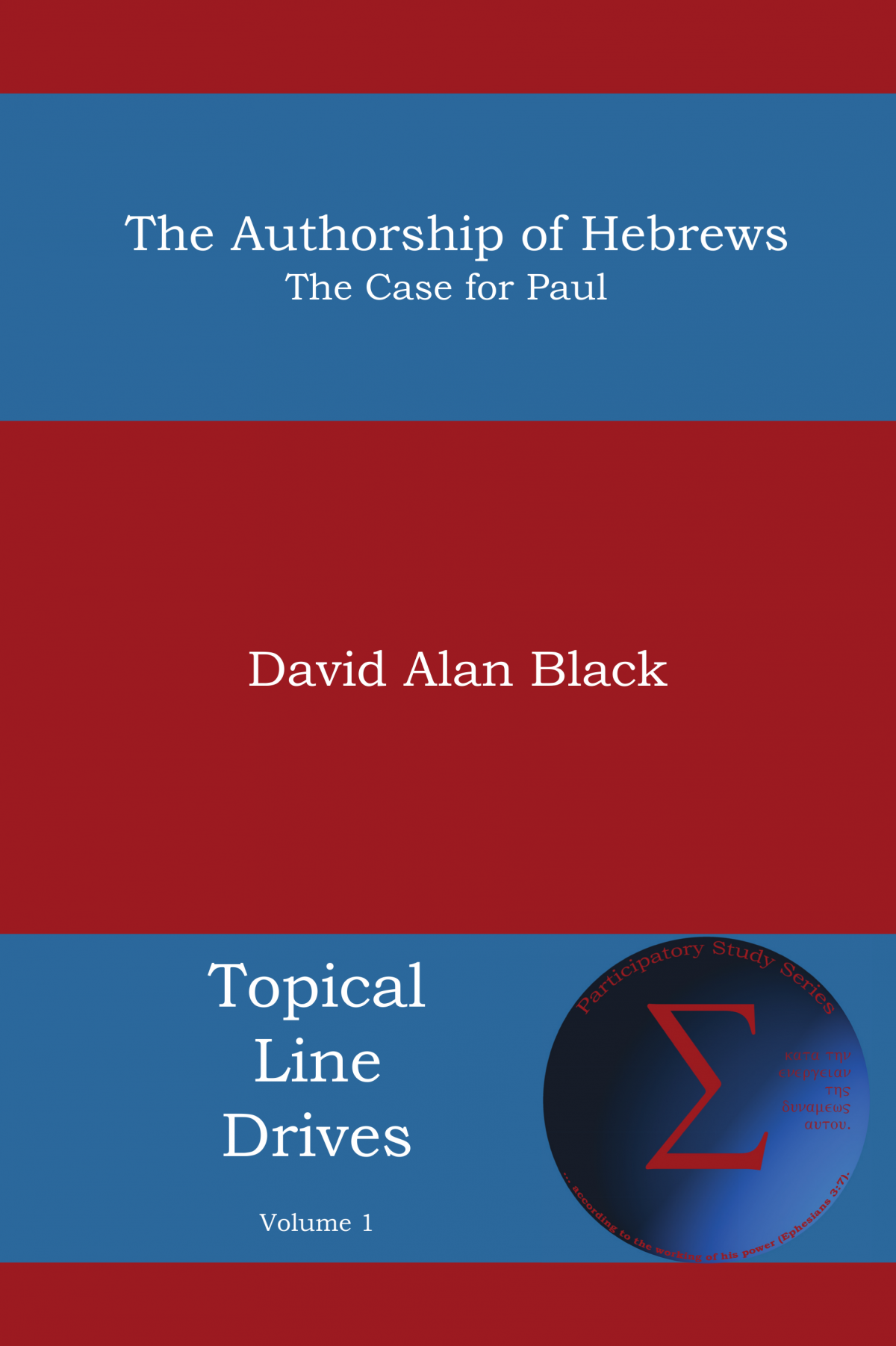
As Dave Black notes, his argument is really not one of internal but of external evidence. Dr. Kok cites Dave’s book The Authorship of Hebrews: The Case for Paul, which I publish. I do note the 2017 publication date, which suggests use of the new hardcover edition, which I link below. The more usual paperback is just $5.99 while the Kindle edition is just $2.99 for those who would like to check Dave’s arguments.
My own view on this is “author unknown.” After reading Dave’s work, I no longer say “anybody but Paul,” but I still find the differences in approach and style from Paul difficult to accept, and I find the absence of Paul’s salutation at the beginning odd, at a minimum. But I put greater emphasis on internal evidence, so this may be simply a difference in approach.
I’m currently reading the book of Acts for my morning devotions and today I read chapter 6. That’s a nice, short chapter!
The disciples find that there are complaints about distribution of charitable works and they decide they shouldn’t be distracted from the Word in order to wait at tables (and other such things). The result is the choice of seven deacons. Again, they pray, and then lay hands on them and commission them to this work. Other than the continuing spread of the message, we’re not told how this organizational structure worked.
As Acts proceeds (since I’ve read it before, I know how the story ends!), we’ll hear quite a bit about Stephen and Philip. It’s interesting to note, however, that we don’t hear about them serving at tables, which, ostensibly, they were chosen to do. In fact, we hear them proclaiming the Word themselves. In chapter 6, it starts with Stephen, and it promptly leads to his arrest.
Let me note a couple of things here:
They don’t record any time of prayer before going out to choose these seven men. It appears they jump straight to the strategy.
They don’t record any time of prayer or deliberation before choosing the seven.
They do pray before commissioning the men by laying hands on them.
We see no record of results of this activity that match the intent. Yes, results. Stephen and Philip are significant players in the story and they are introduced to us here, but there is no record that the issue with distribution of service (apparently particularly food) was resolved.
Now it may be that I’m reading too much into the white spaces here, but this is the second time I’ve noticed this during this pass through Acts. I’d noticed before that Matthias (chapter 1) is appointed as a new apostle and then disappears from history. Considering how much of this portion of early Christian history is recorded just in Acts, one wonders if this is accidental. (My sister Betty Rae pointed this out to me some years ago.) In my reading this time I noticed how the choice to replace the missing apostle is made based on Peter’s interpretation of scripture. There’s no effort made to seek God’s will for this particular instance. Then two people are chose according to criteria they select.
Let’s parallel the numbers:
There is no prayer time as they choose the basic strategy. Unlike Acts 6, this strategy is apparently based on Peter’s reading of scripture.
They choose two people again without any time of prayer.
They now pray and ask God to choose between the two. The situation differs from Acts 6 in that the seven were chosen and then the prayer is offered as they commission them. “Please bless the ones we have chosen,” is the petition. Here it’s “choose one of the two options we’ve given you, Lord.”
No results are recorded.
Now comes the fifth step, which is what’s hitting me on this pass through Acts. God immediately takes action to advance the kingdom, and it doesn’t fit with the human plans, even the plans by the apostles. In Acts 6, Stephen heads right out to proclaim the gospel and defend it. In the case of Acts 1 we have to wait until chapter 9 before we see God choosing someone as an apostle, one who doesn’t fit the list of criteria, but who certainly carries out the mission.
I wonder if Luke is telling us something here? I’m really not that acquainted with scholarship on Acts, so this may have been thoroughly ground to dust somewhere in the commentaries. Still, it’s something to think about.
I publish a couple of books that use Acts of the Apostles as a source for principles to guide the 21st century church. I publish such books with a certain amount of trepidation, as it’s very easy to apply material piecemeal, which results in discovering that the biblical book in question tells us to do what we wanted to do in any case.
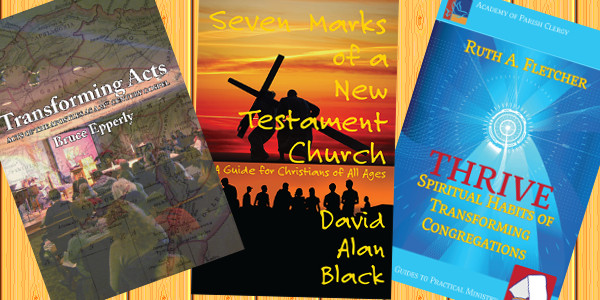
Two books that deal with this issue in the Energion catalog are Transforming Acts: Acts of the Apostles as a 21st Century Gospel by Bruce Epperly and Seven Marks of a New Testament Church by David Alan Black. Now considering that the authors of these two books are some distance apart on the theological spectrum—Bruce is United Church of Christ and Dave is Southern Baptist—one might suspect that there is a wide gulf between what they see as most important or applicable in the New Testament church. In actuality, I found myself more surprised by the level of agreement involved. There are certainly differences, and yet there are themes that are clear to both authors.
I suspect the level of agreement results from greater care in studying the text. No, I don’t believe careful study will make us agree on everything. Careful study tends to do two things: 1) It discovers clear themes, and 2) it clarifies and outlines differences and the reasons for them. I will repeat what I have said before: Most of the heat in arguments between Christians results from not understanding the way in which we’re using our sources. If we did understand the source of an opponent’s beliefs, that wouldn’t mean we’d agree, but it would reduce frustration. There’s nothing like having two people look at a text and clearly see different things. There is a strong temptation to assume the other person is stupid, obtuse, ignorant, or perhaps demonically deceived.
Yet Christianity is a faith that is built on studying sources. We may differ on what those sources are, whether it’s the biblical canon, writers in the theological tradition, or authoritative institutions. The point is not to eliminate the inputs because they might be misunderstood or misapplied. Rather, I would suggest it is to study these sources with an awareness of the differences.
One of the ways to do this is to actually study pieces of biblical literature as they were written. If I get to make a selection of texts, I can definitely bias the results. That doesn’t mean that I will find that everything there applies to my everyday life now, but I do need to be aware of the things I’m not applying and why I’m not applying them.
I started re-reading Acts of the Apostles the other day, and was immediately struck by some of these kinds of issues. Let me note just a few.
Acts 1:2-3 – Jesus teaches the disciples for some time following the resurrection. We don’t have a formal record of this teaching. Is this a plug for apostolic tradition? If it is, note that Paul wasn’t in on this, yet has provided us with much of New Testament theology.
Acts 1:4-5 – Awaiting the promise of the Spirit. Acts was most likely written before John, but here we have that continuing teaching of the Holy Spirit, and when the Spirit does come upon the disciples, it seems to come upon the whole group. Is this a foundation for the belief that revelation continues and can come to each one of us?
Acts 1:21-26 – Choosing a successor to Judas by lot. This one presents some interesting issues. I enjoyed teaching this to a class in a church that had just completed a search for a new pastor. I asked them if their procedure, much different from the one here, was biblical, which resulted in an energetic discussion. It’s interesting to me that we have no evidence here of prayerful discussion. Peter presents his interpretation of scripture, then two people are chosen that fill the requirements (we don’t hear the source of those requirements), and then one of the two is chosen by lot. God is invoked, but God is invited to choose between the two candidates selected by the apostles. At which point the chosen person disappears into history. Most of the book is about Paul, a person who does not fulfill the requirements and is chosen by a completely different method. So is God’s way casting lots or should we wait for the lightning bolt?
Skipping Acts 2 and going to 3:1-10 – Is this the sort of thing that should characterize a modern church? If so, we’re largely too tame. And we should, of course, consider chapter 5 with Ananias and Sapphira. Church discipline, anyone?
My purpose in making this truncated list is to show that there are things here we do (baptism, preaching, even healing [in some sense]), and others that we don’t (casting lots), and it’s worthwhile to realize that something more than just grabbing sentences or paragraphs and applying what they “clearly teach” is going on. I’m not complaining about that extra stuff going on. That’s part of life and yes, part of faith. The problem comes in when we try to pretend that we’ve dumped everything extra. (Note that there are churches who use a form of lots in selecting leadership, so that is a valid item to list.)
The next question to ask yourself is just why you do certain things and not others. Why would you preach, baptize, accept into membership, but not heal? Why do you find it appropriate to await the baptism of the Holy Spirit, but not to choose all church leadership by casting lots? (Notice how I slipped “all” in there when it’s not in the text?) Understanding how we get wherever we are can help us understand one another. It might even help us with course corrections.
Fair warning: I’ll probably be stuck on definitions. In fact, I’m in the process of writing a blog post about it right now. I’ll add a link to this one once the other is complete. (Here’s the link: Bloody Sacrifices and Salvation.)
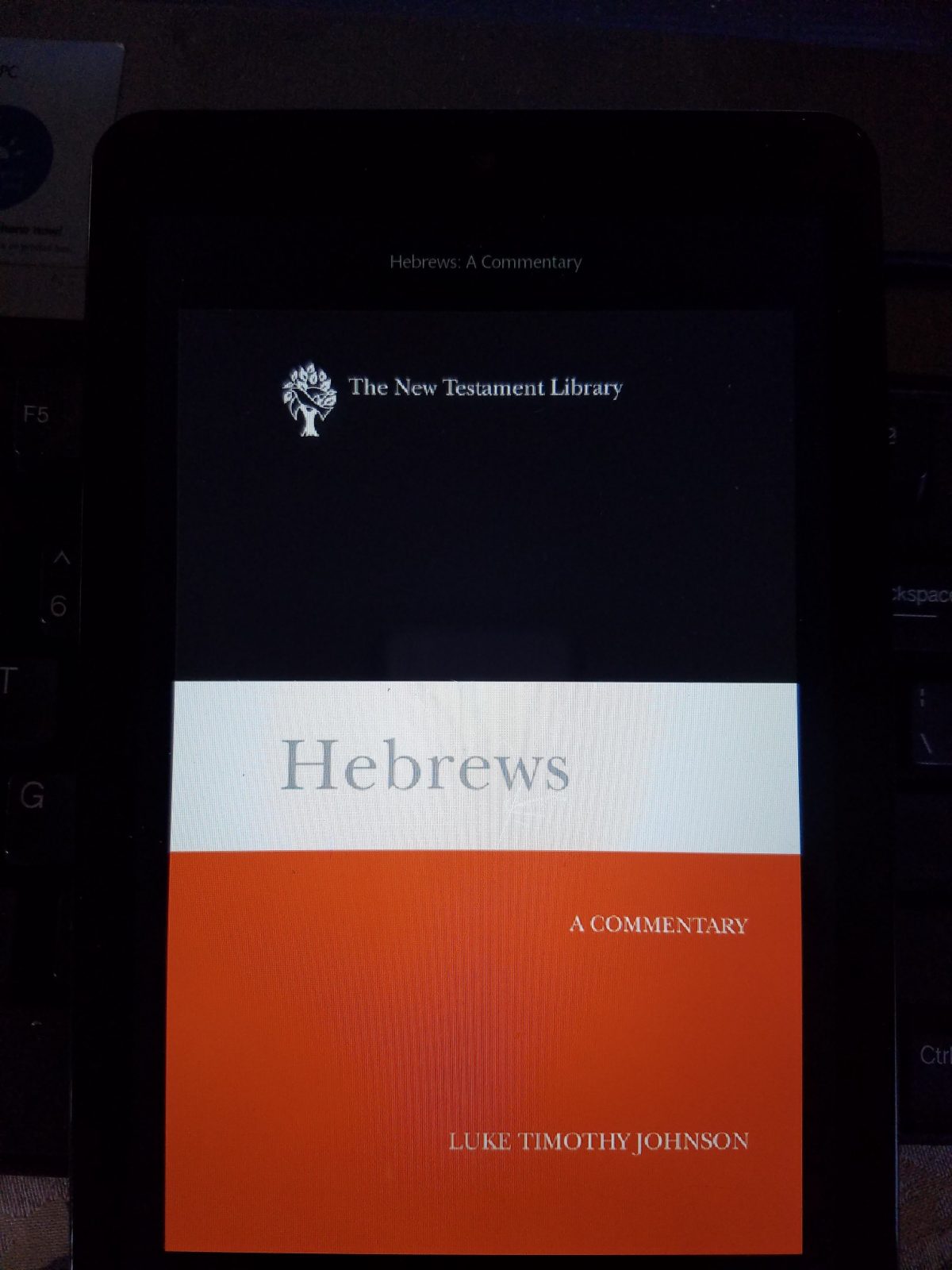
I recently worked my way through Luke Timothy Johnson’s Hebrews: A Commentary (New Testament Library) along with the Greek text, and I’m going to write a few notes on the book, which may, or may not, constitute a real review. Time will tell!
The problem with many blogger book reviews is that they often amount to no more than various length notifications as to whether the author liked the book or not. There are some really wonderful exceptions to this, and you really can find a great deal of information about a title in the blogosphere, but you can also read many words (such as these) which don’t tell you a thing! As an alternative, you get an argument against everything the author wrote in the book, usually without sufficient quotations or references to let you get a feel for what the reviewer is arguing against.
In my view the ideal review identifies the goal(s) of the book, comments on how successful the book was in accomplishing these goals, has some interaction with the ideas, and finally has a summary evaluation which is based on the stated goals. I recall reading a book about Christian apologetics. I thought it was well written, carefully argued, and thorough. There was one problem, however. The author claimed in the introduction that he would close all the holes in arguments from Christianity and the Bible. He compared the work of others to putting one leaky bucket in another: You slow the leak but you don’t stop it. He was going to stop it. In the end, if I was asked whether I liked the book, I would have to say “yes,” despite (or even because of) the fact that I disagreed in many places. Yet in a review I would have to say that the stated objective was not achieved, and making a claim that one would accomplish such an objective was, shall we say, suboptimal.
In the case of a commentary, the difficulty is greater than with an ordinary book. There are two key problems: 1) Many people have very fixed ideas of what a commentary ought to do, and little forgiveness for a commentary that doesn’t accomplish their list of goals, and 2) People (particularly scholars) have quite a variety of very fixed ideas. No matter how you choose to write a commentary, no matter how large or small you make it, and no matter how carefully you draw compromises between never completing the task and short-changing the reader, someone will complain.
I would like you to note here my own inconsistency. I’m writing in prescriptive language about what ought to be in a review, while arguing against prescriptive ideas about writing a book. I will live with this inconsistency.
Besides, this isn’t a review. Here are my general thoughts.
I found Hebrews: A Commentary by Luke Timothy Johnson to be the most helpful commentary I have read thus far in terms of stimulating theological reflection. By that I mean that the author doesn’t merely provide a view, but he argues it in such a way that it stimulates new thinking. My personal response to some of his views is that they are perhaps a little too tied to orthodox theology and a little less daring than the book of Hebrews deserves, but that is at the nit-picking level. Johnson knows how to present quite orthodox theology in a way that is challenging and helpful.
As I studied using this commentary, reading the Greek text and taking second looks at the textual notes, I often found myself reflecting for some time after I’d read my chosen portion for the day. I rarely find that level of stimulation for thought in a commentary.
This is not David Allen’s volume in the NAC series. Dr. Allen covers everything and references everything. The only negative thing I would say about his commentary is that I have to have some energy built up before I go to consult it. If you want a detailed and complete survey of the topic along with arguments in favor of a particular solution, but all means use David Allen’s work. On the other hand, if you want to get more quickly to the topic for teaching and preaching, use Luke Timothy Johnson.
I know we don’t like to think that we might shirk some portion of the possible study of a passage we’re going to teach or preach. We’d like to think that we covered everything before we tried to present an exposition to others. But we all face the clock. Brevity is not a sin.
So when I want to get right to meditating on the text, but with some solid meat to set it up, I turn to Johnson’s commentary.
Now I haven’t called this a review, yet I’d like to present some interaction. I’d suggest, however, that I’ve already done this in blog posts on Hebrews written after reading material from Johnson’s commentary. You can start with Hebrews and the Problem of Writing Introductions. I could provide a number of links, but the simplest thing to do is to type “Hebrews” in the search box after you get to that article. Nearly everything I wrote on Hebrews after that point references Johnson.
#contextchangeseverything – yes, it does. But how?
With the vast array of Bible study materials that are available in the English language comes a problem. How does one choose what materials are worth my time, shelf space (or HD space!), or money? If you search my blog for posts about study Bibles, you’ll find that I have a love-hate relationship with them, and it tends to be mostly hate. Nonetheless, I own—and use—a variety of study Bibles, and you’ll even see some positive reviews.
The reason for the hate side of the equation is that far too many people purchase a study Bible that’s recommended by someone they trust, or even written by someone they trust, not to mention randomly selected from a bookstore shelf and then accept what the notes say because they are written by biblical scholars after all. I recall being accosted by a church member some years ago who asked me about the notes on a particular text. I can’t even recall which text it was. Her problem was that she couldn’t figure out how the meaning presented in the note could be extracted from the text itself. I strongly recommend asking just such a question! I asked her if she’d considered the possibility that the note could be wrong. That was a revelation for her.
What I recommend is that a reader make sure to get study Bibles that are written from different perspectives and use them as an aid, not as a source of the answers. To some extent one should study the Bible text first, and then the notes, but sometimes one can read background material first. A study Bible that provides notes that tell you directly what the passage means can be quite convenient, but also quite misleading.
But one of the key problems for Bible students in the 21st century western world is the extent to which our culture is different from that of the world of the Bible. Very frequently what seems quite plain to us is not at all what the Bible writer is trying to say because we simply don’t share enough of those norms. I have come to believe that I have benefitted more by coming to understand human culture and language over the last 30 or so years than I have by learning the biblical languages. I do not mean to underestimate the value of learning Greek and Hebrew, but if my language learning had not been enhanced by the study of linguistics, history, sociology, and anthropology, it would have been of little value.
Pastors frequently proclaim that “the Greek word ____ means” or “the Hebrew word ____ means” and then build their exegesis on what is essentially simply another gloss. This makes people believe they have been enlightened by the ancient languages, when they have actually simply transferred their 21st century attitudes and presuppositions to a set of sounds they are told is Greek or Hebrew. Understanding a language means to some extent understanding a culture. Similarly understanding a text means understanding something about the person or persons who wrote it and the audience for which it was intended.
This is the key element that I believe a study Bible can provide. Certainly cross-references and historical connections are important, but letting the reader know how people in that time and place lived and thought is much more important.
NIV Cultural Backgrounds Study Bible
NIV Cultural Backgrounds Study Bible on my Android Tablet
(Note: I am basing my notes on the Olive Tree Bible software edition provided to me free of charge as I did not receive my print edition. I will not make comments on the layout or usability of the print edition.)
Thus I come to the NIV Cultural Backgrounds Study Bible. They use the provocative (and obviously true) URL contextchangeseverything.com. I should note here that there are many types of context. There is a literary context, historical context, linguistic context, and (among others) cultural context. We usually think of context in a fairly narrow linguistic sense. A word study might be done by finding a variety of sentences that use a particular word. We know that when Jesus says, “Go and do likewise” we need to look at the context of what has been commanded. We can’t grab some other activity and make that the command of Jesus instead.
Study Bibles generally examine a range of these ideas as well as proposing interpretations for difficult passages, often without providing enough information so that the reader can follow the logic. The final reader is left with the simple logic that the skilled scholar who wrote the study notes concluded X, so X must be correct, an assumption that will be severely shaken in many cases if one compares other Bibles written by skilled scholars.
The Cultural Backgrounds Study Bible aims to help you understand the Bible writers, their audience, and their times. In the notes you will find direct connections between ancient culture(s) and the text itself. Rather than just being told that a certain phrase means a certain thing, you will be given the reason why one might come to that conclusion. This is no guarantee that every interpretation is correct; that would be expecting the impossible. (Which perfect one of us would make the determination in any case?) What it does mean is that for most explanations in the notes in this Bible you can follow the logic path. If you want to, you can do deeper research, and the notes are specific enough that you’ll be able to do your search, Bible dictionary reference, or deeper study in a commentary or at a good library.
Since I’m not reviewing the Bible overall, but rather looking in particular at one book, I won’t spend more time on an overview. Let me simply say that I’m delighted with the intent, and quite impressed with the implementation. There are obviously limitations. This is a study Bible, not a multi-volume commentary or an encyclopedia. It would be easy to complain about what’s not there. In my review of the book of Hebrews, I believe that the editorial choices made were quite good. I would doubtless have chosen differently in some cases, as would just about anyone, but that’s only to be expected.
On to Hebrews
To study Hebrews most effectively using this Bible, start first with the introduction to the Old Testament. Why? Because Hebrews displays an interesting interplay between the text of Hebrew Scripture, seen generally through the LXX translation, and then interpreted in a particularly New Testament light. The details of how these elements interact require some discussion, and that’s why you study and compare, but you need to understand the sources. The introduction discusses 12 issues in which we will see the world differently, and I think all of these issues will impact your reading of Hebrews.
While reading the text of Hebrews you can use the links (if you’re using Bible software) or follow the references to Old Testament passages. You cannot impose your own exegesis of passages of Hebrew Scripture on Hebrews, but it is important to know not just the text that is quoted, but also its literary context that might be brought to the audience’s mind by the reference, and also by ways in which that text might have been understood. It is not sufficient to treat the Old Testament quotations in Hebrews as words used in the context of Hebrews. Of course, the context of their use in Hebrews is the most definitive when we determine how the author of Hebrews intended them, but we need to do everything possible to get into his (or her) world in order to understand that context.
This is the value of a volume like this. I’m currently reading a commentary on Hebrews that is more than 600 pages. I have another on the shelf in front of me that is of similar length. It’s hard to back off and get an overview of the forest using those commentaries, though both are extremely valuable. What I enjoyed with the Cultural Backgrounds Study Bible, even as someone who has read the book of Hebrews many times, and studied the works of many commentators on it, was this broader view. Having dealt busily with the trees, putting each leaf under a microscope, it was nice to get so much material easily available. (This is a general advantage with study Bibles over detailed commentaries, at least the better ones, but the Cultural Backgrounds Study Bible excels).
Content Comparison
I’m going to compare the content of several study Bibles I have on my shelf. Where I give word counts, they are loose estimates based on line counts and my eyeball count of average words per line. The Bibles I’m using to compare are: The New Oxford Annotated Bible (NRSV), The Orthodox Study Bible, The New Interpreter’s Study Bible, The NLT Study Bible, and of course the NIV Cultural Backgrounds Study Bible.
First, let’s compare sheer quantity of text. First, the introduction. (I’ll add a note on approach.)
NOAB: About 450 words, no outline, though an outline can be extracted easily from the notes. The approach of the notes is often technical. Users complain that they don’t get enough theological help.
OSB: About 220 words, short outline provided, stronger suggestion of possible Pauline authorship than others. Theology is consistent with that of the Eastern Orthodox tradition.
NISB: A bit more than 1000 words and a mid-length outline. The NISB is kind of the pastor’s answer to the NOAB for mainline teachers/preachers. It provides more theological reflection, a fact I receive with definitely mixed emotions, though the material is generally helpful in its place. Theology is mainline with a bit of a liberal lean.
NLT Study Bible: About 1500 words and a brief outline. Theology is strongly evangelical
NIV Cultural Backgrounds Study Bible: About 800 words, no outline, features “Quick Glance” section. Theology is evangelical.
Now let’s consider a specific passage, in this case Hebrews 4:12-13, and look at the quantity of notes, along with a count of insets or excurses in the whole text of Hebrews:
NOAB: 21 words. No excurses.
OSB: 54 words. One excursus.
NISB: 75 words. No excurses.
NLT Study Bible: 74 words. 9 excurses.
NIV Cultural Background Study Bible: 136 words. Two excurses.
The critical value of these notes is that they are aimed at the background and at helping you draw a line from the background to the meaning. I would say that the NOAB is great at pointing to technical details, but not so much at theology, while the NISB spends less time on technical details while using much of its space to reflect on theology. The NIV Cultural Backgrounds Study Bible uses its space in drawing a picture and pointing that to possible theological conclusions without trying to be a theology text.
Conclusion
Over the next few days I will post something on a couple of my favorite passages and the specific comments provided by this study Bible. I would consider this an excellent Bible to have at hand for a study of any biblical book. In my To the Hebrews: A Participatory Study Guide (currently under revision), I recommend that a study group have more than one study Bible available. I think it would be good for a group studying Hebrews to have this one at hand. One of the reasons my own guide is being revised is that it is largely a collection of thought questions. I’m going to provide more of a basis for those questions in the second edition. But the book will still be intended for use by a study group that has available multiple resources to compare. This will be one of the few that I recommend.
Note: All of these introductions to the book of Hebrews tend to dismiss Pauline authorship, with the Orthodox Study Bible being the most favorable. My own position is that it is not possible to determine the author. I used to exclude Paul as a possibility, but have been persuaded by the writing of David Alan Black that Paul should be kept as a possibility. I publish his little book The Authorship of Hebrews: The Case for Paul.
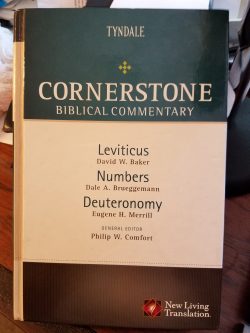
I’m about to move from the section on Numbers in the Cornerstone Biblical Commentary and from there go on to reading Deuteronomy. I’m reading this in parallel with a reading of the Hebrew text.
I’ll first note that I find this commentary very helpful, and I believe it would be helpful to a person preparing lessons or sermons on these books (Leviticus, Numbers, and Deuteronomy), which are not that easy to work with. The authors of all three sections provide good theological reflections on the passages, which I find helpful despite the fact that they are somewhat more conservative than my own theology.
One of the keys for Christians reading the Pentateuch is being open to the questions and looking for the answers. It is much less important to have a set of “good” answers at hand when you finish. It’s OK to admit that the culture reflected is very different from modern culture, and is hard for us to apply. As I have noted before, and recently read in Luke Timothy Johnson’s NTL commentary on Hebrews, modern Christians don’t really understand the idea of sacrifice, amongst other things, and so see the entire tabernacle/sanctuary service/cult as a foreign land.
Numbers 35 illustrates some difficulties. Here we have the concept of the avenger who will kill the person who has killed (even accidentally) a relative. So the cities of refuge are provided. There the killer can find refuge provided the killing was inadvertent. (Just how “inadvertence” is defined is up for some discussion.) In this passage we find the rule requiring at least two witnesses for a capital charge.
So we have a mitigation of vengeance killing, yet even if the person is found innocent of capital murder, he will be restricted to the city of refuge. Having been found not guilty, he still suffers exile. But modern readers may miss what many commentators see as the reason he remains until the death of the high priest. The death of the high priest is seen as atoning. I find the argument for this latter point less compelling than some, but nonetheless a serious possibility, and one which might well impact our understanding of Jesus as both high priest and sacrifice in Hebrews.
Which leads backward, in a sense, to the idea that the land itself is polluted by murder and that atonement must be made in order to remove this pollution. The atonement for intentional, premeditated murder can only be made by the death of the murder, and no ransom can be accepted. There is no indication in the text of what happens in case of doubt, when two witnesses cannot be produced. There would be no atonement. Clearly, people are not expected to atone for a sin they cannot determine existed.
We have here a tension between what we would see as Christian principles and a society based on vengeance. There is mitigation, and yet there is considerable accommodation as well. I think it is a good example of how God works with people. It’s easy for us to say that God should make things absolutely right (as we see it) in an instant. But it is not that easy to change a culture and a society.
Yet if you look at Judaism today, you see an amazing edifice built on just this kind of material, and Christianity grew out of this same soil with some interesting outside influence!
Regarding Numbers 33 and the 42 stations on the route to the promised land, footnote #1 on page 420, (Cornerstone Biblical Commentary on Numbers), notes that “[p]atristic commentators compared these 42 stations to the 42 (3 x 14) generations in Jesus’ genealogy, but that doesn’t shed any light on ch 33 …”
It is quite true that this comparison sheds no light on chapter 33, but I doubt that there was any intention by the author of Matthew to shed light on Numbers. More likely, if he was making a connection, he was intending to have Numbers 33 shed light on his genealogy. Clearly he went out of his way to get 42 generations and divide them into three groups of 14. It’s very easy to make too much of numerology.
Despite that, I am more and more convinced that New Testament authors quite frequently intended to draw more of the Old Testament narrative into their writing than just what was quoted. One reason for this is that I have noted how the lack of knowledge of the Hebrew Scriptures/Old Testament in modern audiences makes discussing certain passages more difficult. The corollary to this is that a greater knowledge would make discussion easier. New Testament writers could count on greater knowledge among their readers than we can today.
What might Matthew be drawing into the text here? I have argued that Matthew 2:15, when it quotes from Hosea 11:1, “Out of Egypt I have called my son,” is drawing the broader story there into his narrative. At first glance, one might accuse Matthew of taking something that is clearly not Messianic and making a prophecy out of it. Hosea 11 continues with telling us that the more YHWH called his people, the more they went away. My initial reaction to this, and the reaction of many, is that Matthew is grabbing a single clause out of context, and making a prediction of something that isn’t actually a prediction. But I’d suggest instead that Matthew is presenting Jesus as Israel doing it right. When God called Israel at various times, they went away, as Hosea is saying. Jesus, on the other hand, when called out of Egypt or when called to the cross, continues to come.
My suspicion is that the use of 42, besides being the numerologically comfortable grouping of three pairs of sevens (and there are so many ways a set of numbers can be presented!), is intended to point us back to the travels of the Israelites in coming to the promised land. I am in no way suggesting that these 42 stops were in some way predictive, nor am I suggesting that Matthew 1:1-17 gives some sort of new or special meaning to Numbers 33. Rather, I’m suggesting that Matthew uses 42 generations as an allusion to Numbers 33 and to Israel coming out of Egypt and to the promised land.
This will be on my YouTube channel and Google+ at 7 pm central time tonight.
I’m actually going to start from what I left off last week and talk about “this generation shall not pass,” which will require me to talk a bit about biblical inspiration. Following that I plan to introduce my (not so original) simple view of eschatology and then look at Mark 13 and how it might fit in.
Next week I’ll be looking at the variety, and some history of prophecy in Old Testament times, and then next week we’ll tackle chapter 4 of Dr. Vick’s book, Prophecy and Apocalyptic.
As I work on these, I’m also working on a series of four talks on Revelation to be presented to some teenagers during the month of October. That may be more challenging than these presentations.




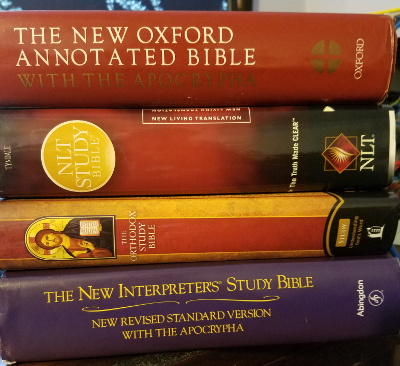 I’m going to compare the content of several study Bibles I have on my shelf. Where I give word counts, they are loose estimates based on line counts and my eyeball count of average words per line. The Bibles I’m using to compare are: The New Oxford Annotated Bible (NRSV), The Orthodox Study Bible, The New Interpreter’s Study Bible, The NLT Study Bible, and of course the NIV Cultural Backgrounds Study Bible.