Threads from Henry's Web

Category: Bible Books

  • Follow-Up on Study of the Gospel of John – Introduction

    I’ll include the YouTube for my first study session on the Gospel of John below. During my discussion I promised to provide a link for the article I referenced suggesting that the Rylands Papyrus, P52, may be dated a bit too early. The article I referenced is available on Academia.edu, and is titled The Use and Abuse of P52: Papyrological Pitfalls in theDating of the Fourth Gospel. I believe registration is required, but it’s not behind a pay wall.

    In addition, you might want to review Larry Hurtado’s comments on an article dealing more generally with early dating of NT manuscripts. The article itself is behind a pay wall, and I haven’t read it.

    I find that these notes generally reaffirm my belief that most paleographical dating of New Testament manuscripts provide too narrow a window, one that is not justified by the level of the evidence. If one truly considered the window, the old date for P52 is about at the lower edge of the new window. Our tendency is to read probabilities as certainties, and thus if we have a date of 125 +/- 25 years, we will often cite it as 125. But that window is important. I’m not a paleographer, so I couldn’t comment on the particulars.

    This coming Thursday, again at 7:00 pm central, 8:00 pm eastern time I will be discussing John 1:1-18. I will post a link to the event, a video trailer for that lesson, and some questions/points to think about prior to the study here tomorrow.

    Also, we will be having a 1/2 hour author interview in the series of Energion Publications Tuesday night hangouts on air with author David Cartwright regarding Cartwright’s recently released book Wounded by Truth – Healed by Love. Elgin Hushbeck, Jr. will conduct the interview. For the second half hour, Elgin will be discussing historicity and the gospels with me, particularly with reference to the Gospel of John. Click here for full information on the Tuesday night hangout.

    And finally, here’s the YouTube for last Thursday’s introduction to my study on the Gospel of John. We’re using Meditations on According to John by Dr. Herold Weiss as the text.

  • Some of My Own Books on Sale (Gospel of John Study)

    Some of My Own Books on Sale (Gospel of John Study)

    henry_saleThe advantages of being a publisher is that I can put books on sale to go with posts. Normally I only do that for things on my company page (Energion Publications), but since I’m starting a study of the Gospel of John on my Google+ Page/YouTube Channel, I’m doing it with a few of my own books. I haven’t spent time pushing my books for some time, I think.

    In any case, the book I’m using for the study, Meditations on According to John by Dr. Herold Weiss, and three of my own books are on sale for 30% off until the end of the month, so this is your opportunity.

    While I’m following Dr. Weiss’s book, I won’t be reiterating the contents of it in the video. I intend to spend more time in the nuts and bolts of how one interprets the passage. Dr. Weiss subtitled his book “Exercises in Biblical Theology,” and I’m going to be doing some exercises during the week myself and sharing these each Thursday night. So if you want to get what he has said, you’ll need to buy his book.


  • Bruce Epperly Interview and Sale

    Bruce Epperly Interview and Sale

    epperly_saleLast night I had the privilege of interviewing Dr. Bruce Epperly, author of several Energion titles out of a total of 28 books he has written so far. Bruce is always both interesting and challenging, and doesn’t avoid the hard questions.

    We placed his books on a special “buy 2 get 1 free” sale just before the interview, but I was so interested in the topic, I forgot to mention it on video! I’ve extended that sale by one day, so it will be good all day today and tomorrow. If you want to stock up on these titles, this is the time to do it. Note that the buy 2 get 1 offer works along with quantity discounts, so if you’d like to stock up for a study group, again, now is the time. Just go to Energion Direct, and you’ll see a section for the sale on Bruce Epperly’s books. You can make your choices from there.

    For those who may have missed it, I’m embedding the YouTube video below.

  • Trailer and Theme for My Study of John

    Trailer and Theme for My Study of John

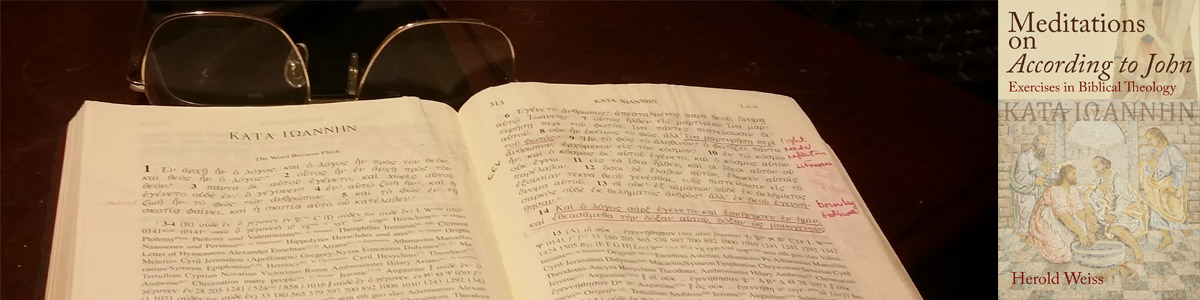
    john banner

    Above is the theme banner for my study of the gospel of John. The video below is a trailer for it. I am working on getting used to video. I’m more comfortable with text, I think.

  • Studying Through John

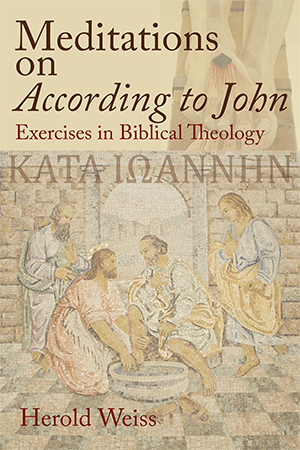
    Meditations on According to JohnWith the new year I’m starting a new online study, working through the Gospel of John using Herold Weiss’s book Meditations on According to John.

    A previous effort by my wife and I to conduct a group discussion failed both due to our schedules and due to low participation. In this case, I will be essentially video blogging live.

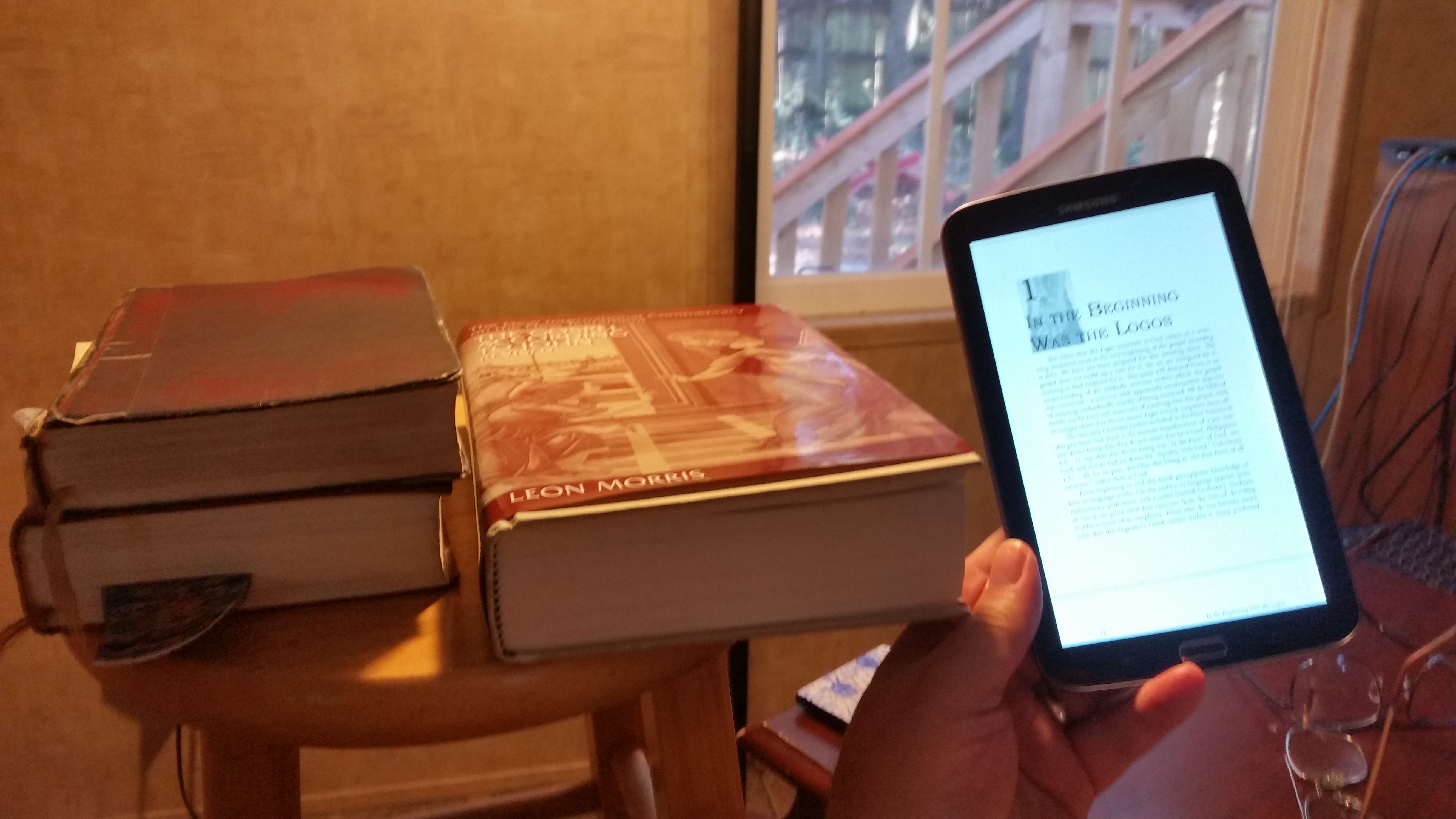
    I will personally be studying the book through in Greek, and also studying Leon Morris’s commentary in the NICNT series. That provides a conservative counterpoint to Dr. Weiss. I’ll discuss where I stand in connection with all this in the introductory study.

    I will always have the Q&A app enabled so that people can interact via text. In addition, I’ll be watching my Twitter feed for any comments or questions. If anyone wants to participate via video, let me know through the comments below or via e-mail (henry@energion.com). The only requirements I will have for participation are that you get a copy of the book (ebook is fine), read the material including the Bible passages, and if there is a sharp disagreement, be comfortable stating your position and then letting it go. I’ll state mine and let it go as well. I’m not expecting video participation but will be pleased if there is some. While I can’t imagine it will be a problem, there is a limit of 10 people (9 + me) on the video.

    So get out your Bibles and your favorite reference sources and plan to join the discussion! I’m posting the YouTube below. At 7:00 pm Thursday night, January 6, it will be live. Once the event is complete, it will show the recording.

  • Some Comments on Writing Introductions with Special Attention to John

    Studying JohnI’m planning to start doing some discussion of Bible passages using Google Hangouts on Air during the coming year. Basically, I’m going to work through material I intend to use in Sunday School. One may ask why I’m doing this, considering that the last time I tried, I had little success. Well, the difference is that before we just created a hangout and waited for discussion. In this case, if necessary, I’m just going to talk through the material I’ve prepared and record it for my YouTube channel. This will be my personal channel, which I’ve been neglecting for some time, not my business channel. Thus whether anybody shows up or not I’ll be talking! (Could be a sign of insanity.) Watch for more information here.

    I’m planning to follow the recent book Meditations on According to John by Herold Weiss, which approaches the book thematically. It’s that approach that I like. I will not necessarily agree with everything in the source book, but I’ll stick with the general structure. I’ll be consulting other materials, of course. Right now I’m reading The Gospel According to John (Revised) by Leon Morris in the New International Commentary on the New Testament series.

    Introductions to Bible books are a very interesting art form. One has to cover a broad range of material and draw on many parallels (or not) as well as many themes from the book in order to provide some generalities to help the user in study. The readers, on the other hand, will not necessarily be prepared to hear all of that yet, because they haven’t yet read the book. I recall one of seminary professors remarking that he wanted to offer Introduction to the New Testament and Introduction to the Old Testament as senior rather than freshman religion courses. He thought students were not ready to appreciate a good introduction until they’d been exposed to, and struggled with, more of the questions. He was only partially saying this tongue-in-cheek. I know that I’ve enjoyed reading Old Testament introductions and theologies much more since I completed my MA program than I ever did as an undergraduate.

    But the art of introduction is to provide the material without completely putting the reader to sleep, and come to some conclusions without losing your entire reading public. The problem is that by now there are so many theories on each book of the Bible that it’s very hard to sort through them all, classify them, decide what needs to be covered in detail, and then focus in on a conclusion. And then, suppose you’re wrong! What happens the someone’s understanding of the book ? We consider context important, and this sets the context, but it’s also easy to place a book in the wrong place.

    For example, was the gospel of John written before or after the destruction of Jerusalem in 70 CE? The consensus indicates it was written later, but there are a number of clues in the book that point to an earlier date. Then there are multiple theories for the origins of the book. Does it involve sources, or was it written more or less as is? How many sources and what did they contain? And whether or not there were sources, who was the author, and if you have sources, who authored them and who was the final redactor? All of these questions have an impact on how you will understand the book.

    I’m reading conflicting introductions right now. Leon Morris leans toward Johannine authorship of the gospel and the epistles, and also toward an early date. Herold Weiss tends to see sources, a late date, and an unknown author. I kind of like that as I get to look at both sides. And the thing is that I find lots of reason to doubt almost all conclusions. In this sort of a mass of theories with evidence light on the ground doubt is a very reasonable position!

    I consider myself a defender of biblical criticism. I appreciate such methods as form, source, and redaction criticism. The problem is that to a man with a hammer, everything looks like a nail. To a biblical scholar with form criticism on his mind, everything is an orally transmitted pericope. To a biblical scholar with redaction criticism on the brain, everything appears to have been added by one redactor or another. And with all due (dis)honor to William of Okham, entities are multiplied all across the landscape. I believe there is orally transmitted material in scripture. I believe there are books that are constructed from sources. In fact, Samuel-Kings identifies sources. I believe that there have been redactors. But the details are very hard to pin down.  The more general ones can be stated with some certainty, though not beyond reasonable doubt. the more detailed the conclusion, the less certain one can be.

    Now in the gospel of John, I’m not sure that there are really sources in the classic sense of the word. It seems to me to be a rather heavily united work. Are there stress lines? Yes. I see some places where it doesn’t seem to be sewn together as well as we might like. But after publishing more than 125 books, I can’t count the number of times I’ve told an author, “You’re transition here doesn’t make any sense.” Books written by human beings don’t always meet the criteria of the theology professor in the ivory tower. That’s because it’s hard to find the Bible book written by someone in an ivory tower!

    So was John written by the apostle John or another eyewitness? Is it valuable in studying the historical Jesus? First, let me note that I’m quite weary of reading discussions that hinge entirely on preconceptions about historicity. One senses that certain scholars don’t want any of the gospels to be written by eyewitnesses, because that would suggest too much historicity in the life of Jesus. It’s easier to dismiss if we don’t have actual eyewitness reports. On the other hand we have folks who must conclude that the gospels were written by eyewitnesses because they must be history. We can determine who was the author based on the evidence (if there’s enough) without necessarily giving up everything else.

    For example, I’m not nearly as excited about eyewitness testimony as it seems everyone else is. This comes from my experience with storytelling and hearing. My mother is now 96 years old, and we can sit down with various family members and get into some amazing disagreements about what went on. I remember a rare occasion in a recent discussion when I disagreed with my mother on something that happened and she said, “You know, I think you’re right.” That was astounding. Normally I defer to her because, quite frankly, she has a better memory than I do. But as I compare my memory with the stories others in the family tell, and compare their memory in turn with what others remember, I find that human memory is rather fallible, especially as our lives move forward. Since our family seems to be fairly long lived on both sides, I’ve had plenty of opportunity to hear stories evolve over time.

    But perhaps a better parallel to oral transmission of stories in the gospels is my experience in church discussing reports of contemporary miracles. These stories also change. Persons with more authority in the group tend to tell the most authoritative version, and other people’s stories will converge toward theirs. Over time, there will be different versions. If you were there, you may not recognize the story by the time a few years have passed.

    As a result, I no longer conclude that if we have eyewitnesses, we somehow have a reasonably accurate history, and if we are hearing from the next generation, we immediately do not. Rather, stories can achieve new highs or new lows within hours or days when humans are involved. In my opinion, there is history to be derived from the gospels, but since our kind of history is not what the gospel writers were aiming at, it’s not surprising that it’s hard to achieve. The question is how well the achieved their own aims.

    And so we come to the question of whether any gospel, and particularly the gospel of John, were written as history. The answer, in my view, is yes and no. The problem is that we tend to take this as a binary question with an easy “yes” or “no” answer. No, I don’t think any gospel writer sat down to write history. By that I mean that they did not have as their primary consideration recording of facts in historical sequence for the purpose of providing a precise view of what happened. But that doesn’t mean that they didn’t care what happened at all. What they were interested in was in presenting the meaning of what happened. God has intervened in history and has been present in the person of Jesus of Nazareth. What does this mean? Now to get to the second question means that you have to have some basis in actual events, but your presentation and what you think is important may be different.

    In this I take an example from preachers’ stories used as illustrations. There are some stories that have been repeated many times and now exist in many different versions. But generally differences come from the lesson the preacher wants to take from that illustration. The story will be shaped to its final purpose. That may annoy a consistency freak (and I confess to being disturbed by stories that exist in more than one version), but it’s natural human story telling. Thus we get different numbers of demoniacs when Jesus crosses the sea, or different numbers of times that the cock crows, or that Peter denies Jesus. I think efforts to reconcile this stuff are doomed to failure and of no practical value. In fact, they are some of the best evidence that we’re dealing with real stories told by real people. If someone made it all up, they’d be more consistent.

    So I’m open to the idea that John the apostle wrote the gospel, and that it does, in fact, contribute to our knowledge of the historical Jesus. But I’m more interested in how it contributes to our understanding (rooted in history, yes, but not stuck there) of who Jesus was and is. Interestingly enough, I find that when I read Weiss’s essays, I don’t suddenly find that I must reject his conclusions if I change my mind about the dating of the book. (I haven’t changed my mind about the date, but I might, and I don’t hold my current view of a late date very tightly.)

    As i study the book I’m going to be focusing on theology, but always mindful of history. I’m really enjoying the journey so far.

    PS: A couple of resources from Energion Publications on this topic.

    9780954018719

    Meditations on According to John

  • 1 Thessalonians 1:1-10 – Translations

    My wife reminded me after her own study of 1 Thessalonians 1 today that those who don’t read Greek don’t necessarily see the same divisions or indicators of divisions. Translation does often involved changing the sentence structure and might require changing the division of paragraphs.

    I noticed that the commentary Dave referenced (see this post) using 1 Thessalonians 1:1-3 as the first division of the book also uses the NIV as it’s English text. The NIV also makes that division in the text. I thought it would be interesting to list some of the major translations and what how they divide the paragraphs in this chapter.

    With some help from BibleGateway, my Logos software, and my bookshelves, here goes.

    A) 1:1, 1:2-3, 1:4-10 – NIV (1984 & 2011),

    B) 1:1, 1:2-3, 1:4-7, 1:8-10 – NLT

    C) 1:1, 1:2-10 – NRSV, ESV, CEB, HCSB, REB, NASB

    D) 1:1, 1:2-5, 1:6-10 – NET, Die Gute Nachricht

    E) 1:1, 1:2-3, 1:4-6, 1:7-10 – CEV

    F) 1:1, 1:2-5, 1:6-8, 1:9-10 – ISV

    G) 1:1, 1:2-3, 1:4-10 – NJB

    I could check quite a number more, especially if I checked all the foreign language Bibles I have available. The author of a commentary on an English translation is generally constrained at least to start from the choices made by the translators, though he or she can certainly debate those.

    I’d make a few points:

    1) The wide variety of divisions indicates the difficulty of translating this long Greek passage into readable English sentences. We simply don’t make one sentence (or two) quite this long.

    2) Reading the passage in English obscures the underlying difficulty. One could wonder why there were so many distinctions.

    3) Reading multiple translations while paying attention to the divisions in the text will help the English reader get an overview of the complexity and of the options available.

    I try to teach people to understand that the divisions are not original to the writers, and that they should consider understandings of a passage that cross the divisions made in the text. Don’t get hung up on the added material.


  • 1 Thessalonians 1:1-10 Structure

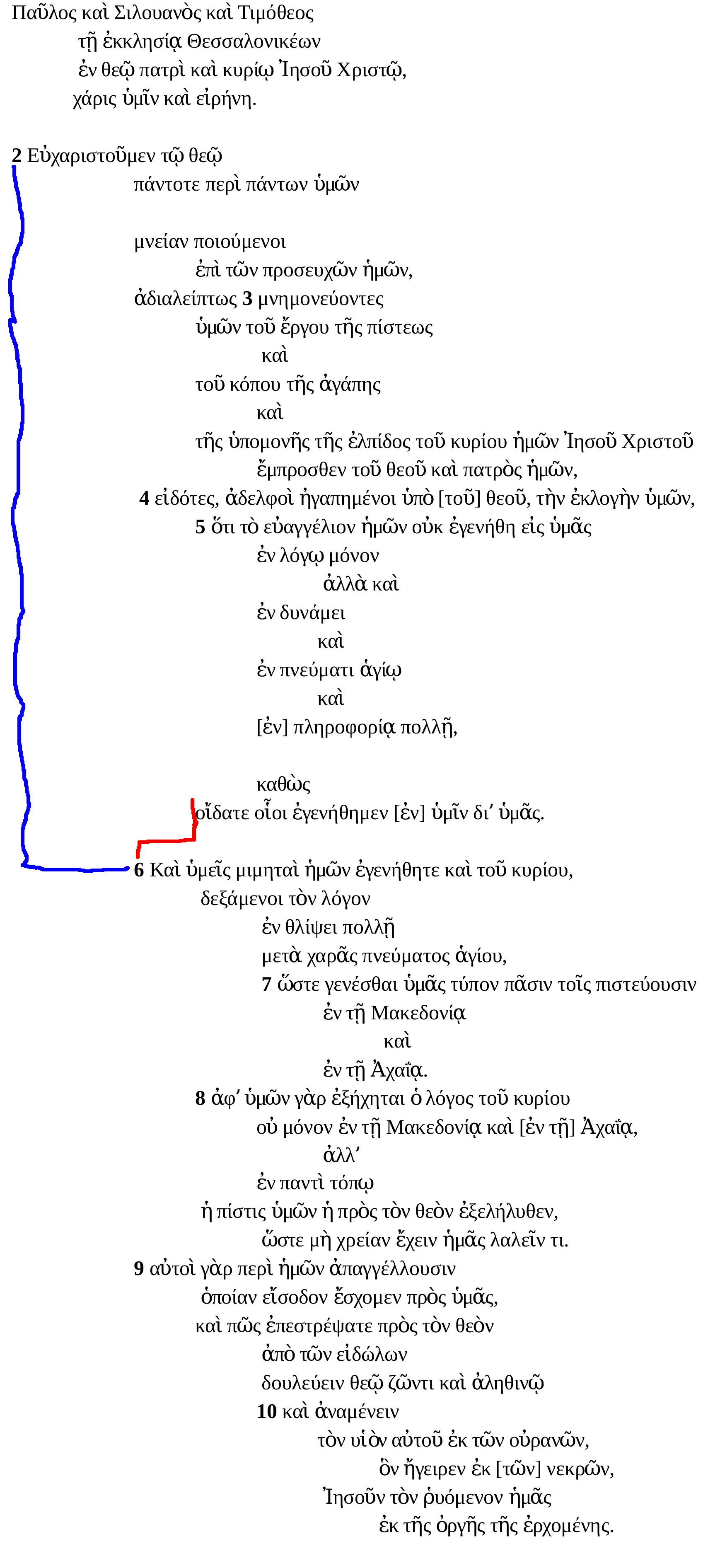
    Dave Black commented on the structure of this passage, and I’ve been trying to work with it a bit. I do a loose form of phrasing when I study, in which I break pieces of the passage in some detail at times and leave others less chopped, so to speak.

    This morning, my Sunday School class, always small, was canceled due to absences, so I spent some time chopping! Here’s an image of what I did. This is a large image. If you want to actually read it, you can click on it, but if you have your Greek NT nearby, you should be able to see just the shape.

    1 Thessalonians 1-1-10 Greek


    Now I don’t know if this was of any value to you, because it’s just my way of thinking about the structure. You may find it hard to follow. I know there are some phrasing systems that are different.

    Nonetheless, it helped me, though I don’t think it finally answered the questions I had. You might want to read Dave’s post (which I copied to JesusParadigm.com so we’d have a good link!) before this discussion.

    There seemed to be two major questions, first whether 1:2-10 should be divided into two paragraphs (2-5, 6-10) or seen as one, and second whether one could imagine a division of the text that used 1:1-3 as a division.

    As to the second question, I could not see when I first read this how it could be divided in that way. First, there is a clear division, in my view, between 1:1 and 1:2, and second, there is no division that I can see between 1:3 and 1:4. I think eidotes is likely parallel with poioumenoi in modifying eucharistoumen. (Pardon some loose transliteration.)

    As to the first, this results from the e-mail that was sent to Dave, challenging the division between 5 & 6. The most logical reading seems to me to relate verse 6 right back to the thanksgiving of verse one. My blue line on my image above would should the structure if 6-10 is a different paragraph. My red line subordinates it to eidotes in verse 4. I was having a hard time seeing that logic until I had broken this down and bit and read it several times. It could be, but I would lean to making 2-10 a single paragraph and tying verse 6 back to verse 2. Lean, not fall head over heels into.

    I rarely post this sort of stuff. I’m not really an expert, and the epistles are not my normal stomping ground, but one must venture off of comfortable territory at some time or another!

    I do want to call attention to Dave’s article and his post because I think it is unfortunate that so many of the epistles are chopped into pieces in the way they are used in the church. We have our proof texts and our favorite passages, but we don’t read them as a whole. They’re short. You can afford to sit down and read the whole thing. I can afford to sit down and read all of 1 Thessalonians in Greek. It’s fun, and it’s profitable.

    On something this short, I recommend starting a study by reading it 12 times, preferably in different sources. It’s a good time to polish up your Latin or French, or if you’re not into languages, just use a number of English translations. People tell me they’ll get bored reading the same thing 12 times. I haven’t found it to be so. I recall being challenged to try this on the Sermon on the Mount. I promised to stop when I found nothing new. I read it over 30x, and stopped just because I needed to study other scriptures. How can it be boring?

    But even more, we neglect so much of the Pauline material in the Bible. Galatians and Romans are the big things, but I think you won’t understand Paul unless you read other epistles. I think 2 Corinthians is another one that is neglected, and by neglecting it, we miss some of who the apostle Paul was and how he led churches.

    Those are my thoughts instead of teaching Sunday School!

    What do you think?


  • Prologue to To the Hebrews: Continuity and Reliability

    I’m continuing to read from the commentary on Hebrews by David L. Allen (Hebrews in the New American Commentary). I’m bound to get way ahead in my reading but I want to make a few remarks about the prologue, which both Dr. Allen and I would say goes through verse 4.

    I have written on this before (comments and translation notes), and I haven’t found any reason to alter what I said in those posts on the subject. What I want to discuss here is how the prologue relates to the theme.

    I think the prologue states the theme. We will find at later points in the book that we can refine the particular nature of the situation addressed and the causes of problems that are addressed, but we already have the basic story right here. The author is interested in two major points, I think: continuity and reliability. He states these in terms of God’s relationship to his people.

    Often people get the idea that Hebrews is about discarding the Old Testament. I recall some participants in discussions I have led telling me that it is obvious that he is making the New Testament supersede the Old, or Jesus to supersede all that came before. People can become quite distressed that I do not see such an obvious conclusion. But if you are looking at the structure of the book, you realize that the entire thing falls apart if the author thinks the Old Testament is somehow wiped away. That isn’t the argument at all.

    Rather, a certain view of the Old Testament is wiped away, most particularly the view that it is the scriptures and is the end, or that in the Torah one would find the ultimate revelation of God. Rather than saying that the Torah is flawed, he is saying that God didn’t finish by presenting the Torah. There is a new center point, and that center point is the revelation of God through Jesus. I would also suggest that our author is not here saying that this is a change from what the Old Testament writers themselves would have said. I think he would maintain that he is correcting course, that the idea that the Torah was everything was never correct, but rather than it was always God who was the focus, and that until God became manifest in Jesus, we didn’t have the opportunity to see that particular radiance.

    So now he is putting the focus of all revelation on God, and letting us know that we can receive God’s message, and that we can enter into a relationship with God because that has been made possible through Jesus Christ, the exact representation of who God is. There is no suggestion here that this eliminates all that other revelation; instead it illuminates it.

    So why do I say the structure would fall apart if the author was simply discarding the Old Testament revelation? Surely he can be arguing that the Old Testament was good enough for its time, but now we have something better, and even the Old Testament writers realized they would be superseded. But I disagree. He is not simply aiming at continuity. He is aiming at reliability. Those Old Testament writers were not some kind of failure on God’s part. Rather, they were leading up to the present time (the author’s and ours!) and that chain of connections shows that not only does the revelation continue, but it can be relied upon by us, just as it was relied upon by the patriarchs (and matriarchs, for that matter). But we now have this additional communication and evidence of reliability. God did come through, did send Jesus, did and does still lead us, and will continue to do so until we reach that (to us) coming Mt. Zion.

    One of the refinements of this theme comes in chapter 11 in which we have the patriarchs represented as more faithful than they actually were in the Old Testament text. But in God’s faithfulness they are even more faithful than they would appear to us to be in their story. Well before the time of Jesus, when they were weak, he was strong.

    I’d suggest spending quite some time with this passage. I’ve read it more times than I can recall. I have the entire book of Hebrews recorded on my phone in Greek so I can listen to it in my car. But I always feel tremendously inadequate as these words roll over me and I realize the freight that has been loaded into these few sentences.

  • Starting Ecclesiastes in Sunday School

    Starting Ecclesiastes in Sunday School

    9781938434662mWhile I was off teaching Revelation elsewhere, my Sunday School class at First United Methodist Church of Pensacola studied from Harvey Brown’s new book Forgiveness: Finding Freedom from Your Past. Harvey’s book is just 40 pages (it’s in our Topical Line Drives series, and that’s the limit), and we discovered just how many questions can be raised in 40 pages!

    Today we’re starting a study of Ecclesiastes, using the participatory study guide just published in November. This guide is written by Russell Meek of Midwestern Baptist Theological Seminary, and though I may be biased as editor and publisher, I think it’s one of the best studies you could do on the book of Ecclesiastes. Still, I’m going to have to tell the class that I disagree with a number of the conclusions in the book.

    But that, you see, is the great thing. Russ presents those conclusions so well, that I’ll have a run for my money making a case against things that he says, even with him absent. And in that discussion, I hope, the members of our small Sunday School class we’ll learn how these things are done.

    We’ll be talking about date and authorship today. This is an area of biblical studies that I think lay people in the church need to understand better. They take dates given in their study Bibles and assume they are either absolute, or at least they are a scholarly consensus. But how is it that serious biblical scholars make determinations about these things. Russ’s lengthy and very readable discussion of authorship is an excellent place to start.

    As I’ve been reading Ecclesiastes in preparation for this class, I’ve been struck by the interesting question of what the inclusion of such a book in scripture means about inspiration. No, I don’t mean about inerrancy, but rather about the way in which God chooses to communicate with us. I think we are often misguided in our discussions of inspiration because we are asking the wrong questions. Then we adjust our views of inspiration according to how effective scripture is at answering our questions. But what if God never intended to answer those questions through scripture in the first place? We might be doing something like querying our physics text to learn how to deal with our emotions.

    So I will also ask the class to think about just what questions might be answered by the inclusion of Ecclesiastes in the canon as well as by the text of the book.