Threads from Henry's Web

Tag: Faith

  • Sorrow Like My Sorrow – Lamentations 1:12

    Sorrow Like My Sorrow – Lamentations 1:12

    12 Is it nothing to you, all you who pass by? Look and see if there is any sorrow like my sorrow, which was brought upon me, which the LORD inflicted on the day of his fierce anger.

    The Holy Bible: New Revised Standard Version (Nashville: Thomas Nelson Publishers, 1989), La 1:12.

    There are several things I could discuss about this verse, but I’ve been thinking about the sorrow. When we are in trouble, many of us feel that we are suffering in ways nobody else can understand.

    In one sense, your sorrow is your own. You experience sorrow in individual ways. Your feelings are your own feelings. But very often when we think this we are missing the suffering of others, suffering we don’t understand and that might even be suffering worse than we are.

    The problem is that there is no real way to measure pain, suffering, and grief. Is what I have experienced more or less than what you have experienced? Neither of us really know. We can’t measure our suffering against our ability to endure.

    Despite all that, I am often shamed when I’m complaining, even just in my own mind, and then find out someone else is experiencing something I perceive to be worse. But I still don’t know the weight of that suffering to another person even when I know it is great.

    In lamentation, we long to have our suffering acknowledged. It is part of being seen and recognized. In scripture the hoped-for recognition is from God. That is the purpose of lamentation. We recognize and express the reality, and we look for the recognition of our pain.

    I will confess that I really don’t like to talk about difficulties. I prefer to keep on a proper “faith face” that suggests everything is fine whether it is or not. That face is often what we put on to avoid lamentation.

    So, honest face or faith face?

    (Featured image generated by Jetpack AI.)

  • Psalm 119:166 – Hope

    Psalm 119:166 – Hope

    I put my hope in your salvation, LORD,
    and I put your commands into action.

    I’m thinking of this today from a distinctively Christian perspective, and less about historical meaning. I’m looking back at the text through another lens.

    In one of my favorite texts, Paul puts these two concepts together:

    … With fear and trembling work out your own salvation, for it is God who works in you both to will and to do his good pleasure.

    Philippians 2:12-13, my translation with the final word taken from the KJV

    This again brings together these two important concepts: Trusting and Doing. If one’s hope is in God’s salvation, then what’s the doing about? Paul makes it clear here (and I think it’s clear in the Psalm as well) that it all depends on God, and yet there is doing involved.

    The problem for us is mixing the two up, getting our hope from our efforts. For many, there is a fear that if we don’t demand effort, no effort will be made. So we try to make salvation, or many other lesser goals depend entirely on work that is simply not sufficient to support it.

    What would it do to someone’s morale if they are facing an impossible barrier, and are told, “You have to put your hope in your own efforts to get over this barrier”? The result is that hope dies and the person gives up. One human approach is to follow this up by calling the person a loser because they have failed to overcome a barrier that was, in fact, impossible.

    The book of Hebrews, also a favorite of mine, leads up to presenting Christ as the one God perfected on our behalf at the end of chapter 5, and then in 6:1 says, “let us be carried on toward perfection.” (I believe the passive, not middle is the correct translation of the verb here.) The idea being that having through Jesus we are now to be carried on to the kingdom.

    If we get this idea of identity, and of a hope provided by God, then the idea of putting God’s commands into action becomes something different. We are winners with every step, not because we have accomplished the goal, but because we are on the journey, being cared along to perfection.

    Given a couple of quotes recently, you might be aware that I’m reading Deanna Thompson’s commentary on Deuteronomy. I have another quote from that book:

    Moses’ act of remembering and retelling Israelite history, as Israel stands between its future and its past, makes an important theological point about Israelite identity: Israel’s relationship with the God who freed them from slavery is its identity, and after years of dishonoring that memory, it is time to remember, honor, and obey.

    Commenting on Deutereonmy 1

    The Bible is very much about trust and hope, but it is also very much about action. Our problem is often leaving one or the other element out, or getting them in the wrong order. Trust and hope make action possible. Knowing who we are is what frees us for action.

    So, after all, this verse of Psalm 119 is very clear and reminds us of the order. Trust in God and do. In that order.

    What will God free you to do today?

    (Featured image generated by Jetpack AI.)

  • Psalm 119:45 – Speaking Before Kings

    Psalm 119:45 – Speaking Before Kings

    I will speak of your testimonies before Kings
    and will not be ashamed.

    Do you speak of your faith to other people? For many, this is a question specifically about making religious statements. Can you attempt to “bring someone to Christ?” Can you make a new disciple?

    What I wonder is whether we can talk about the ways of God, the things we might study from scripture and from God’s world, before others. I’m not opposed to sharing our faith. I think we should. But right now I’m talking about something different: Sharing what we have learned outside of the context of faith and religious activity.

    Can you present things you learn from God in ways that will be valued in a non-religious context?

    In my Sunday School class there is a gentleman who is a master at this. I can present a spiritual idea and he’ll find and express how that applies in professional or business life. The things I will teach from scripture he can present as a part of simply doing one’s job well or helping to change the world around him.

    I really appreciate this input. I also appreciate people who can express their faith without being religious about it. One might call it good advice without sanctimony.

    Can you share something of value that you learned through Bible study with someone else without first trying to convince them that the Bible is the word of God?

    I’d suggest that’s a valuable skill.

    (Featured image generated by Jetpack AI.)

  • Look to Jesus (Hebrews 12:2)

    Look to Jesus (Hebrews 12:2)

    The other day I was just waking up and realizing that I faced a challenging day. I decided to do a little scripture reading before even getting up. I chose to read a language I read only very slowly and with difficulty (Syriac), because that usually gives me more time to meditate. I have a tendency to rush.

    I started in Hebrews 12, and got to verse two, which begins: “Look to Jesus.”

    This seemed to me to be good advice. I stopped there for a bit and marked those two words. (Yes, two words in Syriac.)

    If I had chosen to read it in Greek, the impact would have been a bit different, as the word order goes approximately thus: “Looking to the author and finisher (perfecter) of our faith Jesus.” Not a difference in meaning overall, but it was those first two words that stopped me for a moment, and that was helpful that morning. Good advice, as I said.

    Then I went on to “the head (or beginning) and finisher (perfecter) of our faith.”

    Now that’s a profound statement. This passage (Hebrews 12:1-3) is frequently used a works and behavior modification passage. “You have all these great, holy, and faithful witnesses watching you, so get on with the work of being a Christian. Jesus has saved you, and he expects you to act like it.”

    But that’s not what the passage says. Yes, there is a call to follow, but that call is put in its context right here. It’s Jesus all the way. He begins, he finishes.

    What about all those faithful witnesses?

    Here’s where I get into Bible contradictions. People ask me whether there are contradictions in the Bible and I say, “Yes! They are the best part!”

    Hebrews 11:27 tells us that Moses left Egypt by faith, “not fearing the wrath of the king.” Exodus 2:14 tells us that Moses was afraid and fled. If that isn’t enough, we’re told that Israel passed through the red sea “by faith.” Have you read the story? Not all that much faith was on display!

    Day after day there is not that much faith on display in my life. I worry about everything. I shouldn’t do that, but I do.

    But Jesus is the author and the perfecter of my faith.

    Jesus rewrites the stories of those witnesses’ lives from a grace view. He is doing the same thing for you. It may be very slow, but it’s happening.

    That crowd of witnesses? They’re not people who lived perfect lives and are looking down on you to criticize your every mistake. They know you’re going to make mistakes. They did. They know your faith can be pretty weak at the most difficult moments. Theirs was.

    They’re there to remind you that God saw them through and God will see you through. The grace filtered view of your life is going to make your story heroic.

    Look to Jesus, beginning to end.

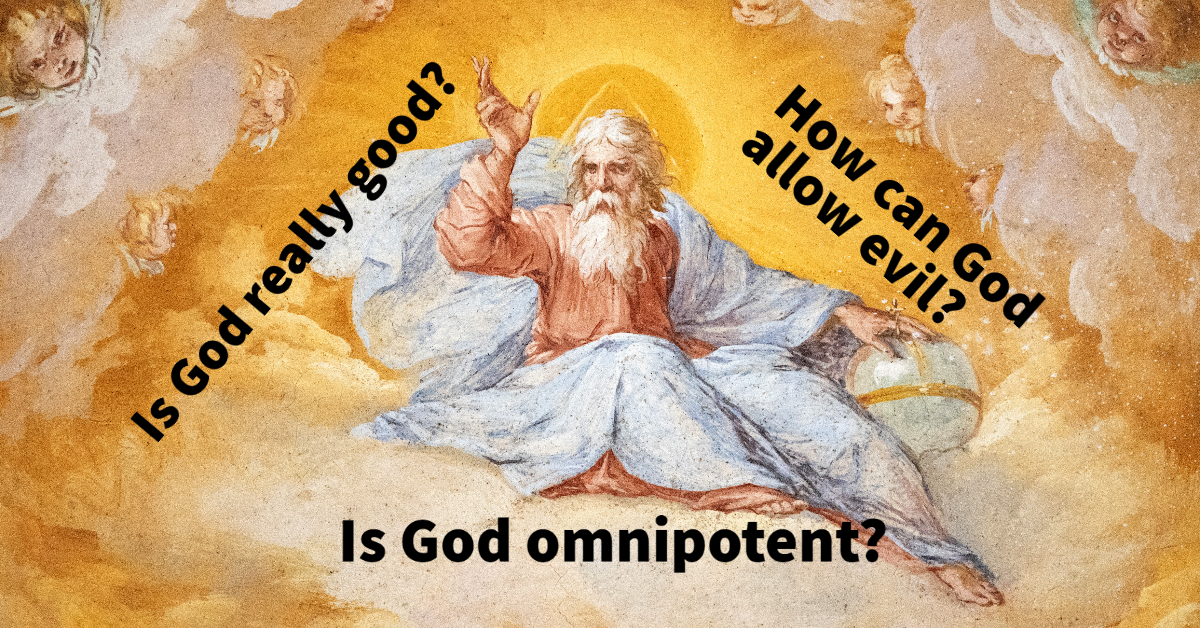
  • A Robust Theodicy?

    A Robust Theodicy?

    As I conduct interviews on theodicy with various authors, I’d like to suggest this:

    We need a theodicy (and in fact a full theology) that is as comfortable in Job as in Deuteronomy. This would be the expression of a faith that isn’t forgotten in good times or repudiated in bad.

    Here again is the first video:

    I will be interviewing Dr. Bruce Epperly and Dr. Allan R. Bevere on Thursday, November 10, 2022 and will be posting those interviews over the next couple of days. Further interviews will be announced here.

  • Fear and …

    Fear and …

    Perfect love, we know, casteth out fear [1 John 4:18]. But so do several other things — ignorance, alcohol, passion, presumption, and stupidity.

    C. S. Lewis, “The World’s Last Night”

    Lewis took this in another direction, but I like the words to point out that, in certain circumstances fear can be a very good thing, and it’s absence dangerous.

    Featured image credit: Pixabay.com

  • Grace and the Book of Hebrews

    Grace and the Book of Hebrews

    In my experience, Hebrews has provided a wealth of texts for sermons that call for works and human effort. Pride of place, perhaps, should be held by the Wesleyan doctrine of Christian perfection, for which one of the central texts is Hebrews 6:1. No matter how many times Wesley affirmed Christian perfection as a gift of grace, he was unable to prevent this becoming a basis for performance based salvation, judgment, and self-righteousness. (While I believe in sanctification, and will mention it below, I don’t accept the idea of perfection in this life.)

    Hebrews 6:4-6 follows, which is often treated as teaching that if we commit some particular sin or other, we will lose our salvation for doing so. I’ve written about this recently, and I disagree, but I’ve heard it preached.

    Then there’s Hebrews 10:26-31, starting with the warning against continuing in sin and ending with what a terrifying thing it is to fall into the hands of the living God.

    Or Hebrews 11, so often preached as a litany of great accomplishments and presented against the lack of accomplishments in the congregation. We must, of course, become faithful like these heroes of ancient times and hold up our end of the deal. After all, God needs us and demands our service.

    Hebrews 12 starts with the clouds of witnesses, which I’ve heard preached as the “encouragement” of having all these wonderful people watching you from heaven, so you had better not mess up. Don’t want all these holy people watching you mess up, do you?

    Of course, you aim to accomplish all of this in fear of the God who is a devouring fire (12:29).

    James may be seen as an epistle of works (not an accurate portrayal, in my view, but Hebrews may well have been the source of more sermons on performance righteousness.

    But is this approach justified by the text of the letter itself? I don’t think so.

    Let me make a couple of assertions that I’m not really going to justify. Knowing that I believe these may help you understand the rest of what I’m saying. The first is that there was never a plan for salvation presented in scripture that did not have as its goal the creation of a holy people. From the invitation to the first couple to walk in the garden with God, to the call in Leviticus to be holy as God is holy, to Jesus asking disciples to follow him, to Paul inviting everyone to put their faith in Jesus, the anointed one, all the plans are part of one plan aiming at that point. The second is that grace is one of the, of not the, most difficult things to accept, because if grace is true, we are not in control. We humans like to be in control.

    Hebrews is a book about God making a holy people, and it’s a book about how none of us are in control.

    Hebrews starts with the description of God’s gracious gift, himself, in the person of Jesus. Hebrews 1:1-4 lays out this presentation. The one who is sent is sufficient to the task. As we move through the book, we see Jesus presented as one of us, tested as we are, and sharing in our experience. I have been asked whether I see Hebrews as teaching substitutionary atonement. If this is a question of whether Jesus died for us and for our sins, then the answer is surely “yes.” But if we mean “penal substitutionary atonement,” as in Jesus taking our punishment in a judical context, I think the answer is “no.”

    In Hebrews, Jesus is presented as becoming one of us. The necessary elements of the sacrifice is that it must be perfect, i.e., fully connected to God, and also fully ours. Then the form of “dying for” is incorporation. We are in Christ who is our king, our parent, and our priest, and we are incorporated in his death. He dies and we die “in him.” It is not a judicial substitution, but rather that the one dies for the nation (John 11:50) as one of the nation, indeed, as the king. The key here is that we become incorporated into that kingdom, that community, and are thus buried in his death and raised into his life (Romans 6). I think Hebrews is closely aligned with this Pauline theological presentation. Everything we are called to accomplish in the book is accomplished in Christ. That’s why Christ is presented first in the book and his superiority is established. (Refer again back to my post on Hebrews 6:4-6 for some backup for this idea.)

    So when we are called to perfection, we are called to be carried on to perfection. This is not the perfection of a person who lives a perfect life, and certainly not something we accomplish on our own. That’s clear through the arguments on why Jesus is the perfect high priest. In order to make that argument, one must establish that we are not capable of this on our own. The perfection to which we are called and to which we are carried is not ours, but the perfection of Jesus (Hebrews 5:9). He, Christ, is the source of salvation.

    Of course it is a terrible thing to fall into the hands of the living God, but we can instead be in the hands of the living God through the high priest who is sympathetic to our weaknesses. Of course, there is no more sacrifice for sin. If Jesus has opened a “new and living way” (Hebrews 10:19-20), then the only options are to go through it or not. If we are offered complete access to God and incorporation into his redemption and sanctification, what other option is needed? What other option could possible work?

    Then there’s Hebrews 11, which I think provides the key to the view of the message of Hebrews I’m presenting here. Contrary to those who preach Hebrews 11 as a triumph of the saints, it is, in fact, a triumph of grace in action. We err if we read this without adequate consideration of the stories from the Hebrew scriptures of these great heroes. Moses doesn’t fear the wrath of the king in Hebrews 11, but he flees in terror in Exodus. Sarah is rewarded for faith, but in Genesis she laughs. These people were not those who tried to obtain perfection, but those who were carried on to perfection. In 11:40 we are told that God’s plan was that they should attain perfection “with us.”

    That perfection, I believe is found in Jesus, and only in Jesus.

    These are the witnesses of Hebrews 12. We are being watched as we are carried on by those who have been carried before us. The question is truly simply whether we will truly be carried on. We can miss this both by thinking that we are going to do it ourselves, or by missing that it needs to be done at all. I’ve used the metaphor of a train for the theme of Hebrews. Get on the right train and stay on it until it reaches its destination. You can equally fail by sitting at the train station by never getting on the train, or if you set out to run alongside the train on your own power. Neither one will work. But if you get on the train you’ll move forward. (As with all metaphors, this one has its weaknesses!)

    In this view of grace, it is not put against faith. It is not faith vs. works, as though there were two approaches and one was better. It’s not a balance between faith and works. No amount of running, even combined with train-riding attempts, is adequate. But sitting in the station is also not a real option.

    What I think Hebrews makes clear is that the grace is available. Jesus opens the way to God. This is grace in action. But rather than being the enemy of true works, works of faith, grace is what opens the door and makes any works, any holiness, and any approach to God possible. Sanctification occurs only on the train, i.e., only when we are being carried on toward perfection in Jesus, our brother, our sacrifice, our high priest, and our king.

    That’s why I see grace as the critical key to the entire book of Hebrews, but I also see the book as providing a critical view of grace, a grace that is active, even more, that is God’s action taken in our lives.

    In this post I have not provided nearly enough scripture and logic to back this up fully. This is just an introduction. My recommendation is that you consider these ideas while reading the entire book to see what you find.

    (Feature image credit: Openclipart.org.)

  • Serious about Whose Faith

    I was mentioned by Ed Brayton (blogs at Dispatches from the Culture Wars) in a comment to a post on Facebook, and made a couple of comments myself. Here’s the Facebook post:

    https://www.facebook.com/ed.brayton.3/posts/10153647364908642

    There are two things here that interest me. First is the claim that moderates and liberals don’t take their faith seriously. This is silly, sort of like the claim that atheists really do believe in God, they’re just rebelling against him. What these two things share in common is that the person making the accusation makes assumptions about the other person’s mental processes that are not justified.

    I have spoken to people who called themselves atheists, but who were actually angry with God. They say certain things that tell you they actually believe. I also have spoken to any number of atheists. While they vary in the reasons they don’t believe in God, I have found their thinking quite clear. I have actually occasionally told someone who claimed to be an atheist that they sounded more like a deist or an agnostic (or a whatever to me), and asked them to explain their use of the term. It’s amazing what you can learn just by asking and listening to the response.

    On the other hand my faith is my faith, i.e., I have come to believe certain things. I don’t deny that many of these result from my upbringing. I was born into a Christian home, and that does predispose me to be a Christian. On the other hand, I know atheists who were born into a Christian home as well. More importantly, I don’t believe the same things my parents did. My Christianity is somewhat different. They were (and are) Seventh-day Adventists. I am not. They accepted and taught me young earth creationism. I have rejected that and am, to the extent I can tolerate the term, a theistic evolutionist. There are parts of the Bible that they treated as historical that I do not.

    How do you find that out? In my case, of course, you could read. But if you want to have dialogue with someone, it’s a good idea to find out what they actually believe. It may differ from your assumptions. I am probably more frequently accused of not taking my faith seriously by people who are more conservative Christians than I am. What they mean, generally, is that I don’t take their faith seriously, and generally I don’t. No, I don’t mean that I don’t take the faith of conservative Christians seriously. What I don’t take seriously is the faith of people who are so shallow as to make such accusations without bothering to investigate and learn.

    Let me illustrate this with a more specific example. While guest teaching a Sunday School class I stated that I found prayer at public events questionable at best, and that if asked (unlikely) I would decline to participate. I emphasized that I was not speaking here of constitutionality.  This was not a political position, but a religious one.

    One of the class members immediately accused me of not really being willing to stand up for my convictions because I would not uphold them publicly by praying there. But you see, those were his convictions about prayer, not mine.

    My convictions say that prayer is communion with God. My prayer takes place most commonly in my office while I’m studying my Bible. My prayer time is largely silent. You might even think I’m sleeping. If I pray in a group setting, I want that to be in a setting where we, as a group or community, pray. My city, county, state, or country does not constitute such a community. I can guarantee that someone in that audience is being forced to participate in my spiritual activity.

    I’d like to say that I don’t do it because I don’t want them to be forced to pray, and indeed I don’t want them to. But what drives me is that my own idea of what it means to commune with my heavenly parent is so contradictory to the idea of someone being involved involuntarily, that I find it offensive. I find it hard to pray. You may think I’m stupid, but those are my convictions, and they are the convictions that I will take seriously and uphold.

    I feel the same way about public school prayer. I would find it personally offensive for my children or grandchildren to be drafted into a government organized (or any other imposed) form of spiritual activity. So when I oppose prayer in public schools, I am not refusing to uphold my faith. Rather I am upholding it against something that is offensive to it. In my view the place for prayer with children would be at home with their parents,  or in some sort of voluntary faith community, not in the classroom with a public official.

    The second thing that interests me is the question of what the Bible actually is. Is it metaphor? Is it myth? Is it history?

    The problem here is that the Bible is many things. It contains history, fiction, a legend or so, plenty of metaphors, liturgy, political discussion, and even occasional theological discourse. In addition, it contains literature that is not commonly found elsewhere, such as visions and apocalyptic passages.

    Anyone who says the Bible is any one thing is either ignorant or not paying attention. The idea that there is a variety of types of literature in scripture is not a liberal or progressive idea. Conservatives are aware of it. Many fundamentalists will try to deny it. But where the serious divide comes is in determining what is what. Is Jonah some sort of historical story or is it fiction? (I would say fiction, and written to challenge the activities of some folks like Nehemiah, but it’s hard to pin down precisely.)

    One of the big questions is whether the early chapters of Genesis consist of myth or history. Obviously, young earth creationists regard them as history. I’ve heard people use the question “Is Genesis 1 a myth?” as a sort of touchstone. If you say “yes” you’re a liberal, but if you say “no” you’re a fundamentalist.

    Well, I say no, and yet I accept the theory of evolution. How can this be? Well, quite simply the question of whether a passage contains accurate history and science is quite different from the question of its literary genre. The genre of Genesis 1 is, in my opinion, liturgy. Liturgy does not need to portray accurate history. Genesis 2:4ff, on the other hand, shares most of the characteristics of myth. It’s a different story, told in a different way.

    I’ve been asked why, if the two stories are contradictory, they appear side by side. The reason is that they function in such different ways that they cannot really contradict, any more than an Easter liturgy, celebrating the resurrection at 11 on Sunday morning in Pensacola can contradict an account of a missing body at about dawn near Jerusalem. They’re just not talking the same language.

    I find it annoying that so much Bible study has to do with proving or disproving the Bible. This often results in people taking positions because of what they need the result to be. One person wants to believe that the gospels were written late because he doesn’t want them to be eyewitness accounts. Another wants them to be written early because he does. Neither desire is relevant to the actual dating. I wrote a post about an hour ago maintaining that I thought it probable that Paul wrote Colossians, a position challenged by some scholars. Does this make me conservative? No, nor does it make me liberal. It means that’s what I believe the balance of the evidence is.

    Whether you are a Christian supposedly defending the Bible or a non-Christian who wishes to challenge it, contrived arguments aren’t going to help. Ultimately they’ll undermine your position with thinking people. I don’t mean every wrong conclusion is somehow a disaster. What I mean is every trite, contrived solution whose best evidence is the fact that you need it to be true, is going to backfire.]

    Well, at least it will backfire eventually with thinking people.

  • Fear, Beliefs, and Questioning

    Image of "Dawn: Luther at Erfurt" wh...
    Image via Wikipedia

    I’ve often said that I think people who become angry when their beliefs questioned are actually less confident of those beliefs, rather than more so. But that’s a pretty broad and inadequate statement, I think.

    I was discussing this with my wife recently, and we were wondering why neither of us get annoyed with people who question our faith, when some folks we know do. In an extreme case, I recall talking to a young man at a book show who responded angrily to my book What’s in a Version?. For him, the KJV was the one and only word of God, and you could see the tension creep in at the very thought that anyone might question that fact. As the discussion progressed, it became clear that for him, faith would collapse should this one doctrinal position prove false.

    In our discussion, I recalled my own departure from faith after I received my MA. I claimed unbelief, but as I processed things, I eventually (nearly 12 years later) came to the realization that I did, in fact, believe. The belief wasn’t something one would call Christian faith, and it was limited, but having shed most doctrinal positions, I found myself believing still. In exploring that, I returned to some doctrinal positions I had held previously, but not to others.

    I think the question here is just what is the object of my faith. If I, like that young man, would find my world unraveling if one could prove that the KJV wasn’t the one and only true word of God, is my faith in God or in the doctrine? Now the KJV-Only position is an extreme example, and I do believe many KJV-Only advocates are guilty of bibliolatry, but it’s very easy, I think, for us to place our personal preferences, and even our correct doctrines, ahead of God.

    For example, T. C. Moore suggests that the Gospel is the Messiah and not the doctrine of justification by faith (HT: Political Jesus). While I accept the doctrine of justification by faith (though not with all the definitions some Calvinists place on it), I would agree. The doctrine tells us something about the object of faith. Thus I could be convinced that I had misunderstood something about the doctrine without it making me question my faith in Jesus.

    On the other hand, I want to avoid the idea that doctrine, or the content of our beliefs, doesn’t matter. What I believe about Jesus is important, at the same time as I place my faith in Jesus and not in what I believe about Him.

    Let me compare this to marriage. I love my wife. I could describe this as adequate. She, and not some one of her attributes, is the object of my love. I know that she is a great organizer, a great caregiver, that she loves and prays for our children and grandchildren, and that if the budget is short she’ll give up something she wants before something that the children, grandchildren, or I would like. It’s important that I know these things about here. They’re true.

    But I don’t focus on those things to the neglect of the person. I could be out every night telling people about those things, while neglecting my wife, herself. But more importantly, what happens when she displays weakness? My love doesn’t change. But if what I loved was merely a list of characteristics, it might.

    The two elements are a package, but I do believe that if the focus, the object, of our faith and trust is right, we will have much less fear of examining the various things we believe about that person. There is no single string you can pull to make my faith in God disappear.

    So pull away at those strands. I’ll enjoy the discussion! Maybe we’ll both learn.

    Enhanced by Zemanta
  • I Believe Some Bizarre Things

    The Sunday School class I currently attend uses a random selection process for the questions we’ll discuss.  Class members put questions in a container, and we draw a question for each week.  Last week the question was:  Why am I such a doubting Thomas?

    As we were discussing how much we doubted, what we doubted, and why, someone commented that what we believe as Christians really is quite bizarre if you haven’t gotten used to it.  Most commonly we would cite things such as the resurrection.  I believe that one person who died about 2,000 years ago didn’t stay dead, but came back to life.  That’s a fairly bizarre thing to believe, or better to base an entire system of belief on.

    The person who made the comment cited the belief that Jesus died for our sins and thus we can have salvation.  I believe that’s equally bizarre.  Who these days would think of such a thing?  The idea of atonement was much more common in the ancient world, but not so much in western civilization today.

    And that brought another question, which seemed to be addressed to me.  Did Christianity seem less bizarre back in the first century.  My answer is “yes,” though different things would seem bizarre and likely in different ways.  As I’ve already mentioned, the atonement would seem more natural, provided one was drawing on a range of ideas prevalent in the ancient world, but there are aspects of it that are odd.  For example, the idea of a single, universal atonement, reconciling the whole world to God, was unique to Christianity, I believe.

    I don’t think it came out of thin air.  There are many, many parallels that come close, but I think the full idea of atonement as expressed especially by Paul, is unique.

    But what first comes to our modern, or even slightly post-modern minds, is generally the question of miracles.  But there is where I think we differ less from the ancients than we generally think.  We imagine that they were much more naive about miracles in general than we are, that they would tend to believe whatever miracle might be claimed.  I see little evidence for this.  In fact, the resurrection was very hard for either Greeks or Jews to believe, and was often a stumbling block, as noted, for example, in Acts 17:32.

    I observe two things.  First, there are quite a number of miracle stories even today, and plenty of people to believe in them.  Second, there is plenty of evidence of ancient people who were quite unwilling to believe miracle stories.  In both cases, such belief tends to be easier regarding miracle stories in one’s own religious tradition than in those of others.  As a Christian, I find it much easier to accept the idea that Jesus ascended to heaven than that Muhammad did.

    I’d suggest that this has a substantial impact on the way I read the Bible, as opposed to how I might read other literature, especially religious literature.   While I look at evidence regarding historical events related to my faith, at some of the most critical points, it is faith, without that much sight involved.

    One important reason to recognize this, I think, is that it will impact the way we relate to other people.  When we understand that, in a sense, one must put on a whole new religious culture before our religious faith makes sense, we may be somewhat more charitable.  I’m afraid I may lean the other way.  I find doubt and even rejection of things I hold dear quite reasonable, despite the depth of my own commitment to those beliefs.

    So I may not believe at least six impossible things before breakfast every morning, I do believe some things that, to someone outside my faith tradition, are bizarre.