Threads from Henry's Web

Category: Bible Passages

  • Tonight’s Energion Hangout

    dating and authorship bannerUsing Google Hangouts on Air, we will again broadcast a hangout with some of our authors. For further information, check the Google Plus event. I will embed the YouTube viewer below. Note that once the hangout is complete, the recording will be available through the same viewer.

    Due to unforeseen circumstances, the event tonight has been changed. Elgin Hushbeck and I had been planning to discuss the dating and authorship of Bible books in April, but we’re going to be doing that tonight. This is a conversation, though Elgin is the moderator/interviewer. This reverses the usual procedure, in which I interview one or more of my authors. Fun!

  • Follow-Up to According to John: No One Has Ascended into Heaven

    I want to follow up a bit on the study last night. I’ll embed the YouTube below for those who want to view this study after the fact. A few things occurred to me since the study.

    1. Meditations on According to JohnI’m really spending a great deal of time on the use of stories and of metaphors in discussing theology. I’m convinced that we don’t recognize the metaphors we’re using often enough. For example, it’s worthwhile to note that most discussion of substitution occurs inside the metaphor of the courtroom. It’s then important to recognize when a discussion, whether current or in scripture, occurs within another metaphor. John 3:16 occurs in a different metaphor, or perhaps more than one, and it comes after John has evoked the story of the serpent in the wilderness (Numbers 21:4-9). In that story, the key line is “look and live.”
    2. It’s very important to distinguish “light” as John uses it from our 20th/21st century use of that metaphor. Yes, that word is another metaphor. Jesus did not claim that he as going to provide physical light to the whole world. The modern tendency is to think of light as information and enlightenment as the reception of information. For John, and for Jesus as represented in this gospel, light is more closely connected to life. To mix the metaphors, you look up at the light as he is lifted up and you live. The healing of the blind man in John 9 links closely to this metaphor. There is light and the ability to see light.
    3. Metaphors allow us to talk about the same general subject from different perspectives. Thus one can talk about atonement using the metaphor of the battlefield, the courtroom, and the family/community without being contradictory. I would suggest that one shouldn’t mix these metaphors, at least without being very aware of what one is doing and doing so carefully.
    4. I had an excellent audience question, and this time one that wasn’t in my notes as something I might discuss. Just what was John doing? Jesus speaks so differently from the way he does in the synoptic gospels. Why? It’s a good question, and I went the right direction as I started to answer it. Overnight it occurred to me, however, that the synoptic gospels also had in mind building community. They were just more tied to an existing sayings tradition in doing so. The change, in my view, is one of emphasis. The particular kind of community building involved is one of defining oneself. What is it that we believe as a group that makes us a spiritual/religious community? There is a danger here in following the example of the community reflected in According to John. They are distinguishing themselves from the Jewish community, of which they had previously been members. Who are we apart from being Jews who believe in Jesus? We have to avoid following this line of reasoning to anti-semitism, as Dr. Weiss points out. In addition, however, we need to avoid community building that is done over-against others. There is a certain amount of “and you’re not” when one defines a community. But we need to avoid defining ourselves in a way that reflects negatively on others. The community in John had good reason—they were a persecuted minority. We have less reason.
    5. I’m very glad for Dr. Herold Weiss as a guide in this study. I’m assuming those who are joining me are reading his essays. He’s much more to the point. I’m adding a good deal of discussion of the nuts and bolts to help people think about their own theology, or at least I hope it helps. This can get boring, but sometimes wading through the nuts and bolts (intentional mixed metaphor!) is precisely what we need to do.

    And here is the YouTube embed for those who may have missed it:

  • According to John: No One Has Ascended into Heaven

    I should have posted this earlier. I’ll use as an excuse that our son is visiting us from Arizona. He’s probably not really to blame, but we are very delighted to have him here. Some distractions are a definite gift from God!

    You can find out more information from my Google+ Event, or watch the study via the YouTube embed below.


  • Quote: The Son of Man Lifted up on a Cross

    From my reading for next week’s study on John (Thursday night, 7:00 pm central time via Google Hangouts on Air):

    In the same way in which a flag lifted up on its pole draws together a people and constitutes it a nation, the Son of Man lifted up on a cross draws toward himself all who believe and constitutes them “born of God.” (Weiss, Meditations on According to John, 42)

    I am truly enjoying my reading in preparation for this study. I’ve been talking about metaphors, and leading toward the point that we use multiple metaphors to describe something that cannot be readily depicted in concrete language. Metaphors allow us to talk about the same subject in a variety of ways, each of which may contribute to our understanding.

    When a single metaphor becomes the one and only one permitted in describing an event, we begin to lose some of the content of the reality. Similarly, any time we allow one word for (or description of) God to replace God—what I call conceptual idolatry—we lose some of the reality of our experience of God. We can allow our description to limit who God is. In terms of the atonement, I believe that stating that the one explanation of the atonement is the metaphor of substitution in a forensic context, we start to lose some of the meaning of the atonement.

    Unlike some, I do see forensic and substitutionary metaphors in play in some scriptural descriptions of atonement. I don’t deny them as ways to discuss and understand atonement. My concern is that they not become the sole view, driving out other strong metaphors. The gospel of John uses a couple of different metaphors, especially centering around light and family, and we need to read those in their own context with their own integrity.

    When I was in college, I took Exegesis of Romans, which was intended as a sort of taste of Greek III, from a professor (Malcolm Maxwell for my fellow Walla Walla alumni), who was an advocate of the moral influence theory of the atonement. I was very attracted to the theology involved, but despite my best efforts, I couldn’t find it in Romans. It is wrong, in my view, though without any diminution in my great respect for Dr. Maxwell, to force the moral influence metaphor onto Romans. It is equally wrong to force forensic substitution onto the gospel of John. You may hear its echoes, but it doesn’t dominate.

    The quote above provides a taste. I’ll be discussing this in more detail on Thursday night.

  • According to John: He Who Follows Me … Will Have the Light of Life

    My Bible study tonight done via Google Hangouts on Air, will be on the topic in the title. I’m going to be following up from my discussion of vocabulary last week in looking at the words “light” and “life” in the gospel of John and how they relate to our understanding of the book’s message.

    Here’s the YouTube viewer:

  • Follow-up on According to John: Making Himself Equal with God

    There are a number of points I need to write about to follow up on my hangout from last Thursday night, but first, here’s the YouTube video of the event.

    I would like to remind you that you can ask questions or comment during the event using the Google Hangouts Q&A feature. Normally I’m also watching my Twitter (@hneufeld) and will see any Tweets @hneufeld. If you comment on something here and I can find a place for it in the next event, I will refer to it.

    I plan to follow up before Thursday with posts on the language of the trinity, and biblical inspiration.

    In the meantime, Bob Cornwall has written an interesting post on the language of the trinity. Check it out!

  • According to John: Making Himself Equal with God

    The reading is chapter 2 of Herold Weiss’s book Meditations on According to John, Making Himself Equal with God and the scriptures in it. My recommendation is to read the entire gospel of John through each week during this study. The topics are so carefully tied together through the entire book.

    Here’s the trailer:


    And you can watch the event here (Jan. 22, 2015, 7:00 pm central, 8:00 pm eastern):

  • Trailer and Theme for My Study of John

    Trailer and Theme for My Study of John

    john banner

    Above is the theme banner for my study of the gospel of John. The video below is a trailer for it. I am working on getting used to video. I’m more comfortable with text, I think.

  • Studying Through John

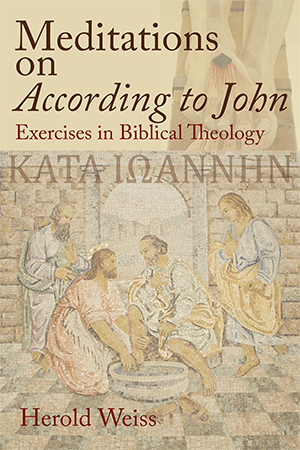
    Meditations on According to JohnWith the new year I’m starting a new online study, working through the Gospel of John using Herold Weiss’s book Meditations on According to John.

    A previous effort by my wife and I to conduct a group discussion failed both due to our schedules and due to low participation. In this case, I will be essentially video blogging live.

    I will personally be studying the book through in Greek, and also studying Leon Morris’s commentary in the NICNT series. That provides a conservative counterpoint to Dr. Weiss. I’ll discuss where I stand in connection with all this in the introductory study.

    I will always have the Q&A app enabled so that people can interact via text. In addition, I’ll be watching my Twitter feed for any comments or questions. If anyone wants to participate via video, let me know through the comments below or via e-mail (henry@energion.com). The only requirements I will have for participation are that you get a copy of the book (ebook is fine), read the material including the Bible passages, and if there is a sharp disagreement, be comfortable stating your position and then letting it go. I’ll state mine and let it go as well. I’m not expecting video participation but will be pleased if there is some. While I can’t imagine it will be a problem, there is a limit of 10 people (9 + me) on the video.

    So get out your Bibles and your favorite reference sources and plan to join the discussion! I’m posting the YouTube below. At 7:00 pm Thursday night, January 6, it will be live. Once the event is complete, it will show the recording.

  • Helping One Another Change

    I just extracted a note from Dave Black’s blog to The Jesus Paradigm. (That site supports his book by the same name as well as a few others that don’t have their own domain name.) In it Dave talks about admonishing, encouraging, and upholding. You’ll have to go read the post to find out what these are about.

    For my purposes here, they are all ways in which we help one another change for the better. In my view, there’s too little helpful activity of this nature in our churches today. We don’t want to get into each other’s business, and often we’re in congregations that are large enough that we don’t really know one another’s business enough to be helpful. In my own congregation I know that one of the considerations whenever we discuss greeting people is that there is a risk of approaching a life-long member as a new visitor. If I can’t be sure a person is a part of the congregation, how can I possibly respond to them in a helpful way about anything else?

    But I think that even in groups small enough to do so, we would have a hard time doing it. We seem to move too easily from neglect to condemnation without taking the necessary steps in between. Dave points out the different ways of handling different people. In order to interact with someone in a helpful way, whether correction or encouragement or any other approach, you have to know them pretty well. One big difference between correction and condemnation is simply the relationship between giver and receiver.

    I “correct” my wife’s use of the computer on a regular basis. I know more about computers than she does, she knows that, and so it generally works. Even so, it still won’t work if I am condescending or impatient. But if I both understand her starting point and work to help her get to where she wants to go, things work extremely well.

    She, on the other hand, corrects my work in the kitchen. It turns out that in the same set of circumstances, I can actually produce a meal with her direction. The things I don’t know how to do she does. The things I might ignore, like precisely which position the oven shelves occupy, she encourages me to get right.

    So here we are in the church. Let me just list some things we might need to work toward in our churches so we can truly help one another change.

    1. We need to know one another better, whatever that takes. If that means more home churches, great! If you can find a way in a large church to get some sort of accountability as a group, great!
    2. We need to understand forgiveness. I hear someone saying that we’re talking about correcting, not letting people off the hook for their misdeeds. That attitude is precisely the problem. Correction that comes with condemnation isn’t generally going to be mutual. We are all sinners together looking to Jesus. We abuse this in two ways. First, we decide we’re all sinners, so we can just forget about trying to change. Second, we can decide that some sinners are more equal than others. I think the call of Jesus is to mutuality. We are all sinners. We all press toward the mark.
    3. We need to ditch our pride. Ouch! Just about anything we do, even what is normally good, will be spoiled by pride.
    4. We need to know the difference between essentials and non-essentials. Too often when we correct others, we are asking them to follow our traditions instead of theirs. If you want to successfully show someone a better way, it helps if the way you’re showing them actually is better.
    5. We need to let love reign in us. All of 1 John is filled with excellent material, but 1 John 4 is particularly important on this point. Note that there is some help here defining love as well as applying it.

    We definitely need to get past the point where the only encouragement or exhortation in our churches comes from the pulpit, and is therefore easily ignored by those in the pews.

    Let us pay attention to each other, so as to stir up of love and good works … (Hebrews 10:24).

    12Therefore restore the weakened hands and the disabled knees, 13and prepare straight paths for your feet so that the lame might not stumble but rather might be healed (Hebrews 12:12-13).