Threads from Henry's Web

Category: Bible Passages

  • 1 Thessalonians 1:1-10 Structure

    Dave Black commented on the structure of this passage, and I’ve been trying to work with it a bit. I do a loose form of phrasing when I study, in which I break pieces of the passage in some detail at times and leave others less chopped, so to speak.

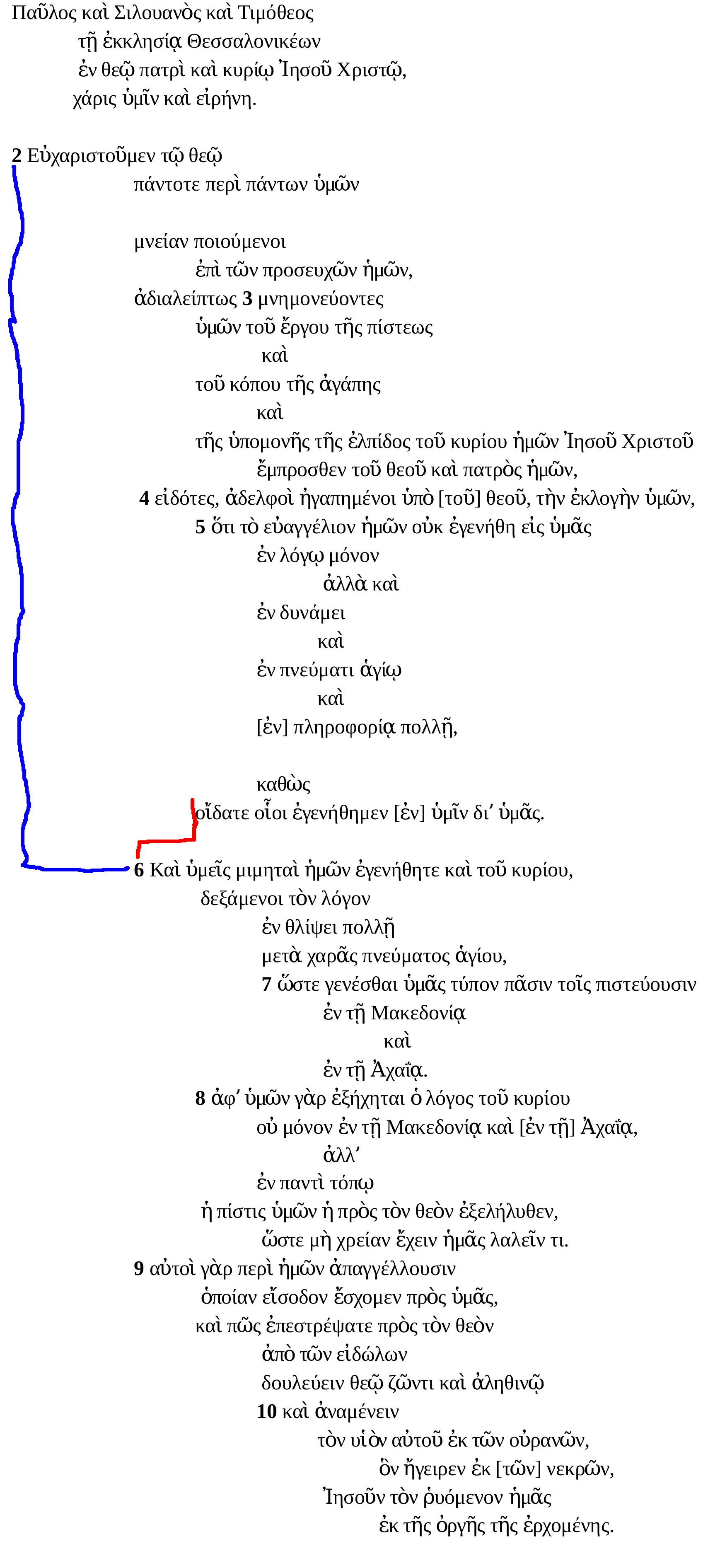
    This morning, my Sunday School class, always small, was canceled due to absences, so I spent some time chopping! Here’s an image of what I did. This is a large image. If you want to actually read it, you can click on it, but if you have your Greek NT nearby, you should be able to see just the shape.

    1 Thessalonians 1-1-10 Greek


    Now I don’t know if this was of any value to you, because it’s just my way of thinking about the structure. You may find it hard to follow. I know there are some phrasing systems that are different.

    Nonetheless, it helped me, though I don’t think it finally answered the questions I had. You might want to read Dave’s post (which I copied to JesusParadigm.com so we’d have a good link!) before this discussion.

    There seemed to be two major questions, first whether 1:2-10 should be divided into two paragraphs (2-5, 6-10) or seen as one, and second whether one could imagine a division of the text that used 1:1-3 as a division.

    As to the second question, I could not see when I first read this how it could be divided in that way. First, there is a clear division, in my view, between 1:1 and 1:2, and second, there is no division that I can see between 1:3 and 1:4. I think eidotes is likely parallel with poioumenoi in modifying eucharistoumen. (Pardon some loose transliteration.)

    As to the first, this results from the e-mail that was sent to Dave, challenging the division between 5 & 6. The most logical reading seems to me to relate verse 6 right back to the thanksgiving of verse one. My blue line on my image above would should the structure if 6-10 is a different paragraph. My red line subordinates it to eidotes in verse 4. I was having a hard time seeing that logic until I had broken this down and bit and read it several times. It could be, but I would lean to making 2-10 a single paragraph and tying verse 6 back to verse 2. Lean, not fall head over heels into.

    I rarely post this sort of stuff. I’m not really an expert, and the epistles are not my normal stomping ground, but one must venture off of comfortable territory at some time or another!

    I do want to call attention to Dave’s article and his post because I think it is unfortunate that so many of the epistles are chopped into pieces in the way they are used in the church. We have our proof texts and our favorite passages, but we don’t read them as a whole. They’re short. You can afford to sit down and read the whole thing. I can afford to sit down and read all of 1 Thessalonians in Greek. It’s fun, and it’s profitable.

    On something this short, I recommend starting a study by reading it 12 times, preferably in different sources. It’s a good time to polish up your Latin or French, or if you’re not into languages, just use a number of English translations. People tell me they’ll get bored reading the same thing 12 times. I haven’t found it to be so. I recall being challenged to try this on the Sermon on the Mount. I promised to stop when I found nothing new. I read it over 30x, and stopped just because I needed to study other scriptures. How can it be boring?

    But even more, we neglect so much of the Pauline material in the Bible. Galatians and Romans are the big things, but I think you won’t understand Paul unless you read other epistles. I think 2 Corinthians is another one that is neglected, and by neglecting it, we miss some of who the apostle Paul was and how he led churches.

    Those are my thoughts instead of teaching Sunday School!

    What do you think?


  • When Theology Overrides Story

    Jody and I were reading the Lectionary passages for next Sunday this afternoon, and I was reminded about how our theology can keep us from reading Bible stories. I think it’s also easy to let our theology trump the theology of a Bible writer, but stories don’t have a one-to-one relationship to theology in the first place.

    The story in this case comes from Exodus 32:1-14, in which Moses is on the mountain talking to God and the Israelites decide he won’t becoming back. (The story is repeated in the reading from Psalm 106.) So they make and worship the golden calf. God becomes angry with Israel, but Moses steps in and persuades him not to destroy the Israelites, even though the alternative is that God will make a great nation of his descendants instead.

    There are two points here that bother different people. Is this picture of God true and/or helpful? Do we serve a God who becomes angry at people and determines to wipe them out? There are, of course, many other stories that raise the same questions as well. On the other hand we are presented with a God who can be persuaded to change his mind. Moses calms God down, so to speak.

    If you’re of some sort of Calvinist persuasion, you’ll likely be OK with the angry God who wants to destroy the Israelites. God’s anger against sin is a key part of that theology. But what about God changing his mind? It’s very likely that this will be dismissed as somewhat of a ploy, perhaps a test of Moses. Will he stand for the people he leads? And of course God knows the results of that test. But actually calming God down or making God actually change his mind is inadmissible.

    On the other hand, if you’re like me, and tend to favor something along the line of openness theology, the latter point is easy to accept. God repents regularly in scripture. So this experience tends to mesh with my own theology that has God interacting with human beings in deciding their destiny.

    Yet many people who share that theology are very uncomfortable with God becoming angry with his people. So in this case one accepts the changeability of God, but not the anger. The anger is dismissed as coming from an excessively primitive view of God.

    I would suggest that in both cases theology prevents an authentic reading of the story. We need to let the story speak first. There is a sense of tension here. God has brought his people out of Egypt, only to have them credit that to an entity they themselves have created. God is, in the terms of the story, rightfully angry. There is the real risk, from the storyteller’s point of view, of the people being destroyed. In fact, it might well be quite reasonable for God to do that.

    There is also a real test of the character of Moses. If our theology didn’t interfere, we’d feel the tension better as Moses has a choice to make. Will he be the leader who identifies with, and serves the best interests of those he leads? If he does so, will God change his mind?

    How we work the story into our theology is another matter, but must come later. Let the story speak first.


  • Irregular Verbs and Hermeneutics

    In a few minutes I’m leaving to teach Sunday School and we’re talking about the inspiration and authority of scriptures and/or of people who claim to speak for God.

    But first, I thought I’d write a quick note on the recent discussion of violence in the Old Testament hosted by Allan Bevere. (To follow this discussion from the start, follow the links here.) This may sound terribly disrespectful, but first let me note that I largely agree with what Dr. L. Daniel Hawk said in his three part series. I like the canonical approach. I agree that we need to struggle with all the difficult passages. I would find some time to quibble about the criticism of the biblical theology school and it’s demise. I find that announcements of the death of schools of thought are often a mite exaggerated and tend to dismiss more than they should. So while I teach using a canonical approach to scripture, I think I should be subject a question analogous to the one I asked when reading material from earlier biblical criticism and the biblical theology school: Why? Why is it that you somehow think that when you get back to the earliest stream you are somehow dealing with something better? For me, there are two questions that arise from the same idea: 1) Why is the canonical form of scripture normative (and for what purpose)? and 2) What is the canonical form? (Canonical form is a bit easier to determine in the New Testament, I think.) I, for example, make use of the OT Apocrypha (a personal choice, since my denomination doesn’t recognize it as authoritative [why?]) and also consider the LXX versions of OT books to have similar authority to Hebrew texts in Christian contexts.

    Having thus raised more questions than I answer (a normal situation for me), let me get to my title.

    I’m a fan of the BBC shows Yes, Minister and Yes, Prime Minister. In those Bernard Wooley, private secretary to the minister and then Prime Minister Hacker, produces on occasion what he calls “irregular verbs.” I couldn’t find a good clip on YouTube, but I’m going to provide one for this discussion:

    I discern the message, you pick and choose, he discards Scripture wholesale.

    Please don’t hear this as an accusation of either Adam Hamilton or L. Daniel Hawk. While I tend to agree much more with Dr. Hawk, my intention is not to throw accusations around. This irregular verb points at me as well. I think, perhaps, that we need to spend more time discerning and discussing the ways in which we pick and choose.

    Hopefully I’ll find the time over the next week or so to discuss a few chapters. In the meantime might I direct you at some earlier efforts: The God-Talk Club and the She Bears (a short story/dialog) and Real Guy Interpretation – A Homily.

  • Prologue to To the Hebrews: Continuity and Reliability

    I’m continuing to read from the commentary on Hebrews by David L. Allen (Hebrews in the New American Commentary). I’m bound to get way ahead in my reading but I want to make a few remarks about the prologue, which both Dr. Allen and I would say goes through verse 4.

    I have written on this before (comments and translation notes), and I haven’t found any reason to alter what I said in those posts on the subject. What I want to discuss here is how the prologue relates to the theme.

    I think the prologue states the theme. We will find at later points in the book that we can refine the particular nature of the situation addressed and the causes of problems that are addressed, but we already have the basic story right here. The author is interested in two major points, I think: continuity and reliability. He states these in terms of God’s relationship to his people.

    Often people get the idea that Hebrews is about discarding the Old Testament. I recall some participants in discussions I have led telling me that it is obvious that he is making the New Testament supersede the Old, or Jesus to supersede all that came before. People can become quite distressed that I do not see such an obvious conclusion. But if you are looking at the structure of the book, you realize that the entire thing falls apart if the author thinks the Old Testament is somehow wiped away. That isn’t the argument at all.

    Rather, a certain view of the Old Testament is wiped away, most particularly the view that it is the scriptures and is the end, or that in the Torah one would find the ultimate revelation of God. Rather than saying that the Torah is flawed, he is saying that God didn’t finish by presenting the Torah. There is a new center point, and that center point is the revelation of God through Jesus. I would also suggest that our author is not here saying that this is a change from what the Old Testament writers themselves would have said. I think he would maintain that he is correcting course, that the idea that the Torah was everything was never correct, but rather than it was always God who was the focus, and that until God became manifest in Jesus, we didn’t have the opportunity to see that particular radiance.

    So now he is putting the focus of all revelation on God, and letting us know that we can receive God’s message, and that we can enter into a relationship with God because that has been made possible through Jesus Christ, the exact representation of who God is. There is no suggestion here that this eliminates all that other revelation; instead it illuminates it.

    So why do I say the structure would fall apart if the author was simply discarding the Old Testament revelation? Surely he can be arguing that the Old Testament was good enough for its time, but now we have something better, and even the Old Testament writers realized they would be superseded. But I disagree. He is not simply aiming at continuity. He is aiming at reliability. Those Old Testament writers were not some kind of failure on God’s part. Rather, they were leading up to the present time (the author’s and ours!) and that chain of connections shows that not only does the revelation continue, but it can be relied upon by us, just as it was relied upon by the patriarchs (and matriarchs, for that matter). But we now have this additional communication and evidence of reliability. God did come through, did send Jesus, did and does still lead us, and will continue to do so until we reach that (to us) coming Mt. Zion.

    One of the refinements of this theme comes in chapter 11 in which we have the patriarchs represented as more faithful than they actually were in the Old Testament text. But in God’s faithfulness they are even more faithful than they would appear to us to be in their story. Well before the time of Jesus, when they were weak, he was strong.

    I’d suggest spending quite some time with this passage. I’ve read it more times than I can recall. I have the entire book of Hebrews recorded on my phone in Greek so I can listen to it in my car. But I always feel tremendously inadequate as these words roll over me and I realize the freight that has been loaded into these few sentences.

  • Bible Study for Monday, July 28

    Well, we didn’t do so well this past Monday, but a new week is coming! On Monday, July 28, we will meet again via Google Hangouts, with the announcement via e-mail (if you’ve requested one), or on my Google+ page.

    Jody has already posted the question for this coming Monday and the scriptures:

    The Scriptures for this week are:
    Isaiah 55:1-5
    Psalm 145:8-21
    Romans 9:1-5
    Matthew 14:13-21

    Opening question is: What legacy will you leave your family and friends? Or What legacy did your parents leave you?

    I’d simply focus in on the word “legacy.” Start with Romans 9:1-5 and work outward. I suggest reading all of Psalm 145 and Isaiah 55. If you haven’t read all of Romans 9-11 recently, try that as well. It puts the question of Romans 9:1-5 into some context. I’ve found that those on the Arminian side of the divide people tend not to like Romans 9-11 very much. When I took Exegesis of Romans as an undergraduate, we didn’t make it out of chapter 8. The semester ended and there we were!

    I recall one discussion group I was leading as we studied the book of Hebrews and its connections with other scriptures. Suddenly in the middle of one session one of the members stopped us all by exclaiming, “Wow! You’d almost think there was a plan!”

    Yeah, you just might at that. Look for the plan. Look for the legacy.

  • Meditations on According to John

    Meditations on According to JohnAnyone who has made a serious effort to teach from the Gospel of John has likely experienced the difficulty of giving people a clear picture of the connections between various parts of the book, not to mention the frequent allusions to passages in the Hebrew scriptures. One can easily run out of fingers to “hold that passage” while one flips to another in order to compare. The difficulty is that one needs to get an overview of the entire book before one can truly comprehend the individual parts, and people rarely study Bible books in that way. Too frequently they jump into a passage on a particular topic from the middle of the book, and the Lectionary encourages this, and never really get a full picture.

    So I was delighted to get a manuscript from Herold Weiss, at one time a professor at my alma mater, Andrews University, and later at St Mary’s College, Notre Dame titled Meditations on According to John. Editors generally look with some disfavor on collections of essays, meditations or sermons. I’ve had to reject not a few such collections. They often don’t sell. One of the reasons they don’t is that people rarely read sermons by anyone who is not famous. They tend to prefer books that cover a particular topic in some detail than a collection of different thoughts.

    But this book is not that sort of collection. It does not consist of unrelated thoughts that have no particular sequence. Rather, the 24 meditations on this book take particular passages in the gospel of John, According to John as Dr. Weiss likes to call it following the Greek title, and then fits them into the scheme of the entire book. I like to invite people to read a Bible book multiple times in order to get an overview. With this book, you get that sort of an overview multiple times, each with a different theme.

    The gospel of John is extremely simple on the one hand, but very challenging on the other. The language is easy to understand at the basic level. But as you meditate further it tends to grow on you and make you think again … and again and again.

    I think I have an excellent group of authors represented in the Energion Publications catalog. I have a long list of books I want to write about, but haven’t had time. Sometimes these books challenge me. Sometimes I am simply saying, “Yes, that was a good presentation of the _____ topic, and people should read it.” But some books stand out in that they inspire me to study as I read the manuscripts as an editor. This one had be referencing my Greek New Testament frequently, and eventually had me re-reading the entire gospel in Greek just to follow some of the thoughts presented.

    You may agree or disagree with some of the conclusions. For example, Dr. Weiss does not accept this gospel as the source of sacramental theology:

    The sacraments were established toward the end of the first century when Christianity was becoming institutionalized and starting to create official channels through which the Holy Spirit could flow under ecclesiastical control. (p. 152)

    and

    It is a bit disconcerting, therefore, to find that most commentators consider this gospel as the New Testament document that provides the basic source for sacramental theology. This judgment is based on interpretations which see the conversation between Jesus and Nicodemus as supporting the sacrament of baptism, and the discourse following the feeding of the five thousand as supporting the sacrament of the Lord’s Supper. The texts, however, do not support these interpretations. (p. 152)

    Now that will annoy a number of my friends! A bit later Dr. Weiss says:

    In According to John Jesus is not baptized, does not celebrate a Lord’s Supper, and does not institute bread and wine as sacraments that need to be administered by authorized clergy. Jesus only institutes the washing of the feet which must be administered by everyone to everyone, in this way democratizing the kingdom of heaven. (pp. 156-157)

    That, I think, is worth discussing. Why is it that only authorized clergy can administer sacraments? I know the theology, but is it well rooted?

    In any case, both reading this book and reading John after reading this book have been beneficial experiences for me. I strongly commend this one to my friends who are interested in either biblical studies or theology. It’s a great text.


  • On Ecclesiastes and Disagreeing with Authors

    Ecclesiastes: A Participatory Study GuideNo, not the authors of the biblical text, though that’s an interesting topic. I’m talking about disagreeing with a study guide author, in this case a study guide author I chose both to publish and then to use in my Sunday School class.

    One class member was surprised—not shocked, annoyed, or disturbed, but just surprised—that I would make those choices.

    More on that in a moment. What is it that I disagree on? Well, it is fairly simple and quite broad: authors, date, and the translation of the Hebrew word hebel. Those are the subjects we’ve covered in the first two chapters. I consider Solomonic authorship unlikely. It sounds to me more like someone later writing in a way that will suggest to his readers hearing this later literature in the light of the life and times of King Solomon. Incidentally, while I haven’t studied it that much, this could be a textual relationship, and the methods taught in chapter 2 could be used to discover whether there is, in fact, such a relationship, or if it’s just a relationship of ideas, or none at all. On hebel, I tend to read it more negatively than does the author of the study guide.

    This recalls to my mind some of the best times I had in college and graduate school. I would get together with a group of fellow students, sometimes with one of our professors, and we’d hash out issues. The goal wasn’t to find people you agreed with. That was pointless. The goal was to find brilliant people who thought differently than you did. Then you’d argue out the details and you’d all learn new things. The only time disagreement was a problem was when someone couldn’t be reasonably gracious about it. Vigorous disagreement and a spirited defense of one’s ideas was good. We tried not to get personal, and generally succeeded.

    What I told my class was that agreeing with me wasn’t even a consideration in choosing what book to publish. If it slipped in, it could just as well be a negative as a positive.

    These first two chapters of the Ecclesiastes study guide are brilliant, in my view, because they present views that will be controversial in many quarters, and they do so thoroughly, but in a way that a serious non-specialist can read and understand. You don’t just learn what the author’s opinion is and the names of some people who oppose it. You learn why he made those choices. The introduction to intertextuality is also excellent and gets Bible students to think of things that we often neglect. Just how do two texts/passages relate? Which might have influence the other? That involves sequence and availability. Which was written first? Is it likely that the earlier work was available to the later writer? What characteristics would show that two texts were related?

    People from all parts of the theological and spiritual spectrum have an unfortunate tendency to read things they find agreeable. I’m hoping that through both teaching and publishing, I can get them to look at things that are very different. This is not simply to get an idea of the spectrum of ideas. It’s also so that people learn why. In the 21st century it is unrealistic for pastors to assume people won’t get exposed to these other viewpoints. Yet there are still pastors who think they can somehow protect their congregations from discovering this fact.

    Bible students all too frequently simply accept what their study Bibles, their pastors, or some Bible teacher says as to authorship, dating, relationships between texts, and interpretation. They don’t understand why those things happen. This guide is attempting to teach people how to examine the nuts and bolts of the process, how to make such determinations for themselves.

    I was reminded of the conversation in class during the sermon. My pastor was preaching from Matthew 5, including the portions that discuss divorce, lust, and adultery. I happened to agree with what he drew from the text, but I noticed that it would be nearly impossible for people in the congregation to rebuild his logic. It’s likely a bit much to expect a pastor to get any of that “other stuff” across in a 20-25 minute homily, but I think it is unfortunate that for many congregants, that one discussion will be all that they learn about that passage. They will go home with an interpretation (assuming they remember it), but will be unable to defend it, and would be unable to reproduce it or apply the same principles to another text.

    I truly don’t look for authors who agree with me. I look for authors who will educate, because education in turn empowers people to take action.

  • On Interpreting Hebrews 6:1-8

    David Allen has an excellent series of posts on this passage (HT: David Alan Black), which I think is the key to the entire book. I am, of course, especially impressed with the fact that much of what he says is compatible with the way I believe the passage should be interpreted!

    Agree or disagree, I think one must admit this is exceptionally well written and reasoned.

    I will doubtless acquire a copy of his commentary on Hebrews in the New American Commentary Series [Hebrews: 35 (New American Commentary)].


  • Hebrews 13:12 and the Historical Jesus

    James McGrath makes a connection here that I had never thought of, comparing a mythicist hypothesis that this refers to suffering outside the gate of heaven (for which we have have what evidence?) as opposed to a common belief at the time that Jesus suffered outside the gate of Jerusalem, for which we do have literary evidence. William of Ockham rules!


  • One Law for Yourselves and for the Alien (Numbers 15:16) – An Exercise in Application

    The Pentateuch is one key source for Christian debates about the treatment of aliens (especially illegal aliens) here in the United States. There are a number of commands that might apply, and they are interpreted differently, or perhaps seen as applicable or inapplicable, by the different sides in fairly predictable ways.

    For example, Leviticus 19:34 – “Like a citizen shall the Ger who is living (cognate of Ger) among you be to you, and you shall love/befriend him as yourself, for you were Gerim (pl) in the land of Egypt. I am the LORD your God” (My literal translation). On the one hand it seems rather clear. The Israelites were instructed not to mistreat the non-citizens living among them. They were to treat them well. Milgrom notes that “…‘ãhab is related to its semantic cognates in the diplomatic vocabulary of ancient Near Eastern treaties which denote fidelity and loyalty pledged by a vassal to his suzerain as well as the reciprocal obligations of support owed by the suzerain to the vassal.” Thus the treatment of the foreigner was in a sense guaranteed as part of the covenant, as Israel’s obligation to God. This didn’t refer to an emotional response, but to lawful and principled treatment. (I commend to you all of Milgrom’s comments on the word “ger” in his Jacob Milgrom, Leviticus 17-22, The Anchor Bible. New York: Doubleday, 2000, 1416-1420.)

    So the first approach might be to simply transfer the command to the present. The Israelites were commanded to do this. God must think it’s a good idea. We should do the same thing. We would, of course, have to deal with details such as what today would constitute a ger, or resident alien, and the differences in borders and how they were handled then as opposed to now.

    Of course, we are not Israel, we were not guided out of Egypt where we were once slaves, though we use those experiences as metaphors for elements in our spiritual lives. So this is also very clearly a command given to Israel. It may be applicable to us in principle, but it is not directed at us as gentiles. Thus one approach to application would be to say that it doesn’t apply to us at all.

    Another approach is to deal with the niggling detail of defining what a ger would be in our society. Perhaps such a person is only a legal alien who has established residency. In that case, the text would have nothing to do with any illegal aliens at all.

    I like to test people by asking them to apply Leviticus 18:22 and Leviticus 19:33-34. Very few people apply both equally. Generally they apply one but explain around the other. It’s an interesting test of your hermeneutics (the way you interpret scripture). Look at these two texts and ask if either or both of them apply to people in the church today. Why or why not?

    The text that I was reading this morning, however, was Numbers 15:16 – “There will be one torah and one mishpat for you and for the ger who is living among you” (again my literal translation). Milgrom (op. cit.) identifies torah here as religious law and mishpat as civil law. The principle is again very clear, in my view. This puts in to practice the “love” that is commanded in Leviticus 19:34. By applying the principles and particular commands of the covenant to the foreigners living among them, the Israelites were obeying that command.

    In practice, it turned out that foreigners weren’t subject to precisely the same religious laws. It was quite possible to adjust provide specific exceptions that derived from the fact that they were not Israelites and therefore lacked some of the obligations of Israelites. Note that the gerim were given relief from some laws. No extra requirements were imposed on them.

    Again, quite clearly this command is not giving to us as modern Christians living in America. I would, however, suggest that it expresses a principle and gives us an idea of God’s intention. It’s an application itself of the principles contained in the golden rule: Do to others as you would have them do to you.

    There are a number of things this leaves unanswered, but I think that this same question would apply in our Christian answer to each of these questions. Who should be able to come through our borders and settle and work here? Does it mandate open borders? I don’t think it answers that question and the nature of borders in the time of Israel was much different from what it is now. What about children born in our country of people living here illegally? Again, it isn’t explicit, because it doesn’t speak to a time when such a thing could occur. The person who was in Israel living and working was a ger, and the law would apply to him. For a certain number of generations, his children would be gerim, and the law would apply to them. We now have a legal situation in which someone can be a legal resident alien or, on the other hand, be an alien and residing but not legal.

    I can see a number of ways to apply the law there, but at a minimum, I think it would mandate that we treat not just fairly but generously those whose situation is not of their own making, as in the children of illegal aliens.

    What I do not think is that this passage mandates an immigration policy. Israel’s law provides us with principles and those principles are reiterated in other contexts by Jesus. (Jesus didn’t experience an immigration situation. The resident aliens of his day were generally in charge!) These principles are primarily applicable to each of us in the way we personally treat others, but I think they would also be applicable in the way we act in society as well.