Threads from Henry's Web

Category: Bible Passages

  • Eschatology: Mark 13

    While I titled the event Eschatology: Mark 13, Matthew 24, and Luke 21, I will be focusing on the first. I will be mentioning the parallels and likely working directly from gospel parallels. I’m embedding the YouTube viewer first, then I’ll make a few comments.

    I had hoped to post more earlier, but the work load this week prevented it. I also hope to post something more this afternoon, giving some background for what I’ll be saying. It is obviously impossible to do a detailed exegesis of Mark 13 in an hour, so I’ll be looking at some key points.

    First, yes, I won’t be able to resist. I’ll mention some elements in the parallels that could play into arguments over Markan vs. Matthean priority.

    Second, I want to talk about my overall view of biblical eschatology, and how I read that in Mark 13. Note that this is, to a certain extent, eisegesis. My overall view is the result of my study of many eschatological and apocalyptic passages, and not a derivative from Mark 13. Yet I will use it. I had planned to wait to present this overview, but I think it’s better for me to give my “mini-eschatology” first and then develop how I connect it with much broader and deeper eschatological views as I move forward.

    Third, I want to focus on just what the disciples would have expected when they heard or encountered this material. Thus I’ll discuss the debates on whether this is original to the gospel (as a whole), whether certain elements were added later, and also just when this was written.

    All of that leads to the point where I—finally—talk about “this generation shall not pass,” which has provided fodder for biblical and theological debate for the last two millenia. How was it understood in the past and how shall we read it now?

    In studying eschatology from a biblical perspective, it is important to realize that one needs to resolve a broad range of questions nearly every time one wants to resolve one question. For example, the way in which one understands Daniel 9:27 impacts how one will understand “the abomination of desolation” and how one understands the vision of Daniel 7 will impact how one understands the son of man coming in the clouds. Not to mention whether one is certain those particular references are in view. Deciding how to understand those chapters involves a range of decisions regarding the text of Daniel as well as its historical and cultural context. Those decisions involve a number of issues regarding how one dates literature.

    I say this because I expect to circle back to many of these passages after we’ve studied others. I think it would be useful to read Mark 13 again after we have done further study of Daniel. Jesus did not live in a cultural or theological vacuum either. Certainly his disciples did not. How might they have drawn these passages into their understanding of the words in the gospels? It is possible that what you or I decide in studying Daniel might be the correct historical understanding, i.e., we might be right about when it was written and how it would have been understood by its original audiences, but that the understanding we get there might not be the one the disciples would naturally draw in as they studied the words of Mark.

    Complicated? Indeed. Fun? I think so!
  • Eschatology: Surveying Symbols and Sources

    Eschatology: Surveying Symbols and Sources

    Some Eschatology SourcesTonight I’m giving myself permission to ramble in my presentation. “How will that be different?” you ask. I would imagine largely in that I won’t feel guilty while I ramble!

    There are few areas that demonstrate differences in views of biblical inspiration and interpretation than eschatology, whether we mean end-time events or our own end-of-life considerations. ”
    Where does everyone go at the end? and What happens to me when I die? tend to lead us to similar issues even though the chronology involved is different. In addition, the difference between a scattered proof-text approach and one that is carefully grounded in historical and literary context will come out substantially different. I don’t mean that if we could just choose one method of interpretation, we would all agree. We’re all human; we will disagree. But it would be nice to debate about the actual issues.

    I recall debating online with a Seventh-day Adventist. Since I am a former SDA, he expected me to “understand” certain things about prophecy, by which he meant that I would “see them as true.” Of course, “understand” and “see as true” are not synonymous. I recall that the debate came down to whether there was a connection between Daniel 8 & 9. Is there some relationship between the opening of the “2300 evenings-mornings” of Daniel 8:14 and the prophecies of Daniel 9? He simply refused to discuss the possibility of a connection. There was no connection and could not be. Why? Because his interpretation of the two prophecies required that they be separated. Now this observation doesn’t determine whether, much less how those two passages are connected. What I’m noting here is simply that for him, there was no possibility of a connection.

    In terms of inspiration, we have the additional issue of just what we expect to be able to know as a result of studying eschatology from scripture. Is there a single view of the end times that one can piece together from pieces coming from 3rd Isaiah (Isaiah 56-66), Ezekiel, Daniel, the gospels (Mark 13/Matthew24/Luke 21), Paul, and Revelation, along with quite a number of other scriptures? Should we expect such a thing? If not, in what way can we view these scriptures as inspired? If so, why is the process of piecing this material together made so difficult?

    My intent this evening will be to draw a very general map of the material and how it contributes to this topic. In order to understand eschatology, one must have somewhat of a handle on the whole of scripture. This is a daunting task. There are far too many people claiming to have simple solutions to everything when they show know awareness of the extent of “everything” with regard to this topic.

    You can read a bit more about tonight’s discussion on the Google+ Event Page.

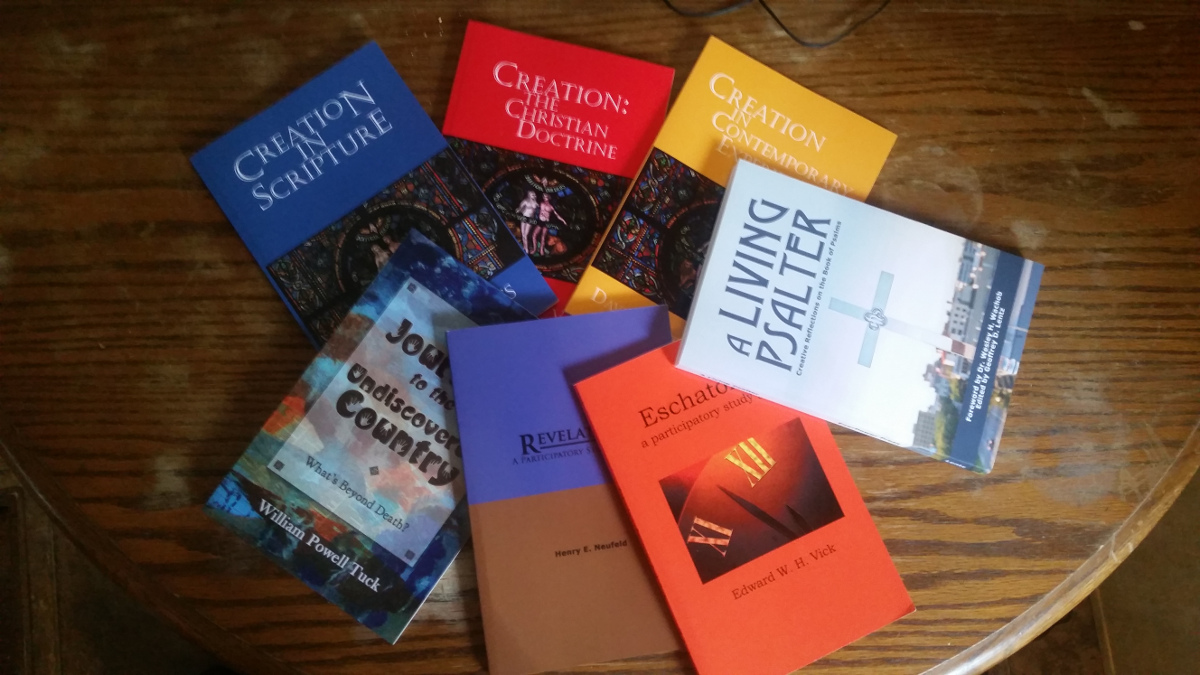
    I’m embedded the YouTube here as well. Below this, I will post a schedule of upcoming topics, where applicable noting the chapters for Eschatology: A Participatory Study Guide by Edward W. H. Vick.

    Here are the topics to follow:

    Eschatology: They Remembered Him (Chapter 2 of Eschatology: A Participatory Study Guide)

    Eschatology: Mark 13, Matthew 24, and Luke 21

    Eschatology: New Testament Eschatology (Chapter 3 of Eschatology: A Participatory Study Guide)

    (All links are to the Google+ events.)

    As you can see, I interspersing material from the study guide with time spent discussing some of the source texts. In some cases, we will come back to those texts after we’ve studied further from the guide and also from other scriptures. For example, does your understanding of Mark 13 change when you think about realized eschatology in connection with it? Does your understanding of the materials in the gospels as a whole change after you study Daniel?

    As you can see, I can have fun with this topic for an indefinite period of time. I may follow up a more general study with chapter by chapter studies of Daniel and Revelation, though I’d be more tempted to do this with Ezekiel. So we shall see!

  • Explaining the Difference Between John and the Synoptics

    In the comments to my announcement for Thursday night’s interview with Dr. Herold Weiss there was a comment that included a question. I missed it and failed to ask it during the interview. I e-mailed it to Dr. Weiss, and he sent me a response. Since this ties into the topic of the interview, I will also include the YouTube embed of the interview video below:

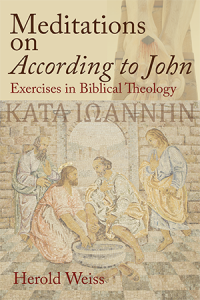
    Meditations on According to JohnQ: As I’m sure Dr. Weiss knows, the Jesus Seminar allocated no sayings of Jesus in “According to John” as “likely authentic.” How does Dr. Weiss rate Jesus’ sayings in “John”, and how does he explain the vast difference between the Jesus of “John” and the Synoptics?
    A: The difference between the Synoptics and John is due to the bifurcation of the oral tradition that started with the disciples but quite early departed into different trajectories. We can identify four of them: the tradition of Q, the tradition in the Gospel of Thomas, the tradition in Mark and the tradition in John. At some points there are connections between them. The tradition of John, as I point out in the book, can be seen being developed within the Johannine community, so that now there are some tensions withing the gospel. As for the work of the Jesus Seminar, I find it a bit pompous. The criteria of authenticity are logical, but their application is always subjective. All the sayings of Jesus are colored by the oral traditions behind them. That is also true of the work of the ‘historians’ of antiquity. They had  no sense of responsibility to evidence and facts. The case of Josephus, or Tacitus is well documented. ‘Scientific history’ is a child of the XIX century.
    There may be some who think that if we cannot be certain of every word in the gospels as ‘history’ we cannot believe in Jesus. I find that quite amazing. If one is to depend on history for what one believes, then all you have is a Jew who was crucified as a traitor by the Romans. The Gospel is about something else completely.

    Here’s the interview video:

  • According to John: Abide in My Love

    It has been that kind of a day. I apologize for not posting this earlier. You can find out more about this discussion on the Google+ Event Page or view it using the YouTube embedded below.

  • According to John: Where Are You From

    According to John: Where Are You From

    john bannerI’ve been planning to create some short notes on John, discussions of topics about which I’ve gotten a number of questions. I recorded the first of these today, and here’s the embedded YouTube video:

    Tonight I’ve decided that I will focus much more on the trial of Jesus and the relationship between ritual, symbol, and spiritual reality. You can find more information on the Google+ Event Page, or you can view using the embedded viewer below.

  • From My Editing Work: The Cross and Resurrection

    From Galations: A Participatory Study Guide, p. 9:

    Paul’s words gave the Galatians hope for transformation and they are hopeful to us, too.  Jesus Christ frees us from bondage.  The external world may not immediately change, but the cross and resurrection of Jesus Christ frees us from guilt, fear, anxiety, and hopelessness.  God acts in Christ to set us free to live joyfully and creatively.  The cross and resurrection are a matter of life and death – they must be proclaimed – spiritually, ethically, and communally.  Anything that challenges God’s liberating message must be confronted boldly.

    Besides the excellent message, there’s a good “editorial” moment in there. Do you see “the cross and resurrection of Jesus Christ frees us.” Grammatically, I should correct that to free us, except that I know from the context that these are being seen as a single event. I’m sure some folks will say this is an error. Perhaps it is, but it is intentionally so.

  • According to John: Clean by the Word

    Again, I’m announcing this late, but you can get more information on the Google+ event page, and you can watch using the viewer below. Note that the Q&A app will be active and you can ask questions or make comments.

  • According to John: The Whole House Was Filled with the Fragrance

    I’m late again. Check the Google+ event or use the viewer below. I really am going to catch up with my blogging, announce these things earlier, and post comments afterward. Really I am!

  • According to John: Have I not Chosen You, the Twelve?

    According to John: Have I not Chosen You, the Twelve?

    john bannerTonight, internet permitting, I continue my study of the gospel according to John following Dr. Herold Weiss’s book Meditations on According to John. You can find more information at the Google+ Event Page, and view either there or via the embedded viewer below.


  • Correction – According to John: Salvation is from the Jews

    I posted this hangout incorrectly in my previous post. The Google+ link is now on my own page, and the correct YouTube viewer is below:

    I apologize for the confusion!