I have more understanding than the elders, for I have kept your precepts.
One of the difficult things to keep in balance is respect for one’s elders and at the same time the realization that those elders are not always right. In fact, those elders can be corrupt.
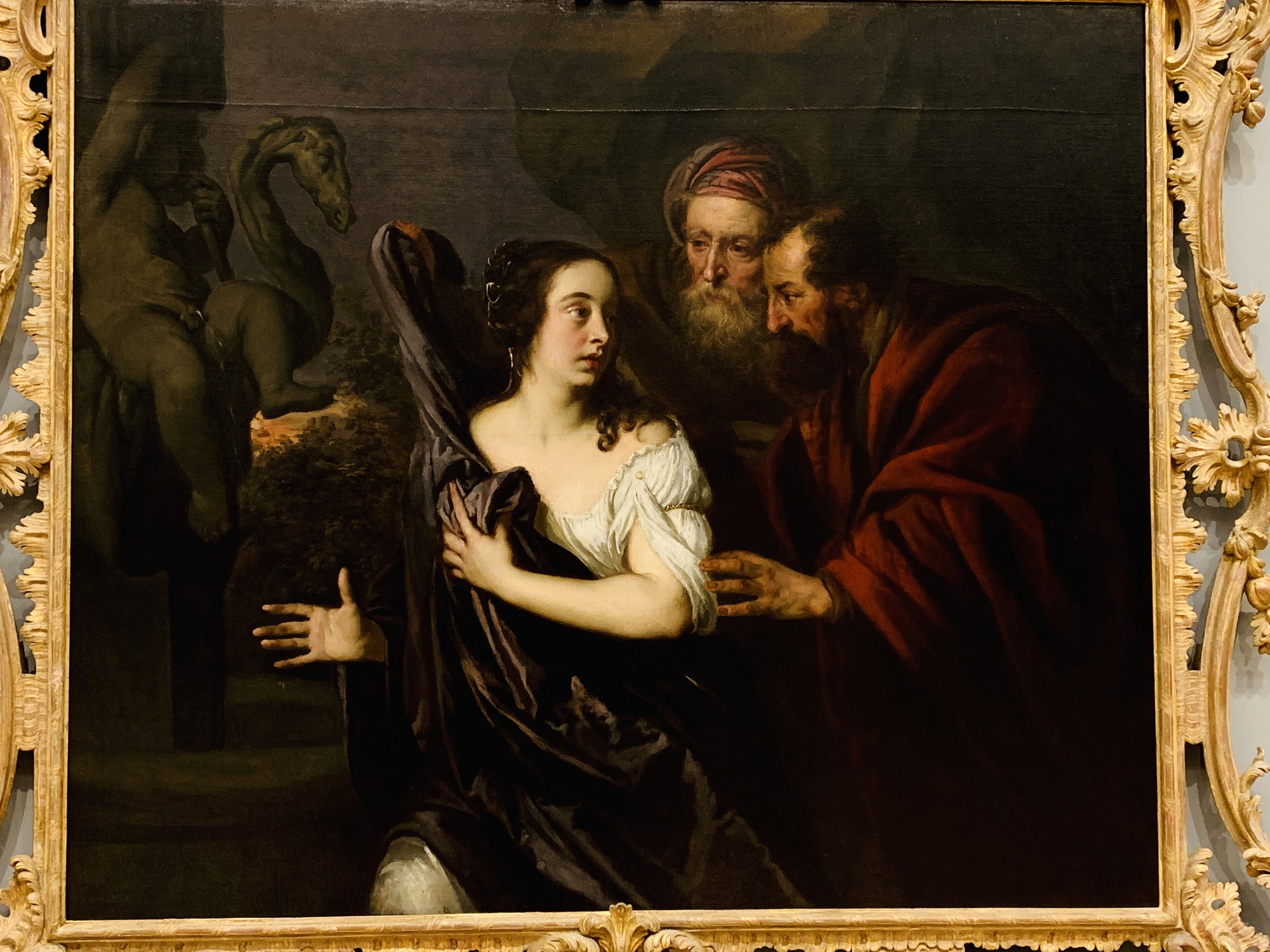
Rather than my own discussion of this, I’m going to take a different approach. There are some Greek additions to the book of Daniel which are part of the Old Testament Apocrypha, accepted as scripture by Roman Catholics, Orthodox and some others. One of these additions is the story of Susanna.
Susanna is a godly and beautiful women. Two elders develop lust for Susanna and contrive to catch her alone in her garden, as she has sent her maidens away. They tell her they will testify that they saw her with a young man if she does not yield to them. She stands firm.
They take her before the other elders and testify that she is an adulteress and she is sentenced to death. A young man, Daniel by name (surprise!) is disturbed by the verdict and through his wisdom catches the men in a lie, finding that they contradict themselves about the type of tree under which they had encountered her with her supposed lover.
As a result, Susanna is set free and Daniel becomes famous.
“But that’s true!” some of you are thinking. And you’re right. The statement is true. Its usage can be a bad idea.
I’ve rarely heard this statement from someone who was actually trying to make worship about God. To those of you who use it in that way, my sincere apologies. More frequently, I hear it as a church leader’s response to complaints about the worship service.
Now let me make an excursus on complaints. If you are a church leader, you are inundated with complaints. You get tired of hearing complaints. You want people to come help or just shut up. This is not unnatural.
But on the other hand, the people in the congregation have grown used to mediocre leadership by people who are overworked and tired, or who have simply turned their church activity into a dead routine, doing the same thing over and over.
So people basically give up. The habitual church goers will keep on going, because that’s what they do. The church leadership will go on doing what they do because they have always done so. Both will piously utter the line: “Worship is all about God.” They do this to tell those on the other side that they ought to do it their way.
Let me suggest another view. For us, worship is all about God. For God, worship is all about us.
I came to this conclusion while doing an extended study of Leviticus. People tend to skip over Leviticus. If they’re reading the Bible in a year, they try to get through it as fast as possible and probably remember very little. But when I studied the book with the three volume Anchor Bible commentary (unfortunately out of print) written by the incredibly good scholar Jacob Milgrom, I started to learn differently. Dr. Milgrom made the comment, and I paraphrase from memory, that the tabernacle rituals taught in Leviticus were a training ground.
It was not that God is going to be injured if we fail to follow a particular ritual. God can handle many different things in worship. Both Judaism, in creating the synagogue service(s), and Christianity in creating our own worship practices now worship God in ways that are very different from those prescribed there. But God wants to accomplish something in us through our worship, and it’s defined in Leviticus, “Be holy for I am holy” (Leviticus 11:44,11:45,19:2,20:7,20:26,21:9).
And for those Christians who might complain about my basing all this on Leviticus, it’s quoted in 1 Peter 1:14-16: “Like obedient children, do not be conformed to the desires that you formerly had in ignorance. Instead, as he who called you is holy, be holy yourselves in all your conduct; for it is written, “You shall be holy, for I am holy.”
One of the things I learned from this study was that it is, in fact, very much about God, and not our desires. That applies to the church leadership, who want to keep everything under control so they don’t have any unpleasant surprises. This applies to the members, who often prefer to have things that entertain them and make them feel good, rather than things that challenge them.
The question to ask yourself is this: Is the worship service I conduct (if you’re a leader), or attend (if you’re a member) preparing me to be holy before God? If you’re place in this week after week isn’t changing, probably not. If you are simply warming the pew, probably not. But equally, if you are simply a performer entertaining the pew sitters, probably not. I don’t think God is going to accept the excuse that the people wanted to be entertained.
If you’re going to claim that worship is all about God, then take action as thought that’s the case. If it’s all about God, as God demonstrated in the words of Leviticus, the purpose is to make that holy people. That means worship has to point people to God, help people connect with God, be aware of God’s presence, understand God’s gifts and God’s grace, and let God get to work.
If the main purpose is getting the same back sides into the same pews next week, then worship is not about God.
I frequently hear various people complain about labeling. We shouldn’t label people, they tell me. But labeling is essential. Language wouldn’t function without labels.
For example, sitting right next to me as I write this is a cat. I label him “cat” and I tell you he’s a cat, and we communicated. Behold, the cat, also named, labeled, that is, Li’l Mo.
Li’l Mo, a Cat!
Thus the label is useful. None of you are shocked at the picture after being told it would be that of a cat.
But …
A Tale of Two Cats
Now behold two cats.
The cat with longer fur is Cheena. In this video, which was taken only a couple years before Cheena crossed over the rainbow bridge at 16 years of age, Li’l Mo is about 6 months old.
I credit Li’l Mo with extending Cheena’s life by perhaps a year because she seemed to gain new energy with him around. She mothered him, in the way a crotchety old aunt might, not too clingy, but playing with him and occasionally putting him in his place. As long as she was alive, she remained the dominant cat.
So we have two animals labeled cats, one labeled Li’l Mo, and one labeled Cheena.
Where Labels Cause Problems
I have repeatedly noticed something interesting when I describe these two cats. I love both. I remember Cheena fondly and frequently.
Cheena was very set in her ways. She would spend her time sleeping on the bed, specifically on my side. She didn’t want a lot of attention but about once a week she’d spend an hour or so on my lap. She adored having her hair brushed every night. She was picky about her food. She was dignified, and would take what I called “princess strolls” through the house, head high, looking left and right, making sure everything was in order.
She also hated the vacuum cleaner, and would hide at the opposite end of the house when I brought it out. As most animals do, she hated the vet, but unlike any other cat I’ve had, she was very sweet about it. I remember after I picked her up from surgery after her foot got infected (Li’l Mo bit it!), the vet offered me a carrier box as they saw I hadn’t brought one with me. “No,” I said, “I don’t need it.” A couple of members of the staff followed me and watched as I carried her across a waiting room filled with dogs and a few other cats while she just hung out against my shoulder. Not a peep or a wiggle.
Cheena was generally unconcerned with the activities of the humans as long as she got dinner on time and found me in my chair where she could sit on my lap.
When I tell people about Cheena, they often say, “Well, she was a cat.”
Mo, on the other hand flies around the house like a mad cat. Princely strolls are only occasional and generally short. He also hates the vet, but I wouldn’t even think of taking him there without a carrier. Oddly, he’s totally cooperative with the staff, and totally uncooperative the entire rest of the time. He’s unafraid of the vacuum cleaner. If he deigns to notice it at all it’s to chase it and pounce on it. He has no concept of riding peacefully on my shoulder. He is deeply concerned about his food being on time.
When I tell people about Li’l Mo, they often say, “Well, he’s a cat!”
And therein lies the problem, though it’s usually not an issue with cats. It’s not important, except to me regarding my cats, and perhaps to the cats, that people notice their individuality. But in many other cases, it very much does matter.
A Personal Example
A friend of mine for some years never conducted what I would regard as a complete conversation. Whether the issue was religious, political, or even how to accomplish some task, he would jump in when I was half-way through explaining my position and say, “Yes, I understand completely.” He would then carry on the conversation in a way that made it clear to me that he had checked off my view as matching some compartment he had created in his mind, and I was stuck in that compartment. Discussion would die.
I found this very frustrating, as he was a person with interesting ideas and I would have enjoyed exploring our differences more seriously. But once I was placed in the compartment, the discussion was over. He never appeared to be thinking of me negatively. He’d usually put me in a compartment that was agreeable to him., but it was still frustrating.
Lazy Labeling
And that is the problem with labeling. Not the use of labels in itself, but refusing to use accurate, or at least carefully chosen labels. This doesn’t mean we can’t use general labels. Cheena and Li’l Mo are (or were) indeed cats. They’re also individuals.
My views might generally fall into a category chosen, but they might also differ in important ways.
Make the Effort
In relationships and discussions of ideas, be willing to do the work of understanding and labeling accurately. Your life will be enriched for the effort.
In the way of your testimonies I rejoice As over great wealth.
Teachers and preachers often say that Jesus, in the Sermon on the Mount, was moving the law inside and making it of the heart. And that is certainly a theme of that sermon.
But the fact is that the heart was always the object of the law. We are the ones who tend to look at the statutes, the regulations in modern terms, as the point of the law. It’s a simple path. We look at the law, and we do what we can to do what it says to do. So the point becomes the list of regulations for our lives. Aren’t these regulations wonderful? Shouldn’t we be happy about them?
Overall, Psalm 119 is a restful adoration of God and God’s promises.
Have you thought of it like that?
I commend his series to you, especially if you are musical. He does studies of the music of the Bible. There is great value in looking at these passages from different perspectives. I try to read a number of these as I meditate on the passage.
“Restful” and “joy” both represent something internal, a response to the law (remember Torah/instruction), and not an external assent.
And the Psalmist rejoices.
I want to quote another one of my Energion authors, Deborah Roeger, author of The Power of Obedience:
Before we conclude this lesson, we have some personal work to do. We have established that as God’s covenant people we are tailor-made by Him to live by His wisdom not our own! If we would lay down our right to live life on our terms – if we would turn to Him in submission, letting Him rule and reign as the perfect Creator and Lord of life in every aspect of our life – we would then joyfully know by experience what it means to know Him. If there is any area of your life that you have been holding back from Him, would you be willing right now to drop to your knees, bow your heart and your head before Him in complete surrender? Life will never be the same! And praise God for that!
One of the things I find most interesting about the Bible is the way that its stories openly–one might even say brutally–cover the faults and failings of the main characters. Nobody manages to come off all that well in the story. Even Moses, author of the Torah, or perhaps receiver of it, is not presented as a perfect man, though his failings seem rather minor. I’m reasonably certain that I would have done massively worse in his situation!
I was reminded of this aspect of Bible stories when I listened to the story of Jephthah while walking on my treadmill, and then listening to my pastor’s sermon on Sunday, which was taken from Matthew 1. The sermon was focused on the righteous actions of Joseph, but I couldn’t help looking over the genealogy as he spoke.
We’re introduced to Jephthah as “a mighty warrior” but he was the son of a prostitute. Yet he’s presented as one of the people who saved Israel. In Judges 11:15-28 he gives quite a recitation of the history of Israel, and in verse 29, the spirit of the LORD comes up him. What struck me in reading the story, besides the always disturbing story of his daughter, is that he is otherwise presented as a solid leader in Israel.
My mind links things in sometimes odd ways, and what struck me in this story was the mention that Jephthah’s mother was a prostitute. It’s sparse and bold, neither covered up nor overemphasized. It was not, as one can gather from the story itself, something that endeared Jephthah to the good and normal citizens of Israel.
That, in turn, led me to the genealogy of Jesus in Matthew 1. It’s odd, considering the times, that there are four women mentioned here. Tamar, who seduced her father-in-law while acting as a prostitute (Genesis 38), Rahab, the prostitute from Jericho who saved her family’s lives by helping the Israelite spies escape, Ruth the Moabitess (Deuteronomy 23:3), who was quite clearly a chaste woman, but barred from becoming an Israelite by the law, and finally “the wife of Uriah the Hittite,” the victim of David’s lusts.
It interested me to consider why the Bible emphasizes these people. And I do the authors of these stories as making these folks stand out. Further, they stand out in some of the most powerful stories in the Bible. Genesis 38 hardly seems a necessary part of the story of the patriarchs, yet it is woven in later.
I think there’s a point to be made here. The Bible is not a story of spiritual superheroes with superior ancestors. The heroes of the Bible do not stem from noble stock, the sort of people from whom we expect great things. Jephthah had become an outlaw with good-for-nothing men gathered around him. Then he got a call and the spirit of the LORD came upon him.
And here in Matthew we have a close tie to the stories of Hebrew scriptures in these little hints provided in the genealogy. Jesus is the son of David–such noble ancestry! But look! There are some moments in that story that other people might prefer to tell.
All that stands between you and me and doing great things is that call and that spirit. Good-for-nothing isn’t really in God’s vocabulary. “Nothing” is waiting for God’s “something.”
How shall a young man keep to a pure way of life? By keeping it in the bounds of your word!
I have a feeling that some would question the way I translated that verse. It’s OK. Poetry is challenging. In this case I was aiming more for meaning that being faithful to the poetic form. For those who read some Hebrew, let me recommend Psalm 119 as a good way to become more comfortable with these poetic forms.
There are all kinds of things that we could take from this verse, but through the day today my mind was repeatedly brought back to this: We need to teach sanctification, holiness, integrity in living, truthfulness, and the breadth and comprehensive nature of God’s Word.
Sanctification is by grace (there’s a big subject), or better, in the words of the Psalm, it’s a path of blessing. I think it’s no accident that Psalm 119 starts with “blessed.” We need to realize that this is God’s work. It’s worked in us, but it is about God both in goal and in method.
If we don’t talk about living a pure life in the church, people are likely to drift into perfectionism, legalism, arrogance, spiritual pride, and condescension. Those who avoid those issues usually wind up in cynicism and discouragement.
The one way to go, and I think it is the way of this Psalm, is to recognize that it’s all about God, the creator of all. God sustains us (see Psalm 104, for example) on a constant basis. The way to holiness without arrogance is a profound thankfulness and recognition of blessings received. The best antidote to spiritual pride is to keep our eyes on God’s law.
That will lead to being blessed and being kept in the pure path.
They also don’t act with malice In God’s ways they walk.
This verse could be translated in many ways, but the basic message doesn’t change.
We’ve had too verses talking about blessed people and what it is that they do. This verse introduces an “and one more thing” moment. They also don’t act maliciously. The KJV, a bit more literal than I am, says “They also do no iniquity.”
I may just have a problem getting into this elite group!
But let’s keep a couple more verses in this very section of the Psalm in mind, such as verse 5: “Oh that my ways were steadfast, to keep your statutes.” and the plea in verse 8: “Don’t forsake me completely!”
The Psalmist sees a glory in the law, a glorious challenge. This is something he would like to do. The one keeping the law is in a blessed state.
Yet he knows he’s not perfect. In verse 176, a long ways down the road from where we are, he says, “I have gone astray like a lost sheep.” That can seem like a real downer of an ending for a lengthy poem celebrating the law. But it’s nothing of the sort. It comes from the heart of someone who appreciates the beauty of God’s law, and trusts in God to seek him.
There are two ways we tend to dodge God’s law. First, we can trim it down to size. We make it something we can do easily. We create a relaxing law of God, an undemanding law. We aim low, and generally we end up even lower than we aim.
On the other hand, we can say, “This law is much too hard for me to keep. Forget it! It’s no good.”
The Psalmist makes neither error. He realizes God’s law is glorious, that it is a high standard, and he’s glad of that. He also realizes that he needs the God who welcomes the seeker (119:2) is, in fact, the seeker. In this he finds great joy and great comfort.
From a Christian perspective, this reminded me of this song, which probably dates me just a bit! Note “the buyers and the sellers were no different fellers than what I confess to be.”
(Featured image generated by Jetpack AI. This post is part of a series on Psalm 119. For all entries to date, see tag Psalm 119. For a deeper look at the language and poetry of the psalm read Bob MacDonald’s series, starting here.)
I regard as a basic manual for true spiritual warfare. I believe that it is much better to hear the themes of spiritual conflict than it is to try to identify specific referents. Of course, finding referents contemporary to the author can help us understand the themes. So these approaches are not mutually exclusive.
Previously, I’ve written about making an image to the best and the enumeration of “beastly” attributes. Now I want to look for a moment at the power of the beast and how it can oppress God’s people. No matter what else we may do with the interpretation, somewhere behind it lurks the question of why God’s people have to suffer in the ways indicated in this book.
In Revelation, God’s action/permission is often indicated with what is called a “divine passive.” This is far from an original observation by me. Let me quote two sources.
… In addition to a mouth, the beast is given authority. Four times in the Greek text of vv. 5 through 7 we read the passive edothe (“was given”), emphasizing the subordinate role of the beast. Although in vv. 2 and 4 it was the dragon who gave power and authority to the beast, John’s readers would understand in these later verses a reference to God, the ultimate source of all power. The reign of the beast is by divine permission. He operates within the limitations determined by God….
Robert H. Mounce, The Book of Revelation. Grand Rapids, MI: Wm. B. Eerdmans Publishing Co, 1977), on Revelation 13:5-7, emphasis mine. (Logos edition).
The passive “was given” is used repetitively to emphasize that the beast does not assume his power on his own, but rather that his power is given to him by God. The beast acts by God’s permission.
… To stress yet again that the beast’s powerful actions, even those that operate against God’s interests, are under God’s ultimate control, John emphasizes the divine passive in the ensuing section with an almost redundant use of edothe (“it was given,” twice in v. 5 and twice in v. 7; see the commentary on 6:2; 9:1-21 introduction; 11:1)….
Brian K. Blount, Revelation: A Commentary. Louisville, KY: Westminster John Knox Press, 2009,, 337 (Nook edition). Emphasis mine.
The beast was “given a mouth”–even his ability to proclaim his message is a gift (13:5a). He was given authority for a period of time (13:5b). His ability to make war was given to him (13:7a), and so is the area of his authority (13:7b).
This is both troubling and comforting. If bad things are happening, they are because God has given permission. Thus we have an entry point to theodicy and the problem of evil. At the same time we know that evil does not exist without limits. It’s dominion, authority, and the extent of time over which it operates are limited.
As a young person attending a small Christian school I memorized (as a requirement) Psalm 119. In the KJV.
Passages such as “Wherewithal shall a young man cleanse his way? By keeping heed thereto according to thy word” (Psalm 119:9, KJV), or “Thy word is a lamp unto my feet, and a light unto my path,” (119:105 KJV) were hammered into my brain. I have, on occasion, responded to someone who was boasting about Bible memorization with the question, “But have you memorized Psalm 119?”
Rabbit trail: As I was checking my memory 55 years after the fact using BibleGateway, the displayed Verse of the Day was Psalm 119:18: “Open my eyes that I may see wonderful things in your law.” (NIV). Source of spiritual pride? I remembered the text, the punctuation, and the reference perfectly. (See below.)
Spiritual Study
I have a pamphlet and infographic titled “Seven Barriers to Hearing the Word.” This one isn’t on it, though it is closely related to #3, “Scholarly, not spiritual.” I would note that study can be both scholarly and spiritual. The problem would be in leaving out the spiritual side.
Works-Based Righteousness?
Any good thing can become a work intended to earn one’s way to righteousness (more simply, make God like you). Bible reading is no different. Ask yourself why you read your Bible. Or in many more cases, ask yourself why you don’t.
Here are some critical questions:
Are you discouraged because of your failure to read enough? Whether you are not reading at all, or reading diligently at every opportunity, the problem may be that you’re reading as a duty, something you do to earn God’s favor. Relax. Don’t let other people put you down. Don’t condemn yourself.
Are you discouraged because it’s hard to understand? You may be forcing yourself through passages at a pace that isn’t right for you. If you’re not reading now, it may be the result of such difficulties in the past.
Are you feeling pride at how much you’ve read and/or memorized? See my note about Psalm 119. I am glad I memorized it. I’m not pleased that I have used that fact to shame others. That was spiritual pride talking.
Diverse People, Diverse Approaches
Is there an answer?
I’d suggest there are many answers. God created diverse people. We don’t all function in the same way.
Think about these points:
God already loves you. You don’t need to earn it. He’s not keeping score of your Bible reading. This is a tough thing for someone like me, who wants people to read the Bible more. But works based salvation, though it sounds paradoxical, does not work. It doesn’t even produce very good works.
How do you best take in information? You may want to look for an audio Bible or a multimedia Bible. I am currently listening to Robert Alter’s translation of the Hebrew Bible via Audible while I walk on my treadmill. I don’t normally like audiobooks, but oddly enough, this has become a new way of hearing the word.
Look at spiritual practices that keep you close to God. For me, the Bible is that starting point. I find it easy to read and to spend time. My most God-filled (by my perception) moments come while studying God’s Word. My wife spends time with praise and worship music. Note that we each find the other’s approach helpful from time to time. Prayer time is important.
Don’t be pressured to read specific books. Let God lead. My theological ideas are heavily centered on Leviticus, Ezekiel, and Hebrews. Those are not books that most people want to start with. The Bible is a diverse book. Find out where you best connect with it.
Conclusion
Do check out my Seven Barriers materials. They look at a list of things, often good things, that can still be barriers to you hearing the Word yourself.
Let me suggest an earlier post of mine on approaches to Bible reading, and the Fast Tracts booklet I Want to Study the Bible. These are both written for beginners.