
Threads from Henry's Web

Category: Uncategorized

  • Bible Study as a Work

    Bible Study as a Work

    As a young person attending a small Christian school I memorized (as a requirement) Psalm 119. In the KJV.

    Passages such as “Wherewithal shall a young man cleanse his way? By keeping heed thereto according to thy word” (Psalm 119:9, KJV), or “Thy word is a lamp unto my feet, and a light unto my path,” (119:105 KJV) were hammered into my brain. I have, on occasion, responded to someone who was boasting about Bible memorization with the question, “But have you memorized Psalm 119?”

    Rabbit trail: As I was checking my memory 55 years after the fact using BibleGateway, the displayed Verse of the Day was Psalm 119:18: “Open my eyes that I may see wonderful things in your law.” (NIV). Source of spiritual pride? I remembered the text, the punctuation, and the reference perfectly. (See below.)

    Spiritual Study

    I have a pamphlet and infographic titled “Seven Barriers to Hearing the Word.” This one isn’t on it, though it is closely related to #3, “Scholarly, not spiritual.” I would note that study can be both scholarly and spiritual. The problem would be in leaving out the spiritual side.

    Works-Based Righteousness?

    Any good thing can become a work intended to earn one’s way to righteousness (more simply, make God like you). Bible reading is no different. Ask yourself why you read your Bible. Or in many more cases, ask yourself why you don’t.

    Here are some critical questions:

    1. Are you discouraged because of your failure to read enough? Whether you are not reading at all, or reading diligently at every opportunity, the problem may be that you’re reading as a duty, something you do to earn God’s favor. Relax. Don’t let other people put you down. Don’t condemn yourself.
    2. Are you discouraged because it’s hard to understand? You may be forcing yourself through passages at a pace that isn’t right for you. If you’re not reading now, it may be the result of such difficulties in the past.
    3. Are you feeling pride at how much you’ve read and/or memorized? See my note about Psalm 119. I am glad I memorized it. I’m not pleased that I have used that fact to shame others. That was spiritual pride talking.

    Diverse People, Diverse Approaches

    Is there an answer?

    I’d suggest there are many answers. God created diverse people. We don’t all function in the same way.

    Think about these points:

    1. God already loves you. You don’t need to earn it. He’s not keeping score of your Bible reading.
      This is a tough thing for someone like me, who wants people to read the Bible more. But works based salvation, though it sounds paradoxical, does not work. It doesn’t even produce very good works.
    2. How do you best take in information? You may want to look for an audio Bible or a multimedia Bible. I am currently listening to Robert Alter’s translation of the Hebrew Bible via Audible while I walk on my treadmill. I don’t normally like audiobooks, but oddly enough, this has become a new way of hearing the word.
    3. Look at spiritual practices that keep you close to God. For me, the Bible is that starting point. I find it easy to read and to spend time. My most God-filled (by my perception) moments come while studying God’s Word. My wife spends time with praise and worship music. Note that we each find the other’s approach helpful from time to time. Prayer time is important.
    4. Don’t be pressured to read specific books. Let God lead. My theological ideas are heavily centered on Leviticus, Ezekiel, and Hebrews. Those are not books that most people want to start with. The Bible is a diverse book. Find out where you best connect with it.

    Conclusion

    Do check out my Seven Barriers materials. They look at a list of things, often good things, that can still be barriers to you hearing the Word yourself.

    Let me suggest an earlier post of mine on approaches to Bible reading, and the Fast Tracts booklet I Want to Study the Bible. These are both written for beginners.

  • Determinism Anyone?

    Determinism Anyone?

    In a practical sense, I have to agree on this. I’m not sure if that’s the reality behind everything.

  • On Collective and Individual Responsibility

    On Collective and Individual Responsibility

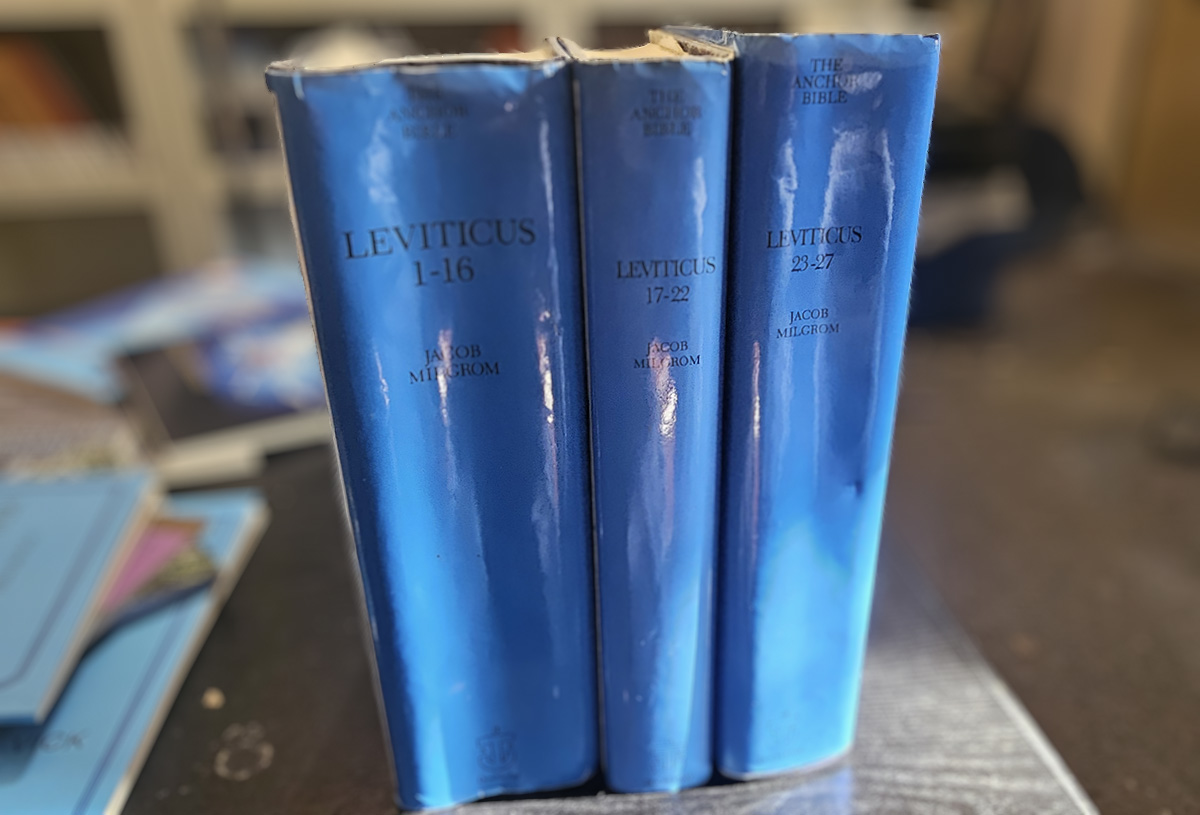
    From the late Jacob Milgrom’s 3 volume Anchor Bible Commentary on Leviticus, specifically on Leviticus 4:1-35, Purification Offering:

    The Priestly doctrine of collective responsibility yields yet another corollary. The “good” people who perish with the evildoers are not innocent. For allowing the evildoers to flourish, to pollute the sanctuary beyond repair, they share the blame. Indeed, they are the inadvertent sinners who contribute to the pollution of the sanctuary. Let a modern–hence, more vivid–example illustrate the point. World War II would have presented no theological quandary for Israel’s priests of old. They would have rejected with scorn our contemporary theologians who have proclaimed that “God is dead.” Instead of bewailing the silence of God, they would have pointed the accusing finger at the human culprits, the inadvertent sinners, the “silent majority”–the German people who voted the Nazis into power and the peoples of the free world who acquiesced to the annexation of the Saar, Austria, and Sudetenland while barring their own doors to the refugees who managed to escape. A worldwide cataclysm was thus inevitable. Indeed, Israel’s priests would have asked: How long under these circumstances could God have been willing to abide in his earthly sanctuary?

    Jacob Milgrom, Leviticus 1-16, The Anchor Bible, p. 261 (emphasis mine)
  • Pious People Popping Platitude Pills

    Pious People Popping Platitude Pills

    Tacky title, eh? I don’t apologize. I had fun constructing it.

    The other day someone asked me whether there were any scriptures I liked to go to when I was having problems. I gave the answer immediately and then explained, but I’m going to do the opposite here. I’m going to explain and then tell you the most helpful passage of scripture for me when life varies from irritating to frightening.

    Well, I lied. I’ll give you part of the answer. There aren’t any “nice” passages of scripture that I use to give me comfort. In fact, when people quote those at me, I get annoyed. I already know them. If they were going to help me, they would have already.

    What good does it do me to be reminded that God owns the cattle on a thousand hills? Send some of those annoying animals to market and pass the money on to me!

    What good does it do me to be reminded that God heals all my diseases when I have a headache and stuffy head and can’t concentrate on my work? Heal my disease, and do it now!

    Besides, it’s likely I can give you sound exegetical arguments for why those passages don’t apply to my situation.

    It isn’t that I don’t believe in prayer, or God’s healing, or God’s provision. I can cite plenty of examples.

    Counterexamples, too.

    My father was healed in a manner I regard as miraculous. One day in 1971 he was told he would never work again, and would be dead in 10 years. Two weeks later, after he called for the elders of the church and they anointed him with oil and prayer, he was back at work, and was the sole physician for a 54 bed hospital, on call 24/7 for a year. He lived another 35+ years.

    Then there was the time when a friend of his had a heart attack. Despite his prayers and his best efforts as a physician, he was unable to revive and stabilize the man. It was the longest and hardest he had ever worked on anyone. He didn’t want to give in. But the man still died.

    A friend asked me to pray with him for $1500 to pay his mortgage so he wouldn’t lose his house. I did so gladly. The next day $1500 arrived in his mailbox.

    My thoughts? Where is my rent money for my mobile home? I’m honestly not resentful that people have bigger houses. (I do sin through jealousy and resentment about other things, but I like my mobile home.) But I was having a hard time coming up with the rent at the same time as, apparently in answer to my prayer, my friend got his mortgage payment.

    I was asked to go on a mission trip to do some teaching. I’d just gotten back from a month overseas, and had nothing with which to pay for a trip. I flippantly said, well, the Lord has to provide, because I’m tapped out, but I’ll go of God provides. Within the week the trip was paid for. As I was preparing to leave I found that I had no spending money. I figured I’d survive. God had, after all, provided the cost of the trip. A friend drove up in my driveway and said, “You’re going to need some spending money on your trip.” He handed me two $100 bills.

    No, no negative “balance” story this time.

    Sometimes I’m just whining and crying, but sometimes God doesn’t make it easy. God doesn’t intend to. What I never appreciate is a platitude I memorized a long time ago.

    Yes, a passage of scripture can be a platitude under the right set of circumstances.

    In scripture, one can balance great promises of good things with times of trouble, times that are ordained by God. We do ourselves and everyone else a disservice by reading the nice stuff and skipping over the bad.

    In Sunday school, we hear the story of Peter being freed from prison (Acts 12:3ff). We rarely mention that this comes right after James is beheaded (Acts 12:1-2). We like Samuel and Kings and the message that if we do what is right, God will bless, but we’re less happy with Job, in which a person identified as righteous suffers substantially. Or we have Ecclesiastes 9:11 which seems to tell us that our efforts don’t matter, and instead of proposing an alternative of God’s will, says “time and chance happens to them all” (Ecclesiastes 9:11).

    In fact, to some extent we are promised trouble, particularly persecution. Perhaps when life is going too well we should ask ourselves whether we are doing what we should!

    The problem is one I’ve observed regarding Hallmark movies. The boy doesn’t always get the girl (or the girl the boy), your parents don’t always reconcile at the last minute, your business isn’t always rescued from bankruptcy by a helpful crusader, and no, your child doesn’t always get better. It’s nice to have a movie that says so, but it’s not always our experience.

    I remember standing at Disney and listening to them singing about wishes coming true. I was standing there crying while everyone laughed, because I knew that my wish was not coming true. I was fighting that knowledge, but it was still there. My son was not going to be staying with us; he’d be going on to glory. I hated that song in that moment.

    In our dealings with others, we need to be prepared to recognize the nature of life and not to say or to imply that God will always solve every problem immediately and according to our preferences.

    So what do I find is the most encouraging passage?

    Job 38.

    Yes, that one.

    You see, I know that I’m darkening counsel by words without knowledge. I know that I’m pretty ignorant. I know that God knows much more.

    Infinitely more.

    But what it also tells me is that while I’m thinking I’m alone, while I’m thinking there is nothing left, God is there. God doesn’t promise that you will not have troubles, but God does promise to be there. I can get that.

    God’s promises are quite valuable, but like everything else they need to be taken in context—in the context of life, in the context of the passage of scripture, and in the context of the overall story.

    I have two friends who suffer from health issues that many of us would consider overwhelming. Both of them, to the contrary, see God working through their situation. Their prayer is not for healing, but for God to use them in the situation they’re in. I would imagine they would be happy if God decided to heal them at some point, but that is not their focus in life.

    They have the promise that God will be with them no matter what the problem.

    That is a message I can truly appreciate and appropriate.

    (Featured image credit: Openclipart.org.)

  • A Moment with Brevard Childs on Exodus

    A Moment with Brevard Childs on Exodus

    I’ve appreciated the work of Brevard Childs since I first encountered him via his Isaiah volume in the Old Testament Library series.I just finished with the first section in his Exodus volume (see below), and I have to say that I find it even better. Childs takes note of source and redactional issues, but subordinates them to hearing the text as a part of the canon.

    Sections view the text in its Old Testament/Hebrew Bible context, its New Testament use, history of exegesis and finally theological reflections.

    Admittedly, many pastors would find it difficult to follow all the material, but the time taken to think both broadly and deeply about a passage will produce a reward in understanding and the ability to share one’s reflections with others.

    I may review this book when I have read it through, but the start was so rewarding that I wanted to comment immediately.

  • Outrage

    Being outraged about everything has a similar effect to being outraged about nothing.

  • Measuring a Liberal Bias in Psychology

    Measuring a Liberal Bias in Psychology

    As a self-professed passionate moderate (the liberal charismatic title was thrust upon me by an opponent), I’m very conscious of bias on both the liberal and conservative sides. To be human is to be biased. I have my moderate biases, including a bias toward considering anything from the left or the right obviously biased. You just can’t win with me!

    A number of readers likely already know that FiveThirtyEight.com is one of my favorite, of not my absolute favorite, news source. Besides their efforts to state their own biases, and the fact that I like numbers, this is a result of their efforts to cite their sources and show their work. If I question their rating of a pollster, for example, I can go look at what goes into that rating.

    Before I get to the article I’m linking from them today, I want to emphasize something important. I like numbers, yes, but you have to be careful. The reason for this is that you have to understand how the numbers you’re liking were produced. Let me give an example. A friend asked me to read a book on the ancient world because I know the languages and he wanted an assessment of how much credence I should give it. In the book, someone gave measurements for the original size of the great pyramid in millimeters. There is no way the author could actually have that information. Numbers calculated in that way are designed to give the impression of precision even when such precision does not exist.

    A more common way to produce a number is to assign it, such as asking people to rate something on a scale from 1 to 10. In order to know the question asked, how it’s asked, and who it’s asked of. After that you might consider asking what those people might know. For example, asking a random sample to rate the quality of cardiac care in this country on a scale from 1 to 10 produces information on how the sample views this, but might tell you as little as nothing regarding the actual state of such care, depending on who is being asked and what they could know.

    So here’s the article, Psychologists Looked in the Mirror and Saw a Bunch of Liberals. (You need to read the article—the whole article. This material is useless without the reasoning behind it and the look for solutions.)

    Someone noted the bias with a simple show of hands, and followed up with a study looking at the way in which results of studies were presented in journal abstracts. Here’s the generalization:

    Sure enough, the abstracts more often explained their findings in terms of conservative ideas rather than liberal ones, and conservatives were described more negatively in the eyes of the raters.

    The study authors tested for a bias in their raters and found that their liberal raters actually rated the abstracts as more negative regarding conservative views than did conservative raters. In a  separate test, they also note that a panel of psychologists surveyed for their expectation of bias expected the results to be more biased than the study showed they were. You should, in turn, read the note on the potential problem with the panel of psychologists surveyed.

    Note to self: Doing a deep enough study on an issue to have a strong opinion is a lot of work and takes a lot of time!

    One of the solutions suggested is studies done by “trans-ideogical teams,” i.e., have research done by people who expect different results and who then design a study based on what would change their mind on the topic. I like this idea quite a lot.

    I’ll note that this has a great deal to do with the way I publish (my company). I look to create conversation between people of widely differing viewpoints. (This is not identical to creating a church congregation, where some identity is necessary. I also support diverse congregations, but the boundaries will be set up differently.) I believe that in learning, there is great value in hearing the opposing position from someone who actually supports it.

    A conservative professor requiring readings from a liberal book and explaining liberal ideas is not as challenging as hearing from an actual liberal. Similarly, if you reverse liberal and conservative. I have lived and learned in situations dominated by conservatives and at other times in ones dominated by liberals. The result I see is the same: Complacency, laziness, and arrogance. One decides one doesn’t have to have support for an idea because “everybody knows that.” But this “everybody” is a very selected subset.

    I don’t see any solution here except intentionally involving people who disagree. I have found for myself that I cannot truly express the support for an idea I don’t accept myself nearly as well as a person who truly does support it, even if I try diligently.

    This article is encouraging to me because it attacks bias in two ways: 1) Identifying and quantifying it, and 2) Looking at ways to correct for it.

  • Deceiving without Lying

    Deceiving without Lying

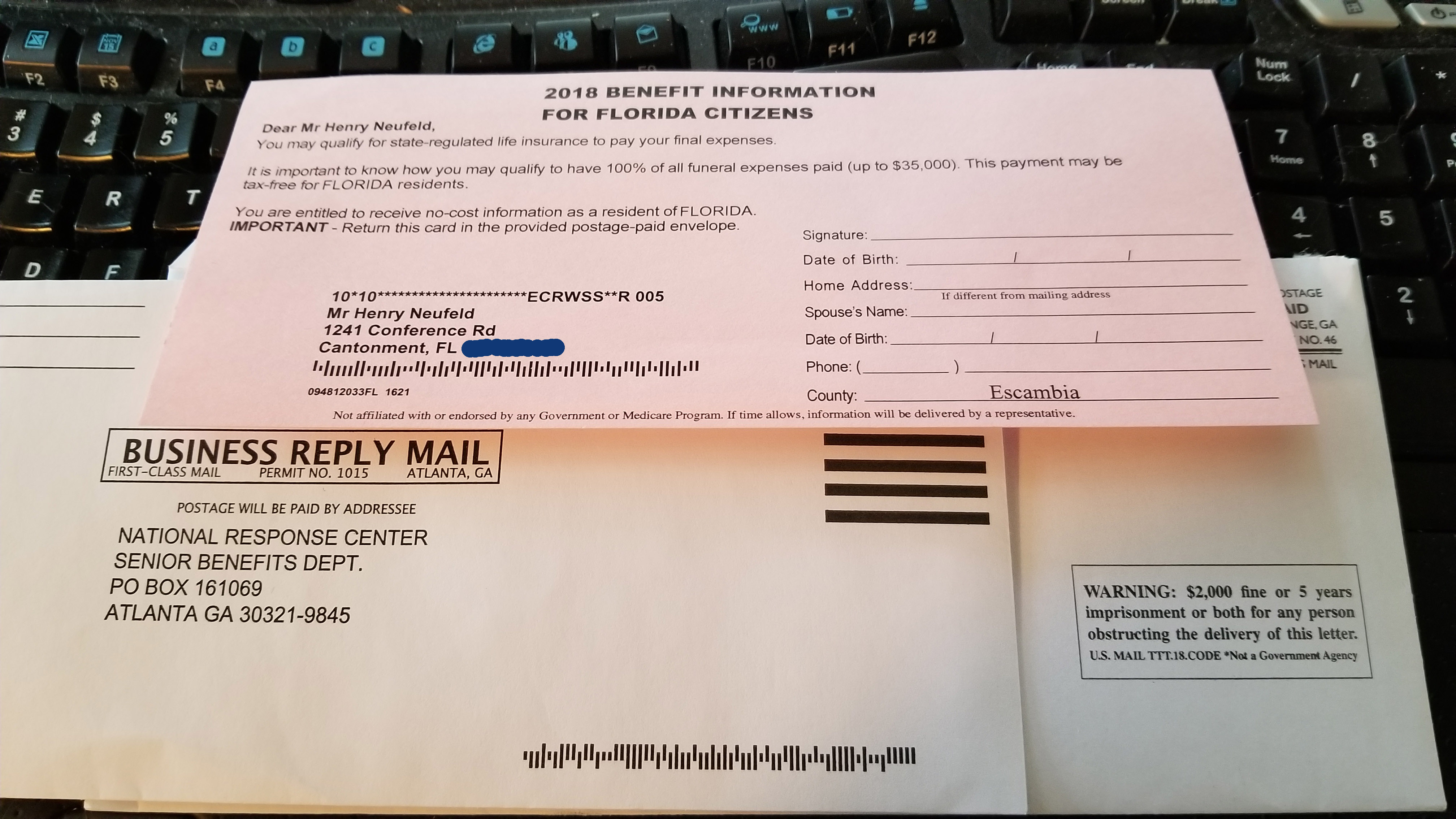
    I got this letter in the mail.


    If you look at the reply envelope, you’ll see that there is no identification of the company that is sending this e-mail out. Look to the right, where I’ve let a bit of the outer envelope show. It shows a quite correct statement of penalties for obstructing mail delivery. It’s not particularly relevant, but whatever. At the end, in smaller print, we note that this is not from the government..

    At the bottom of the pink sheet, we see a note that this is not “affiliated with or endorsed by any government of Medicare program.” Another statement that is likely quite true.

    With the “NATIONAL RESPONSE CENTER SENIOR BENEFITS DEPT.” the intention is to keep the recipient from thinking of this as a ad for life insurance, which it is, and to suggest that they are being informed of benefits already earned (Medicare, Social Security), which they are not.

    I wouldn’t post this normally, but I did for two reasons:

    1. This is aimed at the elderly, and there are many actual benefits available. There are many organizations and government agencies that do work to provide information about actual benefits. Because of that, someone else can slip in deceptively and imply that they are such a group, while making sure that they don’t actual tell any lies and have all the disclaimers available.
    2. Most of my readers will find this particular mailing trivially easy to analyze and dismiss. In the modern world, you are assailed much more commonly by e-mail, something many of you are much less skilled at evaluating. You need to apply the same sort of logic. How does a reputable company go about introducing you to its services? Does the e-mail you’re looking at look like and function like that sort of introduction? If you look carefully at the e-mails you receive that are legitimate, especially those from businesses with which you have a relationship, you will more likely recognize when someone is playing around.

    It’s possible for people to spoof the sender of an email. That means they use a name or an e-mail address that is not theirs. It is much more difficult, but nowhere near impossible to place false data in the actual record of how the e-mail was transmitted. I have nonetheless had friends receive e-mails that purported to be from me. I got them to forward the e-mail to me and I was able to check that it was indeed not sent from the appropriate server, and just my name was faked (not even the e-mail address in a couple of recent cases).

    Just like someone could type my name on a piece of paper and forge my signature, so they can fake that information on an e-mail. Or they can fake yours. They can do this without hacking your account. Your information is easy to access.

    They could, for example, extract my address from the picture above, but that is ubiquitous on the web. I blacked out my zip code, but anyone who wants it already has it. My point here is don’t assume that simply showing the right return information makes it certain the e-mail is correct. If you have any doubt—and please take enough time that you’d notice—then confirm with the sender before following any links or opening any attachments. A huge percentage of the fraud problems on the internet would be abated considerably by this.

  • James and a Living Gospel

    James and a Living Gospel

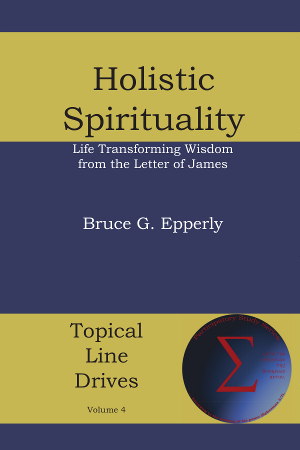
    Our pastor at Chumuckla Community Church started a sermon series on the book of James. This provoked me to look again at Bruce Epperly’s little book Holistic Spirituality: Life Transforming Wisdom from the Letter of James. Here’s a sample:

    Despite Martin Luther’s misguided dismissal of James as “an epistle of straw,” due to James’ emphasis on agency and lifestyle rather than receptive grace as central to Christian experience, James is good news for congregants and seekers. It is the gospel lived out in everyday life, not by words alone or doctrinal requirements, but by actions that transform the world. This is the good news of Jesus Christ who shows us the pathway to abundant life, and not a dead letter or a soul-deadening creed or abstract doctrines about the divinity of Jesus unrelated to daily life. James invites us to be companions on the pathway of the living Christ. (p. 4)

    Dave Black quoted today from Gordon Fee’s commentary on the epistles to the Thessalonians, discussing the connection between believing and living. I’m going to link to Dave’s post again tomorrow, when I briefly discuss Bible commentaries, but Dave’s post is worth reading in this connection as well.

    Bruce Epperly comments again on the supposed contrast between James and Paul:

    While Paul’s theology is often contrasted with the Letter of James, both Christian leaders believed that faith without works is dead (James 5:17).8 Paul affirms “the only thing that counts is faith working through love” (5:6). (Galatians: A Participatory Study Guide, p. xxvii)

    I think we frequently see contrasts when we should see differences in emphasis and even in circumstances.


    Read Now


  • The Army Field Band Sings This Right

    … even to this Air Force vet’s ears.