Using Google Hangouts on Air I’ll be having a conversation with Nick May and Heath Taws, two authors who are also young adults involved in pastoral ministry. Join the excitement!
Embedded YouTube player below:
Using Google Hangouts on Air I’ll be having a conversation with Nick May and Heath Taws, two authors who are also young adults involved in pastoral ministry. Join the excitement!
Embedded YouTube player below:
Last night I interviewed author Doris Horton Murdoch about the importance of testimonies. Here’s the YouTube:
In the Energion hangout for Consider Christianity Week tonight I’ll be joining Joel Watts and Elgin Hushbeck, Jr. to discuss Christian unity. Joel posted about this event today on his blog. The time is 7 pm central time.
You can find out more about the event on the Energion Publications Google+ page, or you can view it using the viewer below.
I was thinking of titling this “In Which I Annoy My Evangelical United Methodist Friends,” since so many of them are talking about the Wesleyan Quadrilateral and trying to privilege scripture within it in some way. I am not entirely in sympathy with many of these approaches.
You see, the moment I decided to take a closer look at the United Methodist Church was when I read in the United Methodist Discipline (1992, I think), about the sources of our faith. It’s not that I thought this statement was unique. Neither was it because I thought that Methodists had discovered the way to understand scripture correctly. Rather, I thought it honestly described what we actually do. And by “we” I do not mean just Methodists, but all Christians who use the Bible. We do not understand the Bible without our experience and our tradition, which is just experience collected across space/people and time. Reason ties these things together. Without our reason, we don’t come up with any interpretation of scripture at all.
What privileges scripture, to the extent that it is privileged, is that it is the most universal, most tested, and most accepted source. My personal experience may be very important to me. In fact, it is. My personal encounters with God have an enormous impact on how I understand my faith. But the fact that I believe that God has told me a certain thing doesn’t make that determinative for someone else.
Each congregation has a tradition, built on the collected experiences of that group. There will be similarities within a denomination, but there are local traditions. There are family traditions as well, collections of the experiences of members of that family over time. Denominations have traditions of their own and stand within broader tradition streams. For Methodists we have the Church of England as a source of tradition. Yes, we do carry things from that background. Then we have many who have broken off based on various elements of our own tradition.
All of these experiences have an impact, conscious or otherwise, on how we understand and apply scripture. It cannot be any other way.
This is one reason why I dislike the inerrancy debates, even though I’ve participated. I do not affirm the doctrine of inerrancy. The usual response to that is for someone who does affirm it to ask me for my list of errors with the intention of providing his or her list of resolutions for those errors. I don’t have a list of errors in scripture. I believe the Bible is what God wanted it to be. But that’s a belief that derives from my doctrine of God and not from any observations about the Bible and history or the Bible and science.
Each item on such a list of biblical errors can be translated as “My errant understanding of subject X says that my errant understanding of scripture passage Y is in error.” Where’s the inerrant standard, inerrantly understood, that lets me determine whether the Bible is actually inerrant?
So I make a different affirmation: When you’ve heard the message God has for you in scripture, that message is true. I follow it with an additional note: To the extent you need to, you can discover God’s message for you in scripture. Or anywhere else, for that matter.
I have absolute confidence that God is speaking. I have similar confidence that my hearing is defective. That goes whether I’m feeling God’s presence as I listen to Mahalia Jackson singing “Just a Closer Walk with Thee,” hearing God’s voice in my head as I pray and spend silent time listening for it, or interpreting a passage of scripture.
So what advantage does scripture have over my general impressions? To paraphrase Paul, much in every way. I’m tremendously thankful to folks like Abraham who had to listen to God’s voice without having that huge body, the “great cloud of witnesses” (Heb. 12:1) whose testimony has been tested over and over again. It’s the church’s testimony and it’s of paramount importance as I work my way through my own experiences.
Here’s a discussion of this very issue. Thomas Hudgins and I don’t agree on all the details, but we do agree that these things work together to give us confidence in God.
But it’s also a training ground. Read about maturity in Hebrews 5:11-14. The Bible fails if we treat it as systematic theology, as a science text, or even as a history text. That failure is not because of some list of theological, scientific, or historical errors. Rather, it’s because God has chose to speak through the testimony (witness to experience?) of many different people at different times and places. He requires us to use discernment and to see what is right and wrong as the decisions are placed before us.

So back to the quadrilateral. I treat it both as quadrilateral and as equilateral. We can enter by any door. Any one of these elements may provide the right question and might contain the right answer. It will not always end at scripture.
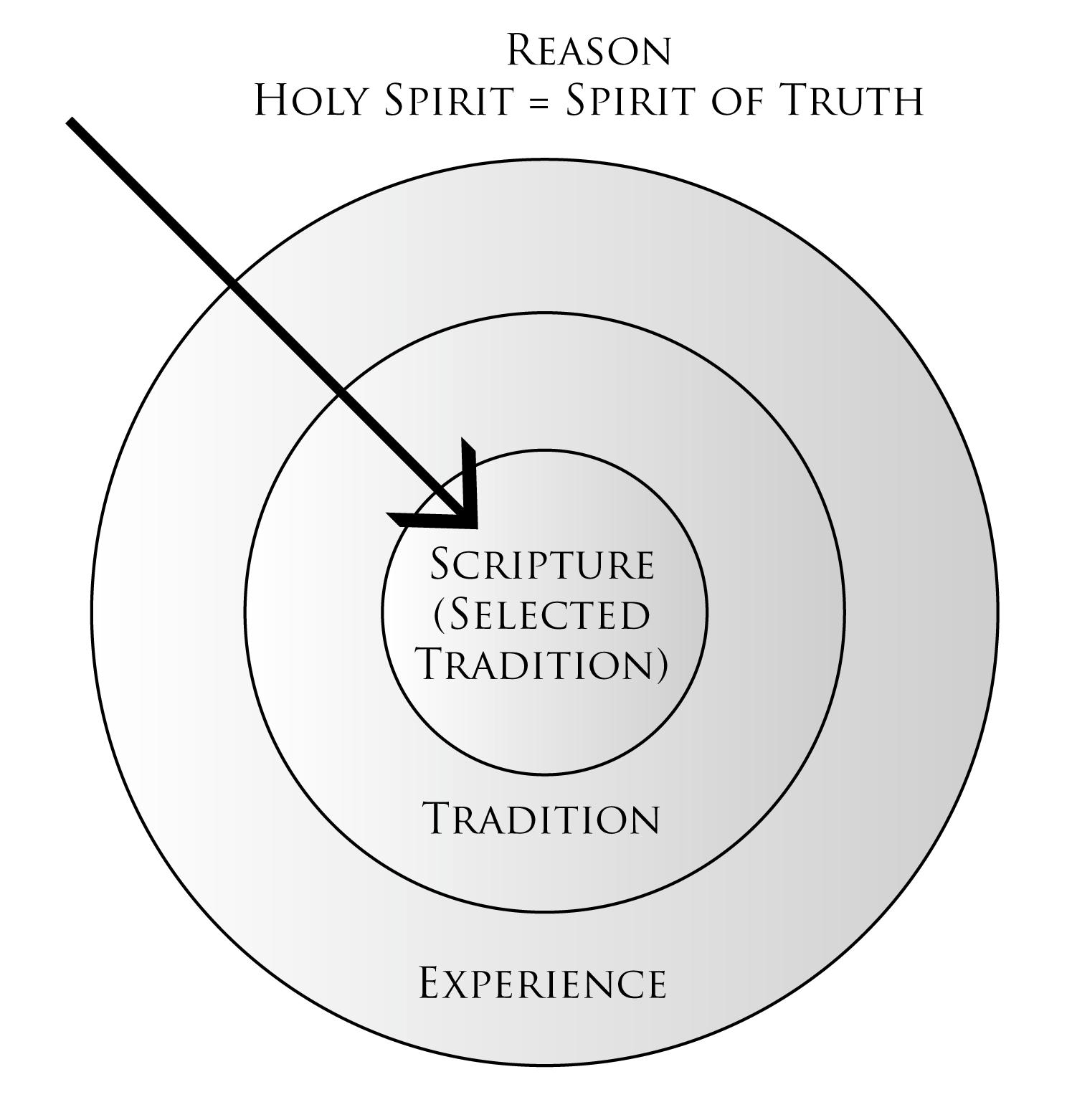
But … and it’s an important but … there is a problem with the way United Methodists use the quadrilateral all too often. We tend to use it as a four lane highway. Which of the lanes can I get my idea through? If I get my idea through one, that’s enough. Instead, we need to use this as a four layer filter. Every answer we get to a question needs to interact with all elements. How does it relate to scripture? How does it fit with experience? What can we learn about this sort of thing through tradition? All of those questions will, of course, be processed by our reason. But that’s what the Spirit of Truth is for, after all, to guide us into all truth (John 16:13)! I illustrated this process with the diagram to the left in my book When People Speak for God.
I believe that the nature of scripture is absolutely intentional on God’s part. Rather than giving us easy answers to easy questions he has given us a combination of testimony to God’s action in the world and principles (embedded in the testimony) by which we can make such decisions. When Jesus says, “On these two hang all the law and the prophets” (Matthew 22:40), he provides us with such a principle of interpretation. This is not a principle that helps you discover what the historical intent of a writer was. We have quite useful techniques of exegesis for that. But it provides us a principle for how we, as Christians living in the 21st century should apply it. Sometimes it says that the people who were doing their best to follow God didn’t live up to it. We should take those stories and try to hang the lessons we think we learn from them from the two commands as Jesus said.
It’s interesting to compare the stories of Patriarchs in Hebrews 11 to their sources in Hebrew scripture. Moses left Egypt, not fearing the wrath of the king (Hebrews 11:27), but he was afraid (Exodus 2:14). A biblical error? A contradiction? No! A testimony to what is seen by the eyes of faith.
We need to struggle with these stories if we’re to see where we are and where we need to be brought to greater maturity. How many of us need to learn not to fear the wrath of the king? But if we look earlier in that same passage, how many of us need to learn not to take God’s work into our own hands through violence?
Testimony, the telling of our own stories and experience, doesn’t give us the sort of systematic set of answers we might prefer. But it does train us to think, to discern, and to decide.
My guess is that’s what God was after in allowing scripture to come into being as it did.
Oh, and one more thing …
Tonight I’ll be talking with author Doris Horton Murdoch about testimonies in a Google Hangout on Air titled Lent: Season of Testimonies.
This was so good I had to embed it!
https://www.facebook.com/178609685499598/photos/a.558486050845291.147623.178609685499598/1068493119844579/?type=1
This past Tuesday night I had a conversation about forgiveness (with a long interlude on fiction writing!) with author Nick May. Nick was a last minute stand-in for two guests. My wife Jody was unable to participate because of a sore throat. Renee Crosby, author of the recent release The Fringe, had catastrophic technical difficulties, and Nick was available. We’re going to interview him along with his colleague, contemporary, and fellow fiction author Heath Taws on March 31. Besides being a fiction author (Megabelt, Minutemen, Molecricket), Nick is the pastor of Northstar Church’s Pensacola campus. Here’s the video:
One of the topics we discussed was Matthew 6:14-15: “If you forgive other people their trespasses, your heavenly father will forgive yours. But if you don’t forgive other people, neither will your father forgive your trespasses.” Interesting and harsh! Well, perhaps just realistic. I wonder if the person who remains unforgiving can ever truly be forgiven. Nick and I discuss this in the video. I think that forgiveness involves reconciliation, i.e., it’s a two way street. This doesn’t mean that an individual can’t get it started, and can’t benefit from a forgiving attitude. On the contrary, I think it’s important to give up the burden of resentment against someone else, even if they will not participate. In addition, someone has to get started. What I’m suggesting is that unforgiveness creates an atmosphere in which it’s hard, or even impossible, to receive forgiveness. Maintaining a separation between ourselves and other people also creates a separation between us and God.
One thing I didn’t have time to bring up in the discussion is a suggested translation in Leviticus 5:17 from Dr. Jacob Milgrom, author of the Anchor Bible commentary on Leviticus 5:17. This passage refers to someone who has transgressed and doesn’t know that he has done so. Milgrom suggests that the Hebrew ‘asham when it occurs without an object, means “feel guilt” as opposed to incurring guilt or being guilty. So this passage would best be rendered: “If a person transgresses, and has committed one of the acts with the commands forbid but he doesn’t know it, when he feels guilt, he will bear his responsibility.” The idea is that this sacrifice is for a time when one feels guilty, but is uncertain of what act may have caused that guilt. Thus we have a sacrifice for making oneself feel better! (This last line is my point, not Milgrom’s.) This is covered in detail on pages 343-345 of Volume 1 of his commentary, part of his comments on the reparation offering. I found his suggestion entirely convincing.
Finally, this morning in my e-mail I received my regular eNewsletter from Rabbi Moffic, who was talking about forgiveness. His particular topic was forgiving ourselves, or receiving forgiveness. His remarks (and the Jewish parable he tells) are well worthwhile. While you’re at his site, consider subscribing to his newsletter. I’ve found it very helpful.
On February 24, 2015, I hosted a discussion between Energion authors Elgin Hushbeck, Jr. and Alden Thompson on the topic Biblical Essentials. Here’s the YouTube:
Today another Energion author, Dr. Allan Bevere, posted an entry on his blog titled Doctrine: The House in which the Church Lives. (Allan Bevere and Alden Thompson will be participating in a discussion of violence in the Bible, particularly the Old Testament, on June 2, 2015. I’ll post more information on that later.)
Here’s my question: Is the essentials/non-essentials paradigm a good one? If not, why? If so, what does it accomplish?
I’m well aware that I’ve asked this question and have used this model on this blog many times before. But I’d like a bit of discussion.
I have always thought this was a good model to help set up one’s fellowship, as in what congregation or organization should I be a part of. An individual congregation might have one set of “essentials,” while a particular Sunday School class within that congregation had another. The denomination (or other organization of which the congregation is a part) would have a broader set, while the concept “Christian” might specify something much looser.
Having characteristics on which we gather both to learn and to serve seems valuable to me. But I see a problem when we use that same sort of paradigm as a means of inclusion or exclusion, including the attempt to determine who is “saved” and who is not. The participants in our hangout had a simple answer for that, with which I agree wholeheartedly. Since it’s not our job to determine who goes to heaven and who doesn’t (or any one of a number of other ways of specifying the “eternal in-crowd), we cannot use these essentials for that purpose.
I do think we can use essentials to help define a label. Labels can actually be good things. Without labels I could not write a blog post. Language labels things. The problem is when we force people (or reality in general) to fit the labels rather than looking for the best label to use with reality from a particular perspective.
What do you think?
To help you think, here’s Dr. Herold Weiss, answering a similar question in my interview with him this past Thursday:
Hanz Gutierrez has reviewed Creation in Scripture by Herold Weiss on the Spectrum Magazine web site. Spectrum is published by the Association of Adventist Forums. Many may not realize that Dr. Weiss is Seventh-day Adventist, though he clearly differs with the officially proclaimed church view on creation. He describes his journey in another book, Finding My Way in Christianity.
I commend Creation in Scripture (note that I’m the publisher, so that’s likely!) because it looks at multiple views of creation in scripture. Each of these viewpoints can help us understand something about God the creator.
Here’s a YouTube of Dr. Weiss talking about God the creator and creationism:
You can get more details on the Google+ event, and you can watch either through that link, or using the viewer below.
I apologize for posting this so late. I will post the YouTube and some comments tomorrow. Dr. Weiss is the author of the book I’m using for this study, Meditations on According to John.
I’m editing the manuscript for a new Topical Line Drives volume, Stewardship: God’s Way of Recreating the World, by Steve Kindle. It’s currently scheduled for the end of May, but I’m hoping we’ll get it out a bit earlier.
Here’s a taste:
The apostle Paul revealed to us the key to successful fundraising in his appeal to the Corinthian congregation to assist in the collection he was taking up for the Jerusalem church. His formula: 3For, as I can testify, they voluntarily gave according to their means, and even beyond their means, 4begging us earnestly for the privilege of sharing in this ministry to the saints— 5and this, not merely as we expected; they gave themselves first to the Lord and, by the will of God, to us, …
2 Corinthians 8:3-5
The Macedonians, in spite of their poverty, begged to give to the Jerusalem church—even beyond their means—because they first gave themselves to the Lord. Sure, it is possible to raise a lot of money using sophisticated methods based on psychological triggers and emotional appeals. These are too often resorted to as substitutes for the Macedonian way. A congregation that first “gives themselves to the Lord,” recognizes their stewardship partnership, and everything they do springs from that commitment. So let’s not encourage tithing, that’s about money. Let’s encourage seeing all we have as God’s and act accordingly.
The book isn’t laid out yet, so I can’t give you the page this will be on. I will tell you that I had to choose between several good quotes to use here. This book also looks at stewardship much more broadly than money, including our stewardship of the world we live in.
We’ll also be hearing from Steve Kindle tonight in his conversation with Elgin Husbheck, Jr. on the topic Lent: Season of the Resurrection.
I just extracted a post from Dave Black’s blog and put it on The Jesus Paradigm. For those unacquainted with Dave’s blog, I do this so that I can get a permanent link, and I have his permission to do so.
Dave asks some important questions. How do our values impact the way that we live and the way that we serve? I often hear my generation telling the next one how they ought to be careful and make sure that everything is properly cared for before going into service.
On the other hand, my parent’s went overseas to serve in remote areas with all their worldly goods in a station wagon and small trailer, along with four children in the car. Was it risky? No doubt it was. Did they believe they were doing the right thing? Absolutely! I never heard them say that they would have had it any other way. They believed God had called them and they answered.
My mother tells her story in her little book Directed Paths. I’m going to offer a free copy of her book to a randomly selected commenter on this post. I’ll close the contest on Monday. Just make enough of a comment that I know you’re asking for the book and that it’s not spam.