1) One of the most authentic worship services I ever attended occurred when the praise band failed to show up and one individual put a transparency on the projector (yes, it was THAT long ago!) and started singing. It wasn’t crafted at all. It just happened. The praise band wasn’t well-prepared; they were in another part of the country, having made an error on their calendar. It was certainly authentic and substantive. Sometimes in the search for the perfect worship service we forget that we can’t really make that happen. I could repeat this story many times. (And no, I do NOT believe we should be slip-shod and haphazard in our planning because God can work with anything. God expects us to use the gifts God has given us.)
2) Well-crafted and authentic must, I believe, come from the discernment of those who minister regarding where they are ministering. Too many people think they can copy worship services to gain particular results. “If we just do it like ________ Church, people will come,” they say. Won’t work. Authentic worship happens when one is acting according to God’s will. Recently I attended a house church service. It was one of the best times with the Lord and with fellow believers I have experienced in many years. It left me charged up to go out and do more for the Kingdom. It was nothing like I have ever experienced in a designated church building, thank God!
Bottom line: Don’t get stuck on worship categories. Look for what it means to worship in spirit and in truth.
I’m going to ask Bob how he handles the authority of the text he is preaching from, and especially whether he will deal with some of the more violent passages and how he will preach from them. There are quite a number of passages in the books of Samuel that could be very troubling to a 21st century conversation.
This morning, I was reading one of those: 1 Samuel 15. You can read the whole thing if you want to get a general picture, but let me just summarize here. God tells Samuel to pass the order to Saul, King of Israel, that he should go and wipe out the Amalekites. He is supposed to designate them as herem, meaning that they are devoted to destruction, every person, every creature, every thing is to be destroyed. And lest we be tempted to soften the story, we are told that this included men, women, and even nursing babies.
Saul disobeys God and doesn’t kill everyone. The best of the animals are preserved, and the king is taken captive. Saul blames this on the people. God blames Saul and says he has cut Saul off (or at least Samuel says God says this) from being king over Israel. This story opens the cycle of stories about the conflict between David and Saul, which ends with Saul’s death in battle and David’s accession to the kingdom.
I have heard this story handled in a number of ways:
Get a modern lesson from it, ignore the gory details, and hope nobody notices. I remember hearing it in my early years taught as a story about obedience. When God tells you to do something, you better do it. When I did ask about the killing, I was told that it was God, so it was OK.
Emphasize the gory details. We’ve all become too cowardly to truly uphold God’s will in the world. (Yes, I’ve actually heard this.) We can just hope folks like this aren’t too serious.
Some things in the Bible are less inspired than others, and this is one of the less inspired. Bloodthirsty people did bloodthirsty things and blamed God.
When people lived in a violent world God worked within their context. So things that might be commanded then could be forbidden now, not because God has changed but because he is staying the same, and working with us where we are.
The Old Testament God was violent. That’s why we stick with the New Testament. (If you take this approach, you should likely avoid texts like most of Revelation and Acts 5:1-11.)
Let’s never read this in church and hope nobody notices.
I could probably come up with some more given time. I’ll be interested to see how Bob Cornwall handles the text. He’s both a good preacher and accomplished scholar, so I expect his comments to be helpful.
In the meantime, two things. Following a challenge on a similar text, I wrote two blog posts. The first was a story/dialogue discussing the text, titled The God-Talk Club and the She Bears, on my Jevlir Caravansary fiction blog. (In the God-Talk Club series I write dialogue without any intention of expressing my own point of view. It’s sort of an exercise for me in trying to express several views on a topic.) The second was a homily on the same passage, titled Real Guy Interpretation.
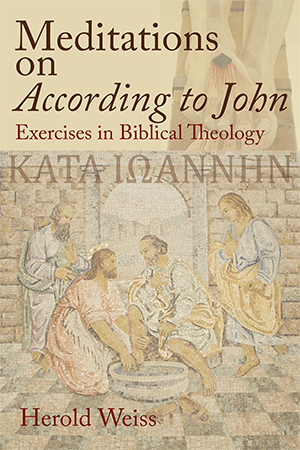
Well, last night my discussion of According to John covered a lot of other ground. In particular, I was looking at the eschatological use of “hour” and “now,” and I suggested that John has a fairly simple eschatology to go with his fairly simple soteriology. I’m not going to rehash all of this. The foundation is found in Chapter 19 of Herold Weiss’s book Mediations on According to John: Exercises in Biblical Theology. For those who might wish to review the video, here it is.
In the middle of this discussion I got into talking about the ‘L’ word. No, not liberal. Literal. I tell people that we should avoid simply saying that we’re not taking something literal, and get specific about just how we are taking whatever it is. “We don’t take that literally,” has become commonplace in discussions of the Bible in mainline and progressive circles, but often we don’t tell people just what we do with the thing we aren’t taking literally.
Last night I was talking about something that is fairly simple to pinpoint, symbolic language in a vision report. (Note that you don’t necessarily have to believe that a person has received a divine vision in order to accept a literary category of “vision report.” I do believe people have visions, but the form remains no matter the source.) If we take a vision such as Daniel 7, for example, we have beasts (which represent something), coming up out of the sea (which represents something), onto the land (which represents something), and so forth. “Not taking Daniel 7 literally” means that I don’t believe that Daniel’s vision was about actual creatures coming from an actual sea onto the land. Rather, these beasts represent something else. Rather than taking them literally, one should take them as symbols of something else.
One of the problems with the way visions are often interpreted is that people drop from the symbolic to the literal. The beasts, the sea, and the land are symbols, sure enough, but when the Son of Man appears in the clouds, that’s literal. But there isn’t any justification in the text for taking one part of the vision literally. One interpreter of Revelation has maintained (actually more than one, but I won’t list) that we should take everything literally that we can in the book, and only treat it as symbolic where that is essential. It’s a vision! It is filled with symbols! The default has to be that anything in the vision is symbolic unless you have good reason to believe that the writer is seeing actual events. And quite bluntly, in Revelation (or the latter chapters of Daniel), you don’t.
I think a couple of extensions of how symbols might function would be in order, and Revelation provides examples. First, something literal can be used as a symbol. There is no doubt that the seven churches were real places. Under the rule of taking what can be taken literally, we would see the messages as tailored messages to those particular seven churches. But I would argue here that the actual churches are being used symbolically, with the number seven indicating that the messages to the seven churches constitute as a whole a message to the whole church. Various schemes, such as applying the churches to periods of history and their messages as specifically applicable to such times, while interesting, have the potential to lose us part of the message to the whole church. Second, I would use Revelation 12 as an example of where a visionary symbol points not to something physical, but to something spiritual. We might call it a symbol of a symbol.
It’s a bit more complex to specify how this works in other passages. For example, I would call Genesis 1 liturgy. That is, by most people’s understanding, non-literal. In addition, there are symbols within the liturgical text. This is why I think it’s important to talk about how we understand a passage and why we understand it that way and avoid simply saying that we don’t take it literally. There are many non-literal ways of taking things.
I will go into these issues in greater detail when I begin my YouTube study on eschatology starting August 17. On August 10 I plan an interview with Dr. Herold Weiss, winding up my study of According to John. I will begin the eschatology study by looking at the landscape of eschatology using Eschatology: A Participatory Study Guide by Edward W. H. Vick, and then proceed to eschatological and apocalyptic passages. I talked about this in more detail yesterday.
I’ve generated a bit of surprise by my agreement with Dr. Herold Weiss (Meditations on According to John, chapter 18) in last Thursday’s video study from the gospel according to John (not to mention my Sunday School class), that the gospel is not attempting to institute or to teach sacraments.
As a foundation to this brief note, you might want to either read Weiss’s chapter (pp. 151-158), watch my video (about 1 hr, embedded below), or both. I’m just going to follow up on a couple of items here. I suspect not that many people will watch an hour of me talking, so I will try to make these notes self-contained.
First, the video:
My view of the sacraments is simple: I think that there are public actions and rituals that we take that reflect what is happening spiritually. I do not believe that the presence of Jesus in these activities is dependent on having ordained clergy to preside. I don’t believe that the rituals in themselves are valuable.
The value of sacramental acts is that they help us recognize and participate in the spiritual reality that is behind, in, and through them. Thus if I partake of communion, a shared meal, and then spend the following week withholding food from those in need, or cutting off fellowship from people I don’t like for various reasons, my act of communion has become a dead ritual.
Weiss discusses the difference between footwashing and communion in his chapter. One has become a sacrament and one a sacramental act, the latter rarely performed. I could perform the ritual act of footwashing, which rarely has the same impact or feeling that it would have had in Jesus’ time, and then go out and refuse to place myself in the service of others. In that case, the act of footwashing would be a dead and empty ritual as well.
In the video I relate the experience of my own baptism, at which time we celebrated, as Seventh-day Adventists do frequently, by washing one another’s feet. I was partnered with a Chamula gentleman (this occurred in the mountains of Chiapas, Mexico when I was nine years old) who had walked for days to be at this event. We were both newly baptized. He laughed when it came time to wash my feet because I had shoes, while he had but sandals, and I had walked a half mile or so as opposed to days. Washing his feet was meaningful to me and has stuck with me.
Despite my views, however, I don’t go out offering formal services of the Eucharist as an unordained person. Despite the fact that I don’t think the presence of an ordained pastor should be required, this is an act that is, by nature, done in community. As a member of a United Methodist congregation, part of my duty is to act in community.
At the same time, I believe that I can and should make every meal a sacramental act. The greater joy I get from the celebration of communion in the church congregation is not that I believe God is more present there, but rather that it is an act I perform in community and covenant. Sometimes in order to be in community, we have to do things the way the community does them, whether we think these things are special or not.
At the same time I have become fully convinced of the concept of open communion, and by this I mean fully open. I have long accepted the notion that when Paul, in 1 Corinthians 11, talks about taking this “unworthily” he is talking about the way in which the celebration is done, not about the character of the person receiving it.
By nature of its source, in the shared meal, and its institution, which included offering it to Judas as he prepared to betray Jesus, I think this sacramental meal is intended to invite and not to exclude. It is reaching out, not commemorating our special status as members of some inner circle. Thus communion should be offered to all both in church and when we share our meals with others. I question the idea of a Christian sacrament that celebrates membership in the club.
But, you might say, what about baptism? Surely baptism can’t be for everyone!
Yes, baptism is different, yet it is different by its very nature. It is the testimony, the ritual representation of our dying with Christ and being raised with him to new life. It is a singular (generally) event. It does not celebrate how we have become special, but rather how we have chosen to give ourselves up and become part of a community, a community that, in turn, reaches out to draw others in.
And even here we invite anyone who wishes to testify to that, anyone who wishes to become a servant.
I think this becomes a problem when we see these events as a sort of initiation, bringing us into the club of the special, in which there are other special rituals in which only other special people can take part. The “in group” view of the people of God that many of us have, consciously or not, leads us to misread scripture. The Jews weren’t chosen by God to sit around and be special. They were chosen to be a blessing. Sometimes being chosen isn’t much fun. There’s the great line in “Fiddler on the Roof” when Tevye wonders if God couldn’t choose someone else for a while.
Christians, who are often anxious to appropriate the promises made to the Jewish people, are not nearly as often anxious to appropriate the calling, the tasks, and the negative responses of others. Being chosen, being “in” with God isn’t necessarily a picnic.
In conclusion, I suppose I could say that I have a high view of sacramental acts, and that I consider sacraments to be no more and no less. My high view says God is present and active in sacramental acts. The Holy Spirit works in and through them. But just as the rituals of tabernacle and temple didn’t magically accomplish forgiveness and reconciliation, but rather accompanied God’s actions, so these sacramental acts are filled with God’s presence when done “worthily.” (Note: I’m indebted to Jacob Milgrom, author of the Anchor Bible volumes on Leviticus among many other works, for my view of the relationship between ritual and divine action. Milgrom sees this presented, in contrast to some of the surrounding religions, in the way rituals are presented in Torah.)
Paul’s words gave the Galatians hope for transformation and they are hopeful to us, too. Jesus Christ frees us from bondage. The external world may not immediately change, but the cross and resurrection of Jesus Christ frees us from guilt, fear, anxiety, and hopelessness. God acts in Christ to set us free to live joyfully and creatively. The cross and resurrection are a matter of life and death – they must be proclaimed – spiritually, ethically, and communally. Anything that challenges God’s liberating message must be confronted boldly.
Besides the excellent message, there’s a good “editorial” moment in there. Do you see “the cross and resurrection of Jesus Christ frees us.” Grammatically, I should correct that to free us, except that I know from the context that these are being seen as a single event. I’m sure some folks will say this is an error. Perhaps it is, but it is intentionally so.
On the Energion Hangout tonight at 7:00 PM central time, we’ll be discussing the topic of violence in the Bible, with a particular emphasis on the Old Testament. But as participant Dr. Alden Thompson will doubtless remind us tonight, there’s violence in the New Testament as well. Alden Thompson is author of the very first title in the Energion catalog, now in its 5th edition, Who’s Afraid of the Old Testament God?. Joining Alden will be Dr. Allan Bevere, author of The Character of Our Discontent, a book that resulted from his decision to preach from the Old Testament more, even though he’s a New Testament scholar.
I’ve known Alden Thompson for a long time. He was my professor for two years of undergraduate Hebrew and for my first quarter of Aramaic. It is no accident that Who’s Afraid of the Old Testament God? was first in the Energion catalog. It was out of print and I ask to reissue it because I wanted to use it in my own teaching.
I would say, in fact, that Alden is one of the major reasons why, despite all the doubts I’ve had over the years, I’m still a Christian. No, he didn’t prevent me from leaving the church following seminary, and I’m no longer a member of the same denomination, but the kinds of approaches to the various problems in both biblical studies and theology have stuck with me. In addition, I use some of the approaches he teaches, both to inspiration and to dealing with diversity in the church, quite frequently.
Alden takes a kind and gentle approach to working with those who disagree, no matter what their perspective. He’s careful with questioners’ faith, while still being willing to take their questions seriously.
I met Allan Bevere more recently, through the medium of blogging and then of print publishing, but I’ve also developed a friendship with him. Allan takes orthodox Christian doctrine seriously and is a pastor first and foremost. He is also an adjunct professor, and helps prepare other pastors.
Tonight I intend to challenge both these scholars regarding difficult passages of scripture. Can we bypass the violence? Can we look at some aspects of scripture as just plain wrong? If not, how do we deal with such passages as Numbers 31?
I think this discussion will be lively and lots of fun!
That’s a very broad title, but I do want to look at the connection. One of the places where we, as Christians, find the most disagreement is in our study of the Bible. In my view, there’s a good reason for this. The Bible is a complex book. Yes, one can find common themes, but there are also many topics on which we can disagree legitimately. While I object to any claim that the Bible doesn’t have inherent meaning—I always say that at least we know it’s not talking about the pink elephant—I still recognize that serious students can come to different conclusions. I find the demeaning way that we refer to scholars who are far from us on the theological spectrum quite unhelpful. Is it not enough to say “I disagree,” or “I disagree strongly”?
This relates closely to views of attaining Christian unity. Let me highlight two opposed approaches. First, we have the idea that somehow we must eliminate the differences in Bible study. For Catholics, this generally leads to a reference to the magisterium of the church. Protestants often look with some longing at such an authority, an authority that might bring some sense out of the chaos of protestant views of scripture. So you know my prejudices, let me state bluntly that, irrespective of what set of doctrines and interpretations such a magisterium imposed, I would not be a member of the resulting church.
The second approach is to say that we can have unity of purpose and action in a chaos of individual ideas and spiritualities. The application of this can be quite variable. Do we look to a small list of teachings which are sacrosanct while allowing freedom on all others? Do we allow for just any position at all? Or do we perhaps unite on practice?
I believe that the difficulty we have with Christian unity is our own hostility to what is different. I recall meeting with members of a church about a particular service of which they disapproved. It turned out that not only did they not attend that service, but that no matter what was changed, they would not begin to attend it. I had to tell them that I could hardly present to the pastor the idea that a service should be altered in form so that nobody would attend! They were hostile to spirituality and forms of worship that someone else was doing when they weren’t even present.
I’m actually quite a doctrine driven person. I don’t know which actually came first, the doctrine or the practice (though I suspect in my life it was practice), but when I think about things now I start from doctrine and move to practice. That’s just the way my mind works. So the doctrinal standards of a church congregation are important to me. I don’t join a church that strongly proclaims doctrine that I cannot support. I was considering joining a church once before I discovered their approach to politics. In fact, the problem was that I discovered that, contrary to any statement they might make, they had a congregational approach to politics. So I went elsewhere.
In protestant churches, and particularly among charismatics in my experience, there is a desire to fight the doctrinal chaos with a sort of mini-magisterium. This results in a “don’t go against the pastor” or “don’t touch the Lord’s anointed” attitude. The pastor is the one who makes the determination. I object to this as strongly as I do to larger versions of the magisterium. Protestantism by its very nature (and I’m an unrepentant protestant) is a break from submitting one’s conscience to that sort of authority.
I would suggest that what we need in Christianity is not a unity of conformity, but rather a unity of attitude and spirit. We claim to follow one master. Let’s allow others to follow him, rather than trying to make them follow us. Let’s approach this with the greatest measure of grace for others. If we need to meet in separate buildings, no problem. Let’s do what is best for loving God and loving our neighbor as ourselves. But let’s do it without hostility. Perhaps we could manage to resolve our differences in worship practice by meeting in separate times of worship in the same building. There are many ways to work together.
In the study of the gospel of John I’m doing via Google Hangouts on Air, last Thursday night’s session was titled “I Finished the Work.” This reflects Jesus confidence that he had completed his mission, even before he had died on the cross or risen from the dead.
For many Christians the reason Jesus had to die is quite simple. He had to die for our sins. More specifically, by his death, Jesus took the penalty for our sin(s) so that we would not have to. In theology this is referred to as penal substitutionary atonement, or sometimes just as forensic atonement, because it is set in a metaphor of the courtroom, and we avoid the just legal penalty of our actions because Jesus takes it instead. Thus if Jesus had not died, we would not be saved, and would be doomed to eternal death.
But the courtroom is a metaphor, and as such, it may not provide the complete or the only meaning of what it tries to describe. Another metaphor is built on the family, in which we are adopted into God’s family as God’s children and thus are saved. You can find a clear statement of this in 1 John 3:1, but this metaphor is in play frequently in the gospel of John as well.
Someone familiar with 1 John might point to 1 John 1:8, with the blood of Jesus cleansing us from sin. And indeed there are a number of points where the various metaphors touch. One thing we don’t always understand well in the west is the sense of community, of being collectively part of one nation, people, or family, so much so that we can be referenced as a unit, or spoken of by reference to a king or leader. In Genesis 14, there is a battle. We’re told in Genesis 14:9 that it was “four kings against five.” Surely it wasn’t just the kings! They must have had armies. Of course they did. But they were referenced by the titles of their kings.
So when these kings were defeated, the people were defeated. If they won, the people won. We have that sort of vocabulary left in terms of sporting events and even of war, but we use it with less meaning. Thus if we said that one person suffered or died for a nation, we would generally be saying that the one person suffered instead of others. But in the ancient near east, we might well be saying that the a whole family or a whole people group was included in the suffering of that one person. In this way we can say that in Christ we have all died, and in celebration of Easter, in Christ we have all been raised. It’s helpful to read the servant passages of 2nd Isaiah (Isaiah 40-55 is identified as 2nd Isaiah) with this in mind. Is the servant a single individual, a group, or the whole of Israel. I think the answer must be “yes,” if we incorporate all the references.
In 1 John 1:8, we also need to note that there is a different sacrifice in view than a sin offering. Here the issue is cleansing, and it would probably be much better to understand this as a purification offering than a sin offering. (I will try to blog more about these offerings soon!) Jesus dies for us, in this case, but it is not in a forensic sense, not taking a penalty, but rather is a cleansing ritual.
In the gospel of John another way of expressing atonement, bridging the gap between God and humanity, is the simple one of looking up. We always cite John 3:16, but we’d do well to start with John 3:14 and not stop before John 3:21. Here the metaphor is a simple one of looking up. Looking up at the One sent by the Father, looking to the one who is our pioneer and representative, who is the head of our family, who is showing us the Father (John 1:18). It’s a very simple but important metaphor.
And in this metaphor Jesus also dies for us, i.e. on our behalf. It is not here a sacrifice for sin, but rather it is the way that he is lifted up so we can see him. The son of man is lifted up on the cross, and in turn, lifted up right out of the world at the resurrection, and this finalizes the mission, the work, that he performed for us, and a great deal of that work was revelatory, showing us the father, curing our blindness so we could see, and getting us to look up so we would be looking at the right person.
And this leads me back to the question implied by my title. Why did Jesus have to die?
One reason is simple: To complete his mission. If Jesus was the one sent from the Father, here to show God to us, and thus bridge the gap between heaven and earth, infinite God and finite us, then he needed to do so completely. One cannot come and live as a human without facing and eventually experiencing death. Death is such an overwhelming fact of life. To skip it would make the rest of the story rather meaningless. “For God so loved the world that he looked in on us for a while” just doesn’t have the same ring as coming and going the whole distance as we have to.
But why did the death have to be so awful?
Because that is how someone who behaved as Jesus did would die in first century Palestine. That was how the ruling government, the Romans, behaved. If you or I had lived in that time and had possessed the courage and integrity that Jesus did, we would likely have ended up the same way. Certainly, divinity could have avoided the end, but by doing so would have separated itself from humanity. And Jesus was here to do just the opposite.
I don’t want to deny any metaphor for the atonement. I think it is rich enough of a reality to allow for many metaphors. But I also don’t want to find myself limited to one way of looking at it. It is too rich in meaning to allow for that.
This is an exceptionally good chapter to be studying on Maundy Thursday, though I’m going to assume nobody will miss a Maundy Thursday service in order to listen! We’re going to talk about footwashing, signs, miracles, works, and witness and the difference between a sign and miracle. We’re also going to discuss what Jesus meant by “greater works” (John 14:12). What are these “greater works”?
Here’s the key quote from the chapter that will guide what I’ll be talking about tonight:
Jesus lived performing signs that pointed to the time when he would finish his work. Therefore the life of the Christian must provide signs that advertise the source of strength and vision for those who live by faith. Signs and faith must remain closely bound in the lives of the disciples of the one who is THE SIGN that must be seen and believed. (91-92)