Today, says Allan Bevere, is the feast of John and Charles Wesley. The source of this is The Lectionary Page. It is, however, listed amongst the Lesser Feasts and Fasts. (It’s an Episcopal site. What can I say?)
Category: Christianity
-
Book: I’m Right and You’re Wrong
When I started Energion Publications just over 10 years ago, my primary interest was in Bible study materials. My goal was to get the people in our churches to study the Bible more, and to do so for themselves. My complaint about much of the material available was that it was often shallow and repetitive, and that people had often been seeing the same things over and over again. (I don’t mean that there were or are no good materials; merely that there are not enough materials that address people in the pews.)
It wasn’t just that some material was shallow. It was that often when the material was a bit deeper it tended to present conclusions without really teaching students just how those conclusions were reached. Quite frequently, church members were simply accepting the conclusions they were taught on authority, not because they had really examined them and come to accept them for good reasons. Their pastor, or some well-respected person from their denomination or tradition stream claimed that a verse meant a certain thing, so that’s what it meant.
When people from two different tradition streams would meet, debate could get heated as people fired spiritual canon loaded with pre-interpreted texts. They thought they were firing them at one another, but generally they were firing them past one another, because their targets had memorized a completely different interpretation for that particular passage.
I launched several projects in response to this. First was the Participatory Study Series, the first series I know of to intentionally select authors from different tradition streams to cover different books of the Bible. My idea was to give people a chance not just to study about the various methodologies, but to study a whole book of the Bible with the guidance of a qualified scholar from different traditions. Thus you can study Philippians with the guidance of process theologian Bruce Epperly and Ecclesiastes with conservative evangelical Russel Meek. As time goes on, this variety will increase rather than decrease.
There was still more to be done. Our conclusions about scripture depend heavily on our approach to interpretation, our interpretation depends to some extent on our view of authority, and both interpretation and authority depend, to some extent on our understanding of inspiration.
Thus I published Learning and Living Scripture: A Introduction to the Participatory Study Method, but that little book didn’t really deal with the conclusion. It embraced it and invited more! So I wrote my own book about inspiration and listening to God, When People Speak for God, and then acquired a truly masterful work, From Inspiration to Understanding: Reading the Bible Seriously and Faithfully by Edward W. H. Vick. Shoring up a more conservative viewpoint was Elgin Hushbeck’s Evidence for the Bible.
 With all those books, the question still remained. How does one learn to understand and even benefit from the variety of approaches to Bible study?
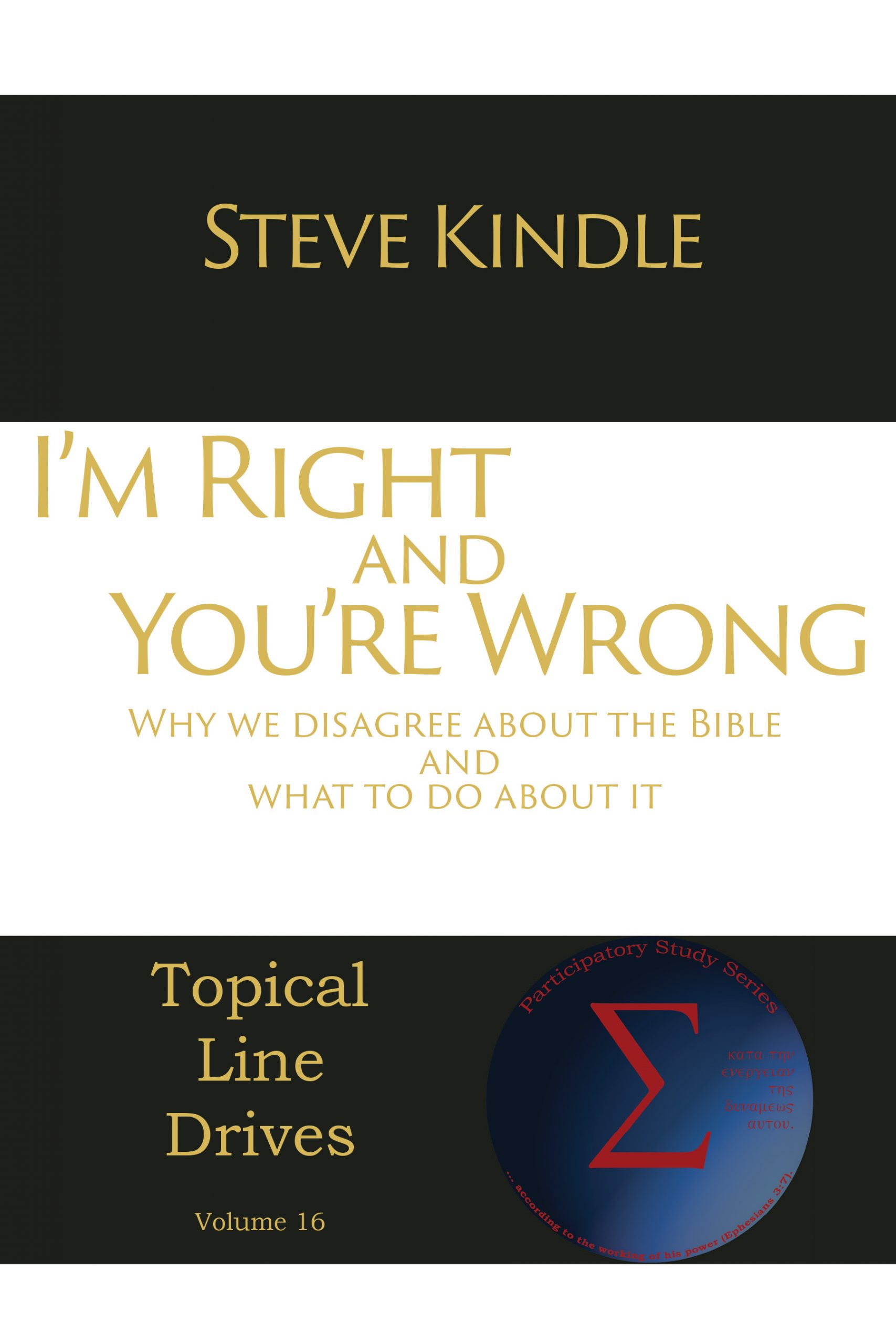
Well, now we have a short, easy-to-read book that will help you understand why we disagree about what the Bible says, and why so many of those disagreements are so intractable. It’s I’m Right and You’re Wrong: Why we disagree about the Bible and what to do about it. It’s a challenging title, and in just 40 pages, you’re going to begin to get a picture of the variety of scriptural interpretation.
Author Steve Kindle writes with a gentle passion. This is not a book proving that his approach to interpretation is the one and only right approach. He doesn’t deny that there is objective truth out there; he just doubts that we are going to be able to get there with are finite and not-so-objective minds. What he does instead is try to give us an idea how various approaches work.
There are at least two things you can do, starting with this book. The first is simply improve your ability to converse with people whose approach to the Bible might be different than your own. With the basic information Rev. Kindle provides, you can build your understanding by listening to others. Second, you can use the excellent footnotes to find more detailed expositions of these various approaches and learn more about them than could possibly be contained in a 40 page book.
As a publisher, of course, I would be delighted if you’d also embark on a journey with the Participatory Study Series and actually study some books using guides written from a perspective other than your own.
At a minimum, however, learn how to break through the hostility that often characterizes debates about the Bible to come to understand how someone else has become convinced that he’s right and you’re wrong!
Note: This book is already printing, but we’re leaving the pre-order pricing up for one more day. That means you can order from Energion Direct for just $3.49. If you take this opportunity to get 3 or more copies, shipping will be free. The shipping charge is just $2.00 on orders of less than $9.99.
-
Was Jesus Really a Healer?
 By this question, I meant to ask whether Jesus actually cured people of illnesses, not whether he accomplished spiritual healing. I asked the question of Dr. Bruce Epperly, author of the book Healing Marks, when I interviewed him last night in an excursus to my series of studies on the gospel According to John. Here’s the video:
I’ve found it quite interesting to discuss Bruce’s views on this with other Christians. His theology, as a process theologian, is different from what you will hear in most churches, especially those which hold healing services. Yet the actions are similar. He describes a different spiritual process (no pun intended), shunning the word “supernatural,” and yet he is describing something very similar to what I hear from charismatic believers.
I have been called “liberal charismatic,” because I take a fairly open view of doctrine (though I don’t think it is unimportant), and also believe that all the gifts of the Holy Spirit are as available today as they were to the early church.
So what do you think? Was Jesus a healer? Can healing take place in churches today?
-
Are Panentheists Atheists?

Updated 17:09 central time to fix video link.
Last night I interviewed Dr. Bruce Epperly, process theologian, as an excursus to my study of According to John using Google Hangouts on Air. I’m following the book Meditations on According to John by Dr. Herold Weiss, but I wanted to talk to Bruce about his book Healing Marks, in which he discusses the healings recording in John 5 & 9. More relevant to this extract, however, is his book Process Theology: Embracing Adventure with God.
Since there has been some recent discussion of panentheists in particular, and liberal Christians generally, I thought would be nice to hear an actual panentheist answer the question. I started my interview by asking Bruce: Are you an atheist? I’ve extracted his answer to this and posted it to YouTube. Here it is:
Now I do not embrace process theology or panentheism, but I’m also not allergic to either term. It seems to me that one of the great tensions in scripture is between the story, which often reads very much like panentheism as Bruce noted, and the theological affirmations, which tend to separate God from the world more. I’m not sure that this tension is not valuable in itself, in that it keeps us from being too certain of our answers. We can see both in action, as God repents of making humankind or bargains with Abraham about how many righteous people need to be found in Sodom for that city to be spared. Both stories speak as if God doesn’t actually know the answers ahead of time. Yet at the same time we have the affirmation that he knows the end from the beginning, and indeed some scriptures that seem to say that he predetermines all. I see a parallel to the “God is sovereign” and “people have freewill” affirmations. Many Christians affirm both (whether they are Calvinists or Arminians), but explaining how they work together is much more difficult.
For those who watched the interview and would like to know where I started with this discussion, James McGrath’s post Is This Atheism? is a good place to start. In fact, it links to one of my points in turn. I’m also planning to post another excerpt from the interview, in which I ask Bruce whether Jesus was a healer. His answer there might be enlightening in connection with asking whether he’s an atheist!
-
Serious about Whose Faith
I was mentioned by Ed Brayton (blogs at Dispatches from the Culture Wars) in a comment to a post on Facebook, and made a couple of comments myself. Here’s the Facebook post:
https://www.facebook.com/ed.brayton.3/posts/10153647364908642
There are two things here that interest me. First is the claim that moderates and liberals don’t take their faith seriously. This is silly, sort of like the claim that atheists really do believe in God, they’re just rebelling against him. What these two things share in common is that the person making the accusation makes assumptions about the other person’s mental processes that are not justified.
I have spoken to people who called themselves atheists, but who were actually angry with God. They say certain things that tell you they actually believe. I also have spoken to any number of atheists. While they vary in the reasons they don’t believe in God, I have found their thinking quite clear. I have actually occasionally told someone who claimed to be an atheist that they sounded more like a deist or an agnostic (or a whatever to me), and asked them to explain their use of the term. It’s amazing what you can learn just by asking and listening to the response.
On the other hand my faith is my faith, i.e., I have come to believe certain things. I don’t deny that many of these result from my upbringing. I was born into a Christian home, and that does predispose me to be a Christian. On the other hand, I know atheists who were born into a Christian home as well. More importantly, I don’t believe the same things my parents did. My Christianity is somewhat different. They were (and are) Seventh-day Adventists. I am not. They accepted and taught me young earth creationism. I have rejected that and am, to the extent I can tolerate the term, a theistic evolutionist. There are parts of the Bible that they treated as historical that I do not.
How do you find that out? In my case, of course, you could read. But if you want to have dialogue with someone, it’s a good idea to find out what they actually believe. It may differ from your assumptions. I am probably more frequently accused of not taking my faith seriously by people who are more conservative Christians than I am. What they mean, generally, is that I don’t take their faith seriously, and generally I don’t. No, I don’t mean that I don’t take the faith of conservative Christians seriously. What I don’t take seriously is the faith of people who are so shallow as to make such accusations without bothering to investigate and learn.
Let me illustrate this with a more specific example. While guest teaching a Sunday School class I stated that I found prayer at public events questionable at best, and that if asked (unlikely) I would decline to participate. I emphasized that I was not speaking here of constitutionality. This was not a political position, but a religious one.
One of the class members immediately accused me of not really being willing to stand up for my convictions because I would not uphold them publicly by praying there. But you see, those were his convictions about prayer, not mine.
My convictions say that prayer is communion with God. My prayer takes place most commonly in my office while I’m studying my Bible. My prayer time is largely silent. You might even think I’m sleeping. If I pray in a group setting, I want that to be in a setting where we, as a group or community, pray. My city, county, state, or country does not constitute such a community. I can guarantee that someone in that audience is being forced to participate in my spiritual activity.
I’d like to say that I don’t do it because I don’t want them to be forced to pray, and indeed I don’t want them to. But what drives me is that my own idea of what it means to commune with my heavenly parent is so contradictory to the idea of someone being involved involuntarily, that I find it offensive. I find it hard to pray. You may think I’m stupid, but those are my convictions, and they are the convictions that I will take seriously and uphold.
I feel the same way about public school prayer. I would find it personally offensive for my children or grandchildren to be drafted into a government organized (or any other imposed) form of spiritual activity. So when I oppose prayer in public schools, I am not refusing to uphold my faith. Rather I am upholding it against something that is offensive to it. In my view the place for prayer with children would be at home with their parents, or in some sort of voluntary faith community, not in the classroom with a public official.
The second thing that interests me is the question of what the Bible actually is. Is it metaphor? Is it myth? Is it history?
The problem here is that the Bible is many things. It contains history, fiction, a legend or so, plenty of metaphors, liturgy, political discussion, and even occasional theological discourse. In addition, it contains literature that is not commonly found elsewhere, such as visions and apocalyptic passages.
Anyone who says the Bible is any one thing is either ignorant or not paying attention. The idea that there is a variety of types of literature in scripture is not a liberal or progressive idea. Conservatives are aware of it. Many fundamentalists will try to deny it. But where the serious divide comes is in determining what is what. Is Jonah some sort of historical story or is it fiction? (I would say fiction, and written to challenge the activities of some folks like Nehemiah, but it’s hard to pin down precisely.)
One of the big questions is whether the early chapters of Genesis consist of myth or history. Obviously, young earth creationists regard them as history. I’ve heard people use the question “Is Genesis 1 a myth?” as a sort of touchstone. If you say “yes” you’re a liberal, but if you say “no” you’re a fundamentalist.
Well, I say no, and yet I accept the theory of evolution. How can this be? Well, quite simply the question of whether a passage contains accurate history and science is quite different from the question of its literary genre. The genre of Genesis 1 is, in my opinion, liturgy. Liturgy does not need to portray accurate history. Genesis 2:4ff, on the other hand, shares most of the characteristics of myth. It’s a different story, told in a different way.
I’ve been asked why, if the two stories are contradictory, they appear side by side. The reason is that they function in such different ways that they cannot really contradict, any more than an Easter liturgy, celebrating the resurrection at 11 on Sunday morning in Pensacola can contradict an account of a missing body at about dawn near Jerusalem. They’re just not talking the same language.
I find it annoying that so much Bible study has to do with proving or disproving the Bible. This often results in people taking positions because of what they need the result to be. One person wants to believe that the gospels were written late because he doesn’t want them to be eyewitness accounts. Another wants them to be written early because he does. Neither desire is relevant to the actual dating. I wrote a post about an hour ago maintaining that I thought it probable that Paul wrote Colossians, a position challenged by some scholars. Does this make me conservative? No, nor does it make me liberal. It means that’s what I believe the balance of the evidence is.
Whether you are a Christian supposedly defending the Bible or a non-Christian who wishes to challenge it, contrived arguments aren’t going to help. Ultimately they’ll undermine your position with thinking people. I don’t mean every wrong conclusion is somehow a disaster. What I mean is every trite, contrived solution whose best evidence is the fact that you need it to be true, is going to backfire.]
Well, at least it will backfire eventually with thinking people.
-
Tuesday Night Energion Hangout
Using Google Hangouts on Air, I will moderate a discussion on Tuesday night titled Biblical Essentials. What are the essentials of the Christian faith, and why are they essential. If you’d like me to ask our panel a question, put it in a comment, or log in to Google+ during the hangout and use the Q&A app. Guests will be Dr. Alden Thompson, professor emeritus of Biblical Studies at Walla Walla University, Dr. Allan R. Bevere, United Methodist pastor and Adjunct Professor at Ashland Theological Seminary, and Elgin Hushbeck, Jr., Christian apologist and writer.
Oh, I almost forgot. Pete Enns posted a great cartoon and some interesting comments, obviously just for my convenience and enjoyment.
You can watch on YouTube via the viewer embedded below. Time is 7:00 pm central / 8:00 pm eastern, Tuesday, February 24, 2015.
And remember that on Thursday night, February 26, also at 7:00 pm central time, I will be interviewing Dr. Bruce Epperly as part of my continuing series on the gospel of John.
-
Did Jesus Give the Great Commission?
Thomas Hudgins, writing on the Across the Atlantic blog he shares with Antonio Piñero, asks whether the gospel commission is original with Jesus, i.e., did Jesus say these words. I’ve been thinking of writing a post about historicity in general, though I’ve been focused on the Gospel of John, which I’m working through in a series of Google Hangouts on Air.
(I’ll be announcing details of the next hangout tomorrow, but I’ll let you know ahead that Dr. Bruce Epperly, author of Energion titles Process Theology: Embracing Adventure with God and Healing Marks, will be joining me this Thursday night at 7:00 pm central time. You can find this via my YouTube channel.)
Yesterday I posted on the issue of copying and translation, and there I deal only with the reliability of the transmission process. The original doctrine could be fiction or a forgery for that matter, and it wouldn’t impact my points in that earlier post. Discussing the reliability of scripture involves a number of different topics.
It’s unlikely to surprise any of my regular readers that I think this isn’t as simple a question as it might first seem, i.e., there are more than two (yes/no) answers available to the question of whether Jesus spoke these words.
Here are some possibilities as I see them:
1) This could be essentially a word for word record of words spoken by Jesus. The word for word accuracy could result from someone with an excellent memory, from someone who took notes (unlikely but not impossible), or due to the inspiration of the Holy Spirit. (While I don’t see any evidence that the Bible’s words were dictated by God, I don’t doubt God could if God so desired.)
2) This could be a speech created to fill out a more general memory. In other words, the writer of the gospel might be recording a memory or tradition of a meeting with Jesus in which he gave such instructions to the disciples, but the words themselves could be a literary construction.
3) This could be an event that ratified the early church’s perception of a call to reach the whole world, with this call derived from various things Jesus said to them, and the guidance of the Holy Spirit in their lives (perceived or actual).
4) It could be a complete construction without any basis other than the goals of the early church.
The reason I think it’s important to break these differences out is that the binary response might result in an inaccurate perception. I, for example, believe that Jesus did meet with the disciples following the resurrection. Various stories of these meetings imply different things about spiritual vs. physical appearances, and I”m not concerned with that issue. For a church that believes in resurrection, things said by Jesus in either form of appearance should be regarded as things said by Jesus, just as Paul’s call, a visionary experience, is considered valid.
Nonetheless I am not convinced that we have an extremely close, word for word record of the activities of Jesus. I believe we have a record taken from memories and orally transmitted. Even if the gospels were written by eyewitnesses, they were written some time after the events were recorded, and recalling every detail of the speech is unlikely.
Again, I fully believe that the Holy Spirit could recall such things precisely, but I don’t see evidence that he did. In fact, to the extent that I see eyewitness testimony in the gospels, I see very human eyewitness testimony, with differences in perspective, in details, in focus, and so forth.
So if you asked me the original question in binary form, I’d feel obligated to say no, but that would tend to make hearers/readers believe that I don’t accept that the gospel commission originated with Jesus.
Quite the contrary, I believe it did, though I believe the church took some time to grow into it. So answering for myself, I would say something like my #2 above. I take this position because I believe that a robust set of appearances of the risen Christ would be necessary to launch the Christian movement.
On the other hand, while I consider #2 most likely, I have no problem with those who would choose #3. I believe that God led not only with the physical presence of Jesus, but with the presence of Jesus with the church through the Holy Spirit. Thus I am not disturbed by the suggestion that this is largely a construction.
Many of my more conservative friends are disturbed by what doesn’t disturb me. (One should note the tag line of this blog, “passionate moderate, liberal charismatic Christian.” There are reasons why I have been called liberal!) But the fact is that while I tend to be slightly conservative in my own assessment of historical issues, I find the reason for my faith more in an experience of the living God.
When asked why I believe, I quote the song: “You ask me how I know he lives, he lives within my heart.” When I returned to the church after a 12 year “wilderness wandering” following completing graduate school, it was not because I was suddenly convinced that the historical problems of the Bible had been solved. There was no change in my intellectual assessment of historical data. What actually happened was that no matter how hard I tried to avoid it, I truly did believe in God.
Fortunately I had already encountered ways of approaching scripture from various teachers that allowed me to re-encounter God in scripture. (Without intending to blame any of them for my own theological positions, I would mention Lucille Knapp, Dr, Alden Thompson, Dr. Larry Geraty, Dr. Sakae Kubo, and Dr. Leona Running, all of whom, and many more, helped shape the concepts that go into my understanding of scripture. Since my return to faith, I have added many more to that list.)
Because it was not a conviction about the historicity of scripture that brought my faith back into activity, debates about the historicity of scripture do not have the power to shake my faith. In fact, I welcome and embrace them.
I am truly delighted that there are people who see and preach the grace and love of God who differ in their understanding of historical (and even theological) issues. I welcome things that clear the way for us to look up (John 3:14-15).
I am confident in Jesus. I am not confident in any particular historical or theological construction. I can discover that I am wrong, and hopefully correct myself. He is always there and never mistaken.
-
According to John: To Bear Witness to the Truth
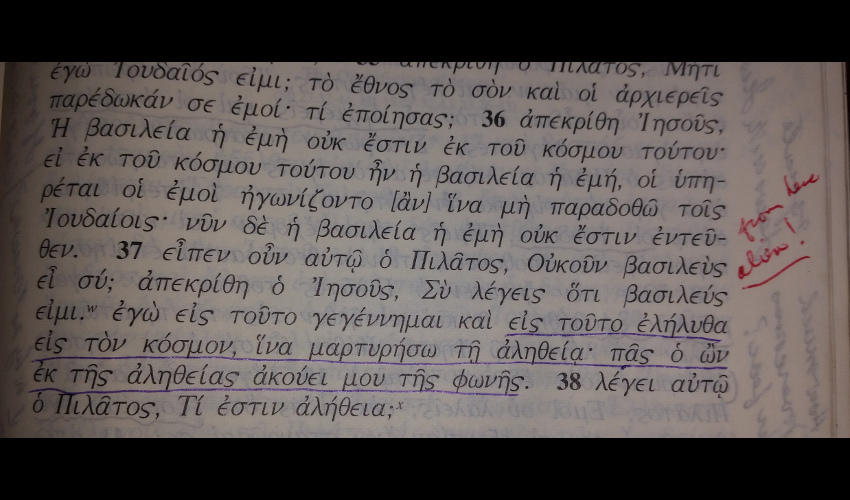
 My Google Hangout on Air on the gospel of John tonight will be based on chapter 6 of Herold Weiss’s book Meditations on According to John, “To Bear Witness to the Truth.” I will focus on the meaning of “true” or “genuine” in the gospel.
I’m embedding the YouTube player below. Note that you have to sign in with Google+ to use the Q&A App.
-
Tonight’s Energion Hangout
 Using Google Hangouts on Air, we will again broadcast a hangout with some of our authors. For further information, check the Google Plus event. I will embed the YouTube viewer below. Note that once the hangout is complete, the recording will be available through the same viewer.
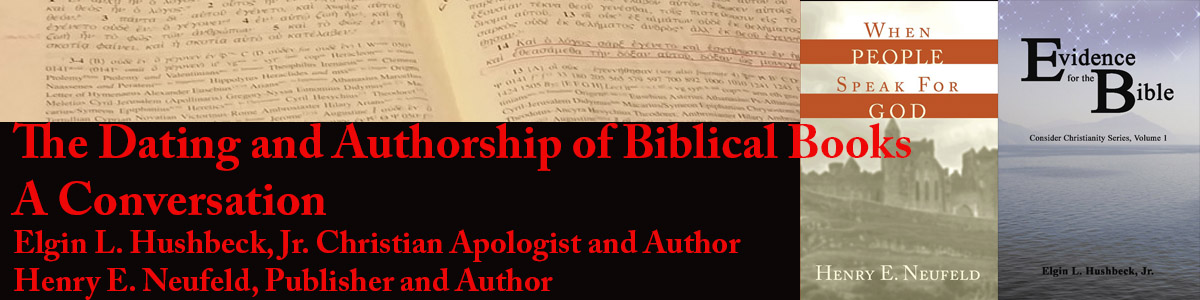
Due to unforeseen circumstances, the event tonight has been changed. Elgin Hushbeck and I had been planning to discuss the dating and authorship of Bible books in April, but we’re going to be doing that tonight. This is a conversation, though Elgin is the moderator/interviewer. This reverses the usual procedure, in which I interview one or more of my authors. Fun!
-
Link: Is the Trinity Biblical?
In my study of John last night I referred people to a post by Michael F. Bird, author of the book Evangelical Theology: A Biblical and Systematic Introduction
. I have been using his book as one of my theological references for the study. He responded to a review in which he discussed some of the same issues I’ve discussed. I promised a link last night, and here it is.
For what it’s worth, I believe that the trinity expresses a combination of various biblical materials and the experience of the early church in language that is demonstrably not in the Bible. I don’t see this as a problem. In general, when we write doctrinal statements of any sort, they reflect a combination of the way we read scripture, our traditions, our personal and collective experience, and of course the function of our reason. I perceive myself as seeing the connection as looser than Bird asserts, so I’m certainly willing to defend him from critics who say he hasn’t claimed enough. On the other hand, he may have claimed too much, and in this case, perhaps more than needs to be claimed.
Nonetheless his book is fun. Note also that the subtitle illustrates the point I was making. I tend to think that the more systematic our theology gets, the less biblical it is. Being both systematic and biblical seems to me almost a contradiction in terms. The Bible is not systematic. But that’s part of the fun of my current study!