
Threads from Henry's Web

Category: Bible Study

  • Free Will and Hardening Hearts (Romans 9:14-24)

    Free Will and Hardening Hearts (Romans 9:14-24)

    This is a follow-up to my last Wednesday night’s (November, 2018) discussion from Romans 9 at Chumuckla Community Church. The passage cited is not my suggestion of a good division of the material in Romans 9, but rather is just where we started and ended up. I did have to look back to verse 13 “Jacob I loved, but Esau I hated” to lay the foundation.

    Background

    Wesleyans frequently don’t spend much time preaching from these passages, I suspect because they’re not as much fun from our point of view as some other passages. But, as I try to remember and point out often, you can ignore the passage, but it’s still there. In setting the scene I would note that I have already said that I don’t think predestination and election as such, particularly as part of soteriology (study of salvation), are primarily what Paul wants to talk about. There are certainly some statements with a substantial impact on soteriology, but they come under the larger heading of “What About Israel?”

    Introduction

    Romans 8 ends with a powerful affirmation of God’s presence and faithfulness. Nothing can separate us from God’s love. I think that statement can be read broadly and applied both individually and in community. It does not mean that we will not have trouble, but rather that God will be faithful to be present with us through what trouble comes.

    Having made that statement, Paul is left with a problem, one foreshadowed by his discussion of Jews and Gentiles in the first two (or three) chapters. If God is faithful, and if Israel was (is?) God’s child, and the bearer of the promises (Romans 9:4), how is it possible that the apparent separation is occurring with Gentiles constituting more and more of the church, and the church taking on so much of the mission? But even more, the question for Paul is why so few of his own people accept what he now affirms and proclaims, that Jesus is Messiah and Lord?

    Contrary to those who see chapters 9-11 as a kind of parenthetical remark or even an insertion from some other source (a position proposed, but not broadly accepted), I see it as precisely the point to which Paul has been driving. God is a God of grace who wished to bless the entire world. God is faithful and is carrying out that mission, bring blessing to everyone. That blessing is mediated through Israel. But how can a faithful God abandon one set of people just as the blessing carried forward through them for millenia is being delivered to the rest of the world?

    For Paul, this is impossible, and his message would be a failure if it were so. God cannot faithlessly abandon one group of people and expect to be viewed as faithful by another. I compared this in class to a new foster child coming to a family which then immediately kicks a previous foster child out of the house. Right after they do that, the foster parents tell the new child that they are faithful and will stick with him come what may. The second child may feel a bit uncertain of this sort of “faithfulness.”

    Romans 9-11 and Anti-Semitism (An Aside)

    As an aside, let me note that some of Paul’s statements have been taken as antisemitic and as justifying negative attitudes toward the Jews. This is inappropriate in a number of ways, not the least of them being God’s own commands regarding how we are to treat others. But beyond that, we should remember that Paul is a Jew, that he is here presenting how God will not abandon the Jews, and that he expresses in this the extreme gratefulness Gentiles should feel in being invited to faith in, and to receive grace from, Israel’s God. Chapter 11 makes it clear that Gentiles, having received this grace (grafting into the tree), should not boast or place themselves above the previous branches. Whatever a gentile Christian thinks about the Jews or even what Jews may think about Christian doctrine, we Christians are heavily indebted to the Jews.

    Further, what a Jew in Paul’s time (thus Paul himself) can say to his fellow Jews over what was still a doctrinal dispute rather than a developed new religion cannot possibly justify racial or religious prejudiced by Christians against Jews. From a theological point of view, anti-semitism or anti-Judaism both constitute a form of sawing the limb you’re sitting on off on the trunk side. Differ in beliefs, but don’t do any looking down, much less despising.

    So watch the proof-texting you do from a passage in which Paul intends to affirm God’s faithfulness to his (Paul’s) own people.

    God’s Hardening

    This is all as background. The question I wanted to explore further, both for those left with questions (as I would expect!), and for those who were unable to attend the class for various reasons, is the idea of God hardening Pharaoh’s heart. We started by tying this back to 9:13, which quotes Malachi 1:2-3, “Jacob I loved, but Esau I hated.”

    However we translate, we have selection and rejection. I would maintain that the selection is as people of the promise, those who would carry forward the blessing promised to Abraham. This says nothing about ultimate salvation, but rather about mission. This is, of course, a mission that Paul has affirmed both in this chapter and back in chapter 3 as a blessing. So Jacob is getting a blessing for which Esau is rejected. (Genesis makes it a pretty dramatic thing!)

    So now in Romans 9:17, we have the affirmation that not only did God harden Pharaoh’s heart, but he raised him up for that purpose (quoting Exodus 9:16). Note that translation can alter the full impact of that passage, but this is where we were in the class. While you can alter the full impact, you really can’t get away from the idea here that God purposefully put Pharaoh in this position in order to use him as the foil (or revelational straight man) for what he intended to do as Israel.

    In Exodus, however, we have different expressions: Pharaoh’s heart was hardened (Exodus 8:19 and many others), I (God) hardened [Pharaoh’s] heart (Exodus 10:1, 11:1, etc.), and Pharaoh hardened his heart (Exodus 8:15, 8:32, etc.). Thus arises the question, “Who hardened Pharaoh’s heart? Was it God hardening it, or did Pharaoh harden his own heart?”

    To which I firmly and decisively answer, “Yes!”

    And to which people promptly ask, “How does that work?”

    To which I answer, “We don’t know, but …”

    From a Wesleyan-Arminian position, one wants to emphasize the choice. Pharaoh chose to disobey and to harden his heart. It would be nice to weaken the other affirmation. Calvinists look at it the other way. After all, if you can affirm that “[b]y the decree of God, for the manifestation of his glory, some men and angels are predestinated unto everlasting life; and others foreordained to everlasting death,” one king put in position and hardened to as to display God’s glory in putting that person in his place is relatively minor.

    Let me look at some of the elements before giving my view.

    Free Will

    I would suggest using a search engine and find one of the many web sites that have copies of the Westminster Confession of faith in which you will find affirmation of both predestination and free will, which are somehow made to work together so that human beings are still to be held responsible, and God is also not the author of sin. This manages to affirm all the scriptural points, but doesn’t make them work together and doesn’t claim to. I’m not here trying to affirm or challenge the Westminster Confession of Faith, but I have found that relatively few Wesleyans are aware that the Confession affirms free will.

    The problem with free will is that it’s not really free. Even with my belief in actual free will, a belief that’s incompatible in my view with absolute predestination or determinism, I believe that God does have responsibility for what happens in God’s universe. I’d go with Isaiah 45:7 as opposed to various confessions.

    We tend to debate free will as though it was somehow absolute, that I have a full menu of choices and can choose any one of them. But in reality I have both inherited DNA and the environmental factors that have brought me to this day. My choices are limited by my background and my current environment. We should really be talking not about whether the will is totally free, which it clearly is not, but whether there is any freedom. If there is no freedom at all, we would have determinism. With cause and effect working without any real randomness, everything would be entirely predetermined. In the famous thought experiment, used in Stephen Jay Gould’s book Wonderful Life, of winding back the movie of life to a previous point, it would always proceed precisely as it did. And I mean precisely.

    If one believes in God in such a universe, everything was determined from the moment of the big bang, or whatever event one sees as the beginning. One might see God interfering, but nobody else, since those in the universe would have every thought and action determined by preceding physical causes. Many people find this “extreme” position hard to accept or even imagine, but it’s a quite logical whole. In this universe, any idea of free will is an illusion, and predestination would be true, and true in its most extreme expressions.

    My belief based on scripture’s affirmations about humanity, is that we do have a true creative ability, so that we can, in fact contribute to reality through our choices. This “free” will is very much constrained, however, by the reality in which we live. I am impacted by the choices of everyone who came before me, even the creatures who come earlier. So while I have a creative contribution, my free will is more a matter of wiggling than it is of profound course changes. I will respond to events around me according to my background. I can change, but it is difficult, and limited by physical, mental, and spiritual circumstances.

    Sovereignty

    The debate here is not about God’s sovereignty, and I find it disingenuous for people to suggest that it is. God does not become less sovereign when he decrees something, even if that decree is the creation of a person who has the power to do things that are in opposition to God’s will. Why? Because God is really sovereign. Unlike human powers he doesn’t have ego problems or an inferiority complex. He can handle decreeing that someone else will have some power within His universe.

    Whatever will one has is the result of God’s decree. Whatever choice one makes is the result of God’s decree. This is why I like the Wesleyan term “prevenient grace” so much. God makes it possible for us to have a choice. We get to make that choice.

    In response some will wonder how that is not a work of righteousness by which we earn God’s favor? I would respond that all of this occurs, as it must, inside God’s will. It is no more just us if we have a choice than it is just us if God decrees what the choice will be. In either case, we have precisely what God gives us and God has set the boundaries of his response. This is why, I believe, we can talk both about election, and also about choice.

    Foreknowledge

    One of the great issues with either view of the choice for salvation is foreknowledge. There are those who feel that God having foreknowledge means that, in effect, the decision is pre-made. It is known before I make it, so how is it possible that I make it. There are alternative ways of looking at this such as open theism or process theology. (William Lane Craig has written a good deal on this point, see Time and Eternity.)

    I don’t believe we know how God relates to time, though I enjoy reading all of these options. I would like to add here that if God is outside of time, God would not see our actions as a sequence. It’s hard to get an analogy to work, but supposing I create a computer program with random events generated, at least from a perspective inside the program, which creates a complete picture in what seems to me the blink of an eye. From the internal perspective, my random number generator creates these things and the result is not known until the decision is made. From my perspective outside the program, the picture appears instantaneously (or seems to).

    Now imagine, insofar as you can, that my perspective is infinitely expanded, while the program maintains its finite perspective. This would be my imagined relationship of God to the world. God sees all at once the things at appear to take much time.

    As another aside, this is how I see the whole issue of soul sleep. I grew up as a Seventh-day Adventist, understanding death as a sleep until Jesus returns. Many Christians believe one goes to heaven when one dies. I view these two positions as equally viable depending on one’s perspective. To us, there is a delay. To the person who dies, there is none. They do not become infinite, but they live in infinity. So one can imagine one’s loved ones who have died looking down, because from eternity, all of the history of the universe appears as a point in time. The two views make no real difference whatsoever.

    So the common Wesleyan-Arminian view that God elects or predestines the ones he knew would make the right choice would fit right in. God sees at once that which we choose over what appears to us to be a long time.

    The Perspective of the Story

    We also need to consider the perspective of the story. In Genesis 18 we have the story of Abraham receiving three visitors. Eventually the text (18:17) presents YHWH as the narrator, and YHWH says that he is going to go down to Sodom and see if the outcry of their evil is as justified (verse 21). This is not the perspective of foreknowledge. Yet we have to read the story in that fashion to hear Abraham’s bargaining properly.

    The key here is this: In a story, a statement may have a perspective that is related to that story. In order to understand the story, one must work from the story’s perspective. There is no current theological view that I know of which would require God to go visit a city to discover what was going on there. This isn’t a matter of foreknowledge even, but just of a reasonable amount of ordinary knowledge for a deity. Yet the story will read very strangely if you don’t allow it that perspective.

    Back to Pharaoh

    Did God harden Pharaoh’s heart, or did Pharaoh harden his own heart? Put aside any view of foreknowledge and look at the story itself. Pharaoh is who he is. He has demonstrated this over time. God clearly knows Pharaoh. Unless God is to choose to either free his people by some sort of physical transportation miracle, or to do it at some other time, Pharaoh will have to be pressured to let them go. The story teller does not imagine God magically transporting people, so that’s not really on our menu of options. God has clearly decided to liberate God’s people, so that option is left out. Not impossible, but excluded by God’s plan and will.

    So God, knowing that Pharaoh is not one to bend to this kind of pressure nonetheless puts that pressure on Pharaoh. God knows that pressure on Pharaoh will result in Pharaoh’s heart being hardened. So God hardens Pharaoh’s heart by proceeding with God’s plans, while Pharaoh hardens his own heart in accordance with Pharaoh’s nature.

    Conclusion

    We can still discuss the fairness of all of this. I don’t think this answers all questions. Why doesn’t God care enough about Pharaoh to reorder the plan in order to make it more possible for him to make a better choice? I don’t know. I make the assumption that God knows, but I don’t even have a proposed solution to that other than my expectation that God works things out.

    At this point, however, I can read Romans 9 with a view both of election and of free will. I could be wrong. The scriptures do not make the relationship clear. But this is how I read it.

     

  • Getting What Was Said

    It can be hard to go from a text to a sermon. The line from past to present can be hard work. But at the root, one must hear clearly what was said. Dave Black looks at a text.

  • Preparing to Teach Romans Tonight: Quote

    Preparing to Teach Romans Tonight: Quote

    From Meditations on the Letters of Paul, by Herold Weiss:

    Jesus’ faith in God is what gives life to sinners. This point is made in another famous Pauline confession: “I have been crucified with Christ; it is no longer I who live, but Christ who lives in me; and the life I now live in the flesh I live by faith in the Son of God, who loved me and gave himself for me” (Gal. 2:20). This text says it best, but again attention must be paid to the original Greek, which reads: “but what I now live in the flesh, I live in the faith, that of the Son of God who loved me and gave himself for me.” As a Christian Paul lives in two locations: “in the flesh” and “in the faith;” that is, Paul is crucified with Christ, and as a consequence the faith of the Son of God is active in Paul. Christians live “in Christ,” as Paul does not tire to say. Paul does not have faith in Jesus. He has the faith of Jesus because he is “found in him.” Jesus had faith in the effective power of God; likewise, Paul has the faith of Jesus in the power of God to raise the dead. In passing, it is also to be noted that in this very personal confession Paul gives specific credit to Christ saying that the Son of God “loved me and gave himself for me.” It is not just that God loved the sinners, sent forth His Son, and pours out the Spirit on human hearts. It is also the case that the Son loves humanity and gave himself for all humans. (pp. 67-68)


  • Reading, Studying, Discussing, Teaching, and Proclaiming but not Practicing

    Reading, Studying, Discussing, Teaching, and Proclaiming but not Practicing

    I was struck by Dave Black’s note on Hebrews 4:14-16 from Wednesday on his blog. I extracted it to jesusparadigm.com, as Dave’s blog is a journal that doesn’t offer links to individual posts. (I have his permission.)

    I highly recommend his post. It struck me because Hebrews is such a central part of my reading and study. There are those who claim I can’t get through an hour of study, no matter what the subject, without referring to the book of Hebrews. Within Hebrews, 4:14-16 has to be one of my most quoted passages in the book.

    Dave talks about not going to our great High Priest first. That really struck me, because I think I don’t either. The other day I woke up in a cold sweat because I had dreamed about something critical going wrong. Now I’m working through quite a number of things that can justify worry, in a normal sense. I was telling Jody about my “awakening” and she just said, “Next time you wake up in a cold sweat, just remind yourself that Jesus has it all under control.” Jesus says, “Can anxious thought add a single day to your life?” (Matthew 6:27 REB).

    I don’t intend to do less. But I’d also like to worry less. None of the problems I’m facing have been alleviated by my worry. Not one.

  • Biblical Studies Carnival 149 (June 2018)

    Biblical Studies Carnival 149 (June 2018) has been posted at Reading Acts, and I was somewhat shocked to find a link to my own blog when looking through for nifty scholarly articles on topics of interest. Somehow my rantpost about church buildings got a link. Yay!

  • Beware CNN Bearing Bible Verses

    Beware CNN Bearing Bible Verses

    Mom’s Grave Marker

    When my mother passed away in April, my brother and sisters and I chose a text for her grave marker: “I will content with him that contendeth with thee, and I will save thy children” (Isaiah 49:25, KJV). It was one of mother’s favorite texts, and her concept of “children” was broad. She was a nurse and a teacher and was involved in the lives of many.

    There was, however, a period in her life when she was deprived of her favorite text. Someone with scholarly credentials told her that the text didn’t mean what she thought it meant, and that she could not claim this as a promise for herself that God would save her children.

    She confided this to me in the car one day. She was deeply saddened not to have this text, but she didn’t want to use it if she was misusing it.

    Now if one looks at the context of the passage, both literary and historical, it is not talking about spiritual salvation of the descendants of a modern American mother, or of keeping them safe from all danger. It’s talking about the exiles of Judah who are to be brought back to their homeland. In that sense, anyone outside of the time frame of 2nd Isaiah cannot claim the passage for themselves, as it isn’t talking about them. It’s addressed narrowly and specifically.

    So are quite a large number of Bible verses.

    So here’s how I responded. I told her that yes, indeed, the historical context was different, but that I saw in that passage something about the character of God, portrayed in this passage. God is a God of redemption and works to redeem. God is interested in the generations to come. (It might not surprise you in this context to learn that Psalm 78:1-8 is my theme text for my teaching ministry. God cares about the generations to follow.) I could certainly find many other texts to indicate this as well, but Isaiah 49:25 encapsulates it very well, while placing it in the context of God’s negative judgment as well. This suggests in turn that God’s judgment is intended to result eventually in redemption.

    So while the text was not addressed to Myrtle Neufeld in the 20th century (which was when the conversation occurred), and did not specifically speak of her children and what would happen to them, it did express God’s nature and desire for those children. My mother was never naive enough to believe that, despite any choices made, God would make everything right. What she did believe was that God was working to save her children at all times and in all circumstances.

    Mom decided that she could use the text after all. Mission accomplished.

    So today I read this article from CNN. What struck me in this was not the debate about Romans 13. I have definite opinions on that, but at the moment I will only note that people I respect deeply, who are both sincere and well qualified, disagree with my definite opinions on Romans 13. Well, I should acknowledge that many agree as well! I’ll get to the matter of disagreeing on the meaning of texts in a moment.

    The passage that struck me was Philippians 4:13. “I can do all things through Christ who strengthens me.” Or let me quote a bit more in context:

    10 It is a great joy to me in the Lord that after so long your care for me has now revived. I know you always cared; it was opportunity you lacked. 11 Not that I am speaking of want, for I have learned to be self-sufficient whatever my circumstances. 12 I know what it is to have nothing, and I know what it is to have plenty. I have been thoroughly initiated into fullness and hunger, plenty and poverty. 13 I am able to face anything through him who gives me strength. 14 All the same, it was kind of you to share the burden of my troubles.

    The Revised English Bible. (1996). (Php 4:10–14). Cambridge; New York; Melbourne; Madrid; Cape Town; Singapore; São Paulo; Delhi; Dubai; Tokyo: Cambridge University Press.

    You know something? Here’s the comment from the article:

    When the Apostle Paul wrote that line, he was referring to a Christian’s ability to withstand suffering. It wasn’t about winning; it was about enduring loss. Paul wasn’t taking a victory lap; he was in prison contemplating his execution, says Van Voorst, a professor at Western Theological Seminary in Michigan.

    Um, true. Paul didn’t play basketball. But he wasn’t just talking about a Christian’s ability to withstand suffering. He was talking about being able to handle whatever life throws at you. If you’re a basketball player, what life throws at you might be a career-ending injury or it might be an opportunity to make a couple of free throws to end the game victoriously. Yes, it is quite possible to apply this verse in ways that are not appropriate. It doesn’t mean you’re always going to win, for example.

    Neither does Romans 8:28ff. The passage goes on to say that nothing can separate us from the love of Christ. It’s a powerful passage about spiritual things, about our ultimate salvation. But it’s also a powerful passage about God being with us at all times. It doesn’t mean things will happen the way I want them to. It does mean that, in the end, what God works out will be good. And yes, that good may come in the next life.

    I have two major problems with what goes on in this article, though first I must note that many things noted there about abused texts are quite correct. It’s certainly possible to misuse a text. It’s also possible to disagree quite rationally about the meaning of a text or to rob that text of all applicability.

    1. My first problem is this: Biblical scholars can suck the lifeblood from Scripture. With enough historical study, one can assure that nothing in Scripture applies to anything in anyone’s life. Scripture is understood in community, and how it applies to the present grows out of the community and its understanding. It is important to use historical scholarship as an anchor. It’s important to acknowledge and celebrate the history. But for those who believe that God is still God, it’s quite possible to think that God might act again in ways God has acted before. If you don’t believe God is still God, your argument is on that point, not in the understanding of Scripture.I would hope that scholars would encourage, inform, and edify the members of the community, not nit-pick them into abandoning a personal reading and application of Scripture.
    2. My second problem is simply this: If we understand that there are multiple possibilities for ways to understand and apply Scripture, we should also expect that a news article from CNN that quotes a couple of scholars cannot settle the issue of meaning for multiple Scriptures. This is why I prefer “I disagree with that view” to “That view is wrong.” There are some really bad interpretations out there, but some of those are held by highly qualified people, and a response should include careful argumentation. “There’s another way to view this” will accomplish more, I think, than “Your view of this is stupid.”

    Most obviously, I might suggest that a short article is hardly going to set the record straight on multiple Scripture passages. I found places I agreed and places I didn’t. I know of serious commentators who would agree and some who wouldn’t.

    As a life-giving, spiritually invigorating support, a text can be wonderful. As a club to beat up your neighbor? Not so much.

  • The Critical Need for Transformative Bible Study

    The Critical Need for Transformative Bible Study

    I know relatively few people who will not complain from time to time about proof-texting. At the same time, I know equally few people who don’t prefer to be able to pull out a single line from scripture that makes their point. If you just have chapter and verse, then you can be scriptural. A number of current debates rely on trying to wave the banner of a particular scripture at opponents.

    We tend—and I include myself in this—to search the scriptures for the answers to doctrinal, social, or political questions, and hope to have as an outcome a simple text or set of texts that will leave our opponents reeling. Most of us a realistic enough to realize that we won’t convince them that easily. They’ll reel off to some place where they can find more congenial company. There are those who seem to think that if you don’t join the chorus, it’s because you don’t really care about the issue or the people involved. The volume and persistence of your contribution is seen as a measure of your commitment.

    While I’m as tempted by all this as the next person, I am unconvinced that any of this type of exchange (I cannot call it discussion) actually accomplishes anything useful. What we need, instead, is transformative Bible study.

    Transformative Bible study occurs when we (or I) study the Bible in order to behold and be changed (2 Corinthians 3:18).

    I do not mean that we do not study Bible in community. The church, from small groups to congregations to denominations, and to the Body of Christ universal, needs to study to be changed.

    I do not mean that others do not need to change. There are many people who, I’m quite convinced, are behaving in ways they ought not to behave.

    I do not mean that the formulation of doctrine is not important. I am a member of a congregation in a denomination that I believe has great difficulty defining doctrinal boundaries that are sufficient to maintain a cohesive community.

    I do not even mean that we don’t need to do some doctrinal enforcement. Saying that one is a member of a group has to mean something. There is a need for some identity.

    I also don’t mean that we can’t suggest ideas or even correct others, though we should be equally willing to hear. Such exchanges require some level of relationship, however.

    But I think the best way to lead in a better direction is to always read the Bible with a focus first on its changing me. In community, that should be with a view to changing us.

    We want to change others because we are certain they are wrong. It is frightening simply to trust that if we can help give people a glimpse of Jesus, and then trust God and the Holy Spirit to implement change. We’re no longer in control. I would point out that we are not in control in any case. All the loud yelling is not actually changing people’s minds.

    I’m suggesting a meditative study, open to the leading of the Holy Spirit, and carried out with a willingness to make changes. It’s a matter of example.

    I hope you’ll think about it. I plan to!

  • Tonight in Romans

    Tonight in Romans

    This evening, at 6 pm at Chumuckla Community Church, we continue the study of Romans, just starting chapter 2. Here’s a quote from some of my reading today:

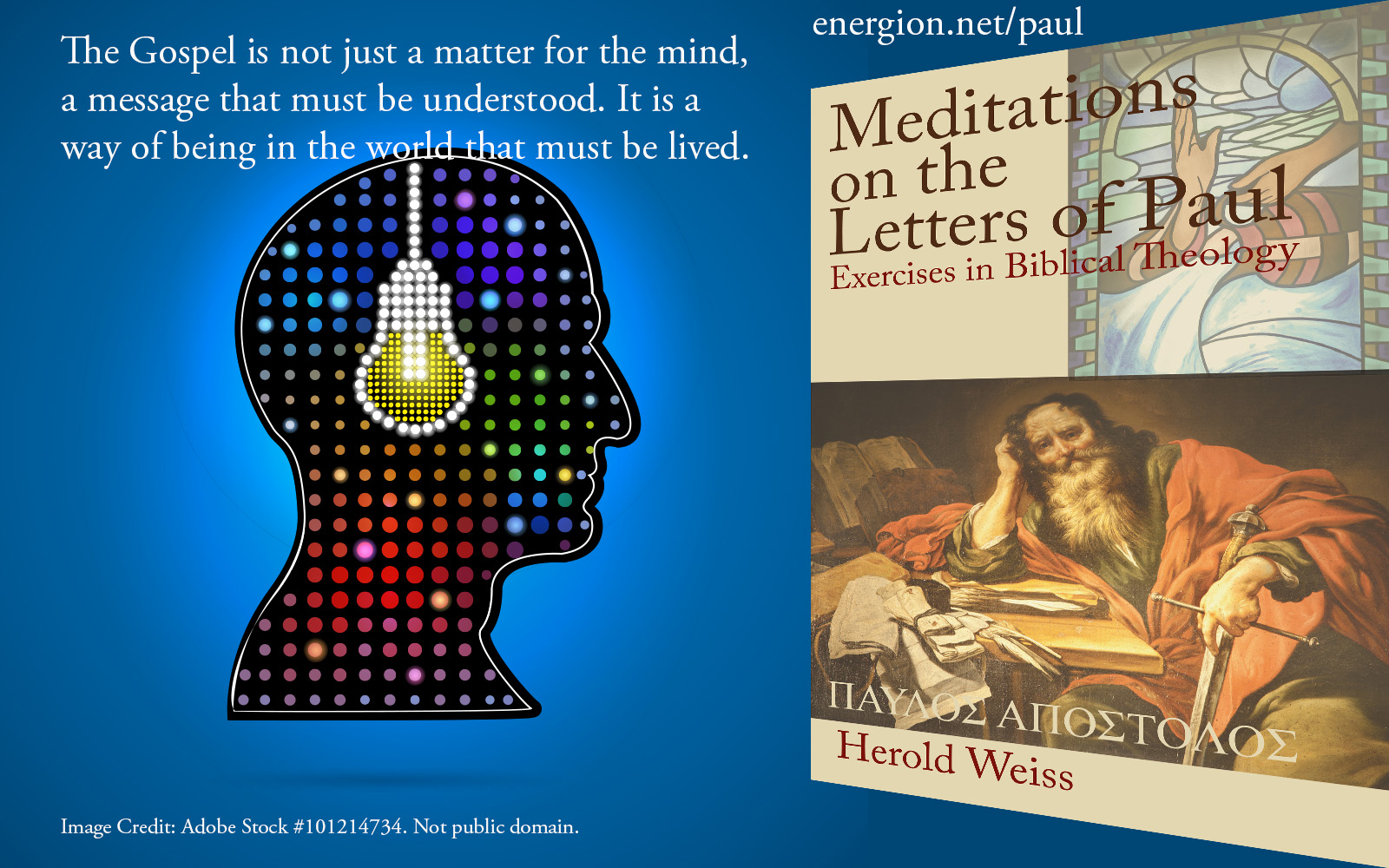
    The Gospel is not just a matter for the mind, a message that must be understood. It is a way of being in the world that must be lived. The Gospel may reach the individual through the mind, and the mind has a task to do with it, considering its premises, judging its arguments, evaluating its goals. But the Gospel must find its home in the heart, the seat of being. It cannot get to the heart without passing through the mind, but it is not effective unless it settles in the heart, changing it in the process. As Paul puts it, the heart must be circumcised (Rom. 2:29). The power of sin in it must be expurgated. The Christian has a mind renewed from above and a circumcised heart. Paul’s promise to his converts is that “the peace of God, which passes all understanding, will keep your hearts and your minds in Christ Jesus” (Phil. 4:7). To keep the mind and the heart together is to live by faith and reason. The love of God that the Spirit pours into the heart does not dislodge the unity of the mind and the heart. It strengthens it. In the Christian, faith and reason abide as one. (Herold Weiss, Meditations on the Letters of Paul, pp. 59-60)

    There are those who think we’re moving slowly. I think we’re moving at lightning speed! If you live in the area, come and join us for an exciting discussion.

  • Repentance in Hebrews 6:4-6

    Repentance in Hebrews 6:4-6

    When I talked about structure, I mentioned that I’d write a follow-up after my Wednesday night class. Here’s the rundown, though I plan to keep it brief. I’m indebted to David Alan Black for the basic note about the participles in this passage, and in a scholarly article I would need to cite a number of additional sources. The structure of the passage followed my own take on it in the context of Hebrews and made the argument easier. I include this discussion in my book To the Hebrews: A Participatory Study Guide, which is currently under revision for a second edition. (The main problem with the current edition is that I created it with readings, exercises, and questions, along with several appendices with discussion. I’m putting some discussion in the lessons!)

    There are a number of passages I referenced in class, but there are three passages before 6:4-6 that I see as key, and then one after. The reason is that the author of Hebrews signals new topics well ahead of the main discussion and then ties them in to later discussion.

    So if you look at Hebrews 2:1, “drifting off course.” This is an early signal of what I think is the key theme of the book, one that is further developed in 6:4-6 especially. At this point, the author has presented Jesus as the true representation of God and is now ready to open up the door to the result. God has spoken in these last days through a Son, which sounds good, even exciting, but what does it mean?

    Frequently Hebrews is read as a book with a message of works and perfectionism. In fact, as someone with a Wesleyan background, I’m used to starting there in my thinking. But the more I study the book, the less I think that is the correct reading. The warnings in Hebrews are not about human performance of good actions, but rather of total confidence in the one who has been presented here in chapter 1. Verses 1-4 present the Who, while the rest emphasizes that Jesus is greater than the angels. There will be more emphasis on precisely who Jesus is, but we have this pause in the first few verses of chapter 2 so we can get a preview of the theme.

    Through the rest of chapter two and into chapter five, but especially in 4:12-16, we’ll develop the things that make Jesus ideal as our priest, even though we aren’t quite sure what such a priest will accomplish.

    In 5:8-9 we get the second key connection, as we are told that Jesus learned obedience through suffering (and a rich passage that is, even though I’m just going to touch on it only briefly. Verse 9 tells us that he was perfected. It is this “perfection” that I think is the key object of Hebrews, the perfection of Jesus, not the perfection of any human being.

    I see 5:11-14 as a bit of reverse psychology, challenging the readers/hearers with their dependence on milk just before he goes ahead and introduces some meat anyhow.

    The third key passage is Hebrews 6:1, and “going on toward perfection.” It’s my understanding that United Methodist pastors are still asked this question on ordination, and I believe not a few have their fingers crossed when they answer. Figuratively speaking, of course! But though few translations do it, this can be taken as a passive, and thus be translated “carried on toward perfection” rather than “going on toward perfection.” I would go further and argue that the perfection that we are to go on toward is Jesus, and is only to be attained “in Christ” and not by us or as something possessed by us.

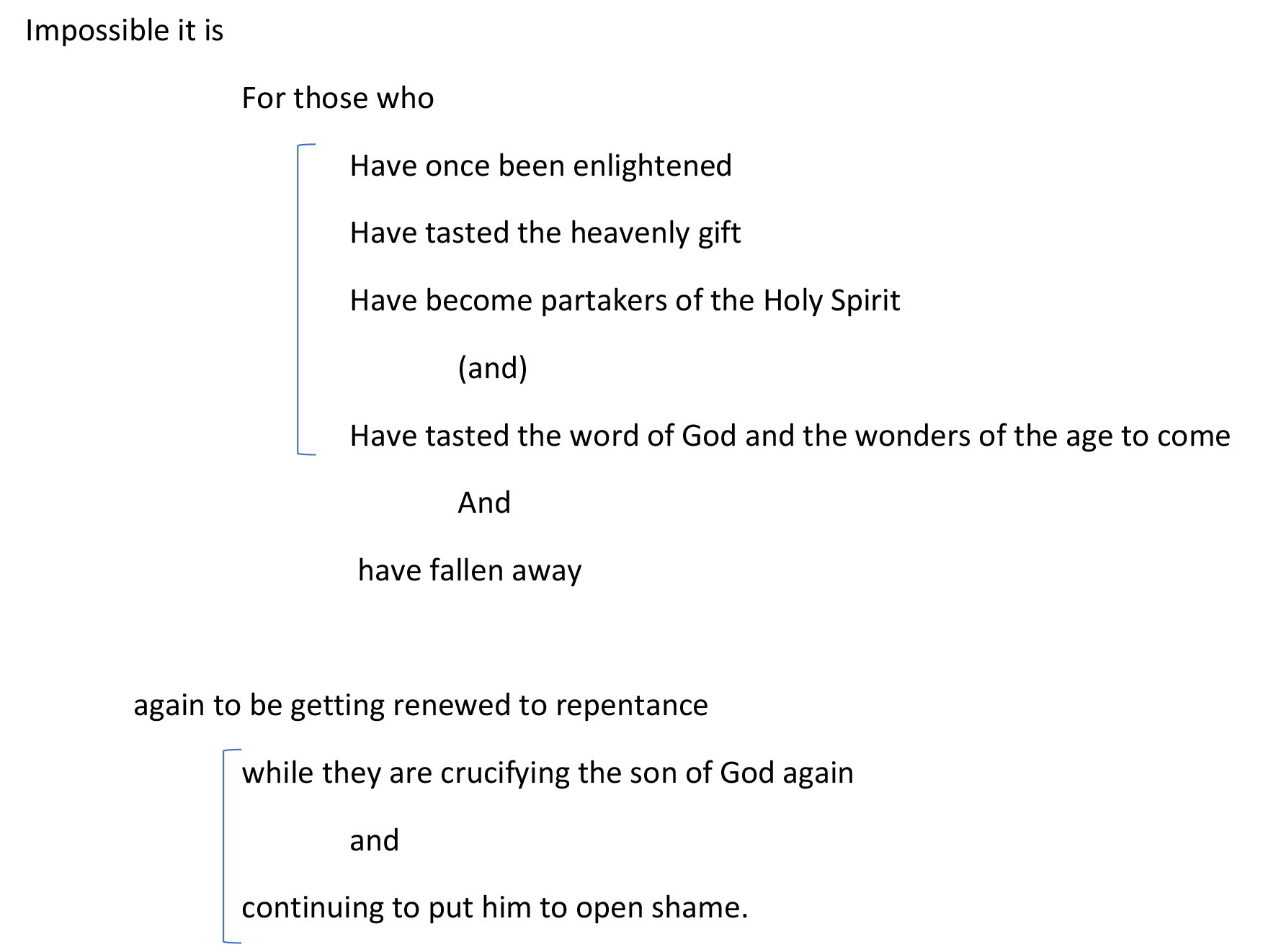
    Having jumped from signpost to signpost, this leads to 6:4-6. I have noted previously that I don’t take this as a “once out always out” passage, but rather as a warning against rejecting the voice or urging of the Holy Spirit. Paying closer attention to structure and the participle tenses helped back that view up and expand it.

    Here’s my translation with structure:

    I have summarized the theme of Hebrews as “get on the right train and stay on it until you reach the destination.” The key is that if you have the best, the greatest, or even the only hope of rescue and you don’t take it, rescue escapes you. That’s why I have the temporal sense here. If you are rejecting the final sacrifice of Christ, according to the concepts developed in the preceding five chapters, what option is there? Jesus, the Christ is sacrificed once-for-all, and cannot be sacrificed again. If we continue to fail to accept the finality, we are crucifying him afresh.

    But it’s even more simple than that. You can’t accept while you reject.

    Does that make it too simple? Actually, I think it makes it a clear statement of precisely the point of Hebrews. You have two choices: This train or no train.

    And that leads to the final passage I want to use, Hebrews 10:26-27. Here we have no sacrifice for sin after Jesus. It’s often used in sermons to threaten people with how seriously they should take New Testament commands. But that’s not the point at all. There is no more sacrifice because the sacrifice has been offered. If you don’t accept the sacrifice, there isn’t another one. You can’t redo it or substitute it.

    The whole message centers on confidence in the grace that has opened this “new and living way” (10:20), in the perfection of our High Priest, and in the necessity of placing our full confidence in Him.

    Let me add that I believe that the “cloud of witnesses” in Hebrews 12:1ff should be seen as those who are cheering us on because they have experienced the weaknesses and the failings that we have and know the grace of God and the final reward. It should not be used as a club as I have heard it preached, in the sense of: “Look at all these holy people who are watching you. Don’t screw up!”

    (Featured Image Credit: Openclipart.org.)


  • How People Mess Up Interpretation

    How People Mess Up Interpretation

    No, this is not a post about the crazy ways people interpret the Bible. It’s about the way in which people make precision difficult in communication. Am I thinking about biblical interpretation? Of course I am. If you have to guess what I’m thinking about and I don’t give you a clue, “biblical interpretation” is a good bet.

    When I teach Greek or Hebrew, and as I’ve mentioned, this is to people by ones and twos, not in seminary classes, I try to emphasize basic linguistics. How does language work in day to day usage. I can illustrate what I mean by people messing up interpretation using a one line rule I give my Greek or Hebrew students: People are lazy. This rule applies, for example, to the reason why sounds tend to drop out of common phrases. “Good day” becomes “g’day,” an expression that may be more commonly used in Australia. (I say this so that I can get in a bit of a pet peeve. Check this sort of stereotypical thing out if you can. In this case, I find “g’day” in an article titled Outrageous Aussie Stereotypes Debunked. Not promising!)

    But my “people are lazy” rule has many problems (or exceptions, if you wish), which also illustrates one of the problems of language. People are diverse. What I think is easy to pronounce someone else may find next to impossible. I remember vividly trying to learn to pronounce a few Hungarian words while driving with my translator. She would pronounce the word and I would imitate. It always went downhill from there. In Hungarian actual vowel length, i.e. the length of time a vowel sound is sustained in speech, is phonemic (i.e., it impacts the meaning). In English, this is not the case. I was taught long and short vowels, but they were not sustained for different periods of time, but were actually different sounds. (That’s a very loose way to explain it! See? I mess up interpretation too by being lazy.) For me, properly judging the length to sustain a vowel sound was next to impossible. For her, it was second nature.

    So another rule: Things you have become accustomed to doing will seem easy. To you.

    People just don’t follow one set of rules. We may have learned in English class that a paragraph consists of a thesis sentence, followed by three explanatory sentences, and ended with a conclusion. How many paragraphs in this post look anything like that? I tend to paragraph by sound, and often set off a sentence that would either be a conclusion or the introduction of a new element by itself, simulating the pauses for emphasis I might use in public speaking.

    Like this one.

    When I was an undergraduate student, one of my professors (J. Paul Grove at Walla Walla College for those who might know), required me to turn in three sermon outlines a week as part of a course in Hebrew prophets. I thought this was a horrible requirement, as I had no intention of becoming a preacher. I was going to be a biblical scholar. Bless Professor Grove! It turned out to be one of the better exercises of my educational process because it made me think of a connection between the data I was accumulating and the real world. It didn’t result in even one sermon outline that I would ever use in preaching, even though I have preached frequently. That’s because I vigorously eschew three point outlines and diligently work to violent rules of homiletics.

    Which means that I’m human. I don’t always follow the rules.

    I turn this now to structure, which I discussed a bit yesterday. Studying structure is good in interpreting scripture. Just don’t be too structured about it. I’ve been asked if I accept various outlines of Hebrews, such as Vanhoye’s. I guess it depends on what you mean by “accept.” I find a great deal to commend his work, but I don’t find that any structure is followed closely. I believe that in studying Hebrews you have to carefully track what the author has done, the ways in which he connects and interweaves his topics. He’s flexible; the interpreter must be flexible.

    Just like getting stuck on one label when trying to communicate, getting stuck on a structural label can be harmful to your mental health. People rarely follow the rules completely. Most commentaries that I’ve read do provide caveats about their structural conclusions. You should provide more.

    Flexibility is a key to sound interpretations, because people are flexible.

    (Featured image credit: Openclipart.org)