Threads from Henry's Web

Category: Bible Study

  • Evaluating Doctrines regarding the Holy Spirit (Pneumatology)

    Evaluating Doctrines regarding the Holy Spirit (Pneumatology)

    I have encountered a few questions lately regarding the work of the Holy Spirit, particularly the manifestation(s) and gifts of the Holy Spirit as they may be observed in a church setting. There is always a problem with evaluating theology based on the visible actions of God, because this gets confused with identifying God’s actions. This latter is difficult to accomplish.

    My aim in this post is to point to the way in which I look at any Christian doctrine, using as examples the manifestation (note singular) and gifts of the Holy Spirit. By my use of those expressions I point you to 1 Corinthians 12-14, where those are used in verses 4 & 7 of chapter 12.

    (I have a prior series on 1 Corinthians 12-14, which includes 1 Corinthians 12-14, 1 Corinthians 12-14 Greek Terms, 1 Corinthians 12, 1 Corinthians 13, and 1 Corinthians 14.)

    What I frequently hear done is that one identifies what the gifts of the Spirit are by looking at the list in 1 Corinthians 12, sometimes combining this with lists in Romans 12 and Ephesians 4, and thus identifying whether a gift is “of God,” that is, has its source in God’s action, by whether it occurs in the list. Should one use a gift that is not in the list, that gift is seen as suspect.

    I find that process suspect, because I do not believe that Paul is attempting to teach the Corinthians about the gifts of the Spirit here. Rather, Paul is teaching them about true spirituality, and is using the gifts as an illustration. I imagine that the Corinthians would have agreed with the list of spiritual gifts he gives, and thus he can use it to illustrate the real way to test.

    He gives that real way in 12:3, which can be boiled down to the assertion that Jesus is Lord. That is the key assertion. How that works is detailed in verses 4-11, with 11 being the wrap-up. It is one Spirit, that acts in the church under the church’s one Lord.

    We depart from this test at our peril in the church, and it is the test that Paul puts up front. He doesn’t say, “Check out whether the person is speaking in tongues,” or “Check out whether they can prophesy,” or even “Look at whether they have some gifts of administration.” Rather, he emphasizes that all of those come from one Lord.

    I am not a theologian by profession, though many will point out that a Christian is always a theologian in a certain sense. Having the opportunity of reading and studying under some quite gifted theologians, however, I don’t want anyone to think I’m claiming to be one them.

    I found this view repeatedly stated by one of the authors I publish, Edward W. H. Vick. To summarize his various statements, just one of which I will quote below, the way you determine if a doctrine is Christian is by asking whether it is centered in Jesus Christ. He makes this note in his book Eschatology: A Participatory Study Guide, in From Inspiration to Understanding: Reading the Bible Seriously and Faithfully, and Creation: The Christian Doctrine.

    I quote the latter here:

    The essential Christian conviction is that God moved toward man and made his decisive revelation in Jesus Christ, that what is known of God is known in Jesus Christ, that in Jesus Christ we have the clue to the meaning of reality, not this or that part of reality only (although this as well), but to reality as such. This means that the Christian must attempt to see every aspect of reality in the light of God’s revelation in Jesus Christ. We emphasize: the starting‑point, the sine qua non of Christian theology is belief in Jesus Christ. Belief in Jesus Christ is evoked by God’s revelation in Jesus Christ. That is given. Once present it is never questioned. The faith in Jesus Christ that is a result of God’s revealing activity in Him provides the theologian with the starting point. All Christian doctrine, works from this starting-point, A Christian doctrine of creation must start here. No scientific research or discovery can touch this basic religious conviction or its theological expression. It is a method of interpreting the world and an explanation of the very existence of the world. It is an explanation of the world that says basically that the world is dependent on a reality that may not be known by an examination of the world alone.

    Edward W. H. Vick, Creation: The Christian Doctrine, (Gonzalez, FL: Energion Publications, 2013), 104-105.

    You can have numbers everywhere and plenty of scriptures and calculations to back them up, but if the center of your eschatology is not Jesus, the Christ, it is not Christian. It may be partially, even mostly, based on scripture, but it will remain outside Christian doctrine. Similarly, you can know ever so much about creation, whatever your view on the details is, but if you do not find Christ in creation, your doctrine of creation is not a Christian doctrine.

    Finally, and perhaps most importantly, you can know ever so much about scripture, but if Christ is not at the center of your interpretation, it is not Christian. Note here that I do not mean that non-Christians cannot interpret scripture, nor that Christians should not do historical interpretation using sound, scientific methodologies. I’m speaking of the scriptural interpretation that nurtures and builds (edifies, to use the term from 1 Corinthians 14) our faith and our community.

    I use this principle in two ways. First, as you have seen, I define (having learned from Dr. Vick), a doctrine as Christian based on whether it is centered in Jesus Christ. Multiple tie-downs to various scriptures, appeals to experience, or a variety of other options do not make a Christian doctrine.

    Second, however, I use this to help me define the essentials. When looking at doctrinal disagreements, I ask how those disagreements impact the view that Jesus has come in the flesh (1 John 4:2-3) and that Jesus is Lord. This is not a clean checklist, because not everything has an equal impact. I’m usually willing to trust the expressed intent of the person who holds the doctrine.

    I believe it is important to know the difference between essentials and non-essentials in order to prevent ourselves from becoming narrow and judgmental. Romans 12-14 covers much of this ground, and it is often quoted out of context on both sides of the divide: the importance of right doctrine, and the importance of some flexibility and of letting the Lord lead.

    This leads me to the way in which I evaluate either gifts attributed to the Spirit or manifestations attributed to the Spirit.

    First, the manifestation of the Spirit comes in many ways, one of which is the availability of the gifts of the spirit. The spirit is also made manifest through the fruit of the Spirit (Galatians 5:22-24). Most importantly, the gifts are made manifest directly in calling forth the confession that Jesus is Lord (1 Corinthians 12:3).

    Second, does the expression of any doctrine of the Spirit center on Jesus Christ, in other words, is the doctrine itself a specific expression of the broader statement that Jesus is Lord?

    Third, as Paul expresses himself in the rest of 12 and then reinforces and expands in chapters 13 and 14, is the expression of the doctrine or the manifestation of the Spirit something that builds the body of Christ? (The term we’re used to in chapter 14 is “edify,” which is fine, provided you really hear it!)

    The love chapter, 13, is often treated separately from 12 & 14, but Paul is here giving us a key to the way in which we identify gifts. For example, are people claiming superiority over others because of the gifts of the Spirit? That is not manifesting the love of Christ, nor is it building the body of Christ. It is therefore hardly an expression of the statement that Jesus is Lord.

    Tomorrow (hopefully I will make time!), I will discuss the idea of manifestations a bit more, but this is going to be the foundation of everything. I think one of our human problems is equating “things that make us comfortable” with “things that build the body.” Those may not be the same thing.

    So we’ll discuss!

  • Of Isaiah 40 and Grasshoppers

    Of Isaiah 40 and Grasshoppers

    Last night in our Tuesday night group we discussed this rather interesting chapter, one that I believe expresses the basics of the gospel message well.

    Now I don’t mean by this that it mentions the name of Jesus or even directly predicts anything about his ministry. There is some material here that is used of John the Baptist and Jesus, but that is another subject. What I mean is the basic principles. I will express these as: We can’t, God can, God does.

    There are those who find the whole depravity thing in Christian theology somewhat morbid. But there’s a really simple point, and one I think is obvious once you see it. We really can’t!

    Once we accept the fundamental idea of God as creator at all, we accept total dependence and our inherent smallness. As Isaiah calls us, grasshoppers. God looks down from the circle of the earth and the inhabitants (that’s us) are as grasshoppers.

    If we think about it for a moment, not only can we not do good without God, we can’t do anything at all. We can’t exist. We are, before our creator, nothing at all.

    And yet!

    And yet, God is coming to God’s people. God cares, in great detail.

    Here is the Lord GOD; he is coming in might,
    coming to rule with powerful arm.
    His reward is with him,
    his recompense before him.
    Like a shepherd he will tend his flock
    and with his arm keep them together;
    he will carry the lambs in his bosom
    and lead the ewes to water.

    (Isaish 40:10-11, REB)

    God’s greatness is not something that should make us miserable. Face it, we have looked at the universe and it is incomprehensibly large. We are small. Yet we are significant. If God is the creator, as we believe, then God is incomprehensibly large, and we don’t really have anything to offer.

    And yet!

    When I consider your heavens
    the work of your fingers
    the moon and the stars
    which you have put in place,

    What is a human being
    that you take notice?
    A mortal that you seek him out?

    Yet you have made him a little lower than God,
    with glory and honor you have crowned him.
    You have made him rule over what your hands have made.
    You have put everything under his authority.

    Psalm 8:4-7 (my translation)

    Isaiah 40 tells us that while we can’t, God can, and God will.

  • On Violence in the Bible

    On Violence in the Bible

    Allan Bevere reviews L. Daniel Hawk’s new book The Violence of the Biblical God.

    I cannot resist calling attention to a much earlier book by my undergraduate advisor and mentor Alden Thompson, which it happens I publish! It’s Who’s Afraid of the Old Testament God?.

  • Symbols, Actions, and Idolatry

    Symbols, Actions, and Idolatry

    I encountered a question recently that I’d like to explore a bit. The question comes in three parts, or perhaps with three perspectives.

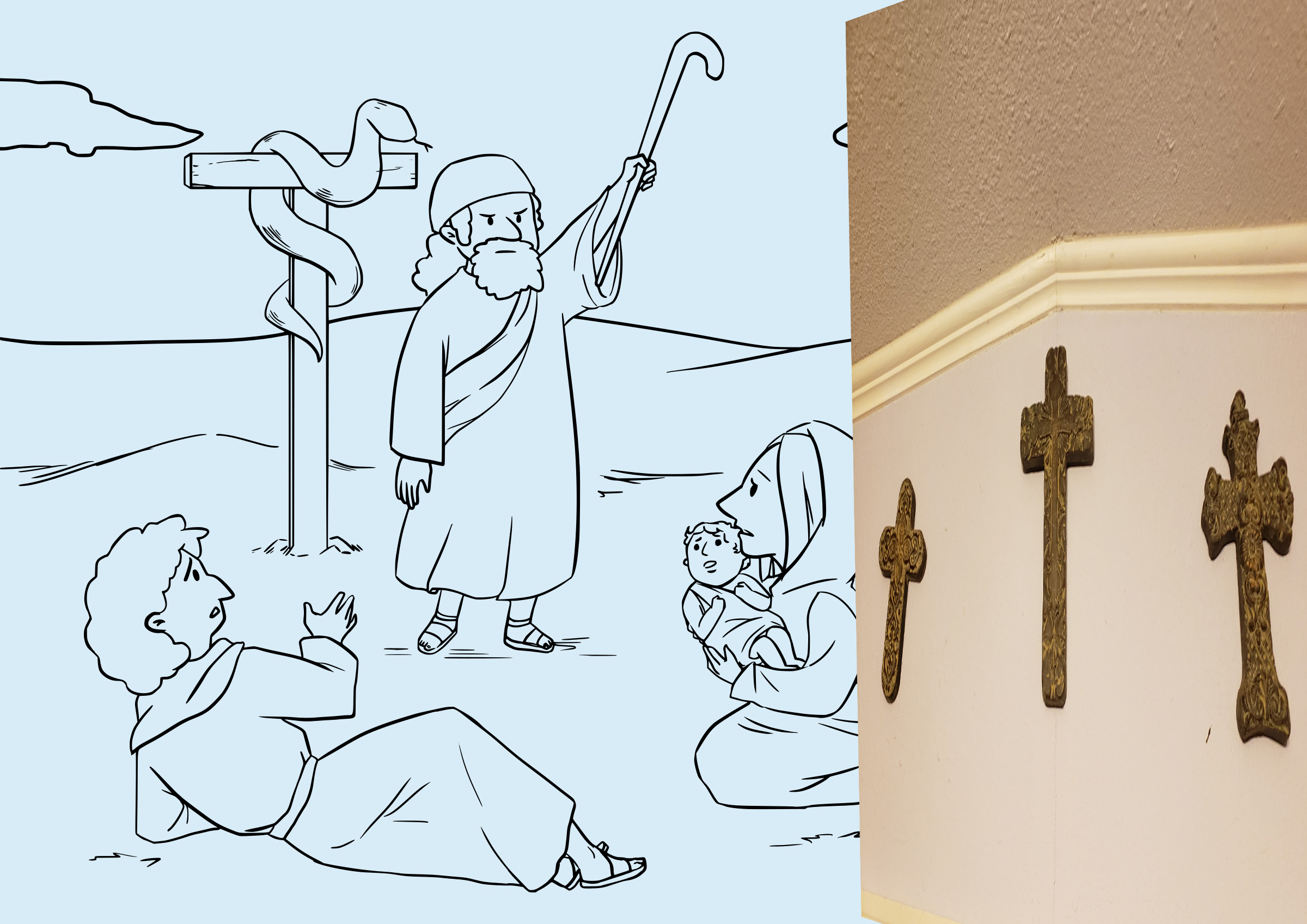
    • When God commanded the Israelites to look to the bronze serpent to be healed, was God commanding idolatry?
    • Why would God give this command?
    • Was this a good command?

    It’s easy to dismiss the question by simply saying that it is God’s command, therefore good, and further cannot be a command to sin. But if we consider that, as Paul says, “these things are examples for us” (1 Corinthians 10:6), perhaps we might want to explore just why God would command such a thing.

    Idolatry

    Let me first note that idolatry is rather easy to fall into. We are very much idol-making people. I often use Paul Tillich’s vocabulary in this, that idolatry is making something that is not ultimate your ultimate concern. We can take a book, such as the Bible, from which we get God’s Word, and make the book, the thing, into the object of worship.

    An example of this would be using the Bible as a sort of magical talisman. I have seen people who expect the possession and use of the physical book to accomplish miracles. Not so! The power of scripture is in revealing God who is the one who takes action. It is not minimizing or dismissing the book to realize that it is what conveys to us God’s will rather than being magical or an object of worship.

    An unopened Bible sitting on the shelf in your home in a prominent place might well become your idol. You believe you are closer to God because of the object. A picture of Jesus might function in a similar way. It displays to others your faith. The question is, are you in Christ and Christ in you? That same picture on the wall might either be a reminder or it might be an idol.

    I have three crosses over the door to my office. If I treat them as an object of worship, and forget what they symbolize, they could easily become an idol.

    Some Objects and Commands

    The ark of the covenant became a problem in this very way in scripture. It was commanded by God and built according to God’s instructions. It was supposed to be there in the temple. There was some critical symbolism involved in that under those cherubim, where there would have been an image of a god in a temple of another religion, there was empty space. Empty, at least, to human sight.

    This was part of the ritual of Israel’s worship. It played a key role. But when the sons of Eli decided to take it from the tabernacle and to war, something else happened. Idolatry broke out! In 1 Samuel 4 we have the story, as Israel gives this triumphant shout, the Philistines hear it and decide that the gods have come into the camp of Israel.

    Israel’s actions were idolatrous. They thought that God was confined to the thing. Now the thing was good. It was commanded by God, but it was being used in a way that was inappropriate. Idolatry is dangerous, because it disconnects us from God and connects us to, and limits us by, our own power.

    As a public event, this idolatry also provided a false witness to the Philistines, who believed that God was again limited to the object.

    So the question becomes, why did God want the ark built if it could be so misused?

    In this case, we have considerable evidence to suggest why this should be. The ark provided an important symbol in Israel’s worship, and even an antidote to idolatry in what it symbolized.

    At the same time we see one of the key sources of idolatry: We really like to have something to take hold of, something we can see, and a course of action that will let us take control. When Eli’s sons took the ark, they were trying to force God’s hand. If God wouldn’t save them from a distance, they’d bring God to where God could do what they wanted done.

    We combine that with liking to repeat the action. If it works once, let’s do it again.

    The Command to Worship

    We have many rituals commanded in the Hebrew scriptures, yet the prophets tend to downplay these to some extent. I think a good place to look at this is Psalm 51. Here we have a prayer of repentance, which says that God doesn’t want sacrifice (v. 16), but then says that burnt offerings will be acceptable (v. 19). What’s the difference? Repentance!

    The point of the sacrifice is a ritual that works with, reminds us of, and reinforces the actions that we need to take. It is a good ritual in that sense. But if we replace repentance with a ritual of repentance, the action itself becomes idolatry. It suggests that some action I take can box God in. “Oh well,” it says to God, “I may have sinned, but I offered a sacrifice so now you’re stuck with forgiving me.”

    We have an idolatry of action, by placing the action in place of God. Only God forgives. Leviticus and Numbers are worded carefully to not suggest that forgiveness is accomplished by the sacrifice. Rather, forgiveness comes from God. The sacrifice is God’s command, and becomes a means of bringing us to repentance and keeping us there.

    So here’s another command of God that can be abused, and in much the same way as the ark of the covenant was abused by Eli’s sons.

    A Means of Healing

    When Naaman comes to Elisha for healing he’s told to dip himself in the Jordan river seven times (2 Kings 5). Is there something particularly efficacious about the water of the Jordan river? Not at all! This is something God is commanding Naaman to do. The action doesn’t heal. God heals. God asks for that act of obedience before God heals.

    Now we could make a cult out of Jordan river water, saying that it has special healing powers. Come to think of it, we do make quite a thing out of Jordan river water, being baptized in it, bringing back bottles of it from trips to Israel.

    Now don’t get me wrong. Enjoying an experience isn’t idolatry. But if you for one moment think that being baptized in the Jordan river is better than being baptized elsewhere, that the water of that particular river has more power to cleanse from sin, you have fallen into idolatry.

    The Idolatry of Places

    When Jesus is transfigured, Peter wants to set up camp. It’s a sacred place. It’s a natural response (Matthew 17, see especially verse 4 for Peter’s response).

    That response was also natural in both Jews and Samaritans. It’s better to worship on Mt. Gerizim. It’s better to worship in Jerusalem. All of which depends on what God has commanded. It is not the place that does it, though a place can help us. I like to pray in the church sanctuary. Is this idolatry? Only if I believe that it’s the only place God can reach me.

    Jesus said that those who worship God will worship in spirit and truth, and not based on place (John 4:23).

    Again, it’s easy to see how the command works. Gathering in a place is part of the human process of building community, so God commands a place. Making the place more sacred than God is our desire to bring things under our own control. A good command becomes an idolatry of the particular place.

    About that Snake!

    In the case of the snake on a pole (Numbers 21:4-9). Here we have a simple command of God that the Israelites are to look to the serpent and they will be healed.

    Before I go to our three related questions, let’s look at two other scriptural points of reference. The first is 2 Kings 18:4. Hezekiah is reforming the land and destroying idols. He destroys the very serpent referenced in Numbers 21:4-9 at the time. Why? Because people were burning incense to the serpent and had even named it. This is idolatry. What God had once commanded and used for God has been turned to another purpose.

    This is one of the best illustrations of the process of idolatry. We find something good, something that God commands or approves, and there are good results. Instead of realizing that it is God’s power in action, we make that set of actions, circumstances, things, or the very location the means of our receiving good. We are then worshiping the creature, rather than the creator (Romans 1:25).

    In this case we have another scriptural reference point:

    Just as Moses lifted up the snake in the desert, so must the Son of Man be lifted up, so that everyone who believes in him can have eternal life.

    John 3:14-15 (my translation)

    Here we have a symbol by analogy, so again the serpent, destroyed by Hezekiah, serves God’s purpose. Never underestimate God’s power to redeem, whether that redemption is of a symbol or of a person!

    A key here, as back in Numbers, is that the person looks up to the serpent but is healed by God, and there’s a fulfillment in a person looking up to Jesus and seeing God. The lesser symbol points to the greater/greatest.

    The Questions

    Is God commanding idolatry? No. God’s command is to look at, not to worship the snake. The healing comes from God. Idolatry would be to assume that the snake healed. But the text doesn’t say that.

    Why does God command people to look at the snake? This one is harder. I don’t really know. By analogy, I assume it has something to do with teaching them other lessons. I can also look forward to the lifting up of Jesus. But how this act connected for the people I don’t know. I understand, however, that making a place of worship, providing an ark, and providing sacrifices each had an impact on the people, and I assume this did as well.

    Was it a good command? God’s word doesn’t return empty. Just because I don’t know the reasoning, which is lost in history, doesn’t mean that God doesn’t know. My guess is that Moses and the people understood this in a way I can’t, that it made sense in the situation. I have heard numerous explanations, and I can’t claim any one as definite. The fact that someone turned it into idolatry down the road doesn’t indicate that the command itself was bad. We are idol making machines. We make idols.

    Was This a Good Question?

    Perhaps I could word that differently. Should we ask this kind of question of God’s actions? Should we not just assume that God’s command is good?

    I would suggest that this is an excellent question. If you don’t ask this kind of question of a story in scripture, you can’t really learn from it. Simply appending a moral that says, “God said it, so it’s good,” doesn’t involve much learning.

    There are commands in scripture that are much more troubling, I think, and we need to be prepared to examine and see what we can learn.

  • Freedom and Responsibility

    Freedom and Responsibility

    I posted an extract from Dave Black’s blog on The Jesus Paradigm today. (I do this because you can’t link to a specific post on Dave’s blog, and I have his permission.) Dave is talking about Galatians 5:13-15, and what freedom means.

    Rather than commenting on this passage myself, I want to put a quote from one of my other authors alongside Dave’s. I like to do this both in terms of seeing where we disagree, but also to note where we might come from different denominations and/or tradition streams, and nonetheless agree.

    This is from Galatians: A Participatory Study Guide by Bruce Epperly:

    We are called to freedom, Paul proclaims. Many people believe that freedom means doing exactly what they want without regard to its impact on others. In individualistic North America, we hear the following cries of freedom: “It’s my money and I can do whatever I want with it,” “It’s a woman’s choice,” “It’s my property and I will use it as I please,” “Don’t infringe on my right to gun ownership,” “It’s not hurting anyone, I can do what I want in my private life.” Paul sees Christian freedom from a very different perspective.

    Freedom finds its fullest expression in loving relationships that take into consideration the needs of others. Christian freedom is not coercive, it is invitational, and it invites us to let go of our individualistic possessiveness and live in light of God’s grace and generosity, manifest in our willingness to sacrifice some aspects of our freedom for the well-being of others and the communities of which we are a part.

    “Do not use your freedom as an opportunity for self-indulgence, but through love become slaves to one another” (5:13). Freedom involves responsibilities as well as rights. In fact, in Christian community, Paul asserts that freedom involves sacrifice for the greater good of those around me. Paul’s understanding of freedom within the Christian community is captured in his Letter to the Romans: “I know and am persuaded in the Lord Jesus that nothing is unclean in itself; but it is unclean for anyone who thinks it unclean. If your brother or sister is being injured by what you eat, you are no longer walking in love. Do not let what you eat cause the ruin of one for whom Christ died” (Romans 14:14-15). True freedom goes beyond self-interest to embrace the best interests of those with whom we interact.

    Epperly, Galatians, 57-58

    I find that a critical element of my Bible study is to consult a variety of sources, not just different theological positions, but also different approaches. In my current study of Romans, for example, I follow a theological commentary, an exegetical commentary (from a different perspective), and a linguistic/technical commentary.

  • Link: Linguistics and Gospel Origins

    Dave Black had some interesting notes on this subject today, which I posted to The Jesus Paradigm. There is a constant debate on what is “correct” usage. We have this with regard to modern usage. I’ll have authors cite some manual against their editor, usually on optional items.

    So why do we expect all usage to be equal in Koine Greek?

    Here’s Dave’s money quote, I think:

    Lately it’s become clear to me that the question concerning correctness and incorrectness in language is not so much a linguistic one but a sociolinguistic one. In other words, it is people who determine what is correct and incorrect in language, not textbooks. In a sense, then, if everybody says “It’s me,” then this construction is correct. 

  • Link: Geneaology Mixup in Luke Manuscript

    This from CSNTM will give you some insight into the study of manuscripts: From the Library: Luke’s Genealogy in NT Manuscripts.

  • A Moment with Brevard Childs on Exodus

    A Moment with Brevard Childs on Exodus

    I’ve appreciated the work of Brevard Childs since I first encountered him via his Isaiah volume in the Old Testament Library series.I just finished with the first section in his Exodus volume (see below), and I have to say that I find it even better. Childs takes note of source and redactional issues, but subordinates them to hearing the text as a part of the canon.

    Sections view the text in its Old Testament/Hebrew Bible context, its New Testament use, history of exegesis and finally theological reflections.

    Admittedly, many pastors would find it difficult to follow all the material, but the time taken to think both broadly and deeply about a passage will produce a reward in understanding and the ability to share one’s reflections with others.

    I may review this book when I have read it through, but the start was so rewarding that I wanted to comment immediately.

  • Jacob’s Ladder as an Example of Grace

    Jacob’s Ladder as an Example of Grace

    I believe that God’s grace is taught as much in the Old Testament (or Hebrew Scriptures) as in the new.

    The key element here is that Israel was never called to obey in order to earn God’s acceptance, but rather were offered God’s acceptance and then called upon to obey. One of the problems with modern views of grace is the notion that consequences in the real world are canceled by it. But that is a subject for considerable words at some other time.

    In Genesis 28 we have the story of Jacob’s flight after Rebecca warns him of Esau’s anger. It’s a simple situation. We often picture God’s action following our request to God. There’s no record of Jacob asking anything. He just sets up a place to sleep and sleeps. God sends a message of comfort, hope, and promise to Jacob without any action on Jacob’s part.

    Now there are certainly many cases of someone asking and getting an answer. I’m not arguing against prayer, though I think prayer is mostly for the good it does us. God already has a pretty good idea of what’s going on.

    (Image credit: Openclipart.org.)

  • What’s Old about the Old Testament?

    What’s Old about the Old Testament?

    Many years ago, more years than I will admit to, I went into a Jewish book and supply store and requested a copy of the “Hebrew Old Testament.” I recall vividly the look on the store clerk’s face, and I apologized, but it’s not an error that you can recover from easily. To a Jew, of course, it’s the Bible, not the first part of it that must be finished with another text in another language.

    Many Christians are unaware, or only vaguely aware of how their faith relates to the Hebrew scriptures, and thus it is very easy to be offensive in one’s language without intending to. Unfortunately, there are those who will be intentionally offensive.

    Over the years I changed my terminology. I didn’t actually abandon the term “old testament,” but I took up a somewhat complicated usage, one I have to explain regularly. That doesn’t bother me, as I believe that in explaining it, I invite my Christian audiences to think about things they may not have considered before.

    My Terminology

    That’s what I’m going to do here. First, the terms.

    • Old Testament – I use this when, and only when, I’m referring to these books as part of Christian scripture. For reasons I will expand on below, I believe that a sacred text differs according to the way it is used, and only fully functions as part of a faith community.
    • Jewish Bible – I use this term less frequently, and largely when I’m going to quote actual Jewish scholars expressing their views. I have found that studying the Jewish Bible using commentaries and other tools produced by Jewish scholars of various branches of Judaism is powerful and very helpful to me, but I prefer not to have people think I am expressing the Jewish point of view in other than a limited sense.
    • Hebrew Scriptures – Though I didn’t know it, this was what I set out to study when I chose to major in biblical languages. By Hebrew scriptures I refer to these same books as Ancient Near Eastern literature and look to read them as such literature, looking for their historical setting and meaning. Some assume that one can simply read ancient texts and move directly to their applicability to a modern setting, but that is precisely what requires a community of faith and a hermeneutic process. A hermeneutic process cannot be validated, in my view, apart from a community of faith. I use this term when I do not intend application to the present but rather to discuss how the text was used and understood at a time in history.

    Some would suggest either that Jewish or Christian interpreters have the right process of interpretation and application, while the other fails. Now it’s likely that various of us are wrong about some things and right about things, and I believe in objective truth, but it is difficult to call things right or wrong without also considering the community of faith that’s involved. We would have to talk about whether a whole community was right or wrong, and that’s even more difficult!

    Some Christians may be wondering at this point whether I believe in evangelism and disciple making. I do. I just don’t believe that those things are about intellectual persuasion. Rather, conversion is an act of God, not an act of persuasion. Saul on the road to Damascus did not encounter an intellectual argument. He had a powerful encounter with the one he would call Lord and Savior. Other experiences may take more time and be more subtle, but I think no less an act of God.

    A key note here: Christian witness must come from Christian community. This is a major problem for the church today. In fact, the community of faith is central to interpretation, application, and therefore to witness.

    Reading as Ancient Near Eastern Literature

    When I started my studies in biblical languages and literature, it was my expectation that I would learn the history, determine the historical context of any verse or story, and the intended lesson, which would allow me to correctly and objectively apply that lesson to my time and situation. The reality? Not so much!

    As an example, I often use two texts from Leviticus in teaching about hermeneutics to lay audiences. The are:

    • “You shall not lie with a male as with a woman. It is an abomination.” (Leviticus 18:22)
    • “When an alien resides with you in your land, you shall not oppress the alien. The alien who resides with you shall be to you as the citizen among you, you shall love the alien as yourself, for you were aliens in the land of Egypt: I am the LORD your God.” (Leviticus 19:33-34, NRSV)

    The results are often interesting with current American audiences. I’ve been using these two verses for years and I have seen no real change, other than differences based on the demographics of the audience I use it on. There will be people who are willing to accept both, but there are only a few of those. There are many who want Leviticus 18:22 to be applicable but not Leviticus 19:33-34, and those who want 19:33-34 to be applicable but not 18:22. Those who have thought through that application and provided a hermeneutic that can be consistently applied to texts are few and far between.

    Doubtless among my readers there are those who have thought these verses through and can explain their use of one, both, or neither in determining modern theology. If you have done so, you are engaging in hermeneutics, and you most certainly have been influenced by your faith community.

    For example, many Christians will claim that Jesus or other New Testament authors have reaffirmed one text or the other. Others may feel that one fits with Christian values better. Others may try to discuss cultural applicability.

    Yet others will say, “The Bible says it, and I believe it.” That, of course, is problematic in Leviticus, especially for Christians. We don’t do most of what Leviticus tells us to do. If you doubt me on that, read Leviticus 11 & 13. There are many more examples, but that one will do. In this case, though different filters are used, Jews don’t expect gentiles to keep all of those rules. They have a very limited set that come from outside this portion of the Torah that would apply to us. Christians have a different filter. The key here is that we both have a filter.

    Thus my goal was not realistic. The process of study was, however, quite useful. There is a value in historical study. It just doesn’t convert without difficulty into application.

    Reading as the Jewish Bible

    So working in reverse, I look at the term Jewish Bible.

    The key element here is Judaism as a community of faith. I don’t mean that we try to tell just what is correct Judaism. I have found great value in works from quite different branches of Judaism. I continue now, many years after I did the study, to consider studying Leviticus with Jacob Milgrom’s commentary in the Anchor Bible Series as the most profound spiritual experience of my life. But I have benefited from discussions with Reform and Orthodox scholars and from reading their books. Nahum Sarna’s works, and particularly the JPS Torah commentary series which he edited is another extremely valuable source. (You can find many of these titles and others in the Energion retail store page on Torah.)

    We need to read the Hebrew Bible as a Jewish book because …

    • It is a book given to Israel and preserved by them. Paul makes the Christian affirmation of this in Romans 3:1-2 and elsewhere.
    • We might learn to understand the text better. Because the books of Hebrew scripture have been borrowed and reused we have the benefit of seeing it from different perspectives. This is an advantage no matter what one is trying to do. One of the great features of Jacob Milgrom’s Anchor Bible commentary on Leviticus is that he looks at the history of interpretation including Christian and secular looks at the text.
    • If we are to affirm the Jews as God’s chosen people, then at a minimum we should have some idea who they are and what they believe.
    • It’s a great joy to do it!

    Reading as Christian Scripture

    There are a couple of fundamental points we need to keep in mind in studying the Hebrew Bible as the Old Testament of Christian scripture. First, we need the other views. It is impossible to understand where people were in the first century as Christianity came into being without looking at how those people would have seen it. Second, because our scripture is so seriously rooted in Hebrew scripture—even the term “New Testament” comes from the Old—we need to understand these roots.

    Regarding the first point, I am often annoyed by Christians who make remarks such as, “Jesus is so clearly taught in the Old Testament! How can the Jews not see this?” And yes, the Apostle Paul can get on my nerves. He should remember that he had to be pretty much struck by lightning to change his mind. He shows the zeal of a convert on this point. But those of us who have not been struck by lightning should be aware of the interpretive problems, and also of what Jewish interpretations are. Besides the Jewish commentaries I use, I keep a copy of the Jewish Study Bible from Oxford University Press at hand for quick reference.

    Those who use Paul’s writings in an antisemitic sense should both be aware of his own attitude at the time and also of the difference between our time and his. That is also hermeneutics. “Paul did it, so I can,” is not a safe statement in a world that has changed. Paul spoke to a group that had not truly separated from Judaism at the time. We speak to a world in which persecution of the Jews has been rampant and vicious. What might he say regarding his “brothers and sisters, his fellow countrymen according to the flesh” (Romans 9:3)? Or how might Jesus address descendants of the Pharisees in the light of what his self-proclaimed followers have done in the meantime?

    At the same time, I read the whole Christian Bible, including both testaments as Christian scripture and as the core of my faith. As one of my Energion authors, Edward Vick noted, (see Creation: The Christian Doctrine), the key to something being a Christian doctrine is that it centers in Christ. He makes that statement even clearer in his book Seventh-day Adventists and the Bible when he said:

    God’s decisive revelation is in the events the Bible records and in the life, death and resurrection of Jesus Christ. All Christian revelation has Jesus Christ as its point of reference, since God’s revelation in Jesus Christ is the event from which Christians interpret all history and all experience. The problem for the Seventh-day Adventist church is to make Jesus Christ central and primary in this way in its doctrine. The problem for the theologian and for the framers of church doctrine is to interpret the Bible, life, practice, doctrine, so that the centrality and primacy of Jesus Christ comes decisively and clearly to view…. (p. 5)

    He is addressing his own denomination, but the point applies to any Christian group, I believe.

    Thus I read the Bible unabashedly Christocentrically as a Christian. My doctrine forms around the person, mission, and teachings of Jesus. At the same time, I have no need to deride other approaches, nor should I be unable to discuss those other elements from a compatible point of view. Someone who does not accept Christ, as I do, is unlikely to be interested in the “centrality and primacy of Jesus Christ.” Yet we can discuss the text.

    Failure to recognize differences in our approach to hermeneutics is at the root of many of our most fierce and least constructive discussions.

    A Note about Certainty

    At this point, I need to make a note regarding thinking people are wrong. Any time one thinks one is right, one necessarily thinks those who disagree are wrong. We get into problems because we then look down on those who disagree with us, holding positions contrary to our obvious truth. I think this sort of behavior is both unnecessary and does not indicate confidence, but uncertainty.

    In all areas of life, I think there are two goals: 1) We must seek truth in some sense, and 2) We must be able to maintain community (faith, local, national, and world) while still disagreeing. I think it is unfortunate when we feel we have to smooth over our differences in order to get along. We should instead celebrate our differences and dialogue about them so that we can improve.

    I consider efforts to force change to be counterproductive. The best way of constructively changing anyone’s view on anything is respectful dialogue. Being respectful doesn’t mean abandoning your principles. It means listening attentively and courteously and clearly explaining your viewpoint. Contrary to popular option, it is not the noisiest who are firmest in their convictions. Only one who is confident in what he or she believes, including sufficient confidence to recognize and admit the unknown, can get the most out of dialogue.

    So How Old Is It?

    The problem with the word “old” is that we tend to see it in negative terms such as out of date, obsolete, and requiring replacement. That is whenever we’re not fantasizing about a golden age that never actually existed. In the case of the Old Testament, Christian theology works against making it a golden age. Why would we have a new testament if the old one was a golden age?

    I’ve discussed this extensively with reference to the book of Hebrews, which has the statement, rather unfortunate when taken out of context (as it usually is), that “what is becoming old is soon to disappear” (8:13) is sometimes used to suggest that the Old Testament is no longer applicable and in some cases hardly worth studying. If it’s obsolete, why red it?

    I’m not going to go into a study of Hebrews, but let me simply say that if the author of Hebrews thinks the Old Testament (as a collections of books) is obsolete, he has cut the limb off behind him, as he bases all his arguments on texts from that same Old Testament. He has other concerns.

    And that is my first problem with the term “Old Testament.” The books of the Hebrew scriptures do not constitute a covenant or testament. They contain more than one such covenant. So if Hebrews, or any other passage of the New Testament refers to the passing of the “old covenant,” they aren’t referring to all the books of Hebrew scripture.

    The division of the Christian Bible into Old and New Testaments tends to create some errors. I should note that it also presents an important division. What did we borrow from someone else and what did we add? That’s a good distinction. It might be more accurately presented in other ways.

    It would help if Christians recognized the Jewish divisions, Torah, Prophets, and Writings. The covenant with Israel is stated in the Torah, and a great deal of the rest is dedicated to discussing how to keep that covenant, or proposing God’s new covenant (yes, I mean new). “New covenant” (or testament) is not a New Testament idea. Jeremiah 31:31-34. This proposed new covenant differs from the old one largely in the enabling grace given to people to keep it. The main problem with the old one, a problem that might be seen to make it obsolete, is the failure of Israel to keep it.

    Which leads to another Christian problem. We often look at the experience of Israel with disdain. How could they be so unfaithful? Why didn’t they just keep the covenant God had given them? Why turn to other gods? We do all of this while we turn away from God and ignore what God has commanded ourselves. We would be well advised to heed Paul’s command in Romans 11:20, “put away your pride and be on your guard,” which he gives precisely in reference to this attitude of superiority.

    My next problem is simply with the view of “old” that we often hold, as though God’s later acts are better than his former acts. People and circumstances change, but I believe that God’s aims stay pretty much the same. The covenant with Israel expresses accurately God’s desire for his chosen people, Israel. That doesn’t mean we can’t learn from it, but we should remember who it was addressed to. I would suggest that one of the key elements of that covenant was to establish an identity for Israel, an identity that was necessary to allow them to carry out their mission. I would suggest that goal was carried out with great success. More than 3000 years later we hear the echo of this in Tevye’s remark in Fiddler on the Roof, “I know, I know. We are Your chosen people. But, once in a while, can’t You choose someone else?” The Jews have a very strong identity.

    While we may not be subject to the same regulations, we still need an identity as God’s people. There is a history here that we need to learn. The covenant is, in a sense, as old as the hills and as new as tomorrow, because God is still looking for ways to get his message out to the world.

    So the Old Testament needs to be seen not as a single entity that has become obsolete or been replaced, but as the witness to God’s activity which has been continued in other ways. If we pay attention to this, we may be able to better understand some of the goals of the New Testament.

    But even further, the New Testament itself doesn’t come in a single package. It is also a collection of books that looks at the witness of Jesus, the witness to Jesus, and the vision of the future of God’s world. Without understanding this background, we are unlikely to understand what New Testament writers were up to, because we don’t know where they are coming from.

    Conclusion

    Despite my wordiness, I have left much untouched.

    How old is the Old Testament? As old as the hills and as new as tomorrow.

    How old is the New Testament? As old as the hills and as new as tomorrow.

    Both are rooted in and lead to eternity.

    We ought not to discard either.