Threads from Henry's Web

Category: Bible Study

  • Thoughts on James 2

    Thoughts on James 2

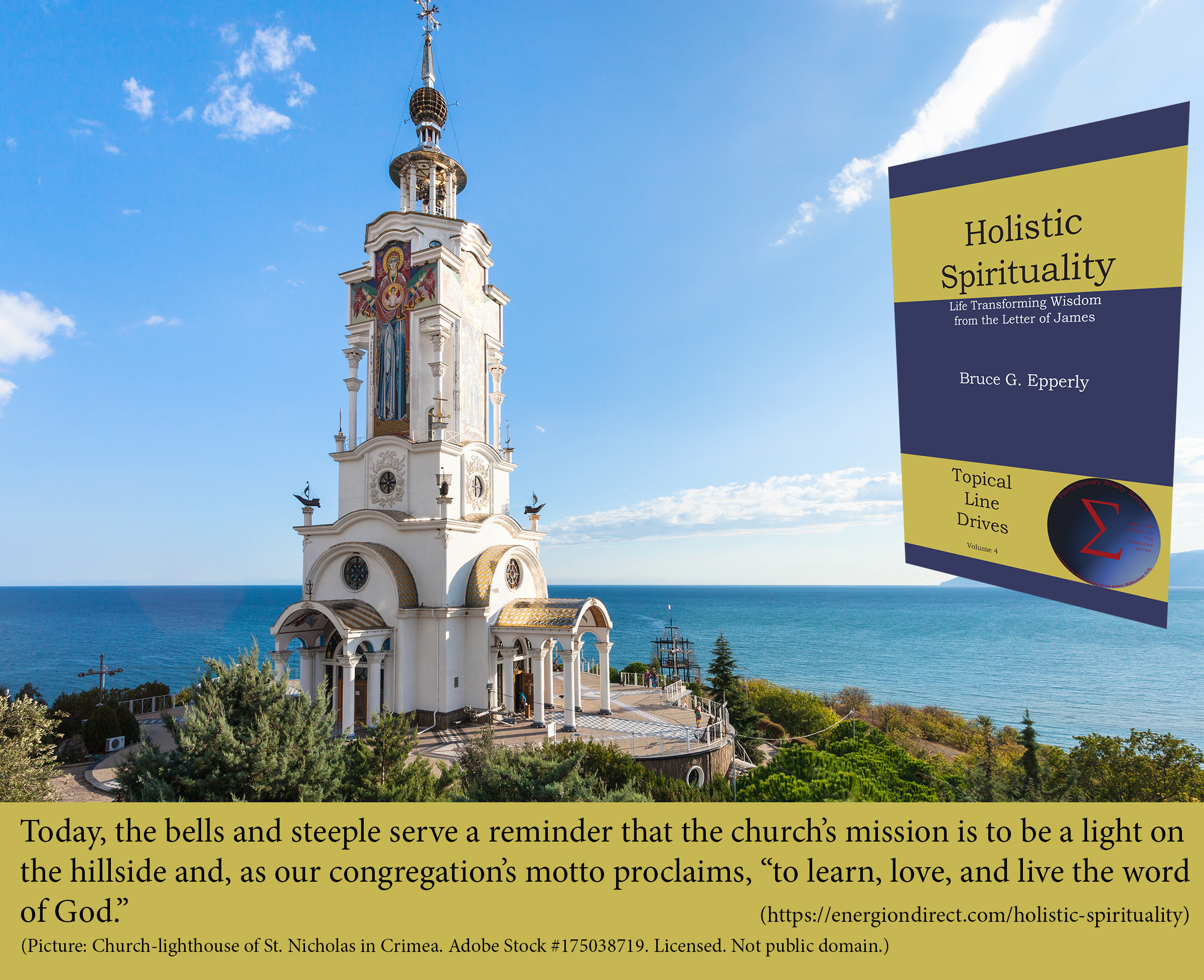
    Our Sunday School lesson, which I’m not teaching this week, is from James, focusing on chapter 2. I’m not teaching, but in studying, I looked at a book I publish, Holistic Spirituality: Life Transforming Wisdom from the Letter of James.

    Bruce Epperly makes a number of important comments. I’m going to do a bit of quoting from his chapter 3, pp. 15-21.

    One of my great joys is my first glimpse of the steeple of South Congregational Church, when I round the bend toward home. In earlier times, the church’s steeple guided mariners safely to shore. Today, the bells andsteeple serve a reminder that the church’s mission is to be a light on the hillside and, as our congregation’s motto proclaims, “to learn, love, and live the word of God.” (p. 15)

    I like that motto, “learn, love, and live.” I think it may go the other way as well, we learn from what we live, especially when we’re trying to live the word of God.

    Faith means nothing unless it lights the way of pilgrims and seekers, providing guidance, comfort, and nurture. (p. 16)

    Here Bruce combines faith in action and faith in witness (and our action is, I think, our best witness) in a way of which I think James would approve. We are not Christians, or Jesus people, for our own benefit alone. We receive grace to share grace. That’s why grace cannot be a passive thing. It erupts in action.

    … The Apostle asserts that because God loves us, our vocation is to love one another, even if this means crossing the barriers of race and ethnicity. Grace makes us all first-class Christians, worthy of respect regardless of ethnicity or economics. This is the essence of James’ message as well.

    James believes that a holistic faith brings together belief and action. In the spirit of the Quakers, what is important to James is to “Let your life speak.” … (p. 17)

    I think that the tendency of many interpreters to see James and Paul as opponents is misguided. They do have a different emphasis, but it is not because Paul hated or devalued action or that James thought beliefs were unimportant. Each had an emphasis, but these emphases are compatible or complementary.

    Loving Jesus means loving your neighbor. And if James is right, it means standing aloof and becoming counter-cultural in
    relation to socially-acceptable, but life-destroying, values – “being unstained by the world” – that put profits ahead of people, neglect the needy, and blame the poor for their poverty. We are all created in the image of God and we all deserve to be loved, to have a place to call home, and an opportunity to live out our gifts and talents as God’s beloved daughters and sons. (p. 19)

    That’s were it will start to get with us. Sanctified wallets are the hardest of possessions to acquire. Or, looked at the other way, the wallet is the hardest thing to give up. How much stuff must we have? What is first in our life? Putting God first will result in also putting our neighbor first.

    But what can you do? Maybe all you have to spare is coins in your pocket.

    In the realm of God, no deed is too small, for with one action at a time we can become God’s companions in healing the world. Let your life speak. (p. 20)

    This is a great little book, just 40 pages of text from Energion’s Topical Line Drives series, for accompanying a study of James. It might just be, as the subtitle suggests, life transforming!

    Read Now


  • The Little Horn of Daniel (Again)

    Since I grew up as a Seventh-day Adventist, I almost have to be interested in Daniel 8, particularly 8:14, which is critical to the development of the Adventist movement. For those not acquainted with that history, this is the verse from which the prediction of the second coming of Jesus on October 22, 1844 was derived. In turn, that doctrine developed into the doctrine of the investigative judgment, which I list as one of my reasons for not being an SDA today.

    While at first my objections were exegetical and based on Daniel 8:14, I have come to be more concerned with the soteriology involved. I still hold to those original objections.

    Thus I link to an article from Adventist Today, Why the Little Horn of Daniel 8 Must Be Antiochus Epiphanes. I would note that the author, Winston McHarg, resigned from the SDA ministry in 1978, while I was a student at Walla Walla College, and still a few years before I left the SDA church. For a short article, this one is well-done exegetically.

  • A Note on General Revelation

    A Note on General Revelation

    No, that the horribly misused book, but the theological concept of general revelation.

    It is quite common to express concern about the quality of knowledge of God that one can get from general revelation. It lacks specificity, it’s easy to misunderstand, or it has become corrupted.

    I’m not writing this note to challenge the idea that extrapolating from the creation to the God of creation can be difficult. On the other hand, I was just reading Psalm 33 in preparation for next week’s Sunday School lesson, and I note that in vs. 6-9, we have a rather direct line drawn from creation to creator. By his word the heavens were created. He established, and that’s how it was. He commanded and it stood.

    My thought is this: I have found in written scripture that often we reject the meaning of a passage because we don’t like it. I’ve told classes that you can get a clue to how little people like what a passage says by how much ink has been used explaining it. That doesn’t mean that there aren’t obscure passages or those where the obvious is actually wrong. It can be a clue, however.

    I suspect that it may be where nature does not tell us warm and comfortable things about God that we tend to think it’s unclear. Perhaps we need to find a way to distinguish “unclear” from “very clear, but annoying.”

  • Ezekiel 36: Telling the Story

    Ezekiel 36: Telling the Story

    This was one of my texts from yesterday, though we worked from Titus 3:3-11, where I think vs. 3-8 parallels chapter 36 quite nicely.

    But my interest today is not in a specific verse, but rather in the way in which Israel’s story is told. Christians often have ambivalent, if not downright negative, feelings about the Old Testament or Hebrew scriptures. You’ll hear people say, “I’m more of a New Testament person.” In a certain sense, we should all be New Testament (Covenant) people. We are God’s people under terms of the new covenant. That’s why we call that portion of Scripture the “New Testament.”

    Nonetheless, Israel’s story is critical. One reason it is so useful is the way in which Israel told their story. Other nations record their triumphs and their successes, crediting the appropriate historical characters. Sure, one will have comments on how the gods favored this person or that, but the overall story is one of human triumph.

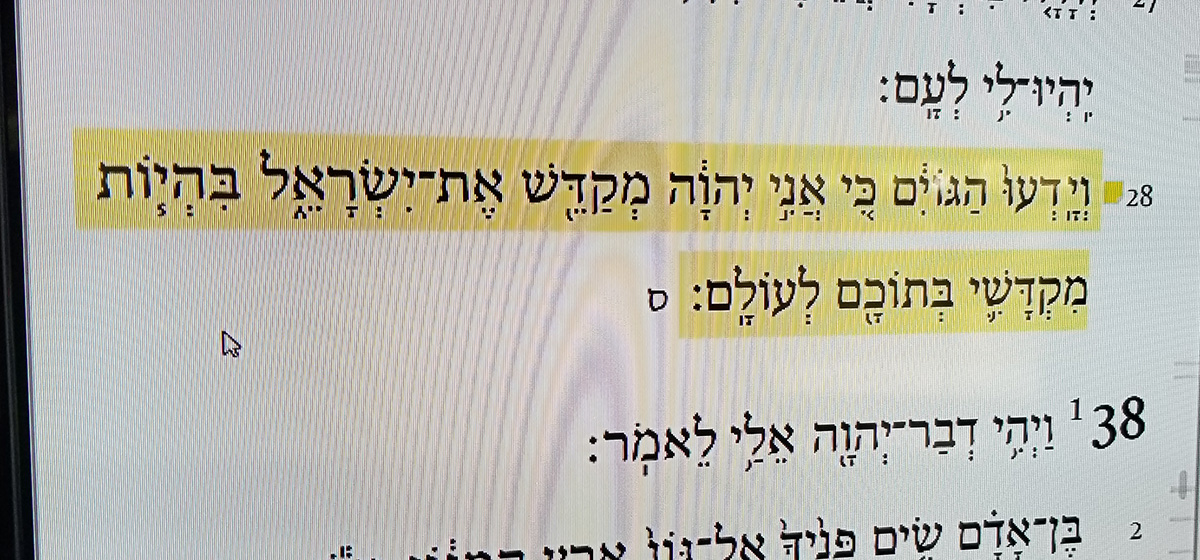
    Israel, on the other hand, records key failures. We focus on things like slavery in Egypt, and the human leader who brings out Israel is a reluctant leader, taking actions as God initiates. One of the key high points, the establishment of the Davidic monarchy, is told with amazing details about the failings of the human players. Then we have the exile, from which Israel emerges due to the intervention of a foreign monarch. Ezekiel 36 underlines this by not claiming that Israel had, themselves, reformed, but rather that YHWH would cleanse them, give them a new heart, restore them, and be their God. He wouldn’t even do this for their sake, but for the sake of their reputations, ending (Ezekiel 37:28) with the nations knowing that he is God because he makes Israel holy.

    Christianity joins this tradition as it is born out of the depths of despair and not the heights of triumph. We need to remember this as we strive for position and power. We serve one who did not. We honor (I hope!) a tradition that does not give its greatest honor to the powerful. We are sinners in the hands of a God who is making us holy. That is the story of salvation.


  • OT v. NT: God Does It

    OT v. NT: God Does It

    One of the differences some claim between the Old and the New Testaments is that in the Old Testament it’s about works, while in the New it’s about God’s grace. I’ve found vanishingly few Old Testament scholars who hold this difference, but in the pews it’s fairly common. One response, of course, is to read a good collection of the commands to action in the New Testament. On the other hand, one can read the Old, as I was doing this morning in preparation for teaching Sunday School.

    I’m studying Ezekiel 36 & 37, looking particularly at the actions of the Spirit there. There is a theme in chapter 36, and it’s important. While God talks about Israel’s failings, and the reason they were scattered, when it comes time for redemption, there is no discussion of the punishment having taught them their lesson so that from now on they will be good on their own power. Rather, the emphasis is that God is causing them to be gathered for God’s reasons and purposes.

    “I YHWH have spoken, and I will do it” (v. 36). “My Spirit I will put within you, I will make it happen that you will walk in my statutes, keep my judgments, and do them” (v. 27). Both those translations are a mite over literal, but I could get even more literal to connect the Hebrew vocabulary in v. 27 “I will do that … you will do.” The reform is presented here as a decision and an act of God, not of human beings.

    Human action is certainly called for, both here and elsewhere, including all through the New Testament. But the decision and cause is put back to God’s Spirit.

  • Following the Path of Jesus

    Following the Path of Jesus

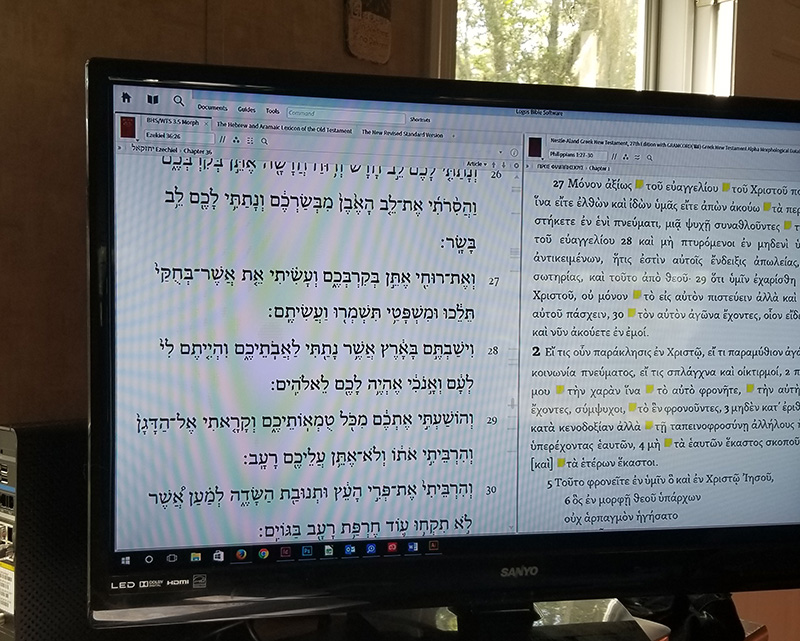
    On January 1 God called two texts to my attention as themes for the year. They are Philippians 1:27-30 and Ephesians 5:1-2. I haven’t said a great deal about this, though the theme of those texts has shown up in a number of posts. Then yesterday I saw Dave Black’s latest translation of Philippians 1:27-30, which I like a great deal, and I wanted to mention it. Reading a text in a modern, clear, might I say dynamic, rendering brings it home. Here’s the translation:

    Now the only thing that really matters is that you make it your habit to live as good citizens of heaven in a manner required by the Good News about Christ, so that, whether or not I’m able to go and see you in person or remain absent, I will be hearing that all of you, like soldiers on a battlefield, are standing shoulder to shoulder and working as one team to help people put their trust in the Good News. Don’t allow your enemies to terrify you in any way. Your boldness in the midst of opposition will be a clear sign to them that they will be destroyed and that you will be saved, because it’s God who gives you salvation. For God has granted you the privilege on behalf of Christ of not only believing in Him but also suffering for Him. Now it’s your turn to take part with me in the life-or-death battle I’m fighting — the same battle you saw me fighting in Philippi and, as you hear, the one I’m fighting now. (emphasis mine)

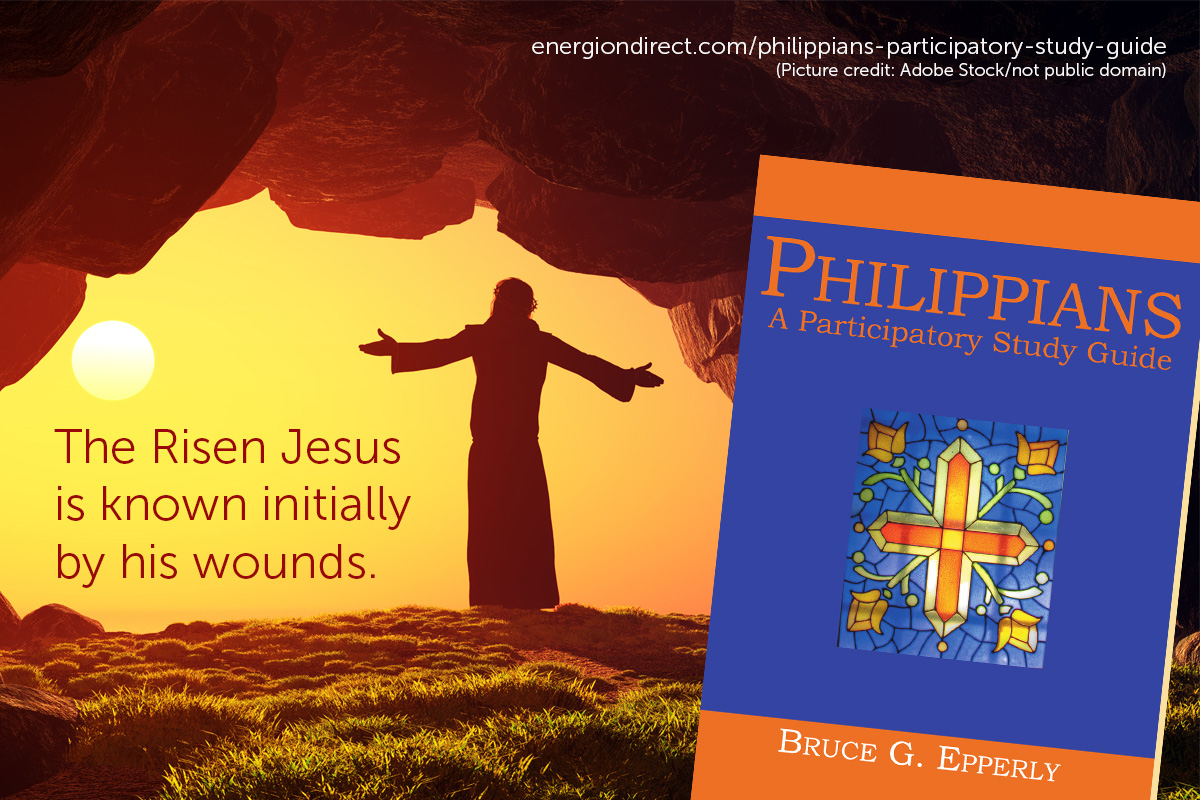
    This emphasized line led me to a quote from Bruce Epperly’s book Philippians: A Participatory Study Guide:

    Even now in our time, we can take confidence in Paul’s assertion that God is with us and that, in life and death, and celebration and persecution, Christ sustains us. We are resurrection people. But, our lives are also cruciform or cross-shaped. The Risen Jesus is known initially by his wounds, and we too may experience suffering and loss as a result of our relationship with Christ. Still, at the end of the day, integrity, fidelity, and the promise of resurrection life far outweigh any trials of this lifetime. – p. 19

    Bruce also quotes the song “I have decided to follow Jesus.” It’s a good song, but it’s one that should be very hard to sing. No, not musically, but due to meaning.

    (I must note here in passing that I love to use materials that come from very different theological streams. It is especially important, I think, when people from opposite sides of the spectrum agree fully on the meaning of a text, even more so when that text says something people would often rather not hear.)

    On the night when Jesus was betrayed, there were twelve people (at least) who had decided to follow Jesus. One betrayed him. One denied him publicly. The rest “advanced in the opposite direction.” We can take hope from the fact that so many found their way back!

    Ephesians 5:2 similarly gives us a hard call “walk in love.” Now we like that, because we often call very unloving things “love.” But the verse goes on “just as Christ loved us and gave himself for us. We have a very clear pattern for what love actually means. I’m a love proclaimer. I believe in the power of love. The reason love so often seems wishy-washy, that it so often fails, is that what we call love is often partial. It is not commitment, but rather a sort of generic liking. That’s why the key to following Jesus is not the experience of miraculous physical acts, or wealth, or healing for everyone in sight, or healing of all our emotional ills. The key to following Jesus is the willingness to take up the “privilege” of suffering for him.

    This, I must confess, is not the true story of my life. Nonetheless, just as I can travel northward by using the pole star as a guide even though I’ll never reach it, so I will keep facing this way, and trust in the grace of the One who gave himself first.

    (Allow me to call attention to two previous posts: God Perfected through Suffering and Thankful for the Gift of Suffering for Jesus?)

  • Acts 12: Reacting to Miracles (and Their Absence)

    Acts 12: Reacting to Miracles (and Their Absence)

    Acts 12 is an interesting chapter, both because of what happens and what doesn’t.

    James, the brother of John, is seized by Herod and killed. No comment, backstory, or reaction provided. One short verse and gone. I’ve just said more!

    Then Peter is seized, and they expect him to be killed as well. The whole church prays for Peter. We’ll suppose that the church prayed for James as well, though it’s possible he was seized and killed so quickly the word didn’t get around until he was dead.

    I think the stark presentation of James’s death, followed by the prayer of the church and then the rescue of Peter starkly emphasizes that prayer doesn’t always make things work the way we want it to, provided we haven’t figured that out by reading about Stephen’s death in Chapter 7. Yet the church prays.

    As we watch calls for prayer regarding the aftermath of Hurricane Harvey, and recognize the prayer that went before, we should perhaps note that prayer isn’t a means of steering hurricanes according to our desires, nor of doing the cleanup afterwards. As I once heard preached, prayer isn’t a substitute for anything else, and nothing else is a substitute for prayer. Prayer has its own functions.

    In any case, this time while the church is praying, an angel is off to rescue Peter. It may be just my imagination, but it feels like Peter is kind of an automaton through the first part. In verse 9, we’re told he thinks it’s a vision. He is certainly not thinking, “Oh, yes, here’s the angel I expected come to rescue me.” Once he’s in the street and the angel poofs, he realizes it’s really happening.

    He heads off to where the church people are praying, and here we get a cameo by young Rhoda, who appears in scripture this once to be so happy at hearing Peter’s voice that she doesn’t open the door for him, but rather heads off to tell the other people he’s alive.

    There are a few people like her around today. They want to see a miracle happen, or even something they can imagine to be a miracle, and their purpose is to talk about it. They too can forget to open the door to whatever is happening next.

    The people in the house are also quite normal people. They don’t believe Rhoda. After all, if you knew the security arrangements around Peter, you likely wouldn’t believe he was there either. I’d probably think someone got the guards drunk, stole the key, and then led Peter out of prison. If it was today, I’d think some kind of sleeping substance added to their food. At least they let Peter in off the street.

    Sometimes Bible stories are really sparse. I keep wondering about Peter’s thoughts. He keeps knocking, but I imagine he was a bit put out when they didn’t open the door. Peter’s angel, indeed! (12:15).

    Finally, we have Herod’s reaction. Imagine being one of those guards. I know I go off track, but I kind of feel sorry for the guards. They’re just ordinary guys off serving their country/ruler, and Herod isn’t for a moment going to believe that they were miraculously put to sleep while their prisoner was taken. Honestly, Herod’s reaction is quite rational. The best explanation for the facts he has before him is that the guards either shirked their duty or perhaps even took bribes to let Peter go.

    Peter, who seems a relatively sensible guy in this story goes somewhere else.

    I think if we read this story and let some of the turns sink in, we might away from a mechanical view of prayer and providence. It’s worth a try in any case.

    (Some books I publish that relate: Pathways to Prayer (David Moffett-Moore), Angels, Mysteries, and Miracles (Bruce Epperly), and Directed Paths (my mother Myrtle Blabey Neufeld. Featured image credit, Openclipart.org.)

     

  • Alden Thompson Speaking at Adventist Forum Conference

    Alden Thompson Speaking at Adventist Forum Conference

    Alden was my undergraduate advisor at Walla Walla University (then college), I publish two of his books (Inspiration: Hard Questions, Honest Answers and Who’s Afraid of the Old Testament God?), and he is a friend. Many of my friends have heard him speak in person. Here he is presenting a paper at a conference, so is somewhat less free-wheeling than he is normally, but he’s making some important points.


  • Literal Problems, Literally

    Literal Problems, Literally

    I found Should we read the Bible literally via Facebook, and want to commend it to my readers. I can’t tell for sure, but I suspect the writer is perhaps more conservative than I am, yet he makes many points I frequently try to make. I think he may be a bit too optimistic on the hope of recovering the word “literal” from popular abuse.

    I’ve often said that if I could take one saying away from Christian conservatives it would be, “The Bible plainly teaches …” Our frequent disagreements as Christians seem to challenge that idea. It’s always possible that the teaching is plain and we just want to work around it, but who has the right view and who’s working around? It would be better to just bring forth the arguments in favor and let someone else decide how plain it is.

    On the other hand, the phrase (regarding the Bible) that I’d most like to take from liberals is “We don’t take that literally.” The problem is, how do you take it? The meaning of the word “literally” is “literally” not that settled. Biblical scholars and theologians use it differently than the general population. So whether you’re telling someone to take it literally or not, the odds are they’re going to understand it differently.

    For example, I regard Genesis 1 as never having been written with the intention of developing a sequential, historical, scientific view of origins. Rather, it speaks in the context of its current cosmology and gives God’s role in creation. Contemporary readers would likely have perceived it in those senses, but there’s no necessity that one do so, and the elements the stories are trying to convey are not harmed by changing chronology or method of creation. (In my view, at least!) I do not doubt the reality of God’s action. Is that literal or not? It’s a bit more difficult to answer that question than the example of calming the sea in the referenced article. But that’s why I suggest that “not literal” is also not helpful.

    What we have to do is specify how we do read the text. For example, I read Genesis 1:1-2:4a as liturgy and the rest of Genesis 2-3 as myth, in the best sense of that word. “Myth” frequently becomes a synonym for “not true” when, in terms of literature, it speaks to the foundational function of a story in a society. A myth might not be a true story, in the sense of narrative history (we often use “literal” here), but it also might be. Historical events do become myths in functional terms.

    Ian Paul makes that point in the referenced article with regard to the story of calming the sea. There is extended meaning. One can take the sea and the boat allegorically, but the allegorical meaning is built, for many at least, on the idea that the underlying story really happened. I would disagree that one can’t get allegorical meaning if one doesn’t take the story as historically real, but there would be a difference in that meaning.

    All of which simply leads back to the first point. We need to be careful with our use of language. I think that too many Bible students use their own definition of literal, by which I mean the one understood by most Bible scholars, and tell people they should interpret the Bible literally. People in turn believe they are being told to make the Bible concretely applicable no matter what. Which problem is not helped when someone like Tim LaHaye says to take the Bible literally if at all possible, and then applies it by making all the symbols of Revelation apply in a concrete sense to future physical events. Some of the words in Revelation do refer to such things. Others refer to spiritual things. There is a variety of usage. It’s a vision; expect some variety in the author’s (and Vision-givers) intent.

    Most importantly, try to be aware of how you are taking a passage. Literal/figurative is not adequate. What type of figure is it? What time of reality does it reference?

    In answering those questions, you may well discover why I so dislike hearing that “the Bible plainly teaches.”

  • Acts: God Moves in Unexpected Ways

    Acts: God Moves in Unexpected Ways

    I’m currently reading the book of Acts for my morning devotions and today I read chapter 6. That’s a nice, short chapter!

    The disciples find that there are complaints about distribution of charitable works and they decide they shouldn’t be distracted from the Word in order to wait at tables (and other such things). The result is the choice of seven deacons. Again, they pray, and then lay hands on them and commission them to this work. Other than the continuing spread of the message, we’re not told how this organizational structure worked.

    As Acts proceeds (since I’ve read it before, I know how the story ends!), we’ll hear quite a bit about Stephen and Philip. It’s interesting to note, however, that we don’t hear about them serving at tables, which, ostensibly, they were chosen to do. In fact, we hear them proclaiming the Word themselves. In chapter 6, it starts with Stephen, and it promptly leads to his arrest.

    Let me note a couple of things here:

    1. They don’t record any time of prayer before going out to choose these seven men. It appears they jump straight to the strategy.
    2. They don’t record any time of prayer or deliberation before choosing the seven.
    3. They do pray before commissioning the men by laying hands on them.
    4. We see no record of results of this activity that match the intent. Yes, results. Stephen and Philip are significant players in the story and they are introduced to us here, but there is no record that the issue with distribution of service (apparently particularly food) was resolved.

    Now it may be that I’m reading too much into the white spaces here, but this is the second time I’ve noticed this during this pass through Acts. I’d noticed before that Matthias (chapter 1) is appointed as a new apostle and then disappears from history. Considering how much of this portion of early Christian history is recorded just in Acts, one wonders if this is accidental. (My sister Betty Rae pointed this out to me some years ago.) In my reading this time I noticed how the choice to replace the missing apostle is made based on Peter’s interpretation of scripture. There’s no effort made to seek God’s will for this particular instance. Then two people are chose according to criteria they select.

    Let’s parallel the numbers:

    1. There is no prayer time as they choose the basic strategy. Unlike Acts 6, this strategy is apparently based on Peter’s reading of scripture.
    2. They choose two people again without any time of prayer.
    3. They now pray and ask God to choose between the two. The situation differs from Acts 6 in that the seven were chosen and then the prayer is offered as they commission them. “Please bless the ones we have chosen,” is the petition. Here it’s “choose one of the two options we’ve given you, Lord.”
    4. No results are recorded.

    Now comes the fifth step, which is what’s hitting me on this pass through Acts. God immediately takes action to advance the kingdom, and it doesn’t fit with the human plans, even the plans by the apostles. In Acts 6, Stephen heads right out to proclaim the gospel and defend it. In the case of Acts 1 we have to wait until chapter 9 before we see God choosing someone as an apostle, one who doesn’t fit the list of criteria, but who certainly carries out the mission.

    I wonder if Luke is telling us something here? I’m really not that acquainted with scholarship on Acts, so this may have been thoroughly ground to dust somewhere in the commentaries. Still, it’s something to think about.