


Threads from Henry's Web

Tag: penal substitutionary atonement

  • The Moral Influence of Jesus’ Death

    The Moral Influence of Jesus’ Death

    In my Sunday School class yesterday we discussed Mark 15. We’re reading this with Allan Bevere’s Keeping Up with Jesus: A Narrative Devotional Commentary on Mark.

    In the thought questions for chapter 15, Allan asks both why Jesus is silent at his trial as depicted in Mark, and what it means that Jesus died for our sins.

    On the first question, there were a number of answers, including simply, “prophecy,” that it was expected. But I want to focus on one note I make myself about this, because it relates to the third question, which is how we understand Jesus dying for our sins. (There are three questions following each chapter in the commentary. I’m focusing on the first and third.)

    In a trial with a foregone conclusion, there is really no point in making a defense, unless you are doing so for someone listening. In this case, I suspect the crowd is well selected for hostility (at least of the moment), and thus not prepared to actually listen to a defense.

    This leads me to what I think is a key point about the death of Jesus. It creates a story of contrast and of black and white confrontation. Nobody is seeing the day in shades of gray. In a book by one of my favorite authors, David Weber, there’s a quote by one of the characters, which I paraphrase from memory here: “Very few days are outlined in black and white, and most of those days have a body count.” I don’t know if that quote is original to Weber, and I can’t locate the correct book, but it’s good.

    The day of the crucifixion was not set out in gray, and it definitely had a body count. It creates the moment of contrast between what good is willing to do and what evil is willing to do. Good dies for others; evil kills what it does not like.

    A portrayal such as this is one that day to day reality can’t really live up to. We don’t have the clear line drawn in the story. We have our struggles both to understand and to do. But that is a critical value of the story: It drives us to higher ground. If we let it.

    So what did this have to do with the third question. What does it mean that Jesus died for our sins?

    What I loved about this question was that it called for each person to think: What does that mean to me? It’s easy to be very prescriptive. We like to have one interpretation and get everyone to understand it.

    The Values of Multiple Metaphors

    I would suggest that no single metaphor can possibly do justice to the atonement. It’s a good thing we don’t have only one!

    Moral Influence

    As an undergraduate working on my degree in biblical languages, there was a required course on exegesis of Romans in Greek, to be taken after I completed intermediate Greek. The professor for this class was an advocate of the moral influence theory of the atonement. This theory is often presented simply as Jesus providing an example in his life of how we should live and influencing good behavior in us.

    That’s not the whole story. In that theory, the portrayal of good and evil meeting at the cross becomes a powerful influence, a powerful changemaker.

    I didn’t get that in class. I wanted something other than penal substitutionary atonement, and I hoped that I could accept what this scholar presented. I wanted to read this view in Romans. I tried to do so diligently.

    It never worked.

    It took me some time to realize that there was something here for me to take in and make a part of my understanding. That portrayal, brutal as it was, was a necessary part of the story of salvation. It was easy to miss this in other views. Then I started to see other metaphors for the atonement, and to see how they build a picture.

    Penal Substitutionary Atonement

    In fact, I came back to appreciate the courtroom metaphor presented by penal substitution, which, among other things helps portray completeness, and finality while excluding the idea of us earning the result. I have conservative friends who still think I’m ditching this dominant evangelical view of the atonement and progressive friends who wonder why I don’t just ditch it. To me, however, each of these views is essential. Since this is not my main topic, I’ll leave it at that.

    I turn next to expressions of faith by the Apostle Paul. Paul can be an annoying character. He covers a lot of ground and expects you to keep up.

    About Paul

    I was interviewing author Herold Weiss, author of the book Meditations on the Letters of Paul in a series I did titled “Who Was Paul?” One question I asked was this: Let’s imagine you’re at a conference and you have the duty of introducing Paul as the next speaker. What do you say?
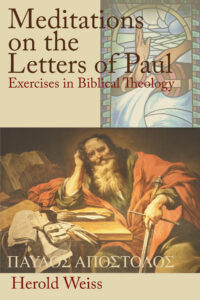
    Herold laughed and said, “I don’t have to answer that. You see, Paul would never have been invited to speak in the first place!”

    He’s likely right. Paul was too much of a disruptor to be invited to church conferences. It was much more likely that conferences would be held to talk about him and what he was doing, such as in Acts 15.

    Paul, Good and Evil, and Crossing the Line

    In many of Pauls’ letters we have what looks like a theological section, which generally talks about salvation and will frequently inform you that it is not of works. Then you move to a section that talks about things you ought to do. Often these sections are presented as distinct, as though Paul had multiple personality. “Not of works, now get to work,” so to speak.

    I think a closer look will allow these to be coordinated, and I think Philippians is an excellent place to do so. The reason is that until chapter 3, which seems to be a kind of side-tirade, Paul is ready to go through the basics quickly.

    By Philippians 1:27 he’s telling his readers/hearers to live in their community in a way that is “worthy of the good news (gospel).” He wants to hear that they are “standing firm,” and “striving together” for the gospel. He continues that God has granted the the privilege not only of believing (a privilege, a gift, not a purchase), but also of suffering for Jesus as well.

    Not of works. Here come the works.

    Well, yes and no. Paul is writing here, I think, on that line drawn between good and evil at his crucifixion. You get a choice. Are you a crucifier or are you crucified?

    Too often Christians have answered that they are with the crucified one while picking up nails and erecting crosses.

    Persecuted or Persecutor

    I was asked once in Sunday School who I thought was right when two groups were fighting over doctrinal points, really fighting, to the extent of killing one another. It has happened way too much in Christian history. I said that anyone who was killing the other one over their beliefs was wrong. Killing people in the name of the one who went to the cross silently and said, “Father forgive them,” is blasphemous.

    Have I departed from Paul and his letter to the Philippians? I think not.

    How to Look at Other People

    Paul now tells the Philippians to make his joy complete (2:2) by being of one mind (sharing viewpoint) and having the same love. Nothing is to come from selfishness or vanity, but they are to regard others as better than themselves (2:3) then also look to the interests of others, rather than their own.

    I think Paul is looking at that line. Are you a crucifier or are you with the crucified?

    Philippians 2:5-11 is a famous passage. Jesus emptied himself, humbled himself, became obedient, and went to the cross. Others called for his blood.

    This was a portrayal of the nature of good and the nature of evil. That is something we should not forget about the crucifixion, if for no other reason that we avoid becoming the persecutors.

    As Paul says it in Galatians: “I have been crucified with Christ. I’m no longer the one living, but Christ lives in me” (Galatians 2:19b-20a). That’s the line drawn in morality and in history. Paul has no intention either in Philippians or in Galatians of telling his hearers that this is easy. He doesn’t suggest that everyone will love them after the decision or that they will get a new job, drive a better car, or be suddenly totally free of disease.

    Be crucified with Christ.

    Identifying the Power

    Things start going off the rail again right here. We think that having been crucified with Christ, or at least made the choice of which side of that line we want to be on, we must get on the ball and be better people.

    Indeed, Jesus was exalted after death and given the name above all names. But first he went to that cross, was taken into the tomb, and was raised again by the very power he laid down in the first place.

    Remember where the power comes from.

    Having died, and been buried with him by baptism, you don’t come back and start fixing yourself.

    “So, if anyone is in Christ, there’s new creation. The old stuff is gone. It has all become new.” (2 Corinthians 5:18b)

    You can’t sanctify yourself. You’re dead. You’ve got no stuff at all. It’s all new, and it’s all His.

    Who Works?

    So back to Philippians and one of my favorite passages:

    (12) So, my beloved, just as you have always obeyed, not only when I’m there, but also when I’m away, with fear and trembling work out your own salvation. (13) For it is God who works in you all, both to will and to accomplish his pleasure. (Philippians 2:12-13)

    So how does this work?

    I wonder why it’s so hard to see God at work in us morally when we already know God is at work in us. If you are a believer in God and that God is the creator, then everything, ultimately, is a gift of God. I could paraphrase this physically as “Do your own breathing with fear and trembling, for God is at work in you both to make you want to breathe and also to make you breathe.”

    I don’t think that’s a ridiculous way to put it. I couldn’t type the next letter without God. God makes the various particles move around in a certain way. God brought me into the world. I can’t even make mistakes without God.

    If you try to take over and do your own working, that just makes everything harder. God knows that and has a plan for all that as well. God makes you want. God works in and through you. But ultimately it’s all God.

    If you go try to do it yourself, then it’s like jumping back to the person who just died, forgetting about being buried and raised to new life by divine power, and deciding to do it all just as if none of that every happened.

    Does this mean there’s nothing to do? Actions are still important. Actions have consequences. Paul even says this in Galatians, his strongest book against works of the law. “Don’t be deceived! God is not mocked! Whatever a person sows that person will also reap” (Galatians 6:7).

    The Life Context of Commands

    Again we have to look at context, in this case, life context. Not every command, not every discussion of good and bad, smart and stupid, effective and ineffective is about whether or not you are saved or have eternal life. Deciding someone’s eternal state is not my job and it’s not yours. Let’s say that I am hiking a trail in some beautiful mountains, tremendous beauty all around, and I get careless, lose my step, and fall off a cliff. Gravity (created by God) still works. The ground (created by God) is still hard. My body (created by God) is still not up to a fast encounter with a hard place. I die.

    Are the mountains still beautiful? Yes.

    I also still have eternal life.

    But it would have been a good idea to be more careful.

    The Invitation

    The invitation to salvation is not an invitation to an untroubled life. It’s not an invitation to always make perfect decisions. It’s not an invitation to comfort.

    It’s also, and this is critical, not an invitation to think of yourself as better than other people. It’s not an invitation to be God’s favorite grandchild, spoiled rotten and looking down on all the other children who have somehow failed to earn all that love.

    If you thought going to church was joining the popular kids’ club and becoming one of the important people, you missed the point. If you get a charge out of feeling superior, you’re missing the point.

    “Looking to Jesus, the author and completer[sic] of our faith …” (Hebrews 12:2).

    Completion

    Read Philippians 2:5-11 again. Try to imagine just what it was that Jesus thought was not something to hang onto, what Jesus gave up. That’s where God is taking you. Don’t diminish that by looking sideways or looking back. When your measuring stick is God’s glory and God’s grace, the differences in human beings are literally not measurable.

    And just as Jesus not only went to the cross and the grave, but rose again and ascended, so we now that God will complete what God has started.

  • Substitutionary Atonement: One of Many Perspectives

    I have often annoyed people by saying both that I believe in substitutionary atonement, though I prefer not to use “penal substitutionary atonement,” and also do not believe it is the sole reason for, view of, or metaphor to describe what God did in the atonement.

    So it’s nice to link to Roger Olson, who may be a bit less critical of substitutionary views than I am, but yet explains both the positive in this theory of the atonement and also some of the misunderstandings. If nothing else, this may help us discuss serious presentations. Well worth reading.

  • Penal Substitution is ONE of the Ways to Talk about the Atonement

    I think The Truth Is … Out There on the Wesley Bros. Blog did a good job of expressing this.

    To my liberal brothers and sisters: Yes, I do believe in penal substitution.

    To my conservative brothers and sisters: No, I don’t believe in it as the one and only way to believe in or discuss the atonement.

    One of the ways. Your mileage may differ. In fact, I hope it does.

  • The Relevance of Atonement Theories

    The Relevance of Atonement Theories

    Discussion Ahead traffic sign in woman's hand on a white background
    Discussion Ahead traffic sign in woman’s hand on a white background

    On the Energion Discussion Network we have two essays posted in answer to the question “Do atonement theories continue to speak to the human condition?” The “yes” answer, written by Dr. Allan Bevere appeared yesterday. The “no” answer appeared today, written by Rev. Steve Kindle. I find both of these articles well worth reading.

    In the past I have been accused of rejecting penal substitutionary atonement because of the fact that I don’t see it as central, or as the explanation of the atonement. In fact, I don’t see any theory of the atonement as a single explanation of the atonement. Our theories of the atonement are metaphors, used to carry across some of the meaning to us.

    As does Allan Bevere, I do find pretty much all theories of the atonement relevant in one way or another. Where I tend to be concerned is where a metaphor begins, in some people’s minds, to become the reality, i.e. that rather than believing in the cross of Christ we believe in our particular metaphor, the one that may best speak to us. I recall a professor from whom I took a class in exegesis of Romans from the Greek text. What was remarkable about the class was that his favorite theory, or metaphor, for the atonement as the moral influence theory. Now I have a bit of a liking for that metaphor myself, but it is not the metaphor Paul uses in Romans. There is some overlap. But this professor, because that was his very most favorite metaphor, taught nothing but, twisting Paul considerably in the process.

    I’d add one more caveat. Relevance is a word that points both ways. A metaphor, to be relevant must communicate to one who hears. If it doesn’t, it isn’t working as a metaphor. I think quite often we need to correct the presentation of some metaphors to make them function better. If they don’t carry something over, they aren’t relevant in that case, however great they might be otherwise.

  • Why Jesus Had to Die

    In the study of the gospel of John I’m doing via Google Hangouts on Air, last Thursday night’s session was titled “I Finished the Work.” This reflects Jesus confidence that he had completed his mission, even before he had died on the cross or risen from the dead.

    For many Christians the reason Jesus had to die is quite simple. He had to die for our sins. More specifically, by his death, Jesus took the penalty for our sin(s) so that we would not have to. In theology this is referred to as penal substitutionary atonement, or sometimes just as forensic atonement, because it is set in a metaphor of the courtroom, and we avoid the just legal penalty of our actions because Jesus takes it instead. Thus if Jesus had not died, we would not be saved, and would be doomed to eternal death.

    But the courtroom is a metaphor, and as such, it may not provide the complete or the only meaning of what it tries to describe. Another metaphor is built on the family, in which we are adopted into God’s family as God’s children and thus are saved. You can find a clear statement of this in 1 John 3:1, but this metaphor is in play frequently in the gospel of John as well.

    Someone familiar with 1 John might point to 1 John 1:8, with the blood of Jesus cleansing us from sin. And indeed there are a number of points where the various metaphors touch. One thing we don’t always understand well in the west is the sense of community, of being collectively part of one nation, people, or family, so much so that we can be referenced as a unit, or spoken of by reference to a king or leader. In Genesis 14, there is a battle. We’re told in Genesis 14:9 that it was “four kings against five.” Surely it wasn’t just the kings! They must have had armies. Of course they did. But they were referenced by the titles of their kings.

    So when these kings were defeated, the people were defeated. If they won, the people won. We have that sort of vocabulary left in terms of sporting events and even of war, but we use it with less meaning. Thus if we said that one person suffered or died for a nation, we would generally be saying that the one person suffered instead of others. But in the ancient near east, we might well be saying that the a whole family or a whole people group was included in the suffering of that one person. In this way we can say that in Christ we have all died, and in celebration of Easter, in Christ we have all been raised. It’s helpful to read the servant passages of 2nd Isaiah (Isaiah 40-55 is identified as 2nd Isaiah) with this in mind. Is the servant a single individual, a group, or the whole of Israel. I think the answer must be “yes,” if we incorporate all the references.

    In 1 John 1:8, we also need to note that there is a different sacrifice in view than a sin offering. Here the issue is cleansing, and it would probably be much better to understand this as a purification offering than a sin offering. (I will try to blog more about these offerings soon!) Jesus dies for us, in this case, but it is not in a forensic sense, not taking a penalty, but rather is a cleansing ritual.

    In the gospel of John another way of expressing atonement, bridging the gap between God and humanity, is the simple one of looking up. We always cite John 3:16, but we’d do well to start with John 3:14 and not stop before John 3:21. Here the metaphor is a simple one of looking up. Looking up at the One sent by the Father, looking to the one who is our pioneer and representative, who is the head of our family, who is showing us the Father (John 1:18). It’s a very simple but important metaphor.

    And in this metaphor Jesus also dies for us, i.e. on our behalf. It is not here a sacrifice for sin, but rather it is the way that he is lifted up so we can see him. The son of man is lifted up on the cross, and in turn, lifted up right out of the world at the resurrection, and this finalizes the mission, the work, that he performed for us, and a great deal of that work was revelatory, showing us the father, curing our blindness so we could see, and getting us to look up so we would be looking at the right person.

    And this leads me back to the question implied by my title. Why did Jesus have to die?

    One reason is simple: To complete his mission. If Jesus was the one sent from the Father, here to show God to us, and thus bridge the gap between heaven and earth, infinite God and finite us, then he needed to do so completely. One cannot come and live as a human without facing and eventually experiencing death. Death is such an overwhelming fact of life. To skip it would make the rest of the story rather meaningless. “For God so loved the world that he looked in on us for a while” just doesn’t have the same ring as coming and going the whole distance as we have to.

    But why did the death have to be so awful?

    Because that is how someone who behaved as Jesus did would die in first century Palestine. That was how the ruling government, the Romans, behaved. If you or I had lived in that time and had possessed the courage and integrity that Jesus did, we would likely have ended up the same way. Certainly, divinity could have avoided the end, but by doing so would have separated itself from humanity. And Jesus was here to do just the opposite.

    I don’t want to deny any metaphor for the atonement. I think it is rich enough of a reality to allow for many metaphors. But I also don’t want to find myself limited to one way of looking at it. It is too rich in meaning to allow for that.

    Here’s the YouTube of “I Finished the Work.”

  • Quote: The Son of Man Lifted up on a Cross

    From my reading for next week’s study on John (Thursday night, 7:00 pm central time via Google Hangouts on Air):

    In the same way in which a flag lifted up on its pole draws together a people and constitutes it a nation, the Son of Man lifted up on a cross draws toward himself all who believe and constitutes them “born of God.” (Weiss, Meditations on According to John, 42)

    I am truly enjoying my reading in preparation for this study. I’ve been talking about metaphors, and leading toward the point that we use multiple metaphors to describe something that cannot be readily depicted in concrete language. Metaphors allow us to talk about the same subject in a variety of ways, each of which may contribute to our understanding.

    When a single metaphor becomes the one and only one permitted in describing an event, we begin to lose some of the content of the reality. Similarly, any time we allow one word for (or description of) God to replace God—what I call conceptual idolatry—we lose some of the reality of our experience of God. We can allow our description to limit who God is. In terms of the atonement, I believe that stating that the one explanation of the atonement is the metaphor of substitution in a forensic context, we start to lose some of the meaning of the atonement.

    Unlike some, I do see forensic and substitutionary metaphors in play in some scriptural descriptions of atonement. I don’t deny them as ways to discuss and understand atonement. My concern is that they not become the sole view, driving out other strong metaphors. The gospel of John uses a couple of different metaphors, especially centering around light and family, and we need to read those in their own context with their own integrity.

    When I was in college, I took Exegesis of Romans, which was intended as a sort of taste of Greek III, from a professor (Malcolm Maxwell for my fellow Walla Walla alumni), who was an advocate of the moral influence theory of the atonement. I was very attracted to the theology involved, but despite my best efforts, I couldn’t find it in Romans. It is wrong, in my view, though without any diminution in my great respect for Dr. Maxwell, to force the moral influence metaphor onto Romans. It is equally wrong to force forensic substitution onto the gospel of John. You may hear its echoes, but it doesn’t dominate.

    The quote above provides a taste. I’ll be discussing this in more detail on Thursday night.

  • How and Why Ezekiel, Hebrews, and Leviticus Shaped My Theology (Briefly!)

    In a comment, Steve Kindle asks:

    … in regards to your formative books, Hebrews, Ezekiel, and Leviticus, is it because you see Hebrews as teaching substitutionary atonement that springs from Leviticus? And Ezekiel foresees a renewed covenant that Hebrews embellishes? Just wondering.

    The briefest answer would be “no.” But leaving it at that would be rude, or at least would appear rude to me.

    My view of the atonement does not center on the substitutionary view, nor on the even more specific penal substitutionary view. This annoys one set of my friends, and perhaps an enemy or two. To annoy the rest, I must emphasize that I do not deny substitutionary atonement. I believe it is one way in which Scripture talks about atonement, though I don’t see the strong courtroom sense of the modern PSA in Scripture. What I actually believe is that there are many metaphors in in Scripture for God saving us from sin and death, and that each of these enlightens us in some way. Each of them, however, if made the sole metaphor, will also tend to lead us into various forms of imbalance.

    While the substitutionary view of atonement does occur in Hebrews, substitution itself is not in focus. Similarly, I do not get such views of substitution as I do have from Leviticus. The most famous quote on this is Leviticus 17:11, quoted at Hebrews 9:22, but if this is made to carry the weight Christians often make it carry, it will actually produce a contradiction in Leviticus, and the ransom theory/metaphor, one which fits the text of Leviticus more closely, works quite well in Hebrews.

    So having eliminated substitution as the formative view, what exactly did lead me to take these three books so seriously. I must admit that the key reason is simply that I chose to study them. I had no idea what I was getting into, but elements of the books fascinated me. But in fact some common themes became very much formative for me.

    Once I got started on Ezekiel, however, the key issue because the presence of the glory of God. There are interesting movements of God’s glory throughout the book, and they produce some quite interesting ideas. My first question was why we have a vision of God’s glory in Babylon in the first chapter, then we see the glory leaving the temple in Jerusalem in the 8th and 9th chapters, and finally it returns to Jerusalem in the 43rd chapter. The illogic on the surface of the first chapter led one commentator, whose name I forget though Eichrodt comes to mind, to suggest that the first chapter was moved by a later editor. Obviously God’s glory couldn’t appear in Babylon before it left Jerusalem.

    But on thinking a bit further I came to believe that was precisely the point. God’s glory was not restricted to the land of Israel. God was able to act anywhere. At the same time as God was able to act anywhere God has not rejected Israel either, so we see the glory return to the temple and life flow from the temple later in the book. In its very structure, Ezekiel looks forward to the blessing of the entire world in fulfilment of the promise to Abraham. Chapters 8 & 9 also make clear, however, that one cannot behave however one wishes and still expect God’s glory to remain and bless. So we see the withdrawal of God’s glory in those chapters along with the condemnation of all who do not sigh and cry for the abominations in the land (9:4).

    External to the three books I would point out that this “presence/absence of God” idea stuck with me. You’ll see it in Torah in wilderness, and you see that the presence of God is not necessarily safe, but is much to be desired. But the whole ceremonial system, as I was taught to call it, didn’t seem to make sense. In fact, the problem was that I heard about it almost exclusively as substitutionary sacrifice for sin. What I, as a Christian, was supposed to know was that lambs (little, cute, wooly lambs in Sunday School terms) were killed because of how awful people’s sins were, and this had pointed to Jesus dying as the lamb of God. Now I in no way want to diminish the view of Jesus as the lamb of God, and especially the application of that we see with the lion/lamb metaphor in Revelation 4-5. But why is there this huge body of literature starting in the latter portion of Exodus and going through numbers, with a few points in Deuteronomy? So from there I started my study of Leviticus.

    I began to see a much broader sense of the ceremonial law, how many of the things taught by the prophets were foreshadowed in liturgical form. These include a priestly teaching of the doctrine of repentance, a repeated turn away from ritual as powerful in itself, and a drive to learn to distinguish holy and unholy, not to simply avoid the unholy, but to become holy, to increase the bounds of the holy. God told the Israelites to be holy because he is holy. A simple yet extremely daunting command.

    My wife said that during this study I would come away from my personal devotion time detached, as though I had been in an extraordinary time of spiritual experience. All I can say is that I would love to write a study guide for Leviticus with the intention of drawing more Christians into that story, but that I feel utterly inadequate to the task. In my study I would read the text in Hebrew, then in the LXX, and finally in an English translation before going to Milgrom’s commentary. It takes hard work to get even a good start on this material, but I consider it well worthwhile, in fact, the most worthwhile year of personal devotions I have engaged in.

    And that turns me back to Hebrews, where I see Hebrews 6 as the center of the book’s message, but if you step back right before, one of the characteristics of mature Christianity is having one’s faculties trained by practice to discern good from evil, a close parallel to Leviticus. I think it is also closely aligned in goal, i.e., this training of the faculties is part of the endurance, staying on the track. And note that I don’t think this contradicts it being a gift from God. The Torah is also a gift from God, and it was instruction. It’s purpose was to train.

    If I could summarize, I get from this that my faith is to be an active faith, an active seeking of the presence of God, a life of practice. We are changed and transformed by looking, by finding, by discerning (2 Corinthians 3:18). That is the key element of theology that I get from Ezekiel, Hebrews, and Leviticus, and I think it shapes all else.


  • Atonement: The Error Adrian Warnock and Giles Fraser Share

    Adrian says it wouldn’t be Easter “without a row about the atonement” and he has promptly located one in a Guardian article by Giles Fraser, in which Fraser says:

    Thinking about the celebration of Holy Week in my new adopted cathedral brings home to me quite how important it is for Christians to insist upon a non-sacrificial reading of the death of Christ. For too long, Christians have put up with a theory of salvation that has at its core the idea that God requires the sacrifice of his own son so that human sin can be cancelled. “There was no other good enough to pay the price of sin,” we will all sing. The fact this is a disgusting idea, and morally degenerate, is obvious to all but those indoctrinated into a very narrow reading of the cross.

    Adrian, in presumed response (I can’t find his precise quote in the article he links), says:

    I am not surprised by the strong language used by the opponents of the view of the cross generally called “penal substitutionary atonement” but understood by millions of children simply as “Jesus died to be punished for our sin.” If millions of Christians are as wrong as Fraser believes then no wonder that he would speak the way he does.

    But I would note here that for many, the word “punished” is not nearly so central, and the statement is that Jesus died for our sins, whatever that may mean. Most of us will admit that we don’t know quite precisely what it means.

    So let me confess here right up front that I don’t really understand the atonement. But before all you knowledge-filled people jump up to tell me how you do understand it, and are thus in a position to set me straight, I’m going to refer you to 1 Corinthians 8:2, which I think applies here.

    And that’s the problem with these views. Adrian points out that both those who find penal substitutionary atonement is “the most precious truth of the Bible,” and those who believe it is “cosmic child abuse” cannot both be right. I agree! But both of them can quite easily be wrong.

    Now I don’t want to make accusations regarding Giles Fraser. It’s possible that he might nuance his point a little more if he had more space than a newspaper column. Adrian, on the other hand, has convinced me rather thoroughly that he is clear on his view and intends what he says. My summary, which I make available for criticism, is that penal substitutionary atonement, the idea that Jesus took the punishment demanded by God for our sins, and that this is to be understood in a judicial sense, is the true core meaning of the atonement.

    The response of some seems to be, “No, it isn’t. It doesn’t mean that at all. It means something else entirely.”

    That’s the error that I think is shared. In fact, I’m going to suggest that any statement that says that the singular meaning of the atonement is X, is wrong for any value of X. Neither side seems to be able to handle metaphor. Oh, we’ll get acknowledgment that theological language is metaphorical, but the same persons who make such statements don’t behave as though the language is metaphorical.

    To Adrian I would say that the language of penal substitution is a highly refined and narrowed form of one scriptural way of talking about atonement. It even deprives the sacrificial metaphors of much of their meaning, because sacrifice is not centrally about judicial penalties.

    One of the problems with understanding the death of Jesus as a sacrifice is that most of us in the Christian world have a very narrow and superficial idea of what sacrifice was about in the ancient world. If we’re going to use the metaphor of sacrifice, we ought at least to use it in a Jewish context, and not emphasize the most pagan elements, such as appeasement.

    But again, I would tell Adrian and those in his camp that if this particular metaphor suffices to make them believe that God forgives them, and thus is for them the most precious truth of scripture, then by all means see it as precious and cling to it. That’s what a good metaphor is about.

    But at the same time, realize that this specific formulation isn’t all there is to it, and isn’t necessarily central. Others may find their understanding comes through other metaphors. Metaphors are useful that way–not everybody has to get cozy with every one of them!

    But to turn to those on the side of Giles Fraser, don’t throw out the metaphor just because some people have grabbed it as a singular truth. You’re quite right to object to some results of the penal view of the atonement, and even the sacrificial view. But the penal view is only part of the sacrificial view, and the notion of sacrifice is an important part of how theology of the atonement developed and is understood.

    It’s a metaphor; it doesn’t tell us everything. It’s not supposed to. But the beauty of metaphors is that you can use many different ones to describe the same thing, with each one giving you additional light and understanding.

    In addition, one metaphor provides a corrective for another. When sacrifice or penal substitution leads us to see God as vindictive, we then need to look to other ones to help build our understanding of God.

    There is a beauty in the cross, but it’s a beauty that comes through transformation. Jesus took what was disgusting, despicable, and evil, symbolic of the worst of human nature, and transformed it. A symbol can be transformed.

    One way to understand that transformation is by the metaphor of sacrifice, but Jesus also transformed the very idea of sacrifice. Fraser alludes to this, but then proceeds to dispose of the metaphor itself. If you dispose of the metaphor of sacrifice, how can you see the transformation? If you dispose of the cross, how will you see God’s transforming power?

    If you try to blot out Good Friday, how will you comprehend Easter morning?

  • Coolness and Complacency

    OK, I’m going to try for three short notes at a time. In this case I’m helped by Dave Warnock, who already wrote on the topic.

    It seems that Adrian Warnock doesn’t like people to be “cool-headed” about the atonement. He says:

    To be honest, when I heard this book was going to be “cool-headed” I was already concerned about it. I’m not sure the atonement is a subject that it’s possible to be terribly cool about. That’s because another word for cool is lukewarm. Jesus hates us to be lukewarm about crucial issues, even threatening to spit the lukewarm from his mouth (Revelation 3). I much prefer interacting with someone who is either hot or cold about important issues like this.

    Dave correctly points out that Adrian is using a questionable definition of “cool-headed.” But I would like to make a few more remarks.

    There’s a tendency among many religious or spiritual people to believe that the more belligerent and confrontational one is, the more truly one believes and is committed to one’s beliefs. I would suggest that just as frequently the one who is belligerent and pushy is quite insecure about those beliefs and makes up for confidence with bluster.

    I’m frequently told that my self-designation as a passionate moderate is an oxymoron, as one cannot be both passionate and moderate at the same time. There’s a grain of truth to this, if I accept that the meaning of words is determined by usage. But many people who self-identify as moderates would also regard themselves as passionate about their moderate beliefs. Having determined on a position that is not at either extreme on a particular issue, I can be quite passionate about opposing either of the extremes.

    But there’s another point here. Often being cool-headed is the best way to advocate for a particular course of action. You stir more people up by being confrontational, but you don’t necessarily persuade anybody that you’re right.

    Having said that, I’m not sure that I’m as cool-headed as Dave on this one. Frankly I do find the hard-line position of penal substitutionary atonement, when it includes the idea that this is the meaning of the atonement, rather than one (only slightly) helpful metaphor amongst many, is not just wrong, but dangerous. It is a position that drives people away from God’s grace, not toward it in many cases. I also believe it is scripturally wrong.

    Often the liberal or moderate position is argued as an OK, not so tense, alternative to the conservative position–acceptable, rather than more correct. That is unfortunate. I believe what I do because I believe those positions to be better than, not merely an OK alternative for more relaxed people. I regard the teaching of PSA as the meaning of the atonement as wrong. I regard exclusion of women from positions in ministry as wrong. It is not that I ask tolerance from my more conservative brethren for my sake. Rather, I believe tolerance would be good for them.

    So perhaps I’m not the best person to argue for cool-headedness in this case.

  • Guilty of Pastoral Malpractice

    Thom Rainer posted an article on Lifeway’s Web Site claiming that pastors who did not preach penal substitutionary atonement (he didn’t use the term, he described the doctrine in very strong terms) are guilty of pastoral malpractice. He used the word “treasonous.”

    Will, a United Methodist pastor and blogger pleads guilty in that case. I know a few other United Methodist pastors who would join him in that. I was talking to one the other day who regards PSA as a serious heresy that leads in turn to a heretical view of the trinity. Not being as interested as others in just what “heresy” is, I won’t go there.

    A commenter on the Lifeway post cheers on Mr. Rainer, and comments on how people are tired of a “watered down gospel.” What I’m wondering is this: Why is it OK to water down God’s love, but it’s somehow “treasonous” to water down his wrath?

    I wonder which is more important.