Threads from Henry's Web

Category: Christian Ministry

  • The What-About Lifestyle

    The What-About Lifestyle

    Especially in political discussions we frequently here something like “but what about,” followed by a misdeed of the folks on the other side. In turn, we hear complaints about “what-about-ism,” which tends to annoy people on the other side, whichever other side that may be.

    This is not, as you might think, a preface to a political post. Rather, I have found myself asking just where this “what-about” approach comes from. And as I thought about it, I almost immediately realized that this is a lifestyle. Not a rare one either!

    Whether it’s in our personal lives, our work, or in our ministries, we have this tendency to look down the road, across the aisle, or over there somewhere, and we find someone or some organization that we can put in the “what-about” position.

    “My church is not doing well. But it’s doing better than that church down the road.”

    “My language is inappropriate sometimes, but not as often as _____’s.”

    “I’m occasionally rude, but there are others much more rude than I am.”

    “My church is really quite mission oriented. Well, more mission oriented than most churches in our area/denomination/conference.”

    We usually talk about judging and Matthew 7:1 as a command not to hurt other people. That’s not a bad lesson. We shouldn’t be judgmental. (I’m only a little judgmental, much less judgmental than several people I could name!) But there’s another point here. When we start living by judging other people, we start deteriorating ourselves.

    Paul said something about this:

    We do not dare to classify or compare ourselves with some of those who commend themselves. But when they measure themselves by one another and compare themselves with one another, they do not show good sense.

    2 Corinthians 10:12 (NRSVue)

    Many feel that if we aren’t vigorously judgmental, people will feel that they can slack off. They’ll do worse. But because the only standards we can achieve are fallible human ones, this judgmental approach actually achieves the opposite effect. There are some who become discouraged on being judged and give up. But there are many who, expecting judgment, carefully blunt the standards to make themselves look good.

    One key way of blunting the standards is to point at someone else.

    The northern Kingdom of Israel demonstrated this. It’s interesting to read the judgments given of the kings. Kings are generally judged to the first king of the northern kingdom, Jeroboam I. Later kings are either more evil than he was or evil, but not as much. The general standard is that they kept on repeating the sins of Jeroboam I.

    What strikes me about this sequence is the final king, Hoshea.

    In the twelfth year of King Ahaz of Judah, Hoshea son of Elah began to reign in Samaria over Israel; he reigned nine years. He did what was evil in the sight of the Lord, yet not like the kings of Israel who were before him.

    2 Kings 17:1-2 (NRSVue)

    He did evil, but he wasn’t as bad as his predecessors. And Samaria fell and the northern tribes went into exile in his reign.

    Hoshea could have said, “What about Ahab? He got to complete his reign!”

    [L]ooking to Jesus, the pioneer and perfecter of faith….

    Hebrews 12:2 (NRSVue)

    Put your eyes on the right standard. Better, let Him draw them.


    Some years ago I did a short presentation on this, which I titled “The Sin of Jeroboam.” Video here is kind of ancient, so bear with it!

  • What Do You Get from Church?

    What Do You Get from Church?

    No, I don’t mean getting your money’s worth for what you put in the offering plate. I mean what changes for you because you attend church?

    Church architecture has bothered me for years, because churches tend to look set apart from other structures and provide a division between the “church people” and the “non-church people.”

    In my experience, I’ve found that many people attend church from habit, and don’t expect that much other than the solid, traditional feel of having been to church. I’ve also noted that many times people describe a sermon as “good” or “challenging” and yet if you ask what, precisely are you going to do about that, they really don’t know.

    What is your experience? Comment about the value of church below, positively, or negatively, but please include suggestions for making things better than they are.

  • Psalm 119:85 – Arrogant

    Psalm 119:85 – Arrogant

    The arrogant have dug pits for me
    which were not according to your instruction.

    I chose the word “arrogant” here as the translation as a description of those who think they can make their own rules and trap people with them. I’d like to offer translations from a couple of other people.

    Bob MacDonald, in the book Seeing the Psalter, translates:

    For me the presumptuous dig ditches
    that are not of your instruction

    Psalm 119:85, from page 384

    I think “presumptuous catches what I hear in this verse quite well. Bob translates quite directly in an effort to clearly convey the structure of the Psalm.

    Mitchell Dahood, in his Anchor Bible commentary on the Psalms translates,

    The presumptuous have dug pits for me,
    who are not in conformity with your law.

    Psalms 100-150, Anchor Bible, p. 166, on Psalm 119:85

    His translation is quite possible, but I tend to disagree on what is not according to your law. I would see the pits as violations, rather than a general declaration that the diggers are not in conformity.

    Now there are many ways in which one can dig pits for another person. Sometimes it can be an attack on their reputation, falsehoods told about them, or even truths told in a harmful way. I am a strong proponent of privacy. Not everyone needs to know everyone else’s business. Often we do harm even in passing on prayer requests. I’m going to go far afield. I don’t think the psalmist was thinking all these things, but I do think they are based on the same principle expressed in this verse.

    But there’s another form of pit, and that’s making up our own rules and then tripping others with them. I recall a complaint against a pastor because he had not mowed the grass on the rather large property. It happened that I knew and was friends with the former pastor, who had really enjoyed riding a tractor and mowing the grass. That was really not the new pastor’s thing. In this case nobody was arrogant, but they tripped the new pastor with a rule that was imaginary.

    At another time I was working with a visiting singing group from overseas who were at our church to present a program. The leader came to me to ask me if they could move any of the furniture on the platform. I say, “Why not?” He said that they had gotten into considerable trouble in churches for rearranging furniture in order to fit their equipment in.

    I should have realized that, because it takes very little time for things to become traditional in a church, and the positioning of pews and items of furniture can take on an oversize role in “church order.”

    At another time I recall people complaining that a pastor had changed the order of worship. In one case the change had been accidental. But people piously claimed that the service had not be conducted “decently and in order.” That’s from 1 Corinthians 14:40, but I doubt the complainers had read the chapter. I wonder what they would have thought if two or three prophets (1 Corinthians 14:29) had spoken in the service!

    There’s nothing like fake, pious-sounding rules to trip people up. And the “orderly” people are good at sounding pious. We impose this on newcomers. We impose it on our youth. We find things that they have to get right. We want them to learn how to “do church right!” God deserves our best, from clothing to respectful silence, to offerings, and more.

    I recall an American who was in Guyana before us who informed my parents that he had told Guyanese church members to “wash their hair and take off their hats” for church services. I have no idea where the “wash their hair” came from, but the women in the church wore really gorgeous hats. This man had a rule in his mind that was not according to God’s instruction (there are biblical statements that say quite the opposite!), that these women should not wear hats. I assume this came from his local church. Some of my fondest memories of church services are from my time in Guyana. They had no need for someone to tell them how to do church.

    I think we need to be just as clear as to what God hasn’t said as to what God has said. Don’t go digging pits, or ditches, or building walls where God hasn’t placed them.

    I’m going to include a video of some young people discussing things that have driven them away from the church. I found quite a number of really good points here, especially when they discuss telling young people they have to clean up or give up bad habits before they can come to God. That’s a big, ungodly barrier. Grace is a free gift, not a payment for fixing yourself.

    Full disclosure: Two of these young people are my granddaughters!

    (Featured image generated by Jetpack AI.)

  • If You’re Nice, Diversity Will Take Care of Itself

    If You’re Nice, Diversity Will Take Care of Itself

    Bad Ideas I Learned from Good Leaders #2

    I’ve heard this one from so many people that I would hardly know who to blame for it if I wanted to blame someone. I’ve been told that if you will just be nice and positive, you can ignore the differences in your congregation and everything will take care of itself.

    This is incorrect. If you ignore the diversity that is present in your congregation, you will likely encounter a number of problems.

    1. You will find that people will have differing definitions of the boundaries and thus create conflict in the church unnecessarily.
    2. Different people offer different gifts, and if you fail to discover these gifts, there will be missed opportunities.
    3. Problems in the surrounding society may cause division in the church unnecessarily.

    If you don’t believe me on any of this, read 1 Corinthians. Here we have a church with division, and Paul tells them that God has brought them together from differing backgrounds, with different talents, and made them into one body with different gifts. Read especially 1 Corinthians 12. As a follow-up, read Romans 14, or even better Romans 12-14. (I’m not a good proof-text person. Read a few chapters!)

    Note here that I’m not talking about some sort of quota system or diversity inclusion. I believe in inclusiveness, but in this case, I’m assuming what I’ve seen in most churches, and that’s a variety of people already present. The problem is that they are carrying out a one-day-a-week religious program because the church has failed to incorporate them into a single body, the Body of Christ, to have an impact on their world.

    To accomplish this, it is necessary to actively acknowledge the differences among the members of the congregation. These differences should be recognized not for the purpose of a select group of individuals asserting superiority over others, but rather to appreciate the diverse gifts that have been gathered, value those gifts, and collaborate effectively by utilizing all available resources.

    Diversity in any organization is valuable. It allows us to accomplish things that none of us could achieve on our own. The problem is that many of us are so focused on our own strengths and weaknesses that we fail to recognize how others operate and what they can achieve.

    This could be as simple as finding the nerdy young person who doesn’t seem to fit in socially, but who, unknown to you, has a talent with electrical systems and would be able to run your sound system better than anyone else. That young person, being socially uncomfortable, is vanishingly unlikely to volunteer. They probably assume they’ll be pushed aside or ignored for no better reason than that they have been pushed aside and ignored over and over.

    This “different” person doesn’t need you to change their personality. They need you to let them be who they are and do what they are gifted to do. To do this, you need to have a clear understanding of what is a moral difference that is a standard for the church and what is a difference of personality. Too often, we treat Christian discipleship as a personality change.

    Don’t figure that you have to make the Jock do lots of hours of detailed Bible study. God may well have called them to a straightforward understanding of their faith and to be a good, kind, fun loving, and active person. And don’t expect the Nerd to be ready to engage in all those physical and social activities that you think are so essential to life.

    Oh, and don’t expect everyone who gets involved to be ready to serve on a committee. They might be quite willing to take direction but not to spend seemingly endless time discussing.

    In addition, there is value in being clear about the core beliefs of your church (or any other organization for that matter). This is not so you can go hunting for heresy. I recommend a short list of essentials, the common beliefs that unite this specific group. The purpose of clarity is to avoid unnecessary misunderstandings.

    Let me recommend a couple of books to help learn about and deal with diversity, whether in the church or in the community. I commend both of these books for making diversity a value rather than a burden to be borne or a duty to be carried out diligently.

    The first I already mentioned in the first post in this series, Perfectly Square by Dolly Berthelot. This book is short, illustrated, easy-to-read, and fun. It’s not particularly directed at churches. That’s a good thing. Your church is not perfectly square either. Church people are people. There are thought questions and discussion topics listed in the book. It’s good for group reading and discussion.

    It is also not a prescription for programs, but rather it is aimed at changing attitudes and opening up new ways of thinking about the differences we find all over.

    The aim is to recognize these differences and profit from them as a community rather than making them a cause of discord and division.

    The second is a book explicitly for church groups. I Know We’re All Welcome at the Table, but Do I Have to Sit Next to You? Now there’s a long title! But this book provides ideas and courses of action that a community group can use to begin to deal with those people we don’t want to deal with. The focus is on people and groups we may already have identified, probably stereotyped in our minds, and determined that we dislike or worse. How can you get back together.

    My suggestion here is that to really lead we need to learn how to work together, and use all of the diverse gifts and resources we have in our congregations in order to impact our communities.

  • A Video for My Book Identifying Your Gifts and Service

    A Video for My Book Identifying Your Gifts and Service

    A Video for My Book Identifying Your Gifts and Service

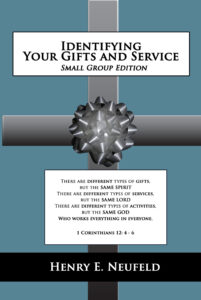
    Front cover of the book Identifying Your Gifts and Service
  • Ask Them to Implement Their Own Suggestion

    Ask Them to Implement Their Own Suggestion

    Bad Ideas I Learned from Good Leaders #1

    I’m never going to identify which leader I learned these things from, because I have deep respect for all of them. Many of them helped me ditch bad ideas of my own, though doubtless I still have a bunch!

    The bad thing I learned is this: When someone makes a suggestion for some project in the church, you immediately ask them to lead out in executing that idea.

    There is a very good point involved here. Actually two very good points. First, a person who goes to the trouble of suggesting someone is likely fairly passionate about it, and are likely to be diligent in getting it into action. Second, there are numerous people who will tell pastors and other church leaders all the various things they think “the church” should be doing. They have no intention of serving. They just want to complain. “Why don’t you take the lead on that?” will often either slow down the complaints, or in some cases even get someone moving.

    That’s the good side.

    The bad side is this. Your church is probably already an example of the 80/20 principle: 80% of the work is done by 20% of the people. (Well, you might be more like 90/10, but why be negative?) Most of the good ideas, the ones you should want implemented, are coming from that busy 20%. After all, the 80% don’t really want to go to the trouble of meeting with the pastor to present an idea.

    The 80/20 principle is self-sustaining. The 20% are the workers in the church because they’re the ones with initiative and creativity. Some people aren’t like that. Some people are willing to serve, but they don’t have the imagination, the initiative, or perhaps the knowledge of the church to locate a task and involve themselves with it.

    Since the 20% generally have those characteristics in various (but substantial) measure, they tend to imagine that the 80% aren’t serving because they’re lazy, apathetic, or don’t really care about their church. Some of them may have these problems. But more of them likely are waiting to be identified.

    In my book Identifying Your Gifts and Service (Small Group Edition), I suggest that church members and leaders need to observe one another to learn about gifts and help others find a place to serve that utilizes their individual gifts and also fulfills their needs. Yes, they are serving others, but that service is also of benefit to them, provided they are allowed to use their gifts in positive ways, rather than just being put to work.

    Here’s a summary of the points I make about this in that book:

    1. Listening: Group members identify each person’s gifts based on observations and what they believe the Holy Spirit has revealed. ​ This involves a group discussion where each person shares what they see as the gifts of others. ​
    2. Expressing: Each individual expresses their understanding of their own gifts. ​ This step involves self-reflection and sharing with the group. ​
    3. Examining: A survey is provided to help individuals think about their gifts and areas of service. ​ The survey is designed to stimulate thinking and challenge assumptions about one’s gifts. ​
    4. Fitting: Group members discuss and clarify God’s call on their lives and how their gifts fit into the church’s needs. ​ This step involves prayerful discussion and focus on how to use identified gifts effectively. ​
    5. Unifying: The group examines how individual gifts align with the church’s mission. ​ This step involves the participation of church leadership to help integrate members into appropriate areas of service. ​

    The book emphasizes the importance of listening to the Holy Spirit and to one another, and it provides practical exercises and discussions to help identify and utilize spiritual gifts within the church community.

    A Look Ahead

    One of the key elements in this process is recognizing church members as diverse individuals. They don’t all have the same gifts, goals, personalities, education, or general approaches to life. Learning to recognize these is important. Next week I plan to write about this as a bad idea I learned from otherwise good leaders: Don’t get stuck on expecting one personality type in members of a congregation.

    I will reference there the book PERFECTLY SQUARE. You can get a head start with this lovely little book that’s a quick read.

  • Stephen S.J. Hill on Our Much Loved Identity

    Stephen S.J. Hill on Our Much Loved Identity

    S.J. Hill Interviewed by Barry Adams

    It is very difficult to get me to watch any video. Yes, that’s true, even though I create videos and do online interviews on multiple subjects. It’s not my medium of choice. Getting me to watch an hour extends into the impossible.

    But I watched this one …

    I recommend that everyone, but especially those involved in ministry, whether pastoral, teaching, missions, or any other service activity, listen to this and take it in. I have dealt with this myself.

    When are you good enough?

    Change the question!

    Note: As the owner of Energion Publications, I am the publisher of S.J.’s book What’s God Really Like?. I recommend the book as well!

  • So Why Not Change?

    So Why Not Change?

    Sojourners has an article titled SEVEN LIES ABOUT CHRISTIANITY — WHICH CHRISTIANS BELIEVE.

    There’s a great deal here that I resonate with, especially in the seventh point:

    The problem with romanticizing Christianity is that we turn our faith into a product, using various selling points to make it look more attractive.

    Sojo.net

    But what I’m responding to is the part about ministry and evangelism:

    Pastors and missionaries are considered high-risk candidates within the medical community because of their susceptibility to addiction, stress, and abuse. 

    Sojo.net

    I was first made acquainted with this problem when I was studying in seminary and was told that the seminary students had higher rates of various problems, such as divorce. I was tutoring Greek and Hebrew for the seminarians (I was in the School of Graduate Studies, though sharing many classes), and this was brought to my attention because of academic expectations. Many of the seminarians found the academic class schedule very challenging. I could see they were gifted for pastoral ministry, but some of what the academics, such as I hoped to be, expected of them was stressful rather than helpful.

    My question is this: Why don’t we change the way we do things? I have commented before on realistic job descriptions for pastors. Our expectations are extremely high. We expect them to do all the work of the church from visiting the sick and those shut-in to evangelism and ministry. Everyone in our society seems trained to go right to the top, and in the way we portray pastoral ministry, that’s the pastor.

    I consider this a major failing of Christian life and Christian ministry. Every Christian is called to ministry, that is to service of others, according to their gifts. Nobody should be getting burned out by the kinds of expectations we have of our pastors and other church leaders.

    My friend (and Energion author) Dave Black often comments that he’s waiting for the church sign that reads “Whatever Name Church – Head Pastor, Jesus – Ministers, the entire congregation – Servants to the ministers, the church staff.” (For more, see Seven Marks of a New Testament Church.)

    I wrote a fictional short story about this some time ago titled Our Pastor Is Lazy. In this case, while the story is fictional, I think it’s exceptionally true. Over and over again.

    Let’s not just shake our heads about this. Let’s do something.

  • Habitually Going to Church?

    Infographic: Old Habits Don't Stick For Churchgoing | Statista You will find more infographics at Statista

    Interesting! It used to be said that if the habit is established while they’re young, they won’t lose it later. I don’t know how true that might have been, but it doesn’t appear to work in this chart.

  • Church Titles, Anyone?

    Church Titles, Anyone?

    I have frequently observed that if we were to understand the way authority works in the Kingdom of God, we would have less arguments about who gets what title. Maybe we’d drop as many titles as possible.

    Dave Black comments on this, and quotes Markus Barth today. I think he has a point.