Threads from Henry's Web

Category: Doctrines

  • Interview: A Day for Joy

    Interview: A Day for Joy

    Background

    As a former Seventh-day Adventist I often get interesting questions. These questions include how I could leave the one true church (from SDAs), or why would I publish books by SDAs (from those who consider Seventh-day Adventism a cult. From many on either side, I’m asked what were the reasons I left the Seventh-day Adventist church.

    Sounds complicated? Well, let’s add that there is a common assumption that the seventh day Sabbath will be a key reason. But that is not the case.

    In fact, while I believe that the new covenant view of sacred time is that all time belongs to God and we use it for ourselves as God directs, I envy Adventists the Sabbath. My approach is hard, and I frequently fail. I fail particularly in getting adequate time for rest and in allowing others time for rest.

    On True Churches

    As for how I could leave the “one true church” I simply don’t believe that the “true church” is the same as any denomination, but rather a collection of believers everywhere as known only to God. So I became a Methodist. I don’t see that as the true church any more than the Seventh-day Adventist Church.

    This also explains why I publish SDA authors. I’ve been told that most former SDAs are antagonistic to the church. I value my heritage and education as an SDA. I honor a number of people who influenced me, worked with me, encouraged me, and taught me. Disagreement on doctrines is fairly minor to me.

    But there’s another reason as well. I think the SDA church has something to teach other denominations as well. One of these valuable topics is the Sabbath, because, as Keith Clouten points out in his interview, while we deal a great deal with sacred space and even sacred resources, we do much worse looking at sacred time. But as he also points out, God ended creation by setting aside and consecrating time.

    The Interview

    To my Seventh-day Adventist readers, I commend this interview as a theologically strong basis for Sabbath keeping. Clouten presents it not as a matter of fulfilling regulations, but of a response of love and a constructive practice for Christian living. To those who are not SDAs, I challenge you to think about what God desires of your time. What is it that God is calling you to do as you live in God’s rest?

  • Why I Still Like the Wesleyan Quadrilateral

    Why I Still Like the Wesleyan Quadrilateral

    Yes, I’ve heard the complaints, and those who say it isn’t actually Wesleyan or has deteriorated through the years, but I met it in the United Methodist Discipline before I first joined a Methodist church (though without the name) and I still like it.

    For those who may not be aware of the quadrilateral, it states simply that doctrine is formed not from scripture alone, but from scripture, tradition, experience, and reason. (I discussed the importance of experience in a 2015 blog post.)

    On this blog, I have discussed this several times before. Today I want to add a metaphor and expand a bit on the hermeneutic that I use as a result. As I have noted before, many intractable arguments result from discussing conclusions from scripture without discussing hermeneutics, the way in which we come to those conclusions. The other person may seem obtuse to you, but if you understood how they are coming to their interpretation, you might understand their point of view. You also might still abhor it, but you’d understand it!

    The metaphor I want to introduce here is the confluence of four streams. This metaphor uses “confluence” to suggest the way sources interact to help form doctrine.

    To help clarify this and its purpose, let’s start with its opposite. For many, scripture is a fixed source of data. You go to it, mine the data, and then directly apply it to your life or the life of your community here and now. We should have learned from the experience of the Christian community that it doesn’t work that way. Thousands of denominations and various church splits, carried out by people who thought they were (and generally think they are) faithfully following the Bible should have given us a clue.

    The nature of scripture itself should give us a clue. It is not organized as a compendium of knowledge. It is not organized like an encyclopedia, or like the Boy Scouts Handbook (a metaphor I’ve heard frequently), nor like the more modern FAQ page. It’s a collection of a variety of material produced in a variety of ways, organized and presented differently, and then collected and placed in one volume. Out around the edges, various of those denominations disagree on the details of what should be considered part of the Bible.

    I have this feeling that God accomplishes what God sets out to do, thus when I see a Bible that looks almost entirely unlike what so many people want it to be, I come to suspect that God didn’t want what they want. If God had wanted that, it would be what we have. We don’t, so God didn’t.

    I recognized the problem back in 1993 when I was considering a return to church after about a dozen years, but I didn’t have the vocabulary to express it. For a number of reasons that seem to me providential, I visited what was then Pine Forest United Methodist Church (now Wilde Lake Church), and generally liked what I heard, but I’m an idea-driven person and I wanted to know what these Methodists believed. On being asked, the pastor thought and finally handed me a copy of the United Methodist Discipline.

    As I read that document (the first 100 pages or so, not the organizational stuff in the back!) I encountered the description of what is often called the Wesleyan Quadrilateral. I loved it. Not because I thought it was a good prescription for how to do Bible study, but because I thought it described how people study the Bible.

    We bring to our study what is in ourselves, such as our observation of the world, our thinking about various things, our experiences with others, our knowledge of past events, things we know work for us, things we know do not work, and our relationships or community, in whatever shape that community bears.

    The simple explanation for why our interpretations differ is that we differ. Those differences are not just in us, but in the way in which we are connected to others both in space and in time. These are not things we can escape; they are part of us.

    The Bible looks a great deal like it was produced by people much like us.

    Do I mean by this that there is nothing special about the Bible or that there is no divine inspiration involved? Not even a little bit! What I mean is that I see Divine action in a community of people that stretches not only through space around the world but also that stretches through time. It is a diverse book delivered through diverse people who lived in diverse communities to a wide diversity of other people and communities across the span of time.

    Does this mean that I can learn nothing from the Bible? Not at all! What it does mean is that I can’t reach into the Bible and grab a rock to throw at you or at anyone else, and truthfully call the rock “divine.” And I think that’s a good thing. Possibly even a Divine thing.

    As I was thinking about all of this, I was also looking at some pictures of river confluences (if anyone cares, along the Essequibo River in Guyana and its tributaries), and I thought, “A confluence of four streams comes closer than anything else I’ve thought of to the way the quadrilateral actually works!”

    Of course, there’s nothing quadrilateral about this metaphor. Well, except the “4” part.

    Let me note what I see as the problems of the previous metaphors, especially my own. The whole “quadrilateral” metaphor tended to make four elements equally authoritative in forming authoritative doctrine. In many ways, we’re still looking for that rock to throw, but we want its authority to be derived in a different way.

    My own response with the four-layer filter, in which I suggested that a doctrine should be tested by all four elements, suffers a similar problem. I don’t find it entirely unuseful, but as with many metaphors, it needs a “don’t stretch” warning label. My metaphor of the four-lane highway, a critique metaphor, similarly starts with our hoped-for conclusion and then tests it against the four, in this case looking for a lane that will work.

    The four streams metaphor suggests several things, including that the streams keep flowing. They are not actually static. The water in the stream that results is a mixture of all four, which may vary by season, situation, and geography.

    Is any of this safe? No, but nothing is safe. Doctrine is not a static object that exists outside our community. It is formed in community, practiced and taught in community, and it belongs to the universal church, not to you or me personally.

    This does not make me take the Bible lightly. In fact, it suggests to me that I need to immerse myself in scripture and also in my community of faith in order to be guided by the God who guided the community over time and continues to guide it and me. No superficial glance intended to prove myself right and someone else wrong will do for this.

    We embrace a diversity of interpretations that fit within the streams that meet at the confluence to produce doctrine. It is a continuing journey, along with that “great cloud of witnesses” led by Jesus, the “author and finisher.” (See Hebrews 12:1-3 with reference to Hebrews 11.)


  • What Creationists Could Learn from Herold Weiss

    What Creationists Could Learn from Herold Weiss

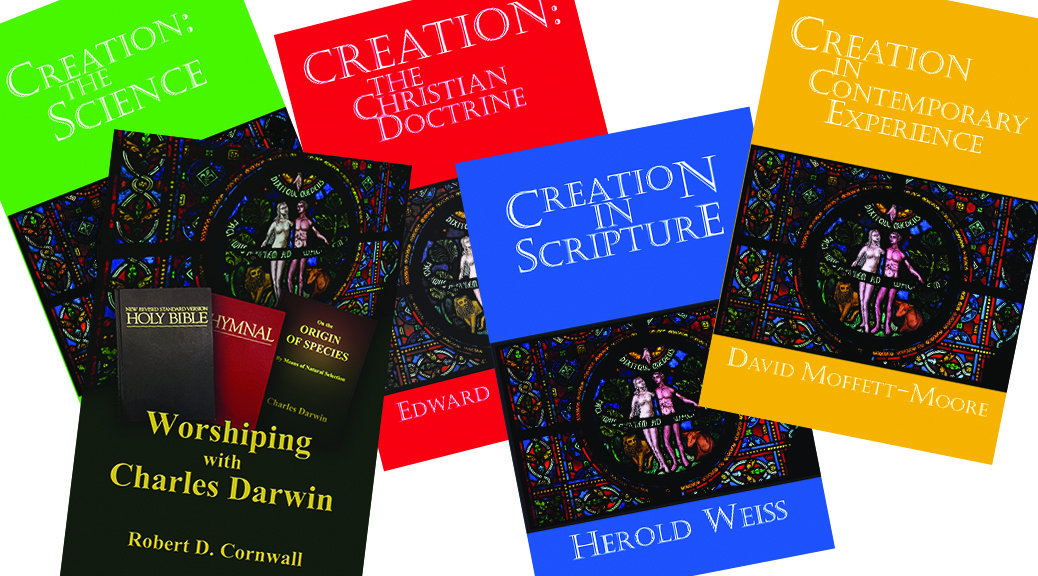
    creation-5We’re starting a new series of posts on the Energion Discussion Network and the current author is my friend and Energion author Dr. Herold Weiss. He’s the author of the book Creation in Scripture, the first in a series discussing creation from the point of view of those who accept the theory of evolution. That note should tell you that Dr. Weiss’s work can be controversial, as are all discussions of this topic.

    I don’t happen to like the terms generally used, but it is generally somewhere between frustrating and futile to try to change language. “Creationist” has become the label of those who believe in a recent (read 6 to 10 thousand years) creation in a literal week, while “theistic evolutionist” labels those who believe God is creator but that the process of evolution is how he has chosen to diversify life here on this planet.

    Dr. Weiss does something in his first post in this series that tends to annoy creationists (using the definition above). He calls their view unscriptural. The typical view of a creationist is that their view is scriptural while the theistic evolutionist has chosen to ignore the Bible in favor of evolutionary theory. No matter how strong the evidence for evolution (and they will, with few exceptions, maintain that it is weak), they would not see how it could override the Word of God. So the argument, at least as they generally present it to me, should be couched in terms of their strong convictions about scripture and the weak convictions of the theistic evolutionists, which are to be defended.

    But neither I nor Dr. Weiss thinks our position is biblically weak. In fact, I did not change my view from a young earth creationist, which I was until some time during my third year in college, because I had studied evolutionary science. My science requirement was fulfilled in a chemistry class, taught, by the way, by a young earth creationist. It was in doing research for a paper that I found that I could not reconcile the biblical texts on the basis required for young earth creationism. The starting point was chronology, and it wasn’t even comparisons with archeology. It was simply looking at what must have happened between two points in the biblical story, and determining that it was beyond extremely improbable; it was impossible. And further, there was no report of some sort of miracle to connect the dots.

    From there the question changed for me. Why is God presenting the story in this manner? (I’m ignoring here all the things I have come to believe about biblical inspiration over the years and discussing my thinking at age 20.) From there I started to ask just what it means to me that God is the creator and how that doctrine reverberates through scripture.

    And this is what I think creationists can learn from Dr. Weiss. No, I’m not suggesting they will all read his book and decide to become theistic evolutionists. He isn’t even trying to make that case in the book, and I know my own views would be unlikely to change in reading one book. What he does that is important is look at how creation, and its implications, is presented in various parts of the Bible. Creationists seem to me to be hung up in Genesis 1-3, important chapters to be sure, but not the only thing in scripture on the topic. And yes, I do think these chapters are important, even foundational, even though I read them differently. And no, I’m not claiming that creationists are ignorant of all other passages. What I’m suggesting is that they are not brought into the discussion enough.

    Too much of the debate about creation and evolution is concentrated on when and how and too little is focused on so what now?.

    I think it would be great if we spent more time on the third question. Yes, we’d still disagree on when and how, and we’d still argue that both of those questions impact the answer to the third, but we might have a chance to shed a bit more light. I think Dr. Weiss has facilitated that.

  • Essentials of the Faith – or Not

    C. Michael Patton has written a post on doctrinal essentials which is quite interesting. James McGrath responds.

    I find this a very useful discussion even when I disagree on what is essential. For example, while Patton states that he is writing about doctrine, and that another post could be written on essential practice, I would suggest that whether or not the primary essential of salvation is belief in doctrines or certain practices, a combination of the same, or indeed none of the above, is itself a rather important doctrinal question. And since the question is on just what, doctrine and/or practice, is essential for salvation, it is doubtless an essential question, at least.

    I use a different method of dividing these issues in my post Unity, Diversity, and Confusion. There I am not trying to state what beliefs are necessary for salvation. In fact, I find the idea that someone must successfully believe certain propositions to be a form of salvation by works. But in creating a community, one must define what it means to be in the community and not in the community, even if one does not assume that “in the community” is equivalent to salvation.

  • Progressive Orthodoxy

    C. Michael Patton has an interesting post today taken from his introduction to theology students.

    I would particularly like any number of the folks in the various Sunday School classes I teach to absorb some of the material. This is not because I generally agree. I perceive myself to be both to the left and well to the Arminian side of his theology. Yet there are a number of point there that especially many of my Methodist brethren do not understand about either Reformed theology or in general of evangelical theology.

    The first of those items is the definition of sola scriptura. Use that phase in most Methodist churches, in my experience, and people think of a complete rejection of tradition even in terms of the method in which we approach and understand scripture. Thus most of these same Methodists reject sola scriptura.

    Patton describes it thus:

    2. Scriptural Orthodoxy. This is the belief that Scripture alone sets the bounds of orthodoxy without any (or minimal) aid from the historic body of Christ. This should not be mistaken for sola Scriptura—the belief that the Scripture is our final and only infallible authority in matters of faith and practice—but as a radical rejection of any other sources of authority such as the church, tradition, natural revelation, etc. It is often referred to as solo Scriptura or nuda Scriptura. Here, there would not be minimal (if any) authority derived from the body of Christ, historic or contemporary, as an interpretive community that either fallibly or infallibly has the ability to define orthodoxy. Adherents would often be found saying, “No creed but the Bible.”

    The second would be the idea of progressive understanding, or “illumination” as illustrated in the various graphics. He describes that as follows:

    6. Progressive Orthodoxy. This is the belief that the ultimate authority for the Christian faith is found only in the Scriptures (sola Scriptura) and that orthodoxy is a progressive development of the Church’s understanding of the Scriptures. …

    Patton is an advocate of progressive orthodoxy.

    I believe I fall a bit to the left of that position, because I fail to see the clear line between “revelation” and “illumination” that comes at the end of the canon. I accept that we can, and indeed have, developed doctrine past the revelation of the canon, but I don’t see the hard and fast line. In a sense, the “nuda scriptura” folks (to borrow from Patton’s definition) have a point in that if the canon is complete, why would it not define such doctrines as the trinity if, in fact, the trinity is an essential. It’s interesting to me that many who claim the Bible alone in this narrower sense do accept the doctrine of the trinity, even though it seems to me that it requires some Christian tradition to get to what I would call the orthodox doctrine at least.

    I appreciate also the essentials/non-essentials distinction, which many folks have a hard time making. It’s too easy to make the essentials be totally coterminous with their personal belief system. I wrote about this in a post Unity, Diversity, and Confusion, in which I argue that you must have some core of common belief, but you can also have way to much required common belief.

    I continued this theme in several posts, notably Excessively Large Tent = Crash, and Christian Essentials – Incarnation at the Center, in which I discuss where I start in defining essential doctrines. Each of those posts provides links to my own further discussion.

  • Responding to the Evangelical Manifesto

    I never refer to myself as an evangelical, but occasionally others do for reasons that are largely unfathomable to me (except a few from across the pond that make some sense), so I usually take a look at documents that come out relating to evangelicalism. I’m always interested in the potential for finding one of these documents that I could go along with 100%. Of course, I realize that if that happened, there would also be a number of evangelicals who would say that the document, statement, or in this case manifesto was inadequate.

    I have read the entire manifesto (HT: evangelical outpost) and not just the summary, and I find very little in there to which I would want to respond. First, very few evangelicals of my acquaintance would accept that manifesto as adequately expressing their own confession of faith. The few who would are in the United Methodist Church and go a bit light on some of the elements, such as penal substitution. (Note that I am using “evangelical” as a reference to those who would self-identify as such.) I would expect that the expression on the inspiration of scripture would be considered a bit weak by many. One can read inerrancy there if one tries, but it’s not terribly clear. If I wanted to interpret with great latitude, I could fit my own view of scripture in there. I imagine there will be some who will do so.

    Second, I think the idea of rescuing terms is a very hazardous business. The statement from page 4 illustrates this point. “There are grave dangers in identity politics, but we insist that we ourselves, and not scholars, the press, or public opinion, have the right to say who we understand ourselves to be.” The problem here is that I have to first decide who is a “real” evangelical before I know who to ask for a definition. You may think this is nitpicking, but I know evangelicals (by their self-identification) who believe that most evangelicals aren’t really evangelicals any more. Personally I take as a starting place those who are in the majority of a group, and thus break out of the circle, but it does create a problem. I’m left to wonder if evangelicalism as stated in this manifesto is similar to an older evangelicalism. Are they defining a new position, returning to an old one, or something between?

    Such expressions as “Yet we hold to Evangelical beliefs that are distinct from the other traditions in important ways — distinctions that we affirm because we see them as biblical truths that were recovered by the Protestant Reformation, sustained in many subsequent movements of revival and renewal, and vital for a sure and saving knowledge of God — in short, beliefs that are true to the Good News of Jesus” (pages 4-5), equivocate between recovering something old and latching on to something new at some point.

    I would have to say that if I read the affirmations on scripture and salvation as I believe the authors meant them, I could not adopt this statement as my own. I could be wrong on the way they meant those statements. They could even be trying to provide latitude to someone like me. That’s just not how I read it.

    I would add simply that I find the description of liberalism (pages 8-9) to be largely a strawman, though I’m afraid I would not be very likely to persuade evangelicals of that. I often think conservatives are just going along with the culture, while liberals are arguing against the tide, but part of each position seems to be a different perception of the tide.

    In any case, this is an interesting manifesto, as much for what it doesn’t say as for what it does. Whether it will accomplish any of the goals its authors set out to accomplish is another matter. I’m doubtful that it will.

    Here’s some reaction links from Moderate Christian bloggers. Most of it is more positive than mine.

    * = updates after initial post

    Any other members of the Moderate Christian Blogroll can leave comments if I missed your post, and I’ll promote the links to the body of the post. My observation thus far is that the bulk of the moderate bloggers are responding more positively to this than I am.

  • Believing in Words and Symbols

    In a previous post I discussed “true belief” and some of the comments have gotten quite interesting. I’ve considered promoting part of the exchange with commenter Lifewish to a post of its own.

    One commenter mentioned the issue of essentially believing the Nicene Creed as opposed to a more simple statement of belief in God, the divine, the supernatural, or another similar concept. I want to make even clearer that my own leap of faith was not to the Nicene Creed, but rather to a simple belief in a “ground of all being” underlying and beyond existence. Now the same theologian who coined the phrase “ground of all being”, Paul Tillich, also noted that all language referring to God was by nature symbolic, which is one of a number of substantial contributions he has made to theological discourse. I could wish that I had been less concentrated on pure Biblical studies, and a little more open to theological reflection, as a seminary student. Had I read Tillich in seminary I might have saved myself much needless confusion.

    I believe that our theological language tends to begin in spiritual experience. That is not to say that all theologians are somehow mystics and relate their own experiences, but rather that theology starts with people who hear voices, see visions, or dream dreams that they regard as meaningful. I have a certain amount of the mystic in me, as I have related recently, and thus I can state the first of two points from personal experience: When you put a spiritual experience into words it immediately loses something. When I feel the presence of God I cannot completely relate that story in words. Words are limited. Words are, by nature, intended to describe things. We even find them a bit inadequate dealing with emotions.

    Thus the validity of what I say about spiritual experience is automatically subject to question. When I take a step further, and start generalizing doctrines, such as the doctrine of the trinity, I have taken several steps beyond that, as I use symbolic language to describe generalized, common spiritual experience. There is a big difference in my mind between saying, “I believe in God,” and saying “I believe in the trinity.” If nothing else, the first is part of the “leap of faith” I described previously, while the second is something derived from that, and form the experience and teaching of others.

    Some of my orthodox brethren may get pretty uncomfortable with this, but while I regard myself as a trinitarian Christian, because I find the language of the trinity most useful in talking about God, I have serious doubts about how accurately that doctrine, or any other doctrine of God, actually describes God. I find that the language of trinitarian theology combines quite well the mystery and the experience of God as I encounter it. The language of the trinity works perfectly well for me. But I have no basis for jumping on people who cannot accept it. While I have said that I no longer can imagine not believing in God–I’ve tried to disbelieve and failed–I could easily imagine a set of circumstances that might cause me to quit believing in the trinity. Just provide me with a better set of symbols to use in talking about the divine, tie them into the tradition (long-term experience) of my community, and I’ll take a look.

    One argument that will not convince me that the trinity is false (or not useful), however, is the argument that it doesn’t make sense. It does, and it doesn’t. In my view it describes our experience of God quite well, and it points me toward God effectively. At the same time it has the truly endearing quality of refusing to let me feel that I have fully grasped it. In a similar way, I think that if I think I have grasped God fully, that is the best indication that I’m off the track. I think it’s going to be hard to invent a doctrine that works better (for me) as a symbol for God than the trinity, but I leave open the door to such trials.

    In conclusion I just want to say that I find tinkering with theological concepts great fun. It is unfortunate that there has been so much judgment applied to the process, and that people have been put to death over mysterious doctrines such as the trinity. Considering our infinite ignorance of God (at least I regard myself as infinitely ignorant of an infinite being), it seems awesomely arrogant to burn other people at the stake over disagreements between our various forms of ignorance–or to condemn or ostracize them.

  • Experiencing the (Baptism of the) Holy Spirit

    Experiencing the (Baptism of the) Holy Spirit

    This is a topic where I tend to make just about everyone uncomfortable. Long time readers may recall a previous discussion of speaking in tongues, and my own experience of it. Those who expect me to be intellectually oriented and rational are uncomfortable with mystical experiences, and many who are comfortable with the mystical experiences are deeply troubled by my tendency to analyze.

    But the fact is that I am one person, i.e. the same person who examines data about the historical Jesus and expresses skepticism of some of the details recorded in the gospels also claims to experience the risen Jesus in a personal way. So when Adrian Warnock started talking about the experience of Holy Spirit baptism, I decided to say a word or two.

    I’m not going to defend my particular theology in this post, but let me simply state that I believe that Holy Spirit baptism can, and ideally should occur at the time of one’s baptism in to the Christian faith. Nonetheless in the book of Acts we have numerous instances where the two experiences are separated. I believe nobody comes to Christ in the first place without the work of the Holy Spirit, but the idea of the baptism of the Spirit involves one personally experiencing and being transformed by it.

    At the same time I want to guard against the notion that this experience is singular, that one checks off the boxes of conversion, then baptism in the Holy Spirit, and then one has attained. I don’t like the idea of Christians who have “attained.” I think they tend to fall quickly into pride. I know I would, so if I ever get to the point where I believe I have attained, it will be the surest sign that I haven’t. I know I’d fall straight into spiritual pride without passing Go or collecting my $200.

    I do remember a specific experience at the time of my own baptism at age nine. I was in Mexico with my missionary parents and had to convince them and a Spanish speaking pastor that I knew what I was doing. It was the strong conviction that had come on me that made me able to do so. They were very skeptical.

    But I want to discuss a later experience, that came when I was working in the church. This happened several years ago. I was trying to get material written for the early stages of Pacesetters Bible School, and I would be interrupted frequently. But one week almost the whole church staff including the pastor was going to be out of town on a mission trip, and I was looking forward to a week of writing with few interruptions. It was not to be.

    One of the things about “mystical” or “spiritual” experiences that I have noticed is that they do not occur for my convenience. My Monday of that week happened as I had hoped. I got a great deal done. On Tuesday I was praying through my prayer list. I had an extensive prayer list, and was quite systematic about praying for the people on it. Having checked off my list, I felt that I had done my part in praying for the congregation.

    Included on my list were all the college students and all the church leaders. As I began praying through the list that day I was interrupted by a voice. Now all the more intellectual folks and those who are not Christians are permitted here to doubt my sanity. I generally just assume it’s loosely attached. But I did hear a voice. It said, “Stop.”

    So I stopped a moment and then started to pray for that person again. Again, I heard “Stop!” Then the voice began to question me about these persons. What were their gifts? Regarding the students it asked me what they were studying, when they would be finished, and what their ambitions were. For the church leaders it asked me what their specific roles were.

    Now the fact is that I didn’t know most of this stuff. They were on the staff or on committees, or they were students, so their names were on my list. I didn’t have a clue as to who they were personally. Then the voice asked me, “How do you expect to function as a teacher in the church if you don’t even know what these people are supposed to be doing?”

    Good question! But I’m a stubborn person. I argued with that voice for the remainder of the week, from during the morning Tuesday through around noon Friday. By noon Friday I was pretty much done. I think I had a mild idea of how Elijah must have felt when God said, “What are you doing here?” (1 Kings 19:9)

    What happened at noon on Friday? Finally I admitted that I needed to change the way I did business. I was all in the books. I planned curriculum according to what I thought people (in general) needed to know. I didn’t really want to know the people themselves. That was messy and took up too much time.

    It was a transforming moment in ministry for me. I may be insane to argue with a voice for several days. Each day I returned to the office intending to work, and it didn’t happen. When I shut down and went home, things went back to normal. But that insanity was transforming. People noticed the difference. They would ask me, “Who are you and what have you done with Henry Neufeld?” The main obvious difference was that I started taking a personal interest in people’s lives, their call, and their work in the church. I started to try to meet those needs.

    Now this seems fairly obvious in hindsight. Isn’t that simply good people skills? But at the time I didn’t exercise that variety of people skills, and due to my knowledge in other areas, and basic teaching skill, people put up with me anyhow. It took this spiritual encounter–in my view an experience of baptism–completely being overpowered–by the Holy Spirit to get me on track.

  • Why I Don’t Like Left Behind

    Hat tip to Gentle Wisdom for this quiz on eschatology:


    What’s your eschatology?
    created with QuizFarm.com
    You scored as Amillenialist

    Amillenialism believes that the 1000 year reign is not literal but figurative, and that Christ began to reign at his ascension. People take some prophetic scripture far too literally in your view.

    Preterist

    100%

    Amillenialist

    100%

    Moltmannian Eschatology

    60%

    Postmillenialist

    35%

    Dispensationalist

    25%

    Premillenialist

    25%

    Left Behind

    0%


    Now I know why I don’t like the left behind books! It was also mildly funny to discover that I don’t have an “eschatology” category. I think I’ll leave it that way and just use the tag.

  • Heresy Hunting with Closed Ears

    Since I write frequently on minimizing the number of essential doctrines, and maximizing lines of communication, I just had to call attention to this blog, Herescope. It’s “About” tells the story:

    This non-interactive blog contains information revealing heresies and false teachings affecting the Church today. . . . [emphasis mine]

    Need I say more?