Threads from Henry's Web

Category: Christianity

  • Trailer and Theme for My Study of John

    Trailer and Theme for My Study of John

    john banner

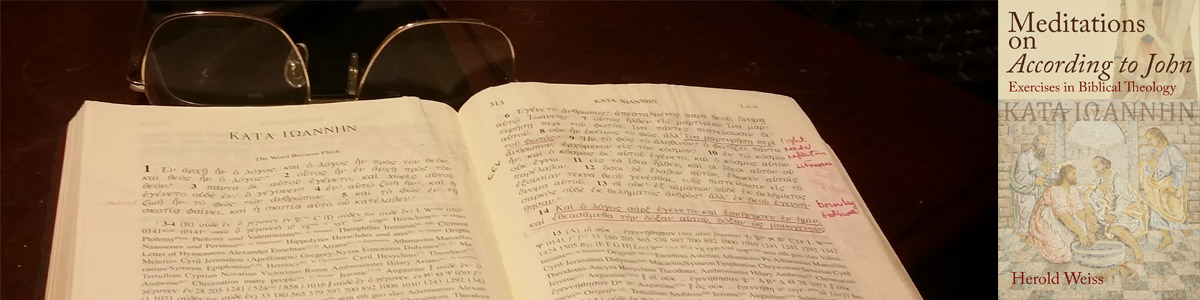
    Above is the theme banner for my study of the gospel of John. The video below is a trailer for it. I am working on getting used to video. I’m more comfortable with text, I think.

  • Sunday School Today: Authority and Truth

    1893729389I think I titled the next chapter in my book When People Speak for God rather pretentiously: Authority and Truth. That’s what we’ll be discussing today in my Sunday School class.

    As I was reading the chapter, I came across the following, which ties into several things I’m thinking about these days:

    There is, however, a deeper claim that’s involved in both the virgin birth and the resurrection. These doctrines state that God is fundamentally interested in communion with human beings. In the virgin birth we have the statement that God is prepared to share our form and our condition and to become a part of that history. In the crucifixion, God says that he is prepared to carry that sharing all the way, to experience death. In the resurrection, he states that despite his willingness to share it, he’s above it, and thus able not just to communicate with us, but to redeem us.… (pp. 135-136)

    I call my view of inspiration incarnational, because I see God’s Word, however it is expressed when it is communicated with human beings, as a form of incarnation. The problem with this is that I think the orthodox doctrine of the incarnation is not well understood. (There is, of course, the sense it which it will never be well understood and will always be a mystery!) But the way people often hear the term “incarnational” in connection with inspiration is as a claim that the Bible is a mixture of divine and human. When I call scripture incarnational, I do not mean a mixture. I mean that it is all divine and all human. We can sense aspects of divine and aspects of human, just as we can with Jesus the man, but we cannot divide.

    Inspiration is all-the-way incarnation as well. God’s power is contained in the finite form. What we need is ears to hear and eyes to see.

    I’ll have more to say about this over the next few days.

  • Studying Through John

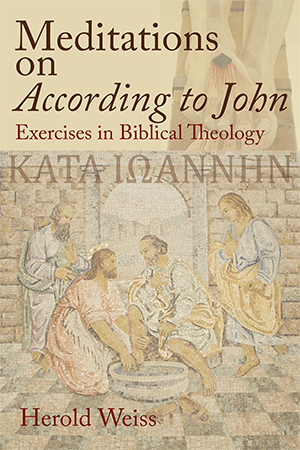
    Meditations on According to JohnWith the new year I’m starting a new online study, working through the Gospel of John using Herold Weiss’s book Meditations on According to John.

    A previous effort by my wife and I to conduct a group discussion failed both due to our schedules and due to low participation. In this case, I will be essentially video blogging live.

    I will personally be studying the book through in Greek, and also studying Leon Morris’s commentary in the NICNT series. That provides a conservative counterpoint to Dr. Weiss. I’ll discuss where I stand in connection with all this in the introductory study.

    I will always have the Q&A app enabled so that people can interact via text. In addition, I’ll be watching my Twitter feed for any comments or questions. If anyone wants to participate via video, let me know through the comments below or via e-mail (henry@energion.com). The only requirements I will have for participation are that you get a copy of the book (ebook is fine), read the material including the Bible passages, and if there is a sharp disagreement, be comfortable stating your position and then letting it go. I’ll state mine and let it go as well. I’m not expecting video participation but will be pleased if there is some. While I can’t imagine it will be a problem, there is a limit of 10 people (9 + me) on the video.

    So get out your Bibles and your favorite reference sources and plan to join the discussion! I’m posting the YouTube below. At 7:00 pm Thursday night, January 6, it will be live. Once the event is complete, it will show the recording.

  • Interview with Dr. Bruce Epperly

    On Tuesday, January 6, 2015, I will be interviewing Dr. Bruce Epperly on his newly released book Finding God in Suffering: A Journey with Job.

    I’ve just completed a trailer for this event:

    You can watch the actual event here:

  • So Why Don’t We Do Something about It?

    I’ve been exchanging thoughts with Dave Black about the pastoral role and biblical languages, including textual criticism. One of my difficulties here is that I am more likely dealing with people on a day to day basis who are not well acquainted with their English Bibles, and thus it’s a bit harder to talk about whether they should know textual criticism. That doesn’t mean they shouldn’t, necessarily. It just means the goal is further away!

    But in some comments today I think Dave got right to the heart of the issue. Then another Energion author, Allan R. Bevere, linked to a post by Thom Rainer titled Seven Myths about a Pastor’s Workweek. That reminded me of a short story I wrote some time ago titled Our Pastor is Lazy.

    It seems to me that we all know that “pastor” as a “job” is crazy. It isn’t working. We’re wearing out our pastors and we’re not accomplishing the work of the gospel. I find remarkably little disagreement with that.

    So my question is this: Why don’t we do something about it?

  • Should Pastors Learn Textual Criticism?

    I’ve been watching one discussion and participating in another that converge in this post.

    The first discussion is via blogs, David Alan Black (extracted to The Jesus Paradigm for a permanent link) and Thomas Hudgins both posting significant numbers of entries recently regarding textual criticism. The second is one I’ve had personally, and it regards the ways in which people lose their faith.

    Let’s look at the second first. It’s hard to find a mainline Christian community where the discussion of how and why people are dropping out of church and/or losing their faith. There are many groups and ideas that get the blame. Some blame liberal university and seminary professors. The idea here is that being told about these ideas by people with some academic authority drives people out of the church. Often the proposed solution is to pull back from advanced education, lest one be led astray by the notions of the excessively educated.

    On the other side, the blame often is placed on excessively conservative church leaders and parents. Many believe that those who have been pushed into too narrow of a mold will tend to break out when they get the opportunity, or the first time they have a chance, for that matter. The solution suggested is usually that we loosen up and be more open about questioning and re-examining our doctrinal beliefs so that young people don’t feel excessively constrained. In addition, they can come up with different answers in many cases and still remain in the community.

    I haven’t done any scientific studies, and I have some doubts about those studies I have seen (question design is interesting, and helps drive results), but my observation is that both of the scenarios I have mentioned are possible, as are many others. The stories of faith, loss of faith, return to faith, and struggles with faith are as diverse as are the people who live them.

    My own experience led me from a rather fundamentalist upbringing in the Seventh-day Adventist Church to a relatively moderate theology as a member of a United Methodist congregation. I experienced the various players in these stories. There were the overbearing and oh-so-superior professors, though frankly not many of them. Most of my professors were quite helpful. Some were more liberal than my upbringing, but by the standards of the general Christian community, all would be considered conservative. My father, whose beliefs were doubtless fundamentalist, was at the same time one of the influences in my life that allowed me to explore. He had a practical, living approach to faith that carries over to my practice today, even though I don’t hold all the same doctrines that he did.

    I have also seen many people who are strongly influenced by college, graduate school, or seminary. I observe a “seminary effect” in newly graduated pastors. They tend to hold views that were taught by the professors at their seminary. Sometimes they dismiss views held by professors at other seminaries. It’s not a surprising thing. One lives in a particular community and one absorbs its values, unless one is recalcitrant or perhaps just independent. In my case, I held closer to the values of the theology department at my undergraduate school (Walla Walla University) than to those at the Seventh-day Adventist Theological Seminary, though in the end I left the SDA community entirely.

    The positive side of my education was the ability to look at serious issues of theology and Scripture as part of a community of faith. One of the greatest difficulties involved was the simple fact that I was unable, in the end, to remain part of the community in which I grew up. I simply came to disagree with them on too many issues. I was able to maintain respect for them, and for many individuals who helped—and still help—me in my spiritual walk.

    The result of my observations of my own experience and that of others, including many who were raised as Christians but no longer are, is that a key component to maintaining one’s faith while learning new things is the ability to explore these issues inside a community of faith. I think that even if your community maintains boundaries, if they can bless you as you move on to explore with another community, the result will frequently be positive. If you’re extremely sectarian, and equate leaving your existing community with “leaving Christ” or becoming an apostate, then you’re likely to drive someone away from faith entirely.

    A friend of mine once noted that the greatest problem with the King James Version Only movement, especially as represented in this area by Peter Ruckman, is that it ruins people for the rest of Christianity. They have heard other Christians vilified so much that if they find they can no longer support their movement and its leader, it is impossible to move into a mainstream Christian community. There are those SDAs who still regard me as an apostate. I recall one meeting where I was working with an SDA author, and I was approached by a young man who quickly informed me that he could not comprehend how someone could possibly leave the SDA church because of doctrinal differences. I was prepared to discuss with him, but he wasn’t interested. He just wanted to inform me as to how wrong I was and move on. Fortunately, the majority of my SDA associates had a much more open attitude. They may disagree, but it’s a disagreement we can live with.

    So my view is that exploration in community is an essential to keeping one’s faith. In the age of the internet, a congregation will not remain unaware of other positions on major topics. A pastor used to be able to figure on the majority of the congregation getting all their information from him. Not now. There is no “ignorant congregation” option. The only question is where the discussion will take place. I think pastors who try to avoid all the hard issues would have been wrong in the old days, but they’re both wrong and in serious danger now. They need to discuss the major issues of the day with their congregations, recognize that people will read and study books which the leadership doesn’t approve, and learn to work with this.

    Note especially that I’m not saying what the position of the congregation needs to be. The key is that the congregation cannot be deceived. The pastors and teachers in the church need to openly discuss the issues, give their views and their reason for holding them, and then work with the congregation. If people find that they are no longer within the boundaries of a congregation, do your best to find a way to bless them as they seek elsewhere. I’m not suggesting that you change your beliefs or the doctrinal statement of your church in order to keep people. There are times to change and times not to change, and that is a process of discernment for a congregation. But if an individual or group needs to move on, that should be facilitated with a loving attitude. “Truth with love” is a difficult standard to meet, but I think it must be our goal, even as we recognize that we may fall short of the truth ourselves.

    Which brings me back around to the discussion of textual criticism. How much textual criticism does a pastor need to know? One of the problems I have with this discussion is that we keep piling things onto the pastor’s plate. Who else is going to handle this issue? But my experience is that often pastors barely have a working knowledge of their English Bibles while people who read the biblical languages are trying to get them to learn more advanced things. I recall one continuing education event in which one of my authors, an Old Testament scholar, was teaching a group of United Methodist pastors. A number of the pastors couldn’t keep up with finding the Old Testament texts referenced. I had been concerned they might not have studied the Old Testament enough to even have the questions the speaker was answering. I was unprepared to find that they couldn’t find the texts.

    In that context, what is the most important thing to pursue in terms of pastoral education? Is it textual criticism or basic biblical knowledge? And then what about the range of things we want pastors to be able to do? I recall sitting with a pastor while planning an event and somehow our discussion turned to my education. He remarked that he was “in awe of” my ability to pick up my Greek New Testament or my Hebrew Bible and just read. I was shocked by the phrase “in awe of.” I’m kind of in awe as well. I’m in awe of the experience. There is nothing like sitting down to my devotional reading with the text in the original languages. But I am in awe of the power of the word and thankful that I can experience it in that particular way.

    After a moment, I simply responded that I was in awe of his ability to sit down with a couple, and through counseling, restore a marriage. The point was simply that God gives different gifts to different people. I cannot imagine being a marriage counselor. If I didn’t have many other reasons not to want to become a pastor (quite apart from not being called by God), the idea of people coming to me to share problems with their marriages would drive me away.

    So how long does it take one to train to be an effective marriage counselor? A church administrator? A human resources director? A theologian? A biblical scholar? A textual critic? The problem is simply that we have too many things that we expect pastors to be. I think this is where we need to share the functions of the church more. The ideal can be the enemy of the good, in that we ask so much of pastors in their education that they simply can’t make it. But it’s more important that we ask all these things of a single person. Most of the pastors I’ve met simply would not have time to maintain a high level of proficiency with their biblical languages. They’re too busy with other things.

    Which brings us full circle. How can a church sponsor a community where exploration can take place on serious issues of theology and biblical studies, not to mention social issues, when there is no way the pastor can be an expert in all these things? Believe me, the number of things I’ve been told “every pastor should know” is quite astonishing and beyond the ability of a super-genius.

    Divide and work together.

    Huh?

    We need to divide the tasks between members of the church. Unlike some, I don’t have a problem with paid staff, provided the staff is paid for the right things. We should be paying the staff to do the work or ministry of the church. I suspect practically any church out there has people in it with business experience. Most have people with training in counseling, teaching, and various other academic subjects. Not all churches have all of these things, however.

    So first, divide the work of the church amongst the members. I can’t count the number of times I’ve been invited to teach about biblical studies by a pastor who didn’t have my knowledge of biblical languages but knew there was something that needed to be taught. There are lots of people with the right sort of knowledge. Don’t try to force them into the boxes created by planned curriculum. Let them bring their experience and knowledge into action.

    Second, work together. Not all churches will have people with expertise in biblical languages, for example. Find the churches that do. Work together. Share your educational time so the congregation can hear from other people with different expertise. Will they hear some things you consider wrong? Doubtless they will. Get over it. They’re going to hear such things in any case.

    I think we have tremendous resources in the church. The problem is that we aren’t making the necessary effort to use them.

  • Links: Some C. S. Lewis on Christmas

    Thomas Hudgins provides samples: here, here, and here.

    For those who may not know, Thomas Hudgins is the lead translator for the Spanish edition of David Alan Black’s intorductory Greek grammar, Aprenda a Leer el Griego del Nuevo Testamento, which we expect to start shipping around mid-January 2015. If I can find the time, I’m going to comment on some posts of his regarding teaching textual criticism.

  • Helping One Another Change

    I just extracted a note from Dave Black’s blog to The Jesus Paradigm. (That site supports his book by the same name as well as a few others that don’t have their own domain name.) In it Dave talks about admonishing, encouraging, and upholding. You’ll have to go read the post to find out what these are about.

    For my purposes here, they are all ways in which we help one another change for the better. In my view, there’s too little helpful activity of this nature in our churches today. We don’t want to get into each other’s business, and often we’re in congregations that are large enough that we don’t really know one another’s business enough to be helpful. In my own congregation I know that one of the considerations whenever we discuss greeting people is that there is a risk of approaching a life-long member as a new visitor. If I can’t be sure a person is a part of the congregation, how can I possibly respond to them in a helpful way about anything else?

    But I think that even in groups small enough to do so, we would have a hard time doing it. We seem to move too easily from neglect to condemnation without taking the necessary steps in between. Dave points out the different ways of handling different people. In order to interact with someone in a helpful way, whether correction or encouragement or any other approach, you have to know them pretty well. One big difference between correction and condemnation is simply the relationship between giver and receiver.

    I “correct” my wife’s use of the computer on a regular basis. I know more about computers than she does, she knows that, and so it generally works. Even so, it still won’t work if I am condescending or impatient. But if I both understand her starting point and work to help her get to where she wants to go, things work extremely well.

    She, on the other hand, corrects my work in the kitchen. It turns out that in the same set of circumstances, I can actually produce a meal with her direction. The things I don’t know how to do she does. The things I might ignore, like precisely which position the oven shelves occupy, she encourages me to get right.

    So here we are in the church. Let me just list some things we might need to work toward in our churches so we can truly help one another change.

    1. We need to know one another better, whatever that takes. If that means more home churches, great! If you can find a way in a large church to get some sort of accountability as a group, great!
    2. We need to understand forgiveness. I hear someone saying that we’re talking about correcting, not letting people off the hook for their misdeeds. That attitude is precisely the problem. Correction that comes with condemnation isn’t generally going to be mutual. We are all sinners together looking to Jesus. We abuse this in two ways. First, we decide we’re all sinners, so we can just forget about trying to change. Second, we can decide that some sinners are more equal than others. I think the call of Jesus is to mutuality. We are all sinners. We all press toward the mark.
    3. We need to ditch our pride. Ouch! Just about anything we do, even what is normally good, will be spoiled by pride.
    4. We need to know the difference between essentials and non-essentials. Too often when we correct others, we are asking them to follow our traditions instead of theirs. If you want to successfully show someone a better way, it helps if the way you’re showing them actually is better.
    5. We need to let love reign in us. All of 1 John is filled with excellent material, but 1 John 4 is particularly important on this point. Note that there is some help here defining love as well as applying it.

    We definitely need to get past the point where the only encouragement or exhortation in our churches comes from the pulpit, and is therefore easily ignored by those in the pews.

    Let us pay attention to each other, so as to stir up of love and good works … (Hebrews 10:24).

    12Therefore restore the weakened hands and the disabled knees, 13and prepare straight paths for your feet so that the lame might not stumble but rather might be healed (Hebrews 12:12-13).

  • Being Subject to the Authorities

    The Forum - from Rome.info
    The Forum – from Rome.info

    While I haven’t written anything on it myself, I’ve published quite a number of books regarding how Christians should relate to authority. These include Christian Archy and The Jesus Paradigm (David Alan Black), Ultimate Allegiance and Faith in the Public Square (Bob Cornwall), Rendering unto Caesar (Chris Surber), and Preserving Democracy (Elgin L. Hushbeck, Jr.). The last one isn’t primarily about the Christian’s relationship to authority, but it does deal with what the author believes are the legitimate functions of government, and ways in which the authorities can definitely be illegitimate.

    As I was reading from Luke 12 this morning, and realized that Jesus was speaking to people who were likely facing persecution, sometimes from those very authorities, I started to think a bit about why we tend always to start with the “rendering unto Caesar” passage, and much less from Romans 13:1-7, 1 Peter 2:13-17, or Acts 5:29. The first of those passages is quite frequently abused by those who believe that one must obey the government no matter what.

    I’m not going to write an extremely long post on this today. I just wanted to bring the subject up. The one line I appreciated most in the commentary I read on these passages came from The New Interpreter’s Study Bible, p. 2029, commenting on Romans 13:3-5.

    Governing authorities derive legitimacy and serve God by punishing bad and approving good—that is, by implementing justice. The just purposes of government evoke submission by the ascent of conscience (v. 5) rather than by fear of punishment. An unjust tyrrany, by implication, would not qualify as an authority instituted by God.…

    There are a couple of points in that passage that I believe are overstated, but I think the main point is correct. Paul here speaks of the government carrying out it’s legitimate functions, functions which the Roman government often did quite well. When, at other times, the authorities turned against the good, then one must obey God rather than human authority (Acts 5:29). A Christian would obey the legitimate authority even of an unjust government, where that is possible (often it is not), and would reject only the unjust actions. I think 1 Peter 2:13-17 implies this. Christians were to be model citizens wherever they could thus blunting accusations brought against them. When the state ordered them to do something they could not do in good conscience, then the authorities would be unable to say, “These people just ordinary lawbreakers.” Rather, they would only have the matter of conscience at hand.

    Having government ordained by God cuts both ways. First, it gives authority and order a divine imprint, and becoming simply a rebel or an anarchist is precluded short of a complete loss of legitimacy. Second, however, it places human government under the divine authority. Note that I don’t mean by this anything at all like theocracy. I do not think theocracy is desirable, nor is it called for in this passage. Rather, what this means in practice is that one’s conscience controls. It should make me subordinate to all legitimate authority and limit when I can stand against that authority to cases when I would be required to perform an act that was evil or unethical.

    The “government no matter what” spin that some have put on this passage tends to make Paul into somewhat of an idiot. Perhaps we need another rule of interpretation: If the way you interpret a passage makes the author look like an idiot, reconsider. Sometimes the God’s wisdom may look like foolishness to us, but so does actual foolishness.

    I know I’ve left a huge number of holes in this discussion, but I’ll leave those for later discussion. It’s a blog post, and sometimes I have to write one that is less than 1000 words!

  • Rambling Through Ephesians

    Rambling Through Ephesians

    Wedding Band with Ephesians 3:14-21 insideThis past Sunday I was reading the Lectionary passages for Christ the King Sunday in which the epistle is Ephesians 1:15-23, in which Paul gives thanks for the Ephesian believers. I find the style of Ephesians quite fascinating, and especially these long prayer passages. In fact, I used two of them in a pamphlet I wrote some years ago, Prayer Scriptures for Prayer Warriors in which I paraphrased some passages of scripture into the form of prayers.

    The image to the left is of the inside of my wedding band, which is inscribed Ephesians 3:14-21. This passage of scripture was read as a prayer and Jody’s and my wedding, and it’s something we want to be reminded of regularly.

    As I finished reading Ephesians 1:15-23 I couldn’t help but go on reading. I ended up reading the entire book and then going back and reading the first 14 verses as well. There were a number of things that struck me and I’m just going to mention a few thoughts that came to me as I read. One element, that of thanksgiving, stuck with me through the week. I’m going to blog about it for my Energion Publications thanksgiving message. This is a rambling post as the title indicates, so be warned!

    Even though I read 1:1-14 last, let me start at the beginning of the book. Right in verse one the words “by God’s will” stood out to me. Paul is an apostle by God’s will. Frequently I think we remember our will and our gifts in connection with whatever vocation we follow. We may acknowledge God’s call, but we remember mostly the human process and recognition. I have heard people talk about who was involved in laying hands on them and praying, as though this was more important than the call of God. I do not want to diminish the historical connection to the community that’s involved in the human recognition, but I think we’re in much more danger of forgetting that we are who we are by God’s will. I can say, “I’m Henry Neufeld, publisher by the will of God.”

    Now there could be a tendency to make this a matter of pride. I am what I am by God’s will, therefore all must recognize how important I am. But this isn’t the point here at all. In fact, we will see some comments on our call later, the call to be a servant, not an overlord. We like to read “chosenness” and “calling” as something that makes us special and puts us above. That’s not the way it works in God’s kingdom.

    I’m going to skip past the entire Thanksgiving prayer of 1:15-23, as I plan to base a thanksgiving message on it, but it has been an encouragement to me all week. I’ve been thinking about thanking God  always, particularly for people. Who are the people you can thank God for?

    Ephesians 2:8-10 provides one of the greatest encapsulations of the gospel in a few words that we’re going to find anywhere. I think if we read it frequently, it would help us. We’re saved by grace through face, and it’s not the result of works. But at the same time one of the gifts God gives is to begin restoring to us the purpose for which we were created. One analogy I like to use for salvation is that it is like the gift of a toolkit. A toolkit is a wonderful thing, but merely having it is not very useful. There are many things it can do. Now the toolkit analogy can break down. All happens as God works in our lives. Both our justification and our sanctification are God’s gifts to us. We may debate the matter of choice between Arminians and Calvinists, but whether we have a choice about receiving this gift and remaining in God’s plan, but in either case it is totally God’s power.

    2:20-21 – the foundation of the apostles and prophets and Christ the cornerstone remind me of Hebrews 1:1-4 and 2:1-4, an interesting set of parallels.

    3:12 – both “access” and “boldness” remind me of Hebrews 4:14-16.

    4:1 – walk/live in a way that is worthy of your calling. I tie this back to verse 1, by the will of God. Our temptation is to think “special me.” God seems to see it the other way around. We need to live up to the calling. Continuing through verse 14, look for all the instances of various forms of “one” and “all.” It’s an interesting theme. Again, this looks back to our calling. We are always called to help build up the body.

    4:15 – “speak the truth in love” is one of the most difficult ones to keep, but the most important. We are often tempting to abandon truth for a form of love, or, on the other hand to abandon love while we boldly defend some height of truth. Very few are the vigorous defenders of truth who nonetheless are able to do so with respect and in love.

    4:22 – I’ve heard Ephesians and other epistles divided between the faith and salvation part and the “works” or the “what then” part. Ephesians mixes these together with another example here. It is because Christ is faithful that we can leave behind the former behavior.

    4:34 – giving grace to others. There is a call of grace. We are treated graciously and called to gracious living. God provides the example

    5:1-2 – imitators of God. That’s a high standard, but it’s one that is quite common in scripture. This is one reason it’s very important to look at the nature of God. If we are to be imitators, we need to know what God is like. Is God a God of violence or gentleness? Love or hate? Or are those alternatives actually appropriate? Perhaps God combines characteristics in ways our minds find difficult to comprehend. “Be imitators” is a challenging task.

    We should note further that this opens the section on family relations, which is often read as though it is about authority. But as we get to 5:25 we realize that husbands, whatever else they may be charged with, are to love their wives as Christ loved the church. That means being ready to die for her. If we’re fighting for any position here it’s for the privilege of being the first to die. Any volunteers?

    Of course chapter 6 brings us the familiar “armor of God” passage. We should remember that this armor is designed to be used in fending off evil, not in attacking other people. The spiritual warfare metaphor can be very helpful, but if someone doesn’t pay attention to the entire message, it can be used very destructively. I’d strongly recommend the entire book of Ephesians so as to understand the context in which the armor is provided.

    Be imitators of God. Imitate God. Ouch! Wow! I think that one will stick with me for some time.

    You may wonder why I wanted to ramble through this book. There are two reasons:

    1) I’m frequently asked how one can enjoy reading the Bible. Many people find it to be a task. I don’t find it easy to answer this question empathetically. For me the odds are more that I will get carried away reading the Bible and get lost in thought. I didn’t come by that attitude by my own efforts. To a large extent it started with the way my parents taught me. Scripture can be hard to follow in early reading. The first time you read through the Bible or even just the New Testament you may find it slow going. But the more you know, and the more you can draw connections, the more interesting it gets. My early studies of computers were similar. I had to put the work into early reading so that later reading could be much easier. In the case of the Bible, my parents got me started, and it’s a start I’ve been thankful for ever since.

    2) It’s important to do devotional study. One of the strong temptations of my life is to neglect my devotional life while telling myself it’s OK. I’m reading plenty of Bible passages in preparing to teach Sunday School or to write something. I’m usually at some point in the editorial process of a good Christian book. So my excuse for not doing devotional reading is that I’m reading plenty of scripture. But you also need to spend time with God through scripture, not checking references or debating someone’s theology or preparing a manuscript. Ephesians  has stuck with me through the week and helped me deal with certain things that were going on. If I hadn’t let God lead me to do this reading, I would have had a more difficult time during the week.

    So I encourage you to find time for devotional reading, time when God can lead you to the next passage or the next thought. And keep at it until it becomes second nature to you, however long that may take!