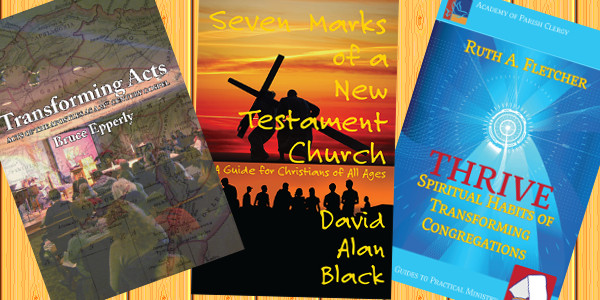
I will be putting more material from Bruce Epperly in as I post more on the church, but here’s an exercise he suggests in his book Transforming Acts, pp. 19-20.
Acts of the Apostles is clear that doctrines are symbiotically related to behavior. Our doctrines emerge from spirit-centered experiences. Our experiences are clarified by our beliefs and take shape in practical application. Accordingly, what behaviors might your beliefs inspire in the areas of:
»» Personal stewardship
»» Care of family and children
»» Marriage and other significant relationships
»» Community involvement
»» Political involvement
»» Care of the Earth
»» Response to diverse opinions
»» Ways we respond to personal or global conflict (violence, reconciliation, consensus, peace-seeking balanced by appropriate protection).
»» Involvement in justice issues – first-hand support of vulnerable people and/or political involvement to achieve a social order more reflective of Jesus’ values.
One of the great strengths of Bruce’s book is that he challenges us at the end of each chapter to thoughtfully and prayerfully move to action.
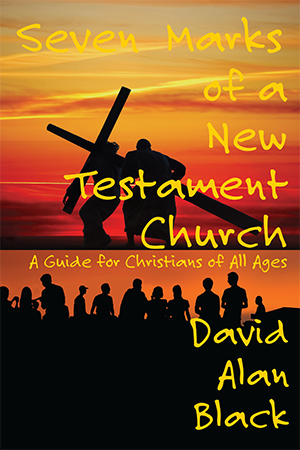
I’m starting a series of posts inspired by my recent interview with Dr. David Alan Black regarding his book Seven Marks of a New Testament Church. He bases this book and the seven marks on Acts 2:37-47. You can see a video of that interview below.
I had the privilege of interviewing Dave while he was visiting Pensacola the weekend of September 6. The interview was recorded by Kyle Hall in the library at First United Methodist Church here in Pensacola. I want to thank Dave for visiting and Kyle for recording the video.
But what does all this have to do with my belief that church pews are unbiblical?
The starting point for Dave’s book is that you can look at the book of Acts, and the activities of the early Christian church, and find things that are normative, or at least very valuable, to modern Christians. Dave isn’t alone in this conviction, but I want to start with the question of how we move from what we find in Acts to what we should do in modern churches. This topic is discussed in the first 4.5 minutes of the video.
We don’t find sound systems or their use in the New Testament. Neither do we find hymnals, organs, pianos, praise bands, orders of service, parking lots, or many other things that are automatically part of our modern life, and often of our church activities. Is it wrong to have something in church that isn’t actually mentioned in the New Testament? There are those who would think so.
On the other hand there are those who would say that church has changed so much that we need to come up with our own unique ways of doing things, that looking back to the early church isn’t going to be enough to deal with our complex world of the 21st century.
I think there is some truth in both points. There are, in fact, critical principles in the New Testament that need to be part of any church that wants to label itself Christian, or more important wants to consider itself a community of disciples of Jesus. (I’d prefer the latter personally.) On the other hand we have situations in the modern world that weren’t a part of the world of the New Testament.
The question is whether the way we choose to meet the challenges of the 21st century is worthy of the good news about Jesus. Do our solutions to modern problems, even when those problems are not directly reflected in some New Testament story or statement, fulfill the principles that Jesus taught? When we make a change does it help us love God and one another? Does it help us to make disciples wherever we go?
So I come to church pews. They aren’t mentioned in the New Testament. They wouldn’t have been needed, though doubtless the various Christian homes that hosted meetings had chairs of some sort. I have a problem with church pews.
Now my problem is that we can’t develop new tools and new practices to meet 21st century demands. The problem is that I don’t think church pews help us love God or one another more and I think they tend to prevent us from fulfilling the gospel commission.
Bicycles are also not mentioned in the New Testament. They’re really good and very helpful in many places. Neither are motorcycles mentioned, but what a blessing they are. I can’t count the number of times I’d head out as a teenager, living with my parents in Guyana, South America, riding on the back of a motorcycle behind an evangelist, holding my trumpet case in one hand. It was the 20th century, true, but it was a very non-1st-century scene. Well, in one way, not 1st century. But in another, the young person heading out to help the evangelist do his work is a very 1st century scene. The tools changed, but the mission didn’t.
But what about those pews? Yes, back to pews. What do pews do for the work of ministry. The very arrangement of our sanctuaries with pews lined up facing a platform where the more important people sit and from which they tell the less knowledgeable what to think tends toward hierarchy. If we’re going to fulfill the hope of Jeremiah 31:34, we need to get more people involved. Our problem is not that our churches don’t have enough order it’s that we don’t have the problems of 1 Corinthians 14. Too many people wanting to speak? On the contrary, just try to get them to do so.
The pews enable this bad behavior and congregational laziness. The people in the pews are there to listen, to receive, not to share and participate.
And then there’s the matter of stewardship. A church “sanctuary” (and what happened to worshiping in spirit and in truth?) is by nature going to be wasted space. There are so many things you can’t do there, because there are very few meetings, other than a totally platform-centered church “service” (who is getting served?), that can take place there.
The same space, made level and filled with movable chairs would be of value for many other purposes. Children could play games. Groups could meet and discuss, putting the chairs in a circle. One might even celebrate communion as a full meal. Yes, I know, we probably have a fellowship hall for that. But why do we do that? Probably because sitting down together and eating isn’t sacred enough to happen in the holy space filled with holy pews.
After we take the pews out, I wouldn’t mind having musical instruments, video, and plenty of parking for those who meet there, none of which are mentioned in the New Testament.
It’s not what’s mentioned and what’s not, but the type of people we are to be and the way we are to behave as disciples of Jesus.
Oh, we could also offer meals to those in need using that space. If it didn’t have pews, that is.
This will be on my YouTube channel and Google+ at 7 pm central time tonight.
I’m actually going to start from what I left off last week and talk about “this generation shall not pass,” which will require me to talk a bit about biblical inspiration. Following that I plan to introduce my (not so original) simple view of eschatology and then look at Mark 13 and how it might fit in.
Next week I’ll be looking at the variety, and some history of prophecy in Old Testament times, and then next week we’ll tackle chapter 4 of Dr. Vick’s book, Prophecy and Apocalyptic.
As I work on these, I’m also working on a series of four talks on Revelation to be presented to some teenagers during the month of October. That may be more challenging than these presentations.
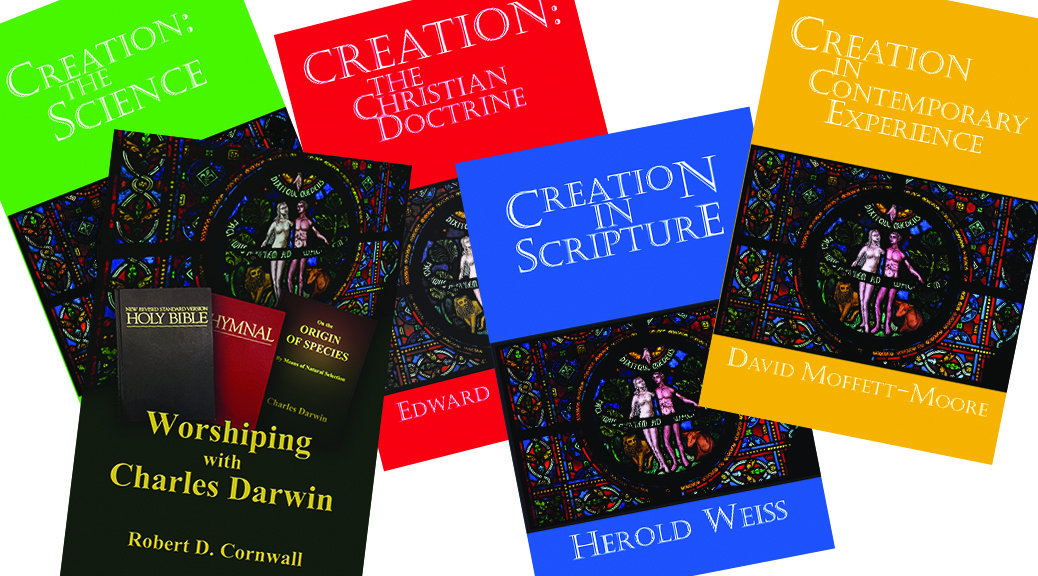
We’re starting a new series of posts on the Energion Discussion Network and the current author is my friend and Energion author Dr. Herold Weiss. He’s the author of the book Creation in Scripture, the first in a series discussing creation from the point of view of those who accept the theory of evolution. That note should tell you that Dr. Weiss’s work can be controversial, as are all discussions of this topic.
I don’t happen to like the terms generally used, but it is generally somewhere between frustrating and futile to try to change language. “Creationist” has become the label of those who believe in a recent (read 6 to 10 thousand years) creation in a literal week, while “theistic evolutionist” labels those who believe God is creator but that the process of evolution is how he has chosen to diversify life here on this planet.
Dr. Weiss does something in his first post in this series that tends to annoy creationists (using the definition above). He calls their view unscriptural. The typical view of a creationist is that their view is scriptural while the theistic evolutionist has chosen to ignore the Bible in favor of evolutionary theory. No matter how strong the evidence for evolution (and they will, with few exceptions, maintain that it is weak), they would not see how it could override the Word of God. So the argument, at least as they generally present it to me, should be couched in terms of their strong convictions about scripture and the weak convictions of the theistic evolutionists, which are to be defended.
But neither I nor Dr. Weiss thinks our position is biblically weak. In fact, I did not change my view from a young earth creationist, which I was until some time during my third year in college, because I had studied evolutionary science. My science requirement was fulfilled in a chemistry class, taught, by the way, by a young earth creationist. It was in doing research for a paper that I found that I could not reconcile the biblical texts on the basis required for young earth creationism. The starting point was chronology, and it wasn’t even comparisons with archeology. It was simply looking at what must have happened between two points in the biblical story, and determining that it was beyond extremely improbable; it was impossible. And further, there was no report of some sort of miracle to connect the dots.
From there the question changed for me. Why is God presenting the story in this manner? (I’m ignoring here all the things I have come to believe about biblical inspiration over the years and discussing my thinking at age 20.) From there I started to ask just what it means to me that God is the creator and how that doctrine reverberates through scripture.
And this is what I think creationists can learn from Dr. Weiss. No, I’m not suggesting they will all read his book and decide to become theistic evolutionists. He isn’t even trying to make that case in the book, and I know my own views would be unlikely to change in reading one book. What he does that is important is look at how creation, and its implications, is presented in various parts of the Bible. Creationists seem to me to be hung up in Genesis 1-3, important chapters to be sure, but not the only thing in scripture on the topic. And yes, I do think these chapters are important, even foundational, even though I read them differently. And no, I’m not claiming that creationists are ignorant of all other passages. What I’m suggesting is that they are not brought into the discussion enough.
Too much of the debate about creation and evolution is concentrated on when and how and too little is focused on so what now?.
I think it would be great if we spent more time on the third question. Yes, we’d still disagree on when and how, and we’d still argue that both of those questions impact the answer to the third, but we might have a chance to shed a bit more light. I think Dr. Weiss has facilitated that.
I asked Dave about going into prayer in such a way as to simply reinforce what I already think and want. He talks about how important listening is as part of prayer. It’s not a catalog of our desires sent to God. It’s a time of listening and learning.
I also asked him what to do if one wanted to improve the prayer life of a church congregation or community, and how one proceeds when someone asks for prayer for a specific purpose.
Dave is practical and down to earth. I really enjoyed the conversation and learned from it.
Well, my prospective, perhaps presumptive garden, that is.
One of the important elements to understanding stories in the Bible, parables included, is our perspective. In Christian circles, when we hear “the sower went forth to sow,” (Matthew 13:3), or perhaps “a farmer went out to sow his seed,” we generally see ourselves in the role of the one doing the planting. We are evangelising, and people have different kinds of hearts. Have you ever heard someone describe another person as being rocky ground? Or perhaps someone has said, “He’s trying to dig some hard ground there!” Usually these expressions are used regarding targets of evangelism.
I’ll mention evangelism later, but first, let me place myself in the role of one receiving the seed. Is that not what I do when I pray and hope to hear from the Lord? Is that also not what I do when I open my Bible and hope to be changed by God’s message? So I am the ground, not the sower.
But let me tell you the story of my garden thus far. Fortunately for me, I have few plans that involve saving money on food, supplementing my diet, or saving on the food budget. I had one purpose in starting a garden: I need to spend more time in physical activity. Now I’m a bit of a workaholic. I have a hard time not doing anything. The easiest way to get myself to do what I need to do was to make it into work. Then I can feel good while I do it.
So I picked a plot on our little place out here and started to work on it. It has gone through being broken up with an excavator (at which time I killed power to my office and broke our water line, but that’s another story), lots of hoeing and raking, and digging up of roots and rocks. This morning I finally got to the point of being ready to actually till the plot. My previous work had been aimed, not at getting the soil ready for actual planting, but at removing obstacles. I have a large pile of brush, roots, and rocks at either end of the plot, things I have removed as I worked.
Then I had a period of time when I was just too busy with work. Between my work with computers and computer networks and my publishing work, I was simply overwhelmed. The phone would ring by 8 am and I wouldn’t get that much done outside. What do you suppose happened? Well, the plot got some new growth, but not the stuff I want to grow, of course, since I hadn’t yet planted. So out came the weedwacker, the hoe, and finally the rake.
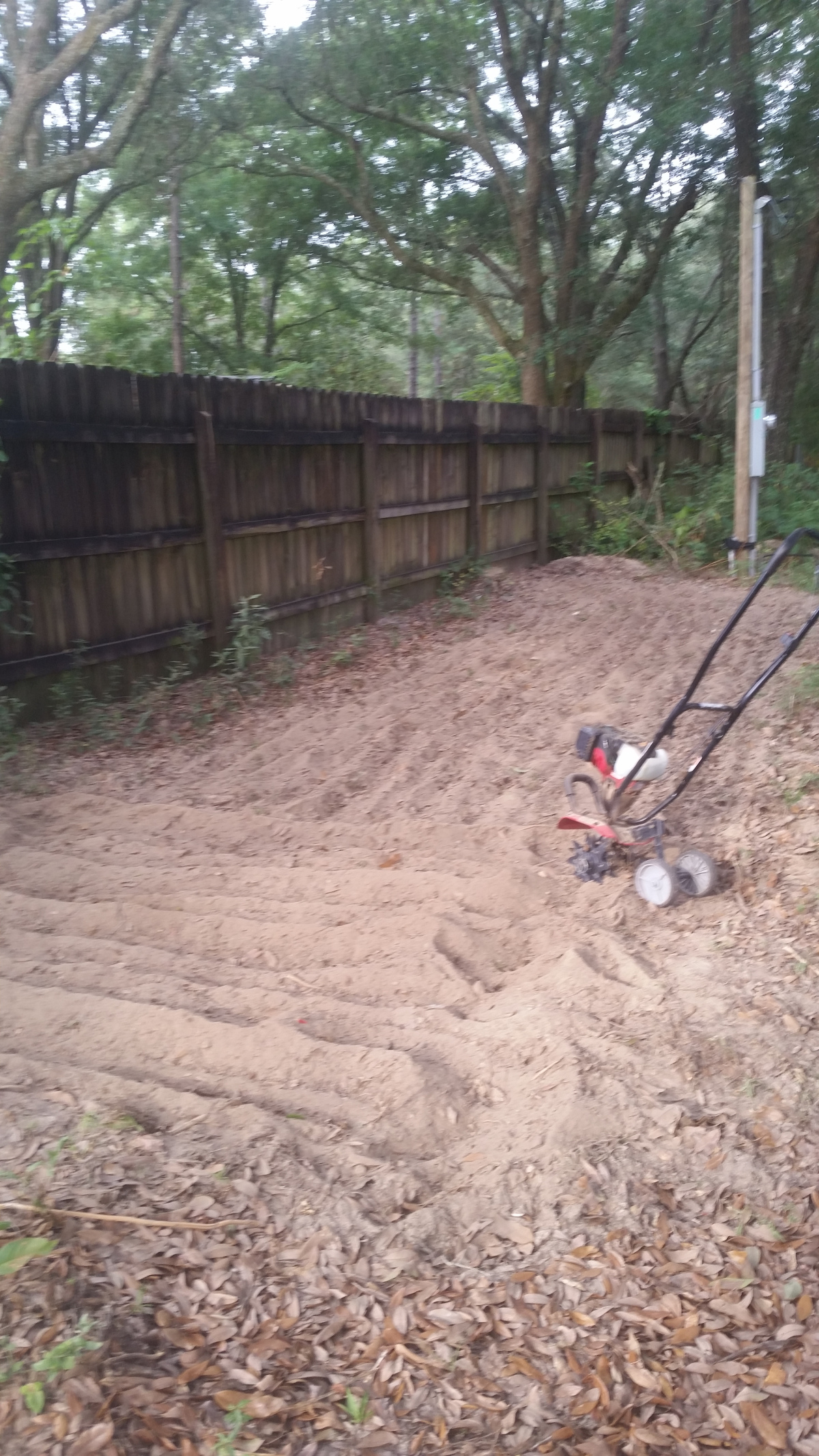
Today I finally got to the tiller. That’s the tiller, in the picture to the left. I borrowed it from my friend Tom Hunt. If you need a floorplan done for a new house, he’s the one to go to.
There were some interesting things about using the tiller as well. Weeds leave behind small roots that tend to wrap themselves around anything available. No matter how may rocks you’ve removed there may be a few more. Run the tiller in a couple of directions. The pile of dirt from one pass may hide some hard soil. Power tools are great, but I ended my morning session more tired than when I worked with the hoe. The tool helps, but the human still better put heart and back into the effort.
Let me apply these to Bible study just a bit. You might want to reference my post from yesterday. Here are some thoughts I had while listening to that wonderful purr (or roar) of the tiller motor.
Different tools accomplish different things. No matter how much you may have gotten with one approach, try taking another look from another angle or with some different help.
Weeds don’t stay dead. You’re never really done. It’s easy to get complacent and think you already have it covered. Now it’s all about telling other people. Don’t get in that place. If you neglect your heart garden for a while, you may find the ground hardening and the weeds getting tall.
Don’t imagine that a period of neglect is the end. That’s what weedwackers, hoes, shovels, rakes, and tillers are for. Those of you who have forgotten your biblical languages after seminary, consider this as well. How about working on reviving them? Yes, I believe you can study the Bible effectively without the biblical languages, but after investing all that time and effort wouldn’t you like the benefit of that tool?
Don’t be blind to the rocks that are still there. You may have removed bunches of rocks, yet there are still some to find and remove. I often joke with Jody that it would be nice if I could measure the quality of my cleaning by the quantity of dirt I removed and not by what was left. Read 1 Corinthians 8:1-3 if you’re thinking you’re good!
Tools help but they don’t do the job. I love Logos Bible software. I love sites that let me compare versions (BibleGateway.com, for example). But these things don’t do your studying for you. They will make you more efficient. Many Bible students amass information and yet don’t get to what the text is saying to them. I was reminded of that forcefully as I moved the tiller through my prospective garden. It did more work than I could have accomplished with the hoe, but it still required me to make the application!
Sometimes you get so tangled with the weeds that you can’t really go on clearing and tilling. I experienced this as left-over weeds and roots tangled up the tiller. I had to stop and clear the blades so the tiller could work efficiently. I’ve experienced this in preparation for teaching my Eschatology series on Google Hangouts on Air (link to next session, Thurs. night at 7 pm central time). Eschatological views are based on many, many texts, and there are many, many views on each of these texts, plus mountains of theology done to tie them together or explain them away. It’s very easy to get so tangled in the details that you can’t see the actual text in front of you. I bounced this off my wife Jody, who has a practical mind set. I asked her to read Mark 13 the other day and then question me about it. She had a set of questions that helped clarify the chapter.
I’m sure there are many more lessons, but those are the ones that occurred to me as I worked this morning. But does any of this apply to evangelism?
Quit trying to judge the people you witness to. You can’t see what’s under the ground.
The best way to witness is to till your own heart. I can’t emphasize this enough. Most people can tell very quickly if you’re trying to use them for something else. So if you are making relationships with other people in order to convert them or make them into church members, they’re going to get that feeling. But if you are genuine and genuinely care about them, they will also know that.
The Christian life and Christian witness isn’t a strategy. See #2. Enough said!
God is the one who changes people. You witness. God acts. Be humble enough to give God the credit. Be humble enough to let God take the responsibility.
Do you see what happened? Quite frankly, all the lessons but one applied to me. As for reaching others, I have one duty: plant the seed. Now planting the seed can be complex, but I suggest that it starts with some of the points I made above. Let God’s word impact your life. Continue to let God’s word impact your life. Continue some more letting God’s word impact your life. Continue yet much more letting God’s word impact your life.
Yesterday I wrote a bit about using prayer and Bible study as a starting point for change. The problem is that it’s very easy to pray and study the Bible in such a way that it makes you a worse person.
I’ve found a relatively simple way to determine whether I’m doing this myself:
If I’m studying the Bible to figure out what other people are doing wrong, how other people need to change, I’m making a worse person of myself.
If I’m studying the Bible so that by beholding I can be changed, so that I can find out how to be a better follower of Jesus, I’m allowing God to make a better person of me.
I frequently hear (and have sometimes myself offered) prayers that ask God to fix someone else. If you’re praying for your pastor and asking God to make him or her see things your way, you’re on a dangerous path. Let God make the decisions. It might just turn out that what needs to change in your relationship with your pastor might be you.
In Bible study I’d take another step and say that one’s general approach needs adjustment. When I started studying biblical languages I imagined that I would discover the original text and read it in the original languages, and thus resolve issues, at least to the extent that I would be certain of what was right and what was wrong. Getting that information was my entire intent.
As I studied, I found that every aspect of that approach was problematic. Even the idea of an original text wasn’t easy to define. Was I looking for the text that came from the pen of the writer, however inaccessible that might be? Was it to be found in whatever sources were used by a writer? Perhaps the text actually used in the early church was more important than some earlier text that was beyond my reach. Having discovered (or pretended to discover) whatever text I was after I then had the problem with where and how it applied. The hard and indisputable facts were generally in dispute, no matter how long I studied.
Over time I have come to believe that there is value in studying all levels of the text. Those who prefer canonical criticism look down on form, source, and redaction critics, and claim that the canonical form is the “special” form of the text. Source criticism, just as an example, assumes that one wants to get closer to the roots of the text.
I find both approaches helpful. One is certainly on less solid ground looking at the prehistory of the text. While I may have doubt about the details of the canonical form of the text, I am frequently in serious doubt about the text’s prehistory. Yet when I’m studying the text to see God in action, I am always able to listen for the voice of God. Sometimes that voice will even get through the static of my own thoughts.
Talking to God and listening to God are about changing me. Only when I first focus this on me will I be in a position to help someone else. If I respect them and love them as I believe God loves me and calls me to behave, I have to allow them to behold and become changed (2 Cor. 3:18) as well.
Over the last few years I’ve come to believe that we have two key elements that need to be changed, but more fundamentally, we keep talking about the church too much differently than we talk about individuals. As individuals, we need to be following Jesus, not just appropriating the label “Christian.” As a church, we need to be following Jesus. Those who are following Jesus will be witnesses. A church following Jesus is a witness.
What do I see as the two key elements?
Lack of Bible study and reflection. I see this broadly, as in study that leads us closer to God.
We do not lead lives of prayer. This differs from praying occasionally, or offering pre-written prayers in a church service.
I think that if we were to correct these two elements, others would correct themselves. I need to correct them as well. There are those who commend me on my biblical knowledge and who consider me a man of prayer. (Others, not so much!) But the fact is that I don’t live up to the standards I believe in. While we are, indeed, all imperfect, we can all keep heading in the right direction.
I also think these two elements are much more closely connected than is generally realized. Prayer should be communication, conversation, not a monologue directed at God. Bible study should include the discipline of listening and a constant process of opening one’s self up to what God has for one in scripture.
Last weekend Dave Black was our guest here in Pensacola. I recorded some videos for promotional and educational purposes and Dave also preached and talked about missions (with plenty of pictures) at Chumuckla Community Church. I will be posting some of these videos soon, but they are not quite ready yet.
Dave is a professor at Southeastern Baptist Theological Seminary. I’m a United Methodist with the dreaded ‘L’ word in my blog tagline (“Thoughts on biblical studies, religion, and living from a passionate moderate, liberal charismatic Christian”). Obviously this is some sort of liberal-conservative dialogue.
Not really. I’ve written recently about dialogue and why, as a publisher, I publish books from a variety of perspectives. In a video I produced in the early days of Energion Publications I used a triangle, with the points being charismatic, liberal, and evangelical. I would note that for this to work now it should be “conservative evangelical” as the label “evangelical seems to have lost some cohesion. This will happen to words, especially those that are perceived as positive labels.
But even those three points fail to catch some of the issues, and there’s a bit of a tendency to think of Christians grouped at the points of the triangle. One of the reasons many have trouble with labels is that people don’t fit into the center of the semantic range of a label. In addition, on different issues one may take different positions. I have political views on some subjects that seem very conservative, while on others I seem quite liberal. Similarly on theological issues I don’t try to fit all in one camp.
There are two points (I think!) in all this rambling. The first is that we don’t fit cleanly into one label on all issues. The second is that we may be able to connect with people in other camps on particular issues. In all cases (should this be #3?) this should suggest options for learning from one another.
For example, when many charismatics talk about modern revelation they use theological arguments that are also commonly expressed by liberal or progressive theologians. Not a few of those I’ve talked to want to deny any connection, but behavior and practice tell a different story. There is some theology to be learned here! Similarly many charismatics should—and do—learn biblical studies from their evangelical brethren.
Many liberals or progressives, on the other hand, don’t want to be linked to charismatics because of emotionalism or other extremes. Yet too frequently progressive biblical reflection tends to be more a matter of challenging the conclusions of evangelicals rather than developing a robust theology and application of scripture. Yes, this can be a stereotype. I have several authors in the Energion Publications list, such as Dr. Bob Cornwall, Dr. Bruce Epperly, and Dr. Drew Smith, none of whom fit the picture. And there are many more like them.
One of the interviews I conduced with Dave was about his book Seven Marks of a New Testament Church. Dave goes back to the book of Acts for keys to how the church should behave now, in the 21st century. And this brings up a very different spectrum: church structure.
We could make a spectrum that runs not from conservative to liberal, but from strongly hierarchical to mutually submissive, from high church to low, from central control to local. Similarly we might look for a spectrum of views on who is in charge of the church, how much, and in what way. That could run from Jesus in charge directly to a highly hierarchical view of how the lordship of Jesus is implemented in the life of the church. None of these would exclude people from any liberal-conservative, charismatic-evangelical, or any similar ideological spectrum.
My plan is that as soon as I’ve posted my interview with Dave on his Seven Marks book, I’m going to start blogging through the Marks. As I do so, I’m going to bring in points from some other authors, such as Bruce Epperly, whose book Transforming Acts: Acts of the Apostles as a 21st Century Gospel also goes back to Acts to ask what we can do in the church today. Beside both of those I’m going to reference the book Thrive: Spiritual Habits of Transforming Congregations by Dr. Ruth Fletcher. There are definite differences of approach in these books, but there are also many points of contact.
So I’m going to ask two questions in my series:
Can we find a way to apply these seven marks in other theological and ecclesiological traditions? (I fully believe we can, though there are places where our ecclesiology needs to change, and that’s a good thing!)
More specifically, how can a United Methodist congregation look back to the New Testament and so become a more authentic witness for Jesus in the world today? There are those who would say many of these ideas are not possible under denominational rules, but I wonder. How much would a simple commitment to being “servant of all” on the part of those at the top of the organizational chart might change the reality without altering the paperwork?
So watch here over the next week. I’ll post the video and then begin the discussion. I hope I can find some people to discuss this with me vigorously. My comment policy is largely open. If you don’t threaten the family friendly nature of the blog, you can express yourself.