
Pure exegesis is a great guide but an unreachable goal.
Category: Bible Study
-

Seeking a Bible Topic
Franklin Graham is quoted by the Huffington Post as saying that the President Trump’s refugee ban is not a Bible topic. He actually said a bit more, but “not a Bible topic” is going to be the quote that follows him all the (remaining) days of his life. And well it should, though I think most are missing what’s being said.
My purpose is not to defend Franklin Graham on this; in fact, I am diametrically opposed to his position on these refugees. I believe that we should welcome Muslims in the same way as we would welcome anyone else in need. It’s relevant, in one way, to point out that many refugees from Syria and Iraq are Christians. But for a Christian that shouldn’t be the issue. If all were Muslims we should remain equally concerned for their welfare, and equally willing to put our own welfare at risk on their behalf.
But I think the issue here is a bit different. Let me quote just a bit more from the article. (If you’re diligent, you’ll go and read my source, and perhaps some of its sources in turn.)
“It’s not a biblical command for the country to let everyone in who wants to come, that’s not a Bible issue,” Graham told HuffPost. “We want to love people, we want to be kind to people, we want to be considerate, but we have a country and a country should have order and there are laws that relate to immigration and I think we should follow those laws. Because of the dangers we see today in this world, we need to be very careful.”
The issue here is not directly that refugees are not a topic in the Bible. The specific question is whether the Bible provides a command that can be directed at the United States, that directs us to admit all refugees. This question is one of hermeneutics. How do you make such a determination?
One passage that might be cited is this:
The alien who resides with you shall be to you as the citizen among you; you shall love the alien as yourself, for you were aliens in the land of Egypt: I am the Lord your God. (Leviticus 19:34)
That line “love the alien as yourself” might come up in a discussion of how a Christian should look at this. I would not want to be left in a refugee camp for years, and if I had gone through a series of checks in that camp, I would not be delighted to suddenly learn that I would be left there for another six months (or perhaps more). A person who loves an alien as himself probably wouldn’t do that.
But does this law apply to us right now? I personally believe it applies to me (for reasons I won’t detail here), but does it apply to my country?
At this point we might consider another passage from Leviticus:
22 You shall not lie with a male as with a woman; it is an abomination. (18:22)
Now if Leviticus 19:34 is a command, is not this also a command? If the first applies to America does the second not apply also, and vice versa?
But what we find is that those people who want Leviticus 18:22 to apply find a way to make it apply. I’m not discussing here whether their way works or not, but merely consistency. A certain number of those don’t want 19:34 to apply and they find a way to explain that it doesn’t. Again, the reverse is also true. No, not everyone is thus inconsistent. Some will apply both and others will not apply both, but there is a considerable amount of inconsistency.
Is there a valid, consistent hermeneutic that can make one apply and not the other? Possibly. But we rarely hear about that.
I was teaching the New Life Sunday School class at First United Methodist Church of Pensacola as a guest this Sunday and we discussed this topic a bit. One of the members quickly brought the conclusion: Most of us have our viewpoint first and then find scripture to support it. I pointed out that this was also the case when we reject or accept someone else’s viewpoint and biblical claim.
From one point of view, I can’t help but agree with Franklin Graham. No, not about refugees. I agree with him that in the sense he describes (using the full quote) that there is no scriptural command that could be said to apply to the United States and that would require that we accept anyone who wants to come here.
 I also disagree, with some vigor. That is not the way to determine what is a biblical issue. I’ll be interviewing one of my undergraduate professors tomorrow evening for our Energion Tuesday Night Hangout. (Note: It appears this hangout never took place. – HN 02/06/2021) I’ll embed the YouTube viewer at the end of this post. He used to tell us to narrow the letter and broaden the spirit. That is, you find out who it applies to originally in the narrowest way possible, but then you find the principle or spirit that inspires that command, and you apply that much more broadly.
One might say that this approach offers a great deal of leeway. Indeed it does. And so does every approach to interpreting the Bible. That’s because the Bible wasn’t created by a committee of lawyers and mathematicians. Rather, it is the result of the experience of (some of) God’s people with their God.
As such, the Bible can enlighten, guide, inform, and help, but does remarkably little (if any) direction in the sense that Franklin Graham was apparently applying. If that approach is applied consistently, the Bible fades into insignificance.
Except as a fig-leaf used to cover our pre-existing passions.
This is one reason I advocate the process of letting the Bible change you and then that you, through your actions, influence others. Even better, let God use the pages and text of scripture as God wills to change your own life.
In my case, this would mean adjusting my way of thinking about other people. It would mean making me feel empathy for those who suffer. As such, I would want to live in a nation with policies that reflect such a view. I don’t have to ask anyone to live according to one divine decree or another, always in dispute. Rather, I simply use what influence I have in favor of that position.
If the Bible is used in the sense of the quote from Franklin Graham, then very little is a Bible issue, at least in terms of politics or society. But if we look at the Bible as one of the ways in which God changes our character, then everything is a Bible issue, because through it I let God change me and then I go forth to influence the world.
I believe that Jesus would want me to welcome Muslims into my country, my neighborhood, and even my home. But I know people from many faiths, and indeed some atheists who would agree with my goal. So I can advocate this as a good policy from a secular or a religious viewpoint.
A collection of books I publish and recommend on inspiration.
-

When Definitions Tangle: Law vs Law and Will vs Will
I might have said collide, as sometimes seems to be the case, but let’s start with tangle. Here’s Paul in Romans 2:
12 All who have sinned apart from the law will also perish apart from the law, and all who have sinned under the law will be judged by the law. 13 For it is not the hearers of the law who are righteous in God’s sight, but the doers of the law who will be justified. 14 When Gentiles, who do not possess the law, do instinctively what the law requires, these, though not having the law, are a law to themselves. 15 They show that what the law requires is written on their hearts, to which their own conscience also bears witness; and their conflicting thoughts will accuse or perhaps excuse them 16 on the day when, according to my gospel, God, through Jesus Christ, will judge the secret thoughts of all. (Romans 2:12-16, NRSV, courtesy of BibleGateway.com).
What definition of “law” can you use that will actually make sense of everything Paul is saying. Those who have sinned “apart from the law” also perish “apart from the law.” First inclination is to think those without Torah perish without Torah. Of course we might compare Romans 7:7 and ask just where is sin without a law. To get out of Pauline literature, we might note that 1 John 3:4 identifies sin as the transgression of the law (or lawlessness), while (back to Paul again) “whatever does not proceed from faith is sin” (Romans 14:23). Pardon me for jumping about, but I’m illustrating the problem of definitions here.
Then we have verse 13, where the “doers of the law” will be justified, except that we can refer to Galatians 2:16 (another book, but still Paul), where we are informed that nobody will be justified by the works of the law. So is Paul referring to the same law in Galatians 2:16? I’m not going to resolve all this here. I’m just suggesting the serious need to look at definitions. I’ve heard these various passages put together, and I myself have quoted 1 John 3:4 as though it came from Paul, just because I have it squirreled away in my brain along with Paul-talk.
But just with Paul’s discussion we may be looking at some tangles, as verse 14 suggests that Gentiles, not possessing the law, might instinctively do what the law requires. Now doubtless this doesn’t refer to the Gentiles instinctively knowing to practice Leviticus 6, which provides detailed instructions for a trespass offering. Not to mention any number of chapters around it. So there’s something other than the details of Torah that Paul has in mind here. From verse 15, “what the law requires is written on their hearts” suggests the same thing, and apparently God will judge them according to the law that they have.
My own though here and throughout the writings of Paul is that he sees an overall law of God which is then instantiated for those God is working with. The law (as you have it) reflects the law (as God desires it), and expectations are laid on you accordingly. The closest reflection of living by God’s law would be when our acts proceed from faith (Romans 14:23). I’m not really trying to fill out this thesis here. Rather, I’m suggesting that a great deal of confusion in reading Paul would be eased if one were as flexible in understanding the word “law” and connected phrases as Paul is in using the term.
Which leads me to the term “will.” What is God’s will? What is God’s plan? Some people are wonderfully comforted with the idea that God has a plan for their lives. Others are not that happy that they don’t really have a choice. Sometimes these ideas clash even when they are used by people who would both (or all) say that they want to live “in God’s will.”
But what do we mean by that?
I would suggest that we, in the modern church, are even more flexible in our use of “will” than Paul is in his use of “law.” I would suggest that God’s will is actually a very flexible thing. God’s plan for your life is that you make the best use of your gifts and talents according to the principles of God’s law. Just what has God decided and what is left to you? Listen, think, act, and enjoy.
God is flexible enough to deal with it!
(Featured Image credit: Openclipart.org.)
-
Bloody Sacrifices and Salvation
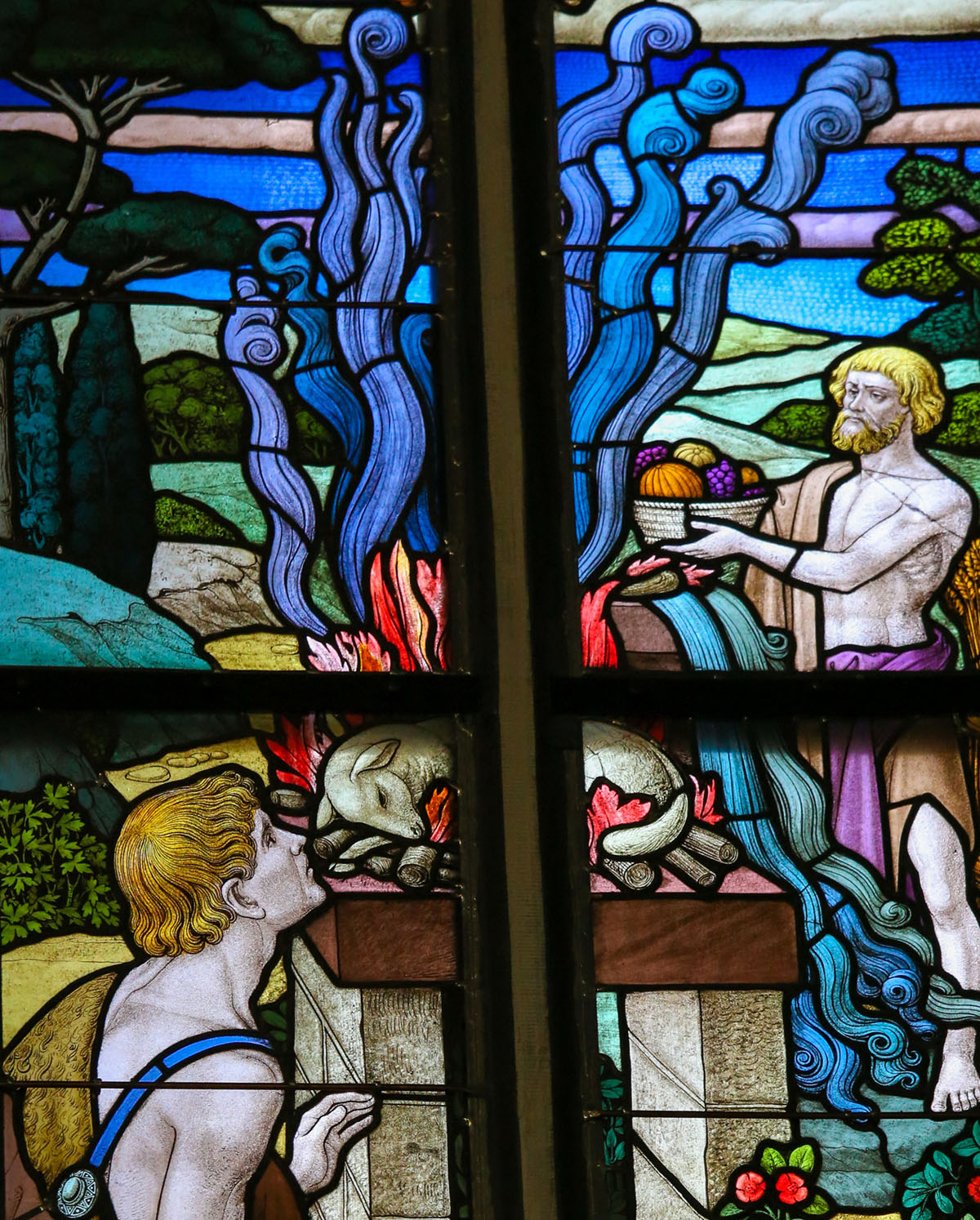
One of the problems with understanding biblical talk about salvation is that we do not live with a sacrificial system. For many Christians, the whole idea of sacrifices is that someone sinned and a bloody sacrifice was required for atonement. Christians believe that because of one bloody sacrifice, that of Jesus on the cross, no other bloody sacrifices need be offered, and we’re very relieved. In Judaism, the sacrifices have been replaced by Torah observance, without sacrifices due to the absence of the temple. Despite the desire of some Jews to rebuild the temple, I suspect the majority are quite happy with its absence.
This was emphasized to me recently as I prepare for (never ending) episodes of my study on Paul, especially as I read Galatians, and even more as I read Hebrews. The problem is that every word needs to be defined, and we are, to a large extent, convinced that we already know what the words mean. In fact, we are so convinced that we can define ourselves right past the message of the scripture we’re reading. As Mark Twain said, “It ain’t what you don’t know that gets you into trouble. It’s what you know for sure that just ain’t so.” (Read more at BrainyQuote).
My purpose here is not to provide a new and perfect (I have been reading Hebrews, after all!) answer to the question of what sacrifice really means. The word means different things in different places. I has a range or ranges of meaning. In cultic terms, as opposed to the more personal,, it seems to grow out of the idea that one needs to communicate with the divine. That can be as simple as the need to present your petitions effectively or as complex as wanting to hear from God, or from the gods, what is the ultimate plan for the physical universe, always assuming there is one.
That’s why you have a complex array of sacrifices and rituals in any religious system. The actual sacrifices and rituals evolve as worship takes place, and as people believe they receive communications, or more specifically directions, from the divine. The actual rituals are a mix of what people expect such things to be (tradition), from what people perceive to have worked (accurately or not), what people have heard, and available options and resources. These rituals will also combine the perceived needs of people, secular authorities, and religious authorities in various measures.
It may seem somewhat irreverent to some to apply this kind of process to biblical rituals, but as I argue in my book When People Speak for God, communication involves at least two termini, and one of those, in this case, is human. The lesser (slower, narrower, less precise) terminus determines the quality of the received message. In addition, a culture does not turn on a dime. Even revolutions are actually evolutionary to some extent.
The result is that the cultic system serves a range of needs. In modern Christianity we’ve come to think of salvation in rather simple terms: Avoid hell, and go to heaven. The intervening problem is that we’re sinners (though that term can get complex too), and the solution is the sacrifice of Jesus. All of which can be quite helpful except that it leaves us living in this world with all the many and varied issues in our lives.
The biblical concept of sacrifice was not quite so narrow. Or, rather, I should say that the biblical concepts of sacrifice were not quite so narrow. There is no particular reason to assume that every author in scripture is going to use the word “sacrifice” (or rather, various words sometimes so translated) in precisely the same way. If you read the texts carefully, you’ll find they are quite varied and nuanced.
In Leviticus, the world is made up of sacrifices. That’s because, for the most part, Leviticus is a book giving instructions about the cult to priests who were to carry it out. In that book sacrifices speak to the continuous presence of God, to atonement for specific sins, to atonement for guilt perceived for unknown reasons, to thanksgiving for blessing, to rituals for healing and purification, and ever so much more. The sacrifices were an integral part of the way the community of Israel was to live in community with its God.
The sacrificial system was not universally loved. For the prophets, it was often a dead routine carried out in Jerusalem by a nation in rebellion. Even earlier we have Samuel’s comment to Saul:
22 And Samuel said,
“Has the LORD as great delight in burnt offerings and sacrifices,
as in obedience to the voice of the LORD?
Surely, to obey is better than sacrifice,
and to heed than the fat of rams.(The Holy Bible: New Revised Standard Version. (1989). (1 Samuel 15:22). Nashville: Thomas Nelson Publishers.)
Or as Hebrews Hebrews 10:5-7 quotes Psalm 40:6-8:
Consequently, when Christ came into the world, he said,
“Sacrifices and offerings you have not desired,
but a body you have prepared for me;
6 in burnt offerings and sin offerings
you have taken no pleasure.
7 Then I said, ‘See, God, I have come to do your will, O God’
(in the scroll of the book it is written of me).”The Holy Bible: New Revised Standard Version. (1989). (Hebrews 10:5–7). Nashville: Thomas Nelson Publishers.
Now the author of Hebrews puts Psalm 40:6-8 into the mouth of Jesus, and here emphasizes something that is often missed in Christian discussions of atonement. One of the claims made by various New Testament writers was that Jesus accomplished God’s will in a way that humans had failed to do. It’s not that we don’t have in mind the idea that Jesus accomplished God’s will. Rather, it is because that is not part of our view of atonement.
I think this is why we so often have trouble understanding something like John 3, in which yet another different view of atonement is presented, one in which we immediately “have” eternal life. The typical response to this is that I’m going to die. How is it that I can have eternal life? But that’s because we get off the track of a desire to create community here and to be in communion with God (and both of these concepts invite further discussion and definition), and have limited our idea to one thing. Where do I spend eternity?
That is a question that doesn’t work well in isolation. It makes faith, salvation, and atonement a narrow and selfish thing. It’s not that we shouldn’t want to care for our eternal reward. Rather, it’s because we shouldn’t try to plan our eternity independently and as a solely future event.
I’m mostly raising questions here, and providing way too little in pointing the way. The key thing I’d like to suggest is that we need to quit reading scripture in the elementary or high school sense of “look the word you don’t know up in the dictionary.” That’s a good starting point. But then you need to allow the context of one author’s work build a nuanced definition for you.
I recall reading Ludwig von Mises’s book Human Action back when I was in college. It’s more than 800 pages of rather intense prose. In that book von Mises creates his own vocabulary. He’ll say that a particular word (psychology, for example, which he replaces with thymology [but not precisely]) has problems of definition. Then he defines the word himself and proceeds to use it in further discussion. If you don’t pay attention, you’ll wind up completely baffled a few pages further. You can’t use the dictionary, because the word is not there. What you can do is develop your own understanding of the term as von Mises uses it.
Try that with your Bible. It can be rewarding!
(Featured image is from Adobe Stock [#126750439] and is licensed. It is not public domain.)
-

Perspectives on Paul: Law or Faith
Fair warning: I’ll probably be stuck on definitions. In fact, I’m in the process of writing a blog post about it right now. I’ll add a link to this one once the other is complete. (Here’s the link: Bloody Sacrifices and Salvation.)
Here’s the viewer:
-

When the Bible Story Shocks
I read Joshua 24, including Joshua’s farewell speech today. There are quite a number of texts in this chapter that are quoted regularly without any knowledge of their source or of the circumstances. One is Joshua 24:15 “… as for me and my house, we will serve the LORD.” Now there’s a pink elephant in the room, the genocide of the Canaanites, which is generally ignored. I will just point out that it cannot actually have happened quite that way, because the Canaanites survived in large numbers, as the book of Judges tells us. Yet there’s still the issue of the claim. That’s a shocking point in a story, but I’m going to ignore it today myself.
I’m interested in the fact that the call to faithfulness presented here, described as a torah, or instruction (v. 26, “written in the book of the torah of God”), is embedded in a story. Joshua goes way back to give us the shocking information that Abraham worshiped other gods. There is a much abbreviated presentation of the history that has brought the Israelites to this place.
But the use of story is also challenging. In the book of Jonah, God behaves in unprecedented ways. The book or Ruth presents a story that stands in contrast to specific instructions regarding the Moabites. While Daniel is commended for keeping to Torah, Esther appears to live without people realizing she’s a Jew.
The actual stories present a much more complex picture of God related to his people and God’s people in their activities, ethics, and theology. The story of Samson in Judges is one of those surprises. We can dress it up for Sunday School as a servant of the Lord carrying out his mission for his people with miraculous support, but it really reads like someone who couldn’t ditch the stupid and kept stumbling into ways to kill Philistines, the enemies of Israel. He ends up kill a few thousand while committing suicide.
I believe that theology is easy, but life is hard. Yes, we can debate theology all day, and it’s pretty near impossible to understand the trinity. A pastor friend of mine told me that with the trinity, if you think you understand it you probably don’t. But face it, as much as we enjoy debating theology, mistakes in the classroom have little impact.
When they get into real life, however, theological ideas can end up healing the sick or burning people at the stake. And everything in between. That’s the value, I believe, in reading stories and placing all our theology in real life as much as we can.
It’s not that there’s no truth. It’s not that there’s no right or wrong. It’s just that life manages to scramble our hopes of always having a clear knowledge of it. That’s why we need to exercise our faculties so we can tell.
And when we read stories, and live our lives, we need to go deeper than just finding the moral. If you find just one moral of a story, you probably haven’t thought of it enough. If you learned just one thing from an experience, spend some more time thinking about it.
Life is hard. Theology can help you.
But only if you hone your theology in real life.
(Image credit: Adobe Stock [105521664]. I have licensed this image, but it is NOT public domain.)
-
Eschatology and Apocalyptic in Understanding Paul
I’m embedding this interview with Dr. Herold Weiss, author of Meditations on the Letters of Paul, as it provides some background for understanding some of the discussion of the terminology that I’m doing right now in working through Paul. I find it very helpful in clarifying the issues.
-
Perspectives on Paul: Some Comparisons between Galatians and Romans
This will continue the discussion, dealing more with definitions. In the area of soteriology (the study of salvation) we frequently make the same statements in terms of words and structure, yet mean something quite different by it. “Jesus died on the cross to save us from our sins” means quite different things, depending on who is saying it.
-

Perfection and Maturity in Hebrews 6:1
Perfectionism is an interesting trait, and can be quite destructive. United Methodist pastors are still asked whether they are going on toward perfection, though I have found few who expressed great comfort with the required “yes” answer, and not a few who had their fingers crossed.
The line comes from Hebrews 6:1, and the more I study Hebrews, the less I see this in terms of attaining a moral standard. John Wesley himself made it clear that “Christian perfection” would be a gift of God, given by grace, and not an attainment (repeatedly stated in his compilation A Plain Account of Christian Perfection).
But what is the perfection to which a Christian should go on toward?
Before I look at that, let’s ask about the verb that is being rendered by “going on” here. This is almost universally translated actively, taking it as a middle voice. (Let me skip all the arguments about the middle voice here and just say that in this context, a middle does justify an active translation.) But it can also be taken as passive, and I think it should.
Let me quote David Allen:
…The verb may be construed in the middle voice in the sense of “to bring oneself forward,” but most likely it should be taken as passive, suggesting God as the one who moves the readers along to the desired goal. Christians are dependent upon God and his grace to enable them to press forward to maturity. (Hebrews, The New American Commentary, p. 400 [Nook Edition])
(I was helped to a decision on this in a discussion with Dr. David Alan Black, who should not be blamed for the rest of this post!)
This fits well with what I see as the message of Hebrews in general, which I summarize as “get on the right train and stay on it until it reaches its destination.” Human action is called for in the book of Hebrews, yet it is always action that is empowered by God, and not by us.
But the other side of this is what sort of perfection is involved. In learning we’re often told to go find the definition of a word in the dictionary and then we think we understand a passage we’re reading. For building language skill, that’s not a bad plan. But for coming to understand a relatively complex piece of theology, it leaves something to be desired.
Biblical languages students start by learning glosses for (a word or phrase seen as an equivalent), then learning that there are numerous possible glosses and that the lexicon provides such lists. After they have become skilled at this process, one hopes they will learn to work with definitions and semantic ranges for the words. But even at that stage, the tendency is to discover what a word means in scripture and then to force that meaning into the text.
I think that’s what is happening here. We see this verse as demanding that we continue the quest to attain a state of moral perfection. But in the book of Hebrews our task is to continue in Jesus, our High Priest. If we stay the course with Him, we will attain the promises. (I’m not going to reference everything here. Many of these are themes stated repeatedly and in different ways through the book.)
We might also consider the perfection of Jesus, who is “perfected” through suffering (Hebrews 2:10). Clearly, Jesus is not brought to a state of moral or ethical perfection. Rather, he is being perfected as a High Priest, acquainted with all our weaknesses (Hebrew 4:14-16) but also above us all in all ways (Hebrews 7:26-27), the perfect person to be the communicator or mediator between God and humanity. In this case we’re looking at a definition on the order of “totally suited to accomplish a particular mission.”
I might use this sense in recommending someone for a job. The “perfect” candidate is not one who is never going to make any mistakes, nor is he necessarily a person who is known never to engage in sexual misconduct off the job. Rather, that candidate is the person who is fully qualified to carry out the assigned tasks. It doesn’t mean he’s not wonderful in all those other ways; it’s just not the element in view.
Thus Jesus can be perfect and need perfecting all at the same time, and we see this developed from Hebrews 2-4. Hebrews 5:9, which immediately precedes our passage (I consider 5:11-14 as the first step in an argument that continues in 6:1. The chapter break separates this in a less than helpful manner.
So now we look at the state of the audience. They are stuck at basics and not ready to understand the discussion of Melchizedek which he wants to start. So having noted both the weakness and what strength would look like, he suggests that we lay aside the basics (the milk) and go on to the meat, whereupon he does precisely that.
“Let us be moved along toward perfection …” calls us away from basics and on to the meaning of this high priesthood. There is, I believe, a call to action and yes, to holiness, in moving on doctrinally, but the call here is to get past basic thinking and move on toward more mature thinking. Let your minds be perfected.
As I’ve commented before, students of Hebrews often divide the book into doctrinal presentations and exhortations. It’s not entirely wrong to differentiate, but I don’t believe these two elements are all that separated for him. The understanding of the Melchizedek priesthood of Christ is, in itself, a call to new action.
“Being carried on” or “being moved on” toward perfection is passive in form, but being carried by Christ is a rather active passivity, as we might deduce from Hebrews 11. Note how the preparation for solid food is through exercising one’s faculties.
Active passivity. Gracious working. It might just describe life “in Christ”!
(This post’s featured image is licensed from Adobe Stock, #115932220. It is not in the public domain.)
-

My Life and Educational Experiences for Bible Study
When I am introduced to speak or teach, mention will doubtless be made of my MA in Religion, concentrating in Biblical and Cognate Languages, though the correct degree name will be shortened, and the language skill usually exaggerated. In my mind, however, there are many things that have contributed to my study of the Bible. I’ve never encountered a biblical scholar who found this surprising, but sometimes non-academics are surprised.
I thought I’d list some of the key experiences, many of them not of my choice, which have nonetheless been critical in forming my thinking and informing my study.
- Bible memorization. As a preteen and early teenager I attended a small private school where we memorized substantial Bible passages. By substantial I mean that we memorized Psalm 119, all 176 verses, Genesis 1 & 2, many Psalms, Luke 2, and so forth. We also memorized scatterings of texts on various topics. This memorization, which I certainly would not have accomplished if it had not been required, has nonetheless stuck with me and helps me see the broader picture. I don’t have to go read Isaiah 53 or 58, because I memorized them, and though I could not repeat them in the KJV (which we used), I still have a fair idea what’s there.
- Bible survey. At the same school we were required to memorize titles for most of the chapters (we covered the Psalms by knowing what chapters were in the five books). Along with memorizing, this again helped me with an overview, and made it much easier to find content that I need. I still surprise people by pointing them to a book and range of chapters even when I’m not sure of the specific verse they’re looking for. Further, we had workbooks which asked questions about the text of the entire Bible. These were not thought questions, but content questions. I think it’s unfortunate that people who teach critical and independent thinking often forget that having the facts at hand is useful in thinking, and those who teach the facts often forget that facts strewn about the landscape are not so helpful unless they are critically examined and ordered. Sometimes “Bible study” turns into a simple recitation of opinions, in part because students are so unaccustomed to reading the text and making their own judgment regarding the meaning.
- History and historiography. There is an obvious benefit to knowing biblical history and related ancient history. I think some study of other history–any other history–is of great value as well. One of the problems we have with studying the Bible both “seriously and faithfully” is that we make up special methods for studying it as opposed to other texts. We also make up rules for studying biblical history which might not be accepted elsewhere. There’s no substitute for actually reading and studying some good texts on history unrelated to the Bible.
- Sociology. I hated my undergraduate sociology, but I’ve come to value that area of study, though I still consider the one undergraduate course I took to have been seriously deficient. People are people, and studying how people behave and respond helps me read Bible stories more faithfully.
- And yes, language. Learning to read the biblical languages is valuable in many ways, including being able to spot nuances in the way things are expressed more easily. One of the most important things I learned, however, was how complex the process of translation can be. When you are first learning to read another language (and often for much longer), you are really mentally translating the text into your native language. It can be a struggle and should give you a great appreciation for those who translate on a professional basis. It’s so much easier to criticize scattered renderings where you have a strong opinion than it is to produce a quality translation of a substantial portion of the source text.
- English, my native language. The process of understanding an ancient text and then expressing it in modern terms will tax your knowledge of and fluency in your native tongue. Many times I have been trying to express something from the Greek or Hebrew text and have stumbled for lack of a good English expression. Many really bad ideas in biblical studies have resulted from this, such as claims that “English can’t really express this idea.” The real issue is can you use your native language creatively.
- Church life. I don’t think you’ll understand the Bible unless you’ve experienced church. I don’t mean that church is such a good representation of what’s in the Bible. Usually not so much. But a great deal of the Bible story is about people trying to form and maintain communities, and if you haven’t actually tried, you may not understand them. I hate church politics, but at the same time church politics is a necessary thing. Politics is what happens when people try to act together. You can do it well or poorly, morally or immorally, but you will have to do it.
- Experiencing family. I have nothing against folks who are single, and I remained single until I was 42, and then married and acquired a family all at once. When I was single I was always of the opinion that raising children was likely more difficult than I could imagine. I was right! But again, understanding people who thought of themselves as God’s family is easier after experiencing the parent side of being a family as well as the child side.
There are other things that have helped, but I hope I have made the point that there are many things other than languages, and indeed many things other than academic study that help one understand. These other elements are even more important if one wants to teach. Being able to clearly express a set of ideas involves not only knowing those ideas well, but also knowing the medium of expression (language, art, etc.) and the audience well. The hermit professor, sitting like Simeon Stylites atop an ivory tower, has little impact on the world around.
But further, I suspect not one reader of this post does not have one or more of the experiences I listed, or perhaps others I have not. That means that the person without the degree in biblical languages also has a contribution to make. We ought all be prepared to listen and learn.


