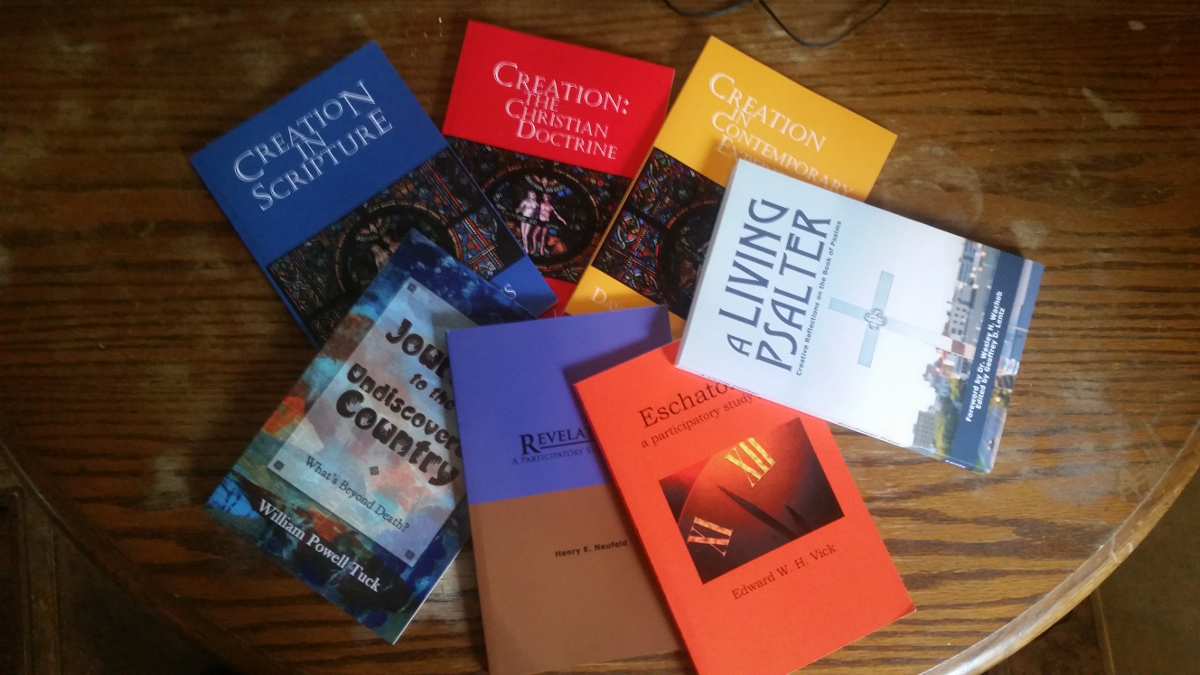
Threads from Henry's Web

Category: Bible Passages

  • Eschatology: Future and Present

    Eschatology: Future and Present

    Some Eschatology SourcesOn Thursday night I’m going to do two things: 1) Present some material related to chapter 6 of Eschatology: A Participatory Study Guide (titled “Eschatology Future and Present”), and 2) Discuss October 22 as the anniversary of the Great Disappointment of October 22, 1844, as it is recalled in Adventism. On Thursday I will also kick off publication of some articles by Energion authors on that event and its implications for how we study the Bible generally and eschatology in particular. I’ll provide links to that material here.

    Here are the links for the event. Below the YouTube viewer, I will post a couple of questions to consider relating to Thursday night’s study.

    Google+ Event Page


    In the study questions (page 67 of the book), Dr. Vick asks:

    (3)     We cannot construct a theology without making assumptions. With what assumptions would you organise your beliefs? Which of the assumptions suggested in the chapter would you be in agreement, and which would you reject? [emphasis mine]

    9781938434105sThe latter part of this question will be hard to answer without the book, but consider the first line. Do you agree or disagree? Feel free to comment here or to bring your comments to the study on Thursday night. If you enter the comments via the Q&A app, they can become part of the study.

    For some perhaps even more provocative suggestions, the following questions come from page 65, and might help in feeling out your way on assumptions.

    What can I believe and what can I not believe? What are the implications of the answers I give to the question? This question then ramifies into more precise formulations.

    What can I not believe about how things happen in the system of an ordered cosmos?
    What can I not believe about how historical reports come to be written?
    What can I not believe about the reliability of human testimony as an avenue to knowledge, whether given verbally or in writing?
    What can I not believe about the capacity of a being with human limitations to foretell the future?
    What can I not believe about the supernatural?
    What can I not believe about claims that the supernatural causes events to take place within the cosmos? (p. 65)

    I’m sure that as you consider these questions, you’ll quickly see their implications for how you might read scripture. One can be open on some of these, certainly. But thinking about how you would approach the question can nonetheless be critical.

  • Eschatology: Eschatology and the Quest

    Eschatology: Eschatology and the Quest

    Some Eschatology SourcesTaken from chapter 5 of Eschatology: A Participatory Study Guide by Edward W. H. Vick. You can find out more about this study on the Google+ Event page.

    Description:

    This study is from chapter 5 of the book Eschatology: A Participatory Study Guide by Edward W. H. Vick. This will be some very basic background, discussing the quest for the historical Jesus and how it has impacted our understanding of Christian eschatology.

    We will also discuss (again!) the critical issue of the way in which we read and interpret scripture and how that will impact our understanding of eschatology, which draws on such a wide variety of sources.

    Or watch here:

  • Eschatology: Daniel and Revelation

    I’ve had a hard time keeping up with blogging this week. It’s a busy month. On Wednesday nights I’m teaching from Revelation for a youth group at a local church, and of course I have my Thursday night events, one of which I’m announcing here, which are a sort of spiritual discipline for me.

    I was going to try to both talk about Daniel and Revelation (in a very general way) and then go on to talk about eschatology and the quest for the historical Jesus, but I have decided not to do that and give myself a slightly more relaxed session talking about the structure and rhetoric of Daniel and Revelation. The two books are substantially different, yet they are the two acknowledged works of apocalyptic literature in the Bible, and almost any Christian discussion of eschatology touches on them at one point or another.

    Growing up as a Seventh-day Adventist meant that I repeatedly studied these books. I even took a college class titled just “Daniel and Revelation.” There was an extract of the SDA Bible Commentary combining the comments on Daniel and Revelation in one book.

    While I will be looking at these two books in particular, my study since has led me to look at a much broader range of material, from Ezekiel, to several chapters in Jeremiah, to much of the latter portion of Isaiah, and much more in the Bible, and also a considerable amount of non-biblical material. Yet these two books still tend to hold pride of place.

    Is their purpose to give us an end-times outline? If so, in what detail, and if not, what is their purpose? I’ll be discussing this on video this evening.

    Google+ Event Page

  • Eschatology: Prophecy and Apocalyptic

    I’ll be working from Chapter 4 of Dr. Edward Vick’s book Eschatology: A Participatory Study Guide and looking at the nature of prophecy and the literary nature of the texts. I’ll also be looking at ways in which we interpret prophetic literature. I apologize for posting this very late. I will try to comment in writing and add some links tomorrow and Saturday.

    Google+ Event Page

  • Eschatology: New Testament Eschatology

    Eschatology: New Testament Eschatology

    9781938434105sTonight I’ll be basing my presentation on Chapter 3 of Eschatology: A Participatory Study Guide by Dr. Edward W. H. Vick. The event description can be found on Google+.

    I’m embedded a YouTube viewer below.

    This will be on my YouTube channel and Google+ at 7 pm central time tonight.

    I’m actually going to start from what I left off last week and talk about “this generation shall not pass,” which will require me to talk a bit about biblical inspiration. Following that I plan to introduce my (not so original) simple view of eschatology and then look at Mark 13 and how it might fit in.

    Next week I’ll be looking at the variety, and some history of prophecy in Old Testament times, and then next week we’ll tackle chapter 4 of Dr. Vick’s book, Prophecy and Apocalyptic.

    As I work on these, I’m also working on a series of four talks on Revelation to be presented to some teenagers during the month of October. That may be more challenging than these presentations.

  • Some Lessons from Tilling My Garden

    Some Lessons from Tilling My Garden

    Well, my prospective, perhaps presumptive garden, that is.

    One of the important elements to understanding stories in the Bible, parables included, is our perspective. In Christian circles, when we hear “the sower went forth to sow,” (Matthew 13:3), or perhaps “a farmer went out to sow his seed,” we generally see ourselves in the role of the one doing the planting. We are evangelising, and people have different kinds of hearts. Have you ever heard someone describe another person as being rocky ground? Or perhaps someone has said, “He’s trying to dig some hard ground there!” Usually these expressions are used regarding targets of evangelism.
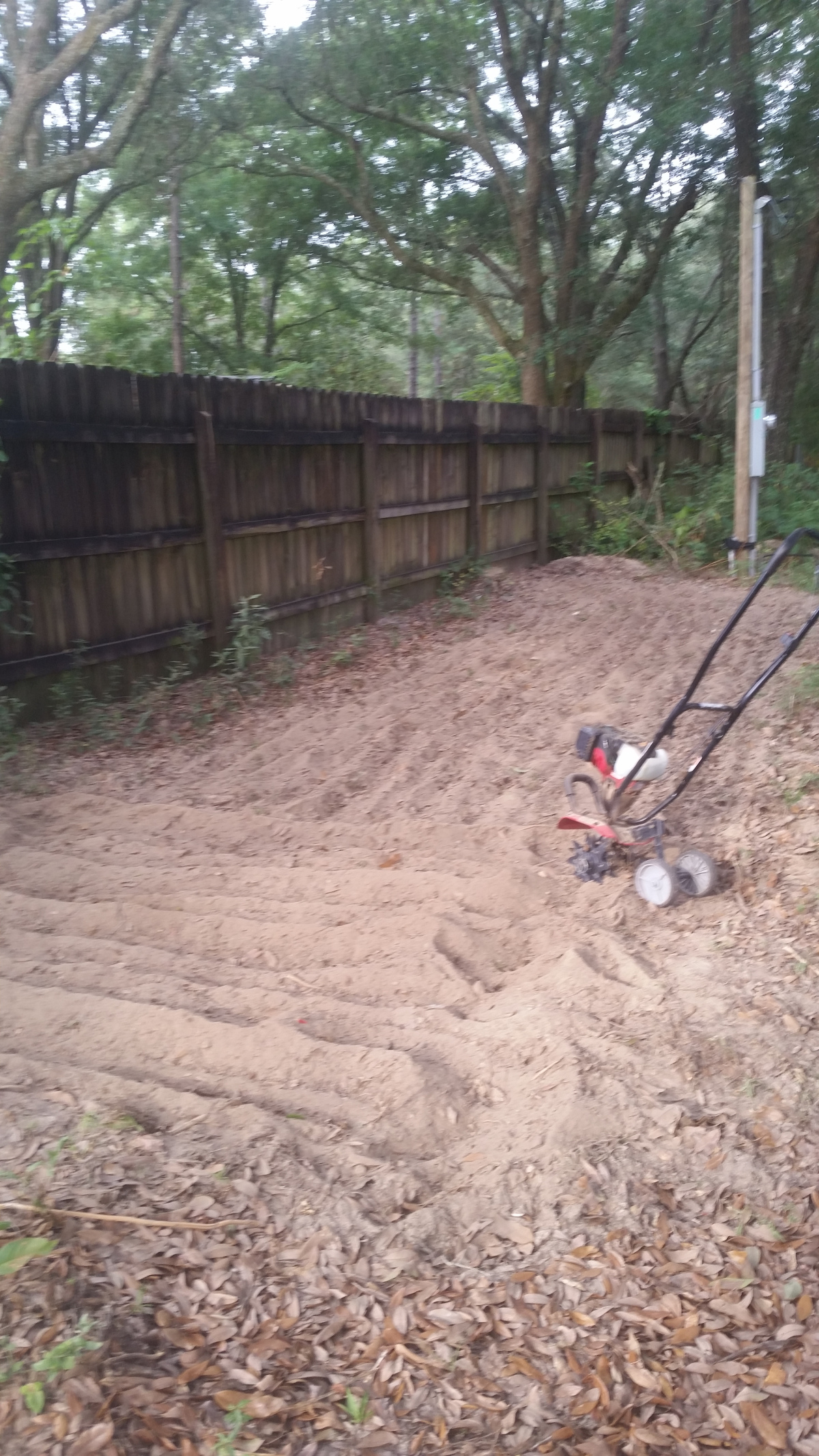
    garden and tillerI’ll mention evangelism later, but first, let me place myself in the role of one receiving the seed. Is that not what I do when I pray and hope to hear from the Lord? Is that also not what I do when I open my Bible and hope to be changed by God’s message? So I am the ground, not the sower.

    But let me tell you the story of my garden thus far. Fortunately for me, I have few plans that involve saving money on food, supplementing my diet, or saving on the food budget. I had one purpose in starting a garden: I need to spend more time in physical activity. Now I’m a bit of a workaholic. I have a hard time not doing anything. The easiest way to get myself to do what I need to do was to make it into work. Then I can feel good while I do it.

    So I picked a plot on our little place out here and started to work on it. It has gone through being broken up with an excavator (at which time I killed power to my office and broke our water line, but that’s another story), lots of hoeing and raking, and digging up of roots and rocks. This morning I finally got to the point of being ready to actually till the plot. My previous work had been aimed, not at getting the soil ready for actual planting, but at removing obstacles. I have a large pile of brush, roots, and rocks at either end of the plot, things I have removed as I worked.

    Then I had a period of time when I was just too busy with work. Between my work with computers and computer networks and my publishing work, I was simply overwhelmed. The phone would ring by 8 am and I wouldn’t get that much done outside. What do you suppose happened? Well, the plot got some new growth, but not the stuff I want to grow, of course, since I hadn’t yet planted. So out came the weedwacker, the hoe, and finally the rake.

    Today I finally got to the tiller. That’s the tiller, in the picture to the left. I borrowed it from my friend Tom Hunt. If you need a floorplan done for a new house, he’s the one to go to.

    There were some interesting things about using the tiller as well. Weeds leave behind small roots that tend to wrap themselves around anything available. No matter how may rocks you’ve removed there may be a few more. Run the tiller in a couple of directions. The pile of dirt from one pass may hide some hard soil. Power tools are great, but I ended my morning session more tired than when I worked with the hoe. The tool helps, but the human still better put heart and back into the effort.

    Let me apply these to Bible study just a bit. You might want to reference my post from yesterday. Here are some thoughts I had while listening to that wonderful purr (or roar) of the tiller motor.

    1. Different tools accomplish different things. No matter how much you may have gotten with one approach, try taking another look from another angle or with some different help.
    2. Weeds don’t stay dead. You’re never really done. It’s easy to get complacent and think you already have it covered. Now it’s all about telling other people. Don’t get in that place. If you neglect your heart garden for a while, you may find the ground hardening and the weeds getting tall.
    3. Don’t imagine that a period of neglect is the end. That’s what weedwackers, hoes, shovels, rakes, and tillers are for. Those of you who have forgotten your biblical languages after seminary, consider this as well. How about working on reviving them? Yes, I believe you can study the Bible effectively without the biblical languages, but after investing all that time and effort wouldn’t you like the benefit of that tool?
    4. Don’t be blind to the rocks that are still there. You may have removed bunches of rocks, yet there are still some to find and remove. I often joke with Jody that it would be nice if I could measure the quality of my cleaning by the quantity of dirt I removed and not by what was left. Read 1 Corinthians 8:1-3 if you’re thinking you’re good!
    5. Tools help but they don’t do the job. I love Logos Bible software. I love sites that let me compare versions (BibleGateway.com, for example). But these things don’t do your studying for you. They will make you more efficient. Many Bible students amass information and yet don’t get to what the text is saying to them. I was reminded of that forcefully as I moved the tiller through my prospective garden. It did more work than I could have accomplished with the hoe, but it still required me to make the application!
    6. Sometimes you get so tangled with the weeds that you can’t really go on clearing and tilling. I experienced this as left-over weeds and roots tangled up the tiller. I had to stop and clear the blades so the tiller could work efficiently. I’ve experienced this in preparation for teaching my Eschatology series on Google Hangouts on Air (link to next session, Thurs. night at 7 pm central time). Eschatological views are based on many, many texts, and there are many, many views on each of these texts, plus mountains of theology done to tie them together or explain them away. It’s very easy to get so tangled in the details that you can’t see the actual text in front of you. I bounced this off my wife Jody, who has a practical mind set. I asked her to read Mark 13 the other day and then question me about it. She had a set of questions that helped clarify the chapter.

    I’m sure there are many more lessons, but those are the ones that occurred to me as I worked this morning. But does any of this apply to evangelism?

    1. Quit trying to judge the people you witness to. You can’t see what’s under the ground.
    2. The best way to witness is to till your own heart. I can’t emphasize this enough. Most people can tell very quickly if you’re trying to use them for something else. So if you are making relationships with other people in order to convert them or make them into church members, they’re going to get that feeling. But if you are genuine and genuinely care about them, they will also know that.
    3. The Christian life and Christian witness isn’t a strategy. See #2. Enough said!
    4. God is the one who changes people. You witness. God acts. Be humble enough to give God the credit. Be humble enough to let God take the responsibility.

    Do you see what happened? Quite frankly, all the lessons but one applied to me. As for reaching others, I have one duty: plant the seed. Now planting the seed can be complex, but I suggest that it starts with some of the points I made above. Let God’s word impact your life. Continue to let God’s word impact your life. Continue some more letting God’s word impact your life. Continue yet much more letting God’s word impact your life.

    You’ll impact the lives of others.

     

  • Eschatology: Mark 13

    While I titled the event Eschatology: Mark 13, Matthew 24, and Luke 21, I will be focusing on the first. I will be mentioning the parallels and likely working directly from gospel parallels. I’m embedding the YouTube viewer first, then I’ll make a few comments.

    I had hoped to post more earlier, but the work load this week prevented it. I also hope to post something more this afternoon, giving some background for what I’ll be saying. It is obviously impossible to do a detailed exegesis of Mark 13 in an hour, so I’ll be looking at some key points.

    First, yes, I won’t be able to resist. I’ll mention some elements in the parallels that could play into arguments over Markan vs. Matthean priority.

    Second, I want to talk about my overall view of biblical eschatology, and how I read that in Mark 13. Note that this is, to a certain extent, eisegesis. My overall view is the result of my study of many eschatological and apocalyptic passages, and not a derivative from Mark 13. Yet I will use it. I had planned to wait to present this overview, but I think it’s better for me to give my “mini-eschatology” first and then develop how I connect it with much broader and deeper eschatological views as I move forward.

    Third, I want to focus on just what the disciples would have expected when they heard or encountered this material. Thus I’ll discuss the debates on whether this is original to the gospel (as a whole), whether certain elements were added later, and also just when this was written.

    All of that leads to the point where I—finally—talk about “this generation shall not pass,” which has provided fodder for biblical and theological debate for the last two millenia. How was it understood in the past and how shall we read it now?

    In studying eschatology from a biblical perspective, it is important to realize that one needs to resolve a broad range of questions nearly every time one wants to resolve one question. For example, the way in which one understands Daniel 9:27 impacts how one will understand “the abomination of desolation” and how one understands the vision of Daniel 7 will impact how one understands the son of man coming in the clouds. Not to mention whether one is certain those particular references are in view. Deciding how to understand those chapters involves a range of decisions regarding the text of Daniel as well as its historical and cultural context. Those decisions involve a number of issues regarding how one dates literature.

    I say this because I expect to circle back to many of these passages after we’ve studied others. I think it would be useful to read Mark 13 again after we have done further study of Daniel. Jesus did not live in a cultural or theological vacuum either. Certainly his disciples did not. How might they have drawn these passages into their understanding of the words in the gospels? It is possible that what you or I decide in studying Daniel might be the correct historical understanding, i.e., we might be right about when it was written and how it would have been understood by its original audiences, but that the understanding we get there might not be the one the disciples would naturally draw in as they studied the words of Mark.

    Complicated? Indeed. Fun? I think so!

  • Eschatology: Surveying Symbols and Sources

    Eschatology: Surveying Symbols and Sources

    Some Eschatology SourcesTonight I’m giving myself permission to ramble in my presentation. “How will that be different?” you ask. I would imagine largely in that I won’t feel guilty while I ramble!

    There are few areas that demonstrate differences in views of biblical inspiration and interpretation than eschatology, whether we mean end-time events or our own end-of-life considerations. ”
    Where does everyone go at the end? and What happens to me when I die? tend to lead us to similar issues even though the chronology involved is different. In addition, the difference between a scattered proof-text approach and one that is carefully grounded in historical and literary context will come out substantially different. I don’t mean that if we could just choose one method of interpretation, we would all agree. We’re all human; we will disagree. But it would be nice to debate about the actual issues.

    I recall debating online with a Seventh-day Adventist. Since I am a former SDA, he expected me to “understand” certain things about prophecy, by which he meant that I would “see them as true.” Of course, “understand” and “see as true” are not synonymous. I recall that the debate came down to whether there was a connection between Daniel 8 & 9. Is there some relationship between the opening of the “2300 evenings-mornings” of Daniel 8:14 and the prophecies of Daniel 9? He simply refused to discuss the possibility of a connection. There was no connection and could not be. Why? Because his interpretation of the two prophecies required that they be separated. Now this observation doesn’t determine whether, much less how those two passages are connected. What I’m noting here is simply that for him, there was no possibility of a connection.

    In terms of inspiration, we have the additional issue of just what we expect to be able to know as a result of studying eschatology from scripture. Is there a single view of the end times that one can piece together from pieces coming from 3rd Isaiah (Isaiah 56-66), Ezekiel, Daniel, the gospels (Mark 13/Matthew24/Luke 21), Paul, and Revelation, along with quite a number of other scriptures? Should we expect such a thing? If not, in what way can we view these scriptures as inspired? If so, why is the process of piecing this material together made so difficult?

    My intent this evening will be to draw a very general map of the material and how it contributes to this topic. In order to understand eschatology, one must have somewhat of a handle on the whole of scripture. This is a daunting task. There are far too many people claiming to have simple solutions to everything when they show know awareness of the extent of “everything” with regard to this topic.

    You can read a bit more about tonight’s discussion on the Google+ Event Page.

    I’m embedded the YouTube here as well. Below this, I will post a schedule of upcoming topics, where applicable noting the chapters for Eschatology: A Participatory Study Guide by Edward W. H. Vick.

    Here are the topics to follow:

    Eschatology: They Remembered Him (Chapter 2 of Eschatology: A Participatory Study Guide)

    Eschatology: Mark 13, Matthew 24, and Luke 21

    Eschatology: New Testament Eschatology (Chapter 3 of Eschatology: A Participatory Study Guide)

    (All links are to the Google+ events.)

    As you can see, I interspersing material from the study guide with time spent discussing some of the source texts. In some cases, we will come back to those texts after we’ve studied further from the guide and also from other scriptures. For example, does your understanding of Mark 13 change when you think about realized eschatology in connection with it? Does your understanding of the materials in the gospels as a whole change after you study Daniel?

    As you can see, I can have fun with this topic for an indefinite period of time. I may follow up a more general study with chapter by chapter studies of Daniel and Revelation, though I’d be more tempted to do this with Ezekiel. So we shall see!

  • Explaining the Difference Between John and the Synoptics

    In the comments to my announcement for Thursday night’s interview with Dr. Herold Weiss there was a comment that included a question. I missed it and failed to ask it during the interview. I e-mailed it to Dr. Weiss, and he sent me a response. Since this ties into the topic of the interview, I will also include the YouTube embed of the interview video below:

    Meditations on According to JohnQ: As I’m sure Dr. Weiss knows, the Jesus Seminar allocated no sayings of Jesus in “According to John” as “likely authentic.” How does Dr. Weiss rate Jesus’ sayings in “John”, and how does he explain the vast difference between the Jesus of “John” and the Synoptics?
    A: The difference between the Synoptics and John is due to the bifurcation of the oral tradition that started with the disciples but quite early departed into different trajectories. We can identify four of them: the tradition of Q, the tradition in the Gospel of Thomas, the tradition in Mark and the tradition in John. At some points there are connections between them. The tradition of John, as I point out in the book, can be seen being developed within the Johannine community, so that now there are some tensions withing the gospel. As for the work of the Jesus Seminar, I find it a bit pompous. The criteria of authenticity are logical, but their application is always subjective. All the sayings of Jesus are colored by the oral traditions behind them. That is also true of the work of the ‘historians’ of antiquity. They had  no sense of responsibility to evidence and facts. The case of Josephus, or Tacitus is well documented. ‘Scientific history’ is a child of the XIX century.
    There may be some who think that if we cannot be certain of every word in the gospels as ‘history’ we cannot believe in Jesus. I find that quite amazing. If one is to depend on history for what one believes, then all you have is a Jew who was crucified as a traitor by the Romans. The Gospel is about something else completely.

    Here’s the interview video:

  • According to John: Abide in My Love

    It has been that kind of a day. I apologize for not posting this earlier. You can find out more about this discussion on the Google+ Event Page or view it using the YouTube embedded below.