Threads from Henry's Web

Category: Bible Passages

  • The Apologetics of Hebrews – Can You Defend a Dead Church?

    In Hebrews 2:1-4 I believe the author of Hebrews provides a basic apologetic outline, and I think it’s a very useful one to follow. After the first two verses, which start from a platform that was already accepted by the audience, the author emphasizes the importance of the decision. If he is right in what he says, the decision is critical in an eternal sense. The elements are these: 1) It was delivered by the Lord, 2) Affirmed by the testimony of those who witnessed, 3) Given divine witness through (a) signs and wonders and (b) the gift of the Holy Spirit.

    Looking first from the viewpoint of process, this argument, and indeed the general argument of Hebrews, is based on ground that will be accepted by his audience. They believed that the Torah was firmly established, and many, at least, believed that it was delivered by angels. Throughout the book, we have this focus on sourcing material from the Hebrew scriptures. Those who argue a simple supersession should pay attention to the form of the argument. At the same time as the author argues that Jesus is greater than, he also argues that the revelation in existing scripture is great and should be honored. Too often we fail to found what we have to say on what we already hold in common, when that can be supported.

    The first element of his argument has two parts, the words spoken by Jesus, and the affirmation of those words by witnesses. For someone who tends fideistic like myself, this is a bit of a rebuke. It’s not that I don’t believe that Jesus spoke, or that there were those who heard. I’m even optimistic that we can get a picture of Jesus from the gospel record. But I tend to ignore that part of the argument and go straight to the experiential second part. This argument says that the faith is founded on historical realities, and that this is worthy of our attention.

    The second element of his argument again consists of two parts, the signs and wonders that follow the gospel, and the gift of the Holy Spirit, delivered as God wills. I’m of course more comfortable here, as my experience (in particular) has much to do with experience (in general).

    I was reading this from The Learning Bible (CEV) this morning, and saw that their note refers these signs and wonders (semeiois kai terasin) refer to past events (from the viewpoint of the readers), such as the exodus from Egypt. I would disagree. That is an element either of the first part, or more properly of the commonly accepted foundation of the Hebrew scriptures. Rather, this is the miraculous events/signs that followed the apostles as we read in the book of Acts, for example. It was by acting on behalf of his apostles that God affirmed their witness of Jesus, both in terms of the truth of the stories they told, and in terms of its continued relevance to those who heard.

    The second part is the gift of the Holy Spirit, which is, I believe, the life of the church. We can see how critical this is in 1 Corinthians 12-14, for example, and I see this as a loose, but nonetheless real point of connection with Pauline theology.

    It’s this last point that I think is the most important in the church today. I believe all these elements should be part of our apologetic, yet having a faith that truly takes hold of hope and makes it possible for one to live differently is, I think, the most important element, and is also the key point of Hebrews. If the church does not show evidence of the gift of the Holy Spirit I think that all the other elements will tend to fail. It is sort of like one builds a machine to accomplish a particular task, explains the science behind it, then the technology that goes into producing the device, and then finally applies the power. But the machine doesn’t accomplish the task.

    By “evidence of the Holy Spirit” I don’t mean speaking in tongues, as many in the pentecostal movement believe, but rather in terms of bringing people together and empowering new life in the one God has anointed forever. As Paul points out in 1 Corinthians 14, we can do without speaking in tongues; it doesn’t build the church. But we can’t do without building.

  • Translating Hebrews 2:6-8 – Gender, Number, and Breaking the Discourse

    Translating Hebrews 2:6-8 – Gender, Number, and Breaking the Discourse

    dreamstimefree_235996_smI’ve written about this a couple of times before, though using the NIV1984 and NIV2011, in A Gender Neutral Example – Hebrews 2:6-8 and Quick Follow-up on Hebrews 2:6-8.
    I covered most of the key issues in those two short posts, but to summarize quickly, I note the questions of how one should translated the quotation of Psalm 8:4-6 as it is presented in Hebrews 2:6-8. One of the questions is the text. In some cases translators have “corrected” New Testament quotations of Hebrew scriptures by using readings from the Massoretic  text even when the NT writer is quoting from the LXX. In this passage “for a little while” gets a footnote to the MT in some translations.

    The question for the translator is whether to reconcile the texts, in this case make Hebrews 2:6-8 correspond to the text of Psalm 8:4-6, so that a reader is not confused (or even challenged) by the difference, or whether the texts should be translated faithfully in each instance. In the case of either decision, what should be indicated in the footnotes?

    I was reading this passage today in the NRSV, immediately after having read it in Greek. Here it is:

    6 But someone has testified somewhere,
    “What are human beings that you are mindful of them,
    or mortals, that you care for them?
    7 You have made them for a little while lower than the angels;
    you have crowned them with glory and honor,
    8 subjecting all things under their feet.”

    In this case there is a footnote (one of several), which reads: ”

    Gk or the son of man that you care for him? In the Hebrew of Psalm 8:4-6 both man and son of man refer to all humankind

    In fact, the plural continues into the remainder of verse 8, which is not quoted: “Now in subjecting all things to them, God left nothing outside their control.” It is not the authors argument here that everything is placed under the command of humanity in general, but rather of one human being, Jesus. I fully agree with the translators (and their footnote), that Psalm 8 is referring, in its original context, to humankind in general, and our relationship, as a whole, to God—our place in creation.

    By translating the quotation “accurately,” as it occurs in a different text and location, the translators have disrupted the discourse of this passage. So while I will not call this an error (it’s certainly intentional, and I can formulate the arguments for doing it, even though I find them dismally unconvincing), I do think it’s a very unfortunate approach. One could let readers know that the quoted text, in its historical context, refers to humanity as a whole, but that it is being used here specifically of one particular human male, Jesus.

    In fact, one could argue that acknowledging “humankind” in Psalm 8 need not be inconsistent with the usage here, as we will shortly see the author of Hebrews continue with the argument that Jesus must very much be one of us (humankind) in order to be able to redeem us. One could discuss the idea of being “in Christ,” though that is not the language of Hebrews. In Hebrews the language is one of kinship and community.

    I do think that this makes it harder, though not impossible to follow the flow of the authors argument in this passage.

  • Eschatology: Daniel 8 with Intro to Daniel 9

    Update: I want to provide two reference links. These are not specifically recommended as better than others, but rather as somewhat representative of their category. The first, giving Daniel 9 (the 70 weeks prophecy) in an historicist context, is The Seventy Week Prophecy of Daniel (Bible Light). The second, showing a futurist interpretation, is Daniel 9:27 Commentary on the site Precept Austin. These two are largely recommended by being at the top of the Google results. In print I use the SDA Bible Commentary for historicist material (and related Seventh-day Adventist literature) and a variety of critical commentaries on Daniel for a 2nd century BCE termination for Daniel 9:27. There are a number of other positions as well.

    I’ll spend a little bit more time on Daniel 8 and its interpretation and then look at Daniel’s prayer and some introductory issues on Daniel 9. Next week, April 14, I will be joined by Elgin Hushbeck, Jr. to discuss the time prophecy portion of chapter 9.

    Google+ Event Page

    YouTube

  • Eschatology: Daniel 8

    Eschatology: Daniel 8

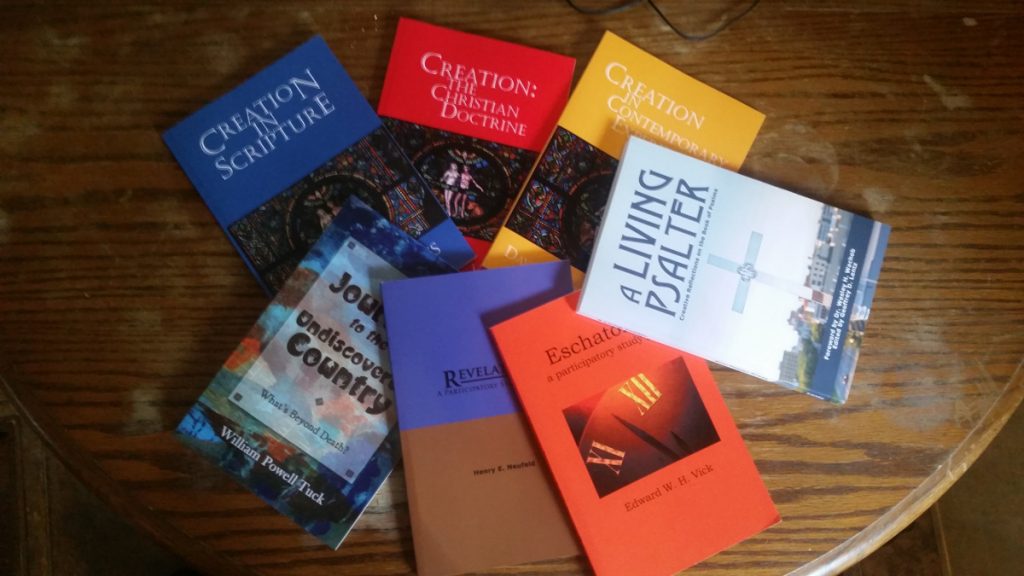
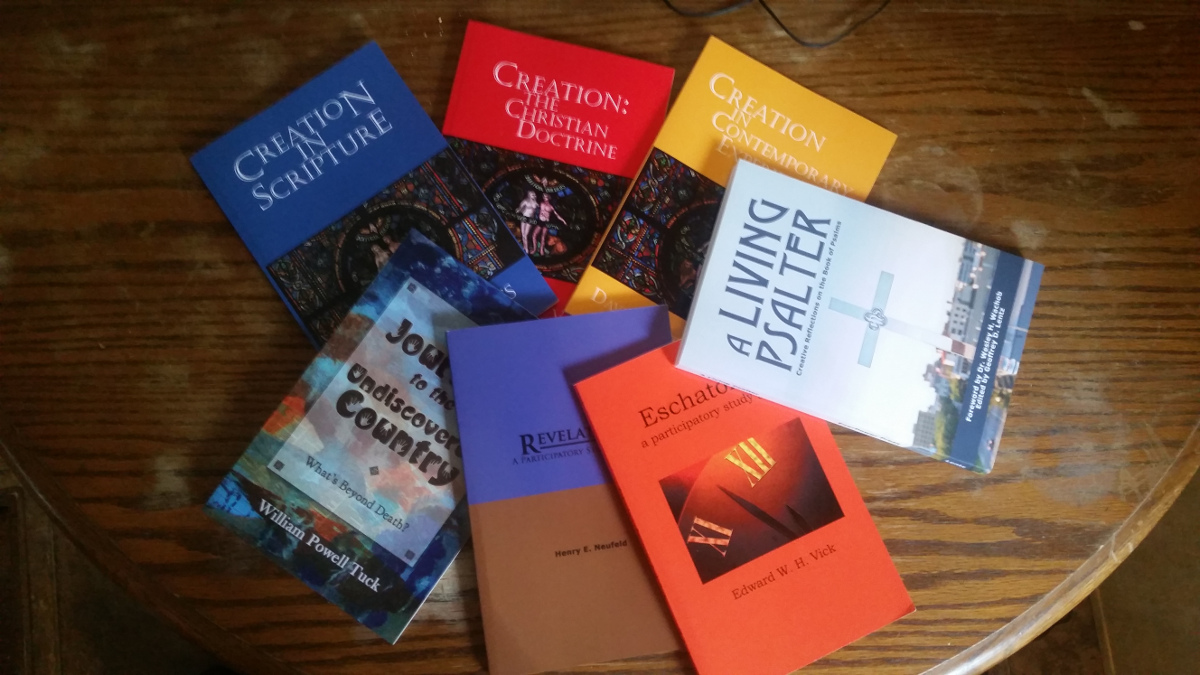
    Some Eschatology SourcesTonight I’ll continue my study of eschatology by looking at Daniel 8. This is a fairly straightfoward chapter to interpret with a great deal of the interpretation provided right in the text. The most interesting element, I believe, is to look at its place in the structure of Daniel and how it impacts our understanding of other visions.

    In addition, as a former Seventh-day Adventist I will look at the Adventist (not just SDA, but advent movement) interpretation of Daniel 8:14. The SDA view of this verse sheds light on a number of significant elements of hermeneutics. In fact, the doctrine of the investigative judgment, which eventually grew up out of the early interpretation of the verse is one of my key doctrinal disagreements with my former denomination.

    As background for this discussion, let me recommend the following two essays by Dr. Edward W. H. Vick, who is also the author the the book Eschatology: A Participatory Study Guide, with which I began this series.

    1. 1844 – 1: Between the Disappointments
    2. 1844 – 2: After the Disappointments

    Here are the links for tonight’s discussion:

    Google+ Event Page

    YouTube:

  • Quick Note on the Chronology of Daniel 1:1

    Quick Note on the Chronology of Daniel 1:1

    For those who hold to the historicity of the story of Daniel and generally to an early dating, Daniel 1:1 is a critical text that presents some problems. As I proceed with my eschatology series, and starting going through the book of Daniel verse by verse, I’m trying to keep all the options in mind and explore interpretation based on the different views.

    As I talked about this last night (February 4, 2016; video embedded at end of post), I thought I was being confusing, and at one point said “Nebuchadnezaar” when I should have said “Pharaoh Neco.” I want to clarify the people and dates and how they apply to the text in question.

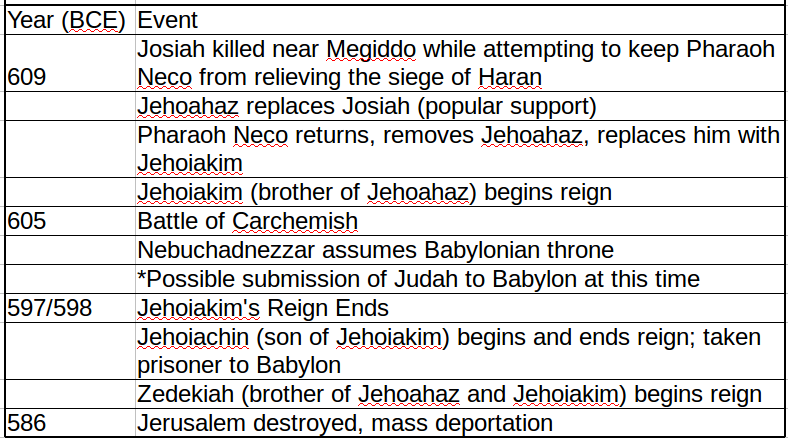
    First, here is a chart of the most critical dates. Note that you will find reference sources that differ on these dates by a year. It is beyond this post to discuss the different calendars and accession year vs non-accession year dating. The sequences involved are adequately handled by the dates I’m using.

    Click to view full size
    Click to view full size

    Biblical sources for this time period may be found in 2 Kings 23:29 – 25:30 and 2 Chronicles 35:20 – 36:23.

    Now for Daniel 1:1, my translation:

    In the third year of the reign of Jehoiakim, King of Juday, Nebuchadnezzar King of Babylon came to Jerusalem and put it under siege.

    Here is a list of the problems:

    1. Unless it is described in 2 Kings 24:1, which seems more likely to describe the events of 598/597 BCE, there is no siege and exile set for 605. It is nonetheless possible that there was one, as the Babylonians became dominant over the territory after winning the battle of Carchemish in 605. There might have been a small exile at that time. Even if 2 Kings 24:1 describes later events, Jehoiakim would have to first submit to Babylon before he could rebel. He was put in power by Pharaoh Neco.
    2. Nebuchadnezzar, as “King of Babylon” could not attack Jerusalem in 605, as he was not yet king of Babylon, but rather became king in that year.
    3. Even if there was a small set of exiles, or perhaps hostages, taken in 605, it doesn’t fulfill the description of the siege.

    The question here is how you evaluate the evidence. One critical element would be one’s determination on other grounds that the Book of Daniel is or is not historical. As an historian one would look for the most probable reconstruction of the evidence. Most scholars tend to support the later dating, even evangelicals, but you can find other arguments regarding dating via my Dating of Daniel Resources page.

    I’ll discuss dating and historicity further in my series, but for now I think this will clarify the issues discussed in the video.

  • Eschatology: Daniel Verse by Verse – I

    Tonight will be my first session on the book of Daniel. I’ll be starting with chapter 1 and going as far as I can. I expect the whole book to take some time, though the first several chapters should go more quickly than the later ones.

    Google+ Event Page

    YouTube:

    I’m going to skip over a good deal of introductory material (though not all of it!) in order to move forward. There are a couple of reasons for this. Most importantly, introductions are often wasted when introducing the topic. That may sound strange, but the reason is that if those reading the introduction aren’t fairly well acquainted with the text, they won’t follow the arguments. How can you know whether you think Daniel is a literary unity, rather than a collection of materials if you haven’t read it? Secondly, I want to use multiple perspectives in interpretation and let us work this out as we move forward.

    To make up for this seeming lack, I recorded an introductory video on the dating of the book, and also created a resource page. The video is embedded on the resource page.

  • Eschatology: Prophets, Symbols, and Time

    Eschatology: Prophets, Symbols, and Time

    Some Eschatology SourcesTonight I’ll be finishing my preparatory studies for eschatology as I look at a few more visions, especially from Zechariah, and then at a bit of chronology in preparation for studying the book of Daniel on a more verse by verse basis starting next week.
    Google+ Event Page

    YouTube:

  • Thursday Night Eschatology Study – Isaiah Part 2

    I’m starting in about 15 minutes. Tonight I’m going to be looking at Revelation 21 & 22 and their use of 3rd Isaiah (chapters 56-66). I want to look at how imagery is used and reused and how this impacts the way we interpret.

    Google+ Event Page


  • Eschatology: Isaiah – 1

    I’ve posted the event for my study on eschatology tonight. I’ll be looking at Isaiah for at least two sessions, the first focused on the servant passages as an exercise in interpretation, and the second on the language of the latter chapters and how it is incorporated into apocalyptic and in turn into our eschatology.

  • From My Editing Work: Faith, Hope, and Love Together

    From My Editing Work: Faith, Hope, and Love Together

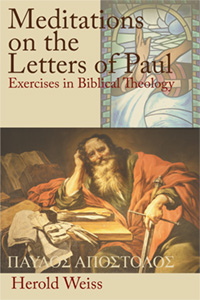
    9781631992223mFrom the forthcoming book Meditations on the Letters of Paul by Herold Weiss:

    The mind does not operate in a vacuum. As it operates it expresses itself in a concrete environment through the body. Faith and hope may be thought as purely intellectual activities – but Paul says “Not quite!” Christian faith and hope cannot be apart from love because in such case they would lack accountability. Indeed, faith and hope are possible on account of God’s love, and are effective when they manifest themselves as Christian love, which can only be a concrete expression of faith and hope. According to Paul, Christian faith, hope and love abide together. Thus, Christians don’t live in the past affirming their faith in what God did in Christ, neither do they live daydreaming about the future final triumph of God’s righteousness. They live in the present, loving the world by being engaged with it.

    I don’t have the page number yet as I’m just working on the manuscript, but watch for this book soon!