No, I’m not. It’s a fact! I’m even a Seahawks fan, to the extent that I’m a fan of any sport. I’ll check the results a couple of times during the evening, but I won’t be watching.
Now don’t fit me out for a halo. A certain number of people probably figure by this time that I’m diligently demonstrating my holiness by going to church. That’s not the case. I just have other things to do. In fact, we don’t even have regular television available in our home. We get things we want to watch via the internet.
I’ve seen or heard people complain about Super Bowl. Churches cancel services. People fail to attend Sunday night services. Such disregard for worship! How can they possibly do that? (It would be those people who might want to fit me for a halo since I’m not watching. But since I’ll doubtless be in my recliner, and may even be watching a British mystery, I don’t qualify.)
There are even those who would claim that canceling church in order to attend the Super Bowl is some kind of idolatry, putting football ahead of God. What it actually is, is putting football ahead of the church’s calendar. One night in the year. Just one.
The idolatry, I think, is the idea that the church calendar is sacred, that the stuff we do on a regular basis cannot be adjusted for any merely human interest. It goes along with the sacredness of church buildings, church regulations, church furniture, and so forth. It’s not all that sacred, except in our minds.
So at heart I’m with the folks who are at Super Bowl parties. I really don’t enjoy that sort of thing myself. I certainly don’t go to the actual games. The crowds are way too big for me to be comfortable.
But I don’t think God has a problem with the folks at the Super Bowl parties. I doubt he was quite as wedded to our schedules as we are. After all, we can easily adjust them to add things to the church program, such as the few days of meetings we inaccurately call “revival” each year.
From my reading for next week’s study on John (Thursday night, 7:00 pm central time via Google Hangouts on Air):
In the same way in which a flag lifted up on its pole draws together a people and constitutes it a nation, the Son of Man lifted up on a cross draws toward himself all who believe and constitutes them “born of God.” (Weiss, Meditations on According to John, 42)
I am truly enjoying my reading in preparation for this study. I’ve been talking about metaphors, and leading toward the point that we use multiple metaphors to describe something that cannot be readily depicted in concrete language. Metaphors allow us to talk about the same subject in a variety of ways, each of which may contribute to our understanding.
When a single metaphor becomes the one and only one permitted in describing an event, we begin to lose some of the content of the reality. Similarly, any time we allow one word for (or description of) God to replace God—what I call conceptual idolatry—we lose some of the reality of our experience of God. We can allow our description to limit who God is. In terms of the atonement, I believe that stating that the one explanation of the atonement is the metaphor of substitution in a forensic context, we start to lose some of the meaning of the atonement.
Unlike some, I do see forensic and substitutionary metaphors in play in some scriptural descriptions of atonement. I don’t deny them as ways to discuss and understand atonement. My concern is that they not become the sole view, driving out other strong metaphors. The gospel of John uses a couple of different metaphors, especially centering around light and family, and we need to read those in their own context with their own integrity.
When I was in college, I took Exegesis of Romans, which was intended as a sort of taste of Greek III, from a professor (Malcolm Maxwell for my fellow Walla Walla alumni), who was an advocate of the moral influence theory of the atonement. I was very attracted to the theology involved, but despite my best efforts, I couldn’t find it in Romans. It is wrong, in my view, though without any diminution in my great respect for Dr. Maxwell, to force the moral influence metaphor onto Romans. It is equally wrong to force forensic substitution onto the gospel of John. You may hear its echoes, but it doesn’t dominate.
The quote above provides a taste. I’ll be discussing this in more detail on Thursday night.
My Bible study tonight done via Google Hangouts on Air, will be on the topic in the title. I’m going to be following up from my discussion of vocabulary last week in looking at the words “light” and “life” in the gospel of John and how they relate to our understanding of the book’s message.
As an editor and publisher, I often have the joy of telling an author that their work will become available to the public, because I have decided to invest in it and publish it. That’s very enjoyable.
Then there are the times that I have to reject manuscripts. There are more of these than acceptances. Often I hope that some other editor will decide that the manuscript is worth publishing. Today I sent a rejection notice out for a book with which I agreed almost totally, but which simply seemed to be repeating things that had already been said. Another was simply longer than the subject matter, and readers, would bear.
As one who has written many, many superfluous words, and who can’t even claim to have discarded them gracefully, I want to tell these authors to stick with it. Don’t let a rejection stop you. Many books, and not a few bestsellers have been rejected by publishers.
I try to explain my decision in reasonable detail. If you get a note that gives you advice, take it seriously. Don’t follow it slavishly. I know it’s a shock, but editors are not always right. Another editor may disagree. Give your manuscript a serious look, add some more polish, fix any problems you find, and send it to someone else.
If the editor who rejected your manuscript suggested it might be acceptable with a few changes, then by all means consider making the changes and submitting the manuscript again.
I would like to address one other class of authors, those who don’t read the submission standards. If you’re one of those, you need to take finding a publisher at least as seriously as you took producing your masterpiece. When an editor receives either a generic submission, or one that shows the author clearly did not read what information was available, he or she will often just reject the manuscript out of hand.
As a writer, you don’t just write. You have to market. If you don’t, you might as well not have written.
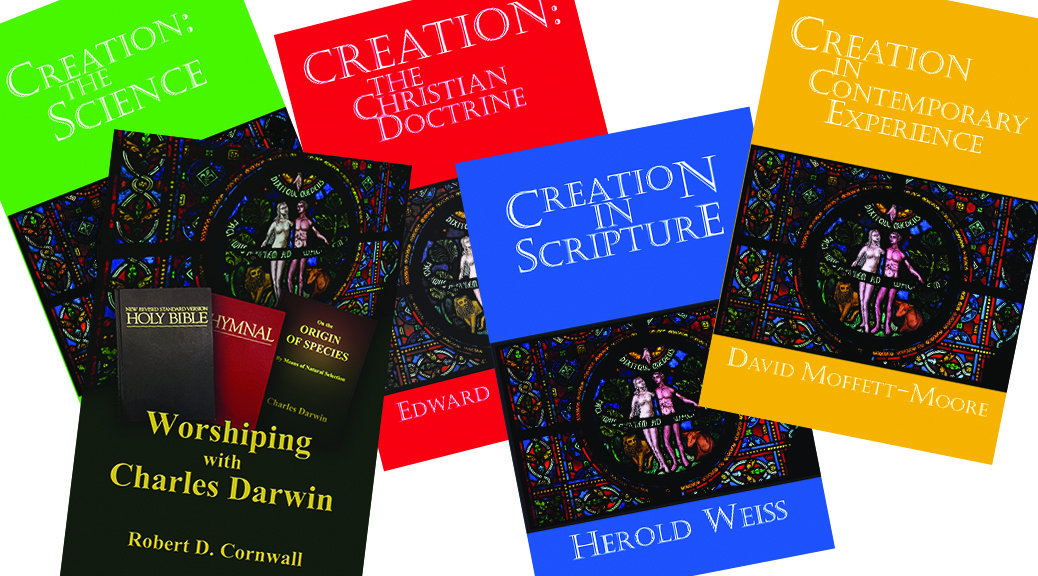
I’ve been promoting the creation book set from my company, Energion Publications. The authors of this set of books all support the theory of evolution. In fact, the contribution made by these books, I think, is that they are talking about how we should live in light of a belief that the “how” of creation, at least with respect to life, is by means of biological evolution. (This could have been a post over on the Energion company site, but since it’s also so much about my own beliefs, I thought I’d post it here.)
Here’s a clip:
Herold Weiss is a biblical scholar and is talking about creation and creationism from the biblical and theological point of view. It was his book Creation in Scripture that got the book set started.
“For creationism I have no use.” I publish that. I’m also a known advocate of excluding creationism from the public school classroom. I’m a board member of Florida Citizens for Science. So we know where I stand on the issue. I’m a theistic evolutionist, though I don’t like that term.
So would I publish a creationist book?
Short answer: Yes.
Now for the longer answer.
I’m often asked this question by people who wonder just how far to the liberal side of the spectrum I’ll go in terms of publishing. In this case, considering how strongly I’m identified with one side of the issue, we have the opposite question.
The easy way to figure out the general answer to this question is to read the company’s short doctrinal statement. As you read that statement, remember several things:
Energion Publications is not a church. Nobody is asked to sign or affirm this statement
We judge manuscripts, not authors. I have been asked about things an author said on his web site and whether they “fit.” That’s not my concern.
There are many issues of definition in even that short doctrinal statement. For example, amongst our authors we have quite a number of definitions of what the word “inspired” means with relation to scripture.
It does provide a general guide to let us focus on an audience
Having said that, if a book falls within that statement, we’ll consider it. Does creationism fall within those parameters? Absolutely.
So the longer answer is again, yes. But remember that this openness to publish covers a large number of other issues as well.
Why are all our books on creation written by those who accept theistic evolution? Again, a simple answer. Those are the ones that were submitted and accepted.
Aha! A snag! What our hypothetical questioner would probably like to know is whether this manuscript, the one he or she has in hand, expending from days to decades, would be considered for publication and what its chances would be. Would the fact that I have a firm position on the issue prejudice me against that manuscript?
Without doubt my beliefs influence what I do. But one of my beliefs is that the best thing to do with theological disagreements is to discuss them, entering into genuine dialogue. I consider creationism to be a very live theological debate and one on which we should be having dialogue in the church. I think actual dialogue on this subject is rather rare, but I’m ready to promote it.
In fact, I see myself as a publisher in the role of an advocate for advocacy. So if I publish a book on creationism I will also put every effort into marketing it.
That doesn’t mean that I will bend over backwards to accept the first manuscript on the topic that I get. I have been studying this subject since I first learned to read, and so I have a very good feel for the literature.
Let me provide an example. Dr. Kurt Wise, who earned his PhD under Stephen Jay Gould at Harvard, is a creationist. He wrote the book Faith, Form, and Time. The link provided is to my review. It’s a good book. I disagree with practically every word in it. I don’t see those two statements as contradictory. I consider it the best statement of a Christian creationism as is available for a popular audience. Wise starts from the premise that Genesis teaches a young earth and a literal creation week, so we must follow from that point and discover the science that proves God right. I disagree with that premise.
If you can send me a manuscript that is as good as that one (good luck!) I’m bound to publish it. And there are lots of other manuscripts that would be good. For example, looked at from the point of systematic theology, how does a young earth or a literal creation week (or both) fit into a doctrinal pattern? What other pillars of the faith lean on those concepts? One could write some excellent systematic theology in that area, and consequently argue with our existing volume, Creation: The Christian Doctrine, which argues that those are not important. It happens I agree with the latter book, but that won’t prevent me publishing a rebuttal!
Now if I had a category for science, which I don’t, I would require that material in it be reviewed by qualified scientists. That would be another matter. I don’t think modern creationism has yet earned a place at the scientific table, and I’m not the one to offer that place. It must be offered by scientists who are active in their disciplines. I’d have a team of them as readers if I were a science publisher. But the biblical, religious, and theological debate is very relevant and active.
For those who are interested, I didn’t become convinced that the earth wasn’t young or that the creation week wasn’t literal by studying biology. In fact, I never took a college course in biology. I’m not going to judge one’s biological pretensions. Well, unless they violate elementary principles, that is. It was through study of the scriptural material that I became convinced it was not possible that God was intended to provide either the “how” of creation or the timeline of earth’s history.
There’s a great deal of open territory for studying biblical studies and theology involved in that!
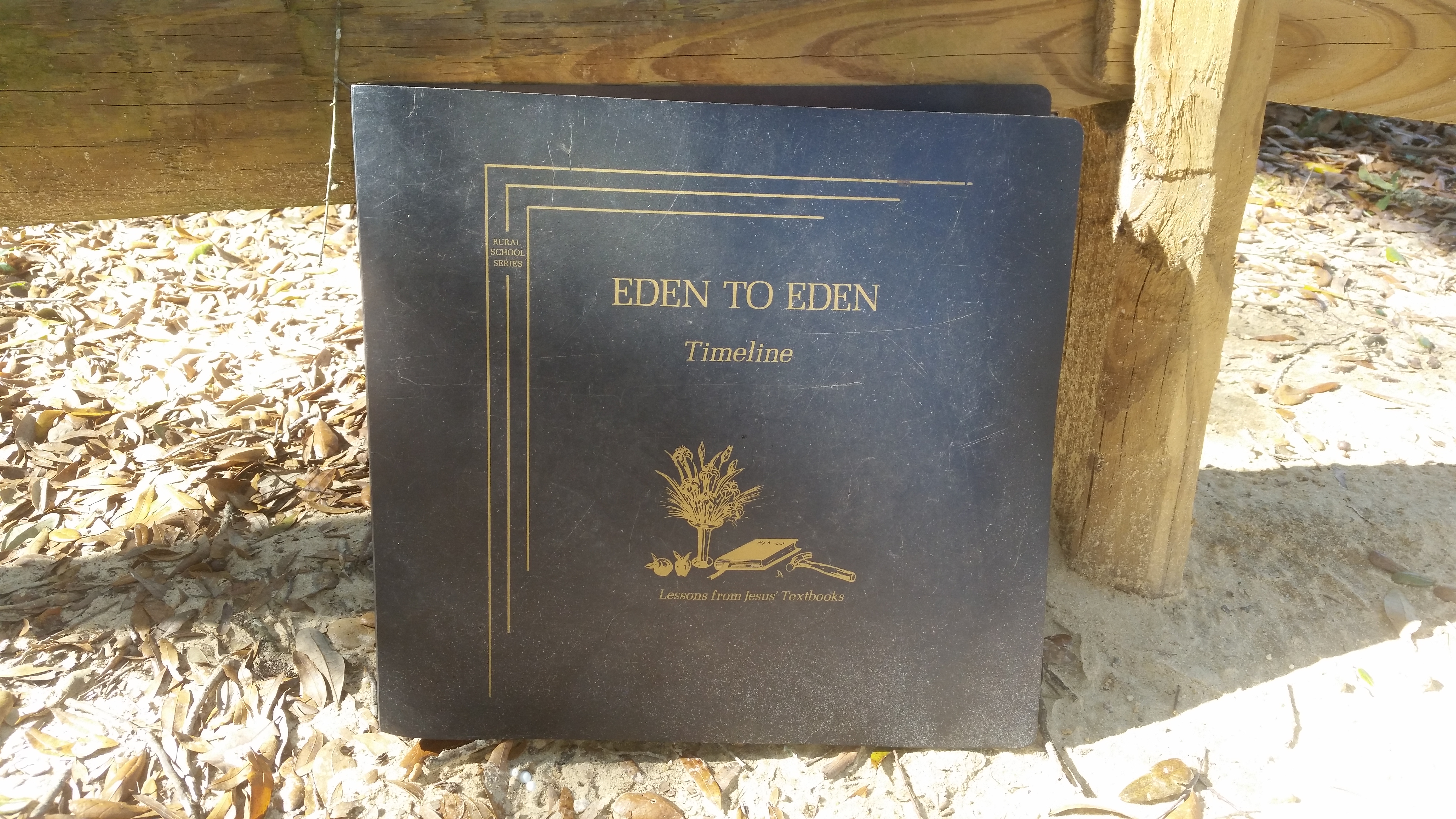
I can’t help but finish with some pictures that illustrate how thoroughly indoctrinated a creationist I was. These are pictures of the “Eden to Eden Timeline.” You can see in the second image that we were taught that the date of creation was 3957 BC, a correction of the more common 4004 BC. Students added pictures and colored maps as we worked our way through the Bible, entirely guided by this timeline.
The title indicates the topic. It starts with creation and ends with recreation. Everything is on a timeline, though the time of the final events is left open.You can see the date of creation represented here and also the proposed date for the end of this period with the flood.This shows how the timeline spread out. I did this outside by the fence, so it’s a bit scraggly. In our classroom we had the whole thing stretched out around the wall. Click on it for high resolution.
Bruce Epperly, author of the recently released book Finding God in Suffering: A Journey with Job, questions the view that God determines the outcome of football games (or, I suspect, any other sport), rewarding the faithful and punishing the unfaithful. The title to this post includes his money quote from his post, Is God a Seahawks Fan?. Here’s the full paragraph:
I am sure that God was present on the playing field but not as a miracle worker or team mascot; God was there urging the players to achieve their best as team members, to be sportsmanlike, and to remain healthy amid a rough and tumble game. I suspect God was indifferent to the ultimate outcome.
I found this post refreshing. God is involved, but God isn’t there to make your team win–or lose. He’s there with each person.
Yesterday was a great Sunday for me, though I still feel as though my previous week never really ended!
There are times when I feel that I heard precisely the right message for the time and place, not just for me, but for all there. There’s kind of a sense with a congregation hearing what they need to hear, or so I imagine at least. Yesterday at First UMC Pensacola was like that as Dr. Wesley Wachob told fish stories. He did this thing with Louis Armstrong’s Jonah and the Whale and really had the congregation going. The idea was “fish that are called to fish.” He ended briefly with the gospel message as Jesus calls disciples away from their fishing nets (Mark 1:14-20), but he spent most of his time in Jonah.
Here’s the Louis Armstrong song with some humorous animation I found on YouTube:
http://youtu.be/9pVBBaJ54ac
In the evening we hosted quite a number of teenagers in our home. I think the count was 14, but I lost track. They were lively, energetic, and very smart. It was fun talking with teenagers about the meaning of the tabernacle, the temple, and sacrifices. And I wasn’t even the one to introduce it; they did!
I believe we generally underestimate our young people and don’t treat them like significant persons, called and gifted by God, and capable of thinking. Sometimes this is because they don’t act like we do when they think something is important. They can shift topics in an instant, and it can be hard to follow, but it’s also worth it.
We need to get our young people involved and active earlier. They have a great deal to contribute.
There are a number of points I need to write about to follow up on my hangout from last Thursday night, but first, here’s the YouTube video of the event.
I would like to remind you that you can ask questions or comment during the event using the Google Hangouts Q&A feature. Normally I’m also watching my Twitter (@hneufeld) and will see any Tweets @hneufeld. If you comment on something here and I can find a place for it in the next event, I will refer to it.
I plan to follow up before Thursday with posts on the language of the trinity, and biblical inspiration.
The following is an extract from Philosophy for Believers by Edward W. H. Vick, pp. 122-123. I’m the publisher. I was reading this section as I was thinking about my study in According to John tonight (Jan. 22, 2015). How does experience relate to the development of religions doctrine?
8 Experience and Interpretation
Question: How shall we decide between interpretations of something that happened, whether unique public experiences e.g. a thunderstorm, or private ones e.g. visions, inner voices?
You and your friends are given a sheet of paper on which a lot of lines have been drawn. You are each asked what it is you see in the jumble. Replies will be different. One will see a horse drinking. Another will see cloud formation. Yet another will see the lines as a jumble of graffiti. We see things differently.
There has been murder in the town. Those people who are aware of it will have very different experiences. The relative, the detective, the editor of the sensational newspaper, each has his different view point of the event based on his unique experience of the event. Since they each experience the same event in different ways, let us call the phenomenon ‘experiencing as’. One experiences it as a personal loss, another as a case for investigation, another as the prospect of sensational front page headline and report.
Now think of different ways of experiencing the same events. As the Chaldeans approached Jerusalem and threatened its destruction, the Jews in the city experienced it as intense fear of coming catastrophe. The prophet experienced the events as the prospective judgment of God on the city. The Chaldean soldier experienced it as prospect for slaughter and booty. The experiences are different because each brings their own immediate background into the process of interpreting the meaning of the event.
So there is an analogy between ‘seeing-as’ and ‘experiencing-as’. Believers see the world as a world where God is present. Non-believers see the world as a series of purely natural events. We must consider that (a) there can be alternative characterisations of the event of ‘seeing’, ‘experiencing’. (b) Something more than the fact that I experience X as Y is required to establish the validity of my interpretation. For when I try to establish my belief in its significance I must explain both what the experience was and in addition contend that it has the significance I give it. This means that I must make explanations, use arguments, give reasons. When others have similar experiences to mine and do not interpret them as I do, it appears that it is the argument I produce to support my interpretation that is the important thing. So the notion of the existence of God can collapse into something that looks like the notion of being convinced by an argument. But the argument is to be seen as the instrument leading to an interpretation. That interpretation makes possible the belief in and so the assertion of the reality of God. It also, when articulated, enables the believer to give some account of his belief.