A couple of weeks ago I was asked to teach a Sunday School class on the history of the Bible. Teaching a class on how we got the Bible in about 50 minutes requires some serious decisions; you can’t cover everything, but you want to cover the most important thing.
At one time I would have thought this idea of translation of translations and copy of copies would largely be a waste of time. Surely everyone understands at least this much of how copying and translation work, both in ancient times and today. But then there is the truly dismal article recently in Newsweek, which demonstrates yet again that you can’t count on major news sources to do even minimal research and fact checking. It’s not my intention to refute that article; it’s both self-refuting, and has been refuted quite ably multiple times. But I am interested in the number of Christians who don’t seem to know how to respond to a claim such as I have in the title.
So has the Bible been translated so many times that you can no longer rely on the content? Has it been copied so many times that the cumulative weight of errors has made it essentially unrecoverable?
Quite apart from bad journalism, these questions were awaiting me in Sunday School. I’m going to first go through the logic copying and translation generations, then talk about definitions and how we use terms such as “reliable,” “original,” “significant,” and “accurate,” then finally look at what we should do about this sort of thing. I really don’t blame Newsweek, surprisingly enough. They are much more a symptom than a cause.
This first part is simple. If you already have some knowledge of the history of the Bible or of ancient manuscripts, you shouldn’t need to read it at all.
The following chart will help illustrate the discussion:
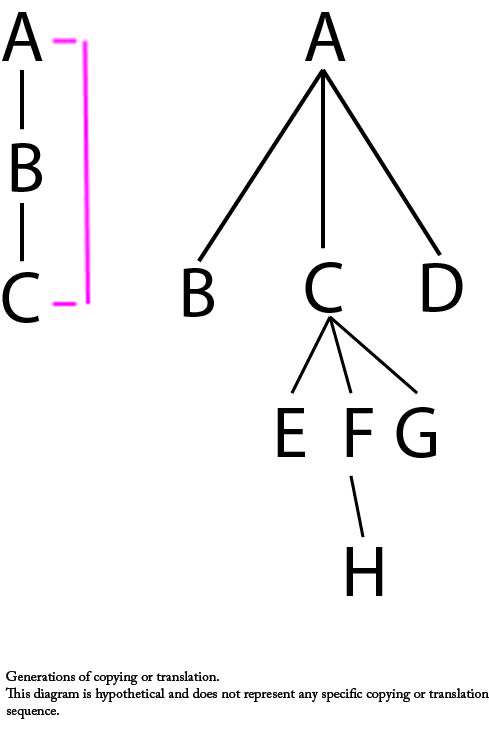
Translating a document is non-destructive. If you look at the left hand side of the chart you’ll see a simple illustration of generations, A, B, and C. If this is the generations of a translation, then some meaning will be lost between A and B, and then additional meaning will be lost if C is translated from B. An illustration might be the translation of the Old Testament from Hebrew to Greek in the LXX (Septuagint), and then into Old Latin. Jerome preferred to go back to the Hebrew when he produced the Vulgate.
The loss of meaning is ameliorated if one consults the original while translating from a translation, as shown by the red lines. This latter situation illustrates the story of the Douai-Rheims Bible, which was translated from Latin, but with the Greek and Hebrew texts available. Until Vatican II, Roman Catholic translators were expected to translate the Bible from the Latin. Since that time, a number of excellent Catholic translations have been produced from the original languages, including the NAB and NJB.
Note, however, that the A-B-C chart on the left illustrates the worst situation, a translation of a translation. Not only that, but you will find it hard to locate a translation of this nature in the Bible section of any bookstore, because almost all modern translations are made from the original languages. One exception is The Living Bible. That version stands alone in being properly called a paraphrase, as it was paraphrased from an English version, the American Standard Version, so it was a paraphrase of a translation.
So the idea that the Bible has been translated so many times that we have lost all idea of its meaning is simply false. Most translations are from the original languages, and besides that, I can pick up my Greek New Testament, or one of my copies of the Hebrew scriptures, and read directly from the original languages.
If we look now at the chart on the right, just the part showing A through D, we see this illustration. Yes, the Bible has been translated many times, but the vast majority of these translations went back to the original languages, and not to any translation.
In class I was asked about the KJV. Where does it fall in all this? It’s a translation from the original languages. There are those who accuse the translators of using the LXX as the source for the Old Testament, but what they actually did was consult the LXX as they translated the Hebrew, which was (and is) a good idea.
So what about copies of copies? Notice that when I said the translators go back to the original, it was always “original languages,” not necessarily “original text.” That’s because it’s quite true that we do not have the autographs. Further, we don’t know precisely how many generations of copying have gone on.
But there are two counterpoints to this. First, it is vanishingly unlikely that the number of generations is in the thousands. We have thousands of copies, but those that date back to the first few centuries are doubtless only a few generations removed. Second, and more importantly, the number of copies made actually works against the issue of copyist generations, because it is unlikely that each generational sequence will produce the same errors. So as you look at the right hand side of my chart above, you will see how you can have many, many copies in only a few generations. In the case of the Bible we can look back through history using multiple paths. This allows us to attain a fairly high level of confidence in the text that we use.
And what we use is a critical edition, either one already available, or one made by the translators of a particular version. We don’t go back and just grab a manuscript and start translating. First we must study the text, comparing these many, many witnesses to the source text, and coming to the best conclusion we can. For the vast majority of the New Testament text, there is next to no controversy.
But here is where the issue of definitions comes in. What is significant? What can be considered reliable? What do I mean by confidence in the text? It’s extremely important for us to be clear on these things, otherwise it’s quite easy to seem to be lying.
There are significant variants in manuscripts. What do I mean by “significant” in this case? Simply that these variants would alter the way I would translate. There may be spelling differences, but these I would not regard as significant.
On the other hand, one might consider only those variants that might impinge about a doctrine, or perhaps a major doctrine, of one’s denomination as significant. Such a variant would be the supposed Trinitarian statement in 1 John 5:7-8.
But that, in turn, raises another type of significance: How viable is a reading. A goof by a scribe in one manuscript out of hundreds that might witness to a particular passage hardly qualifies as significant to the textual critic. Interesting in terms of scribal practices and lack thereof, but hardly significant to determining the actual reading. In the case of 1 John 5:7-8, we would have to say that the reading is not significant, at least to the vast majority of textual critics, as it is not regarded as viable. (Disagreement is possible on virtually anything, of course. The question is how valid or well-founded such disagreement is.)
My point here is that we need to be careful with these terms. I find a text that is 95% non-controversial quite reliable as historical materials go. Historians often work with less. But to certain KJV-Only advocates, the only thing that would be reliable would be 100% equivalence. They tend to waffle, however, when presented with printing errors in the history of the KJV.
I read my Bible with confidence, not because I don’t think there’s any question anywhere in it, but because I think the reconstruction is extremely good and the differences that remain don’t make problems for me. In fact, they make the whole thing more interesting. I see God working in the imperfect people who experience His presence and activity and recorded that for us. I again see God working in the amazing distribution and preservation of copies of what those people wrote. I am not disturbed by the problems; I’m astounded by how few there are.
All this leads me to what I see as the problem. People with the training to understand this process rarely talk about these things in Sunday School or from the pulpit. I have heard two reasons for this: 1) It’s too complicated and people don’t want to know, and 2) It might shake their faith to hear about this stuff.
I think both are bogus. I haven’t encountered anyone who can’t understand the process of copying and translation once it’s explained, and people are going to hear about this from someone, perhaps someone who claims the Bible has been translated hundreds of times, with the implication that it has gone through that many generations. Not talking about it isn’t helping anything.
When we do talk about it, we need to do much ore than simply say that we know how it works and you can rely on your Bible. In modern terms people will expect at least 99.9% accuracy when you say that, if not 100%. The first person to come along and point out that there are thousands of variations in the text will then be able to shake their faith.
You may say that claiming this level of reliability is not deceptive. After all, considering historical processes and understanding how copying and translation work, the Bible is remarkably well preserved. But the people in the pew don’t hear it that way because they often don’t have the background in historical methodology to figure it out. They’re going to feel deceived, because they interpreted what you said within their context, and they got the wrong idea.
You may not regard the absence of John 7:53-8:11 from some of our oldest manuscripts as significant, but your congregation almost certainly will. I’ve been told that it isn’t significant, because we can still teach about forgiveness even without the story, but that is a rather loose idea of reliability, accuracy, or confidence.
My suggestion is to take the time, provide the background, and let people understand just what is in question and what is not. Define terms carefully, so people understand just what portion of the text is in question and what is not.
We need to do more than just respond to miserable articles like the one I referenced above. We need to teach this material up front.
After all, in one way or another our congregations are relying on the Bible as at least one witness to the Word of God. We need to tell them why we think they can.
 . I have been using his book as one of my theological references for the study. He responded to a review in which he discussed some of the same issues I’ve discussed.