
Tonight on our Energion Publications sponsored Google Hangout on Air (completely separate from my series on John), we’ll have a two part program. The first half hour will be an interview by Elgin Hushbeck, Jr. with Dr. David Cartwright about his book Wounded by Truth – Healed by Love. I’ll then be on with Elgin for the second half hour and we’ll be discussing some of the things I’m saying in my John study in relation to the reliability of the gospels and of the gospel message. Elgin is the author of Energion titles Evidence for the Bible, Christianity and Secularism, and What Is Wrong with Social Justice. The trailer for the interview is below.
Author: henry
-
Announcing According to John: The Word Became Flesh
This will be the second study. I’m going to mention a few things to think about. The question remains as to how many of these things I will be able to address, but I think it’s worthwhile to consider these in any case. The study will be via Google Hangouts on Air at 7:00 pm central time, Thursday, January 18. The event on Google+ is here. And here’s the trailer:
I’ll embed the YouTube below, but first, some things to think about! The major scripture for the study is John 1:1-18. If you haven’t read the book of John through completely recently, it will help to review the entire book.
Critical Issues
One issue of source (and to a lesser extent redaction) criticism comes up for this passage, which is the question of whether John 1:1-18 was written as part of the gospel or whether it is an early Christian hymn adapted for and incorporated into the gospel. There are some folks who regard it as poetry with some prose comments added.
Read the passage and pay special attention to the boundary between John 1:18 and 19.
Textual Issues
I’m going to list two, though one comes in two parts:
First, in verses 3 & 4 we have a verse division/sentence division issue. Should it read something like “… without him was not anything made that was made”? Or alternatively “… without him was not anything made. That which was in him was …”? You’ll probably find references to these two possible divisions in the footnotes to your translation. I just looked at the NRSV and REB as I was preparing this, and their notes are pretty clear. The NIV at BibleGatway.com isn’t showing a note. Does your Bible have a note?
The difficulty for the average student is that these translations don’t provide any justification for the decisions made. It would be impractical to expect them to. But if you have a Bible with study notes or a good commentary, you may find a bit more information.
Second, John 1:18 has two alternative readings, which the REB lists as “God’s only Son” (their text) and “the only begotten God” (alternative). Of course, if you read Greek, you should consult your apparatus to discover the evidence for these readings. How much difference does this make? What is the translation choice of the Bible you use? The NIV kind of combines the readings, while the NASB makes the opposite choice to REB and uses “the only begotten God.” I will definitely discuss this variant and something about how these choices are made.
Just for fun, I went through my files and extracted a paper on this verse that I wrote in college, for a course titled “Translation Problems.” Though it doesn’t have a date on it, I think this was in my junior year, which makes the paper more than 35 years old. Read it and see if you agree with my younger self! (I note here that this was written when I was still a Seventh-day Adventist, and references to Ellen White and “the Spirit of Prophecy” should be taken in that context.) Younger readers will doubtless be unacquainted with the quaint device used to produce this paper, a manual typewriter. If I remember correctly it was an old Remington, and no, it had no Greek font!
Theology
Well, combining theology and inter-textual relationships.
First, do you think the cultural/philosophical background for the phrase “the Word of God” should be taken from Greek thought (the word logos is so common in Christian speech that it has almost become an English staple!), or should it be found in passages in the Hebrew scriptures/Old Testament? This will have some impact on precisely how we read it.
Your answer doesn’t have to be one or the other. We discover the precise meaning of a word through it’s use in a particular context, and so this word can be shaped not only by the Gospel of John, but by the New Testament, and by its usage discussing concepts from the Hebrew scriptures, but from doing so in Greek.
Second, I want to explore a connection to one of my favorite books in the New Testament—Hebrews, and specifically Hebrews 4:12, though the prologue (1:1-3) comes into it. James Moffatt, in the International Critical Commentary volume on Hebrews, says: “Here the writer poetically personifies the revelation of God for a moment…. Here it [the Word of God] denotes the Christian gospel declared authoritatively by men like the writer, an inspired message which carries on the OT revelation of God’s promises and threats, and which is vitally effective” (p. 55). Moffatt distinguishes this from the usage in John 1:1-18.
Looking from the other direction, Leon Morris, in his volume The Gospel According to John (Revised) in the NICNT states that the only other place where the word (logos) is used undoubtedly with the same meaning is Revelation 19:13 (pp. 63-64).
I’m going to look at some elements of these two passages. Do you think they are more closely related?
Finally, I want to examine the concept of testimony. We start here with John the Baptist bearing testimony to Jesus, and near the end of the gospel we see Thomas brought to giving a testimony to Jesus: “My Lord and my God” (20:28)! We’ll tie this in later with the critical question of whether chapter 21 was originally part of the book or was added later as a sort of postscript.
Doubtless I will have many words on all these topics and perhaps a few more! The YouTube embed is below.
-
Follow-Up on Study of the Gospel of John – Introduction
I’ll include the YouTube for my first study session on the Gospel of John below. During my discussion I promised to provide a link for the article I referenced suggesting that the Rylands Papyrus, P52, may be dated a bit too early. The article I referenced is available on Academia.edu, and is titled The Use and Abuse of P52: Papyrological Pitfalls in theDating of the Fourth Gospel. I believe registration is required, but it’s not behind a pay wall.
In addition, you might want to review Larry Hurtado’s comments on an article dealing more generally with early dating of NT manuscripts. The article itself is behind a pay wall, and I haven’t read it.
I find that these notes generally reaffirm my belief that most paleographical dating of New Testament manuscripts provide too narrow a window, one that is not justified by the level of the evidence. If one truly considered the window, the old date for P52 is about at the lower edge of the new window. Our tendency is to read probabilities as certainties, and thus if we have a date of 125 +/- 25 years, we will often cite it as 125. But that window is important. I’m not a paleographer, so I couldn’t comment on the particulars.
This coming Thursday, again at 7:00 pm central, 8:00 pm eastern time I will be discussing John 1:1-18. I will post a link to the event, a video trailer for that lesson, and some questions/points to think about prior to the study here tomorrow.
Also, we will be having a 1/2 hour author interview in the series of Energion Publications Tuesday night hangouts on air with author David Cartwright regarding Cartwright’s recently released book Wounded by Truth – Healed by Love. Elgin Hushbeck, Jr. will conduct the interview. For the second half hour, Elgin will be discussing historicity and the gospels with me, particularly with reference to the Gospel of John. Click here for full information on the Tuesday night hangout.
And finally, here’s the YouTube for last Thursday’s introduction to my study on the Gospel of John. We’re using Meditations on According to John by Dr. Herold Weiss as the text.
-
When a Teen Refuses Treatment
My wife has some good comments on a current case. Dealing with cancer in a young person is always heartbreaking. The number of people who are sure they know what the right answer is, is quite astonishing, in my view.
-
Some of My Own Books on Sale (Gospel of John Study)
The advantages of being a publisher is that I can put books on sale to go with posts. Normally I only do that for things on my company page (Energion Publications), but since I’m starting a study of the Gospel of John on my Google+ Page/YouTube Channel, I’m doing it with a few of my own books. I haven’t spent time pushing my books for some time, I think.In any case, the book I’m using for the study, Meditations on According to John by Dr. Herold Weiss, and three of my own books are on sale for 30% off until the end of the month, so this is your opportunity.
While I’m following Dr. Weiss’s book, I won’t be reiterating the contents of it in the video. I intend to spend more time in the nuts and bolts of how one interprets the passage. Dr. Weiss subtitled his book “Exercises in Biblical Theology,” and I’m going to be doing some exercises during the week myself and sharing these each Thursday night. So if you want to get what he has said, you’ll need to buy his book.
-
Bruce Epperly Interview and Sale
 Last night I had the privilege of interviewing Dr. Bruce Epperly, author of several Energion titles out of a total of 28 books he has written so far. Bruce is always both interesting and challenging, and doesn’t avoid the hard questions.
We placed his books on a special “buy 2 get 1 free” sale just before the interview, but I was so interested in the topic, I forgot to mention it on video! I’ve extended that sale by one day, so it will be good all day today and tomorrow. If you want to stock up on these titles, this is the time to do it. Note that the buy 2 get 1 offer works along with quantity discounts, so if you’d like to stock up for a study group, again, now is the time. Just go to Energion Direct, and you’ll see a section for the sale on Bruce Epperly’s books. You can make your choices from there.
For those who may have missed it, I’m embedding the YouTube video below.
-
When Should You Talk about Textual Criticism?
I’ve posted a question that originates with Thomas Hudgins over on the Energion Discussion blog. Here are my comments to go with that post.
The question has quite a number of implications. For example, if your listeners do not normally look at the textual notes in their Bible translation, they might not be aware of the issues. Not mentioning a difficulty might be an issue of honesty. (“Pastor, you never gave me any idea how many variants there are in the New Testament text. You lied to me!”) On the other hand, constantly mentioning textual variants, most of which are fairly minor (though translations normally mention only a very small minority, NET excepted, and thus only ones that impact meaning more significantly), and discussing the text all the time can be very distracting.
I resonate with much of what Thomas says in his post. It’s very easy, as a pastor or teacher, to leave the wrong impression. You can leave your listeners thinking they can’t study the Bible at all unless they’ve spent time with textual criticism as you have. You can make them think no translation is at all trustworthy.
There are always at least two types of tension here.
First, there’s the issue of what skill is needed in order to study the Bible. I took a Biblical Languages major as an undergraduate, rather than religion or theology, because I wanted to understand the Bible better. I don’t think I wasted my time. I can get more out of a passage using what I learned, including a quarter each in New Testament and Old Testament textual criticism, than I could if I was limited to English translations. On the other hand, it is not impossible to understand the vast majority of scripture using an English translation, especially considering the number we have available and the wonderful resources we have in addition.
Second, there’s the issue of the trustworthiness of the Bible. Many pastors avoid issues in the text because they’re afraid people will get the idea that they cannot trust the text of scripture. (“If major translations don’t even agree, how can I be sure?”) I think this is a questionable approach, because the vast majority of the text of the New Testament is not in dispute. It’s much more convincing to mention that before, rather than after, someone discovers textual variants. If you haven’t mentioned it, you’ll sound like you’re on defense, and you’ll sound like you’re making it up as you go along.
Some may ask why I’m concerned this much about the reliability of the text when I don’t accept the doctrine of biblical inerrancy. There are three answers to this:
1) It is a matter of historical fact that we have very strong evidence for the text of the New Testament, and that variations are, on the average, minor. Are there significant variants? Yes, but the disputed texts are not that numerous. In fact, a great deal of debate in this area centers around the vocabulary used to describe the situation. Numbers always need to be kept in perpsective.
2) I do believe in the providential preservation of God’s message. (Vocabulary alert: What is meant by “providential preservation” differs from person to person.)
3) I believe we need to be honest at all times.
-
Trailer and Theme for My Study of John

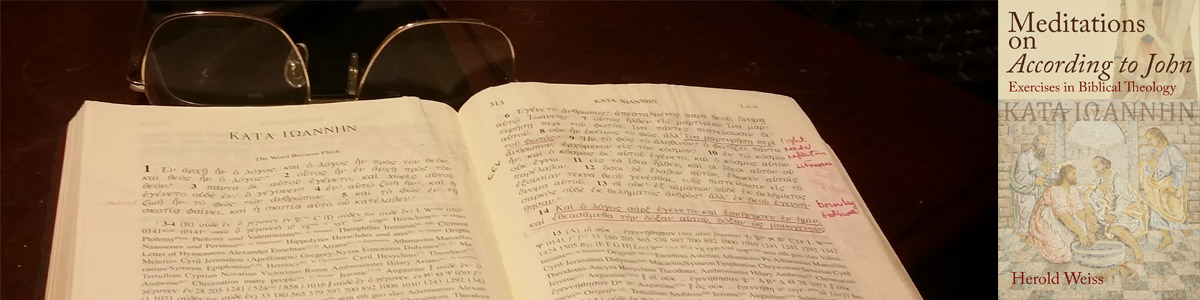
Above is the theme banner for my study of the gospel of John. The video below is a trailer for it. I am working on getting used to video. I’m more comfortable with text, I think.
-
Received Next Round of ALGNT
And what is ALGNT?
I’m glad you asked! That’s Aprenda a Leer el Griego del Nuevo Testamento. Thomas Hudgins has just forwarded the latest round of corrections. You haven’t lived until you’ve laid out a Greek grammar written in Spanish, always assuming Spanish is, for you as for me, a second language.
-
Sunday School Today: Authority and Truth
 I think I titled the next chapter in my book When People Speak for God rather pretentiously: Authority and Truth. That’s what we’ll be discussing today in my Sunday School class.
As I was reading the chapter, I came across the following, which ties into several things I’m thinking about these days:
There is, however, a deeper claim that’s involved in both the virgin birth and the resurrection. These doctrines state that God is fundamentally interested in communion with human beings. In the virgin birth we have the statement that God is prepared to share our form and our condition and to become a part of that history. In the crucifixion, God says that he is prepared to carry that sharing all the way, to experience death. In the resurrection, he states that despite his willingness to share it, he’s above it, and thus able not just to communicate with us, but to redeem us.… (pp. 135-136)
I call my view of inspiration incarnational, because I see God’s Word, however it is expressed when it is communicated with human beings, as a form of incarnation. The problem with this is that I think the orthodox doctrine of the incarnation is not well understood. (There is, of course, the sense it which it will never be well understood and will always be a mystery!) But the way people often hear the term “incarnational” in connection with inspiration is as a claim that the Bible is a mixture of divine and human. When I call scripture incarnational, I do not mean a mixture. I mean that it is all divine and all human. We can sense aspects of divine and aspects of human, just as we can with Jesus the man, but we cannot divide.
Inspiration is all-the-way incarnation as well. God’s power is contained in the finite form. What we need is ears to hear and eyes to see.
I’ll have more to say about this over the next few days.