20 ‘LORD, see how sorely distressed I am. My bowels writhe in anguish and my heart within me turns over, because I wantonly rebelled. In the street the sword brings bereavement, like the plague within the house.
The Revised English Bible (Cambridge; New York; Melbourne; Madrid; Cape Town; Singapore; São Paulo; Delhi; Dubai; Tokyo: Cambridge University Press, 1996), La 1:20.
I find it hard to blame the author of Lamentations, because he is speaking for Judah as they stand devasted by God’s actions. “Lord,” they ask, “Do you really know how terrible this all is?”
Their situation is real, and their question is justified. In fact, I suspect this book is in the Bible precisely because that is such an excellent question.
But I’ve told you that I do these verse by verse meditations not to do biblical exegesis, as interesting as that is, but to meditate on the words and see what may come to mind. In this case, I started asking the question: “What if this question is either not justified or not well motivated?
Let’s look first at “not justified.” I don’t know about you, but I can work myself into a serious problem by not paying attention or by compounding one error with another as I try to fix things. As decisions pile up and then cascade into a landslide of consequences, I have the urge to ask, “Lord, why are you letting this happen to me?”
There’s a simple answer. “Whatever a man sows, that will he reap.” God made the universe in such a way that actions have consequences. When consequences come, it’s possible you may not realize what caused them. It’s a good time to ask, “Lord, do you see what’s happening? Why?” But be ready for an unpleasant answer to that “why” question.
On the other hand, you may be able to see the path clearly. In that case, the why isn’t the right question. You know why. If you were running wildly along the edge of a cliff and suddenly find yourself in a heap at the bottom, the why is obvious. It’s just not very helpful. “How do I get out?” is a much more helpful question.
After that, you can remember the obvious “why” and don’t do that again!
But the question can sometimes come with bad motivation. It’s possible to become so caught up in troubles that trouble becomes your identity. You may not feel precisely proud of it, but it’s you. If you didn’t have your troubles, who would you be? Being a victim becomes a way of life.
Among Christians, there’s a particularly dangerous form of this in which people find affirmation of the “rightness” based on people attacking them or “persecuting” them. Want to feel sure you’re right? Just wait until someone attacks you for your beliefs. “Blessed are the persecuted!” (Matthew 5:10).
But offending someone or making them angry enough to take action against you is not necessarily an indication that you are right. People do get annoyed at others doing right when they know they are not. This can result in persecution in school, at work, or in life. But as soon as you take that as the indication that you’re right, you’re on a dangerous path. The persecution doesn’t indicate you’re right.
You’re blessed if you’re doing right and “doing right the right way” and are persecuted for it. You aren’t blessed if you’re being offensive in order to feel important or find affirmation.
So when things go wrong, ask yourself why first. Often, you’ll find that you know the answer, and the problem is you. Good news: You can do something about that!
19 ‘I called to my lovers, but they let me down; my priests and my elders perished in the city while seeking food to keep themselves alive.
The Revised English Bible (Cambridge; New York; Melbourne; Madrid; Cape Town; Singapore; São Paulo; Delhi; Dubai; Tokyo: Cambridge University Press, 1996), La 1:19.
Sometimes I meditate on these passages for a long time before I come up with what I want to say. Other days, the passage just shoves a topic in my face. This one is even related to the historical context of the verse more closely than usual!
What connections do you build in your life?
It’s a serious question. Many of us, myself definitely included, tend to gather friends and associates randomly. I’m rarely the one who pushes in and initiates a friendship. Others invite me. It’s not that I think others should have the responsibility of accommodating themselves to me. Rather, I’m just slow to figure out valid and constructive social connections.
This verse presents the remnant of Judah in mourning. Their lovers let them down. Priests and elders are dead, and they died taking care of themselves, not their community. The failure is complete. In distress you turn to your support system. What happens if they aren’t there?
There are two categories here I want to look at. “Lovers” in this passage represents friendships and social connections. Multiple lovers was a metaphor used frequently for the way Israel and Judah tended to look at the religions of the nations around them and pick up whatever looked good.
Social connection without commitment will leave you empty and alone when trouble starts. Israel had contact with the nations around, but when what was left of the kingdom was in trouble, there was nobody there to help. In fact, the book of Obadiah is directed at the Edomites who were ready to go scavenge the corpse.
We use the term commitment primarily of marriage, I think, but commitment should also be an aspect of friendship. A friend who is there for the easy part but stays away when things get tough is not much of a friend.
What about your church community? What type of commitment have you made to that community? Is it just a plan to attend and get whatever benefit possible, but if somebody offends you or things get tough, you’re on your way?
What about the attitude of the church to you? Is the commitment mutual? I often hear church leaders talk about how they want committed members. They complain about lack of commitment and look at ways to seek more commitment from members. But if any member asks what they get from this relationship, there is annoyance, even anger. You’re supposed to be here to serve, not to be served!
But in a good relationship the commitment goes both ways. People want to be fed in Sunday School and church. The church leaders wonder why people are just expecting to get, get, get. Good point! The members should be looking to serve. But to serve, they will need to receive.
And that relationship question can be reversed as well. Why is it so annoying when people want to receive from the church? Is it possible that the church doesn’t feel a commitment to its members? In a time of trouble will a member end up saying, “All my friends have let me down?”
Service is an important and essential part of Christian life. But watch out for the person–or the organization–that demands but does not give.
Can people in trouble come to you? Do you have a community you can depend on?
In cybersecurity, Zero Trust is the rule that no source gets a free pass—you don’t trust the email; you verify the sender. That same principle is no longer just for IT departments; it’s now essential for anyone scrolling through a newsfeed.
Zero Trust in Cyber Security
A friend once received an email appearing to come from me, recommending a product. The name on the account was mine, but the actual address wasn’t. Fortunately, he called to verify before buying anything.
I got an email this morning with a sad story and a request that I send free books. I’ve donated hundreds of books. But something looked off. I checked it carefully, and found substantial evidence that it was a scam. People get donated books and then offer them for sale online. They may get few responses, but any books they sell are pretty much pure profit.
A client of mine–well, numerous clients–receives a phone call purporting to be from their bank. It’s not. It’s from someone planning to steal from them.
I teach people that it’s important never to trust that the caller or the email sender or even the person who comes to your door is who they claim to be. Always verify. Failure can mean substantial loss.
A Dangerous Experiment
Over the last couple of weeks I did an experiment. I started scrolling more in social media. Not directed search for topics of interest, but just following the feed. “Doomscrolling” is the term, I believe.
I wondered if somewhere out there, a hidden wealth of joy and wisdom was waiting for me.
No. I didn’t actually expect that. I just wanted to verify.
And I found precisely what I expected, for the most part. I actually found a couple of feeds, such as someone who comments on court cases, that provided good, well-sourced information complete with context. But I didn’t find that many.
I also found numerous feeds that simply created news with no basis in fact at all. They provided nicely formatted news stories that could easily persuade one that they were created by a professional journalist. In fact, they may have been created by such a journalist.
I found a few commentary and analysis feeds that provided useful analysis of verifiable news. I know. I looked up the facts on which they based their analysis up and found good sources. I also found completely wasted words analyzing falsehoods in detail.
I must note that I also found a number of feeds with fun stuff, cat pictures/videos, dog pictures/videos, positive stories of human activity. Well, on this latter one I must note that I found many feeds, and only a few of them were not engaged in scamming themselves. Once you notice it’s easy to spot the fakes. They have long, heart-wrenching stories that totally defy all probability and have a link embedded near the end. But there were a few genuine posts around.
I also found that the “doom” in “doomscrolling” is real. This stuff is depressing. It’s also addictive. Both of these points I expected, but I really didn’t expect as much as what I found. It’s a depressing world out there and social media will feed it to you as fast as you’ll take it in.
And the Result?
In the end I learned the lesson I had already learned before I took this vacation from sanity: Zero trust is useful in social media and news services just as it is in security.
More precisely, I’d say this: Take control of your input, what you feed your brain. Choose what you’re going to read. Choose what you’re going to think about. Vigilantly test your sources.
Older people may be thinking, “Yes, that’s good advice for all these young people wasting their time on social media.”
But this advice isn’t just for younger people scrolling on smartphones. You can “doomwatch” television just as easily. You can absorb sensationalism and half-truths from the evening news if you let TV editors decide what matters.
Zero trust may sound negative. It is not. It is a positive decision to think, to check, and to decide, and not be a passive consumer of any source.
The LORD was in the right,
for I rebelled against his command.
Listen, all you nations,
and look on my agony:
my maidens and my young men
are gone into captivity.
The Revised English Bible (Cambridge; New York; Melbourne; Madrid; Cape Town; Singapore; São Paulo; Delhi; Dubai; Tokyo: Cambridge University Press, 1996), La 1:18.
If you want to fix anything, the first step is acknowledging that something is wrong.
I just got done revising a utility I created, or rather had Gemini AI code, for sharing site feeds between the various websites that are related to my publishing company, Energion Publications. An interesting thing about AI is that while it is not precise about doing what I want, as I’ve been accustomed to for decades, it can create a lot of code very quickly. This introduces a weakness. If I ask for the wrong thing, I generally get the wrong thing. The AI follows my plan for better or worse.
The configuration file for my utility was grotesquely complex. It was precisely what I had asked for. The AI produced code that did what I asked. But my plan was not very good.
After struggling for awhile to learn how to use the code I asked for I realized that this wasn’t going to work. I could probably figure it out, but I’d forget it in a day and then I’d have to start over. I played around with it for a few minutes, and realized there was a massively simpler way to set this up. Minutes later I had new code which works just fine.
The first step in fixing this was to recognize that there was something wrong.
AI’s, in my experience, are not good at recognizing what’s wrong. They usually dig deeper to make the current plan work. On this point, AIs are not that different from humans. Once we have chosen a path we’re likely to stick to it, whether it’s working or not.
This verse is a key. “The Lord was in the right.” Conversely, I was wrong.
I was sitting in the pastor’s study at his invitation. He had a question for me. “Is mowing the lawn really considered one of the pastor’s duties here?”
I had to think about that, and then I realized the problem. The previous pastor liked to ride the tractor and do the mowing. It was relaxing and meditating time for him. But there were others in the church who were quite ready to do that job. I was able to point out precisely who to contact. A few days later I was pleased to see a church member, one who also enjoyed that sort of work, mowing the grass.
That may seem like an extreme case, but it’s also one that had a prompt, happy ending. Over more than two decades in the publishing and public speaking business, I’ve had the privilege of visiting many dozens of local congregations across nearly every denomination you can name. I love the local church, and I have immense respect for the men and women who step up to lead.
But over those years, I’ve developed a quiet, heavy burden for the pastors I meet.
So many of them are completely drained. Congregations quietly expect their pastor to be a spiritual giant, a captivating preacher, an expert counselor, a financial expert, a human resources manager, and a tech-savvy administrator—all while keeping up a flawless family life and an uninterrupted smile. (And let’s be honest, most of us would crumble trying to do just two or three of those jobs at once!)
When visiting a church as a guest speaker, I got into a habit of pulling a few members aside and asking a simple, quiet question:
“What is the mission of your church?”
Almost without fail, the answer was a blank stare or a vague guess. Very few had any clear idea.
These congregations didn’t have bad pastors. They had overworked, overwhelmed pastors. The truth is, the most ungodly thing in many of our churches is the pastor’s job description.
I don’t mean the official one written on paper by a staff-parish relations committee (or whatever group handles that in your church). I mean the unspoken, heavy stack of expectations stored in the minds of the congregation. We expect our pastors to carry the entire weight of the church on their own shoulders, and then we wonder why so many burn out and walk away from ministry after just a few years.
Simply preaching a sermon telling the congregation to “get focused” won’t fix this. What pastors and congregations actually need is an operational model that is spiritually grounded, scripturally sound, and practically workable.
An Unexpected Blueprint
That is why I want to share a new book that gets right to the heart of this problem.
While Energion is not the primary publisher of this book, I want to give it my genuine, wholehearted backing. Having edited and published dozens of ministry handbooks over the years, I can tell you that this one stands out for its practical wisdom and deep respect for the pastoral calling.
Pastor Williams serves as the Lead Pastor of Metropolitan United Methodist Church in Montgomery, Alabama, and is the Founder and Executive Director of The Beacon Center. He isn’t writing from a quiet academic office; he’s writing from the active, messy, and beautiful front lines of community ministry.
He addresses the exact tension that paralyzes so many church leaders: the constant tug-of-war between shepherding people and managing an organization.
Rev. Richard T. Williams II
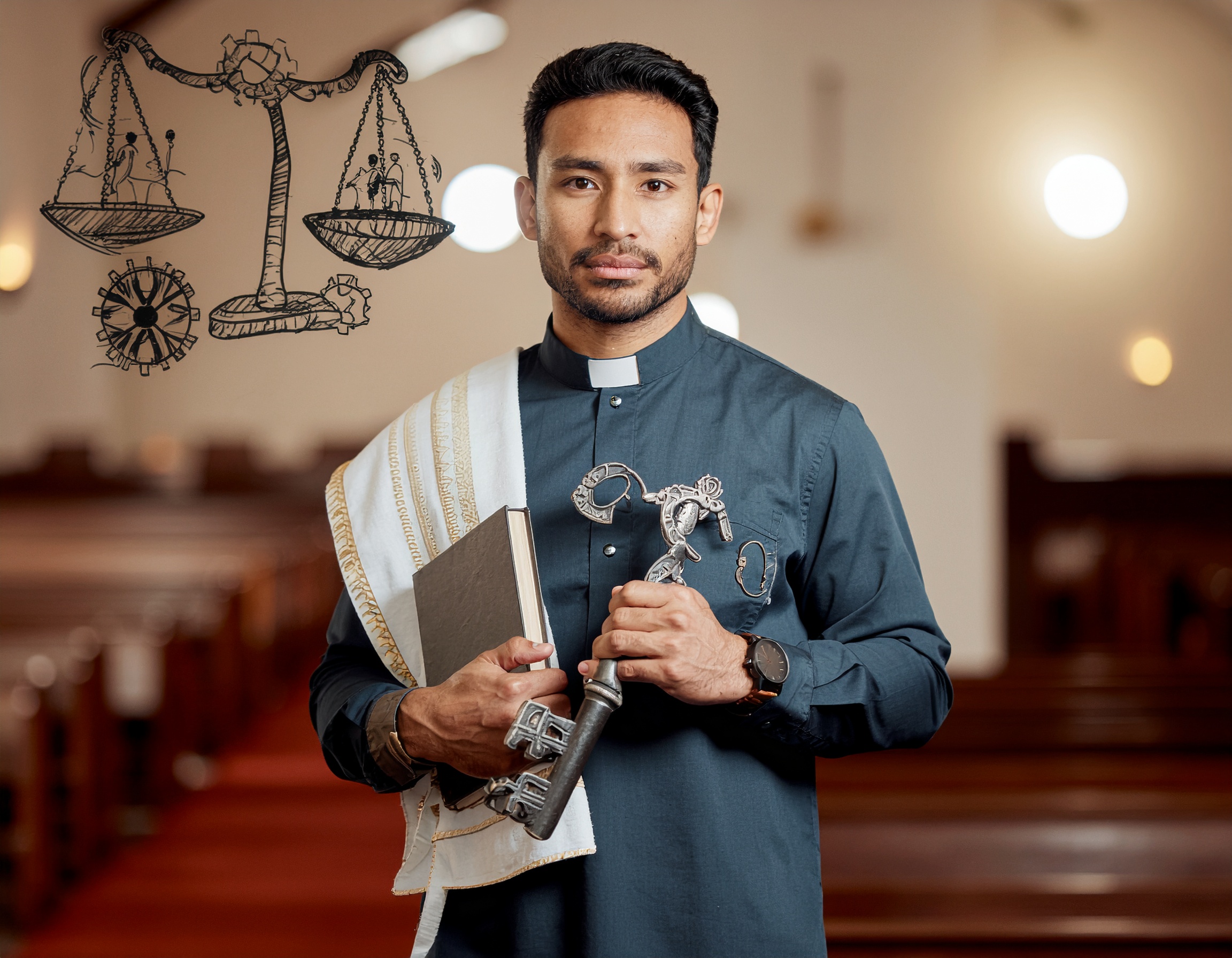
Reclaiming the corporate acronym, he introduces the Chief Executive Overseer—a leader who faithfully holds the shepherd’s staff of care in one hand and the steward’s keys of administration in the other. In God’s kingdom, good structure and vibrant spiritual life aren’t enemies; they are partners. Stewardship, when done with order and integrity, is a genuine form of worship.
A Practical, Hands-On Guide
Rather than offering lofty theories, Pastor Williams provides real-world frameworks, clear checklists, and honest case studies to help church leaders:
Cast Vision with Clarity: Moving beyond vague slogans so the congregation actually understands its mission and knows where it’s going.
Empower Lay Leaders: Drawing on the biblical wisdom of Exodus 18 (Jethro’s advice to Moses) and Acts 6 (deacons handling administration so apostles could focus on prayer), shifting the church away from unhealthy dependency toward a shared priesthood of all believers.
Operate with Integrity: Setting up transparent financial structures and healthy accountability that protect both the pastor and the church.
Yes, as a publishing service provider, part of my job is helping market books. But my primary, lifelong calling is equipping people for ministry and building the Kingdom of God. I warmly support this book because I believe it offers a realistic path to rescue weary pastors from burnout and help local churches find their calling again.
Whether you are a solo pastor running on empty, a denominational leader looking to support clergy, or a faithful layperson serving on a church committee, I encourage you to read this book—and more importantly, put its principles to work in your congregation.
Let’s change those ungodly job descriptions in our churches, and start holding both the shepherd’s staff and the steward’s keys together.
17 Zion lifted her hands in prayer,
but there was no one to comfort her;
the LORD ordered Jacob’s enemies
to beset him on every side.
In their midst Jerusalem became
an unclean thing to be shunned.
Lamentations 1:17 [The Revised English Bible (Cambridge; New York; Melbourne; Madrid; Cape Town; Singapore; São Paulo; Delhi; Dubai; Tokyo: Cambridge University Press, 1996)]
“I’m praying.”
This is one of the most common comments among Christians, combined with “I’ll pray for you,” or “you’re on the prayer list.”
Honorable (or dishonorable) mention goes to “We’re sending thoughts and prayers.”
To back up our prayer claims we tell stories of answered prayer, whether from scripture or from our own lives. Daniel in the Lion’s Den makes a good example. Spending the night with hungry lions and coming out uneaten is quite a feat!
We’re less likely to talk about the times in scripture when praying didn’t come out so well. This verse is a good example.
Zion is praying, and we know the outcome. Exile is coming. The verse says God has commanded it. The prayers are not answered, not positively. Destruction comes.
Why is that?
One reason is that people are doggedly pursuing a path of destruction. If I get drunk, jump in my car, don’t wear my seatbelt, and proceed to drive recklessly, there are certain likely results. The best is actually if I get pulled over and charged with DUI. The worst is death—mine, or that of an innocent person.
But I prayed!
Yes. And God was probably trying to get through with an answer, but as I drove down the path to destruction, I wasn’t able to hear the answer.
Our verse says that the Lord ordered Jacob’s enemies to beset him on every side. Was God really trying to destroy Judah? It’s worthwhile studying this entire period of Israel’s history, not to condemn, but to learn from it.
Often God has us beset on every side, by wise counselors, by the prompting of the Holy Spirit, and by the unrelenting force of the laws of nature. If we don’t allow those barriers to derail our ride to destruction, who do we have to blame?
For years, I worked in IT, helping small businesses. I regularly told people that I could provide security tools and practices. Antivirus software could protect them. The one thing I regularly couldn’t protect someone from was their own actions. If you have a password and a secondary code that are both required for access, and you go ahead and give both of these to a bad actor, no amount of other security will protect you.
I remember a call from a client who said she had just accidentally opened what she was sure was a bad email attachment. I asked her what she had done. “Just what you told me to do. I shut down the computer as soon as I realized it.” I was able to get her system cleaned up and running in less than an hour. (The bad payload was ransomware with high potential to make one’s life miserable.)
At another office I walked up to a workstation to do some routine maintenance and noticed suspicious activity right on screen. I asked the user how long this had been going on. “Oh, I don’t know. Probably all day.” More than 12 hours and considerable expense later, the business got its network back. (Secure backups are wonderful!)
The software was there, the tools were there, the policies were there. Two very different results.
“I’m praying, Lord!”
“Yes, but are you listening?”
(Featured image generated by Firefly 4 Ultra according to a prompt generated by Gemini.)
This is why I weep over my plight, why tears stream from my eyes: because any who might comfort me and renew my strength are far away from me; my children have become desolate, for the enemy is victorious.
“Aloneness” has different meanings to different people.
I’m an introvert. This doesn’t mean I don’t like people, but social events are tiring for me. I particularly dislike social events that don’t have a program. Being expected to make small talk, or to show interest in random topics, makes me want to run and hide.
My wife has said that at a party, she assumes I’ll find a chair in a corner and tune out the scene.
So there is a positive sense to being alone, alone to think, alone to plan, alone to rest. Alone by choice.
Then there is the aloneness that is the result of abandonment. When things start going wrong you find out quickly who cares and who doesn’t. People forget you exist because you’re no longer involved in what is important to them from day to day. There is a descending spiral, as you seem too anxious and needy when a visitor does appear. They may not have the energy to fill the loneliness in your heart.
We tell others that there is no friend like Jesus. Yet sometimes we need the physical person in the room. “When I was in prison, you visited me,” says Jesus in Matthew 25:36. As Jesus often does, he reverses the situation as we see it. We’re thinking of seeing Jesus in the person who is visiting. I need a little encouragement from a real human, that physical person. But here Jesus is telling people what a good thing they did when the visited Him, Jesus, in prison.
When did that happen? When the visited the person who is alone. When you did it for the least, the most insignificant, the least lovely. It’s not even limited to those unjustly in prison. When you visited the least important person in prison. Even if they fully deserved to be there.
I follow my meditations when writing about these passages, and the meditations can go quite far afield. I want to bring this back to Judah and the exile, which underlies the text. Their country is destroyed. They have not friends. Potential friends only see targets and victims. Nobody is there to help because all those who were friends are destroyed or driven away. Judah is devastated and alone.
And yet …
They are still God’s people. We see this book preserved about mourning and lament, and we see the devastation, and restoration, partial though it appears. And we can look at this from the other side. What do you and I do about devastation? Do we ignore it and hope it doesn’t come to us? Or do we seek to change it?
As I think about this, I’m drawn away from my own attitude about aloneness and I’m led to ask myself how often I visit someone who is shut in. How often do I encourage someone who is discouraged? How often is my voice raised in defense of the weak, the hopeless, the victims? Do I care even for those whose problems seem to be of their own making?
I was talking to one of my authors recently and he told me he was headed to the Mexican border, where he would pray for refugees who were waiting there. He couldn’t even get to touch them, but he could pray, and he did.
So what will I do for those who, to the world, are insignificant? What will you do?
It’s very easy to become secure when we are surrounded by people who look like us and think like us. It’s even possible to do so by pretending that we think alike. But in such situations, we often create secure worlds that are mostly of our imagination. By clinging to established rules and to accepted stories, we build an illusion of safety.
But history has a way of shattering such illusions.
In the early 6th century BCE, the inhabitants of Judah lived in just such a secure world. Falsely secure. They believed that the physical presence of the Temple in Jerusalem acted as an iron-clad guarantee of their safety, irrespective of any of their actions. After all, wasn’t this the dwelling place of the Most High God? They had promises to their ancestors, David and Solomon and others that their royal house would endure forever.
Then came 586 BCE. The Babylonian armies breached the walls, the city was leveled, and the Temple was burned to the ground.
For the Judeans, this wasn’t just a military defeat; it was a collapse of everything they believed about themselves and their world. Their understanding of God, the land, and identity was shattered. They found themselves marched off to Babylon—a minority in an empire that dominated the middle eastern world.
How do you sing the Lord’s song in a foreign land (Psalm 137)? How do you maintain a faith when all the physical “props” of your religion have been completely destroyed?
A Tale of Three Messengers
When we look back at this historical crisis, we see that God didn’t respond by handing the exiles a neat list of rules. He didn’t provide them with an explanation that would make them feel good. Instead, He sent specific people to match specific groups in their unique situations.
In my book, When People Speak for God, I explored these distinct exilic situations through the lens of three very different messengers:
Jeremiah: Jeremiah had the agonizing, unpopular task of speaking to those still in Jerusalem who were living in denial. He didn’t just speak the message; he wept it. His life became a symbol of a God who refuses to give up on His people, even when they are marching straight into a disaster of their own making.
Ezekiel: Ezekiel was himself an exile among the captives by the Chebar canal. He was given a wild, wheels-within-wheels vision of God’s glory departing the Temple and traveling east. The message was revolutionary: Yahweh is not a territorial deity bound to Jerusalem. He is mobile. He can travel into the “unclean” dirt of Babylon to personally be a sanctuary for His people.
Daniel: Daniel and his friends had to serve inside the very halls of the pagan Babylonian court. They faced the daily temptation to compromise their identity to gain power, status, and comfort. Even further, to simply survive. Yet, through quiet noncompliance, they proved that one can master the learning of the dominant culture without letting the one true God be pushed aside.
Obadiah: This is the fourth of three! While my book focused on three messengers, a fourth, Obadiah, completes this picture by ministering to the remnants of Judah who were still living in a largely desolate land. I’ll expand on his message below.
Each of these prophets spoke for God in a way that met the people exactly where they were, showing them that exile was not the end of the story—it was a life-size classroom.
This experience preserved the identity of the Jewish people by effectively remaking it, by detaching it from physical Jerusalem. With the temple in ruins, the God of the temple remained God, universal and sovereign. God was not surprised and was certainly not threatened by the powers that overcame the Kingdom of Judah. God was not limited by space.
Obadiah, that fourth prophet, adds a special spice to that message. He most likely ministered in the territory of Judah after the exile. His message is addressed, however, to Edom. What is the purpose of this message, addressed to a foreign people?
To the people who would have initially heard it, the remainder of the Judean population, those the Babylonians didn’t consider important enough even to take into exile, it meant that God was still watching them. (Note that Jeremiah, the weeping prophet, also ministered in Judea, but he was quickly taken to Egypt.) He provides a similar message in Jeremiah 49. God was watching over the population of Judea, and was willing to challenge those who would harm even this lowly remnant of the once proud kingdom.
That message, however, indicates God’s concern for Edom and for other lands. There is no point in words of warning for someone if there is no action possible to turn aside the doom that is proclaimed. Giving a warning is an indication of concern. Compare Obadiah to Jonah. Note that in Obadiah we lack the backstory. We don’t know how directly he might have confronted the Edomites. But what if the Edomites did listen, and stepped back from the brink?
Scrambling Our Modern Labels
Today, we are living in our own season of cultural exile and disorientation. Many Christians feel that they are diminished and less than they used to be. They mourn the passing of a Christian nation, and the presence of people from so many faiths. These things shake our sense of identity.
Sometimes that is the best thing for us.
To be a witness for Jesus in the world as we are called to be we need to have two things, and these things often seem to contradict one another. First, we need an identity. You have nothing to share if you have no identity. But secondly, we need a presence in the world outside our personal, limited visions. A wonderful witness is worthless if nobody encounters it. Your piety is useless if it exists only in the bounds of the church, your home, or people like you.
Israel, and then after the exile of the northern tribes, Judah was called to be a witness. For this, they needed an identity. They built that identity around a city, Jerusalem, and the Temple in it. That identity tended to separate them from the world. There was a need to draw them out of that limited sense of identity to a realization of just how great a mission God was calling them to.
Building that new identity started with the shattering force of the exile. There was no way to have an identity built around a temple that had been destroyed. A territorial identity could not survive with a people scattered from that place.
Through these four prophets, God worked on that new identity, one that made God’s people connect with a broader world and realize that God was not so limited as they had thought. The shatteringly complex vision of Ezekiel 1 tells the prophet something very important: God is here at the River Chebar, just as he would be at the Jordan. Your limited view, Ezekiel, has been shattered. See the vision and learn that your God is greater than you ever imagined.
Limited Vision Limits
When our vision is limited, then our actions will be limited. When the people imagined that God would protect them in Jerusalem because the temple was there, representing God’s presence, that imagination limited their ability to be witnesses to the world beyond.
Ezekiel expanded that vision into Babylon.
Jeremiah taught the people that God was still active in Judah, even when God was simultaneously active in Babylon.
Daniel taught that God was not only active in the camp of the exiles, the people who had thought of themselves as God’s people. God was fully active in the court of the king of Babylon. Not only that, but the King of Babylon was, reluctantly, open to guidance from the God of distant Judea.
Only the concept of God as the God of Israel, or the God of Judah was too limited.
God was the God of Israel. But God was also the God of the entire universe.
Vision needs to be shaped by what is beyond our limited surroundings.
Finding God on the Periphery
If you feel that God’s message is getting lost in the world. If you feel that God is often absent even from the life of your church, you need to find that vision. The vision of the God who sits above those wheels and is served by the flying creatures who are unlimited in their movement.
And in case you think this message was just invented in the early 6th century BCE, the God of the scriptures is, and has always been, the God of the edges. We tend to forget that as we read. For Abraham, more than a millennium earlier, God has a call to something beyond imagination (Genesis 12). Over and over we see biblical characters called to things they didn’t imagine possible.
For Gideon (Judges 6 & 7), some 600 years earlier, God has a call to the edge. When Gideon is called, he is hiding from the enemy in a winepress. There is nothing bold about him. But God changes Gideon’s vision and lets him see what God can do through him, rather than what he can do himself.
God wants to expand our vision. To do that, he has to get us to abandon our own limited vision.
Will it take a disaster to get your eyes off your own limitations?
15 The Lord treated with scorn all the mighty men within my walls; he marshalled rank on rank against me to crush my young warriors. The Lord trod down, like grapes in the winepress, the virgin daughter of Judah.
The Revised English Bible (Cambridge; New York; Melbourne; Madrid; Cape Town; Singapore; São Paulo; Delhi; Dubai; Tokyo: Cambridge University Press, 1996), La 1:15.
I’m meditating on these verses, intending to write one meditation per day, though I haven’t been keeping up. It can seem like the elements of just staying alive are “marshalled rank on rank against me.” If it’s not one thing, it’s another!
Now in the historical context of this book at this verse, this is about the people suffering conquest and exile, and that by cruel conquerors. I want to emphasize that a key reason for this book being in the Bible, in my opinion, is to let people know it’s OK, and even healthy to acknowledge difficulties. Running around pretending things are fine when they aren’t isn’t healthy, and it isn’t productive. You can’t fix what you don’t recognize.
But in meditating I started to think about the way we talk about troubles in our lives. I’m talking especially about those of us who are in some kind of ministry work. What do we say when obstacles are put in our way?
Well, I’ve noted quite a variety, depending on who is talking and their attitude at the time.
I must be doing something right for the Lord, because the devil’s after me!
I must have missed God’s calling or instructions, because I can’t get through these barriers.
I need more people to pray for me, because prayer is powerful, so more prayer is more powerful!
I must keep my faith face on so nobody knows the trouble I’m seeing. (With apologies to the hymn!)
I must be very open and honest about this so other people realize that they’re not alone in having troubles.
How do you know just how to react?
How do you know, for example, whether the devil’s after you, or whether you’re encountering hardship because you have lost your way?
You don’t. But that doesn’t really matter that much, because what you have to do is hold on to the one who does know. You’re probably going to be off the best path very frequently. It’s going to feel like the world is coming at you “rank on rank.”
What do you do? I can give you all the advice: pray more, listen for the Holy Spirit, use your God-given brain, seek and accept help from others, be willing to correct your program.
That’s good. I like to attempt those things. But most importantly, as the song says, “Put your hand in the hand of the man who stilled the waters.” He’s the one who can handle the problems that are coming at you rank-on-rank. Panic will get you nowhere. He will.
(Featured image generated by Adobe Firefly Image 5, from a prompt generated by Google Gemini.)
14 ‘My sins were bound like a yoke tied fast by his own hand; set upon my neck, it caused my strength to fail. The LORD abandoned me to my sins, and in their grip I could not stand.
I’ve actually been meditating on this verse over the last few weeks while I haven’t been posting. I think it’s rather important. I first thought about sin/sins in the way I’m going to speak of them here when I read Ezekiel 23:49 and several other passages that suggest that what the people suffer is simply their own sins brought back on them.
Now this is a more graphic passage, in that we have the imagery of a animal, such as an ox, pulling a load that is secured by a yoke. This is a lamentation, so it’s important to “hear” the poet telling us about living under the yoke.
Frequently we think of sins in the plural, and see them as a sort of list of infractions against ritual or formal rules. We could imagine a workplace where a series of annoying or even stupid rules occur. Since we’re thinking about God, we imagine that we have to check off the boxes because that’s how you get to heaven.
This is not just a mistaken, but an inadequate view in so many ways. When there are suboptimal rules in a workplace, freedom is to be found in finding a better job, thus working in a better environment. You can compare workplaces according to how rewarding they are as a work environment. So you can compare “better” and “worse” workers on a checklist, and “better” and “worse” workplaces in a similar way. Freedom comes by escape to a better place.
But when we talk about “sin” in the biblical place, this is the wrong view. Note here that the sins are bound to the person. The penalty is, in one sense, a complete lack of freedom. The ox cannot escape the yoke, and the lament is that the Israelites were unable to escape the yoke made by their own transgressions. Finally, we have the observation that the punishment here is God abandoning the people to their sins. This is what is causing their strength to fail. It is not some invented judgment or punishment. It is rather the result of their actions.
But this takes us back further to the specific nature of sin, again as displayed in the Bible story. We think generally of making a list of our faults and failings and trying to overcome them. I once had a terrible temper. In fact, I still do. If I overcome that temper, I’ll be that much closer to God, right?
Not so. It’s a good thing to tame one’s temper, but the problem is that that’s just an item checked off the list. It all goes back to the basic rebellion, the desire to be independent of God and of God’s commands. And the gap made by that is great.
We’re not in the workplace, deciding whether we like it, or perhaps that we should move on to a better employer. We’re in God’s universe. The rules are the rules of life. As it says in Deuteronomy 30:15, we’re offered a choice of a way of life and good or death and evil. We don’t have the option of choosing a whole other plan.
This is a great lamentation. We’re abandoned, not to some externally planned torment, but to the results of our own rebellion against the way of life, the way that is life.
The starting point to recovery is simple. It’s coming to the point of sincerely making this lamentation.