We need a theodicy (and in fact a full theology) that is as comfortable in Job as in Deuteronomy. This would be the expression of a faith that isn’t forgotten in good times or repudiated in bad.
Here again is the first video:
I will be interviewing Dr. Bruce Epperly and Dr. Allan R. Bevere on Thursday, November 10, 2022 and will be posting those interviews over the next couple of days. Further interviews will be announced here.
Yesterday I interviewed Dr. Robert LaRochelle as the first in a series of interviews on theodicy. You can find more information on this series on the page titled, shockingly, Theodicy Interview Series, which also includes the questions that will be asked of each interviewee for this series.
I have frequently observed that if we were to understand the way authority works in the Kingdom of God, we would have less arguments about who gets what title. Maybe we’d drop as many titles as possible.
Via Dave Black, I found this post, which outlines the participles of this passage well. I have expressed my view on this passage previously, and it takes the participles into account and aligns with one of the positions suggested.
But all the tools I use benefit from making manuscripts more accessible. I recommend looking at a manuscript digitized in the type of resolution they’re talking about to understand the benefits for researchers. I wrote a paper for my class in NT textual criticism in college and had to acquire microfiche images for a number of manuscripts. Not fun to read!
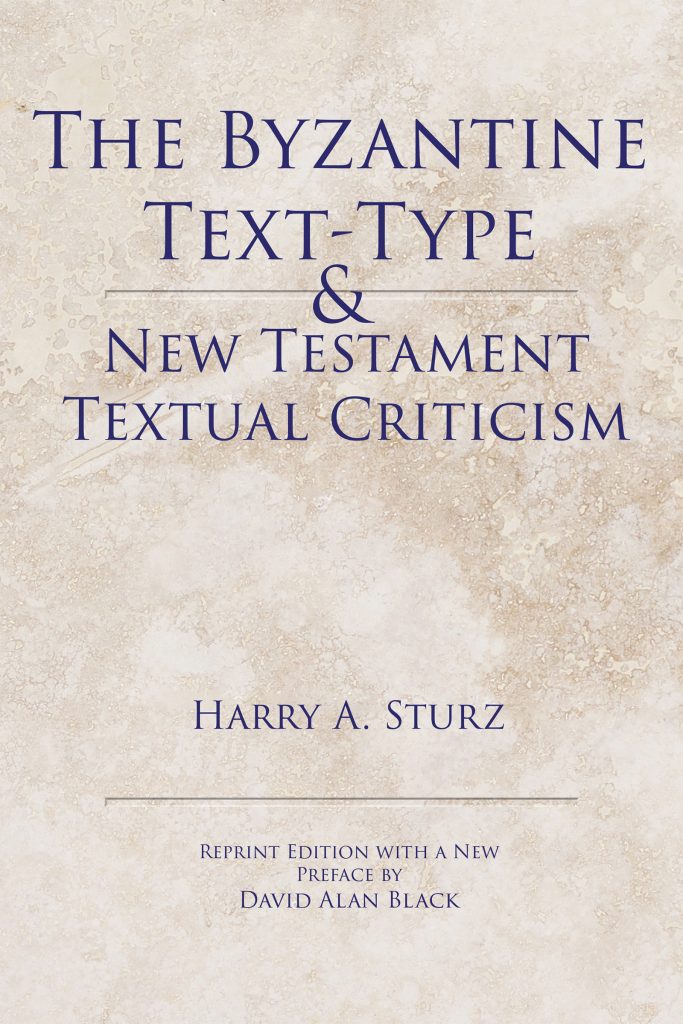
PS: My company has just released a reprint of a work from the 1970s, The Byzantine Text & New Testament Textual Criticism. As I was reading this, I was thinking how much easier it would be to research the kind of information used with current digitized manuscripts.
I wrote this essay some time ago. I’m strongly in favor of caring for our long-term church members, those who keep the church going through thick and thin, and have been doing so for a long time.
But as a member of the long-enduring group, I advocate every effort being made for the next generation, physically and spiritually.
In my business role as president of Energion Publications, I’ve just cleared the proofs for the release of the book The Byzantine Text-Type & New Testament Textual Criticism by Dr. Harry Sturz. This is a reproduction of the original book, released in 1984 and is produced under license from HarperCollins Christian Books.
Note: This discussion is not intended for experts, but for people who have only occasional contact with New Testament textual criticism. While I have studied textual criticism, I am not a specialist in it by any stretch of the imagination.
We have thousands of manuscripts of all (a few) or part (many) of the New Testament. In preparing a Bible translation, translators must make choices of which manuscript readings they are going to use.
It’s easy to overestimate the problem here, because significant and/or doubtful variations form a very small part of the New Testament text. Nonetheless, in public discussions, the variants get all the press, because we like to find things that are different, and therefore more interesting.
One thing I learned early in studying textual criticism was that manuscripts should be weighed, rather than counted. What does this mean and how does it work? Well, in general textual critics divided manuscripts into three large groups, which were named for regions associated with them, though actually divided by characteristics of the text. We had the Western text, associated with Rome and parts west, the Alexandrian, associated with Alexandria, Egypt, and the Byzantine text, associated with the eastern church.
The vast majority of surviving manuscripts are of the Byzantine text-type, largely due to history. The church survived much longer, and many more copies were made in the east. In addition, a great deal of manuscript production in the west was in Latin. I’m brushing past a number of factors, but the bottom line is that there were more Byzantine manuscripts.
In the 19th century, and somewhat into the 20th, there were a large number of manuscript discoveries, or rediscoveries, which produced texts that differed from the common texts found in the majority of the manuscripts. These newly-found manuscripts were older, in general, than the existing manuscripts, and in many cases included readings that scholars thought were more likely original. This produced a strong swing in scholarly work toward the text in these newly discovered manuscripts. The Alexandrian text got a lot of attention, with the western text following not far behind. A theory developed that the Byzantine text was the result of a major editorial effort, that produced a single, new text.
As a result, two things happened. First, the Byzantine text was considered generally more recent than those newly discovered manuscripts, and second that it was likely to have readings that were essential 4th/5th-century revisions. At most, it could reflect essentially one manuscript.
Opposed to this general consensus, on which the text of most modern Bible versions has been based, was the view that the reason we had more Byzantine manuscripts was that the text was actually better preserved there, so that it should be preferred, and manuscripts from the other text-types should be considered some sort of aberration.
Dr. Sturz argued that the Byzantine text-type could and did preserve older readings. It was not to be preferred over all others, but its readings should be given due consideration in all cases. He provided evidence that many Byzantine readings show up in early papyri, showing either that if there was any unifying editorial process, it had not been one that erased all of the prior evidence.
The general result of accepting Dr. Sturz’s argument is to improve the evidence that we have for determining the text of the New Testament, as well as change the weight we give to various sources.
I am glad to be able to release this important book and make it available at a reasonably price again. On the Energion Publications retail site, it will be available for $22.99 (suggested retail 24.99) through Wednesday, which is the official release date.
Below is an interview I conducted with Dr. David Alan Black (who wrote the preface to the new edition) and Dr. Abidan Shah.
In Alice in Wonderland, the queen says that sometimes she has believed six impossible things before breakfast. A fair number of years ago, someone told me that in response to points of my Christian faith. The aim was most likely to shock or offend me.
How did I respond? I don’t recall what I said. It wasn’t terribly memorable. But I do know what I thought. Yes, indeed, I do believe a number of impossible things before breakfast, not to mention after breakfast as well. I have never understood the desire to make so many of the very difficult aspects of the Christian faith as rational as possible. If God can be explained rationally within the incredibly tiny sphere of my personal knowledge, there’s really no point. That’s a mini-god.
Now I don’t mean here that all aspects of religious faith are irrational. There are things I believe that can be rationally explained. Various arguments for the existence of God can, for example, open up a crack through which some light may shine. The arguments of a historian may create a place in which a virgin birth, or a resurrection might just be hinted at as an explanation for so many things.
But I believe in a God who created the universe. I was thinking the other day while I gazed at a picture of galaxies seen from the Hubble Telescope in a part of space that looked empty to the naked eye. The space was filled. Now it’s not entirely impossible to suggest that this was created by someone or something. But when you add to that the idea that the entire universe was created by Someone who actually cares about anything that happens to me, you are proposing something patently impossible. If you claim it is possible, other than in one’s imagination, I suspect you of not really comprehending just how far that is out of the boundaries of comprehension.
As we come up to Easter, we will commemorate a God who became flesh, lived here, and ultimately permitted himself to be tortured and killed. I believe that happened. If you try to reply to that problem with the doctrine of the trinity, let me note that you have responded to an apparent physical impossibility with a logical impossibility, the idea that one person can really be three, and three can be one.
Yet I believe all of those things. I have disappointed not a few people when I decline to try to make all these beliefs rational. The incarnation (a person being 100% God [whatever we mean by that] and 100% human at the same time) is both a logical and, should we be able to figure out what would be involved, would doubtless also be a physical impossibility.
People who believe all these things can certainly also believe in a great number of truly rational and reasonable things. I believe in the laws of nature and live my life largely in accordance with them. (Some of that health stuff is overcome by my general desire to enjoy life!) I find often that I agree to a large extent with those who do not believe in God on matters of ethics, politics, and as far as it applies to daily life, rational interaction with the universe.
But I still believe that God, one capable of creating all those galaxies, well past my imagination already in the physical universe, also, as one member of the trinity (three in one!) became flesh (100% divine and 100% human), died, and rose again from the dead.
I agree, and add the fact that in most cases when I’ve heard Greek referenced from the pulpit it is referenced incorrectly. Use your Greek or Hebrew to enhance your own study, but bring it to the people in their language.
I confess that I usually do use a Greek word (one, unless it’s in a language context), because people expect it of someone whose degrees are in biblical languages and not in theology. But I introduce it with a caveat, and tell people why I’m doing it.
Then again, I’m usually teaching small groups and only rarely preaching.