… a God without wrath does not plan to do much liberating. Indeed, that God’s anger is kindled when harm is done to the least among us not only gives us hope that earthly injustices don’t have the last word but also insight into God’s compassionate nature.
“The established church is far more dangerous to Christianity than any heresy or schism. We play at Christianity. We use all the orthodox Christian terminology — but everything, everything withour character …. There is something frightful in the fact that the most dangerous thing of all, playing at Christianity, is never included in the list of heresies or schisms” .
This review is of a Bible I received as a #BibleGatewayPartner.
When I set out to review a Bible, I find it difficult to determine precisely what I should discuss. There is the translation it is based on, the nature and extent of the notes, the theological positions that drive those notes, and elements of the edition such as text size, arrangement, and paper quality.
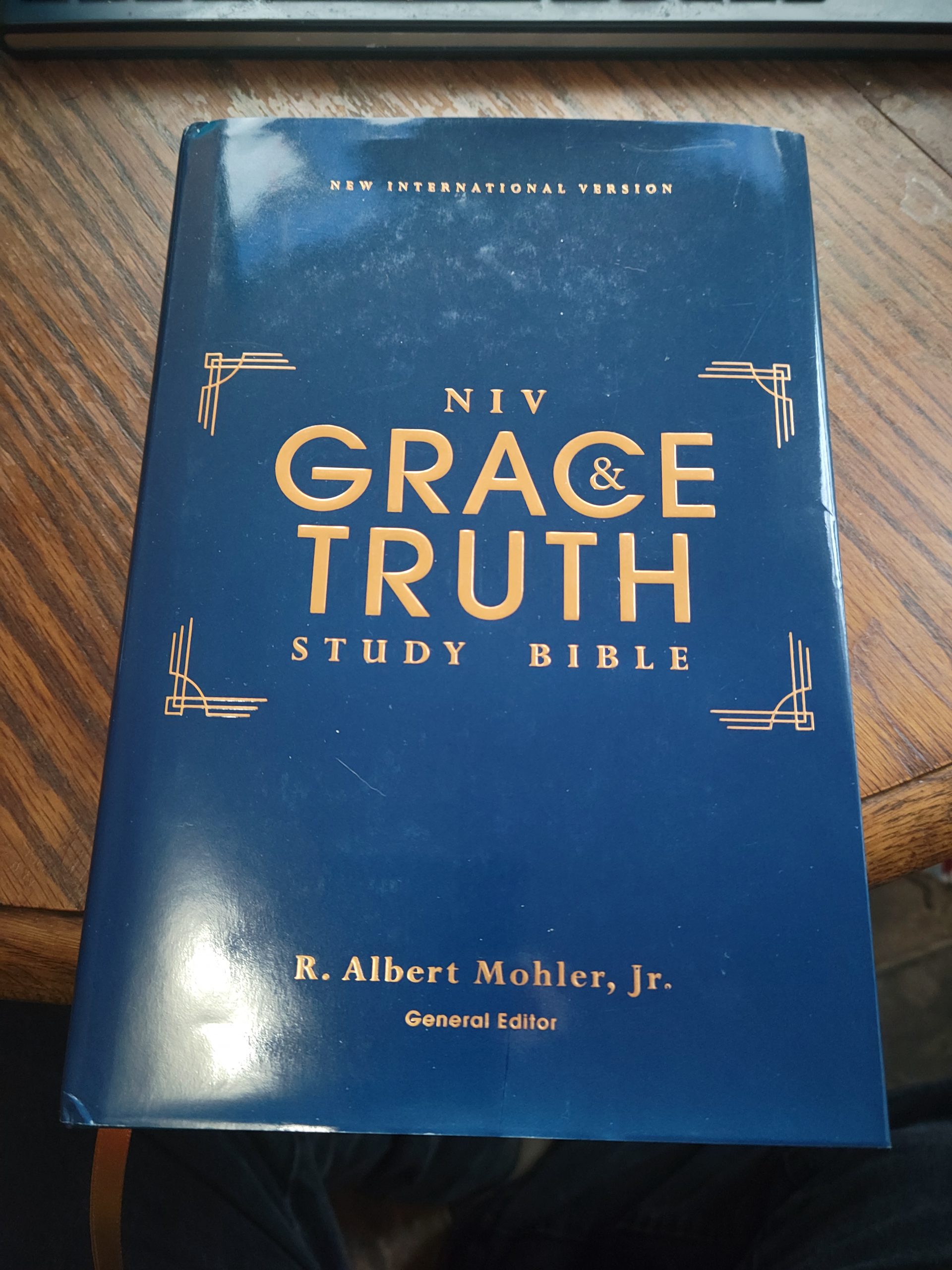
In approaching the Grace & Truth Study Bible, edited by R. Albert Mohler and published by Zondervan, the question became even more interesting when I added it to my Bible store, and found that my distributor has 17 editions/formats available, ranging in price from $39.99 (unjacketed hardcover) to $279.99 (Premium Goatskin, gilded edges). The edition I’m reviewing is priced at $49.99, and is a jacketed hardcover.
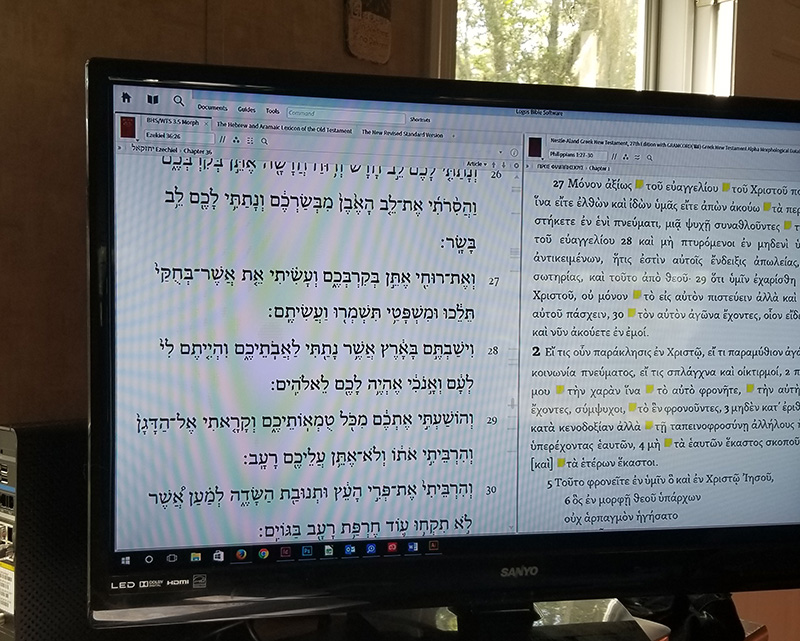
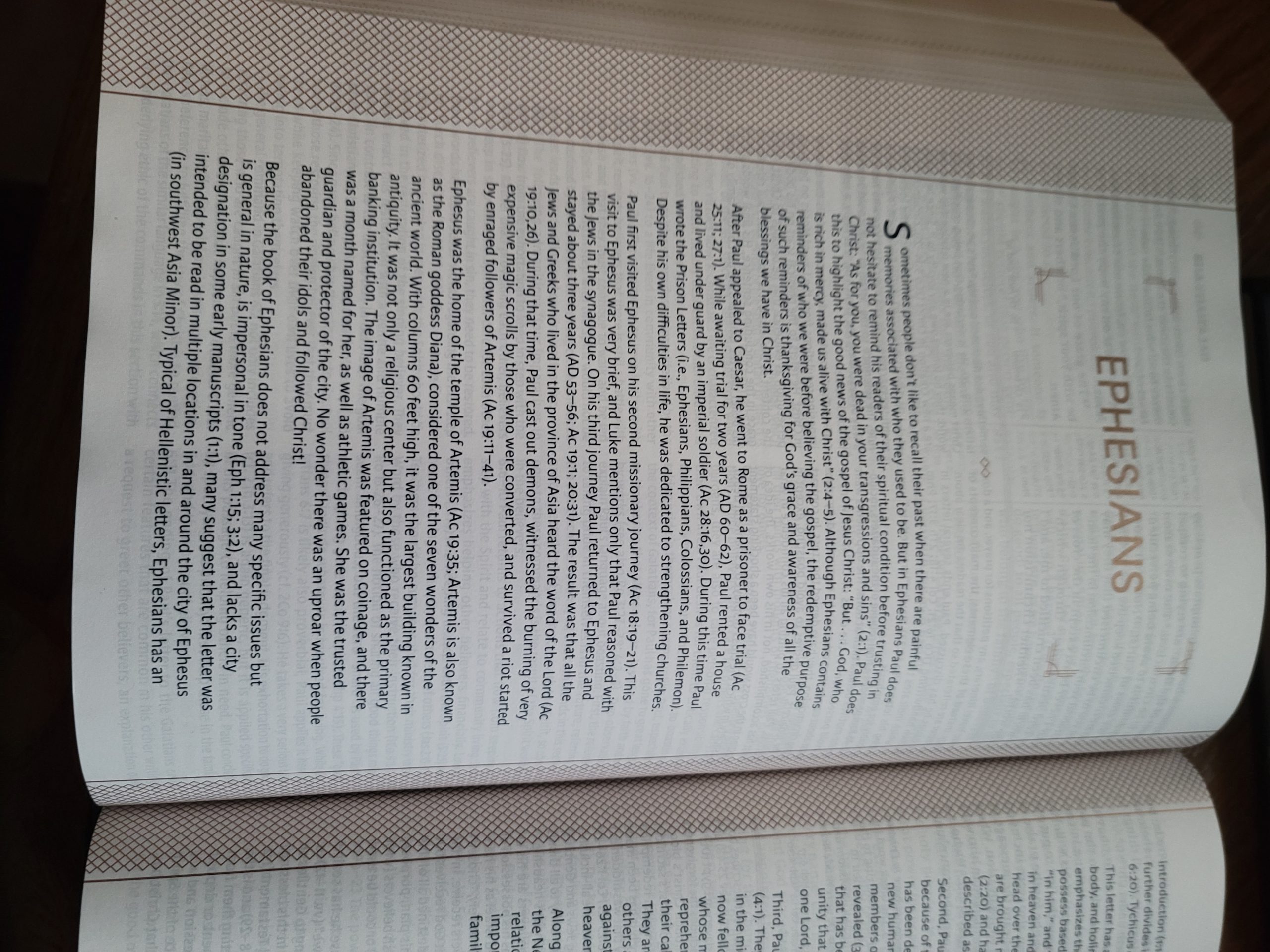
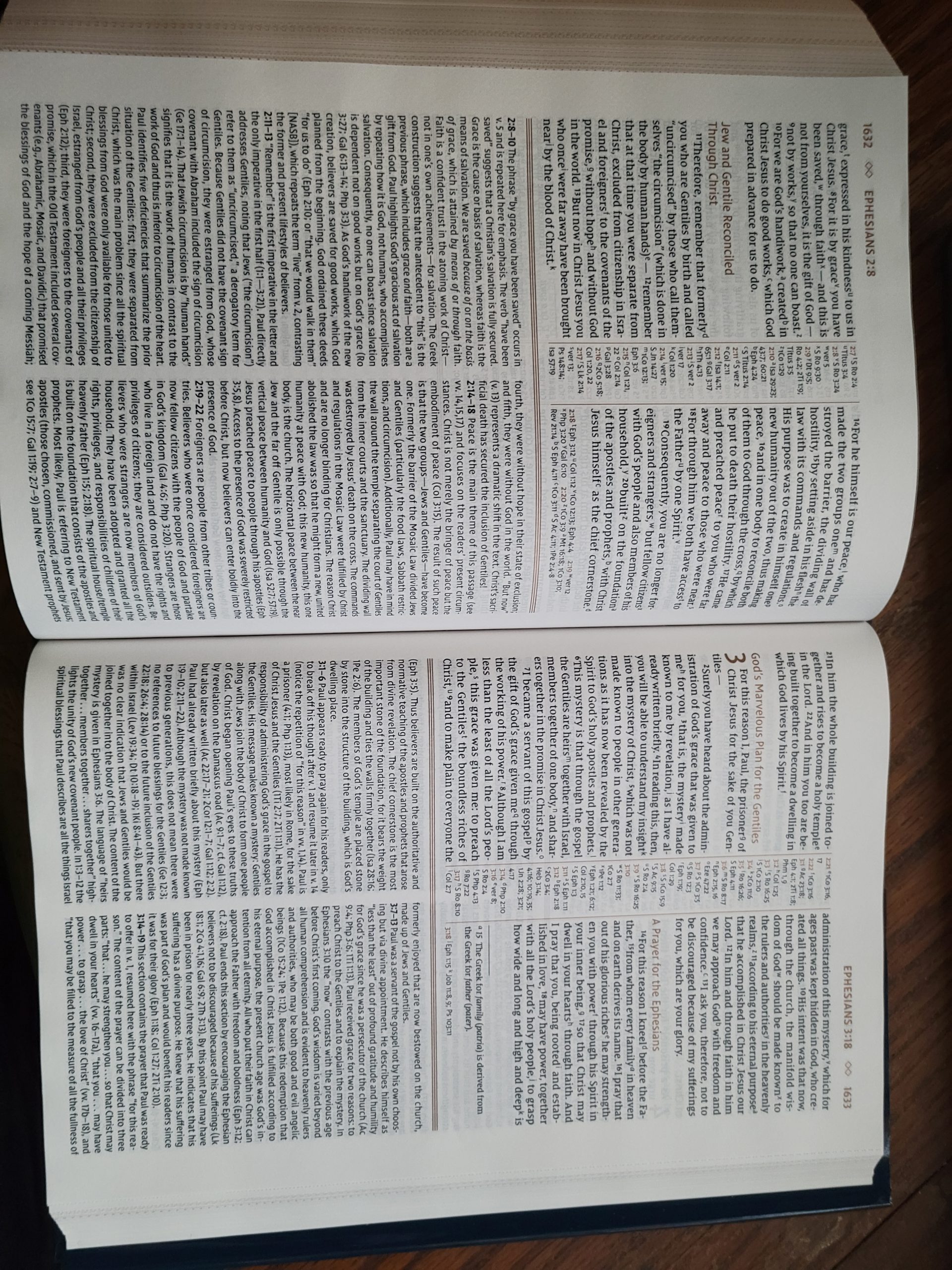
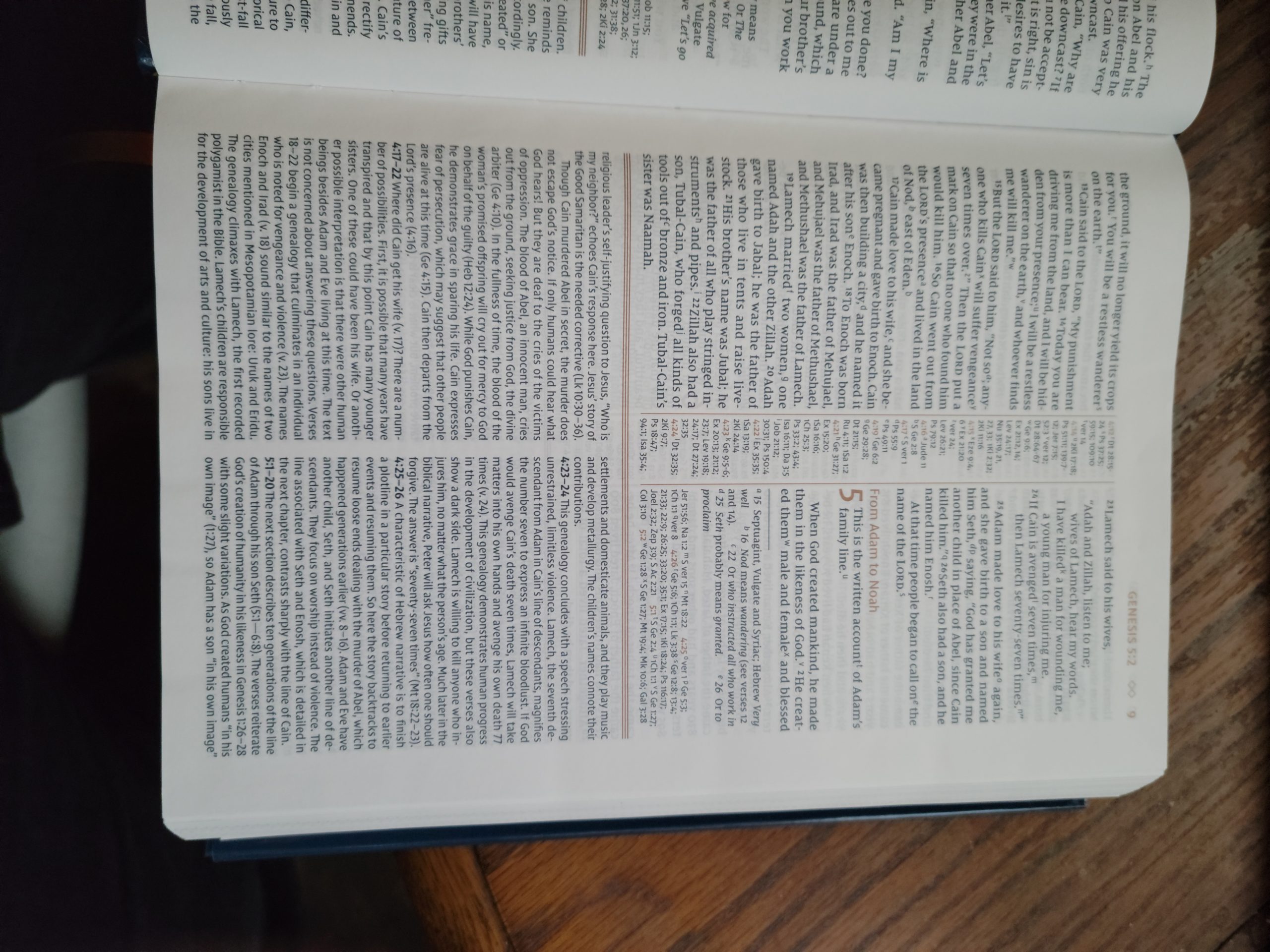
I’ll begin with a few pictures.
Front CoverIntroduction to EphesiansA Spread from EphesiansA Page from GenesisA few pictures of the Grace & Truth Study Bible
Edition / Format
The production is of good quality, as you would expect from a Zondervan product. The layout is quite traditional for a study Bible. You have an introduction to each book, notes at the bottom of each page (allowing me to continue to remind classes to read from the upper part!), and cross-references in the center of the Bible text. In the back you’ll find a concordance and some fairly standard Bible maps.
Other editions have some variations on this, such as different page sizes, binding, and paper.
Overall, there is nothing to criticize about the layout, and in fact, I kind of like the straightforward approach. We don’t have numerous “features” added that really tend to detract from study. There is a text, and there is a commentary, one study Bible! I think few modern readers make great use of cross-references, but it is nice to have them.
The big weakness of this particular edition is the 9 pt font. I found it hard to read extended portions of the text. I’m just five years short of three-score and ten, and thus my eyes may not be quite as good as those of some readers, but I read extensively and rapidly, and reading this Bible feels like work.
It’s important to note, however, that several of the editions do have larger print than the one I’m reading, so one can look at the page and font size and choose a better compromise along those lines.
Content
The translation used is the New International Version. My general comment on this edition is simply that it is a compromise between woodenly literal and freely interpretive dynamic translation work. This means it suffers from the problems of both formal and dynamic equivalence, but it also shares in the benefits. There is no such thing as a perfect translation, and the NIV covers a great deal of ground. It is definitely evangelical in flavor and thus it is not surprising for it to be the basis of this study Bible, considering the general editor. You can find brief comments on the NIV at My Bible Version or in my book What’s in a Version?
First, let me note that I do not intend to criticize this study Bible for differences in theology. Dr. Mohler is a Southern Baptist and I’m United Methodist. The header of this blog proclaims me a “passionate moderate, liberal charismatic,” and while each word of that description brings up issues when applied to my theology, it does not suggest that I’m a conservative evangelical. A book edited by a conservative evangelical is one I expect to be, well, conservative and evangelical. And this book is that.
I strongly recommend that Bible students have on hand study Bibles that disagree with them as well as ones that are from their own theological tradition. I have gotten valuable insights by comparing the comments in various study Bibles.
The commentary is not dedicated to railing against theological opponents. I would describe most comments as gently conservative, but often not putting controversial issues front and center. For example, in the introduction to Genesis there is a comment about treating this not as a scientific or historical account, but understanding it as theology and even as a work of art. I know of people all across the spectrum who would find the literary description of Genesis as quite acceptable. Conservative evangelical interpretations are espoused in the notes as one would expect.
Another example is Romans 1, which is a frequent citation in arguments about homosexuality. The notes do, in fact, express a conservative view, but it correctly (in my view) see the primary point of the passage in idolatry, and it places idolatry at the foundation of human sin.
Book introductions don’t spend a great deal of time on issues of dating and authorship and don’t enter into controversies on these issues, but do assume a relatively conservative chronology regarding the writing of the text. For example, you could read the introductions to each of the gospels and miss any issues of authorship and dependency between the various writers.
The strength of the notes is that they are a nice blend of theological and devotional. Some study Bibles emphasize giving you technical and background details that you might not know. While you will get some of that from this Bible, the devotional value appears to be primary. I would say that this is a sort of theology that is readable by the average Sunday School class. It is not seminary material. It doesn’t give you a list of options for various issues, but basically preaches its way through.
Overall
Overall, I found nothing surprising here. The Bible was very much as I imagined it would be when I first looked over the descriptions involved. I personally wouldn’t recommend it as your sole study Bible. There is a strong possibility of absorbing relatively controversial conclusions without being alerted to the possibility of disagreement. That can be nice for morning devotions, but not as your sole opportunity to study.
I do think it would be valuable as one study Bible out of a set that one uses to study. The other study Bible should be from different tradition streams, and also with a different emphasis. There are a number of evangelical study Bibles that do more analysis of the issues, for example. That may be less devotional, but if you want a balanced perspective, it’s good to know what other views exist.
Note: I received this copy of the Grace & Truth Study Bible as a #BibleGatewayPartner, with the only requirement being an honest review.
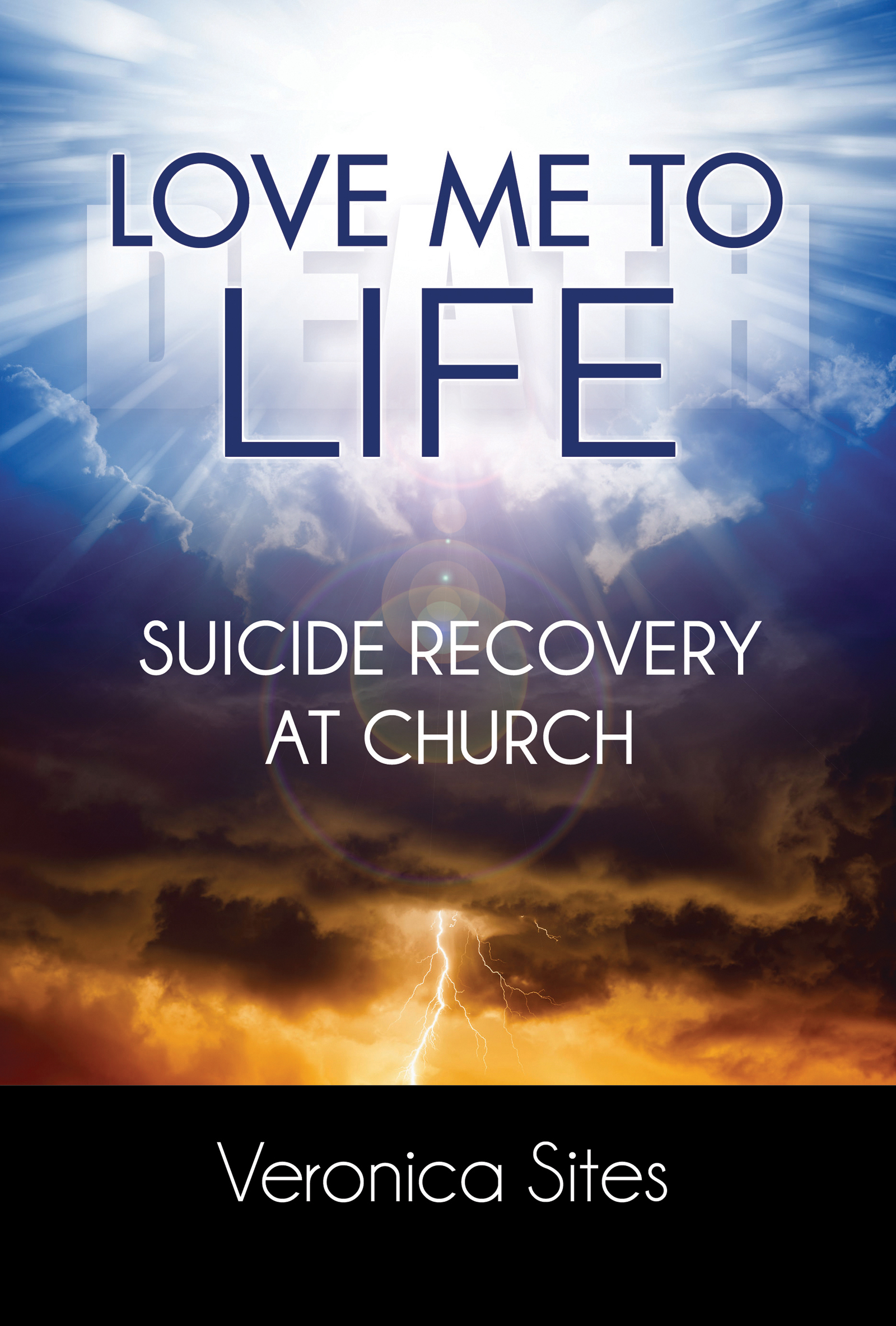
This video is my interview with Dr. Veronica Sites, author of the newly released book Love Me to Life: Suicide Recovery at Church. I was particularly pleased both to publish this book and to do this interview because suicide is often ignored or swept under the rug in the church. This results in harm to just about everyone, those who contemplate suicide, those who survive it, family, and friends.
Veronica takes this issue head-on and discusses it seriously. There are many practical points in the interview, pointing to even more practical materials in the book. I think any pastor or church leader would benefit from a serious study of this. Don’t be caught off guard!
Do you know where you can refer someone who is contemplating suicide? Do you know how to listen? Are you going to add condemnation to the burdens that person is already bearing?
Love Me to Life will help you respond faithfully and positively to those who are very much in need.
I am the interviewer for this video, and am talking with two very good friends, Alden Thompson, who was my undergraduate advisor, and Elgin Hushbeck, Jr., a friend since the mid-1990s when we met on the old CompuServer Religion Forum. Both have since spoken at conferences which I’ve organized.
The purpose of this video was not to settle the issue of inerrancy, which is unlikely to occur, but instead to discuss how each of these scholars use their view of inspiration as they interpret scripture. One interesting result is that while the emphasis is different, much of what they’d say about scripture is very similar.
Neither would be accurately described as either liberal or progressive. This is a discussion between two conservatives, both of whom have a high view of scripture (they discuss what this means), regarding one potential dividing point.
My brother, Dr. Robert Neufeld, preserved a recording of our father preaching, something he did not do all that often. Dr. Raymond D. Neufeld spent his life in service as a doctor. He didn’t talk about it a great deal. He just kept doing what he believed was right.
In this recording, the final 2 minutes and a bit were lost, and my father re-recorded it at my brother’s request.
I hope you enjoy and are blessed. The presentation is titled “The Healing Hands of Jesus.”
My mother was an RN and served with my father in various places. You can learn more about their experiences in the book Directed Paths.
When I’m having a discussion of something about which I have some expertise, say biblical languages, it’s quite easy to get impressed with myself. After all, unlike the “average person” (actually, I don’t believe in average people, hence, the quotes, but that’s another subject*), If I am in doubt of a translation in scripture, or simply hear another person talk about a Greek or Hebrew word, I can actually go check. I may even know of various places that word is used.
*(I hate excessively long parenthetical remarks, don’t you?)
Fortunately for my swollen head, there is a remedy to this. I can go to a seminary campus, or join a group dedicated to biblical languages, where one often finds people who earn their living teaching or researching, and I’ll be put in my place fairly quickly. How? Because in that atmosphere people question my conclusions. I may not change them, but I have to think about them and about alternatives.
As salutary as reducing the size of my head might be, that is not the most important benefit. (Your mileage may vary.) The most important benefit is that it helps me not to get stuck on pet conclusions. I hear about potential difficulties with my conclusions from people who think differently, who know facts I may have missed, or who may just have ordered and prioritized data differently.
My think is challenged.
By responding positively to such a challenge, I may be able to improve my thinking, and (gasp) change my mind!
But here are some things to avoid:
Getting offended. There is such a thing as offensive speech, but much of what is called offensive is simply something presented from a different perspective, which I’d rather not hear. Offense blocks learning.
Doubling down. When presented with a contrary opinion, I need to examine the evidence and the logic and see if I need to change my mind. If not, no problem. Doubling down is a technique to emphasize my superior rightness over someone else.
Dismissing. It doesn’t hurt to think about what someone else has said. It doesn’t hurt to tell the other person you’ll think about it. I don’t know about you, but I don’t have time for every argument. What I can do is listen and then keep the ideas in mind over time.
Equalizing. There are many things on which opinions are just fine, and it’s OK to say, “To each his or her own.” But on many topics, the different viewpoints are in no way equal.
Despising. It’s easy to dismiss the other person because you already despised them. It’s also easy to despise them because of their opinion. Despising let’s you out of considering the opinions of such a worthless person. You are the only one to lose.
Labeling. It’s easy to call someone a name, or group them with people you already reject. In politics we can call the other guy “just a Democrat” or “just a Republican” or whatever party labels apply in your country. We can also call someone a socialist or a capitalist (whichever is negative in our mind) in order to dismiss a particular idea. It’s not that labels are bad. Rather, all of language involves labeling in some way. The thing is that labeling needs to be accurate, and not dismissive.
I think the goal should be to be able to have strong opinions without despising the people who disagree. That’s not easy. The tendency is to either have strong opinions on something and dismiss your opponents, or to try to equalize all opinions. Either one can deprive you of valuable, constructive, necessary dialog.
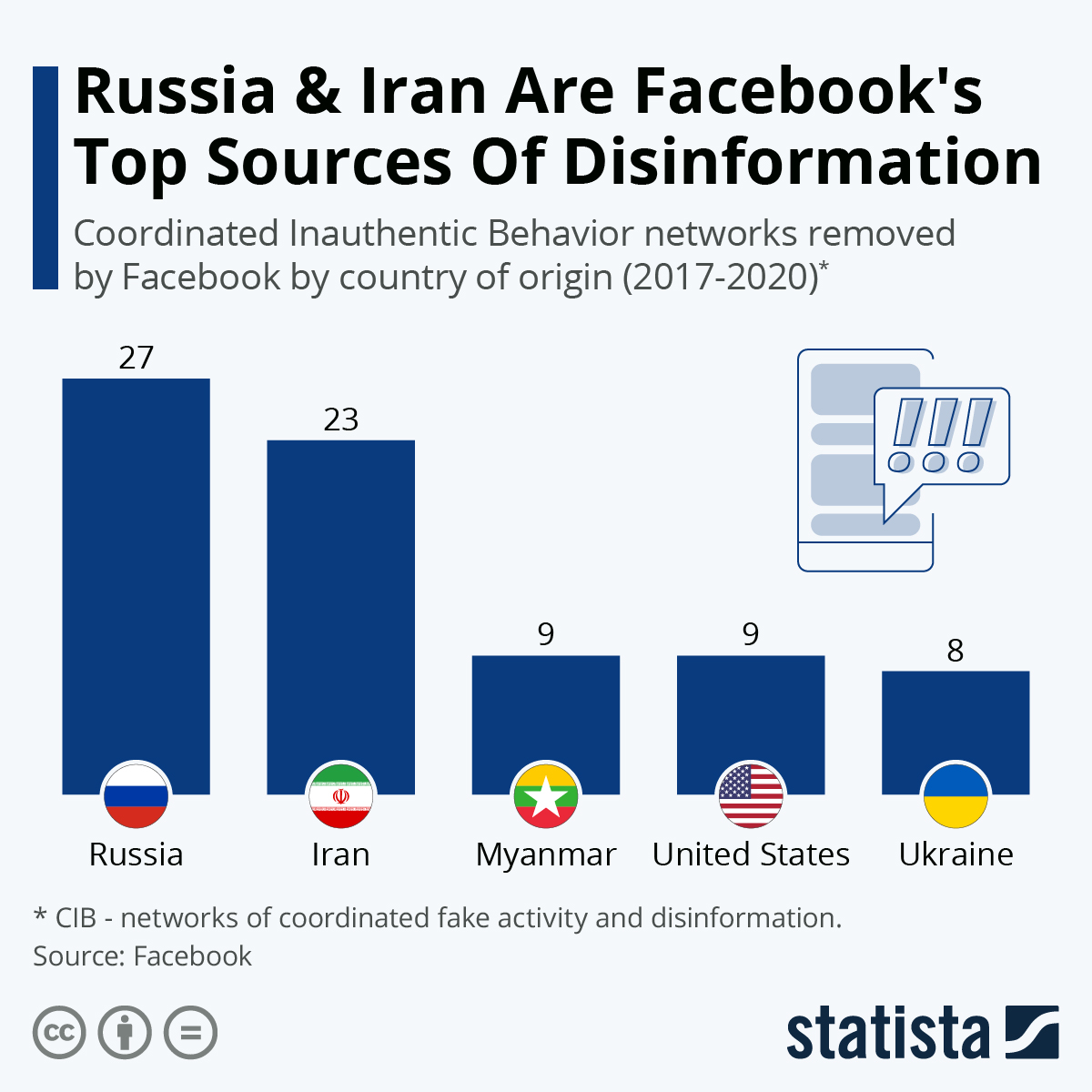
The chart below is produced by Statista, and gives a visual of where disinformation originates on Facebook. It is built on Facebook data. You can read more about it here.
It is worth noting where these attacks come from, with Iran just a little bit behind Russia.
My brother, Robert Neufeld, amateur radio operator N3AU, who also has pretty much every commercial radio license and is a lifetime electronics hobbyist, is going to host a zoom technical discussion each Thursday night at 8 pm eastern time. He plans to have it run around an hour +/- depending on what questions people have.
You can email him at rjneufeldmd@gmail.com if you’d like information about the meeting. The first session is tonight, March 25, 2021.