It’s definitely worth reading Our Radicalized Republic from FiveThirtyEight.com. Lots of data to consider even if you disagree with some of the analysis.
Author: henry
-

Who Was Paul? – Interview with Timothy Dwyer
For those eagerly waiting for me to continue my perspectives on Paul (and everyone else!), here’s my latest “Who Was Paul?” interview, this time with Dr. Timothy Dwyer, author of the book The Gospel in Colossians.
The guy with the stupid smile is me. Dr. Dwyer looks much more sane!
-

Love Is All You Need
Starting on Martin Luther King’s birthday, we have seen a number of quotes advocating love. I intended to post something that day, but as I frequently do I got diverted.
I wrote something about this long ago. It’s unfortunate that love has become a sort of cliche for a benevolent feeling combined with inaction. We can post comments about love and unity, and then go on doing what we were going to do anyhow.
I wrote about this back in 2006 in a post titled On Being a Love Preacher. I still am.
But love isn’t easy. I fail at it on a daily basis. That’s why I’m also a grace preacher. Grace deals with our failure to love.
The next error follows quickly after. Grace is not an alternative to sanctification. It isn’t a way to get out of being transformed. It’s not grace vs holiness. Rather, grace is the one means by which sanctification can happen. Wesleyans call it “sanctifying grace.” But all too often we pretend that sanctifying grace is something other than grace. It’s nice to have all those labels for grace applied in different ways at different times. But we can also forget that some of them are grace.
Sanctification is God working in you. It begins with God’s love and spreads through you. It is very active. It is not easy, any more than love is.
I hope that we don’t just comfort ourselves with quotes about love in action, but rather begin to see others through God’s work in us. Recognizing our limitations and failures and the way God has worked with us, we let grace sanctify the way we see our neighbors.
In the incarnation, God crossed the greatest gap possible, from the infinite to the finite, indeed miniscule on the scale of the finite. Your differences with your neighbor cover much less ground than God already covered.
The same gap crossing God can work in me, and in you.
-

And Yet Another Week
I’m delaying the restart of my studies on Paul for another week. This week was not conducive to getting ready.
I will be starting by applying the study of the law that I presented before thanksgiving to Galatians 2 & 3, particularly chapter 3. How should we understand law as we read these chapters.
I will be making the presentation live on Facebook on the Henry and Jody Neufeld page and simultaneously streaming it to the Energion Publications Facebook page. I will continue to post the video and the PowerPoint to this blog.
I apologize for twice delaying the restart.
-
No Study Tonight (01-14-21)
There will be no study tonight. I will resume on 01/21/21 instead. I will be posting a new interview in the “Who Was Paul?” series tomorrow and will link it here.
-
As Everyone Trades Scripts – Again
Immediately after the last election I wrote this. Please read it before you read this.
I want to reiterate it today. I have meant it sincerely following every election in which I have been a voter, and I registered to vote at the first opportunity.
Speaking with respect is not agreement. It is a way to maximize the range of dialog. I believe deeply in the value of dialog, even with people who I may believe have not earned respect. Those in the military learn how to show respect to someone they may not respect because of that person’s rank and position. That could be a valuable lesson.
Especially with people who have not earned respect.
-

I’m Taking a COVID-19 Vaccine
Back in 2016, I was interviewing my mom about her experiences as a nurse. At the time she was 98 years old. She lived to one month short of her 100th birthday.
She had the opportunity to watch as many of the vaccines we use today were introduced. There were many moments of passion, but one of the strongest was when she discussed vaccines.
“Can these people imagine what it was like before these vaccines were introduced?” she asked. “I can’t imagine that anyone would like to go back to what we had before.”
I have a simple point here. Experts make mistakes. Indeed they do. Medical opinions can be wrong. Just so!
But those mistakes and missteps are nothing like the arrogant ignorance of the non-experts.
I get to observe this with people who are ignorant on subjects in which I have some expertise. Jody says she avoids meeting my eyes when a preacher is using Greek or Hebrew in a sermon, because she knows how frequently I will have a fixed expression on my face, trying to avoid revealing what I’m thinking about what is said.
I have read and studied about vaccines, and I’m convinced my mother, and so many other experts, are right. But my conviction isn’t the issue. I’m so very not-an-expert. What I am doing is relying on those people who are.
When I get the vaccine (2nd dose as applicable), and the appropriate time has passed so that I can reasonably expect immunity, I will continue to wear my mask and social distance until we have a level of vaccination that I can expect the persons I come in contact with will not be threatened. Again, I will do this because the best expert opinions say it is likely possible to spread the virus. I see this not as an infringement on my rights, but as my Christian duty.
I could, of course, be wrong. But experience and mountains of data suggest that the best option is to follow the consensus opinion of those with the appropriate expertise.
And on a humorous note, no, I do not include Facebook posts that start out “I am a doctor” or even “I am an epidemiologist.” I have no way to verify that the person making that claim is actually what they claim. But more critically, that single opinion is not the consensus of the experts.
Image by Michal Jarmoluk from Pixabay
-

The Value of Fact-Checkers
In their aim to express their anger at many things, sometimes even justified anger, people often rail at the MSM fact-checkers. Just using the MSM tag is an epithet indicating a lack of trust. On social media, especially Facebook, this anger goes against the efforts the company is making to correct false information.
As an aside, fact-checking done by the media is not the same thing as government censorship. The refusal of a media company to espouse or even publish your view is not the same thing as government censorship. In fact, challenging the truthfulness of things said by government agencies or political figures is a service done by the media for us. It is a service even if, after careful review, we decide that the media agency doing the fact-checking was wrong themselves. If you don’t like the platform, go somewhere else.
I have found that fact-checking organizations are a great resource, not because of their ratings, but because of the research they do. Most of them provide references for the information they used in checking that data.
Take, for example, a meme that has been posted repeatedly on Facebook claiming that there are just 133,000,000 registered voters in the United States, and thus that there were more votes, by millions, cast in the 2020 election than registered voters. I haven’t taken time to find out where one might have gotten that 133,000,000 figure. For all I know, someone made it up. But using the World Population Review site, and the page Number of Registered Voters by State 2020, and then putting the state by state data in a spreadsheet and adding it up, I find that the number of registered voters is 213,799,467, a number that makes the meme look rather silly. It also has the advantage of agreeing generally with the total population and the estimated number of eligible voters. The eligible voter population will be less than the population, of course, and in turn, not all eligible voters register.
You may think that took me too much time, though it really took very little, and before I’d take my stand on a set of values, I’d do even more research, but that little bit of work makes it pretty clear that the meme is not even in the range for consideration. It’s garbage.
I have repeatedly found this level of information in fact-checking posts, along with the information necessary to back-track and verify the work of the fact-checkers. When I disagree with fact-checkers, it is much more common that I disagree with their rating of a statement or with their analysis of their data. The greatest value is in the data they provide.
Bluntly, if you can’t take the time to check that far, you really should quit posting memes.
We live in a world of information. I think the MSM earned our distrust. They were often not careful enough with their facts and their presentation. Unfortunately, we then turned to “balanced” presentations, and from that to whatever news source caught our fancy. Reality is rarely a balance between opposing positions. Sometimes one of the extremes are correct.
In addition, many turned to “news” organizations with even less fact-checking than the so-called MSM. You have no business, no matter what your political views are, in claiming “TRUTH” when all you did was glean information from a few unaccountable web sites that happen to agree with your position. If you do that, you’re part of the problem.
People are going to lie. Governments lie. Politicians lie. If you want to have any sort of claim to truth, you need to check, double-check, check again, discern, and then express what you know, or at least have a reasonable claim to know. If that prevents you from posting large numbers of your favorite and most comforting memes, that’s all to the good.
If you only read headlines, or respond to fact-checking after reading only the rating, you’re part of the problem.
-

My Hippopotamus for Christmas
Several years ago our friend, Erin McClellan, found out that I like the song, “I Want a Hippopotamus for Christmas.” Don’t push on the reasons. I just like it.
Since Erin has a well-developed sense of humor, she gave me a plastic hippo that Christmas. I was delighted. Jody and I are generally light on the decorations, but we like to have a manger scene in the house. That year, as I recall, it centered around a clay manger scene I had picked up for Jody in Costa Rica.
Jody immediately put my hippo in the manger scene.
Inevitably, questions arose. To switch to active voice, visitors asked questions. “Why is there a hippo in your manger scene?” Some commented: “I’m pretty sure there were no hippos there on the first Christmas.”
Jody also produced the answer: “Because here, everyone is welcome. Nobody is out of place.”
I’ve used that illustration in sermons multiple times, usually accompanied by the manger scene with a hippo.
We often miss some of the messages that come with God appearing in a stable. Yes, everyone is welcome, but it’s the proud and the powerful that are unlikely to come. It’s the onlookers who usually question the ones who are there.
And each year, Erin gives me another hippo.
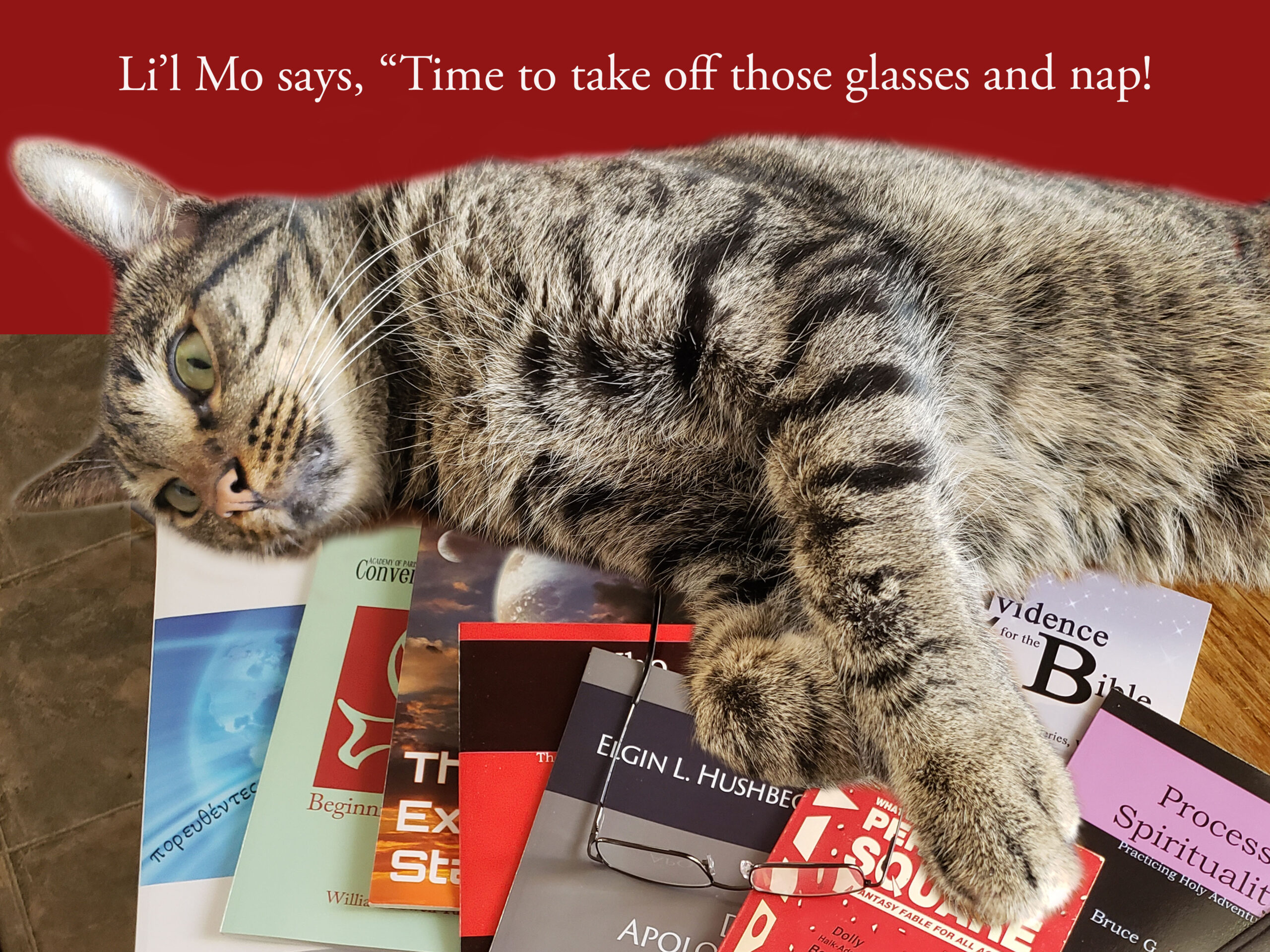
This year Erin brought me a ceramic hippo, and when I saw it my face lit up. We don’t have the manger scene, because Mo. Mo is our young cat. We have added a new word to our vocabulary — to Mo! Things that are Moed are no longer useful for their intended purpose. Mo is thorough. He loves little figures in a manger scene and removes them.
But in my mind the hippo has stood in for the manger scene. I can imagine it all around him. And as for Mo, he belongs too.
God is there with the lamb, the ox, the goat, and all the out-of-place hippos in the world. And with the young, rambunctious cats.

-

Numbers Need Context Too
“There are three kinds of lies: lies, damned lies, and statistics.” — Mark Twain
But I can paraphrase what supporters of gun rights say: Numbers don’t lie. People lie.
People use numbers to lie.
Sometimes it’s unconscious. I can say, “Most people believe X.” But that word “most” is imprecise, and sounds like I may not have studied the subject enough. So “Nine out of ten people believe X” sounds like I’ve studied the people and counted them.
I want to just post a few notes and recommend a couple of books.
- Many (notice that I haven’t counted them) misrepresentations involving statistics result from not noticing the margin of error when sampling is involved. Words like “surge” or “plummet” are used about polls in newspapers when the changes are within that margin of error. The context here is in understanding the precise nature of the numbers themselves. There’s a difference between “there are five books on my table” and “the average American will have five books on their bedside table.”
- Ask how the numbers were generated. If it was a survey, what was the question? In professional surveys, you can trace the numbers back to the survey. Reliable, ethical researchers show their work. For example, if you ask a number of people how many would kill their own mother for a million dollars, you don’t know how many actually would. You know how many say they would. The context here is the underlying basis for the numbers. It’s the difference between “I would guess that about 5 in 10 people do x”, or “I asked them”, or “I had a hidden camera on them and watched them.” All three methods generate numbers, but the meaning is different.
- Numbers don’t generate predictions on their own. They represent a state of affairs defined by the way they are collected and presented. The context of a numeric prediction can be complex. The prediction is only as valuable as the theory that generates it from the numbers, even if it is represented in numbers.
- Probability is a complex field. I enjoy reading about it. Numbers used to express probability are often difficult to follow and seem unintuitive. For those of us who are not mathematicians, a key point to notice is whether the person involved could actually have the necessary information. If you cannot model in detail an entire process, you don’t know the probability. Let me illustrate from Star Trek–the original series. Spock and Kirk are on Organia, and are unaware of the nature of the Organians. Kirk asks spock to rate their chances, and he gives a number including decimals. This number is irrelevant, because Spock doesn’t actually know what he would need to know.
- In number comparisons, the context of all numbers compared is important, as is their relationship. The data in a comparison is not so much in the numbers themselves but in the theory or theories used to connect them.
In my opinion, most (note how I say this) news articles and popular presentations that involved numbers misrepresent their meaning in some way. In most (note again!) that error is not that relevant to the readers. But in many unfortunate cases it is. If you count headlines, the misrepresentation is worse.
So when reading numbers, look for the source, check the context, understand the theory. The numbers may be correct, but the theory and presentation may make them deceptive.
Herewith a couple of books that are quite readable on this subject.
How to Lie with Statistics. This is an older book, but provides the basics in a readable format.
Lies, Damn Lies, and Statistics. I found this more politically slanted, but the principles expressed are quite good, in my opinion. The bias I noted was in the examples. Note that I did not statistically check my impression of bias!
Statistics: A Spectator Sport. I haven’t read this book, but it’s on my reading list. The description notes that it uses examples largely from education. I suspect that could be valuable as it may be less controversial than using primarily political or media examples.