Threads from Henry's Web

Tag: Psalms

  • Psalm 119:4 – Tough!!

    Psalm 119:4 – Tough!!

    About your precepts you commanded,
    “Keep them diligently!”

    Sometimes things are tough. You wonder what’s coming next.

    I’m meditating on these passages one at a time. I read the passage in the morning, and then I write these in the evening. During the day, I keep coming back to that verse. In deciding to do 176 daily meditations (that’s how many verses there are in this Psalm), I knew that some would be more encouraging than others.

    This one is just tough. God says to do this diligently. Don’t just pretend. Don’t follow these precepts sometimes. Seventh percent is not a passing grade.

    I’m reminded of choosing a Sudoku puzzle. How spiritual is that? Well, I like to pick the hardest level in the app I use. Sometimes I’m tempted to do an easier one. If I give in to that temptation, I’m drawn to watch the time and try to complete it as rapidly as possible. Most of the time, however, I choose the hard one.

    Is the call of the toughest “right” living just as strong for me? Do I want to take the hard, but right path whenever possible?

    The bad news, which I notice even in a sparse verse such as this, is that I don’t get there. Not ever. I have a desire, but it’s often a fairly week desire. The good news is that God is working on me, and the fact that he has such high hopes is very encouraging.

    I think the Psalmist shares some of my feelings. But that’s the next verse!

    (The featured image was generated by Jetpack AI.)

  • Psalm 119:2 – The Blessing of Seeking

    Psalm 119:2 – The Blessing of Seeking

    Continuing with Psalm 119, which I began with Psalm 119:1 yesterday. There are some notes on this series there.

    Blessed are those who preserve [keep] his testimonies,
    who wholeheartedly seek him.

    In the translation I use “testimonies” as in the KJV, though there are a number of other possible translations. I’ll comment on these various words for “law” in Psalm 119, though I don’t think the author’s intention is to discuss different types of law and say different things about them. Rather, he is pointing us to the whole of God’s law in its various manifestations through the use of these various types of law.

    It’s interesting to compare two other passages that use the same word used here for “blessed.” One is Isaiah 30:18, which says those who wait on the Lord are happy/blessed. Deuteronomy 33:29 says Israel is blessed because the Lord is their shield.

    There is a blessing simply in being able to seek. The history of Israel at the time of the Exodus shows us a time when we are told the people don’t even know who to call on. Moses has to ask for the name he is to give when the people wonder who sent him.

    When the ten commandments are given at Mt. Sinai, they begin with the declaration, “I am YHWH your God, who brought you up out of the land of Egypt.”

    This verse points us to the blessing there is in simply being able to seek God. This seeking is a result of the call of God. Those testimonies (covenant provisions) are the result of God’s choosing and opening to you the opportunity to seek.

    What does seeking God with your whole heart mean for you today?

  • Psalm 119:1 – Living According to God’s Law

    Psalm 119:1 – Living According to God’s Law

    Introductory Note

    I’ve been meditating on Psalm 119 recently after a conversation with an author regarding a forthcoming book reminded me of it. I’m going to write a few short devotionals. I’m not sure how many I’ll write, but reading this Psalm does make me think.

    For any devotional on Psalm 119, please remember that I’m commenting on no more than a few verses at a time, and thus won’t cover all, or even a substantial number of related ideas. Also, please remember that this is poetry, not a theological essay, so even within the text of the Psalm, ideas are not completed in a systematic way.

    Psalm 119:1

    Blessed are those blameless in their living
    Who act according to God’s instructions.

    Now there’s a challenging verse. We all have ways of avoiding it. But I think it pursues us through all our escape routes.

    Our escape routes often start from something very good. That’s what makes them so tempting.

    1. As Christians, we look immediately to the grace of God, given through Jesus. This is a good thing. We realize that being blameless and having all our actions fall within the range of God’s instructions (Torah), is not something we’re going to accomplish, and we are driven to a gracious God who forgives. But we can use this to avoid the issue. “Because God is gracious, I can safely ignore this,” we think. We think the only reason God talks about good actions is to let us know we can’t make it. But the Psalmist, at least, is talking about doing, hoping to do, an mourning the failure to do.
    2. We can decide that a totally blameless life is, in fact what we’re going to do, on our own and in this life. This leads us astray in two ways. It can be horribly discouraging and end up in cynicism, inevitable failure, and self loathing. On the other hand, it can lead us to imagine ourselves successful even when we aren’t and an incredible spiritual pride that falsely assumes one is blameless.
    3. We can engage in trimming the text, so as to make “blameless” less daunting. We can’t reach the goal, so we move the goal closer, or we pretend the goal is closer. This can result in complacency and also to a trust in ourselves for our salvation. The problem with aiming low is that we generally manage to reach no higher than our aim.

    That’s my long way of getting to this: God has instructions that are worth our attention. Even in our limited ways of attempting to follow these instructions there is blessing, not just bringing us to Christ, as important as that is, but also simply as good ways to live.

    Torah, the word used here for “instruction” (your translation may read “law”), goes beyond giving us a list of rules. I’ll discuss the various rule/law/instruction words in Psalm 119 along with other verses. It also includes stories of heroes of the faith. They were blessed in following Gods law, but they were not generally “blameless.”

    One need go no further than the last version in this section. (Psalm 119 is divided into 22 sections of 8 verses each, in which each verse begins with the same letter of the Hebrew alphabet.) “I remember your edicts. Don’t abandon me completely!”

    The Torah referenced here is the story of how God never abandons, even those who do forget.


    Some Definitions of Law in Scripture

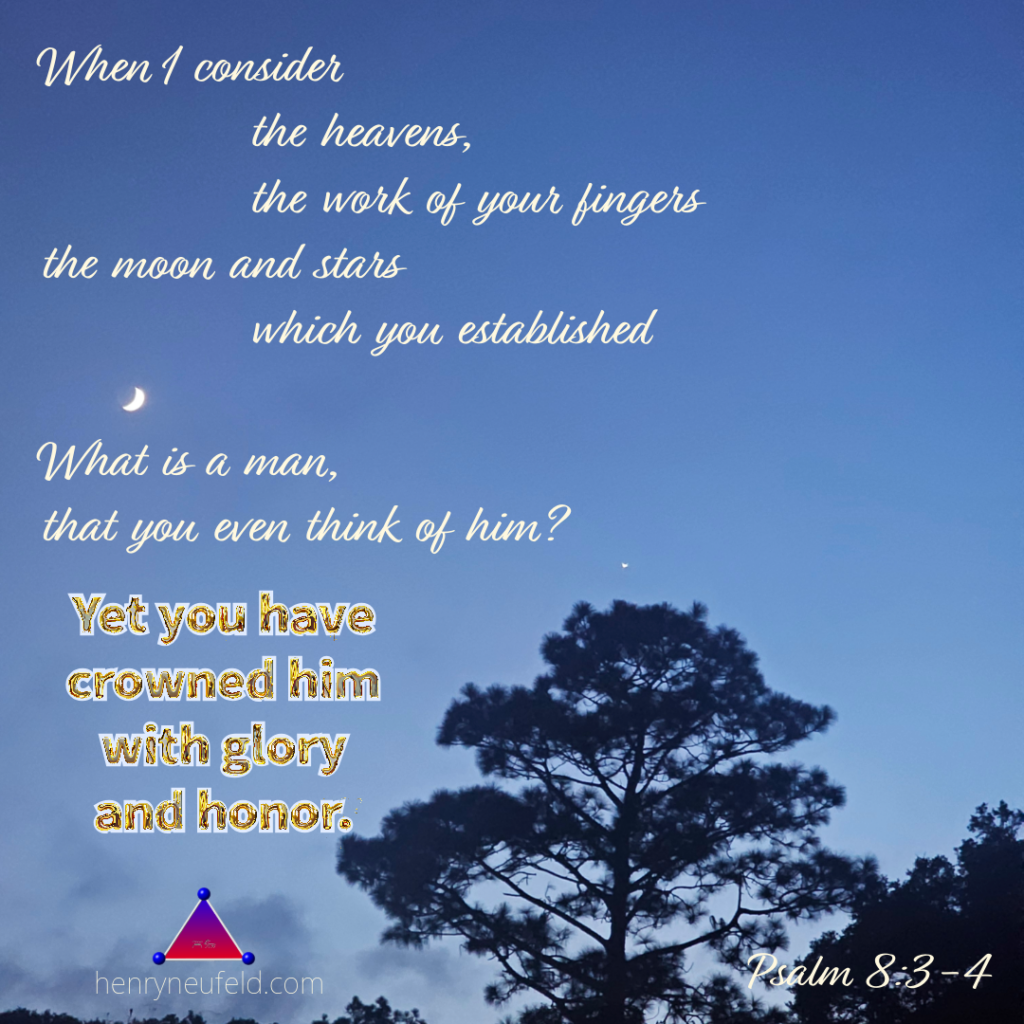
  • When I Consider Your Heavens

    When I Consider Your Heavens

    Psalm 8:3-4

    When I consider
    the heavens
    the work of your fingers

    the moon and stars
    which you established

    What is a man,
    that you even think of him?

    Yet you have crowned him with glory and honor.

    Psalm 8:3-4 (my translation)

    (Note: The theme image is generated by AI. I’m interested in how applicable the image is. The photo in the post is one I took with my Samsung Galaxy S23+.)

  • Perspectives on Paul for 10-07-20

    Perspectives on Paul for 10-07-20

    Presentation Video:

    Power Point:

    PDF:

    https://henrysthreads.com/wp-content/uploads/2020/10/100720.pdf

    Remember: Resources for Studying Paul

  • Music and the Hebrew Text (Hangout Interview)

    I commend to my readers my interview last night with Bob MacDonald regarding his newly released book The Song in the Night. I make some further remarks on the Energion Discussion Network.


  • Translating Poetry

    On March 24, 2016, blog entry marked 11:40 AM, Dave Black talks about translating poetry and links to his essay on the topic from a Festschrift, available via Google Docs.

    Reading Dave’s comments about translating poetry reminded me of one of my favorite translations of poetry from any language to any other, Max Knight’s translations of Christian Morgenstern’s German poetry. You can find samples here. I particularly like Der Lattenzaun/The Picket Fence, but Die Trichter/The Funnels, which Knight translates twice, provides another good example.

    Translation is a creative activity. When the material is very technical, the room available for creative activity, or better the necessity for it, may be lower, but it’s still there. Communication is not easy, no matter what one is trying to communicate, and when one is trying to communicate many things (and often a good writer is doing just that), the translation becomes more difficult.

    In the case of Bible translation, we multiply these problems because we are trying to translate a variety of literary genres across a gap of history and culture, which, in addition, either have or have acquired theological meanings that may relate to times before or after their composition. There’s a great deal of freight in the text and hanging onto it for dear life lest it be lost along the way.

    Into this perilous swamp comes the translator, trying to jump from one foothold to another, always hoping the foothold is not the back of a sunbathing alligator. (Try translating that murky metaphor for comprehension by a desert-dwelling tribe. I dare you!)

    But I don’t see the difficulty of translation as a major problem for Christianity. The major problem I see is that we are afraid of the creativity of translation. We should, embrace it, enjoy it, learn from it, and live it.

    Now that I think about it, we’re afraid of the creativity of communicating, discussing, and embodying the message in our own language.

    As I read a passage like the first chapter of Ezekiel I see a prophet’s creativity challenged. Ezekiel struggles for words. (I wrote a bit about this earlier on the Energion Discussion Network.) One commentator “cleaned up” Ezekiel’s prose and made it rational and orderly, discarding a large portion of the chapter in the process.

    But Ezekiel the prophet is trying to be a translator for us, translating his experience of, his vision of God into terms that can communicate with us. It isn’t easy for Ezekiel. It isn’t easy for me. I don’t think it’s easy for any translator.

    I want the translator to be a good linguist, but I also want him to be able to feel and experience along with Ezekiel and then creatively transfer this vision of God to me as an English reader. Will I get precisely what Ezekiel got? No. Not a chance. But I can get a glimpse of God’s glory as Ezekiel did, as I hope the translator did, and as I hope is conveyed through a good, creative translation.

    Poetry especially deserves this sort of creativity. And we shouldn’t fear it. People often act as if any sort of creativity in Bible translation means the message is being lost. But that is our modern desire for a compendium of facts about God.

    I came out of my MA program in seminary with a compendium of facts and I promptly left the church. I came back struggling with texts I found hard to comprehend, hard to translate, and even harder to live.

    The struggle is greater than the catalog. Every. Single. Time.

    But the facts conveyed by a vision like Ezekiel 1 or a powerful, intricately structured poem such as Psalm 104 are actually relatively few. The glory conveyed is beyond comprehension. I’ll go for not one creative translation (even my own), but for many. I want to try to comprehend the “the love of Christ that surpasses knowledge” and there’s no way I’ll do that with just the facts.

    God could have provided us with a systematic theology, carefully tagged with paragraph and subparagraph numbers, footnoted with additional explanations, structured so as to miss nothing. God didn’t do that. I think God did it intentionally.

    That’s why I’m less critical than others of Bible translators, less willing to say they got it wrong. It’s not that I think they are without error. It’s just that I have such great respect for their willingness to get in there and try.

    I think it would be wonderful if we all encouraged them and gave them the freedom to creatively pass to us the message they experience.

    And all of us, with unveiled faces, seeing the glory of the Lord as though reflected in a mirror, are being transformed into the same image from one degree of glory to another; for this comes from the Lord, the Spirit. (2 Cor. 3:18, NRSV)

    Or perhaps:

    … And when God is personally present, a living Spirit, that old, constricting legislation is recognized as obsolete. We’re free of it! All of us! Nothing between us and God, our faces shining with the brightness of his face. And so we are transfigured much like the Messiah, our lives gradually becoming brighter and more beautiful as God enters our lives and we become like him. (2 Cor. 3:16-18, The Message)

    Or perhaps …

    It’s not by our efforts to get it all right that we remove the veil and see clearly. It’s by turning to the Lord. The Lord is the one who can make us see clearly in spiritual things, because the Lord is Spirit. So when we look in this way, we can contemplate the Lord’s glory and that is what will transform us from glory to glory. (1 Cor 3:16-18, my paraphrase, applying it now, good until the next time I read it)

  • The Priestly Trajectory in Scripture

    Many people regard the idea of trajectories in scripture as largely a method of avoiding “what the Bible clearly teaches.” I believe that there are clear trajectories in the teaching of scripture, and that in those cases one must be careful that one applies the correct principle to modern times.

    One such trajectory deals with priesthood and access to the sacred. I was taught that the tabernacle in the wilderness and the temple in Jerusalem were symbols of God’s presence. And in a sense they were. But they were also filled with symbolism of humanity’s separation from God. Notice how you progress from “outside the camp” to “the camp” to the place where the Levites were encamped closer to the tabernacle itself, then to the courtyard, then the outer room (often called just “the holy place”) and finally to the inner room (“the most holy place”) where we find the Ark of the Covenant and there, between the cherubim, we have the symbol of God’s presence. It’s not filled with an idol, as it might have been in other near eastern temples. God cannot be represented. But there is a sense of separation.

    I was reminded of this yesterday when my reading took me to Numbers 18 and 19. If you read both, I think you’ll see the sense of separation. Even the Levites were not permitted to approach certain sacred objects. Those were reserved for the priests alone. In Numbers 19, with the ritual of the red heifer, you have references to “outside the camp.”

    Now this is not a New Testament vs. Old Testament trajectory. Exodus 19:6 makes the goal clear: a priestly kingdom. 1 Peter 2:9 makes the application to Christians: “But you are a chosen race, a royal priesthood, a holy nation, God’s own people,[c] in order that you may proclaim the mighty acts of him who called you out of darkness into his marvelous light” (NRSV, from Bible Gateway).

    So why all the separation between? The answer lies in Exodus 20, I think. It is there that the people respond to God’s voice.

    18 When all the people witnessed the thunder and lightning, the sound of the trumpet, and the mountain smoking, they were afraid[d] and trembled and stood at a distance, 19 and said to Moses, “You speak to us, and we will listen; but do not let God speak to us, or we will die.” 20 Moses said to the people, “Do not be afraid; for God has come only to test you and to put the fear of him upon you so that you do not sin.” 21 Then the people stood at a distance, while Moses drew near to the thick darkness where God was. (NRSV, again via Bible Gateway).

    Now our tendency as Christians is to see this as a failing of Israel, corrected in the church. But I think it is a mistake to read it that way. One of my principles of application (not necessarily of exegesis) is to point the text at yourself first. Whether we admit it or not, we behave this way every day. Let the pastor pray, study, listen to God, and proclaim. Let us sit passively on Sunday morning and hear what God has told the pastor. I visited a United Church of Christ recently. They have a motto, “God is still speaking.” It’s a good one, I think. But the real question is this: Are we still listening? All of us?

    Our tendency is to say in good southern style, “God is still speaking. Isn’t that special?” The point being that we want to distance ourselves from anything that gets us too close to the edge, too likely to make people question our sanity. We want God to say comfortable things. It’s easier to only hear comfortable things if you let the pastor do all the listening, and get them properly filtered and shaped into a good sermon.

    This week’s Lectionary Psalm is Psalm 99:

    YHWH reigns
    let peoples shudder
    he sits on the cherubim
    let the earth be displaced. (Translation from Seeing the Psalter, p. 312)

    We don’t admit the fear of hearing from God. We like the idea that God might still speak. What we don’t want is for God to displace the earth. We don’t want him to say anything that would make us shudder. We live in Exodus 20, standing at a distance, appointing our pastors and church staff members as “Moses.”

    We’re supposed to be living in John 4, worshiping in spirit and truth, or in 2 Corinthians 6:16, as the “temple of the living God.”

    I learned about this in studying Leviticus using Jacob Milgrom’s 2200 page, 3 volume commentary in the Anchor Bible series. He maintains (summarizing from a sweep of many passages in his book) that the call to distinguish sacred from profane was part of training, a teaching function of the ritual system, and that the call to be holy (Leviticus 19:2) points to the sacred overcoming the profane. More, not less, comes to belong to the sacred sphere. I really should write a post on this subject in particular at some point and bring some material from that commentary to bear, but that will take more time. Condensing 2200 pages, none of them wasted in my view, is not easy!

    But what I saw in Numbers 18 & 19 was that separation them, the one that comes after Exodus 20. It’s not God pulling back from humanity, but rather God accommodating our fear, our unwillingness to get too close to the sacred. To paraphrase another expression, not everyone who says they’re happy to hear from God actually is.

    And I do think there is a role for pastors and for priests in the modern church and world, though that role is primarily in terms of outreach. The church should be carrying out a priestly role to the world, mediating the sacred to those around, being Jesus in living, physical, present form. That is the priesthood of all believers, individually and collectively. We do not require a priest to get to God. Prayers by the pastor are not better than prayers by individual members. We should all at various times be receivers and conveyors or God’s Word.

    I want to note, in addition, that I’m not speaking solely of those who believe that people in the congregation receive prophetic words. I’m speaking of those who hear God speak through scripture as well as those who hear in their minds, see visions, or catch God’s voice coming through the natural world.

    A royal priesthood. Do we really want it? Can we stand it? Will we give up our individual superiority (and inferiority!) so it can happen?

    PS: As I was writing this, notice came in of a post by Bob Cornwall, author of Unfettered Spirit: Spiritual Gifts for the New Great Awakening, dealing with ordination (book extract). Note his conclusion:

    Although our churches may use a variety of structural forms, it’s important to recognize that the church isn’t a democracy, ruled by majority vote. It’s also not a clerical autocracy where elite groups of clergy hold sway. In a gift based ecclesiology, there’s the assumption the Spirit rules, and we are tasked with discerning where the Spirit is leading. This is true no matter what structure we happen to be a part of.

    “Discerning where the Spirit is leading” is not easy!

  • Bible Study for Monday, July 28

    Well, we didn’t do so well this past Monday, but a new week is coming! On Monday, July 28, we will meet again via Google Hangouts, with the announcement via e-mail (if you’ve requested one), or on my Google+ page.

    Jody has already posted the question for this coming Monday and the scriptures:

    The Scriptures for this week are:
    Isaiah 55:1-5
    Psalm 145:8-21
    Romans 9:1-5
    Matthew 14:13-21

    Opening question is: What legacy will you leave your family and friends? Or What legacy did your parents leave you?

    I’d simply focus in on the word “legacy.” Start with Romans 9:1-5 and work outward. I suggest reading all of Psalm 145 and Isaiah 55. If you haven’t read all of Romans 9-11 recently, try that as well. It puts the question of Romans 9:1-5 into some context. I’ve found that those on the Arminian side of the divide people tend not to like Romans 9-11 very much. When I took Exegesis of Romans as an undergraduate, we didn’t make it out of chapter 8. The semester ended and there we were!

    I recall one discussion group I was leading as we studied the book of Hebrews and its connections with other scriptures. Suddenly in the middle of one session one of the members stopped us all by exclaiming, “Wow! You’d almost think there was a plan!”

    Yeah, you just might at that. Look for the plan. Look for the legacy.