
Threads from Henry's Web

Tag: bible

  • Book: I’m Right and You’re Wrong

    Book: I’m Right and You’re Wrong

    When I started Energion Publications just over 10 years ago, my primary interest was in Bible study materials. My goal was to get the people in our churches to study the Bible more, and to do so for themselves. My complaint about much of the material available was that it was often shallow and repetitive, and that people had often been seeing the same things over and over again. (I don’t mean that there were or are no good materials; merely that there are not enough materials that address people in the pews.)

    It wasn’t just that some material was shallow. It was that often when the material was a bit deeper it tended to present conclusions without really teaching students just how those conclusions were reached. Quite frequently, church members were simply accepting the conclusions they were taught on authority, not because they had really examined them and come to accept them for good reasons. Their pastor, or some well-respected person from their denomination or tradition stream claimed that a verse meant a certain thing, so that’s what it meant.

    When people from two different tradition streams would meet, debate could get heated as people fired spiritual canon loaded with pre-interpreted texts. They thought they were firing them at one another, but generally they were firing them past one another, because their targets had memorized a completely different interpretation for that particular passage.

    I launched several projects in response to this. First was the Participatory Study Series, the first series I know of to intentionally select authors from different tradition streams to cover different books of the Bible. My idea was to give people a chance not just to study about the various methodologies, but to study a whole book of the Bible with the guidance of a qualified scholar from different traditions. Thus you can study Philippians with the guidance of process theologian Bruce Epperly and Ecclesiastes with conservative evangelical Russel Meek. As time goes on, this variety will increase rather than decrease.

    There was still more to be done. Our conclusions about scripture depend heavily on our approach to interpretation, our interpretation depends to some extent on our view of authority, and both interpretation and authority depend, to some extent on our understanding of inspiration.

    Thus I published Learning and Living Scripture: A Introduction to the Participatory Study Method, but that little book didn’t really deal with the conclusion. It embraced it and invited more! So I wrote my own book about inspiration and listening to God, When People Speak for God, and then acquired a truly masterful work, From Inspiration to Understanding: Reading the Bible Seriously and Faithfully by Edward W. H. Vick. Shoring up a more conservative viewpoint was Elgin Hushbeck’s Evidence for the Bible.
    9781631990991With all those books, the question still remained. How does one learn to understand and even benefit from the variety of approaches to Bible study?

    Well, now we have a short, easy-to-read book that will help you understand why we disagree about what the Bible says, and why so many of those disagreements are so intractable. It’s I’m Right and You’re Wrong: Why we disagree about the Bible and what to do about it. It’s a challenging title, and in just 40 pages, you’re going to begin to get a picture of the variety of scriptural interpretation.

    Author Steve Kindle writes with a gentle passion. This is not a book proving that his approach to interpretation is the one and only right approach. He doesn’t deny that there is objective truth out there; he just doubts that we are going to be able to get there with are finite and not-so-objective minds. What he does instead is try to give us an idea how various approaches work.

    There are at least two things you can do, starting with this book. The first is simply improve your ability to converse with people whose approach to the Bible might be different than your own. With the basic information Rev. Kindle provides, you can build your understanding by listening to others. Second, you can use the excellent footnotes to find more detailed expositions of these various approaches and learn more about them than could possibly be contained in a 40 page book.

    As a publisher, of course, I would be delighted if you’d also embark on a journey with the Participatory Study Series and actually study some books using guides written from a perspective other than your own.

    At a minimum, however, learn how to break through the hostility that often characterizes debates about the Bible to come to understand how someone else has become convinced that he’s right and you’re wrong!

    Note: This book is already printing, but we’re leaving the pre-order pricing up for one more day. That means you can order from Energion Direct for just $3.49. If you take this opportunity to get 3 or more copies, shipping will be free. The shipping charge is just $2.00 on orders of less than $9.99.
  • Serious about Whose Faith

    I was mentioned by Ed Brayton (blogs at Dispatches from the Culture Wars) in a comment to a post on Facebook, and made a couple of comments myself. Here’s the Facebook post:

    https://www.facebook.com/ed.brayton.3/posts/10153647364908642

    There are two things here that interest me. First is the claim that moderates and liberals don’t take their faith seriously. This is silly, sort of like the claim that atheists really do believe in God, they’re just rebelling against him. What these two things share in common is that the person making the accusation makes assumptions about the other person’s mental processes that are not justified.

    I have spoken to people who called themselves atheists, but who were actually angry with God. They say certain things that tell you they actually believe. I also have spoken to any number of atheists. While they vary in the reasons they don’t believe in God, I have found their thinking quite clear. I have actually occasionally told someone who claimed to be an atheist that they sounded more like a deist or an agnostic (or a whatever to me), and asked them to explain their use of the term. It’s amazing what you can learn just by asking and listening to the response.

    On the other hand my faith is my faith, i.e., I have come to believe certain things. I don’t deny that many of these result from my upbringing. I was born into a Christian home, and that does predispose me to be a Christian. On the other hand, I know atheists who were born into a Christian home as well. More importantly, I don’t believe the same things my parents did. My Christianity is somewhat different. They were (and are) Seventh-day Adventists. I am not. They accepted and taught me young earth creationism. I have rejected that and am, to the extent I can tolerate the term, a theistic evolutionist. There are parts of the Bible that they treated as historical that I do not.

    How do you find that out? In my case, of course, you could read. But if you want to have dialogue with someone, it’s a good idea to find out what they actually believe. It may differ from your assumptions. I am probably more frequently accused of not taking my faith seriously by people who are more conservative Christians than I am. What they mean, generally, is that I don’t take their faith seriously, and generally I don’t. No, I don’t mean that I don’t take the faith of conservative Christians seriously. What I don’t take seriously is the faith of people who are so shallow as to make such accusations without bothering to investigate and learn.

    Let me illustrate this with a more specific example. While guest teaching a Sunday School class I stated that I found prayer at public events questionable at best, and that if asked (unlikely) I would decline to participate. I emphasized that I was not speaking here of constitutionality.  This was not a political position, but a religious one.

    One of the class members immediately accused me of not really being willing to stand up for my convictions because I would not uphold them publicly by praying there. But you see, those were his convictions about prayer, not mine.

    My convictions say that prayer is communion with God. My prayer takes place most commonly in my office while I’m studying my Bible. My prayer time is largely silent. You might even think I’m sleeping. If I pray in a group setting, I want that to be in a setting where we, as a group or community, pray. My city, county, state, or country does not constitute such a community. I can guarantee that someone in that audience is being forced to participate in my spiritual activity.

    I’d like to say that I don’t do it because I don’t want them to be forced to pray, and indeed I don’t want them to. But what drives me is that my own idea of what it means to commune with my heavenly parent is so contradictory to the idea of someone being involved involuntarily, that I find it offensive. I find it hard to pray. You may think I’m stupid, but those are my convictions, and they are the convictions that I will take seriously and uphold.

    I feel the same way about public school prayer. I would find it personally offensive for my children or grandchildren to be drafted into a government organized (or any other imposed) form of spiritual activity. So when I oppose prayer in public schools, I am not refusing to uphold my faith. Rather I am upholding it against something that is offensive to it. In my view the place for prayer with children would be at home with their parents,  or in some sort of voluntary faith community, not in the classroom with a public official.

    The second thing that interests me is the question of what the Bible actually is. Is it metaphor? Is it myth? Is it history?

    The problem here is that the Bible is many things. It contains history, fiction, a legend or so, plenty of metaphors, liturgy, political discussion, and even occasional theological discourse. In addition, it contains literature that is not commonly found elsewhere, such as visions and apocalyptic passages.

    Anyone who says the Bible is any one thing is either ignorant or not paying attention. The idea that there is a variety of types of literature in scripture is not a liberal or progressive idea. Conservatives are aware of it. Many fundamentalists will try to deny it. But where the serious divide comes is in determining what is what. Is Jonah some sort of historical story or is it fiction? (I would say fiction, and written to challenge the activities of some folks like Nehemiah, but it’s hard to pin down precisely.)

    One of the big questions is whether the early chapters of Genesis consist of myth or history. Obviously, young earth creationists regard them as history. I’ve heard people use the question “Is Genesis 1 a myth?” as a sort of touchstone. If you say “yes” you’re a liberal, but if you say “no” you’re a fundamentalist.

    Well, I say no, and yet I accept the theory of evolution. How can this be? Well, quite simply the question of whether a passage contains accurate history and science is quite different from the question of its literary genre. The genre of Genesis 1 is, in my opinion, liturgy. Liturgy does not need to portray accurate history. Genesis 2:4ff, on the other hand, shares most of the characteristics of myth. It’s a different story, told in a different way.

    I’ve been asked why, if the two stories are contradictory, they appear side by side. The reason is that they function in such different ways that they cannot really contradict, any more than an Easter liturgy, celebrating the resurrection at 11 on Sunday morning in Pensacola can contradict an account of a missing body at about dawn near Jerusalem. They’re just not talking the same language.

    I find it annoying that so much Bible study has to do with proving or disproving the Bible. This often results in people taking positions because of what they need the result to be. One person wants to believe that the gospels were written late because he doesn’t want them to be eyewitness accounts. Another wants them to be written early because he does. Neither desire is relevant to the actual dating. I wrote a post about an hour ago maintaining that I thought it probable that Paul wrote Colossians, a position challenged by some scholars. Does this make me conservative? No, nor does it make me liberal. It means that’s what I believe the balance of the evidence is.

    Whether you are a Christian supposedly defending the Bible or a non-Christian who wishes to challenge it, contrived arguments aren’t going to help. Ultimately they’ll undermine your position with thinking people. I don’t mean every wrong conclusion is somehow a disaster. What I mean is every trite, contrived solution whose best evidence is the fact that you need it to be true, is going to backfire.]

    Well, at least it will backfire eventually with thinking people.

  • Tonight’s Energion Hangout

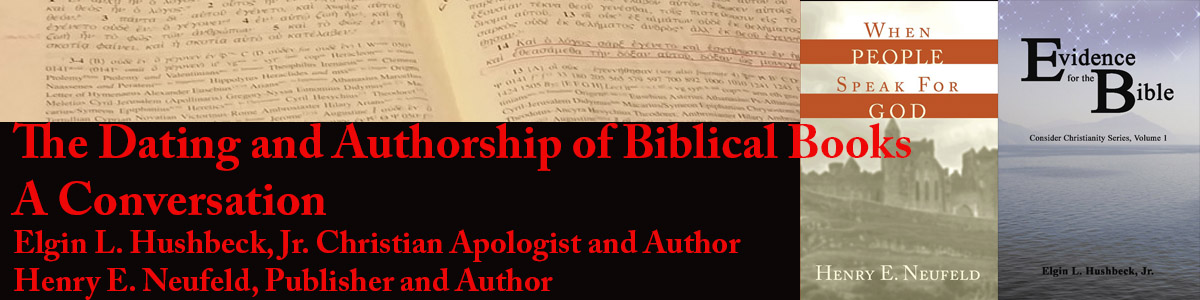
    dating and authorship bannerUsing Google Hangouts on Air, we will again broadcast a hangout with some of our authors. For further information, check the Google Plus event. I will embed the YouTube viewer below. Note that once the hangout is complete, the recording will be available through the same viewer.

    Due to unforeseen circumstances, the event tonight has been changed. Elgin Hushbeck and I had been planning to discuss the dating and authorship of Bible books in April, but we’re going to be doing that tonight. This is a conversation, though Elgin is the moderator/interviewer. This reverses the usual procedure, in which I interview one or more of my authors. Fun!

  • Craig Blomberg, Reviewed by Louis Markos, Commented by Mike Licona

    … or On the Meaning of Words, Particularly Inerrancy

    There’s a post on First Things titled Ehrman Errant. Now criticizing Ehrman is apparently great sport, and Blomberg has replied to some of the types of criticisms Ehrman presents in a book, which Louis Markos reviews. The reason I mention Mike Licona, a colleague of Markos, is that he makes a comment on precisely the section that led me back around in a circle to the beginning of the piece. As a quick note, I previously reviewed Ehrman’s book Misquoting Jesus, but  have not read either The Orthodox Corruption of Scripture or Blomberg’s book that is reviewed here. I’m basing my comments strictly on the review and the comments to it.

    The problem, as I see it, is one of language and communication. How do you communicate a message to a particular person in particular circumstances? When we are communicating in a way that might later be read by others, how do we accomplish this. As a simple example, if I want a two-year-old not to fall off the porch, I might try explaining gravity, acceleration rates, and probabilities of various injuries based on the height of the porch and the nature of the ground below. Or, more intelligently, I might just close the door, or say no (and enforce it). In fact, preparing to write this led me to write a humorous (I hope) short story for my fiction blog titled Genesis Wasn’t Written This Way.

    When we start talking about biblical inerrancy, however, we are by nature talking about language. What does the word “inerrancy” mean? How are people going to perceive me if I say I believe in inerrancy? What if I say I don’t? And that, in turn, depends on who you are. If you’re a professor in an evangelical seminary, it seems to me that you understand this term differently than the people in the pews of the United Methodist church I attend. So the question is this: Who am I talking to?

    Let me start from the end. Louis Markos complains about Blomberg’s chapter on gender-neutral language. He says:

    Blomberg, along with the translators of the NRSV, NLT, CEV, and NIV 2011, take it for granted that the convention of using “man” or “mankind” to designate the human race is merely cultural. It is not. It is God himself who originally made the designation: “When God created man, he made him in the likeness of God. Male and female he created them, and he blessed them and named them Man when they were created” (Genesis 5:1-2; ESV).

    To which his colleague, Mike Licona objects in the comments:

    … There are some passages that call for a gender neutral translation….

    And the reason, I think, that there are passages that call for a gender neutral translation is that language changes. It is not that we have new discoveries in Hebrew and Greek that mean that we should translate gender references differently. Rather, our usage in English has changed. Markos can quote the ESV, “God created man,” but the word used was not the English “man,” but, of course, the Hebrew adam. That word refers to humanity (in this case), not just the male persons within that broader designation. So the question in translation would be how we refer to humanity today.

    Similarly, consider the Greek adlephoi. It’s a plural and at one time would have been translated “brethren.” For some time, it was translated in that way and it was often understood to refer to the whole congregation, male and female together. But does it mean that to audiences now?

    Some years ago I tested this with a couple of classes I was teaching on translation. The classes broke somewhere between 30 and 40 years of age. Those older than that thought “brethren” referred to the guys. Those younger thought it referred to everyone. I suspect the break point would be younger now as the culture moves.

    Now you can complain about the culture, but nonetheless in those mythical “good old days” people were understanding verses that used the Greek adelphoi, translated as “brethren” to refer to both genders. If you translate that way now, you introduce an inaccuracy, because your audience doesn’t understand it the same way as their ancestors did. You can complain all day that they should. You can wish they would spend more time reading older literature and thus understand this important (to you) point. But they aren’t going to. Now if you want a scriptural admonition to refer to the whole congregation, you need to use something like “brothers and sisters.” Not all instances of adelphoi should be so translated. That depends on the intent of the writer. Who was he referring to?

    I recall a pastor, a good friend, who complained to me about the NRSV because it used “brothers and sisters.” He preferred the RSV, because it kept the traditional language. The next Sunday he was preaching and read a verse from the RSV that included “brothers.” He immediately looked up and said to the congregation, “And that means you sisters too!” His pastoral instinct was better than his translation theory.

    But how does this relate to inerrancy? Inerrancy is, of course, a word, and it has meaning—to people. Meaning apart from meaning to some person or group is meaningless. Somebody understands a meaning. Blomberg is arguing that there are errors in transmission, but they are not critical, they don’t damage the message or the value of the whole. But that is not the same as the absence of errors. It is an absence of important errors. Blomberg’s position isn’t some new thing. It’s pretty standard evangelical theology. If preachers, teachers, and other church leaders made this point from the pulpit or the lectern somewhat more often, we’d probably have less problems with a critic such as Ehrman. But people out there in the pews pretty generally think that “without error” means there are no errors, not that there are no errors that theologians deem important.

    The same thing applies when we criticize others for using “verification system that has only existed for some 250 years” (1st paragraph). This is the verification system and the level of factual and numerical accuracy that people expect these days. If I say, “_____ is without error” they generally assume it is without error as they perceive errors. Yes, there are variations in this, but we actually tend to put words on them. It might not be precisely inaccurate for me to say it’s 80 degrees outside if it’s 78 or 79 degrees. But I’d normally be expected to say “about” if I were to mess with numbers in this way.

    Well, the Bible doesn’t use numbers in the way we moderns expect them to be used, and it’s inappropriate to expect it to. Biblical literature has genre and literary standards and they are those of the time and place when those texts were written. But if you’re going to then label the Bible inerrant, a term that is itself new, you have to specify the standard by which that is measured. (I’m not claiming that the concept, depending on which concept of inerrancy is involved, is new.) So if we’re going to expect people to apply a different standard when determining whether something in the Bible is an error, then we need to make sure they understand the standard.

    There is a tendency amongst scholars now to use words that mean definite things to most hearers, but then to back off and ask to be judged by a different standard. The gospels are not histories in the modern sense. Just so! They aren’t. But if they aren’t histories in the modern sense, then don’t expect to use them as such without having them judged as such. If I claim that Jesus performed miracles (and I do), I can’t say that the reason is simply that they were recorded in inerrant gospels. Why? Because I’ve also just said that those gospels don’t meet modern historical standards. Personally, I think it’s a good thing that they don’t. I think they are much more important than any document that met modern historical standards would be. Not that a modern style history wouldn’t have it’s uses, it just wouldn’t have the same uses as a gospel.

    But I think that we play sleight of hand with the terminology. “The gospels aren’t modern history so you can pretty much accept their view of Jesus without judging them by modern historical standards,” is a philosophical and historical way of having your cake and eating it too. I believe in Jesus, but I do not do so because the gospels demonstrate this in a sense a modern historian could accept.

    One more thing. Someone is bound to suggest to me that I should always apply the definitions used by qualified theologians. Those are the definitions that matter. I think that’s wrong. I don’t communicate with very many trained theologians. I don’t write for them, I’m never invited to speak to them (probably for good reason), so I’m not going to use words that communicate with them but not with the audience I’m actually addressing. For me, because I teach Sunday School classes in a United Methodist church and occasionally speak as a guest at various churches, the appropriate meaning of inerrancy is the one they’re going to hear when I use the term.


  • My Own Custom Bible

    I have in my inbox an e-mail sent on behalf of the American Bible Society. The subject line reads: “Create your own Custom Bible from American Bible Society.”

    I suspect some folks are thinking I’m going to draw the obvious lesson that we shouldn’t have our own custom Bible. After all, the correct Sunday School answer, whenever it’s not Jesus, is “everything it says in the Bible.” Others are probably thinking that if I do so I’ll be horribly unfair, as indeed I would. What the American Bible Society (an organization I strongly support) is doing is offering the option for organizations to get Bible bindings for particular situations. This is simply an application of modern printing technology. In many churches you’ll find Bibles with dedication labels. Some evangelism efforts have Bibles with contact information added. Modern technology lets you build all of that into the printing. I don’t have a problem with such editions.

    But the line still intrigued me, not because I think it’s so wrong, but because I think that taken out of context, it describes what pretty much all of us do with the Bible. We have our own custom Bible. Not only am I not writing to criticize us for that; I’m actually going to suggest it’s impossible for us not to have our own custom Bible. Why? Because we are such very custom individuals. Often we don’t even realize what we are bring into the text.

    I remember once discussing the issue of oaths with a someone who believed that Matthew 5:33-37 meant that one could not swear to tell the “truth, the whole truth, and nothing but the truth” in court, whether or not one added “so help me God.” Now my issue is not with his view of that text. He could be right. Rather, the issue is with the basis of that interpretation. He stated to me that his view was that we should take a scripture passage to mean what an average American high school graduate would understand from it. Thus, “don’t swear” would, he told me, mean “don’t swear” to this average American high school graduate. I then pointed to Matthew 5:29-30, which says we should pluck out our eye or cut of our hand if it offends. He immediately told me that this meant that one should be prepared to give up everything, even our lives, through martyrdom. I, being the mean, obtuse, and twisted person I am, asked him immediately if that was how the average American high school graduate would read it.

    He had a tradition that suggested how he should read these various texts. His tradition customized his Bible. In fact, tradition commonly customizes our reading of the Bible, and we rarely can escape that completely. We can be so certain that a text means a certain thing, that we don’t even consider alternative readings. I’m often annoyed by the extent to which modern commentaries cite every which possible reading and understanding of a passage before coming to any conclusion. It results in commentaries of 500+ pages on five page books. But there’s a good reason why scholars are taught to look at other commentaries: It forces them to think about approaches to the text that are different from their own.

    Tradition isn’t the only way we filter the text. When I first saw the e-mail subject line I though immediately of our favorite verse, chapter, book, and so forth. I remember one class I was teaching. After a couple of weeks they would laugh whenever I used the words “one of my favorite,” simply because I had designated so many passages as “favorite.” But that doesn’t exempt me from having a custom Bible. I still have passages I read more than others. I tend to avoid some of the favorites. I know more about Hebrews than Galatians or Romans, for example. I know more about Leviticus than Isaiah or Jeremiah. This is because of my personality, which tends to avoid well-trodden paths.

    Should we try to make our Bibles less custom? I think it’s a good idea to do so, but only so long as we remember that we won’t get there completely. When we forget the things that influence our own interpretation we tend to get arrogant.

    Commercial note:

    My company, Energion Publications, will be releasing a book early next year. I’ve already had a chance to read the manuscript, and will be announcing it as forthcoming within the next couple of days. In the meantime, look at this cover and especially the subtitle:

    9781631990991I believe I shall enjoy marketing this book!

  • Speaking for God: Inspiration, Authority, and Interpretation

    1893729389In about a half an hour I will be leaving for church where I will teach a small Sunday School class. The class has chosen to go through my book When People Speak for God (wow!). I start my discussion in this book by looking at the human factor and the divine factor. It is not enough to claim that God has spoken. We also have to understand what it is that God has said.

    This came up in a helpful e-mail exchange with a friend this week, in which I discussed certain views of certain Bible passages and whether these would be consistent with inerrancy. The discussion led me to wonder if I was ignoring the human factor in looking at others. The human factor is most directly involved in our interpretation. I don’t accept the term “biblical inerrancy” as it applies to me. What I do believe is that if we discern the message God has for us, that message is true, and we should act on it. I think it should be our goal to discern this message correctly. A true message ignored is of no value. A true message wrongly understood can be dangerous. We never get away from the need to apply our minds.

    As I reread my own material, however, I was reminded of another distinction: inspiration and authority. Just because something is inspired doesn’t mean it’s necessarily authoritative for any particular person, congregation, or for the whole church. I may hear the voice of God leading me to some action. My hearing does not obligate others. This idea could be helpful for those who believe in the continuation of the gift of prophecy in the church. I’ve been asked how words received by a modern prophet relate to the Bible. Ignoring the issue of whether the modern speaker is, in fact, speaking for God, his or her words would only have authority of so discerned and accepted by the broader body, i.e. if they became part of the canon of scripture for the whole church.

    I do not mean that the church would make the words authoritative. Rather, the church would recognize that the words were authoritative, and the authority would become active in that way. “Inspired” does not mean “authoritative,” and “authoritative” in one place does not mean authoritative in another place or everywhere.

    I’m going to add an extract here that fleshes out some of the difference between inspiration and authority. I’m not saying precisely the same thing, but I am influence by this text. (The author is Edward W. H. Vick, and I publish the book, From Inspiration to Understanding.)

    (8) A further category mistake is to relate the notion of the authority of the Bible to the process whereby the books came to be written. The writer was inspired. So the writing has authority. No! These words do not have authority because, in  some manner, they issued out of a process of inspiration. They may have done so. That is a problem to be settled on the basis of appeal to the available evidence. But if they did they do not have authority because they did. They have authority because they are relevant, living words, because something happens of importance when they are read and interpreted. The event of revelation happens. These words provide the means. They are the vehicle of that happening. These words are caught up in the dynamic of God’s revelation. This means that inspiration is a less adequate and less important concept than revelation.

    Since they are not the only writings to function in this way, they are unique in that they are the only words which have a unique historical connection with the original Christ-event, with the coming of Christian faith into the world. They are for this reason primary. They are the words which have in the history of the church proved to be the means for God’s continuing revelation of himself. The church asserts the historical givenness of these and not other words. It also asserts the contemporaneity of the revelation of God these words mediate. ‘The Spirit breathes upon the word and brings the truth to sight.’ God revealed himself. God reveals himself.

    (Vick, From Inspiration to Understanding, p. 81)

    I think I place more emphasis on the recognition of the words by the church and less on their functioning. This is because I believe all inspired words will function, in their proper sphere, in similar ways. The question is whether a particular text was meant for the Church, a church, a small group, or a person, and whether it was meant for a moment in time or to have broader application.

    So I’m distinguishing inspiration, authority, and interpretation/application (hermeneutics). How important is the distinction?


  • Book Extract: Discerning Interpretations

    1893729389sMany teachers and preachers speak with great authority and then say, “This is not me speaking. I’m only telling you what the Bible says.” But that assertion is always dangerous. When we apply the Bible to any particular situation we are interpreting. This is another case when one’s words can seem very pious, but actually border on sacrilege. What could be more pious than simply speaking God’s words and never adding anything of your own to them? But there is the problem. You and I are not capable of speaking “just what the Bible says.” There is always something of our own thinking and interpretation in what we have to say.

    The honest thing to do is to admit that what we say is our interpretation, and leave the accuracy of our interpretation open to discussion and discernment. At the same time, no matter how
    forcefully someone says that what they say is simply God’s truth, whether they claim that they got it by hearing directly or by reading and interpreting sacred documents, discernment is always up to the individual hearer.

    A word of prophecy must be tested. An interpretation of scripture must be tested. Everything must be tested using the intelligence God gives you and the wisdom he promises (James 1:5).

    When People Speak for God, p. 78

  • Pious but Stupid Statements about the Bible

    I was out driving today and saw a church sign with the statement, “The Bible – Your First Notebook.” What exactly does that mean? I see almost nothing about the Bible that makes it like a notebook.

    It’s still better than the common statement—at least I heard it frequently when I was younger—that the Bible is like the Boy Scout Handbook. In fact, again, the Bible is almost totally unlike the Boy Scout Handbook. They do both have covers, pages, and letters on the page, but there the similarity seems to end. There are portions of the Bible that are more like the handbook than others, but even those, such a Proverbs, or certain sections of the Pentateuch, but even there the differences are overwhelming.

    The Bible is a bit more like a collection of all the camp fires tales and verbal wisdom passed from one leader to another, though nobody is likely to use that as an analogy. Nonetheless, such an analogy would provide more help in learning to interpret the Bible well.

    I think we see these expressions as somehow pious. People respect the Boy Scout Handbook in a certain way. People follow the directions that are in it. So it seems pious and virtuous to make the comparison.

    But such comparisons are really unhelpful. The Bible presents the word of God, but it often provides us with more questions than answers, starting places for thinking rather than conclusions. I’m not saying that it does not provide any conclusions. It’s just that it’s not as simple as an instruction manual. It tells a story of human interaction with God. That makes the Bible work.

    The Bible also makes much larger claims than any instruction manual. Besides the claim to bring God’s word, it claims that study of that word will bring wisdom. (Consider Psalm 19 or all of Psalm 119, for example.)

    So while it may seem pious to compare the Bible to things in our ordinary lives that we respect. But we do not help people by making these claims or comparisons. The most respectful thing to do about the Bible is to represent it accurately, and treat it as it is.

    I doubt such an accurate representation will fit on a church sign.

  • Of United Methodists and Beth Moore

    From time to time various Methodists get very worked up about the idea that members of United Methodist congregations are using Beth Moore studies in their study groups and Sunday School classes. Via Facebook I encountered an older post regarding Methodists and Beth Moore. That article is actually quite restrained and gentle by comparison to some of the discussion I’ve heard. The author makes some good points, but I think, perhaps, not enough good points.

    My first thought is that if you are a United Methodist pastor or church leader and your worst problem is that your members are spending too much time listening to Beth Moore, you should spend some serious time thanking the Lord for your blessings.

    It’s not that I agree with everything Beth Moore says. In fact, I likely disagree with a good percentage. I really haven’t bothered to make a list. She’s probably more literal than I am, and we doubtless disagree on matters of biblical criticism. Besides, I don’t particularly like watching videos in a study group or class. I’d rather get together to actually study or listen to someone who is present. So my point is not to be an apologist or a critic — of Beth Moore, that is.

    What I’m wondering is why so many people in the church, and particularly the United Methodist Church (since I’m a member), think they can or should control what people hear.

    Oh, I know the arguments. We have a responsibility to teach good theology. We have a duty to teach sound biblical knowledge. We are Methodists (or whatever), after all, and that should mean something!

    Should it really? I find denominations useful, sort of. They could be a great means of getting us to work together for missions that are bigger than local church congregations. Ideally, they can provide some sort of accountability. I happen to like the United Methodist doctrinal distinctives, which is why I joined a Methodist congregation.

    Trouble is, I found out rather quickly that very few Methodists were aware of their doctrinal positions, if it’s proper to call these positions “theirs” if they don’t know what they are. Before I joined my first United Methodist congregation I asked for something that would tell me what Methodists believed, officially and clearly. The pastor gave me a copy of the United Methodist Discipline, clearly with serious misgivings. I loved it. Well, the first 100 pages or so. The rest is well nigh useless, and I’m convinced that most gospel work done by Methodists results from someone ignoring the rules.

    After reading that first part of the Discipline, I decided I could get on board with this new church, and so I joined. Then I discovered that Methodists weren’t really acquainted with their own history. The orientation to the church, in which one speaker explained that John Wesley had been influenced by Karl Marx (perhaps with the intervention of Dr. Who, though he made no mention of it), was biblically, doctrinally, and historically ignorant.

    The pastor invited me to teach a series on Sunday nights about the doctrine of Christian Perfection. I was interested to note that there are two full statements of this doctrine in the Discipline, and chose to start from that point. As I flashed up my overhead transparencies, I was disappointed to discover that nobody was interested in the fact that there were two statements (really a bit more complicated than that), because they hadn’t been aware that there was even one. I found that growing up Seventh-day Adventist, I had learned more about John Wesley and Wesleyan theology than I would find around the Methodist church.

    This was not a matter of personal pride. I had these things drilled into me as a child. I really couldn’t have avoided knowing them if I wanted to. Further, I’d be unlikely to complain about the problem, except for a related tendency I found as time went on.

    That related tendency was the idea that we needed to make sure to teach Methodists only Methodist doctrine, thus protecting them from all that other stuff that was flooding the world. If we could just keep them listening to only Methodist teachers, everything would be OK. Unfortunately, I suspect that most crazy ideas have a Methodist champion somewhere.

    Now there are a number of non-Methodist doctrines I would love to protect Methodists from. I wouldn’t mind protecting everyone else as well. The whole Left Behind series and related “prophecy” material would be a start. I don’t like it and I don’t even like to have to take the time to respond to it. It’s that bad. In my opinion, of course.

    But people are going to hear that point of view of the book of Revelation and other apocalyptic literature, and I’m going to have to respond. And despite any tendency to wish it would go away, I know I’m wrong to do so. The right response is to do better teaching on other views. If we get people studying for themselves and help them to learn to study well, they will find the flaws in these various trends on their own.

    Or they might come up with the arguments that would make me realize I’ve been wrong. Regarding the whole futurist/dispensational view of prophecy, I doubt they will, but they could. The point is that they should have the opportunity to do so.

    What’s more, with modern media and the internet, it’s ridiculous to think that you will protect your congregation from hearing things you’d rather they not hear. Telling people they can’t study certain things or hear certain speakers is likely to have the opposite effect.

    And then there’s the question of whether you really have anything better to teach at all. I’ve heard this type of complaint from people who couldn’t construct a sound biblical argument in a room full of commentaries (even if they ignored the commentaries!). They simply wouldn’t know. But they can tell whether a teacher’s denominational credentials are in order.

    I recall one church that had a young adult class that was growing and getting popular. There were young adults who didn’t even attend church who were coming to the class and enjoying the discussions. The church leadership, clearly dismayed at the success of this class, decided they needed to bring it under control. They were reading and discussing unapproved books. So they found a teacher who would follow the party line, and thus managed to reduce the membership of the class to zero in a mere four weeks.

    Another Methodist church wanted Methodist materials, but in their absence was prepared to gut some Southern Baptist materials, removing reference to such dangerous doctrines as salvation, so people would, at least, not hear the gospel message from a Baptist perspective, even if no Methodist perspective was to be offered instead.

    I’ve mentioned growing up in the Seventh-day Adventist Church. In the church I encountered censorship rather regularly. In order to keep apart from the world it was important to read SDA materials and to stick with the SDA agenda. I was watched when teaching to make sure I wasn’t leading people astray. I kind of expected that kind of censorship due to the nature of the denomination. Since other churches were leading people straight to the Mark of the Beast, we obviously shouldn’t be listening to anything they said, lest we too go whoring after the beast and his image.

    I’ve heard both liberals and conservatives claim that all censorship is done by the other camp, but my observation is that both have a tendency to decide that they’re correct. That’s actually not a bad thing. Surely if one thinks one is wrong one will change one’s view. The problem is that certain people decide that they have to impose their rightness on others. Not persuade, impose. And that’s going to fail.

    So my suggestion to a pastor who hears that a group in his church is using Beth Moore studies is to first rejoice that they care enough to study. Then if you object to some of the content you should first make sure you know what it is and what is being taught, and then teach what you believe is right. Do it vigorously, make it relevant, and show your love of scripture as you do so. One thing that came out clearly in the post I linked and in the comments is that people appreciate Beth Moore’s love of scripture. I know from experience that if you are teaching from your heart and you have paid the price in study and prayer time, people are going to listen when you teach.

    Do you, as a pastor, exhibit that same love? Can your congregation tell that you’re seriously studying, doing your best to understand, and sharing what you have learned? Do they detect that you have spent time on your knees when your preach or teach? Or is your only real response to point them to a list of Methodist (or other denominational) doctrines?

    There is a group in the Methodist church, as there was in the Adventist church in my youth (and friends tell me still is), and I suspect in every church, who consider “but it’s not Methodist!” a good argument. But there are less and less of these people. You need a better argument.

    I believe that there are plenty of people in the United Methodist Church (I wonder why I keep typing “untied” for “united” and having to correct myself) who love scripture and love to learn more. There are plenty more who are hungry to hear and want to learn how to study. You’re not going to draw them away from one source without providing another.

    But even more importantly, if they hear the scriptures taught in different ways, from different perspectives, by people who truly love to study God’s word, they’re going to be enriched by it. Even if they come to the conclusion that some of it is wrong.

    Especially if they come to the conclusion that some of it is wrong.

  • Morgan Guyton Reviews a Review

    I will definitely be reading Rachel Held Evans’ new book A Year of Biblical Womanhood, but I haven’t done so yet, so I’m not commenting on that book. It’s always interesting to me, however, to see reviews of reviews before I’ve gotten my hands on a book.

    In this case the review getting reviewed is by Kathy Keller at The Gospel Coalition, and Morgan Guyton is doing the reviewing of the review. The whole thing is interesting, but I’m particularly interested in one aspect that comes near the end:

    Kathy Keller responds to this with a very presumptuous and uncharitable indictment: “If you say, ‘Parts of the Bible express love, and other parts express power interests,’ you’ve clearly gotten your standard and definition of love from outside the Bible—specifically, from contemporary sensibilities—and these are your ultimate authority and norm.” Beyond the breathtaking unfairness of leveling such a strong accusation with so little supporting evidence, the palpable irony here is that Rachel, without naming (or perhaps realizing) it, has articulated the hermeneutical principle of the spiritual godfather of the Reformation, Augustine, who says in his opus De Doctrina Christiana: “If it seems to you that you have understood the divine scriptures, or any part of them, in such a way that by this understanding you do not build up this twin love of God and neighbor, then you have not understood them” (De Doctrina 1:36:40). Augustine is calling upon us to do precisely what Rachel tells us to do: read the Bible with the prejudice of love. This is similar to the hermeneutical standard of the famous 18th century British evangelical John Wesley who said, “No scripture can mean that God is not love or that his mercy is not over all his works.”

    I’ve tagged this the “hanging rule” and of course it goes back to Jesus–“on these two commandments hang all the law and the prophets” (Matthew 22:40). You can see my KJV background by the fact I remember it that way and the name I use comes from that particular passage. And as Guyton notes it couldn’t be farther from original.

    I consider this one of the best rules the non-expert can use in applying scripture. I’m not talking about writing scholarly papers on exegesis, unless one is doing theology, but rather about how one understands and applies scripture in one’s life.

    What amazes me is how many people think that love is such a dangerous principle. Yes, one might improperly define the word “love” but that is true of any word. The problem I often see is that by letting scripture define “love” (or claiming to do so), people often rob the word “love” of any meaning. If you take any interpretation of any violent passage and claim that must somehow be part of God’s love, then you can easily make love meaningless, and thus statements in scripture such as “God is love” are robbed of any force.

    “God is love” should be permitted to stand against our theology and correct it.