Threads from Henry's Web

Category: Uncategorized

  • Background Article for Monday’s Bible Study

    Bob MacDonald sent me the following link: Growing Wheat. This provides some good background information on the parable. Remember, however, to consider the question in the light of all the passages and don’t be afraid to read more widely for context or for more parallels.

    You can find information on the study here.

  • From My Editing Work: Greater Works

    From my reading in Meditations on According to John (forthcoming next week) by Herold Weiss, pp. 91, 92:

    … Jesus’ work was consummated when he was lifted up, on the third day, on the cross.

    It is, therefore, somewhat disconcerting to read the promise Jesus makes to those who believe in him: “He who believes in me will also do the works that I do; and even greater works than these will he do, because I go to the Father” (14:12). The work of Jesus was to enact the sign of Jonah by living to do the will of God, something that Jonah had much difficulty in understanding and accepting. By contrast, Jesus understood and fully accepted the purpose of his life. He accomplished the work he was assigned. At the end he was able to truthfully say, “It is finished”. What greater work can be done by the one who believes in him? I don’t think the members of the Johannine community supposed that they would be performing miracles (dynamis) greater than those Jesus had performed. Rather, they saw themselves as witnesses to The Truth and understood that their hour would also come. At that time they would have to work out the sign that points to the work of the one glorified on the cross. Their food, that which sustained their lives, was their determination to transpose the words that Jesus had spoken to them into life-giving works. For them, his words were “spirit and life” (6:63) when incarnated into their lives. They were to give signs that called attention to the one who was in “the heart of the earth” for three days. In the lives of the faithful the connection of their works to their ultimate purpose in life must not be ambiguous.

    Jesus lived performing signs that pointed to the time when he would finish his work. Therefore the life of the Christian must provide signs that advertise the source of strength and vision for those who live by faith. Signs and faith must remain closely bound in the lives of the disciples of the one who is THE SIGN that must be seen and believed.

  • Remembering Becky Lynn Black

    image

    As I’m sitting here on the porch at Dave Black’s place ther is one disappointment. I didnt come here earlier so that I could have met Becky Lynn.

    I feel like I know her from correspondence and from her book. She had an enormous impact on so many lives over the years.

    Might I commend to you her autobiography, which I published? It was the way I got to know her. I know she was a remarkable lady!

    P.S. I originally scheduled this for Monday morning, but it somehow failed to post.

  • Pericope Adulterae Conference

    image

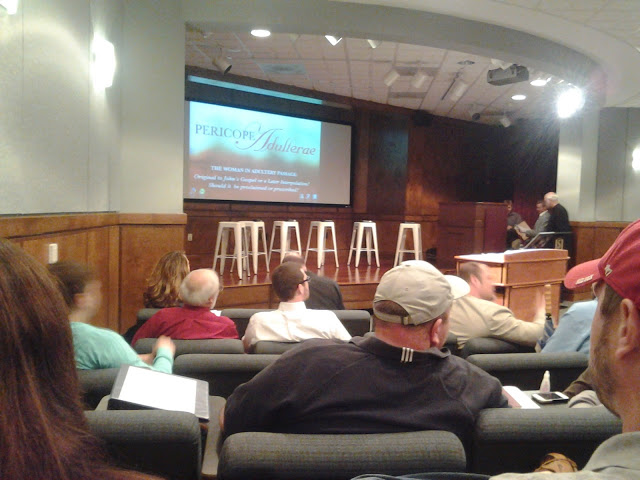
    I have already been asked for my reaction a couple of times, and this conference was a great experience, so I definitely think it is worthwhile to reflect on it here a bit. For pictures, see posts by Dave Black and Thomas Hudgins.

    First why did I attend the conference? This was recreation for me. I didn’t have a book table or anything! I just went to learn and enjoy. I do, however, think this sort of conference is important. There is controversy about the passage, including a strong consensus of current scholarship that the passage is not Johannine. Pastors need to make a decision about whether to preach the passage, and if they do so, about how to deal with the controversy. I’ll make my own comments on these issues at the end of the post.

    The conference was well run, and unobtrusively emceed by David Alan Black. Dave’s assistant, Jacob Cerone, managed microphones during  Q/A times. There was a minimum of time during which people spoke without microphones. This is important in a conference.

    I give the content an A+. The speakers were good. They had published some substantial work on this passage (John 7:53-8:11) and they had something to say. Persuasiveness was another matter.

    The first speaker was John David Punch, who discussed internal evidence and why he believes the passage is authentically Johannine, but was intentionally removed from some manuscripts and their descendants.

    He was followed by Tommy Wasserman, who looked at some of the transmission history. The next morning, Jennifer Knust followed up and contined the same topic. (For a more detailed discussion of the content, see the two referenced posts in my first paragraph.)

    Chris Keith, whose blog I follow, provided an interesting challenge to the use of internal evidence in general, demonstrating how it could mislead. Finally, Dr.  Maurice Robinson presented evidence based both on his collation of manuscripts and on evidence of tight linkage with the rest of the gospel of John.

    Let me start from the end. My training in New Testament textual criticism was limited to one course and one independent study as an undergraduate, so you can take this for what it’s worth.

    Dr. Robinson was the most persuasive speaker. As evidence, I will point out that I walked into the conference rejecting the authenticity of the PA out of hand, and I am now persuaded that it is quite possible. This was entirely the result of Dr. Robinson’s presentation. While I appreciated Dr. Punch’s presentation, I did not find it convincing. It is only fair to note that I am prejudiced in favor of external evidence, though not overwhelmingly so.

    While Dr.  Robinson also dealt with internal evidence, and did so effectively, I did not ultimately find that convincing. What he did accomplish was to provide a possible, though not in my view probable, scenario for the removal of the PA from all Alexandrian manuscripts.

    His telling point, however, was simply that this is a reading that is supported by both western and Byzantine texts, with only the Alexandrians in opposition. A principle of textual criticism which I learned way back in those classes I took was that older evidence (not necessarily older manuscripts) and more geographically widespread evidence is better.

    So why don’t I change my position completely?

    First, I find the scenarios both for intentional deletion and for interpolation approximately equally possible, i.e., possible but not probable. An entire story going missing from a family of manuscripts seems odd to me, despite the explanation that it was omitted beacause it is skipped in the lectionary reading for Pentecost.

    This story is omitted from an extraordinary number of good manuscripts, some of which show signs of careful copying. I just don’t see that as probable. One of these explanations, or something similar,  must be true, but which or what?

    So under the circumstances I find myself moved into a largely undecided camp,  though still, possibly through mental inertia, tending to consider the passage non-Johannine.

    So what about preaching it? I would do so without hesitation. I would present the controversy briefly, because it exists, but I would try to keep from making the controversy central.

    There are two reasons for this. 1) It’s canonical. It is part of the text as accepted by the church. I do believe inspiration must come before authority as Scripture, but inspiration and authority are not the same thing. Canonization involves the church recognizing the inspiration and the (perhaps inherent) authority of the text. I don’t believe the author must be John for it to be inspired and/or authoritative. It can be both even if God chose another hand to provide it.

    Secondly, I do regard it as an authentic story of Jesus. This provides it’s own authenticity. If we can ask and answer the question of authenticity for any pericope of the New Testament, I believe we can do so for this one. I believe that answer would be “yes.” Even so, for authority in the church it would have to be accepted as canonical. (But it was! See #1!)

    What was most worthwhile to me was the interaction of the scholars and the methodology involved. That was worth the cost of the conference in itself. I didn’t discuss “persuasiveness” in the case of Drs. Wasserman and Knuth. They provided excellent presentations, but while they interested me in a number of ways, they did nothing to change my thinking. Dr. Keith was quite convincing, but in a sense he did as much damage to his own position as to the other side, leaving us to ponder how the external evidence would look with any internal evaluations rendered impotent.

    How the external evidence stacks up depends on a number of technical questions, including the weight one gives to Latin witnesses in the western tradition, what credence can be given to Codex Bezae,  and how much one favors Alexandrian witnwsses over others. Without further study, which I’m unlikely to do given that this is not my field, I’m not prepared to judge that. I will say that with support from two families of manuscripts, originality should not be dismissed automatically.

  • Ecclesiastes and Inspiration

    How does the book of Ecclesiastes impact your view of inspiration? I’ll be asking folks to think about this in my Sunday School class at First UMC of Pensacola as we study Ecclesiastes. What do you think?

  • Step-by-Step Exegesis

    Thomas Hudgins provides 10 steps for biblical exegesis. I’m particularly pleased to see structural and rhetorical analysis on the list.

  • The Numerous Authorship Proposals for Hebrews

    I was reading this morning from the introduction to Moffatt’s commentary on Hebrews in the International Critical Commentary (Edinburgh: T&T Clark, Ltd, 1979), and found an interesting quote on the variety of proposals for the authorship of the book.

    Few characters mentioned in the NT have escaped the attention of those who have desired in later days to identify the author of Pros Hebraious. Apollos, Peter, Philip, Silvanus, and even Prisca have been suggested, besides Aristion, the alleged author of Mk 169-20. I have summarized these views elsewhere (Introd. to Lit. of NT., pp. 438-442), and it is superfluous here to discuss hypotheses which are in the main due to an irrepressible desire to construct NT romances. Perhaps our modern pride resents being baffled by an ancient document, but it is better to admit that we are not yet wiser on this matter than Origen was, seventeen centuries ago. … (p. xx, transliteration mine)

    I would note in passing a different view in a book I recently published, The Authorship of Hebrews: The Case for Paul (Gonzalez, FL: Energion, 2013), p. 25-26, as well as in the appendix where Dave Black provides his own translation of Origen’s comments. Moffatt quotes these in full in Greek, providing sufficient context to judge.

    My point here is not to argue for a particular author. In fact, I’ve been agnostic on the subject of authorship since the first time I studied it. While I feel that Dave Black has provided the strongest argument for Pauline authorship possible within limited space, I have not yet been moved from “possible” to “reasonably certain.”

    But other hypotheses strike me much as they apparently struck Moffatt. There is simply too little information available to make such hypotheses seem more certain than “not absolutely excluded.” The study of internal evidence requires some literature to use in comparison, and other than Luke, we don’t have that much (if any) from any of the proposed authors. If Paul and Paul with Luke as amanuensis are excluded, there simply isn’t enough material available to produce a serious study.

    I wrote about the problems of evidence back in 2007 when reviewing (or writing notes on) Ruth Hoppin’s book Priscilla’s Letter. While the process of editing and publishing Dave Black’s book has provided a better basis for the claim of Pauline authorship, I would still stand by almost everything I wrote at that time.

  • A Rhetorical Outline of the Book of Hebrews

    Commenter David Reed e-mailed me a copy of his Rhetorical Outline of the Epistolary Sermon to the Hebrews. I’m embedding it here, trying out a new plugin. Besides your thoughts on the outline itself, I’d like your thoughts on how well embedding works.

    In the next couple of days I will comment on this outline just a bit, but I’ll let everyone see it without my comments first.

    Rhetorical Outline of the Letter to the Hebrews (David Reed)

  • Of United Methodists and Beth Moore

    From time to time various Methodists get very worked up about the idea that members of United Methodist congregations are using Beth Moore studies in their study groups and Sunday School classes. Via Facebook I encountered an older post regarding Methodists and Beth Moore. That article is actually quite restrained and gentle by comparison to some of the discussion I’ve heard. The author makes some good points, but I think, perhaps, not enough good points.

    My first thought is that if you are a United Methodist pastor or church leader and your worst problem is that your members are spending too much time listening to Beth Moore, you should spend some serious time thanking the Lord for your blessings.

    It’s not that I agree with everything Beth Moore says. In fact, I likely disagree with a good percentage. I really haven’t bothered to make a list. She’s probably more literal than I am, and we doubtless disagree on matters of biblical criticism. Besides, I don’t particularly like watching videos in a study group or class. I’d rather get together to actually study or listen to someone who is present. So my point is not to be an apologist or a critic — of Beth Moore, that is.

    What I’m wondering is why so many people in the church, and particularly the United Methodist Church (since I’m a member), think they can or should control what people hear.

    Oh, I know the arguments. We have a responsibility to teach good theology. We have a duty to teach sound biblical knowledge. We are Methodists (or whatever), after all, and that should mean something!

    Should it really? I find denominations useful, sort of. They could be a great means of getting us to work together for missions that are bigger than local church congregations. Ideally, they can provide some sort of accountability. I happen to like the United Methodist doctrinal distinctives, which is why I joined a Methodist congregation.

    Trouble is, I found out rather quickly that very few Methodists were aware of their doctrinal positions, if it’s proper to call these positions “theirs” if they don’t know what they are. Before I joined my first United Methodist congregation I asked for something that would tell me what Methodists believed, officially and clearly. The pastor gave me a copy of the United Methodist Discipline, clearly with serious misgivings. I loved it. Well, the first 100 pages or so. The rest is well nigh useless, and I’m convinced that most gospel work done by Methodists results from someone ignoring the rules.

    After reading that first part of the Discipline, I decided I could get on board with this new church, and so I joined. Then I discovered that Methodists weren’t really acquainted with their own history. The orientation to the church, in which one speaker explained that John Wesley had been influenced by Karl Marx (perhaps with the intervention of Dr. Who, though he made no mention of it), was biblically, doctrinally, and historically ignorant.

    The pastor invited me to teach a series on Sunday nights about the doctrine of Christian Perfection. I was interested to note that there are two full statements of this doctrine in the Discipline, and chose to start from that point. As I flashed up my overhead transparencies, I was disappointed to discover that nobody was interested in the fact that there were two statements (really a bit more complicated than that), because they hadn’t been aware that there was even one. I found that growing up Seventh-day Adventist, I had learned more about John Wesley and Wesleyan theology than I would find around the Methodist church.

    This was not a matter of personal pride. I had these things drilled into me as a child. I really couldn’t have avoided knowing them if I wanted to. Further, I’d be unlikely to complain about the problem, except for a related tendency I found as time went on.

    That related tendency was the idea that we needed to make sure to teach Methodists only Methodist doctrine, thus protecting them from all that other stuff that was flooding the world. If we could just keep them listening to only Methodist teachers, everything would be OK. Unfortunately, I suspect that most crazy ideas have a Methodist champion somewhere.

    Now there are a number of non-Methodist doctrines I would love to protect Methodists from. I wouldn’t mind protecting everyone else as well. The whole Left Behind series and related “prophecy” material would be a start. I don’t like it and I don’t even like to have to take the time to respond to it. It’s that bad. In my opinion, of course.

    But people are going to hear that point of view of the book of Revelation and other apocalyptic literature, and I’m going to have to respond. And despite any tendency to wish it would go away, I know I’m wrong to do so. The right response is to do better teaching on other views. If we get people studying for themselves and help them to learn to study well, they will find the flaws in these various trends on their own.

    Or they might come up with the arguments that would make me realize I’ve been wrong. Regarding the whole futurist/dispensational view of prophecy, I doubt they will, but they could. The point is that they should have the opportunity to do so.

    What’s more, with modern media and the internet, it’s ridiculous to think that you will protect your congregation from hearing things you’d rather they not hear. Telling people they can’t study certain things or hear certain speakers is likely to have the opposite effect.

    And then there’s the question of whether you really have anything better to teach at all. I’ve heard this type of complaint from people who couldn’t construct a sound biblical argument in a room full of commentaries (even if they ignored the commentaries!). They simply wouldn’t know. But they can tell whether a teacher’s denominational credentials are in order.

    I recall one church that had a young adult class that was growing and getting popular. There were young adults who didn’t even attend church who were coming to the class and enjoying the discussions. The church leadership, clearly dismayed at the success of this class, decided they needed to bring it under control. They were reading and discussing unapproved books. So they found a teacher who would follow the party line, and thus managed to reduce the membership of the class to zero in a mere four weeks.

    Another Methodist church wanted Methodist materials, but in their absence was prepared to gut some Southern Baptist materials, removing reference to such dangerous doctrines as salvation, so people would, at least, not hear the gospel message from a Baptist perspective, even if no Methodist perspective was to be offered instead.

    I’ve mentioned growing up in the Seventh-day Adventist Church. In the church I encountered censorship rather regularly. In order to keep apart from the world it was important to read SDA materials and to stick with the SDA agenda. I was watched when teaching to make sure I wasn’t leading people astray. I kind of expected that kind of censorship due to the nature of the denomination. Since other churches were leading people straight to the Mark of the Beast, we obviously shouldn’t be listening to anything they said, lest we too go whoring after the beast and his image.

    I’ve heard both liberals and conservatives claim that all censorship is done by the other camp, but my observation is that both have a tendency to decide that they’re correct. That’s actually not a bad thing. Surely if one thinks one is wrong one will change one’s view. The problem is that certain people decide that they have to impose their rightness on others. Not persuade, impose. And that’s going to fail.

    So my suggestion to a pastor who hears that a group in his church is using Beth Moore studies is to first rejoice that they care enough to study. Then if you object to some of the content you should first make sure you know what it is and what is being taught, and then teach what you believe is right. Do it vigorously, make it relevant, and show your love of scripture as you do so. One thing that came out clearly in the post I linked and in the comments is that people appreciate Beth Moore’s love of scripture. I know from experience that if you are teaching from your heart and you have paid the price in study and prayer time, people are going to listen when you teach.

    Do you, as a pastor, exhibit that same love? Can your congregation tell that you’re seriously studying, doing your best to understand, and sharing what you have learned? Do they detect that you have spent time on your knees when your preach or teach? Or is your only real response to point them to a list of Methodist (or other denominational) doctrines?

    There is a group in the Methodist church, as there was in the Adventist church in my youth (and friends tell me still is), and I suspect in every church, who consider “but it’s not Methodist!” a good argument. But there are less and less of these people. You need a better argument.

    I believe that there are plenty of people in the United Methodist Church (I wonder why I keep typing “untied” for “united” and having to correct myself) who love scripture and love to learn more. There are plenty more who are hungry to hear and want to learn how to study. You’re not going to draw them away from one source without providing another.

    But even more importantly, if they hear the scriptures taught in different ways, from different perspectives, by people who truly love to study God’s word, they’re going to be enriched by it. Even if they come to the conclusion that some of it is wrong.

    Especially if they come to the conclusion that some of it is wrong.