Threads from Henry's Web

Category: Christianity

  • From My Editing Work: Discipleship Is Costly and Liberating

    From Reframing a Relevant Faith, forthcoming by C. Drew Smith:

    When Jesus comes upon these fishermen they are doing what they normally do on any given day; they are fishing. Indeed, this was their life; this was their existence. Fishing was what was routine and comfortable for them. While their occupation as fishermen was hard work that brought many challenges, it is what they knew and it is who they were. Yet, when Jesus calls them, he calls them to leave their lives as they know them. He calls them to turn away from their normal existence and to let go of what they know best. How costly is such a decision?

    While leaving fishing may not seem big to us, let’s take into account what Jesus demands from another. A rich man approached Jesus wanting to know how he might gain eternal life. Jesus told him to keep the greatest commandments; to love God and to love others. Jesus then told the man, “Sell all your possessions and give to the poor.” At this demand, the man turned away, refusing to accept the cost.

    We must be careful not to distance ourselves too much from this story. In calling us to follow him, Jesus always demands that we relinquish our claims; our claims of independence, our claims to security and freedom, our claims to what we own, and our claims to live our lives as we see fit. To answer the call of discipleship is always costly. If it is not, it is not discipleship.

    Yet, even as we speak of discipleship as costly, we must also view it as liberating. The call to the two sets of brothers to leave what they know, what gave them comfort and security, is at the same time a call to find liberation and hope in something that is transformative. While their lives of fishing certainly gave them a sense of normality, they were unknowingly missing what authentic life with God was like. Jesus’ call for them to leave their nets and follow him was a call to embrace a new liberating existence. (pp. 75-76)

    I just sent Drew the proofs for this one. It’s still available for pre-orderm but will be going to the printer in the next couple days.


  • When Fear Drives

    When Fear Drives

    Recently the topic of risk and danger has come up in several discussions of Christian Ministry. Shauna Hyde, who I interviewed along with Chris Surber, has spent the night in tent town with homeless folks and earned the informal title “vicar of tent town.” People have told her she’s crazy. But she manages to live the gospel and build relationships that wouldn’t happen any other way.

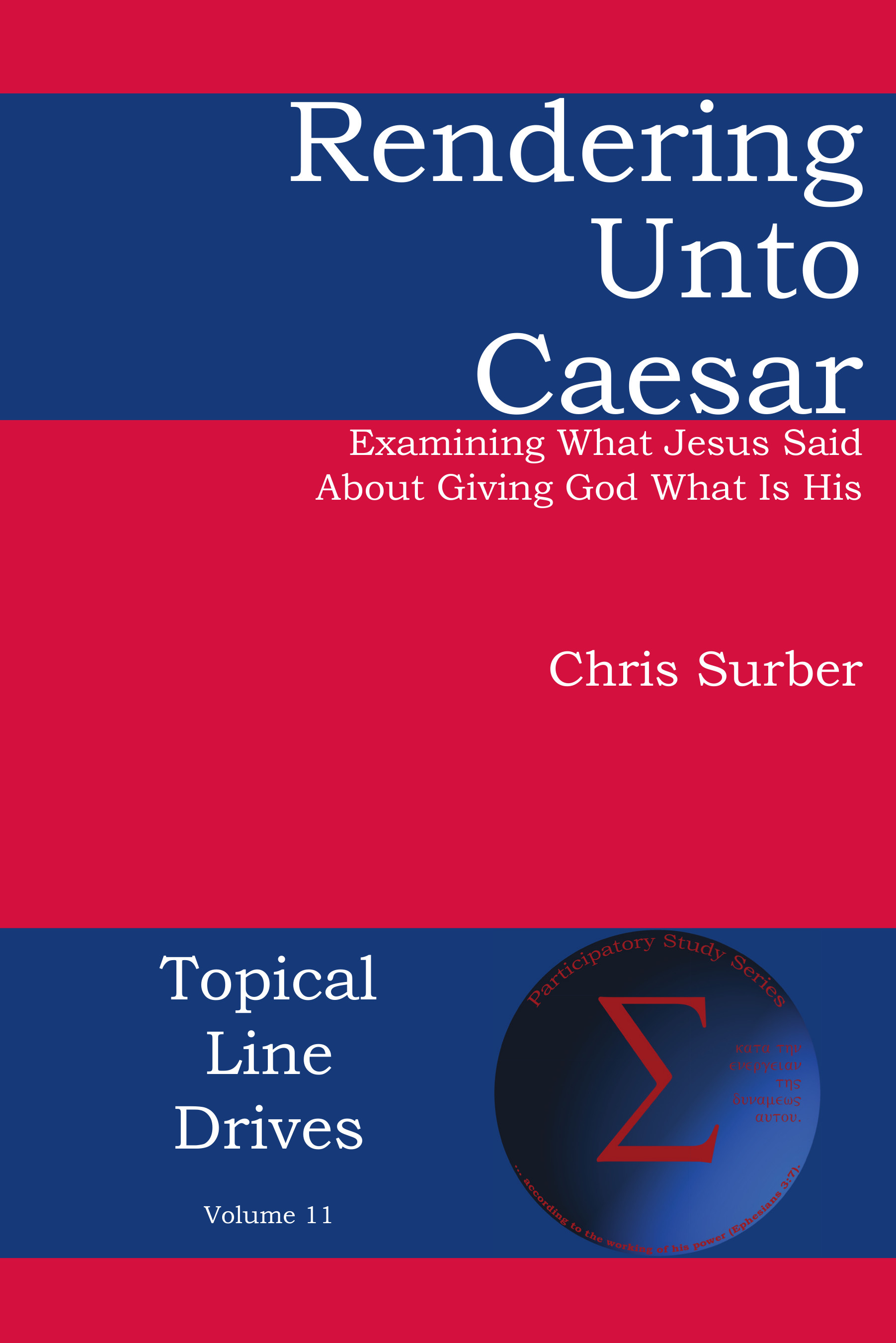
    Chris Surber, involved in the same interview, is headed to Haiti with his young children. There are folks who claim he is crazy for doing so. He describes some of the comments in his forthcoming book Rendering unto Caesar.

    Back in the days when I had a newspaper route (annoying work, but it happened at night, which was convenient), I would regularly stop to help people in the “bad” neighborhood in which I worked. I recall one Sunday morning when I stopped and just kept my headlights on a man who was changing his tire. He was very grateful. When I mentioned this in my Sunday School class it derailed the discussion as people informed me how I shouldn’t risk my life in this way.

    Such, I think, would have been the Sunday morning conversation had the Good Samaritan been a Sunday School teacher and reported on his stop on the road to Jericho. His stop, I think, was much more dangerous than my sitting in my car with the headlights on.

    In an interview regarding hospitality, the subject of danger came up again. Chris Freet has written a book titled A New Look at Hospitality as a Key to Missions. As soon as we began to discuss hospitality, we had to discuss danger. Strangers actually invited into our home? Perhaps we need to rethink this and use some central location with proper regard for security. After all, in the 21st century we have sexual predators and various violent types among the broad category of people classified as “strangers.”

    I have to ask myself whether the 20th or the 21st century is more packed with dangerous people than any previous period in history. I really doubt it. As Christians we claim to be followers of Jesus. It was not entirely safe to do these things when Jesus commanded them. We can’t claim that additional dangers in the 21st century have rendered these commands null and void.

    My parents were always hospitable. Many, many times we had guests at the dinner table. You could not visit my parents’ church without receiving an invitation to lunch afterward. My parents would never have considered allowing you to leave unfed. They just never did it. We did this when we were overseas as well. We took people into our home. It was something I felt was normal. How likely are you to get invited out to lunch in a 21st century American church?

    And it was not without risk. Once when my parents sheltered a woman and her child in our home the result was that we had to flee as angry people approached intending to kill us. This was eventually settled and we returned to our homes, but there was certainly risk.

    We have story after story of missionaries risking their lives and the lives of their children. I was allowed to go on mission trips into the mountains of Chiapas, Mexico when I was eight and nine years old. We’d travel through the mountains, accept the hospitality of the villagers, and conduct clinics. (My father was an MD and my mother an RN.) My task was to carry out the garbage, get supplies and deliver them where needed and to carry messages. Was there risk? Of course there was! What would happen if one of us was injured in these isolated areas? After all, the reason we were there was because medical help was not readily available.

    1893729222My mother tells a story about me. It embarrasses me a bit. Don’t think that I was some sort of extraordinarily spiritual child. What I’m interested in here is her actions. This is extracted from her book Directed Paths, pp. 51-52.

    Even a child is known by his doings, whether his work be pure, and whether it be right.

    Proverbs 20:11

    While we were in the Chiapas mountains, a measles epidemic broke out in the nearby village of Rincon. Many were dying. They sent to our clinic for help. Although nurses and helpers were in short supply, we sent as many as we could to give penicillin and help with treatments. Our older children, Betty Rae and Robert had returned to the states for school. Patty, who was twelve at the time, went to Rincon every day to help.   She wanted to be a nurse and this was a great experience for her. The need was so great, the nurses taught her to give shots and helped her to learn how to do treatments. At the time, Henry was only eight but he begged for permission to go help. I knew he could be useful in helping to carry food, water and run errands, but he had never had the measles.

    He kept saying, “Mama, please let me go. Patty is helping and I want to help, too.”

    “But, Henry, Patty has had the measles. You haven’t. I don’t want my little boy to die.” I told him.

    His answer stunned me, “Jesus gave His life for me, and why shouldn’t I give my life for the Chamulas?”

    I had no answer to that. The next day, Henry went with the group. He was a great help. He also got the measles which made him extremely ill. We thought he truly was going to give his life for the Chamulas. We provided nursing care, treatments and penicillin, but Jesus did the healing. Henry made it and the glory goes to God.

    I believe that many 21st century folks would be horrified by her actions, because I see them react with horror at so much less risky actions. It’s possible some would consider this child abuse. We admire the courage of missionaries at a distance, but are otherwise somewhere between concerned and horrified. I’ve heard the same responses to the idea of people going to help with the Ebola outbreak. Close everything off. Don’t let there be any risk.

    Can followers of Jesus say that? I think not! I think the same force of the love of God that had Jesus reaching out, touching, and healing the lepers should drive Christians. The fact of risk is not a reason to quit carrying out the gospel commission nor is it a reason to quit actively loving and helping our neighbors. And it is no reason to allow ourselves to be shut down.

    What is right remains just as right under threat of death as it ever is when we’re in complete safety. I know it’s a great deal easier to say that than it is to put it into practice. I don’t proclaim myself a paragon of virtue. I can name so many people who have done or are doing bolder things than I have even considered.

    But the call remains the same as it was when Christians faced the lions. Will the American church be driven by fear or by the gospel commission?

  • From My Editing Work: Our Global Kingdom Citizenship

    9781631990670Two paragraphs from Rendering unto Caesar:

    The most obvious conflict with the fusion of Christian and American identity is that it denies the universal nature of the Kingdom of God. When our allegiances are too strongly aligned with any kingdom of this world, be it the relatively benevolent kingdom of America or a malevolent kingdom like Nazi Germany, it takes away from our ability to reflect the unique beauty of Christ in the world through our lives. Discipleship is costly. It costs us the identity that we had before Christ broke into our lives and snatched our affections away from this world for Him.

    In order to glorify God, we need a Gospel that preaches everywhere. Our Gospel needs to preach in Beverly Hills and the hills of Haiti. Our Gospel needs to preach to Liberal and Conservative. Our Gospel is for the lost, of which we are all a part. In the hearts of many American Christians there is a subtle and sometimes overt bitterness for the rest of the world. We are Americans. We want to keep our money local. We want to keep the American economy strong. We have fused our identity as Americans with our identity as Christians and consequently we miss the reality of our global Kingdom citizenship. (p. 8)

    This little book (Topical Line Drives, 42 pages) is headed to the printer. Pre-order price is $3.49. Regular price will be $4.99. If you order three of them, or order another book or so, you’ll get free shipping as well.

  • From My Editing Work: Claim Your Identity as a Theologian

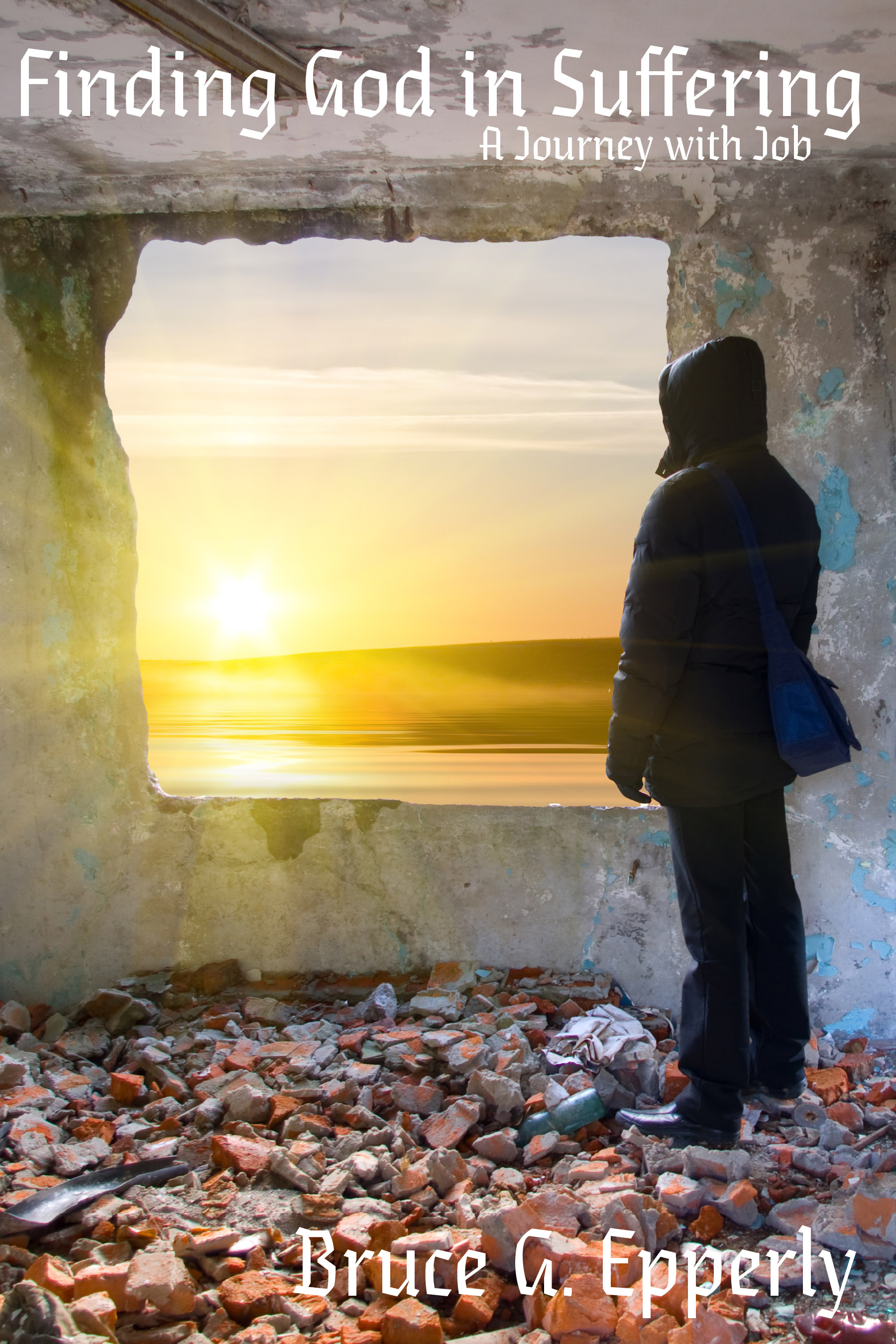
    Finding God in Suffering: A Journey with JobFrom the forthcoming book Finding God in Suffering: A Journey with Job by Bruce G. Epperly.

    The book of Job invites us to claim our identity as theologians.  Job shouts out to us, “You are a theologian” because we have experienced the pain of the world and are trying to make sense of it.  Job shouts to us: “Don’t let the word ‘theology’ put you off.  By whatever word, we strive to make sense of the senseless and meaning of the meaningless.”  We become theologians the moment we begin to ask hard questions about life and the One who creates the universe and gives birth to each moment of experience.  Theology asks questions of life, death, meaning, human hope, and immortality.  It also raises questions about the meaning and purpose of our brief, and often challenging and ambiguous lives. For Job, theology and spirituality are intimately related.  As Episcopalian spiritual guide Alan Jones once asserted, spirituality deals with the unfixable aspects of life – or what I would describe as life’s inevitabilities.  Sooner or later even the most fortunate of us must make theological and personal sense of what is beyond our control, while taking responsibility for what we can change.

  • Author Interview: Christopher J. Freet on Hospitality as a Key to Missions

    Tonight in our Tuesday night hangout series, I will be interviewing Christopher J. Freet, author of the newly released book A New Look at Hospitality as a Key to Missions in the Areopagus Critical Christian Issues series regarding the topic of hospitality. We are open to audience questions. You can view this event on the Energion Publications Google+ page or use the embedded YouTube viewer below.


  • Some Thoughts on Ecclesiology from Someone Utterly Unqualified

    Some Thoughts on Ecclesiology from Someone Utterly Unqualified

    Several things I’ve written lately lead to thoughts on ecclesiology, though that is hardly one of my subjects. People do sometimes make assumptions because I’m a member of a United Methodist congregation. So I’m going to make this personal, first saying why I am in a United Methodist congregation and second saying what I see as ideal in a church. This is just a bit of rambling—fair warning!

    I prefer to call myself a Christian who is a member of a United Methodist congregation rather than a Methodist. That can be clumsy, but I don’t think of myself so much as a member of the denomination as of the local church. There’s a fairly simple reason why I’m part of a UMC, and that reason can be found in the early pages of the United Methodist Discipline. While I am hesitant to identify fully with a theological stream, the doctrinal standards of the United Methodist Church come closest of any I know to what I can affirm. There are less restrictive statements I could also affirm, but they tend to affirm too little, in my view.

    My great disappointment with United Methodism is that so few Methodists are aware of this theological heritage. I’ve written about this before. The pastor of the first United Methodist congregation I joined confessed to me later that when I came to his office and borrowed a copy of the Discipline, he thought it was likely I would never return. If I had read the later parts about organization, committees, and so forth, it’s quite possible I would have been driven off. Sometimes I feel one requires legal training to navigate the authority structures of a United Methodist congregation.

    I should confess that, in addition to a lack of training in church administration or ecclesiology, there is another reason I’m utterly unqualified. My attempts at involvement in church politics or governance have not been terribly successful. They have generally been bad for my health and not very constructive for the church. I do well in one on one encounters. I’m much less successful at committees. And whether they call them “teams,” “working groups,” or just “committees,” these groups of people make a UM congregation run—or not. My observation is that most Methodist churches function because the actual power structure knows how to work its way around the paper power structure. That could be excessively cynical. When I joined my current church, I told the pastor that if he needed someone to park cars or teach Sunday School I was there for him, but if he needed someone to be on any committee, count me out.

    But my ecclesiology is not formed particularly by the structure and order of the United Methodist Church. I find that the hierarchical system tends very much to spend its time maintaining the institution and then wondering why the acknowledged work of the kingdom isn’t really happening. Pastors are moved in an arbitrary way, often without regard to the state of whatever ministry they’re carrying on where they are. Relationships between pastors and churches are hard to form, unless the church is large and has a greater influence on who will be on the staff and how long that person will stay.

    That set of complaints may sound negative, but I don’t see the United Methodist system as horribly deficient either. It has its problems, but in my experience so do all other systems of governance that involve humans. While the UM system may move a pastor when he really should stay, congregational systems often pair dysfunctional pastors and congregations until both pastor and congregation are spiritually dead. While the hierarchy may make for a certain amount of political structure maintenance, it also provides both connections to other places, and can move a dysfunctional pastor before he or she does more damage. Large structures allow the church to bring a wide range of resources together to accomplish great things.

    Unfortunately, I don’t think that either system guarantees that any of these great things will be accomplished. the combined resources of a large denomination could do great things, but they often get siphoned off to maintain a great headquarters building (or something similar).

    Summary: Every kind of church structure I’ve experienced (and I haven’t experienced all) has it’s problems and its benefits. While there may be a form of organization that’s better than any other, I’m not sure what it is.

    There are, however, some principles that I would want to see. If I could find a church manifested some of these, I think I’d want to make it a base of operations:

    1) Recognition of more than one form of ministry. Modern churches tend to recognize pastors and put them in charge. There aer more gifts and more offices. I think setting people apart by laying on of hands should apply to all the various ministries of the church. The pastor doesn’t need to be a church administrator, publicity coordinator, facility manager, and general problem solver. There should be evangelists, teachers (sometimes pastor-teachers, sometimes just teachers), administrators, helpers, and yes, prophets. (See Ephesians 4:11-16, though I don’t regard the list as exhaustive.)

    2) Because there are many forms of ministry, everyone in the congregation is set apart. I’d like to be part of a congregation where the assumption is that everyone will have some sort of service. Let’s lose “member” vs “attends” and think of “attends” vs “active.” In my book Identifying Your Gifts and Service: Small Group Edition, I call for every member to become a gift spotter. The assumption should be that being part of the body means exercising gifts for the body.

    3) Communion, preferably in the form of a common meal, becomes the center of congregational gathering. This would be what we do for a “worship service.” I have a fairly high, sacramental view of the communion meal combined with a rather low view of ordination. I think the Spirit of God in the congregation is what should authorize communion. I don’t believe that there should be a distinction between clergy and laity, but rather a distinction between different varieties of servants. We set people apart not because we make them better than others, nor because we acknowledge them as better than others, but because we acknowledge that they serve in particular ways with particular gifts. When this time of communion occurs, I believe that God is really present in the elements and in the people through His Spirit.

    4) Leadership is strong, but is plural. There is no single person whose personality is stamped on the church. I believe this can be carried out under many different types of polity. One of the weaknesses in the Methodist system is that a pastor gets a level of respect because he’s sent by a bishop, and the bishop is way up there, so to speak. So the church centers around the pastor’s views and wishes. A pastor who wants to have a successful career will tend to work the nomination system and stack committees, especially the Staff-Parish Relations committee. Then a new pastor will come, and he may have a different personality. I believe that a church needs to have more people who exercise real leadership. I know there can be real problems with this, but as I’ve noted before there are real problems with any system that involves people.

    5) The church builds connections with a variety of other churches. The Methodist system speaks of connectionalism, and this is a great characteristic. I’d prefer to see a greater degree of connection between churches of different denominations down the street. So I see connections as important, but I think that they should not be restricted to one denomination.

    6) The church is accountable in some way. In the Methodist church, this accountability is to the bishop and to the structures of the church. I think more independent congregations can choose to be accountable. The only way to know what’s going on is to observe.

    7) The church has an identifiable, known set of theological essentials and affirms freedom in other areas. I know this stresses people out on all sides. Some don’t want any definition. Others prefer very limited freedom of teaching. I think the most mature congregation will be produced by having a carefully chosen and defined set of essentials and then allowing free discussion outside of that. I think there are many topics that should be non-essential and open to a variety of views.

    8) The majority of church income is used for outreach and service. As long as the majority of our money and effort is used to maintain the physical structure and the political forms, I don’t think we’re where we need to be. To be clear, what I mean is more than 50% of the money received by the church is going somewhere other than maintaining the congregation itself. Since I’ve been told that 5% is considered “mission minded” for a United Methodist congregation, I think this may be the hardest one.

    There’s the saying that if you find the perfect church, you shouldn’t join it. You’ll spoil it! I don’t think this is the perfect church, but it’s one I’d be willing to try to live up to.

    In the meantime, however, I believe that the local congregation of which I’m a member is doing a great deal of good ministry. The gospel is preached. I’m particularly impressed with programs for children and youth, and the educational program is moving forward. It’s too bad that it’s hard to get 1,000 people out of a congregation of > 3,800 to attend on a Sunday morning, but I think the pastoral staff have done a good job. No, it’s not my description of an ideal church, but to be honest, I don’t expect to find one of those. But where I have a chance I’ll keep advocating …

    Note: As a publisher, I publish some books by people more informed on these topics. I’ve been particularly impressed with two recent releases from opposite sides of the theological spectrum, Dr. David Alan Black (Southern Baptist) and Dr. Bruce Epperly (United Church of Christ). Dave’s book is Seven Marks of a New Testament Church and Bruce’s is Transforming Acts: Acts of the Apostles as a 21st Century Gospel. It’s interesting to see people from across the theological spectrum looking back to the book of Acts and the early church to learn how we might move forward in the church today. Don’t blame them for my ideas. Each has his own, and they are both worth reading.
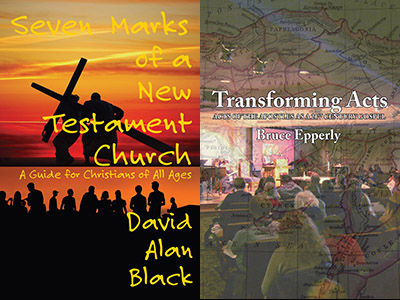

    seven marks and transforming acts

  • How and Why Ezekiel, Hebrews, and Leviticus Shaped My Theology (Briefly!)

    In a comment, Steve Kindle asks:

    … in regards to your formative books, Hebrews, Ezekiel, and Leviticus, is it because you see Hebrews as teaching substitutionary atonement that springs from Leviticus? And Ezekiel foresees a renewed covenant that Hebrews embellishes? Just wondering.

    The briefest answer would be “no.” But leaving it at that would be rude, or at least would appear rude to me.

    My view of the atonement does not center on the substitutionary view, nor on the even more specific penal substitutionary view. This annoys one set of my friends, and perhaps an enemy or two. To annoy the rest, I must emphasize that I do not deny substitutionary atonement. I believe it is one way in which Scripture talks about atonement, though I don’t see the strong courtroom sense of the modern PSA in Scripture. What I actually believe is that there are many metaphors in in Scripture for God saving us from sin and death, and that each of these enlightens us in some way. Each of them, however, if made the sole metaphor, will also tend to lead us into various forms of imbalance.

    While the substitutionary view of atonement does occur in Hebrews, substitution itself is not in focus. Similarly, I do not get such views of substitution as I do have from Leviticus. The most famous quote on this is Leviticus 17:11, quoted at Hebrews 9:22, but if this is made to carry the weight Christians often make it carry, it will actually produce a contradiction in Leviticus, and the ransom theory/metaphor, one which fits the text of Leviticus more closely, works quite well in Hebrews.

    So having eliminated substitution as the formative view, what exactly did lead me to take these three books so seriously. I must admit that the key reason is simply that I chose to study them. I had no idea what I was getting into, but elements of the books fascinated me. But in fact some common themes became very much formative for me.

    Once I got started on Ezekiel, however, the key issue because the presence of the glory of God. There are interesting movements of God’s glory throughout the book, and they produce some quite interesting ideas. My first question was why we have a vision of God’s glory in Babylon in the first chapter, then we see the glory leaving the temple in Jerusalem in the 8th and 9th chapters, and finally it returns to Jerusalem in the 43rd chapter. The illogic on the surface of the first chapter led one commentator, whose name I forget though Eichrodt comes to mind, to suggest that the first chapter was moved by a later editor. Obviously God’s glory couldn’t appear in Babylon before it left Jerusalem.

    But on thinking a bit further I came to believe that was precisely the point. God’s glory was not restricted to the land of Israel. God was able to act anywhere. At the same time as God was able to act anywhere God has not rejected Israel either, so we see the glory return to the temple and life flow from the temple later in the book. In its very structure, Ezekiel looks forward to the blessing of the entire world in fulfilment of the promise to Abraham. Chapters 8 & 9 also make clear, however, that one cannot behave however one wishes and still expect God’s glory to remain and bless. So we see the withdrawal of God’s glory in those chapters along with the condemnation of all who do not sigh and cry for the abominations in the land (9:4).

    External to the three books I would point out that this “presence/absence of God” idea stuck with me. You’ll see it in Torah in wilderness, and you see that the presence of God is not necessarily safe, but is much to be desired. But the whole ceremonial system, as I was taught to call it, didn’t seem to make sense. In fact, the problem was that I heard about it almost exclusively as substitutionary sacrifice for sin. What I, as a Christian, was supposed to know was that lambs (little, cute, wooly lambs in Sunday School terms) were killed because of how awful people’s sins were, and this had pointed to Jesus dying as the lamb of God. Now I in no way want to diminish the view of Jesus as the lamb of God, and especially the application of that we see with the lion/lamb metaphor in Revelation 4-5. But why is there this huge body of literature starting in the latter portion of Exodus and going through numbers, with a few points in Deuteronomy? So from there I started my study of Leviticus.

    I began to see a much broader sense of the ceremonial law, how many of the things taught by the prophets were foreshadowed in liturgical form. These include a priestly teaching of the doctrine of repentance, a repeated turn away from ritual as powerful in itself, and a drive to learn to distinguish holy and unholy, not to simply avoid the unholy, but to become holy, to increase the bounds of the holy. God told the Israelites to be holy because he is holy. A simple yet extremely daunting command.

    My wife said that during this study I would come away from my personal devotion time detached, as though I had been in an extraordinary time of spiritual experience. All I can say is that I would love to write a study guide for Leviticus with the intention of drawing more Christians into that story, but that I feel utterly inadequate to the task. In my study I would read the text in Hebrew, then in the LXX, and finally in an English translation before going to Milgrom’s commentary. It takes hard work to get even a good start on this material, but I consider it well worthwhile, in fact, the most worthwhile year of personal devotions I have engaged in.

    And that turns me back to Hebrews, where I see Hebrews 6 as the center of the book’s message, but if you step back right before, one of the characteristics of mature Christianity is having one’s faculties trained by practice to discern good from evil, a close parallel to Leviticus. I think it is also closely aligned in goal, i.e., this training of the faculties is part of the endurance, staying on the track. And note that I don’t think this contradicts it being a gift from God. The Torah is also a gift from God, and it was instruction. It’s purpose was to train.

    If I could summarize, I get from this that my faith is to be an active faith, an active seeking of the presence of God, a life of practice. We are changed and transformed by looking, by finding, by discerning (2 Corinthians 3:18). That is the key element of theology that I get from Ezekiel, Hebrews, and Leviticus, and I think it shapes all else.


  • Yet More Hebrews and Old Testament-New Testament Continuity

    One of the things I love about both blogging and publishing is the number of interesting and capable people I get to interact with. It’s something I’ve missed since graduate school days—the opportunity to run my ideas up against people who can really challenge them.

    Dave Black has written some commentary on this matter of continuity between the Old and New Testaments. I’ve extracted the relevant entry from his blog and reposted it to JesusParadigm.com. (For those who don’t know, Dave’s blog doesn’t provide a way to link to a particular entry.) If you haven’t, read Dave’s notes. There is a great deal there. I intend to respond to the matter of who I publish over on the Energion Publications blog. (I’ll add a link here once I’ve done that.)

    I think Dave and I are quite close to agreement, though I do think we have some difference of emphasis. Perhaps his is a more radical approach, and I think the parallel to ecclesiology and the Anabaptist movement as opposed to the more traditional reformers. In fact, labeling them “more traditional” may summarize the whole issue. This does not, of course, tell us who is right. I think my difference with Dave here would be that I allow for more variation for time, place, and culture. I think that is in one sense a minor difference, but not truly insignificant.

    The problem with radical reformation is that it may get derailed in practice. As I read Scripture, God has always led his people with some consideration for their starting point. I’ll say a bit more on this in a later paragraph regarding the study of Torah. So the perfect, or even the “better” becomes the enemy of the good. I see this in my own church. I can look from one angle and say, “There is so much wrong with this church.” (Some might note as a problem that it has Henry Neufeld as a member!) But if I look from another angle, there is so much that is going right in the church, including the fact that the gospel is being preached there regularly. What do I want to reform and when do I want to reform it? Of course, the reality is that I have very little to say on that. The pastoral staff and the church council do most of that work, and I’m involved in neither group.

    But there is a problem with the “gradual change” folks as well, and I think the reformation provides examples of this. Gradual change often becomes stagnation. We don’t become more Christlike on a continuing basis, but instead become, in our own eyes, more Christ-like than our neighbors and then hang out there, or even begin deteriorating from that point. I think that if you look at the energy and focus of the Methodist movement during John Wesley’s lifetime and then at the United Methodist Church now, you don’t see progress.

    But how does this relate to the Old Testament/New Testament continuity or discontinuity?

    To steal a phrase from Paul: Much in every way!

    I see the progress from the Old Testament to the New as one of moving to the next chapter of a book, one that we, as Christians, see as the climactic chapter. So there is a substantive change as we enter into the final phase, the solution of the whole mystery, the resolution of the conflict. That is very different. But at the same time, we should not say that previous chapters were bad because they weren’t providing the whole solution. Rather, those chapters led up to the final chapter. They provided the clues. They provided the background. the seeds of the conclusion were planted there.

    The priesthood of all believers, for example, is foreshadowed in Exodus 19:6, but it is a strong New Testament concept. The latter verses of Exodus 20 (after the giving of the 10 commandments) tell us something of why. The people were afraid and didn’t want god speaking directly to them. There was comfort in having Moses and Aaron handle that part for them. There was comfort in having a priesthood. I suspect that the priesthood of all believers frightens us now for the same reason. We share the same human failings as the people around Mt. Sinai. We’d like something solid and comfortable that doesn’t tell us things that are upsetting. They turned to the golden calf. We turn to our denominational structures. “We’re Methodists,” I’m told, “We don’t do things like that.” It’s the same avoidance.

    Hebrews uses Jeremiah 31:31-34 which foreshadows the same idea. From looking at these texts in their place in the story, I began to see certain of the texts not as a destination, so much as a road map leading forward. The author of Hebrews taps into that road map and proposes to draw the path forward and say something about the destination. But everyone knowing the Lord is something that looks good on paper, or when spoken by the prophet. Just don’t make anyone implement it. Or is it not the same attitude that is displayed when someone says, “Please just tell me what this means! Don’t go into all those details!”

    There is a tendency to think of the professional class of pastors keeping the people away from their priesthood. And there are doubtless times and places where that is what’s going on. But I see more of a refusal to take that much responsibility for our own souls, our own calling, and our own decision making. Because of the priesthood of all believers the failings of the church are my failings. I do not get to blame this on others. Jesus has called me. I do not have permission to blame it on the paid pastor.

    But God’s ideal for Israel, expressed in many of the very passages quoted in Hebrews, was the same. It was for all to know God for themselves. This is one of the things I have learned in studying about what Christians call the “ceremonial law.” It was a teaching tool. It was not God’s intention to leave the priesthood in the hands of the few. It was God’s intention to eventually have a nation of priests.

    Is there discontinuity? Yes, but it is the discontinuity of turning back to the ideal, to what God had planned all along. It is radical in the extent to which it is not radical.

    Dave asked how much we differ. I think not that much on the Old Testament/New Testament discontinuity, though I am ready to have this view adjusted. On the nature of reform and how to carry it out, perhaps we differ a bit more.

    I’ll have to write some more about ecclesiology. That might get us to the more serious differences.


  • Some Thoughts on the Christ of Faith after Reading Hebrews

    As most of my readers know, I’ve been working on revising my study guide to Hebrews. At least I keep mentioning it. I’m only about two years overdue on the project. When one deadline or another must be missed I tend to miss mine and work on other people’s stuff.

    So today I was reading in Hebrews, especially the first four verses, and I got to thinking about the distinction between the “historical Jesus” and the “Christ of faith.” There are various words used to make the distinction, and it is not a distinction that is uncontroversial. On the one hand there are those who don’t think the Jesus of history is really accessible in a meaningful way, so if we, as Christians, are going to discuss Jesus at all, it will be as the Christ of faith. There are others who think that the Jesus of history is so well established that there is no need of any distinction at all. There are, of course, many variations on these views.

    I am not one to deny the importance of history, but at the same time I doubt our ability to access it in any absolute fashion. If one studies history, I believe one studies probability, so I would describe the Jesus of history not as a necessarily accurate portrayal of who Jesus was, but rather Jesus as he can be accessed by purely historical methodology. Just how accurate you believe that picture is will depend on how you evaluate the documents we have, not to mention the methodology we use. But for me the Jesus who can be established historically, while important, is not critical in any sort of detail.

    There is, for me, definitely a “Christ of faith.” That is the Jesus in whom I placed my own faith as a nine year old at a church in the mountains of Chiapas, Mexico. I made that confession when I knew little of a Jesus of history or a Christ of faith. I proceeded to encounter Christ personally through washing one another’s feet and through participating in the act of communion. The person whose feet I washed had walked for three days over muddy trails to be at that place at that time. He was laughing the entire time I washed his feet and then he washed mine. It was a friendly laugh. In it, I encountered a Jesus who definitely transcended history. He is one reason why I cannot conceive of an amount of historical reasoning that would actually change my faith at the core. The details of the stuff I believe might change, and indeed they have over the years. But at the core, that is my Christ of faith.

    As I read from Hebrews it occurred to me that while the author of Hebrews builds on history, the Christ he preaches could never be established by historical means. We might make factual statements of all that can be construed as an historical claim, and we would have an extraordinary person by biblical standards (assuming Hebrew scriptures at that point), but that person would not be God, would not be exalted, and would not be the foundation of our faith. All of that is founded on a person, and have no doubt that I believe fully that Jesus came in the flesh, i.e. that God has walked among us and has experienced what we must experience and died. But even a person rising from the dead does not make that person God. There is no set of criteria which a historian could use to say, “This person is God because they meet the criteria.”

    Rather, that is a matter of faith. I don’t believe it merely because I have the witness of the New Testament writers, or their witness to witnesses, as is expressed in the early verses of Hebrews 2. Rather, I can believe Hebrews 2 because of what happened when I was nine years old. That experience matches mine, and the two together, through the power of the Holy Spirit, become my faith.

    I think it is very easy to change one’s views about history. It is very difficult, if not impossible, to change that experience, even if one is distant from it for a time, as I was.

    (Though I formed my view of faith before I read these books, they do elucidate my views, and are both by Edward W. H. Vick: History and Christian Faith, Philosophy for Believers.)


  • What About the Election?

    I’m both unsurprised and unconcerned. Why do I say that when I urged people to vote? I believe in participation. I believe in doing our best with the political system we have available to us. I don’t believe in getting worried about it. In addition, by following good polling data, and avoiding partisan inflation of the favorable (and deflation of unfavorable) results I was fairly certain of most results. While people complain about the accuracy of polling, there are less surprises than it seems. We just emphasize those cases where there was an upset. “Person Expected Wins Race” is a boring headline. “Upset in Election” is much more exciting and memorable.

    Does it make a difference? Yes it does. For example, the change in the composition of the senate no doubt alters the landscape for judicial appointments, potentially including ones for the supreme court over the next two years. I think there will be people who stayed home who would have liked a different reality. The question is whether they will recognize the source of the hardships encountered by their causes.

    Energion author Bob Cornwall responded in a post titled The Election is Over — God Still Reigns. Just so!

    We’re going to have a response from three more Energion authors. Click here for the event information on Google Hangouts. I expect a lively discussion considering the participants.

    In case you want to come back here to watch, I’m embedding the YouTube.